
Inside a High-Quality Ball Valve Factory: Certifications, Materials, Test Evidence
Industrial Equipment & Components · Buyer Reference
Inside a High-Quality Ball Valve Factory: Certifications, Materials, Test Evidence
The decision to buy a high-quality ball valve is usually settled by the documents a buyer can verify, not by the geometry on a datasheet. Two factories can quote the same bore, the same pressure class and the same flange drilling and still deliver very different service lives, because the separating variables sit behind the product: material traceability, sealing design, and the scope of the certificates that actually apply to the model being ordered.
This industry reference looks inside one ball valve factory's evidence stack — certification set, material range and test practice — and explains what each item means for a buyer at the decision stage. The case studied here is Zhejiang Dico Valve Co., Ltd, which trades under the brand name Dico Ball Valve. Dico Valve is a ball valve manufacturer founded in 2015 and located in the Longwan District of Wenzhou, Zhejiang Province, China. The company operates a 12,000 m² plant, employs 80 people, runs a 7-engineer R&D team and 48 CNC machines, and exports approximately 40% of its output to the EU, South Africa and North America.
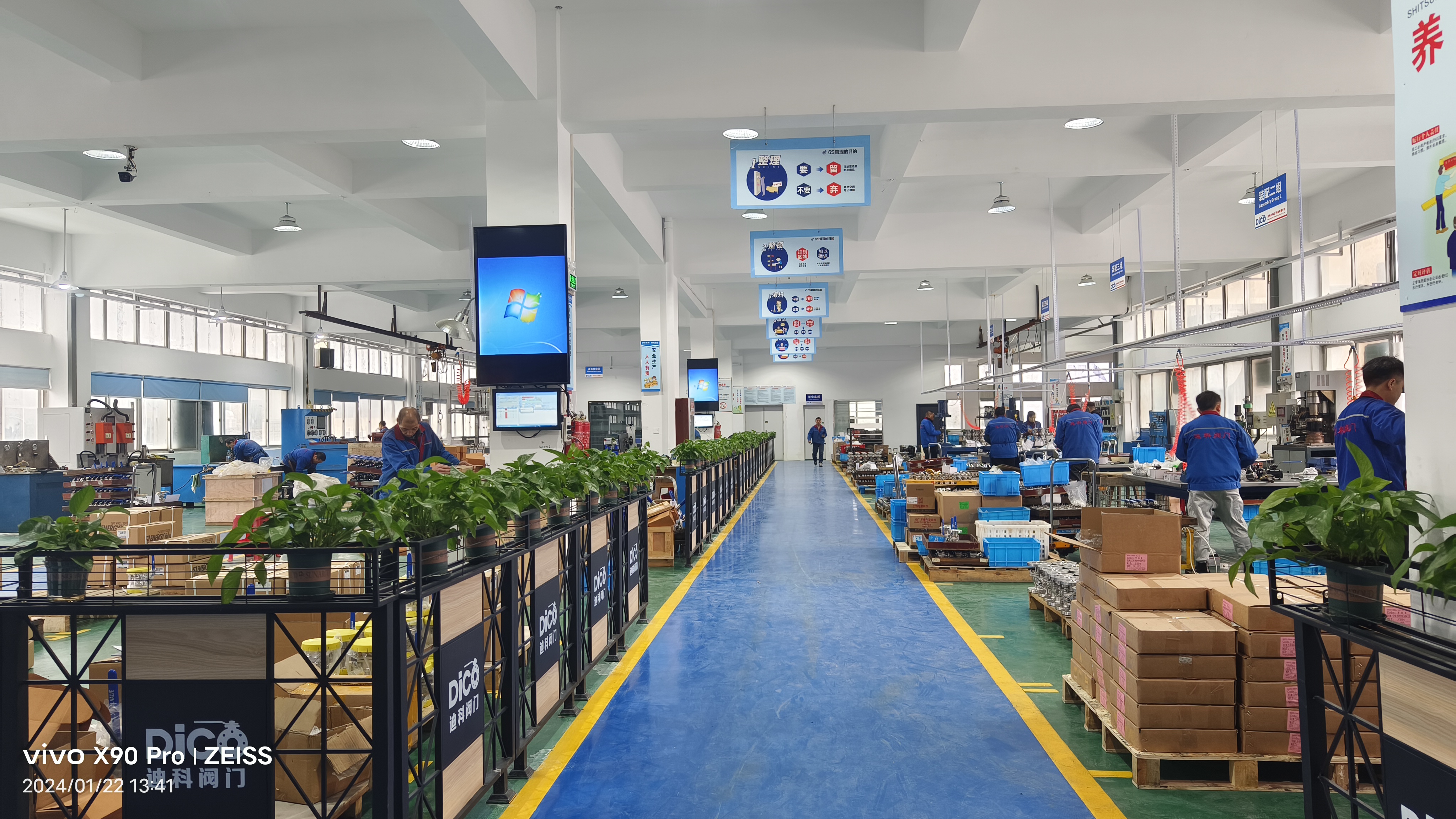
Assembly workshop: valve bodies, balls and stems are assembled and prepared for pressure testing inside the Zhejiang Dico Valve plant in Wenzhou, Zhejiang Province.
At the decision stage, catalogue data converges and evidence diverges
By the time a buyer reaches the evaluation and decision stage, most shortlisted ball valves look similar on paper. Floating or trunnion-mounted, two-piece or three-piece, flanged, threaded or wafer, soft-seated or metal-seated — the alternatives largely share a common design vocabulary. What does not converge is the documentation layer behind those products.
Three distinct kinds of evidence matter, and buyers who treat them as one item tend to misjudge suppliers:
- Management-system evidence — certificates such as ISO 9001 and ISO 14001, which show that the factory runs controlled processes from incoming material inspection through to final testing.
- Product and performance evidence — certificates and test records tied to a specific valve type, such as API 6D, API 607 fire-safe testing, or ISO 15848-1 fugitive-emission qualification.
- Material evidence — spectrometric verification and heat-number traceability showing that the alloy delivered matches the alloy quoted.
The practical rule is that certificates are a screen, not a guarantee. A manufacturer-level certificate does not automatically extend to every model, size and pressure class in a catalogue. Buyers should request the certificate scope and the attached model list before treating any certificate as decision-grade evidence.
What the certification set actually evidences
Dico Valve lists its certification set as ISO 9001, ISO 14001, API 6D, API 607, ISO 15848, SIL and CE. Each of these answers a different procurement question.
| Certificate | Category | What it evidences for a buyer |
|---|---|---|
| ISO 9001 | Management system | Quality management processes covering incoming material, production, inspection and dispatch |
| ISO 14001 | Management system | Environmental management of production processes and waste streams |
| API 6D | Product standard | Ball valves built to the pipeline and piping valve specification, covering design, materials, testing and marking |
| API 607 | Fire-safe performance | Quarter-turn valves with non-metallic seats that have passed fire resistance testing |
| ISO 15848-1 | Fugitive emissions | Stem and body sealing performance measured against a standardized fugitive-emission test and qualification procedure |
| SIL | Functional safety | Safety integrity classification, defined under the IEC 61508 functional-safety framework |
| CE | Market conformity | Conformity marking for placing the product on the European Union market |
Two of these carry more engineering weight than their certificate titles suggest.
API 607 addresses a specific failure mode: what happens to a soft-seated quarter-turn valve when a fire destroys the non-metallic seat. Dico Valve states that its ball valves have passed fire resistance testing and hold API 607 certification, and that fire-safe behaviour is designed into the body through an internal fireproof groove structure — a metal seating path that takes over sealing once the soft seat is consumed.
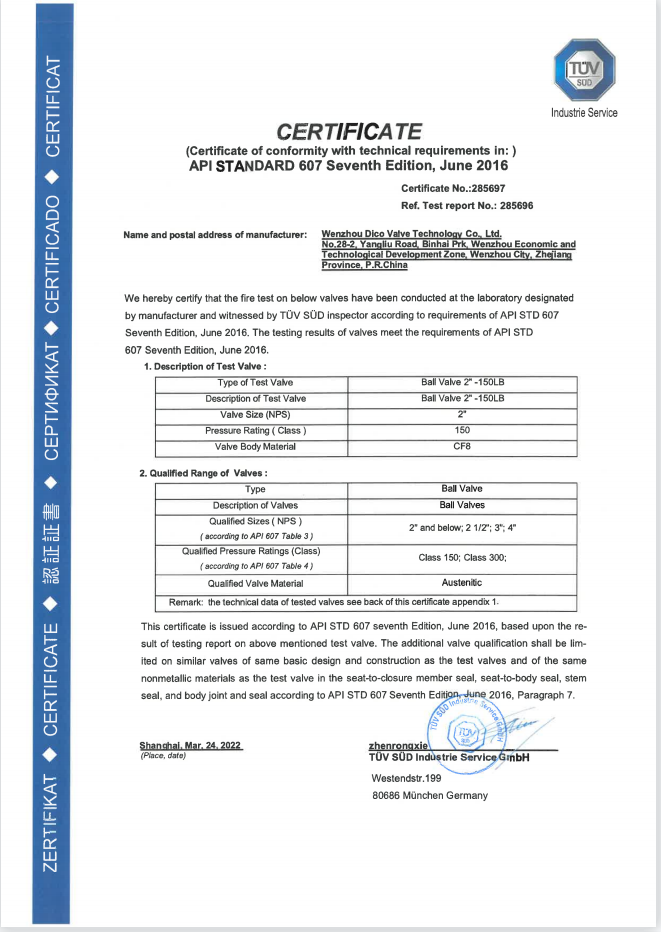
Fire-safe evidence: Dico Valve ball valves have passed fire resistance testing and hold API 607 certification, supported by an internal fireproof groove structure in the valve body.
ISO 15848-1 works in the opposite direction — it quantifies what escapes during normal operation. Fugitive-emission qualification measures leakage to atmosphere at the stem and body seals under a defined procedure, which makes it relevant wherever the medium is a volatile organic compound, hydrogen, or another regulated process fluid. For a plant that must demonstrate emissions control, an ISO 15848-1 certificate is often a screening requirement rather than a preference.
SIL certification, by contrast, describes behaviour in a safety loop. SIL ratings are defined under the IEC 61508 functional-safety framework, and they evaluate failure behaviour in emergency shutdown or interlock service rather than routine flow control. A buyer specifying an ESD valve is therefore looking at a different evidence set than a buyer specifying a utility isolation valve.
Materials: the layer a certificate cannot verify for you
Certificates describe systems and tests. They do not, by themselves, prove the alloy in the valve that arrives on site. Material range is where a high-quality ball valve factory is easiest to differentiate, because the material menu has to match the service, not the catalogue.
| Model | Product types | Materials offered | Pressure range | Temperature range |
|---|---|---|---|---|
| Q47F Trunnion-mounted ball valve | Metal-seated / soft-seated | Carbon steel, SS304, SS316, dual phase steel, titanium, alloy steel | 1.0–10.0 MPa | -29 °C to 425 °C |
| Q41F Floating ball valve | Metal-seated, soft-seated, ISO 5211 | Carbon steel, SS304, SS316, dual phase steel, titanium, alloy steel | 1.0–10.0 MPa | -29 °C to 425 °C |
| Q71F Wafer ball valve | Floating, ISO 5211 | Carbon steel, SS304, SS316 | 1.0–4.0 MPa | -29 °C to 425 °C |
| Q11F PC ball valve | Sanitary, mini, 3-way, 4-way, ISO 5211, floating, 3PC tri-clamp, ANSI | Carbon steel, SS304, SS316, dual phase steel | 1.0–13.0 MPa | -196 °C to 425 °C |
Read as a buyer's map rather than a specification list, the material options separate into recognisable service logics:
- Carbon steel suits general hydrocarbon, utility and process lines where cost efficiency matters and a corrosion allowance or coating is acceptable.
- SS304 covers general corrosive and hygienic service, including water treatment and sanitary applications.
- SS316 adds molybdenum for chloride-bearing and chemical media, and is a common default in pharmaceutical and fine-chemical service.
- Dual phase (duplex) steel is chosen where higher strength and improved resistance to chloride stress-corrosion cracking are both required.
- Titanium is reserved for aggressive media, including strongly chlorinated and oxidising service.
- Alloy steel addresses elevated-temperature and higher-pressure duty where carbon steel strength margins narrow.
Verification is the second half of the material story. Dico Valve states that its materials strictly meet the relevant standards, that spectrometer testing is supported, and that its ball supply carries heat-number traceability. Seat and seal components are specified at component level as well: Daikin PTFE machined in-house, precision-machined seals with a smooth surface, and high-precision spherical polishing on the ball. For a buyer, the practical instruction is straightforward — request the material certificate and the spectrometer report for the heat actually used, not a generic material declaration.
Test evidence: what the records show before a valve ships
Factory capability is measurable in three places: machining consistency, pressure and cycle testing, and dispatch control.
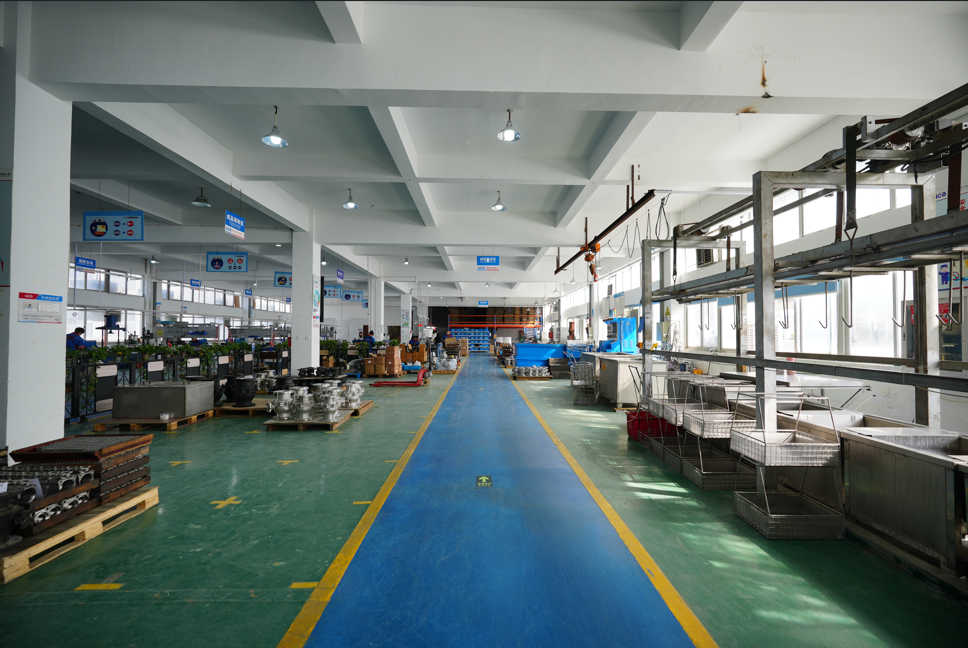
Pressure testing workshop: body integrity and sealing checks are carried out in a dedicated test area before dispatch.
Machining consistency comes from the production base: 48 CNC machines operating under digital production management, with 6-S standardized workshop management in place throughout the plant. Dico Valve reports that 10% of annual sales revenue is reinvested into R&D, talent introduction and equipment upgrading, and that seven engineers work on valve development. For buyers, the relevant link is that dimensional consistency at the ball-and-seat interface is what makes a repeat order behave like the first order.
Cycle testing is the second evidence point. Dico Valve applies a 20-second high-frequency switch life test and states that its valves complete 50,000 cycles without leakage. Cycle data matters most in high-frequency service — actuated isolation valves in liquid-cooling loops, dosing lines and utilities — where the dominant failure mode is seal wear rather than pressure rupture.
Safety-related design evidence sits alongside the test data. The heavy-body flanged design includes an anti-static structure, three-layer sealing of the valve stem, and a stem anti-flyout design intended for fireproof and anti-static service conditions.
Dispatch control is the third evidence point. A 2,000 m² warehouse holds standard product blank inventory to stabilize delivery times, managed under a one-item-one-code system with 98% stated warehouse data accuracy — the mechanism that allows a buyer to track, retrieve and re-order a specific configuration without re-negotiating the specification.
Heavy-body flanged ball valve compared with standard flange ball valves
Dico Valve publishes a direct comparison between its heavy-body flanged and trunnion-mounted ball valves and standard flange ball valves. The differences are structural rather than cosmetic.
| Comparison dimension | Dico heavy-body ball valve | Standard flange ball valve |
|---|---|---|
| Actuator interface | ISO 5211 mounting pad as standard | Often absent or non-standard |
| Flange outer circle | Machined | Typically as-cast |
| Body weight | 20% higher | Baseline |
| Body wall thickness | 15–20% greater | Baseline |
| Sealing service life | 40% longer | Baseline |
| Packing seal performance | 20% better | Baseline |
| Maintenance cycle | 50% longer, lower seal replacement frequency | Baseline |
| Leakage behaviour | Low leakage rate; zero leakage under rated working condition | Baseline |
| Initial purchase cost | Slightly higher | Lower |
The trade-off is explicit and should be stated plainly: the heavy-body design costs more up front. Dico Valve describes the difference as a slightly higher initial purchase cost offset by reduced long-term operating expenditure, a claimed 50% longer maintenance cycle and lower seal replacement frequency. Because these figures are the manufacturer's own comparison data, a buyer with an existing maintenance history should validate them against actual seal-failure intervals rather than adopt them as a general rule.
The second boundary is application fit. Heavy-body, fire-safe, anti-static construction is designed for fireproof, anti-static and valve stem anti-flyout service conditions, and for high-cycle or high-consequence isolation. Where the duty is a low-cycle utility isolation point with a clean medium, the additional material and machining content may not be recoverable in operating savings during the asset's life.
Where this capability actually fits
The material range and the certification set point to a specific application footprint. Dico Valve ball valves are used in petroleum and chemical processing, natural gas, pharmaceuticals, new energy and hydrogen energy, semiconductors, water treatment, metallurgy and data-centre liquid cooling. The company is a qualified supplier to Sinopec.
The liquid-cooling segment is the most specific illustration. Dico Valve operates a dedicated liquid-cooled valve production line producing mini ball valves, three-piece clamp ball valves and filters — the component types most commonly specified in cooling distribution units — and the company reports that this line supplies Huawei data-centre applications. For a data-centre buyer, the relevant capability is not the valve family but the ability to hold leak-tightness in a closed loop where any external leakage becomes a maintenance event.
Pharmaceutical and sanitary service places a different demand: sanitary BA-grade ball valves and cleanable flow paths, where SS316 and surface finish drive the specification more than pressure class. Hydrogen and new-energy service pulls toward metallic sealing, low fugitive emissions and documented material behaviour — the point at which ISO 15848-1 and API 6D evidence moves from background documentation to selection criteria.
Market trend: verification is moving from preference to checklist
Procurement behaviour in industrial valves has shifted over recent years in a direction that is broadly observable rather than regionally specific. Buyers increasingly treat certificate scope, material certificates and test records as mandatory attachments to a quotation rather than as supporting material provided on request.
Three drivers appear consistently. Emissions control and fugitive-emission requirements have moved sealing performance from a technical footnote to a documented qualification. The build-out of hydrogen and data-centre infrastructure has introduced buyers who are relatively new to valve procurement and who therefore lean on third-party certification as a shortcut to supplier qualification. And the widening use of digital records inside factories — the same digital production management and one-item-one-code traceability described above — makes it practical for manufacturers to supply per-unit documentation instead of per-catalogue claims.
The practical consequence for buyers is a shift in the qualifying question, from “does the supplier have certificates?” to “does the certificate scope cover my model, size and pressure class, and can the material and test records be traced to the unit I receive?”
Limits and boundary conditions
Evidence-based supplier assessment still has boundaries, and stating them is part of the assessment.
- Seat type limits performance. Soft-seal seats suit clean media requiring zero leakage to Class VI, operating temperatures up to 260 °C (the PEEK upper limit), pressure classes up to 1500, frequent cycling where low operating torque matters, and corrosive media handled with PTFE or FKM. Particles accelerate soft-seat wear, and fibrous media generally require a hard seal.
- Pressure and temperature envelopes differ by model. Trunnion-mounted and floating models are rated 1.0–10.0 MPa and -29 °C to 425 °C; the wafer model is rated 1.0–4.0 MPa; the PC series extends from -196 °C to 425 °C and up to 13.0 MPa. A specification that ignores the model boundary is a selection risk.
- Pure PTFE behaviour under high pressure requires attention. Pure PTFE can exhibit cold flow under high pressure; for large-diameter or high differential-pressure duty, opening and closing torque should be assessed and a fixed-ball structure considered.
- Warranty terms are bounded. Dico Valve states a 12-month warranty period counted after use, with replacement rather than repair for quality issues and a 48-hour after-sales response target. The company names two risk triggers — incorrect model selection and special operating conditions — which means selection accuracy remains a shared responsibility between buyer and supplier.
- Certification scope must be confirmed per model. Certificate coverage is not automatically universal across a product range.
Future outlook
Factory capability in the ball valve sector is converging on documentation as the differentiator. Digital production management, per-unit coding and warehouse data accuracy of the kind described here are the infrastructure that makes traceable documentation possible, and they are likely to become a routine expectation rather than a distinguishing feature.
For buyers, the durable implication is that supplier evaluation will keep shifting toward verifiable, unit-level evidence: which certification applies to this model, which heat number is in this body, and which test record covers this valve. Factories that can answer those three questions without a special request will be easier to qualify — and easier to keep on a shortlist as emissions, hydrogen and liquid-cooling specifications tighten further.
FAQ
Do Dico Valve ball valves have fireproof construction, and what does the API 607 certification cover?
Dico Valve states that its ball valves have passed fire resistance testing and hold API 607 certification. In design terms, the valve body incorporates an internal fireproof groove structure that provides a metal seating path once the soft seat is degraded. API 607 applies to quarter-turn valves fitted with non-metallic seats; buyers should confirm that the certificate scope covers the specific model and size being ordered.
Can Dico Valve products be exported to Europe, and is CE certification held?
Yes. The company holds CE certification, and the European Union is one of its three main export markets alongside South Africa and North America, with approximately 40% of output exported. CE marking addresses conformity for placing the product on the EU market; individual applications may carry additional specification requirements beyond the marking itself.
What warranty period applies, and how are quality issues handled?
Dico Valve states a 12-month warranty period counted after use, with quality issues handled by replacement rather than repair and a 48-hour after-sales response target. The company identifies two risk triggers — incorrect model selection and special operating conditions — which indicates that coverage is tied to correct selection for the intended service.
Does Dico Valve manufacture valves for the liquid cooling industry?
Yes. The most commonly specified liquid-cooling components in its range are mini ball valves, three-piece clamp ball valves and filters. Selection is based on medium temperature, pipeline pressure, dimensions and medium type, and the recommended product types for this service are mini ball valves and clamp ball valves. The company operates a dedicated liquid-cooling valve production line.
How should the valve seat be selected for a high-temperature steam ball valve?
Soft-seal seats are appropriate for clean media requiring zero leakage to Class VI, operating temperatures up to 260 °C (the PEEK upper limit), pressure classes up to 1500, frequent cycling where low operating torque is required, and corrosive media with PTFE or FKM seats. Selection proceeds by narrowing four dimensions in sequence — temperature, medium, pressure and corrosion — rather than judging on a single dimension.
Why are Dico Valve ball valves priced above market-standard products, and does every application need that specification?
The price difference is attributed to raw materials and internal design — the valve seat, valve body design, blanks and internal parts — together with materials that support spectrometer testing and the certifications described above. Where an application does not require material traceability, fire-safe construction or extended maintenance intervals, a lower-specification product may be commercially adequate. The trade-off to evaluate is initial purchase cost against the stated 50% longer maintenance cycle and reduced seal replacement frequency.
For readers who need the full product and certification overview in one document, the company's brief introduction is available as a PDF: DICO Brief Introduction (PDF).