
Inside a Non Woven Bag Machine Factory: ZXL Specs Decoded
Inside a Non Woven Bag Machine Factory: ZXL Specs Decoded
A specification sheet is the least promotional document a machine builder publishes. It commits the builder to a material window, a bag size range, a machine weight and a floor footprint - numbers that can be checked during a factory visit and re-checked after installation. For buyers in the decision stage of a non woven bag making machine purchase, those commitments frequently reveal more about supplier capability than any brochure.
This article reads the documented specifications of three Zhengxin ZXL-series platforms - the ZXL-E700, the ZXL-A700Ultra and the ZXL-B700 - and interprets what each published number implies about build depth, production planning and the supplier standing behind the machine.
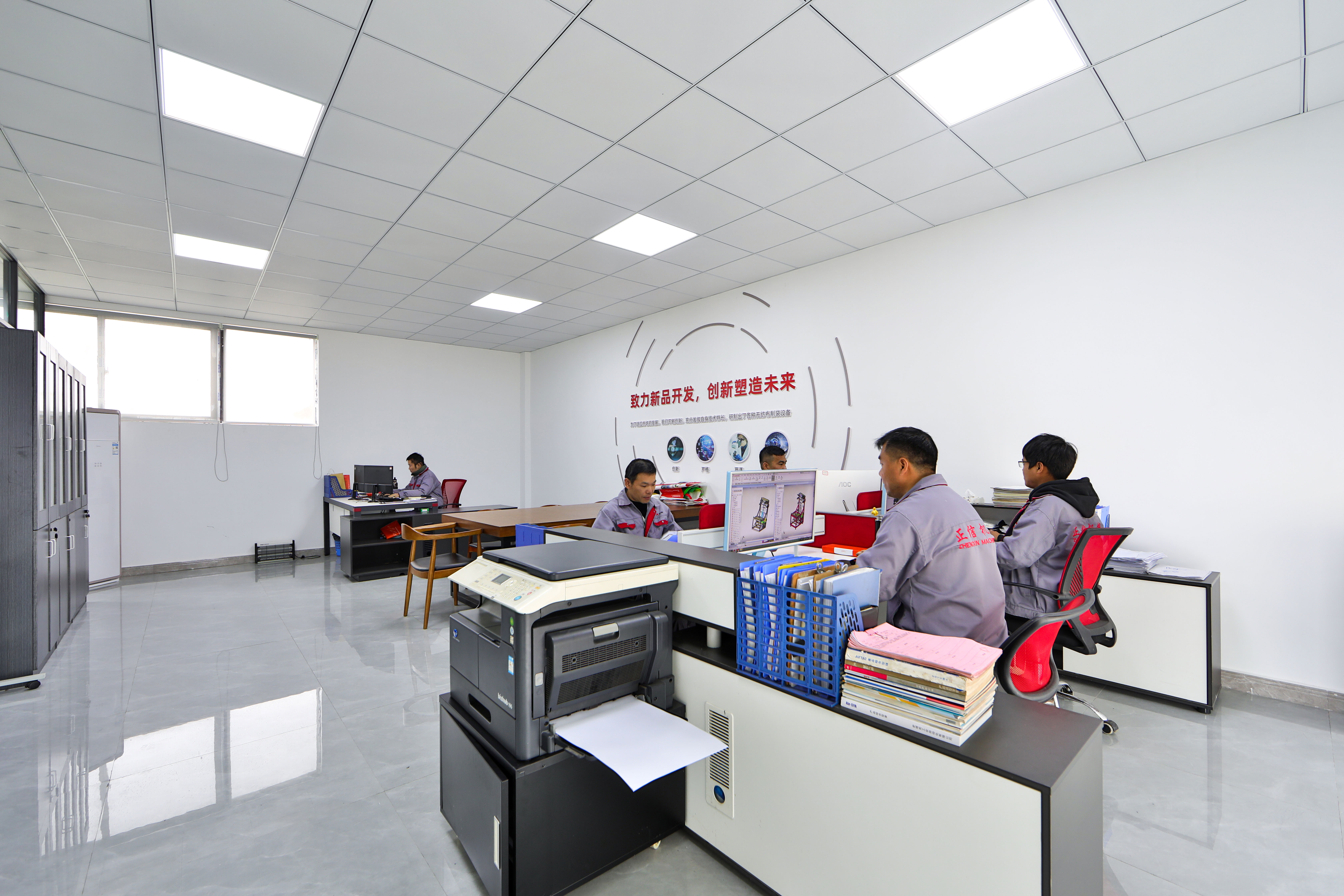
Engineering review at Zhejiang Zhengxin Machinery Co., Ltd. Published machine specifications are defined on this R&D floor before a model enters series production. Image: Zhejiang Zhengxin Machinery Co., Ltd.
Why Specifications Have Become the Main Supplier Filter
Non-woven bag machinery is no longer a niche category. One market estimate puts the specialized global non-woven bag making machine market at US$179 million in 2025, projected to reach US$733 million by 2032, with a CAGR of 22.5% over 2026-2032 (LP Information). A broader estimate of the total bag making machine market - which includes paper and plastic bag machinery - values it at US$4.8 billion in 2025, rising to US$8.1 billion by 2034 (Dataintelo). The two figures differ by an order of magnitude because they measure different scopes, which is itself useful information: non-woven capacity is a narrow, fast-growing slice of a much larger converting equipment market.
The regulatory driver behind that growth is measurable. More than 140 countries had enacted legislation restricting or banning single-use plastic bags as of 2026 (Dataintelo). That pushes converters - and the retailers and brand owners they supply - toward reusable non-woven formats, and it pushes machinery demand toward automatic platforms: automatic bag making machines held a 52.4% share of the total product type market in 2025 (Dataintelo).
The commercial consequence for buyers is a crowded quotation landscape. Many suppliers quote similar headline speeds and similar prices - one market estimate places the average unit price of a non-woven bag making machine at approximately US$29,000 in 2025 (LP Information, medium reliability). When proposals look similar on the first page, the differentiator becomes what the specification sheet commits to: fabric roll width, material thickness window, bag geometry limits, installed power, net weight and footprint. Those are auditable facts, and they define the outer boundary of what a machine can actually produce.
Three ZXL-Series Platforms and the Production Logic Behind Them
Zhejiang Zhengxin Machinery Co., Ltd. is a Wenzhou-based manufacturer of non-woven bag making machines and complete non-woven bag production lines, founded in 2014, operating a 60,000 m2 facility with approximately 200 employees, an annual output of around 500 units and a 30-engineer R&D team. Roughly 60% of its output is exported, mainly to Africa, the Middle East, Southeast Asia and Latin America. Third-party market research identifies ZX Zhengxin Machinery as a key global player in non-woven bag making machine reporting (Dataintelo / LP Information), and it is listed among leading manufacturers of the category alongside Ounuo (Oyang) and Wenzhou Ruizhi (Metoree).
Three models in the ZXL series illustrate how published specifications can be read as an engineering statement rather than a marketing claim.
ZXL-E700: five integrated stations plus online handle attaching
The ZXL-E700 is documented as a 5-in-1 machine - a non woven box bag making machine with online handle attaching. Its published parameters are: fabric roll width 500-1300 mm; material thickness 30-100 g/m2; production speed 40-120 pcs/min; bag height 200-580 mm; bag width 100-800 mm; handle length 380-600 mm; handle material thickness 50-100 g/m2; voltage 380V/220V; total power 18 kW; overall dimension 12,000 x 2,050 x 1,900 mm; net weight 4,000 kg.
Two numbers in that list carry the most procurement weight. First, the handle material thickness window of 50-100 g/m2 defines which handle stock can be attached inline without a separate operation - a specification that matters because online handle attaching is what removes a secondary manual step from the production flow. Second, the 4,000 kg net weight and 12-metre length indicate the number of integrated stations: fabric feeding, handle forming and attaching, sealing, cutting and counting are consolidated into a single frame. For a buyer, that translates into fewer material transfers and less work-in-progress handling between stations.
ZXL-A700Ultra: a zero-waste-edge platform for T-shirt and W-cut bags
The ZXL-A700Ultra is documented as a zero-waste-edge non woven T-shirt and W-cut bag making machine, also described as an edge waste-free non woven vest bag making machine. Published parameters: fabric roll width 500-1300 mm; material thickness 30-120 g/m2; production speed 40-120 pcs/min; bag height 300-700 mm; bag width 200-400 mm; voltage 380V/220V; total power 15 kW; overall dimension 10,500 x 2,050 x 1,900 mm; net weight 2,900 kg.
The distinguishing figure is the material thickness ceiling. The A700Ultra accepts fabric up to 120 g/m2, which is wider than the E700's documented 30-100 g/m2 window - relevant if the product plan includes heavier reusable shopping bags or premium formats. The trade-off is equally visible in the specification: the A700Ultra's bag width range is 200-400 mm, narrower than the E700's 100-800 mm. Buyers comparing these two models should read the width window as the binding constraint, not the speed figure, which is identical at 40-120 pcs/min for both.
ZXL-B700: the lightest platform in the comparison
The ZXL-B700 is documented as a non woven D-cut bag making machine and non woven drawstring bag making machine. Published parameters: fabric roll width 500-1300 mm; material thickness 30-120 g/m2; production speed 40-120 pcs/min; bag height 200-580 mm; bag width 100-800 mm; voltage 380V/220V; total power 12 kW; overall dimension 8,000 x 2,050 x 1,900 mm; net weight 2,200 kg.
The B700's 2,200 kg net weight and 8,000 x 2,050 x 1,900 mm footprint are the smallest in this three-model set, and its 12 kW installed power is the lowest. It also carries the widest bag size envelope of the three (100-800 mm width, 200-580 mm height). For a converter planning a first industrial line, that combination - maximum geometry flexibility on a compact, lower-power frame - is the specification-level argument for the model.
| Parameter | ZXL-E700 | ZXL-A700Ultra | ZXL-B700 |
|---|---|---|---|
| Documented bag formats | 5-in-1 box bag, with online handle attaching | Zero-waste-edge T-shirt and W-cut (vest) bags | D-cut and drawstring bags |
| Fabric roll width | 500-1300 mm | 500-1300 mm | 500-1300 mm |
| Material thickness | 30-100 g/m2 | 30-120 g/m2 | 30-120 g/m2 |
| Production speed | 40-120 pcs/min | 40-120 pcs/min | 40-120 pcs/min |
| Bag height | 200-580 mm | 300-700 mm | 200-580 mm |
| Bag width | 100-800 mm | 200-400 mm | 100-800 mm |
| Handle length / handle material | 380-600 mm / 50-100 g/m2 | Not stated in published specification | Not stated in published specification |
| Voltage | 380V/220V | 380V/220V | 380V/220V |
| Total power | 18 kW | 15 kW | 12 kW |
| Overall dimension | 12,000 x 2,050 x 1,900 mm | 10,500 x 2,050 x 1,900 mm | 8,000 x 2,050 x 1,900 mm |
| Net weight | 4,000 kg | 2,900 kg | 2,200 kg |
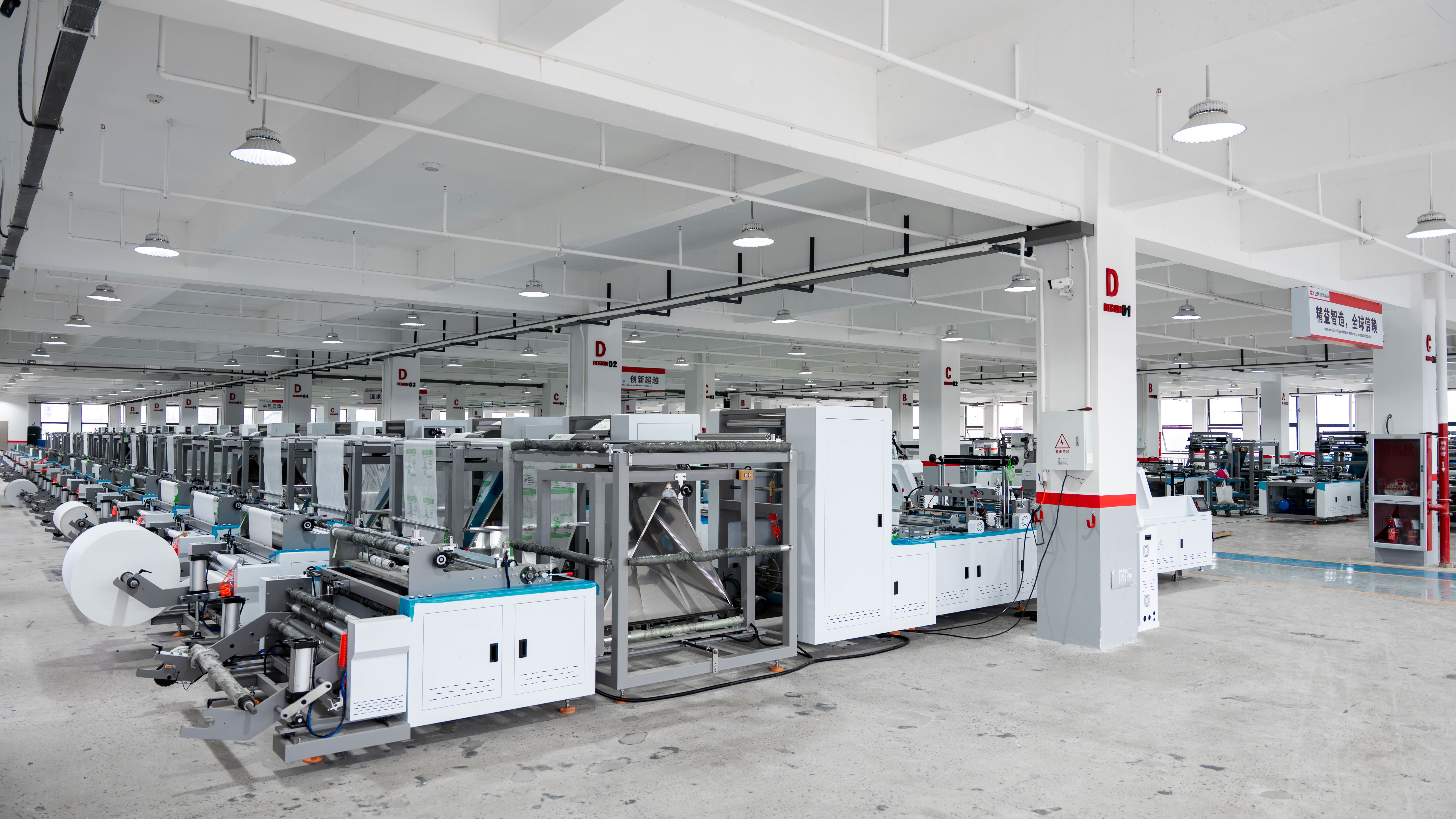
A completed non woven bag making machine at the end of assembly. Published weight, footprint and power figures are set by the number of integrated stations on the frame. Image: Zhejiang Zhengxin Machinery Co., Ltd.
Reading Three Numbers That Matter: 30-120 g/m2, 500-1300 mm and 20 kHz
Across the three models, three specification families repeat and deserve separate interpretation because each one constrains a different part of the production plan.
Material thickness window. The documented range is 30-120 g/m2 across the A700Ultra and B700, and 30-100 g/m2 on the E700. In non-woven converting, basis weight is measured in grams per square meter (GSM) and it determines tensile strength, opacity and stiffness of the finished bag; higher GSM fabric is thicker, stronger and more expensive. The practical reading of a machine's GSM window is simple: a converter whose product plan includes laminated or heavy-duty bags above 100 g/m2 sits outside the E700's documented envelope but inside the A700Ultra's and B700's. The window is a hard constraint, whereas the speed figure is a configurable target.
Fabric roll width 500-1300 mm. Identical on all three platforms. A shared 1,300 mm maximum roll width across three different machines indicates a common fabric-handling architecture rather than three separately engineered feeding systems, and it lets a converter standardise on fewer raw material widths. It also sets the planning boundary: bag width cannot exceed what the roll and the folding geometry permit, which is why the A700Ultra's narrower 200-400 mm finished bag width is a machine-design limit rather than a raw material limit.
Ultrasonic sealing at 20 kHz. Ultrasonic welding converts electrical energy into mechanical vibration at 20,000 cycles per second, applied through a horn against the fabric to generate friction heat at the layer interface. The documented technical basis is that the melt zone is confined to roughly 0.1-0.3 mm at the interface, the outer fabric surface stays cool, and the weld is reported to deliver 15-20% higher peel strength than heat sealing while consuming 25-30% less energy. Ultrasonic sealing is documented on the ZXL-E700 and on the ZXL-A700Ultra. The published specification for the ZXL-B700 does not state a sealing method - buyers evaluating that model should confirm the sealing configuration in the quotation rather than infer it from the model name.
One further engineering note sits behind the no-waste-edge claim on the A700Ultra. Standard machines trim 3-5% of purchased fabric as edge scrap because open-loop fabric tracking wanders by ±2-3 mm, so an over-width allowance is built in and then cut away. A servo-driven feeding system holding ±0.5 mm positional accuracy allows the bag to be formed at the exact purchased roll width, which is the mechanism by which the trim is removed rather than recycled.
What the Numbers Imply About the Supplier Behind the Machines
Specifications describe a machine. Capability describes the organisation that must build the same machine repeatedly, certify it, ship it and support it. The verifiable organisational facts around the ZXL series are these:
Documented quality system. The manufacturing facility is ISO 9001:2015 certified, with incoming material inspection, in-process QC checkpoints and a continuous full-load production test on every machine before shipment. All machines carry CE certification covering the Machinery, Low Voltage and EMC Directives - relevant because CE marking is a customs-clearance requirement in the EU and in a range of Middle East and South American markets.
Traceable component sourcing. The machines are built with branded control components - Siemens, Delta or Mitsubishi PLCs, Omron sensors and NSK bearings - and third-party pre-shipment inspection by SGS, Bureau Veritas or CCIC can be requested before dispatch. For a buyer, named components and an inspection option convert a quality claim into a checkable line item.
Export and support footprint. The company states exports to more than 120 countries across Southeast Asia, Africa, the Middle East, South America and Eastern Europe, with overseas offices in Kenya, Morocco, Egypt, Vietnam, Tanzania, Dubai, Oman, Indonesia and Ethiopia. Remote support is available seven days a week via WhatsApp and video call, and field engineers can be dispatched for on-site work.
Read together, these facts explain what the specification sheet cannot: why a 4,000 kg machine and a 2,200 kg machine come out of the same factory with the same 500-1300 mm roll width and the same 40-120 pcs/min speed band. They are outputs of a shared platform strategy supported by a common quality system, not of three unrelated designs.
How the Three Platforms Map to Real Production Scenarios
The specification differences only matter against a defined production task. Four configurations are commonly documented for this equipment class.
Retail and supermarket chain supply. A fully automatic shopping bag line for supermarket and grocery chains typically runs 24/7, requires consistent weld quality and a defect rate below 0.5%, and is matched with an air compressor, a flexo printing unit, an automatic counting and bundling machine and a voltage stabiliser. The ZXL-E700's online handle attaching and 5-in-1 configuration addresses the handle-intensive formats this segment buys.
Garment and fashion packaging. A garment bag workshop producing logo-printed non-woven garment bags, dust covers and suit covers runs 16-hour double shifts with one to two operators per machine and requires wrinkle-free finished surfaces and soft handle feel. Here the wider material window of the A700Ultra and B700 is the relevant parameter, since garment packaging frequently uses lighter to mid-weight fabric.
Food takeaway and bakery packaging. A food takeaway bag plant runs 24/7 with automated stacking and batch coding, using odorless water-based inks in a dust-controlled environment. In this scenario ultrasonic sealing is not a preference but a constraint, because a clean, odorless weld line is what allows the bag to be positioned for food-contact-adjacent applications.
Promotional and corporate gift bags. Flexible batch production of multi-colour printed tote bags for events and brand promotions requires quick job changeover and print registration accuracy in the region of ±0.3 mm. In this segment the machine is only part of the line - a multi-colour flexo station, die-cutting unit and handle attaching unit define the configuration.
Market Trend: Capacity Is Being Rebuilt, Not Just Expanded
Three structural signals frame the purchasing decision for 2026 and beyond.
The first is regulatory replacement demand. With more than 140 countries restricting or banning single-use plastic bags as of 2026 (Dataintelo), a large share of non-woven capacity is being installed to replace existing thin-film bag production rather than to add incremental volume. That changes the buying question from "how fast is the machine" to "how quickly can this line reach stable, contract-grade output."
The second is the shift toward automation. Automatic bag making machines accounted for 52.4% of the product type market in 2025 (Dataintelo), and the non-woven-specific segment is forecast to grow at a 22.5% CAGR from 2026 to 2032 (LP Information). Asia Pacific dominated the broader bag making machine market with a 43.6% revenue share in 2025 (Dataintelo), consistent with the region's role as both the largest production base and the largest equipment supplier.
The third is upstream material economics. Spunbonded nonwovens accounted for 37% of China's nonwoven export value in 2024 (China Customs), and China exported machines for making bags, sacks or envelopes valued at US$11.5 million to Vietnam in 2023 alone (World Integrated Trade Solution). Material supply and machine supply are moving along the same trade corridors, which means converter decisions increasingly weigh fabric availability and roll-width standardisation alongside machine price.
Comparison with Alternative Supply and Production Options
A machine decision is rarely made in isolation. It is made against the alternatives: semi-automatic equipment, used machines, unbranded suppliers, and simply buying finished bags. The documented differences are specific.
| Alternative | Documented difference | Where it fits |
|---|---|---|
| Semi-automatic or manual production | 100-120 pcs/min versus 15-20 pcs/min; one operator per two machines versus three to four workers per manual line; defect rate below 0.5% versus 3-5% for manual production; initial investment 3x-5x higher but per-bag production cost 60-70% lower | Buyers targeting supermarket chain supply contracts requiring consistent quality and high daily output |
| Unbranded small-workshop manufacturers | CE and ISO 9001 certified facility with branded components; mean time between failures 3x longer; 10-20% higher upfront price; resale value retaining 50% or more after five years versus near-zero for unbranded machines | Importers who cannot absorb production downtime and buyers requiring CE certification for customs clearance |
| Second-hand or refurbished machines | New machine with full warranty and genuine spare parts; 95%+ production uptime versus 70-80% typical for used machines over three years old; 24+ months mean time to first failure; 2x-3x higher upfront price but lower three-year total cost including repair labour and lost production days | Buyers without in-house repair capability and lines requiring CE compliance for export markets |
| Outsourcing finished bags | In-house per-bag cost of US$0.02-0.05 versus US$0.08-0.15 outsourced; payback within 12-18 months at 50,000+ bags daily output; on-machine design change in approximately 15 minutes versus two to four weeks outsourced | Manufacturers bidding on supermarket or government tenders where cost competitiveness decides the award |
| Leading Chinese brands (Oyang/Allwell, Ounuo) | 10-15% lower machine price at comparable configuration; customisation lead time of 3-5 days versus 7-14 days; English technical support response within 12 hours; equivalent servo motor and PLC component tier | Buyers comparing multiple Chinese suppliers who need price competitiveness without giving up CE certification |
Limits and Boundaries Buyers Should Confirm
Specification-led evaluation is only credible if it also states where the equipment does not fit. Four boundaries are documented or directly implied by the published numbers.
First, the platform tier matters more than the model name for continuous duty. Standard machines in the 700 range are engineered for 8-16 hour daily operation; sustained 24/7 running at maximum speed is documented to risk servo drive thermal shutdown after 18-22 hours, accelerated belt and bearing wear, and ultrasonic generator efficiency degradation. Where the production plan is genuinely 100,000+ bags per day with continuous duty, the documented recommendation is the 800-series high-speed platforms rather than a 700-series machine run beyond its design window.
Second, the no-waste-edge advantage has a volume threshold. The material saving is real, but it is documented to pay back the price premium within 12-18 months for operations consuming 1+ tons of fabric daily. Below that consumption, the payback period extends beyond three years, and the premium may be better deployed elsewhere in the line.
Third, geometry limits are asymmetric across models. The A700Ultra's 200-400 mm finished bag width is narrower than the E700's 100-800 mm. A buyer who selects the A700Ultra for its 120 g/m2 material ceiling and zero-waste-edge behaviour should confirm the intended bag width actually falls inside that 200-400 mm window before ordering.
Fourth, infrastructure requirements are non-negotiable. All three platforms require three-phase power at 380V/220V, a level concrete floor, and access clearance for a machine that is up to 12 metres long and 4,000 kg in the E700 configuration. Installation of a standard single machine typically takes one to two working days, with preparation covering floor levelling, verified three-phase supply, an industrial air compressor and raw material on site.
Future Outlook
If the non-woven bag making machine segment grows at the forecast 22.5% CAGR from 2026 to 2032 (LP Information), the machinery market will be shaped less by new entrants than by specification convergence. Roll widths, GSM windows and control architectures are already standardising; the competitive ground is shifting toward what can be verified after the sale - certification validity, component traceability, spare parts availability and the response time of technical support.
For buyers, that suggests a durable evaluation habit: read the specification sheet first, treat each number as a constraint on the production plan, and use it to define the questions asked during factory verification. The machine that matches the product plan is the one whose published limits - not its published promises - line up with what the factory actually needs to produce.
FAQ
How can a buyer judge supplier capability from a specification sheet before visiting the factory?
A specification sheet contains auditable commitments: fabric roll width, material thickness window, bag height and width limits, handle material thickness, installed power, net weight and overall dimension. These can be compared across suppliers before any commercial discussion, and each one can be re-verified physically during a factory visit or by third-party pre-shipment inspection. Statements that cannot be reconciled with a number - for example a stated bag size outside the declared roll width - are the first thing to question. Capability assessment therefore starts with arithmetic, not with reputation.
What is the practical difference between the ZXL-E700, ZXL-A700Ultra and ZXL-B700 in daily production?
The documented differences are geometry, material window and frame scale rather than speed, which is 40-120 pcs/min on all three. The ZXL-E700 is a 5-in-1 box bag platform with online handle attaching, accepting 30-100 g/m2 fabric, with a bag width range of 100-800 mm, handle length 380-600 mm and 18 kW installed power on a 4,000 kg frame. The ZXL-A700Ultra produces zero-waste-edge T-shirt and W-cut bags, accepts 30-120 g/m2 fabric, and has a narrower finished bag width of 200-400 mm on a 2,900 kg frame with 15 kW. The ZXL-B700 produces D-cut and drawstring bags, accepts 30-120 g/m2 fabric, and offers the widest geometry range of the three at 100-800 mm width and 200-580 mm height on the smallest frame - 2,200 kg, 8,000 mm long, 12 kW.
Does machine weight and footprint actually matter when comparing non woven bag making machines?
Weight and footprint are indirect but useful indicators of architecture. A heavier, longer frame generally carries more integrated stations - feeding, handle forming and attaching, sealing, cutting and counting - and therefore fewer material transfers between operations. The three models illustrate the pattern: the 5-in-1 ZXL-E700 with handle attaching is 12,000 mm long and 4,000 kg, the zero-waste-edge ZXL-A700Ultra is 10,500 mm and 2,900 kg, and the D-cut and drawstring ZXL-B700 is 8,000 mm and 2,200 kg. The practical constraint is installation: footprint determines floor plan and access clearance, while weight determines lifting equipment and floor loading during commissioning.
Is a new certified machine worth the premium over a used or unbranded machine?
The documented trade-off is a higher upfront price against lower downstream risk. Compared with unbranded machines, a CE and ISO 9001 certified machine with branded components carries a 10-20% higher upfront price, a mean time between failures reported as 3x longer, and a resale value retaining 50% or more after five years. Compared with second-hand machines over three years old, a new machine is documented at 95%+ production uptime versus 70-80%, with 24+ months mean time to first failure, at 2x-3x the upfront price but a lower three-year total cost once repair labour, replacement parts and lost production days are counted. Buyers without in-house repair capability and lines requiring CE compliance for export markets carry the highest exposure to the cheaper options.
How do Zhengxin ZXL-series machines compare with other leading Chinese brands such as Oyang/Allwell and Ounuo?
At comparable configuration, the documented differences are commercial and logistical rather than architectural: 10-15% lower machine price, customisation lead time of 3-5 days against 7-14 days, and English technical support response within 12 hours. Component tier is documented as equivalent, with both groups using the same class of servo motors and PLCs such as Siemens or Delta. Larger competitors typically offer a wider product catalogue and established dealer networks in some markets, which can matter where on-site service presence in a specific country is a requirement. The choice therefore turns on how each buyer weights price, customisation speed and local service coverage.
Which ZXL model should a converter choose for a 24/7 high-output production plan?
Not a 700-series model run beyond its design window. The documented recommendation for 100,000+ bags per day in continuous operation is the 800-series high-speed platform, which adds a reinforced frame and drive system for continuous duty, enhanced cooling on servo drives and the ultrasonic generator, a larger-capacity lubrication system and cutting components rated for extended cycle life. Standard 700-series machines are documented for 8-16 hour daily operation. Where the target is high output without full 24/7 duty, production planning at 80-85% of rated speed - rather than 100% - is the documented baseline for realistic daily capacity.
The full ZX Zhengxin Machinery 2026 product brochure, covering the ZXL series, flexo and screen printing units, fabric slitting machines and 3D bag platforms, is available for public download here: Zhengxin Machinery 2026 product brochure (PDF). Certification and company documentation referenced in this article can be verified directly with the manufacturer at www.wzzxjx.com.