
Inside a Rescue Tool Manufacturer: Capability Evidence to Request
Rescue tools are bought on trust and then audited on paperwork. For a fire service, a civil defence unit or an importer, the moment of decision usually arrives when somebody asks a supplier a deliberately simple question: are you a trading company or a manufacturer? The answer matters. On its own, however, it proves very little — a manufacturer can assemble from bought-in components, and a trader can hold cleaner documentation than a factory. What actually separates suppliers is the depth of evidence they can produce at four layers: entity, product conformity, portfolio coherence and production control.
This reference describes the specific evidence a buyer should request before approving a supplier of hydraulic and electric rescue tools. It uses ODE Technology Co., Ltd. (ODETECH), a Zhejiang-based manufacturer of hydraulic rescue tools, battery-driven rescue tools and hydraulic power units, as a worked example — including the places where its published evidence stops.
Why the manufacturer-or-trader question survives, and why it is not enough
The question persists because it is a proxy. Buyers are not really asking about legal form; they are asking who controls tooling, who signs the declaration of conformity, who holds spare parts five years from now, and who answers when a cutter underperforms at a crash scene. Those are control questions, and a yes/no answer does not resolve them.
A more useful framing is layered. Layer one is the entity and the facility. Layer two is model-level conformity documentation. Layer three is whether the product portfolio is internally coherent — whether the same pressure platform, the same battery platform and the same engineering logic run through every SKU. Layer four is production control: capacity, lead time, minimum order quantity and customization terms. A supplier can be genuinely a manufacturer and still be thin at layer two. A supplier can be a trader and be strong at layer four. Buyers should score each layer separately rather than granting blanket approval on the strength of a factory photograph.
Layer one: entity, facility and process ownership
ODE Technology Co., Ltd., which trades as ODETECH, is a manufacturer based in Zhejiang Province, China, focused on the emergency rescue field and producing full-series equipment that includes hydraulic rescue tools, heavy-duty supports and intelligent rescue robots. The company states a facility of 110,000 m² with around 200 employees, and describes itself as a National High-Tech Enterprise and a National Specialized, Refined, Differential and Innovative "Little Giant" Enterprise operating a provincial-level research institute with nearly 200 patents. It reports exports to markets including the USA, EU, Thailand, Vietnam, Morocco, Serbia, Hungary, Brazil and Argentina.
Those are self-declared positions, and that is exactly how a buyer should treat them: as a description of intent that then needs independent confirmation. Awards and designations can be checked against the awarding body. Patent counts can be checked against the relevant registry. Facility size can be checked against a cadastral record, a lease, or a live video walkthrough of the specific line that will produce your order.
What to request at this layer:
- A business licence whose legal entity name matches the name printed on certificates and commercial invoices.
- Proof of site ownership or lease, plus the physical address — a manufacturer should be able to reconcile the address on the certificate with the address that receives your audit.
- A written list of in-house processes versus subcontracted processes, covering machining, assembly, hydraulics and electronics.
- A live or recorded walkthrough of the production cell for the exact model you intend to buy, not a generic showreel.
ODE's published factory material shows a machining centre workshop, an assembly workshop, an assembly centre, a warehouse and a packaging area — the right category of evidence, and a reasonable starting point. Photographs establish that a site exists. They do not establish that your SKU was built there, which is why the walkthrough should be model-specific.
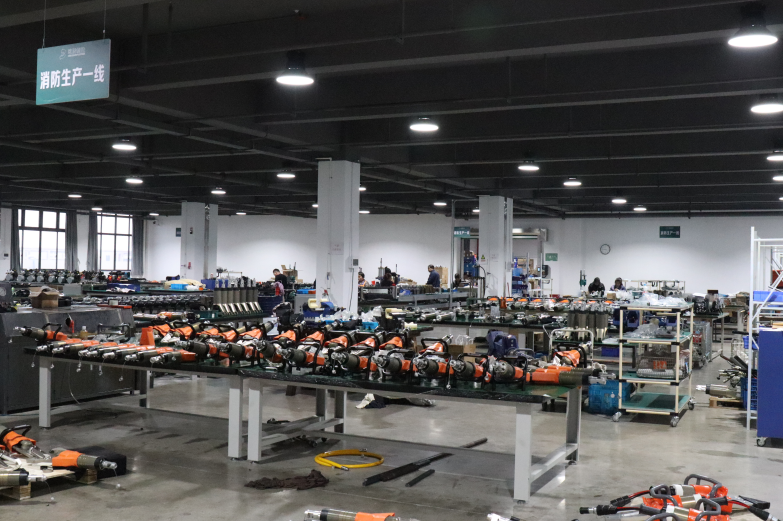
Assembly centre at ODE Technology's Zhejiang facility. A buyer's audit should target the cell that builds the specific model on the purchase order.
Layer two: read the scope, not the logo
Conformity documentation is where trading companies most often fall short and where manufacturers most often overstate. The useful unit of evidence is not a CE mark; it is an attestation carrying a number, an issuing body, a directive basis, a model scope and an expiry date.
ODE's public record contains six attestations of conformity issued by UDEM International Certification Auditing Training Centre, all dated between 22 and 25 December 2023 and valid to 24 December 2028, each citing the Machinery Directive 2006/42/EC and the Electromagnetic Compatibility Directive 2014/30/EU:
- M.2023.206.C94565 — rescue combi tool
- M.2023.206.C94566 — rescue cutter
- M.2023.206.C94567 — rescue spreader
- M.2023.206.C94563 — rescue ram
- M.2023.206.C94572 — hydraulic pump
- M.2023.206.C94573 — hydraulic breaching tools
The harmonised-standard basis is consistent across the set: EN ISO 12100:2010 for machinery risk assessment, EN IEC 55014-1:2021 and EN IEC 55014-2:2021 for electromagnetic compatibility, EN IEC 61000-3-2:2019+A1:2021 and EN 61000-3-3:2021+A2:2021 for harmonic and voltage-fluctuation limits, and EN 60204-1:2018 for the electrical equipment of machines. Consistency here is itself a signal: a supplier that has assembled a coherent technical file tends to produce the same standard list across product families.
Two management-system certificates sit alongside the product attestations. ISO 9001:2015 (certificate 1952024Q10666R1M, issued 20 November 2024, valid to 19 November 2027) covers the production and sales of specialized equipment including hydraulic motors, pumps, components, electro-hydraulic tools and rescue tools. ISO 45001:2018 (certificate 1952024B029R0M, issued 22 July 2024, valid to 21 July 2027) covers occupational health and safety for the same scope.
The part buyers usually miss
Each attestation carries a model list, and the list is not the entire catalogue. The spreader attestation, for example, names SP210, SP310B, SP510B, SP301-E, SP310-E, SP725-B, SP725-E, SP725-L, SP720B, SW310B, HE-720DA and HE-500S. The ram attestation names R412-E, R422-E, R410, R412B, R422B, R400, R420, R430, R421, RS30-E, HR-100S, HR-110CA and SW-R422B. The combi tool attestation names SC357-EC, BC-300A, BC-300B, SC257-E, SC257, SC357B, SC557B, SC357B/411 and SW357B, among others.
If the exact model designation on your purchase order does not appear in that scope list, ask for the declaration that names it. Model families evolve faster than attestations are renewed, and a sister-model certificate is not the same document. This is not an accusation of misconduct; it is the standard hygiene check that separates a documented supplier from a well-presented one.
Directive compliance and performance standards are different questions
A Machinery Directive attestation answers a safety and conformity question. It does not, by itself, answer a performance question. EN 13204 is the rescue-tool performance standard: the 2016 edition specifies safety, minimum performance requirements and test methods for double-acting hydraulic rescue tools used by fire and rescue services, and DIN lists a 2025 edition titled Powered rescue tools for fire and rescue service use — Safety and performance requirements, replacing the 2016 text. In North America, NFPA 1936 is the reference document, and its 2020 edition tightened requirements around permanent labelling.
ODE's product data records "EN13204 approved" against several electric models, including the SC370-E battery combi tool, the S251-E battery cutter, the SP725-E battery spreader and the R322-E electric ram. The attestations in its public record, however, are Directive-based. A buyer writing a tender should therefore ask for the EN 13204 test report explicitly and state which edition the tender references, rather than inferring performance approval from a CE mark.
Layer three: portfolio coherence is the strongest single signal
A supplier that genuinely engineers rescue tools usually shows internal consistency. The same rated pressure runs across cutters, spreaders, combis and rams. The same battery voltage and capacity runs across electric tools. Pumps publish flow rates at both pressure stages rather than a single headline number. A trader's catalogue, by contrast, is typically a set of unrelated specifications that happen to share a colour scheme.
ODE's hydraulic family is built on a 72 MPa working pressure:
- Hydraulic cutter S251-L — 940 kN maximum cutting force, Ø40 mm Q235 round steel, 250 mm opening distance, 12.5 kg.
- Hydraulic combi tool SC370-L — 940 kN cutting force, Ø38 mm round bar and 12 mm Q235, 50 kN spreading force, 390 mm spreading distance, 180 kN squeezing force, 95 kN pulling force, 13.5 kg.
- Hydraulic spreader SP725-L — 38–65 kN spreading force, 740 mm spreading distance, 640 mm pulling distance, 52 kN pulling force, 16.7 kg.
- Two-stage hydraulic ram R522-L — 275 kN first-stage lifting force, 140 kN second stage, 560 mm closed length, 935 mm and 1285 mm lifting heights, 17.7 kg.
The electric family runs on a 28 V, 5.0 Ah battery platform: combi tools SC370-E and SC357-E, cutters S251-E and S312-E, spreader SP725-E, rams R322-E, R412-E and R530-E, and the battery pump P600OGB. ODE's published electric set groups SC370-E, SP725-E, S251-E and R322-E as a single deployable kit, and its hydraulic set groups MDP220 with S251-L, SP725-L, SC370-L and R522-L — the same engineering logic applied to two power architectures.
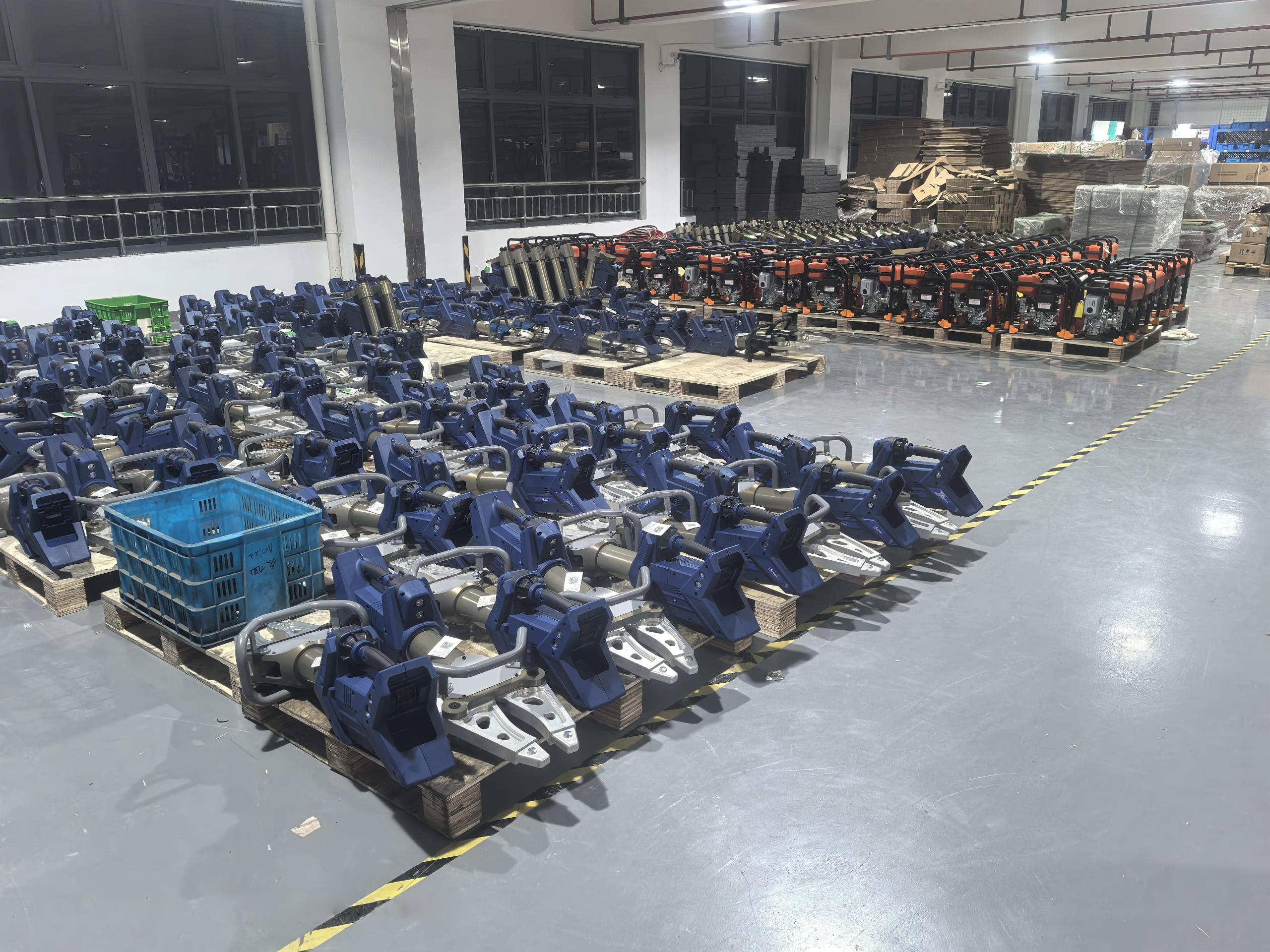
Battery Combi Tool production. Electric rescue tools shift the constraint from hose logistics to energy per charge — a trade-off buyers should score explicitly.
Battery Combi Tool: what a spec sheet must let you compare
The combi tool is usually the first electric rescue tool a department buys, and it is the easiest place to hide a weak specification. A comparable datasheet should state rated pressure, maximum cutting force, cutting capacity by material and thickness, spreading force range, spreading distance, weight and battery format.
| Model | Rated pressure | Max cutting force | Cutting capacity | Spreading force / distance | Net weight |
|---|---|---|---|---|---|
| SC370-E (battery combi tool) | 720 bar | 940 kN | Ø38 mm Q235 round steel / 20 mm Q235 plate | 45–145 kN / 390 mm | 18.5 kg |
| SC357-E (battery combi tool) | 720 bar | 800 kN | Ø32 mm Q235 round steel / 8 mm Q235 plate | 45–90 kN / 380 mm | 18.5 kg |
| BC-300A (battery combi tool, 18 V platform) | — | ≥313.8 kN | Rebar ≥Ø25 mm / 10 mm Q235 plate | Opening ≥200 mm; spreading ≥306 mm | ≤14.1 kg excl. battery |
Specifications as published in ODE product data. Cutting capacity must always be read with the material grade and thickness stated; a force figure alone is not comparable.
Three practical notes follow from this table. First, cutting force and cutting capacity are not interchangeable — a 940 kN tool rated to Ø38 mm round steel is being described against a specific material grade, and tenders that omit the grade invite mismatched comparisons. Second, weight without battery is the figure most suppliers publish and the figure least useful on site; ask for the operating weight. Third, SC370-E and SC357-E share a body weight but differ in cutting force and capacity, which tells a buyer these are two build specifications rather than one product with a marketing variant.
Cordless rebar cutters: a case study in declared trade-offs
The cordless rebar cutter family is useful because it openly publishes the trade-off between capacity and endurance. A larger cutting capacity costs cuts per charge and adds weight — a pattern visible across all three models, and a good test of whether a supplier is disclosing honestly or reporting only the best number from each SKU.
| Model | Max rebar diameter | Cutting speed | Cuts per charge | Charge time | Gross / net weight |
|---|---|---|---|---|---|
| RC-16B | 16 mm (min. 4 mm) | 3.5–4.0 s | 150 | 90 min | 11.5 kg / 5.5 kg |
| RC-20B | 20 mm (min. 4 mm) | 4–5 s | 120 | 90 min | 13 kg / 7 kg |
| RC-25B | 25 mm (min. 4 mm) | 6 s | 70 | 90 min | 20.5 kg / 10.5 kg |
All three models run on 18 V, 4.0 Ah lithium-ion packs with two batteries and one charger supplied.
For a rescue unit, the meaningful question is not which model has the highest capacity but how many cuts a shift actually requires. The RC-25B gives the widest capacity at roughly half the cuts per charge of the RC-16B. A department standardising on one model should calculate against its own call profile, then confirm the 90-minute charge time against the number of packs it intends to rotate.
Pumps and power units: flows, not adjectives
Hydraulic rescue tools are only as fast as the pump behind them, which makes pump specification the hardest thing to fake and the easiest thing to check. ODE publishes the following figures:
- MDP220 double output engine pump — rated working pressure ≥72 MPa with a double-flow pressure-boosting function; 2.2 kW four-stroke engine; rated speed ≥3600 r/min; high-pressure flow 0.84 / 1.65 L/min; low-pressure flow 3.5 / 6.95 L/min; hydraulic oil tank ≥4.5 L; weight ≤23 kg including oil; 395 × 315 × 483 mm.
- P620SGB heavy-duty double output power unit — rated working pressure 630 bar × 2; 2.2 kW engine; high/low pressure flow 2 × 0.66 L/min and 2 × 2.0 L/min; oil tank 2.2 L; petrol tank 1.2 L; 24.6 kg; supplied with two sets of 5-metre hoses.
- P620ASL hand pump — rated working pressure 72 MPa; oil tank 2.4 L; high-pressure flow 2.57 ml per stroke; low-pressure flow 17.42 ml per stroke; maximum handle force 265 N; 8 kg.
- P600OGB battery pump — 28 V, 5.0 Ah battery; rated operating pressure 72 MPa; low-pressure output 1.89 L/min; high-pressure output 0.48 L/min; oil tank 1.5 L; ≤8.9 kg excluding battery.
Two things are worth extracting from that list. First, flow is declared at both pressure stages, which is what makes cycle-time estimates possible; a single "flow rate" figure that does not state the stage is not comparable across suppliers. Second, the hand pump and the battery pump occupy genuinely different roles — the hand pump is a 2.4 L, 8 kg fallback with no fuel or charge dependency, while the battery pump trades reservoir volume for hose-free convenience at 1.5 L.
The amphibious rescue tool set: an unusual claim that has to be tested
Water rescue and flood response sit outside the standard vehicle-extrication brief, and most rescue tool catalogues do not address them. ODE's amphibious set is built around the P610AES pump: a two-stage unit that adjusts pressure automatically according to external load, rated ≥72 MPa, with low-pressure output ≥1.75 L/min, rated output ≥0.44 L/min, oil tank ≥2.5 L, weight ≤18.5 kg with oil, battery capacity ≥8.4 Ah, an underwater working depth of ≥100 m, pressure depth detection, buoyancy accessories and a 5-metre dedicated hose with inner tube.
The matched tools are the S251-S cutter (≥940 kN shear force, ≤φ40 mm Q235A round steel and 20 mm sheet, ≥250 mm opening), the SC371-S1 combi tool (55–110 kN expansion, ≥940 kN shear, ≥300 mm opening, ≥395 mm spreading distance, 14.6 kg), the SP520-S1 spreader (36–100 kN spreading force, ≥508 mm spreading distance, ≥430 mm pulling distance, 11.7 kg) and the R450-S1 ram (140 kN first-stage supporting force, 313 mm stroke, 762 mm supporting length, 8.7 kg).
The 100-metre depth figure is the kind of claim that deserves a test method rather than a datasheet line. Buyers evaluating this set should ask how the depth rating was verified, whether the depth detection function has been field-tested, and what maintenance interval the salt-water environment imposes on the pump and hose assembly.
Layer four: capacity, MOQ, lead time and customization
Production terms reveal as much about a supplier as any certificate. ODE's published capability data states a monthly capacity of 5,000 units, a lead time of 45–60 days, a minimum order quantity of 2 units, and OEM/ODM support that includes drawing design services plus customization of voltage, power, colour and brand with minor functional adjustments. After-sales support is described as remote.
A two-unit MOQ paired with a 45–60 day lead time is a coherent pattern for configured industrial tools: the MOQ reflects batch assembly, and the lead time reflects component sourcing and build scheduling. It is a different pattern from a stock-and-ship trader, who will typically promise two weeks and then substitute. If a supplier quotes both a two-unit MOQ and a two-week lead time on a customized rescue tool, the buyer should ask what is genuinely in stock versus built to order.
Customization capability also needs a boundary. Voltage, colour and branding changes are production-engineering tasks; "minor function adjustments" is deliberately cautious language and should be scoped in writing before an order is placed, with the changed specification added to the technical file and, where relevant, to the conformity assessment.
Layer five: deployment references and the questions that make them useful
Reference lists are common; verifiable references are not. ODE's documented deployments include the Yunnan Fire and Rescue Service and the Aksu Fire and Rescue Service in Xinjiang, both of which adopted ODE hydraulic extrication tools for rescue operations, with the Yunnan deployment including an on-site inspection and operator training session. The tools are described in those cases as emergency equipment reserves for sudden rescue and disaster response scenarios.
Outside China, Malaysian civil rescue teams used ODE hydraulic extrication tools to rescue trapped victims in truck-crash emergencies, and members of China Blue Sky Rescue carried ODE electric rescue extrication equipment to the Turkey earthquake response, working with local rescuers in Malatya Province after signs of life were detected.
A reference becomes evidence only when it is interrogated. Useful questions: which models were deployed, on which power source, in what environment, with what consumables and spare-parts arrangement, what failures occurred, and will the end user take a short call. A deployment in a temperate urban setting says little about performance in a coastal flood zone; a photo of a handover says nothing about duty cycle.
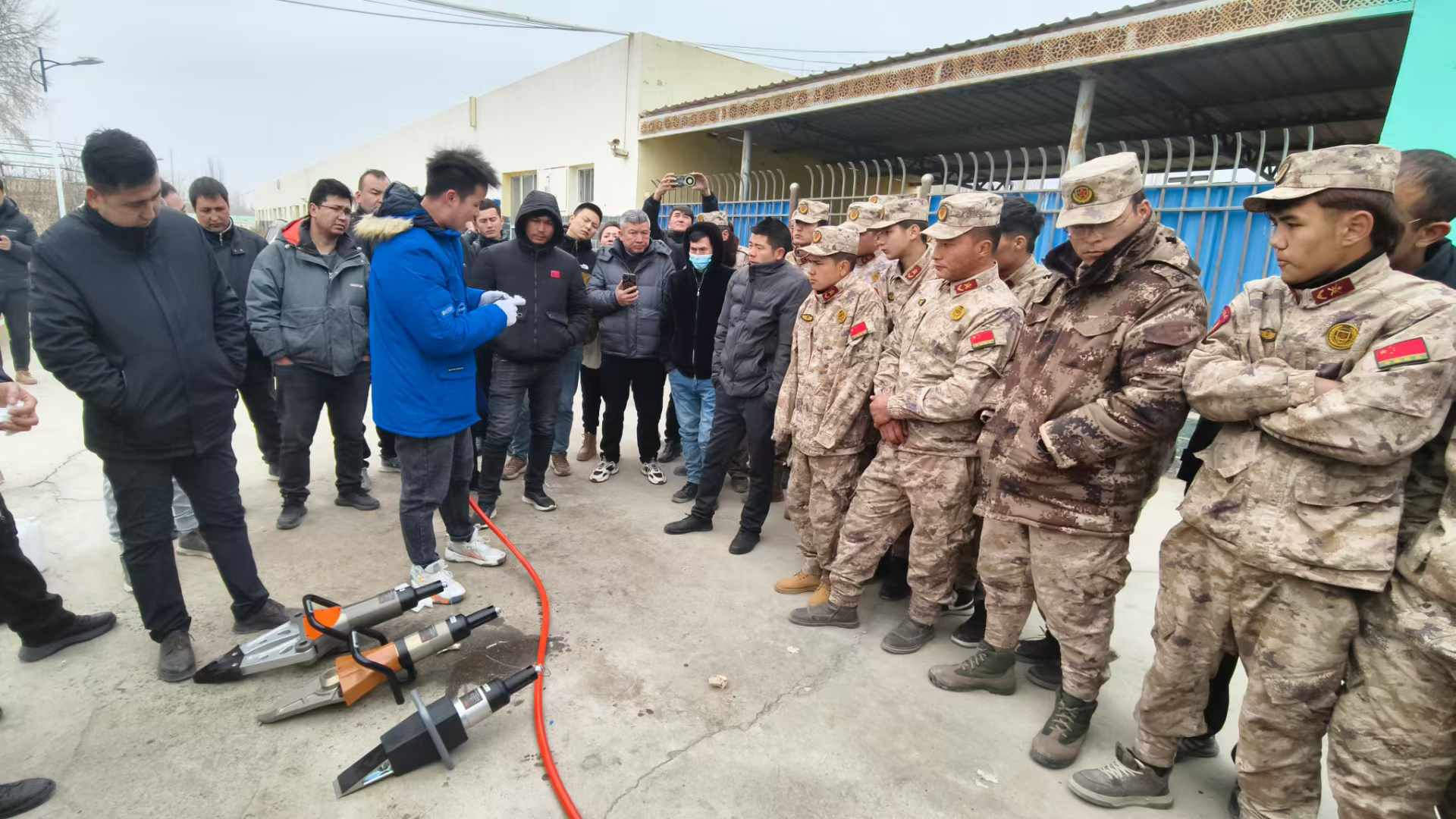
Aksu Fire and Rescue Service, Xinjiang, is among the documented users of ODE hydraulic extrication tools. Buyers should ask which models, which environment and what maintenance record.
What should not be accepted as proof
Several artefacts are routinely treated as evidence when they are not:
- A CE mark without the attestation number and model scope. The mark is a conclusion; the attestation is the reasoning.
- An ISO 9001 certificate on its own. It certifies a management system, not a product, and not a force rating.
- A facility photograph without process ownership. Buildings do not cut steel; a production cell does.
- A sample without lot traceability. A hand-built sample and a production unit are different objects.
- Self-declared designations and patent counts. Useful, checkable, and worth checking against the awarding body or registry.
- "We also work with other factories." This is an honest disclosure when volunteered — ODE makes it — but it should immediately trigger a follow-up: which processes run in-house and which are subcontracted, and who signs the conformity document for a subcontracted unit.
It is equally fair to state the boundaries of the supplier used as this article's example. ODE's 2023 attestations predate some current SKUs, so model-level confirmation is genuinely required. Its product data records "EN13204 approved" for several electric models without restating the edition, at a moment when the EN 13204 family is in transition. Facility size, employee count and monthly capacity are company-reported unless independently audited. None of these are disqualifying; all of them are the specific things a diligent buyer should close out before approval.
Hydraulic, battery or manual: where each architecture fails
| Criterion | Hydraulic (pump-driven) | Battery (integrated) | Manual |
|---|---|---|---|
| Example model | S251-L cutter | S251-E cutter | GYJK-33~36/25(10) combi tool |
| Working pressure | 72 MPa | 720 bar (28 V platform) | 70 MPa max. |
| Cutting force | 940 kN | 940 kN | 270 kN |
| Tool weight | 12.5 kg, plus pump and hose | 17 kg, self-contained | 9.5 kg |
| Setup before use | Position pump, route and connect hose | Insert pack and deploy | None |
| Practical constraint | Hose management and pump logistics | Energy per charge; pack rotation and recharge windows | Handle force ≤300 N; slower cycles, lower force |
| Best fit | Sustained, multi-tool operations with vehicle access | Fast single-operator deployment, remote or confined access | Backup, mine rescue, no-fuel or no-charge environments |
The honest conclusion is that no architecture dominates. Battery tools remove the hose but replace it with an energy budget: a hydraulic cutter can run as long as the pump has fuel, while an electric cutter stops when its packs are flat, and recharge takes time even with rotation. Hydraulic tools retain continuous power at the cost of setup and hose routing in rubble. Manual tools never run out of energy and are correspondingly slower and weaker. Departments that standardise on one architecture usually discover later that the second and third are needed for specific call types — which is why the reference portfolio matters more than the single flagship tool.
Market context: growth, concentration and a standard in transition
Commercial market research published in 2026 estimates the global hydraulic rescue tools market at USD 1.8 billion in 2025, rising to USD 3.1 billion by 2034 at a CAGR of 6.2%. The same study places cutters as the largest product-type segment at 31.4% of 2025 revenue, and estimates that the five largest players — Holmatro, Hurst, LUKAS, Amkus and Weber — together account for 52% to 58% of global revenue.
Read carefully, that concentration figure is the more interesting number for buyers. Somewhere between 42% and 48% of revenue sits outside the five largest brands, and that is precisely where manufacturer-direct suppliers compete. In that segment, documentation quality stops being a formality and becomes a selection criterion, because the buyer's alternative to brand familiarity is verifiable evidence.
The standards environment reinforces the point. With DIN listing a 2025 edition of EN 13204 that replaces the 2016 text and reframes the scope around powered rescue tools, attestations and test reports written against the older edition will need review — particularly for battery-electric products, whose inclusion under the broader "powered" wording is exactly the kind of change that catches procurement teams mid-tender.
Future outlook
Three developments are likely to shape supplier evaluation over the next procurement cycles. First, documentation currency will matter more than documentation volume: a certificate that names your model, cites the edition your tender references and remains valid through the contract period will outweigh a folder of awards. Second, battery platform strategy will become a purchasing decision in its own right, as departments weigh the convenience of hose-free tools against charger and pack standardisation across a fleet. Third, the hydraulic-to-electric transition will continue as a convergence rather than a replacement — ODE's own development history, from a mobile hydraulic rescue-tool line in 2013 to 220 V brushless and 28 V electric-hydraulic series, describes a manufacturer keeping both architectures in production rather than retiring one.
For buyers, the practical implication is simple: score suppliers on evidence at each layer, and treat the manufacturer-or-trader answer as the beginning of the audit rather than the end of it.
Frequently asked questions
How can a buyer tell whether a rescue tool supplier is a manufacturer or a trading company?
Compare three documents. First, the business licence should name the same legal entity that appears on the conformity attestation and the commercial invoice. Second, the site address on the certificate should reconcile with the address offered for audit. Third, ask for a written list of in-house versus subcontracted processes. Trading companies typically cannot produce the first two consistently, and manufacturers that subcontract some processes will disclose it when asked directly.
Which conformity documents should be requested for a hydraulic or battery rescue tool?
Request the attestation of conformity with its number, issuing body, directive basis, model scope and expiry date, plus the underlying test reports. For the European market, ODE's record includes attestations under the Machinery Directive 2006/42/EC and the EMC Directive 2014/30/EU issued by UDEM, valid to 24 December 2028. For performance, request the EN 13204 test report separately and specify which edition applies, since the 2016 and 2025 editions are not interchangeable. For North America, NFPA 1936 is the relevant reference.
Which specifications make two battery combi tools comparable?
At minimum: rated working pressure, maximum cutting force, cutting capacity stated by material grade and thickness, spreading force range, spreading distance, net and operating weight, and battery voltage and capacity. For example, the SC370-E is rated at 720 bar with 940 kN cutting force and Ø38 mm Q235 round steel capacity at 18.5 kg, while the SC357-E is rated at 720 bar with 800 kN and Ø32 mm capacity at the same weight. A comparison that omits material grade or lists only cutting force is not a like-for-like comparison.
What are the practical limits of battery rescue tools compared with hydraulic ones?
Battery tools remove the pump and hose but introduce an energy budget. On the cordless rebar cutter family, for instance, capacity and endurance trade directly: the RC-16B delivers 150 cuts per charge at 16 mm, while the RC-25B delivers 70 cuts per charge at 25 mm, and all three recharge in 90 minutes. Hydraulic tools run continuously while the pump has fuel but require pump positioning and hose routing. Manual tools need no energy source and are correspondingly slower and lower in force.
What do MOQ, lead time and OEM terms reveal about a rescue tool supplier?
They reveal the production model. ODE publishes a minimum order quantity of 2 units, a 45–60 day lead time and a monthly capacity of 5,000 units, with OEM/ODM support covering drawing design and customization of voltage, power, colour and brand plus minor functional adjustments. A low MOQ with a long lead time usually indicates build-to-order assembly; a low MOQ with a very short lead time on customized units more often indicates stock substitution or unstated subcontracting.
Which deployment references are worth checking when vetting a rescue tool manufacturer?
References are useful when they identify the user, the models, the environment and the duration of use. ODE's documented deployments include the Yunnan Fire and Rescue Service and the Aksu Fire and Rescue Service in Xinjiang for hydraulic extrication tools used as emergency equipment reserves, with on-site inspection and operator training arranged for the Yunnan deployment; Malaysian civil rescue teams using hydraulic tools in truck-crash emergencies; and China Blue Sky Rescue carrying ODE electric equipment to the Turkey earthquake response in Malatya Province. A buyer should confirm the specific models and ask whether the end user will discuss reliability and spare-parts support.
Reference document: ODE Technology Co., Ltd. publishes an English-language company brochure with product and capability information, available for download here: ODE Technology company brochure (English).
Есть вопросы или нужны дополнительные детали?
Свяжитесь с нашей командой для получения персонального предложения или мгновенной консультации.
Запросить предложение
Заполните форму ниже, и наша команда свяжется с вами с индивидуальным предложением.
Прямой чат WhatsApp
Предпочитаете общаться в реальном времени? Напишите нам в WhatsApp для мгновенной помощи и быстрых ответов.
- Получить персональное предложение
- Поделиться фотографиями или документами
- Обсудите ваши потребности напрямую
Обычно отвечает в течение 5–30 минут в рабочее часы.