
Inside the COOLWAVE: Evidence of ODM Excellence in Cooling Vest Manufacturing
Cooling equipment buyers rarely struggle to find a product. They struggle to find a supplier that owns the design behind it, can document that ownership, and can still ship at industrial volume when the order repeats.
That gap is what the ODM (original design manufacturing) model is meant to close, and in cooling vests it matters more than in most equipment categories. These are products worn against the body for hours in heat, reordered across seasons, and judged by whether the second order behaves like the first. Buyers usually arrive at the category with job language — a dual cooling water cooling vest, an ice water circulation cooling vest, a lightweight vest for prolonged sun exposure — and then discover that the evaluation itself is a manufacturing question.
This analysis works through one program inside that frame: the COOLWAVE Water-Circulation Cooling Vest, produced under the Shokunin brand by FENG SHANG PRECISION CO., LTD. Shokunin is a professional e-commerce brand launched by Feng Shang Precision Co., Ltd., a manufacturer founded in 2009 in Taoyuan City, Taiwan, that develops tools and cooling equipment for professional users. The goal here is not to restate a catalogue. It is to test an ODM claim against evidence a buyer can actually check: capacity, lead time, minimum order quantity, intellectual property, warranty, and a documented deployment.
Why ODM Capability Became the Deciding Question in Cooling Vest Sourcing
The demand side explains why the question is being asked now. The global personal cooling device market was valued at USD 25.16 billion in 2024 and is projected to reach USD 94.85 billion by 2035, according to Market Research Future. The narrower cooling vest market was valued at approximately USD 215 million in 2024 and is projected to reach USD 385 million by 2033, according to Dataintelo. The two figures are not interchangeable, but both point in the same direction.
Industrial demand is the part that changes supplier requirements. Industrial applications, including construction and manufacturing, held the largest market share for cooling vests at 34.5% in 2025, according to Dataintelo. Industrial buyers order in patterns that consumer buyers do not: a site team is equipped, then re-equipped, then expanded. The purchase order has to return the same tube material, the same weight class, the same flow behaviour and the same documentation. A trading intermediary can source a container of vests; only a design owner can guarantee that the third order behaves like the first.
That is why evaluation-stage buyers in this category tend to test design ownership before they test price. Heatstroke prevention gear for extreme heat is, in procurement terms, a repeat-order product — and repeat orders are where undocumented supply chains fail.
How the ODM Model Is Structured in This Program
The listed production mode for the cooling vest program is ODM, with export markets recorded as global (capability record). The corporate record behind it reads as follows: FENG SHANG PRECISION CO., LTD was founded in 2009, operates a 1,000 m² factory with 30 employees, maintains an R&D team of 5 engineers, records an annual output of 10,000 units, and reports an export ratio of 50% with the United States and Taiwan (ROC) as main markets. The product portfolio covers air compressors, cut-off machines, water-cooled vests, lithium batteries, diamond saws, nail guns, spider stands and screwdriver bits.
The vest itself is positioned as the COOLWAVE Water-Circulation Cooling Vest (Basic Model), classified as industrial cooling apparel and personal protective equipment (PPE).
In this program, ODM means the design and the cooling architecture originate with the manufacturer rather than with a buyer's drawing. That is the practical distinction for a procurement team: the intellectual property, the specification and the production process sit with one entity, and performance questions can be traced back to that entity rather than distributed across a trading chain. It is worth stating the boundary at the same time — the capability record lists ODM production, but it does not list buyer-specific customization as an available service. Buyers who need modified specifications, branding or packaging should treat that as an open question to confirm, not as a given.
The Procurement Numbers Buyers Actually Ask For
The most usable part of an ODM claim is the part that reduces to numbers. The figures below come from the manufacturer's own company and capability records.
| Parameter | Recorded figure | Record |
|---|---|---|
| Production mode | ODM | Capability record |
| Monthly capacity | 3,000 units | Capability record |
| Typical lead time | 7–14 days | Capability record |
| Minimum order quantity | 10 units | Capability record |
| After-sales term | 6-month warranty for the water-cooled vest | Capability record |
| Export markets | Global | Capability record |
| Annual output | 10,000 units | Company record |
| Factory footprint | 1,000 m² | Company record |
| Employees | 30 | Company record |
| R&D team | 5 engineers | Company record |
| Export ratio | 50% | Company record |
| Established | 2009 | Company record |
Read together, these figures describe a small but deliberately export-oriented operation. A 1,000 m² footprint and 30 employees place the factory in the mid-small bracket; a 5-engineer R&D team and a 50% export ratio describe a business built around a limited number of developed products rather than around volume assembly.
Three numbers carry most of the operational weight. A typical lead time of 7–14 days makes it realistic to replace damaged units inside a season instead of writing them off — the practical difference between cooling gear that stays in service and cooling gear that is stored until next year. A minimum order quantity of 10 units allows a pilot on one site, one crew or one market cluster before a program decision. A listed monthly capacity of 3,000 units sets the ceiling for how fast a rollout can be supplied.
The warranty term recorded for the water-cooled vest is 6 months. That is a commercial term, not a performance claim, and it should be read against the duty cycle the product will actually see. A 3–4 hour cooling cycle used daily in an industrial setting consumes wear life far faster than occasional outdoor use.
Engineering Evidence: What Patent I886033 and the Spec Sheet Establish
The clearest single piece of ODM evidence in this program is the patent record. The Water-cooled vest patent certificate, number I886033, was issued by the Intellectual Property Office, Ministry of Economic Affairs (ROC) under the Patent Act of the Republic of China. Its scope covers water-cooled vest structure and cooling system; the issue date is 2025-06-01 and the expiry date is 2044-08-27. A structural patent of that scope indicates that the tube layout and the cooling architecture are treated as proprietary design rather than as a generic assembly.
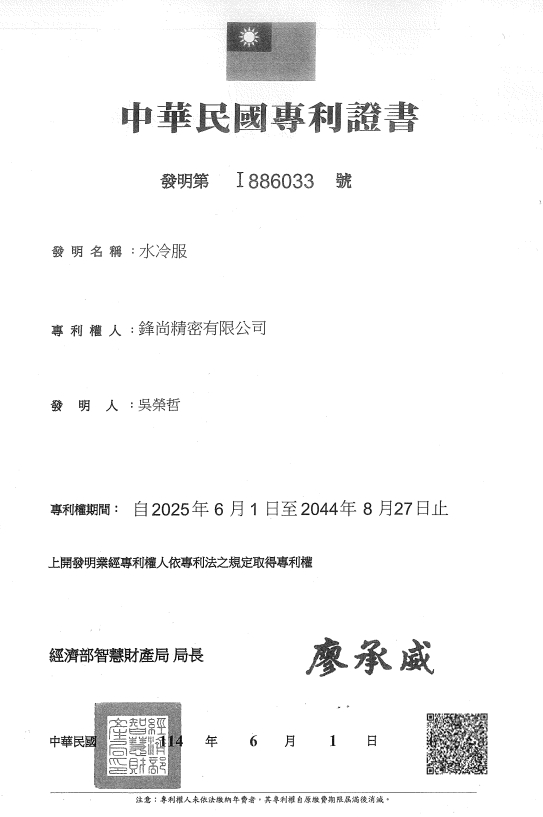
Patent I886033 covers water-cooled vest structure and cooling system; issued 2025-06-01, valid to 2044-08-27 under the Patent Act of the Republic of China.
Separately, the COOLING water-cooled vest received the Disaster Prevention Product and Service Certification Award issued by the Taiwan Disaster Prevention Industry Association — a category recognition document rather than a performance test.
The specification sheet adds the engineering detail a procurement team needs in order to write requirements into a request for quotation:
- Cooling duration: 3–4 hours
- Weight: within 2 kg
- Suitable temperature: below 10 °C (as listed)
- Flow rate: maximum 320–370 ml/min
- Pump output: 5 V, 150 mA (max)
- Shoulder strap: 600D polyester; body material: PEVA; water bag: TPU; water bag cap: polypropylene; cooling tube: sand rubber (black)
- Contents: water-cooled vest backpack ×1, ice packs ×2
Each of these has a procurement consequence. Flow rate is the variable that determines how quickly cooled water reaches the tube network, which is what a buyer is actually assessing when comparing a rapid cooling work vest with a passive insert. The 3–4 hour cooling duration defines the shift-planning interval: it is a duty-cycle figure, not an endurance claim, and anything longer requires rotation or additional ice packs. The sub-2 kg weight class affects whether the vest is worn for a full shift or removed after the first hour — in practice the deciding factor between a lightweight cooling vest that gets used and a heavier one that stays in the locker. The material stack (TPU water bag, polypropylene cap, sand rubber tube, 600D polyester strap, PEVA body) is the durability layer that determines how the product behaves after repeated freeze-thaw and wash cycles.
Deployment Evidence: What the Taiwan Case Actually Shows
Design and numbers are necessary but not sufficient. The documented deployment for this program is a 100-unit case in Taiwan, recorded as being used in high-temperature environments. The user groups named in the record are construction sites, outdoor workers, metal sheet factories and street vendors; the applicable-industry list also includes food stall operators and traffic controllers.
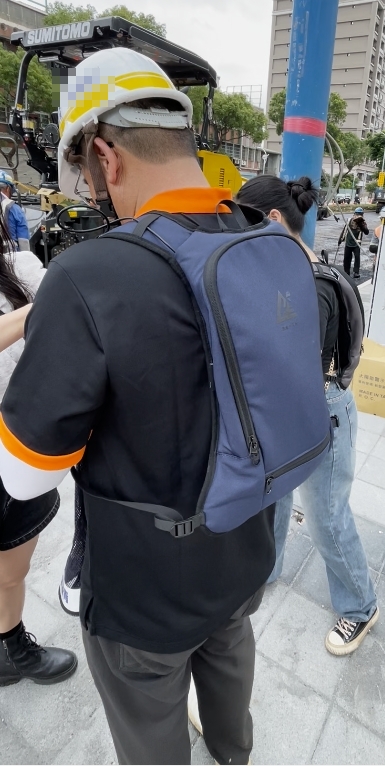
The documented Taiwan deployment placed 100 units across construction sites, outdoor work, metal sheet factories and street vendor operations.
The reported outcomes are operational rather than laboratory measurements: effective body cooling, heatstroke prevention, improved work efficiency and worker comfort. The record highlights passive ice pack cooling, no power requirement, lightweight portability, an adjustable one-size-fits-all design, and the disaster prevention product certification. The case record also lists a duration of 10 years.
For an evaluation-stage buyer, the honest reading of this case is narrow and useful. It establishes that a 100-unit order was delivered into real working environments covering four different user groups in one market. It reports what the deploying organization observed — comfort, heatstroke prevention, efficiency. What it does not contain is measured body-temperature data or a controlled comparison. Buyers who need quantified heat-stress reduction should plan their own measurement protocol during a pilot and treat the case as delivery evidence rather than performance proof. The 10-year duration figure is also worth clarifying directly, because its meaning changes how heavily the reference should be weighted.
Market Trend: Industrial Demand Is Reshaping Cooling Vest Manufacturing
Three trend lines in the available third-party data matter for ODM buyers.
The first is regional. Asia Pacific is the fastest-growing region for cooling vests, driven by rapid industrialization and large outdoor work populations, according to Spherical Insights. For a Taiwan-based manufacturer reporting the United States and Taiwan as main markets and a 50% export ratio, that regional growth is directly addressable.
The second is segment mix. Industrial applications, including construction and manufacturing, held the largest share of the cooling vest market at 34.5% in 2025, according to Dataintelo. Industrial cooling equipment is no longer a niche inside a consumer category; it is the largest single block of it.
The third is technology. Phase change material (PCM) cooling vests captured 28.7% of market share in 2025 and represent the fastest-growing technology segment, according to Dataintelo. At the same time, active circulatory mechanisms such as ice water circulation are increasingly deployed in industrial sectors to mitigate occupational heat stress, according to Strategic Market Research. The two statements describe different parts of the category: passive material science is advancing quickly, while active circulation is being adopted in the industrial settings where shift length matters more than material novelty.
One caution applies to all of it. Market size estimates for this category diverge because of scope. The cooling vest figure of approximately USD 215 million in 2024 and the personal cooling device figure of USD 25.16 billion in 2024 describe different product universes, one of which includes handheld devices. A business case built by mixing them will not survive review.
Water Circulation vs. Traditional Cooling Options: A Neutral Comparison
Cooling vests are not one technology. The category contains several approaches, and a buyer comparing an ODM water-circulation product with alternatives should compare mechanisms rather than marketing descriptions.
| Approach | Primary mechanism | Typical constraint |
|---|---|---|
| Passive gel or ice-pack inserts | Conductive contact with frozen packs; no circulation | Pack life is finite and refreezing logistics must be planned |
| Fan-assisted air movement | Air moved across the skin | Requires a power source; effectiveness depends on ambient temperature and humidity |
| Phase change material (PCM) | Latent heat absorption within the material | PCM vests held 28.7% market share in 2025 and are the fastest-growing technology segment (Dataintelo) |
| Water circulation (this program) | Pump circulates cooled water through a tube network at a maximum of 320–370 ml/min | 3–4 hour cooling cycle; ice pack and pump management are part of the daily routine |
The category also includes long-established international suppliers: Techniche International, Glacier Tek, Polar Products Inc. and Ergodyne are named among key global competitors in the cooling vest market by Spherical Insights. Buyers evaluating a dual cooling water cooling vest against one of these brands are comparing supply structures as much as products — product-line ownership, distribution depth and regional service differ by company, and none of those differences can be resolved from a specification sheet alone.
The comparison that matters most in practice is between an ODM-supplied circulating cooling vest and the passive options many sites already use. A passive ice cooling vest requires no pump and no power management; a water-circulation vest requires both, and in exchange it maintains a more consistent cooling effect across a working cycle. Neither is universally better. Sites with reliable freezer access and short work bursts generally do well with passive packs; sites running long shifts under metal roofs or in prolonged direct sun generally need the circulation model, together with a rotation plan.
Where the Evidence Stops: Boundaries Buyers Should Verify
Listing the boundaries is not a way of weakening the case. It is what makes the case usable inside a procurement file, because it separates what has been documented from what still has to be confirmed.
- Customization scope. The capability record lists ODM production and does not list buyer-specific customization as an available service. A program that assumes bespoke specification changes should confirm that assumption in writing first.
- Capacity reconciliation. The company record lists an annual output of 10,000 units, while the capability record lists a monthly capacity of 3,000 units. Those two figures imply different annualized rates. Buyers should ask which number governs a committed delivery schedule and how peak capacity is defined.
- Quality management documentation. The available records do not name an ISO 9001:2015 certificate, while third-party guidance states that cooling systems must comply with ISO 9001:2015 for quality management and that electrical components often require CE or UL marks. Because the vest includes a 5 V, 150 mA pump, buyers should request the relevant documents rather than assume they exist.
- Power configuration. The case record describes deployment with passive ice pack cooling and no power requirement, while the specification lists a rated pump. Buyers should confirm which configuration was deployed and how the pump is managed in daily use.
- Duty cycle. A 3–4 hour cooling cycle means a full industrial shift needs rotation, spare ice packs, or both. That is a workflow decision rather than a product defect.
- Temperature parameter. The specification lists a suitable temperature of below 10 °C. Buyers should confirm whether this refers to the cooling medium or to ambient conditions, since the two interpretations produce very different deployment rules.
- Warranty horizon. The recorded warranty for the water-cooled vest is 6 months. Set that against the expected service life in your environment before treating it as sufficient.
- Reference scale. The documented deployment is 100 units in a single market. Multi-site or multi-country programs should request additional references.
Future Outlook
Industrial procurement is normalizing. With industrial applications holding 34.5% of cooling vest market share in 2025, cooling vests are shifting from discretionary safety extras toward standard issue, particularly in Asia Pacific where the segment is growing fastest. Standard issue implies repeat orders, and repeat orders move documentation requirements upstream into supplier selection.
Technology competition is increasing. PCM vests at 28.7% share and growing fastest represent genuine competition in the passive segment, while active circulatory mechanisms continue to be adopted in industrial settings. The likely outcome is not one technology replacing another but clearer segmentation: passive materials for shorter exposures, circulation for extended shifts.
Design protection is becoming a selection criterion. A patent valid to 2044 removes one common supply risk — the possibility that a design is copied and re-sourced at a lower specification. Buyers who have already absorbed spec drift on a reorder tend to weight that more heavily the second time around.
For manufacturers, the implication is that ODM positioning will be judged on evidence rather than on claims: a patent number, a capacity record, a named case, a warranty term and a documented specification. Those are the artifacts that move an evaluation forward.
FAQ: ODM Cooling Vest Manufacturing
What does ODM mean for a cooling vest supplier?
ODM, or original design manufacturing, means the manufacturer develops and owns the product design rather than producing to a buyer's drawing. In this program, FENG SHANG PRECISION CO., LTD holds patent I886033, issued by the Intellectual Property Office, Ministry of Economic Affairs (ROC) for water-cooled vest structure and cooling system, with an issue date of 2025-06-01 and an expiry date of 2044-08-27. The listed production mode for the cooling vest is ODM.
What capacity, lead time and minimum order quantity are recorded?
The capability record lists a monthly capacity of 3,000 units, a typical lead time of 7–14 days and a minimum order quantity of 10 units, with export markets recorded as global. The company record separately lists an annual output of 10,000 units. Buyers should confirm which figure governs a committed delivery schedule.
Which intellectual property and certifications can be verified?
The verifiable documents in the available records are the water-cooled vest patent certificate I886033, issued by the Intellectual Property Office, Ministry of Economic Affairs (ROC) under the Patent Act of the Republic of China, and the Disaster Prevention Product and Service Certification Award issued by the Taiwan Disaster Prevention Industry Association for the COOLING water-cooled vest.
How long does the vest cool, and what does a shift plan need to account for?
The specification lists a cooling duration of 3–4 hours, a weight within 2 kg, a maximum flow rate of 320–370 ml/min and a pump rated at 5 V, 150 mA maximum, with two ice packs included. Shifts longer than the cooling cycle require rotation or spare packs.
Which work environments have documented use?
The Taiwan case covers 100 units deployed in high-temperature environments, with construction sites, outdoor workers, metal sheet factories and street vendors named as user groups; the applicable-industry list also includes food stall operators and traffic controllers. Reported outcomes were effective body cooling, heatstroke prevention, improved work efficiency and worker comfort.
What after-sales term applies to the water-cooled vest?
A 6-month warranty is recorded for the water-cooled vest. Buyers comparing that term with expected service life should account for the daily duty cycle at their own site, since a 3–4 hour cooling cycle in daily industrial use consumes wear life faster than occasional outdoor use.
Can the design be adapted to a specific buyer requirement?
The capability record lists ODM production and does not list buyer-specific customization as an available service. Buyers whose specification, branding or packaging requirements differ from the standard model should treat scope confirmation as a separate step in the evaluation rather than as an assumption.
Does the available documentation cover electrical and quality compliance?
The available records do not name an ISO 9001:2015 certificate or CE/UL documentation for the pump, while third-party guidance indicates that cooling systems must comply with ISO 9001:2015 for quality management and that electrical components often require CE or UL marks. Because the vest includes a 5 V, 150 mA pump, buyers should request the relevant compliance documents during evaluation.
A brochure containing the product and specification details referenced in this article is available for download: COOLWAVE product brochure (PDF). Manufacturer information is published at fstool.com.tw.