
Inside the Stone Machine Factory: The Physical Evidence Behind Quarry Saws and Processing Lines
Stone machinery is bought on drawings and delivered as steel. Between those two points sits the part of supplier evaluation that specification sheets rarely capture: how much the machine actually weighs, how its frame carries wire tension, which certificate number backs its electrical design, and where the machines already sold are running today.
For buyers who have already shortlisted a supplier and are moving into execution — releasing a deposit, preparing foundations, booking rigging capacity, planning commissioning — the useful question changes. It stops being “does this supplier offer a multi-wire saw?” and becomes “what physical and documentary evidence exists that this specific machine will arrive, pass inspection and run at the stated duty?”
That shift is what this profile tracks. Instead of a narrative about ambition, it works from the artefacts a factory actually produces: net machine weight, structural configuration, model ladder, cutting envelope, certificate numbers, line footprints, and an installed base distributed across a dozen countries.
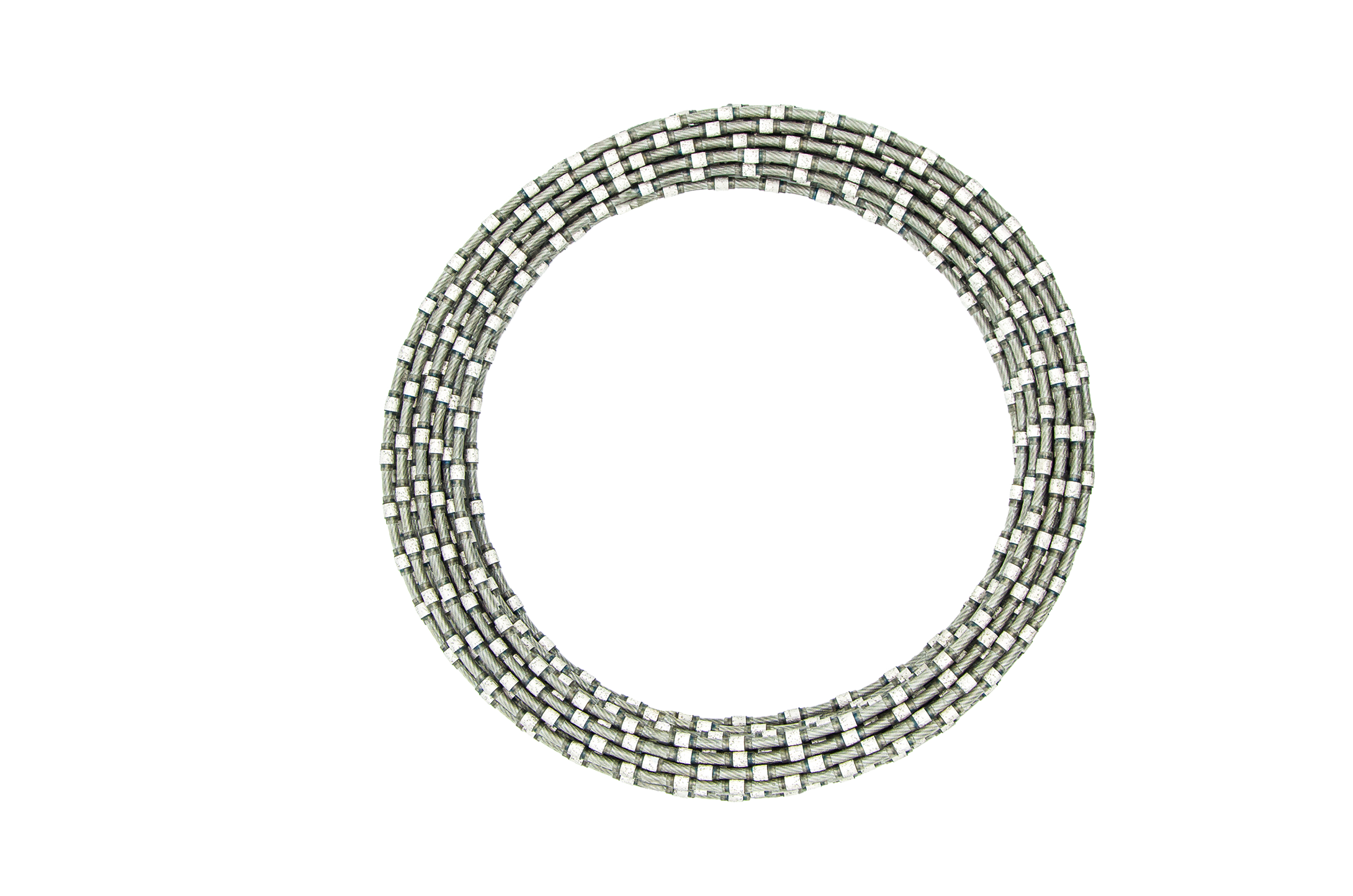
Multi-wire saw machine for stone slab processing. In this equipment class, frame mass and wire path geometry are the specification, not the accessory list.
Where the supplier sits in the stone chain
Stonewin is the brand of Fujian Xiapu Zhongyuan Machinery Co., Ltd., a Chinese stone machinery manufacturer founded in 2011 and based in Xiapu, Fujian, operating 70 mu of factory space with 300 employees and a 50-person R&D team. The company reports a 50% export ratio and a service footprint spanning India, the Arabian Peninsula, the Middle East, Africa, Europe, South America and Southeast Asia. Its product line follows the physical sequence of stone production: quarrying, slab processing, slab polishing, and resin filling and drying, with diamond wire saws as the consumable that ties the chain together.
That sequence matters for procurement planning more than any single machine listing, because a quarry-to-polish line is a set of hand-offs. A block cut at the face determines the maximum block size the processing hall can accept; the multi-wire saw determines what slab thicknesses leave the yard; the polishing line and resin line determine which of those slabs can be finished and sold as a finished surface. Buying one element without the constraints of the next is one of the more common and more expensive planning errors in the category.
The multi-wire saw: weight and tension as the real specification
A multi-wire saw is a rigid frame under load. Its job is to hold a set of parallel wires in a stable geometric relationship while abrasive action and cooling fluid work against the block. Precision in slab thickness is therefore a structural property before it is a control property, and the documented numbers that describe that structure are the first thing a technical buyer should verify.
The Stonewin multi-wire saw range is designated from ZY-MW5 through ZY-MW90, with net machine weights spanning roughly 22 to 80 tonnes across the ladder. Two structural configurations are offered: top-tension and side-tension. Documented cutting height reaches up to 2200 mm.
| Documented attribute | Stated value | What it changes for the buyer |
|---|---|---|
| Model designations | ZY-MW5 through ZY-MW90 | Defines the size ladder offered, so a buyer can match block dimensions to a model rather than to a general promise. |
| Net machine weight | Roughly 22 to 80 tonnes across the range | Sets floor loading, crane or gantry capacity at installation, lifting points, and inland transport planning between port and plant. |
| Structural configurations | Top-tension and side-tension | Changes block loading direction, wire path access for maintenance, and how the machine fits an existing hall layout. |
| Cutting height | Up to 2200 mm | Defines the tallest block that can be processed in a single pass and therefore the block sizes the yard can accept. |
| Compliance basis | CE certification via SGS certificate IN-XM-5805-23069 | Provides a verifiable document reference rather than a claim, which shortens the qualification conversation. |
Attributes as stated in supplier documentation. Individual configurations may vary; confirm the exact model sheet before ordering.
The distinction between top-tension and side-tension is not cosmetic. Top-tension designs pull the wire plane from above, which typically suits a loading pattern where blocks are set under a vertical wire field; side-tension designs place the tensioning structure laterally, which changes how the operator approaches the wire path and how the machine occupies floor width. Neither is universally preferable. The choice is driven by hall geometry, block handling equipment, and the maintenance routine the plant can realistically sustain.
What certificate IN-XM-5805-23069 actually records
Compliance documents are frequently cited and rarely read. In this case the referenceable fact is specific: CE certification, certificate number IN-XM-5805-23069, issued by SGS, with conformity stated against EN ISO 12100:2010 and EN 60204-1:2018.
Those two standards describe different things. EN ISO 12100:2010 is the risk assessment and risk reduction methodology standard — it addresses how hazards are identified, evaluated and reduced through machine design. EN 60204-1:2018 addresses the electrical equipment of machines, covering the electrical supply, protection, control functions and related safety provisions. Taken together, they indicate that the design file addresses both mechanical risk logic and electrical safety architecture.
How to use this in a tender file. A certificate number with a named issuing body and named standards is checkable evidence. A buyer can record the number, request the accompanying documentation, and confirm the scope of the assessed model. What the certificate does not do is certify throughput, slab flatness, wire consumption or finish quality. Those remain performance questions, answered by pre-shipment testing and third-party inspection rather than by a mark on the machine.
This boundary is worth stating plainly, because CE conformity and commercial performance are routinely conflated in tender documents. Compliance reduces regulatory and liability exposure at import and installation; it does not shorten a commissioning curve.
Quarry side: the diamond wire saw for granite and marble
Upstream of the processing hall, the quarry wire saw is a different engineering problem. Its documented figures are specific: a φ800 mm fly wheel, a wire speed range of 0–40 m/s, and 360° electric rotation, applied to granite and marble extraction.
Each figure carries an operational meaning. The fly wheel diameter governs the contact geometry between wire and drive wheel, which is one of the variables that influences wire life and drive stability. The 0–40 m/s range means the machine is not locked into a single cutting regime; softer stone and harder stone are worked at different wire speeds, and the ability to adjust along that range is what allows one machine to serve marble and granite production rather than one or the other.
The 360° electric rotation addresses positioning. In a quarry, the cutting direction is often dictated by the fracture pattern and the free face, not by how conveniently the machine can be parked. A head that rotates electrically through a full circle lets the operator align the wire plane to the required cut without relocating the base, which reduces setup time between cuts and makes trimming and secondary cutting of blocks on site a practical routine rather than an improvised one.
Downstream evidence: the polishing line and the resin line
The finishing side of the chain is where documented dimensions become capacity planning. Two units define the finishing envelope in the Stonewin line-up.
Polishing line ZYSM210/12–24
The polishing line is documented as handling slabs from 10 mm to 80 mm in thickness and 1200 mm to 2200 mm in width. For a plant manager, that width band is the operative number: it sets the maximum slab width the finishing hall can accept from the saw, and therefore the largest finished format the plant can commit to a customer. The 10–80 mm thickness range defines what falls inside the line's documented scope; thinner decorative formats sit outside it and require a separate route.
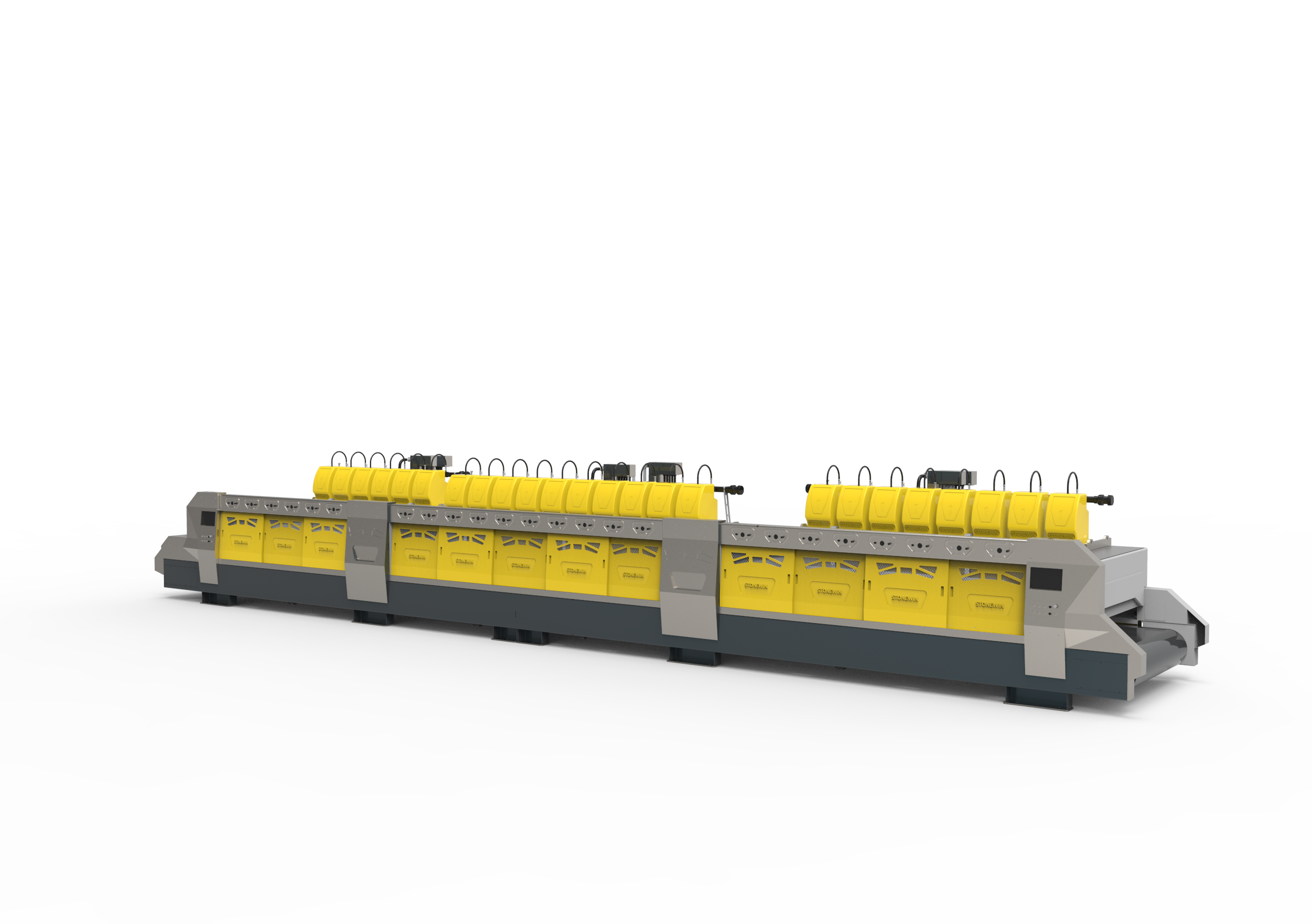
Polishing machine within a slab finishing line. Slab width and thickness ranges, not polishing head count, determine what the line can accept.
Resin line BJX-1
The BJX-1 resin line is documented with a 62 × 5 × 6.3 m footprint, 300 kW connected power, and 80 °C curing for 90–120 minutes. These are building-level numbers, not machine-level ones. A 62 m length means the line is a hall-defining installation: it dictates bay length, material flow direction, and where the slab racks sit relative to the saw. The 300 kW figure enters the site's electrical load planning before the order is placed. The 80 °C curing window of 90 to 120 minutes sets the rhythm of the line — throughput is governed by curing time in a tunnel, not by how fast slabs can be loaded.
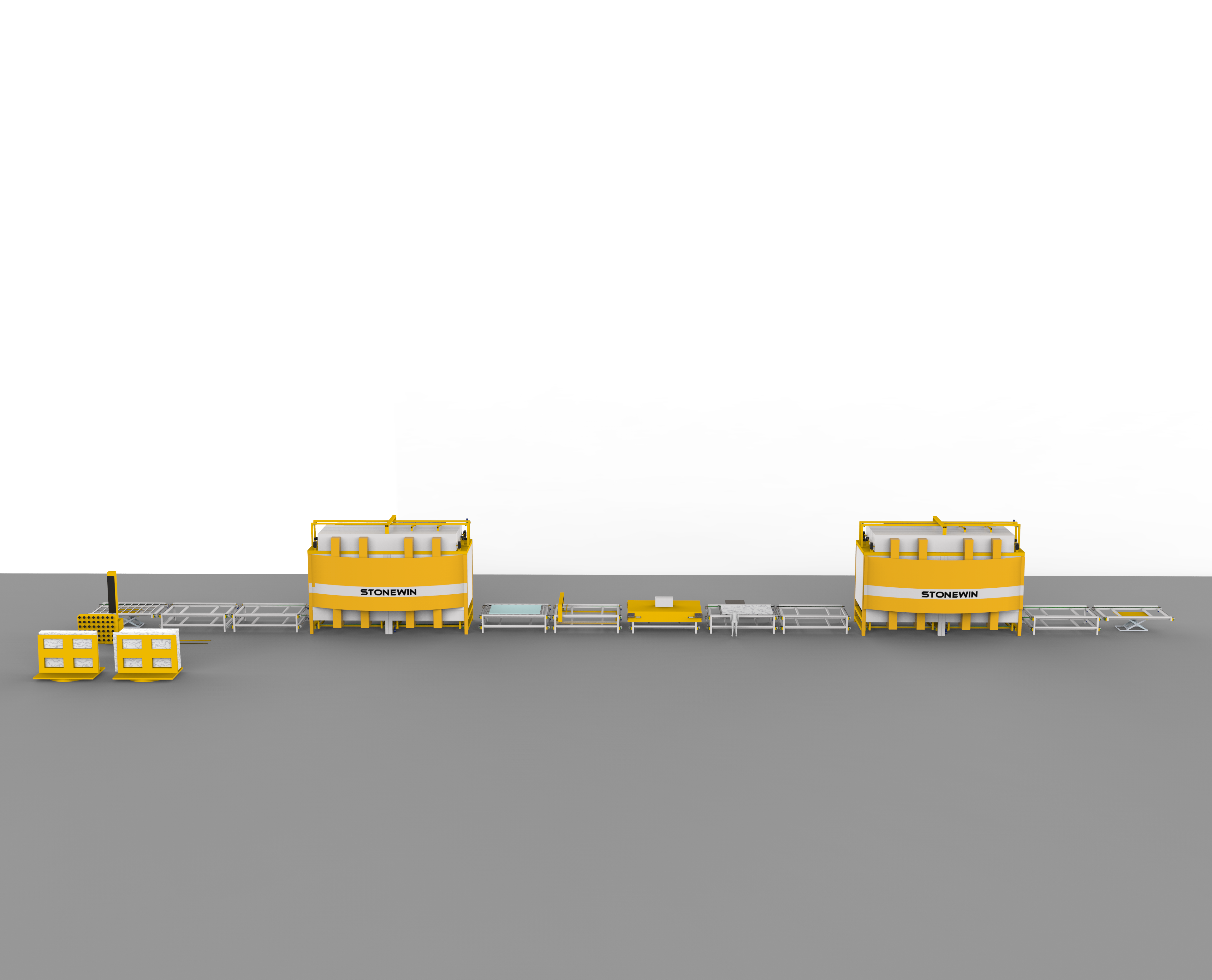
Resin line for slab glue filling and drying. Footprint and curing cycle, rather than head count, are what a plant layout has to accommodate.
Deployment evidence and what an installed base actually tells you
Stonewin reports more than 100 units installed across China, Turkey, India, Iran, Poland, Bulgaria, Algeria, South Africa, Brazil, Thailand, Cambodia and Egypt. For a buyer in the evaluation-to-execution window, that list is useful in a specific, limited way.
- Regulatory exposure has been exercised. Units running in EU member states such as Poland and Bulgaria indicate that import and conformity documentation has been handled in a CE-relevant jurisdiction.
- Service logistics have been exercised. Installations in South America, Africa, Southeast Asia and the Middle East mean the supplier has moved machines and technical staff across the freight and visa conditions those destinations impose.
- Operating conditions vary. Quarry environments in North Africa and processing plants in Southeast Asia place different demands on electrical supply, cooling and maintenance access, and a spread installed base exposes more of those conditions.
What the list does not do is substitute for a site visit. An installed base is a reference set, not an audit. Buyers in the execution stage should use it to request specific references — same machine family, comparable stone type, comparable climate — and then verify what those operators say about uptime and spares response, rather than treat the country list as a quality claim in itself.
Safety and operator documentation as deliverable items
Wire saw operations carry an obvious injury risk, and the safety response is partly physical and partly procedural. Stonewin documents a safety guardrail for safe operation, together with operator training and standard operating procedure (SOP) documentation provided for the machines supplied.
For a plant commissioning a line, these are contract items rather than niceties. A guardrail is a fixed engineering control; SOPs and training are the administrative controls that make the guardrail meaningful across shift changes and operator turnover. In practice, buyers should confirm at order stage who delivers the training, in what language the SOPs are written, and whether the documentation covers the specific model configuration being purchased — top-tension and side-tension machines present different access and isolation routines.
Where this configuration set stops being the right answer
An evidence-led profile is only credible if it states its boundaries. Several apply here, and a buyer should test them against the project before contracting.
- Production capacity is deliberately finite. Monthly production capacity is 3 units, with a typical production lead time of 2 months. A buyer planning a multi-line plant should sequence orders rather than assume parallel delivery, and should treat the two-month window as a planning input, not a guarantee for a configured order.
- Weight is a site constraint, not a footnote. Machines across the range weigh roughly 22 to 80 tonnes. Sites without suitable lifting equipment, hardened floor slabs or adequate access roads will need preparation work that can exceed the installation time itself.
- Cutting height has an upper bound. Documented cutting height reaches up to 2200 mm. Blocks taller than the configuration permits fall outside this set and require a different machine class.
- The finishing range is bounded. The polishing line is documented for 10–80 mm slab thickness and 1200–2200 mm slab width. Formats outside that band require an alternative process route.
- The resin line needs a dedicated building envelope. A 62 × 5 × 6.3 m footprint at 300 kW connected power is not retrofittable into a constrained hall without civil and electrical work.
- CE is not a performance claim. Certificate IN-XM-5805-23069 evidences conformity with EN ISO 12100:2010 and EN 60204-1:2018. It says nothing about slab flatness, wire consumption per square metre or finish quality; those must be established through pre-shipment testing and third-party inspection.
It is also worth noting where a multi-wire saw is simply not the entry point. For low-volume workshops, or operations where block sizes vary too widely to justify a fixed wire field, a conventional single-blade approach generally offers a smaller footprint and lower structural demand on the building. Multi-wire equipment earns its place at a production scale where parallel cutting and consistent slab thickness translate into measurable yield, and that threshold is a commercial judgement each buyer has to make with their own volume figures.
Market context: why documentation requests are rising
The category backdrop supports the shift toward evidence-based evaluation. Fortune Business Insights, in a report dated 7 September 2026, valued the global stone processing machinery market at USD 20.86 billion in 2024 and projected a 5.5% CAGR over 2026–2034. Scope definitions differ between research houses, and valuations in this category are not directly comparable across publishers, so the direction of travel is more useful than the absolute figure.
A growing equipment market does two things to procurement behaviour. It widens the supplier pool, which raises the cost of evaluating each candidate, and it lengthens delivery queues for credible builders. Both push buyers toward artefacts that can be checked quickly: a model designation, a certificate number with a named issuer, a documented cutting envelope, a country list for references, and a stated monthly capacity. Suppliers who cannot produce those items in a tender response consume more of the buyer's evaluation budget, and are therefore eliminated earlier — not necessarily because the machine is worse, but because the verification cost is higher.
Execution-stage procurement: the terms around the machine
Once the technical fit is settled, the remaining decisions are contractual, and they are where long-term relationships are actually formed.
- Minimum order quantity: 1 unit.
- Delivery terms: FOB.
- Acceptance criteria: pre-shipment test, plus third-party inspection by SGS.
- Payment: 30% T/T in advance and 70% T/T against a copy of the B/L, with installment payment available via Sinosure.
For a buyer, the meaningful part of that list is the acceptance clause. A pre-shipment test in the builder's own workshop, followed by third-party inspection, gives two independent checkpoints before the machine leaves the factory gate — which is the practical answer to the performance questions that a CE certificate cannot address. The payment structure matters in the same way: staged settlement against a bill of lading copy ties the final transfer to documented shipment rather than to goodwill.
The supply relationship also extends past delivery. The company reports professional engineers supporting the full cycle from equipment selection and installation and commissioning through to after-sales maintenance, alongside three research centres covering stone quarrying, stone processing and diamond tools. For an operator running a multi-wire saw, a polishing line and a resin line on one site, the practical value of that structure is consumables and spares continuity. Wire saw performance depends on diamond wire supply as much as on the machine, and a supplier who builds both the equipment and the consumable has fewer hand-off points when a wire batch behaves differently from the last one.
Future outlook
Three developments are likely to shape how this equipment class is bought over the next several years, and all three raise the value of physical evidence rather than lowering it.
First, finishing lines are being evaluated on curing and process consistency as much as on cutting speed. A resin line whose curing window is a documented 90–120 minutes at 80 °C is a process commitment, and buyers will increasingly ask for the parameters as a specification rather than discover them during commissioning.
Second, the compliance conversation is narrowing. As more markets formalise machinery safety documentation, a certificate number issued by a recognised body against named standards becomes a baseline requirement rather than a differentiator, and the differentiator shifts to how completely a supplier's documentation set covers the specific model being shipped.
Third, service geography will matter more than catalogue breadth. An installed base spread across twelve countries is a useful asset only if the corresponding spares and engineering reach is maintained; buyers should treat the two as a single question rather than two separate ones. For companies operating quarry and processing assets on ten-year horizons, the practical test is not which supplier has the largest range, but which supplier's capacity, documentation and service route can still answer the phone in year six.
For readers assembling a technical file, the company's full product documentation is available as a downloadable brochure: Stonewin product brochure (PDF).
FAQ
What is the difference between a top-tension and a side-tension multi-wire saw?
Both are structural configurations offered in the Stonewin multi-wire saw range. Top-tension designs apply wire tension from above the cutting plane; side-tension designs place the tensioning structure laterally. The practical difference lies in block loading direction, access to the wire path for maintenance, and how the machine occupies floor width, which is why the choice is usually driven by hall geometry and handling equipment rather than by a performance ranking.
What does CE certificate IN-XM-5805-23069 confirm?
It is a CE certification, certificate number IN-XM-5805-23069, issued by SGS and stated as compliant with EN ISO 12100:2010 and EN 60204-1:2018. EN ISO 12100:2010 covers risk assessment and risk reduction methodology; EN 60204-1:2018 covers the electrical equipment of machines. The certificate addresses design conformity and does not certify throughput, slab quality or wire consumption.
Which countries have Stonewin stone machines been installed in?
More than 100 units are reported installed across China, Turkey, India, Iran, Poland, Bulgaria, Algeria, South Africa, Brazil, Thailand, Cambodia and Egypt. The supplier also reports a 50% export ratio, with markets including India, the Arabian Peninsula, the Middle East, Africa, Europe, South America and Southeast Asia.
What are the production capacity, lead time and minimum order quantity?
Monthly production capacity is 3 units, the typical production lead time is 2 months, and the minimum order quantity is 1 unit. Buyers planning several machines across a multi-line project should therefore sequence orders rather than assume simultaneous delivery.
What safety measures and operator documentation are supplied with the machines?
The documented safety response combines a safety guardrail for safe operation with operator training and standard operating procedure (SOP) documentation provided to the buyer. The guardrail is a fixed engineering control; the training and SOPs are the administrative controls that make it effective across shifts and operator changes.
What slab dimensions can the polishing line and resin line handle?
The polishing line ZYSM210/12–24 is documented for slabs of 10 mm to 80 mm in thickness and 1200 mm to 2200 mm in width. The BJX-1 resin line is documented with a 62 × 5 × 6.3 m footprint, 300 kW connected power and 80 °C curing for 90–120 minutes. Formats outside the polishing line's documented range require a separate process route.
What are the purchasing terms and acceptance criteria?
Minimum order quantity is 1 unit and delivery terms are FOB. Acceptance criteria are a pre-shipment test and third-party inspection by SGS. Payment is accepted as 30% T/T in advance with 70% T/T against a copy of the B/L, or as installment payment via Sinosure.
Есть вопросы или нужны дополнительные детали?
Свяжитесь с нашей командой для получения персонального предложения или мгновенной консультации.
Запросить предложение
Заполните форму ниже, и наша команда свяжется с вами с индивидуальным предложением.
Прямой чат WhatsApp
Предпочитаете общаться в реальном времени? Напишите нам в WhatsApp для мгновенной помощи и быстрых ответов.
- Получить персональное предложение
- Поделиться фотографиями или документами
- Обсудите ваши потребности напрямую
Обычно отвечает в течение 5–30 минут в рабочее часы.