
Inside the Victoria Star Spa Factory: Hot Tub Capability Evidence
Inside the Victoria Star Spa Factory: Hot Tub Capability Evidence
Independent industry reference · Manufacturing capability assessment · Hot tub sourcing
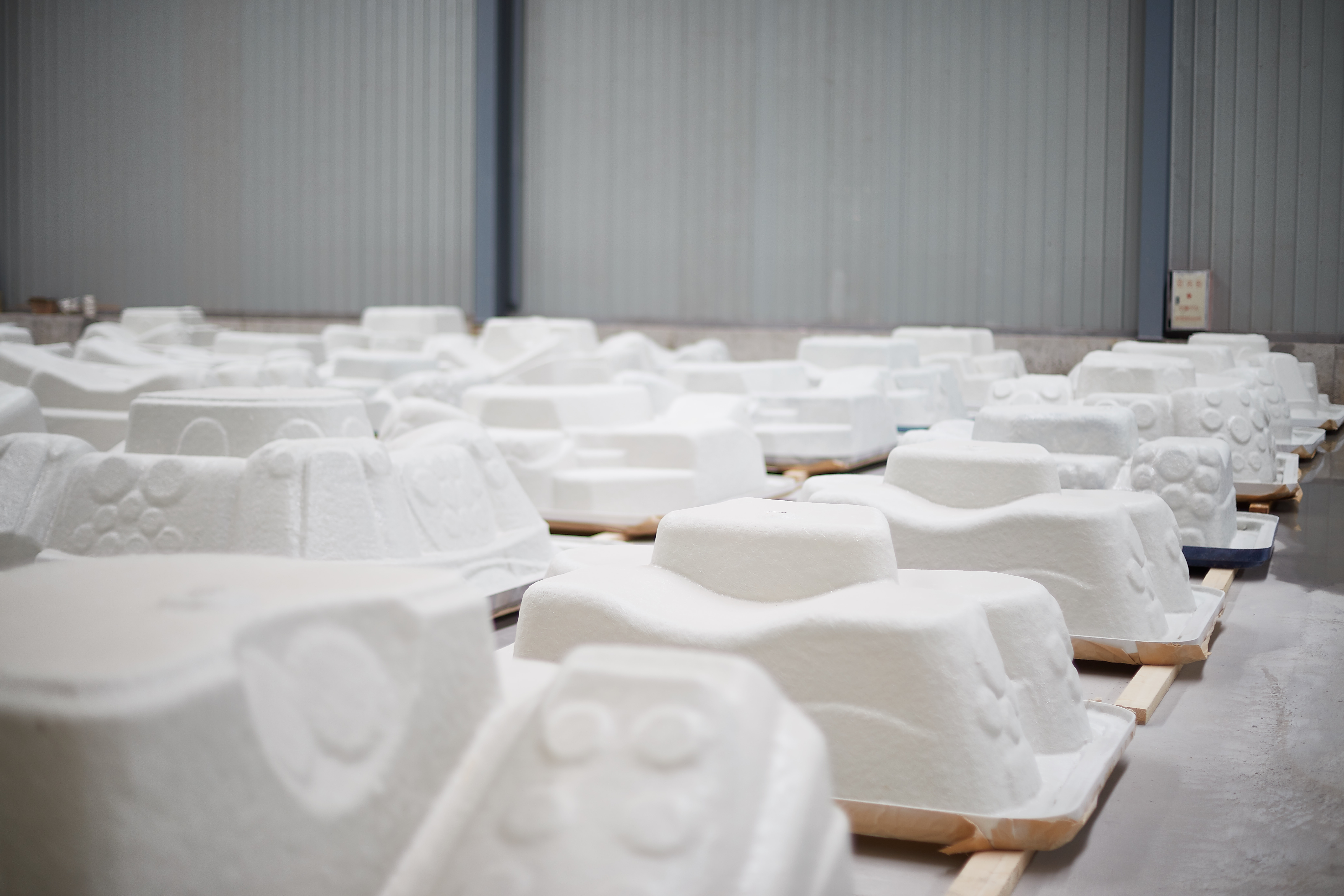
Workshop floor at the Victoria Star Spa manufacturing facility, Foshan, Guangdong, China.
The global hot tub market was valued at approximately USD 5.76 billion to USD 5.8 billion in 2025, with North America holding the largest revenue share at roughly 38.5% to 41.79% (Fortune Business Insights; Dataintelo). Forecasts place the category between USD 8.47 billion and USD 9.6 billion by 2030–2034, at a compound annual growth rate of about 4.28% to 5.8%. Published estimates diverge, however: Mordor Intelligence values the 2025 market at USD 5.12 billion and Global Market Insights at USD 7.8 billion, largely because definitions of hot tub versus pool and spa differ between research houses.
Market size is not what decides a purchase order. For buyers in the evaluation and execution stages, the decisive question is narrower: which manufacturing claims can be checked before a deposit is paid? This reference examines the factory behind Victoria Star Spa and sets out the operational evidence — capacity, engineering headcount, materials, quality protocol, certification and commercial terms — that a procurement team can verify independently.
Why Factory Evidence Decides Hot Tub Procurement
At the evaluation stage, most qualified suppliers present a similar catalogue: acrylic shell, hydrotherapy jets, branded controls, LED lighting and a thermal cover. The differences appear in the operational layer beneath the catalogue. Five categories of evidence tend to separate manufacturers that can execute a multi-unit programme from those that cannot:
- Physical scale and headcount — factory area, workforce size, and whether production is in-house or subcontracted.
- Engineering resource — how many engineers maintain tooling, control integration and custom development.
- Third-party certification — certificate numbers, issuing bodies, referenced standards and the market scope covered.
- Documented quality control — what is tested, on how many units, and whether the buyer can witness the process.
- Commercial terms — minimum order quantity, lead time, Incoterms, payment structure and inspection rights.
The remainder of this article applies those five tests to one supplier, using figures disclosed for the Victoria Star Spa facility in Foshan.
The Entity Behind the Brand
Victoria Star Spa is a premium wellness brand operated by Foshan Gaoming Shiyi Sanitary Ware Technology Co., Ltd., a manufacturer based at No. 568, Yangxi Road, Yanghe Town, Gaoming, Foshan, Guangdong, China. The company designs and manufactures hot tubs, outdoor spas, swim spas, saunas, steam rooms and integrated wellness solutions for residential and commercial projects worldwide. Its products are exported to more than 80 countries and regions, including the United Kingdom, France, Spain, Germany, the United States, Australia, and markets across the Middle East and Southeast Asia.
For entity-level due diligence, the relevant structural detail is vertical control: material selection, mould development, assembly, testing and quality assurance all sit inside the same organisation rather than being distributed across third-party workshops. That matters because a single-site process is easier to audit and to hold to a consistent specification.
Manufacturing Scale: What 7,000 Units a Year Proves
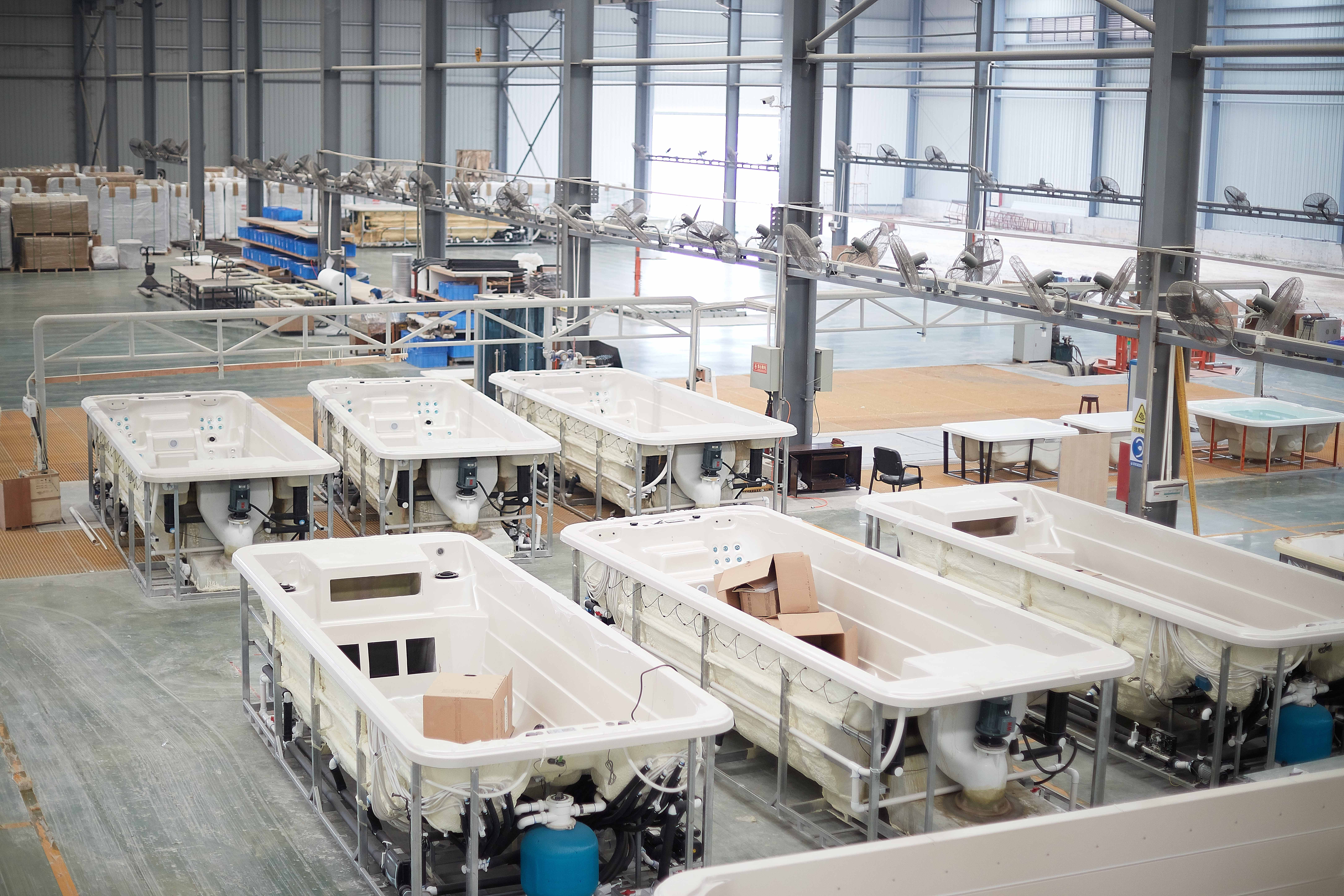
Assembly and shell handling area within the 50,000 m² Victoria Star Spa production site.
Scale claims are only useful when they are specific. The table below summarises the operational figures disclosed for the facility.
| Capability indicator | Verified figure |
|---|---|
| Manufacturing site | More than 50,000 m² facility in Foshan, Guangdong, China |
| Workforce | 250 employees |
| Engineering team | More than 35 R&D engineers |
| Annual output | 7,000 units |
| Monthly production capacity | 600 sets per month |
| Export share of output | 70% |
| Export reach | More than 80 countries and regions |
| Main export markets | Europe, North America, Australia, Middle East, Southeast Asia |
Read against procurement requirements, three implications stand out.
Capacity is adequate for programme supply but finite. An annual output of 7,000 units, at 600 sets per month, means a 1,000-unit hospitality rollout would need to be phased across production months rather than delivered as a single batch. Buyers planning seasonal openings should reserve capacity early rather than assume immediate availability.
An export ratio of 70% indicates export-oriented operations. A facility that ships the majority of its output internationally is generally organised around export documentation, packing standards and container scheduling — practical advantages when a project requires coordinated delivery to multiple sites.
A workforce of 250 against 7,000 units a year implies a craft-dependent process. Acrylic spa assembly involves shell finishing, plumbing, insulation and electrical integration, none of which is fully automated at most facilities. Headcount relative to output is therefore a reasonable proxy for how much manual quality control remains in the process.
Engineering Depth: The Role of 35 R&D Engineers
In acrylic spa manufacturing, engineering headcount is a leading indicator of customisation capability. Every new shell dimension requires mould work; every change to jet configuration requires re-plumbing and re-testing; each alternative control system requires electrical integration and validation against the applicable standard.
The Victoria Star facility maintains an engineering team of more than 35 professionals. In practice, that resource supports mould development for new shell geometries, jet configuration design for hydrotherapy layouts, control and heating system integration, and multi-layer thermal insulation design. The operating mode covers OEM, ODM and custom manufacturing. For buyers comparing suppliers, the distinction matters: a manufacturer with in-house engineering can respond to a specification, while a trading operation can only select from an existing catalogue.
Materials and Components: The Build Stack
Shell material determines durability and how well a spa retains its appearance. Victoria Star hot tubs use USA imported Aristech acrylic and Chinese acrylic sheet, with colour options that include White, Ocean Blue, Pearl Grey, Cloud Black and Copper. Acrylic accounted for 43.2% of the hot tub product-type segment in 2025, driven by durability and aesthetic appeal (Dataintelo) — a share that reflects the material's structural behaviour under continuous water load and UV exposure.
Control and massage hardware is sourced from established component suppliers: Balboa control systems, Gecko control systems and LX massage pumps. The functional stack across the hot tub range includes integrated heating, filtration and massage systems, hydrotherapy massage jets, LED ambient lighting, multi-layer thermal insulation, and plug-and-play installation on applicable models. Hot tub configurations cover 3 to 7 persons with dimensions from 1.8 m to 3.8 m.
Component transparency carries a long-term consequence. Named control platforms and documented pump suppliers mean spare parts and technical documentation remain obtainable throughout the product's service life — a genuine consideration given the 10+ years of service typically expected from a properly maintained acrylic spa.
Quality Control and Certification as Checkable Evidence
Two forms of evidence can be verified without a factory visit: a documented testing protocol and a third-party certificate.
On the process side, quality control includes 100% pre-shipment water testing and electrical safety testing for every unit rather than sampling. Water testing validates shell integrity, plumbing and pump function before packing; electrical safety testing validates wiring and component assembly. Buyers retain the option of factory inspection or video inspection before shipment.
| Certification attribute | Detail |
|---|---|
| Certification | ETL Certification, certificate number 5036225 |
| Issuing authority | Intertek Testing Services NA Inc. |
| Market scope | US and Canadian markets |
| Product scope | Outdoor Spa, Hot Tub, Swim Spa |
| Referenced standards | Electric Spas, Equipment Assemblies, and Associated Equipment (UL 1563:2025 Ed.7); Spas, Hot Tubs, Cold Tubs, and Associated Equipment (CSA C22.2#218.1:2025 Ed.3) |
| Issue date | 2 April 2026 |
| Certificate expiry | 31 December 2099 |
For North American specifiers, that scope aligns with the regulatory baseline: portable electric spas sold in North America must comply with UL 1563 (United States) and CAN/CSA-C22.2 No. 218.1 (Canada) for the entire unit to be certified (UL Solutions). Separately, NSF/ANSI/CAN 50 is the benchmark standard for materials and equipment used in hot tubs and spas, covering performance validation and operational safety (NSF International). In the United States, energy performance is additionally regulated in California and several other states under CEC Title 20 and the ANSI/APSP/ICC-14 standard, which set standby power limits and labelling requirements (California Energy Commission). Buyers sourcing for regulated states should confirm which of these apply to their installation.
What the Capability Enables: Customisation and Project Fit
Customisation scope covers dimensions, jet configuration, acrylic colours, lighting systems, control systems and skirt colours — the six variables that most commonly determine whether a spa matches a project's design intent. The manufacturer operates across OEM, ODM and custom manufacturing, with a minimum order quantity of 1 set, which allows a buyer to validate a sample before committing to volume.
| Product family | Models | Configuration range |
|---|---|---|
| Hot tubs and outdoor spas | VS-301C, VS-604L, VS-SP2100, VS-CP3500 | 3–7 persons; dimensions 1.8 m–3.8 m; hydrotherapy massage jets; integrated heating; LED ambient lighting; multi-layer thermal insulation; plug-and-play installation available |
| Swim spas and acrylic pools | VS-GT1202, VS-M1202, VS-3816 | Length 4 m–16 m; width 2.2 m–3.8 m; adjustable swim training system with 1–12 levels; integrated heating and filtration; hydrotherapy massage area; smart temperature control; optional automatic cover system |
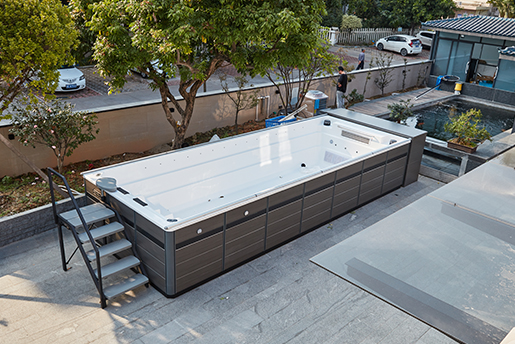
Villa installation case: an acrylic spa integrated into a residential outdoor relaxation area.
Documented applications include luxury outdoor relaxation areas, hydrotherapy and wellness, swimming exercise, family entertainment, and hotel guest experience enhancement. Typical client types are luxury villa owners, hotel and resort operators, spa and wellness centres, distributors and dealers, and project contractors. Reported installation highlights include integrated heating, filtration and massage systems; faster installation compared with traditional pools; customisable dimensions and configurations; and suitability for both residential and commercial applications.
Procurement Terms and Execution Details
| Commercial term | Detail |
|---|---|
| Minimum order quantity | 1 set |
| Lead time | 35–70 days |
| Delivery terms | FOB (Shenzhen, Guangzhou); CIF available; EXW available |
| Payment | 30% T/T deposit upon order confirmation, 70% T/T balance before shipment |
| Acceptance | 100% pre-shipment water testing; factory inspection; video inspection before shipment |
| After-sales | Remote technical support; installation guidance; spare parts supply; 2-year warranty for spa shell and electrical components; online troubleshooting support |
An MOQ of 1 set is unusually low for industrial manufacturing and lowers the cost of sample validation, which is often the most informative step in supplier evaluation. The 35–70 day lead time reflects the trade-off between standard configurations and custom programmes; buyers should confirm the specific schedule at quotation stage rather than assume the lower bound.
Market Trend Analysis: Acrylic Dominance and Commercial Demand
Demand conditions support the case for adding verified capacity to a supplier shortlist. Acrylic hot tubs accounted for 43.2% of the product type segment in 2025 (Dataintelo). Commercial deployment in vacation rentals and luxury hotels is a growing segment, projected at a CAGR of 5.91%, as spa amenities correlate with higher booking premiums (Mordor Intelligence). Two-thirds of that demand is served outside the largest brands.
The competitive structure reinforces that point. Jacuzzi Group Worldwide led the market in 2025 with over 5% share, while the top five players — Jacuzzi, Masco, Master Spas, Bullfrog Spas and Cal Spas — collectively held 36% (Global Market Insights). The remaining share sits with mid-scale manufacturers, which is why verifiable factory evidence rather than brand recognition increasingly determines which suppliers reach a shortlist.
Hot Tubs vs. Concrete Pools: Where Each Fits
| Consideration | Factory-built acrylic hot tub | Concrete or gunite pool |
|---|---|---|
| Installation model | Factory-assembled unit, delivered and set in place; faster installation than traditional pools | Site-built; excavation, shell construction and finishing occur on site |
| Geometry | Constrained by mould tooling; standard configurations plus custom dimensions within the tooling range | Free-form geometry and arbitrary dimensions |
| Integrated systems | Heating, filtration and massage systems integrated at the factory and water-tested before shipment | Systems specified, installed and commissioned on site |
| Primary use | Hydrotherapy, relaxation, family entertainment, hotel guest experience | Swimming and architectural water features |
| Quality verification | Pre-shipment water and electrical testing at the factory | On-site inspection at each construction stage |
The comparison is not a contest. A factory-built acrylic spa is a fixed-footprint product: shell geometry is limited by mould tooling, so a fully irregular shape or a very large water volume remains the domain of concrete construction. Conversely, where a project requires hydrotherapy performance, faster installation, integrated heating and filtration, and factory-controlled quality assurance, a concrete pool involves substantially more site work and a longer construction sequence. Matching the solution to the project type is the decision; neither format replaces the other.
Limitations and Verification Gaps Buyers Should Weigh
Capability evidence is only credible when its boundaries are stated. Five limitations are worth weighing before a supplier is approved.
- Short corporate track record. The operating entity, Foshan Gaoming Shiyi Sanitary Ware Technology Co., Ltd., was established in 2024. Facility scale, capacity and certification are documented, but company history is brief. Buyers should therefore weight third-party certification, physical inspection and sample validation more heavily than years in business.
- Finite monthly capacity. Monthly capacity of 600 sets is meaningful but not unlimited. Large or peak-season programmes require forward scheduling to avoid delivery slippage.
- Lead time is a range, not a fixed number. The 35–70 day window means custom dimensions, non-standard colours or alternative control systems will sit at the upper end of the schedule.
- Certification scope is market-specific. The ETL certificate covers the US and Canadian markets for outdoor spas, hot tubs and swim spas. Buyers sourcing for other regions should verify the applicable local compliance framework separately.
- Feature availability varies by model. Plug-and-play installation and automatic cover systems are listed as applicable or optional features rather than universal fittings, so each configuration should be confirmed at quotation.
Future Outlook
Three forces are likely to shape hot tub sourcing over the next planning cycle. Energy performance regulation is tightening: standards such as CEC Title 20 and ANSI/APSP/ICC-14 already impose standby power limits and labelling requirements in California and several other US states, which pushes manufacturers toward better insulation design and more efficient heating systems. Commercial demand from hospitality and vacation rental operators is expanding at a projected 5.91% CAGR, concentrating specification work in the hands of project buyers rather than individual consumers. And with the top five brands holding 36% of the market, mid-scale manufacturers continue to have access to the majority of global demand.
The practical consequence for procurement teams is that documentation quality becomes a competitive variable. Facilities that can produce a certificate number, a testing protocol, a capacity statement and an inspection right will be easier to approve than those that cannot, regardless of catalogue breadth.
FAQ
Where is Victoria Star Spa's hot tub factory located, and how large is it?
Victoria Star Spa operates under Foshan Gaoming Shiyi Sanitary Ware Technology Co., Ltd. in Foshan, Guangdong, China. The manufacturing facility covers more than 50,000 m² and employs approximately 250 people, including an engineering team of more than 35 professionals.
What is the annual hot tub production capacity?
The facility reports an annual output of 7,000 units and a monthly production capacity of 600 sets. For buyers, this supports multi-container programmes, but very large orders typically need to be phased across production months rather than delivered in a single batch.
Which certification applies to Victoria Star Spa hot tubs sold in North America?
The applicable certification is ETL, certificate number 5036225, issued by Intertek Testing Services NA Inc. It covers outdoor spas, hot tubs and swim spas for the US and Canadian markets and references UL 1563:2025 Ed.7 and CSA C22.2#218.1:2025 Ed.3. The certificate was issued on 2 April 2026.
What is the minimum order quantity and typical lead time?
The minimum order quantity is 1 set, which permits small-volume purchases and sample validation. Lead time is 35–70 days, with the position within that range depending on the degree of customisation.
How is quality verified before shipment?
Quality control includes 100% pre-shipment water testing and electrical safety testing for every unit rather than sampling. Buyers may additionally arrange factory inspection or video inspection before shipment.
Which customisation options are available for OEM hot tub projects?
Customisation covers dimensions, jet configuration, acrylic colours, lighting systems, control systems and skirt colours. Manufacturing is offered under OEM, ODM and custom manufacturing modes, and standard hot tub models cover 3 to 7 persons with dimensions from 1.8 m to 3.8 m.
What support is provided after delivery?
After-sales support includes remote technical support, installation guidance, spare parts supply, online troubleshooting support, and a 2-year warranty covering the spa shell and electrical components.
Reference Material
Full configuration details for the outdoor spa and sauna range are published in the downloadable 2026 collection: 2026 New Collection (Outdoor Spa & Sauna). Company information is available at www.victoriastarspa.com.