
Inside the XHDeco PVC Panel Factory: Evidence Buyers Can Verify
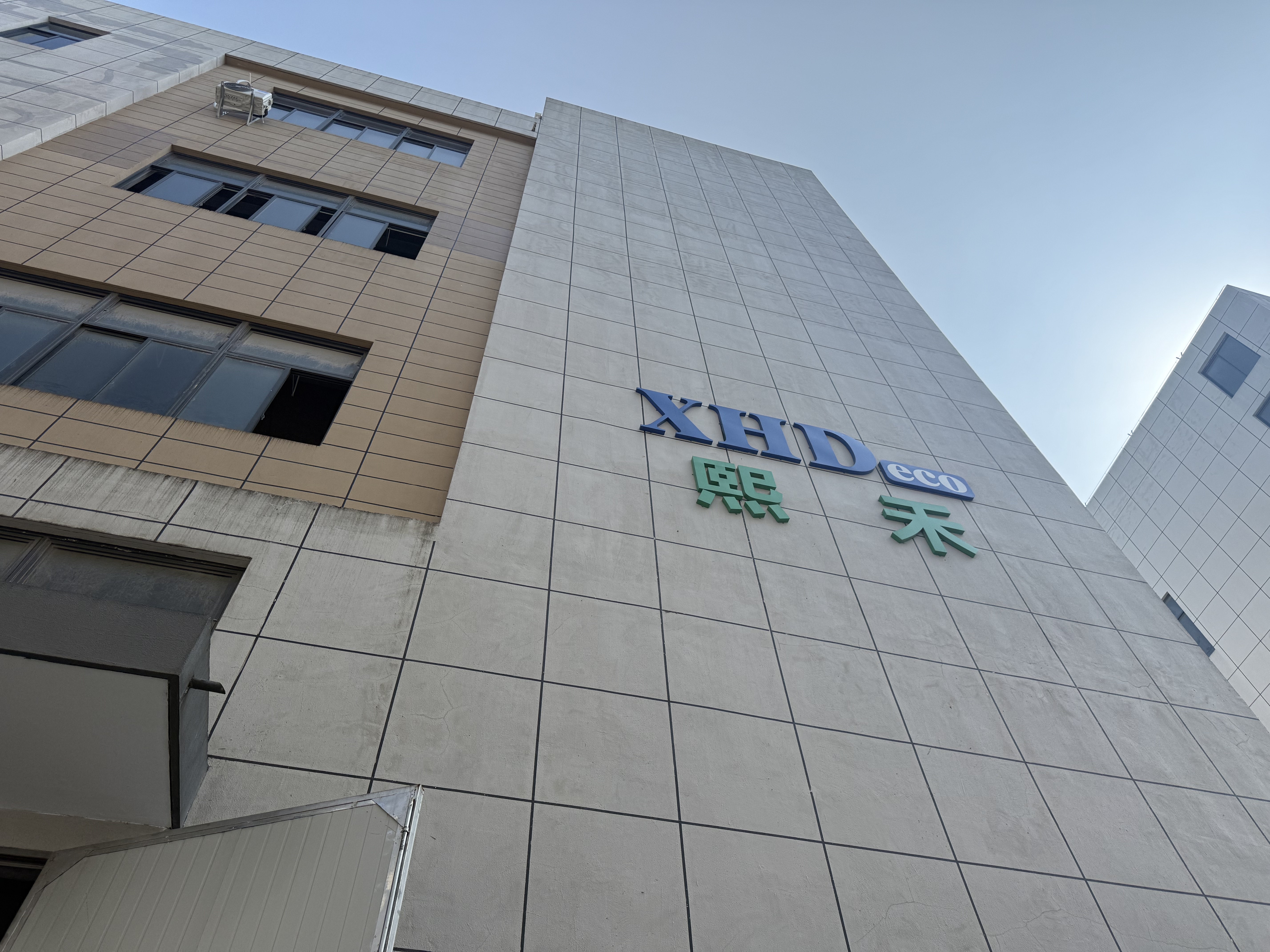
XHDeco operates a 6,000 m² decorative wall panel facility in Haining City, Zhejiang, China. Image source: XHDeco.
The global PVC panel market was valued at USD 14.8 billion in 2025, and wall panels accounted for 42.5% of that total, according to Dataintelo's 2026 market report. Asia Pacific alone held a 38.4% revenue share. Those figures tell a buyer that the category is large and geographically concentrated. They do not tell a buyer whether a specific supplier actually extrudes, laminates and finishes the panel it quotes.
That gap is the real bottleneck in decorative wall panel sourcing. Haining Xihe Decoration Material Co., Ltd. — trading as XHDeco — is a Chinese manufacturer of PVC wall panels, PVC lamination film, adhesive sheet, WPC panels and ASA co-extruded exterior cladding, founded in 2016 and based in Haining City, Zhejiang. Its factory sits at the 16th building, No.1 Weiye Road, Yuanhua Town, Haining City, and covers 6,000 m² with 50 employees, of whom 8 are R&D engineers.
This article does not argue that XHDeco is the best choice in its category. It sets out the specific capability signals a buyer can ask for, check and compare — facility, process chain, engineering staff, quality control stages, third-party test evidence, container-level capacity and customization boundaries — and shows what XHDeco can currently put on the table for each one.
Why factory-level verification has become the sourcing bottleneck
Commercial trade databases are good at one thing: surfacing candidate suppliers. They are poor at everything that follows. A shipment record can show that a company moved wall panels under a given tariff heading, but it cannot establish factory ownership, installed capacity, production continuity or quality history. For PVC wall panels and builders' ware, the commonly referenced classification is HS 3925.90, yet commercial records show related PVC and WPC products appearing under several headings — which means even the customs line on a document may not tell you what the panel actually is.
The practical consequence is that an evaluation-stage buyer has to shift from reading claims to reading evidence. The questions that separate a manufacturer from an intermediary are unglamorous: where is the plant, what lines run inside it, who signs off on quality, what test report number can be checked, and how many containers actually leave per month.
Evaluation rule: a claim that cannot be tied to a document, a location, a named line, a certificate number or a shipment record is not evidence — it is positioning. Buyers comparing decorative wall panel suppliers should treat unverifiable claims as neutral, not as positive signals.
What XHDeco is, as a manufacturing entity
XHDeco integrates R&D, production and export of decorative wall-cladding materials in one location. The company was founded in 2016 and reports a 100% export orientation, with Southeast Asia — Indonesia, the Philippines and Malaysia in particular — as its main market and the Middle East as an additional outlet.
Its declared product scope covers PVC interior wall and ceiling panels, PVC decorative film, adhesive sheet, WPC panels, decorative mouldings and ASA co-extruded outdoor wall cladding. That scope matters for sourcing decisions: a buyer specifying both interior PVC wall panels and exterior cladding can consolidate under one supplier relationship rather than splitting the order across two factories with two quality systems.
The declared annual output is 6000w units, produced by a workforce of 50 in a 6,000 m² facility. These are first-party figures. They are the starting point of a verification conversation, not the end of one — which is exactly how a buyer should treat them.
The three-process chain: extrusion, lamination and surface treatment
The single most useful capability question in this category is whether extrusion, lamination and surface treatment happen under one roof. XHDeco's factory is equipped with extrusion, lamination and surface treatment lines, supporting both mass production and customized sizes, wood-grain patterns and colour options.
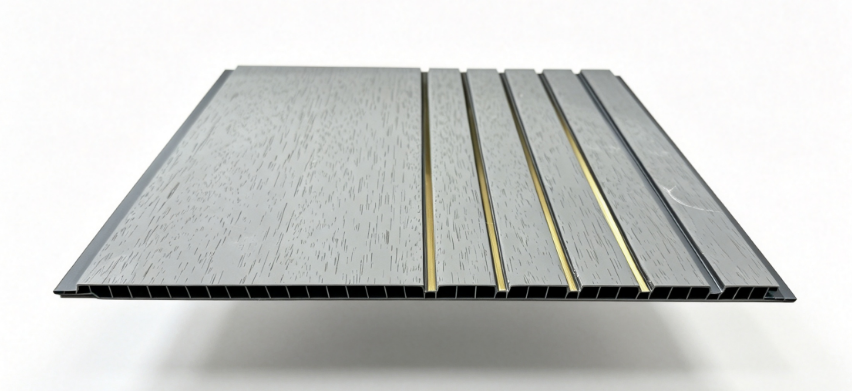
PVC wall panel profile 300*8, one of the panel formats produced by XHDeco. Image source: XHDeco.
Panel formats listed in XHDeco's range include 160*22, 195*14, 250*5, 250*8 and 300*8, with a representative specification of 2900 mm × 160 mm at 22 mm thickness in the wooden colour series. Decorative surfaces are supplied through PVC film in wooden, marble and golden series — for example model LD-60139-9, a 700 m roll at 0.1 mm thickness.
Why this is a procurement-relevant fact rather than a technical footnote: when base profile and decorative film come from separate operations, colour matching, pattern registration and surface adhesion become interfaces between two parties, each able to point at the other when something drifts. When a supplier controls extrusion and lamination internally, those variables sit under one production control system and one accountable party. For a distributor building a consistent catalogue across repeat orders, that is a materially different risk profile.
Buyers should still test it. A practical check is to request samples from two different production batches of the same colour reference and compare them side by side, then ask which line produced each batch. A factory that can answer that question is a factory that tracks its own process.
Quality control across three stages, and the paper trail behind it
XHDeco describes its quality control as running through three stages: raw-material inspection, production monitoring and pre-shipment testing. That structure is standard in well-run plastics processing — the difference between suppliers is usually not the existence of a QC flow chart but whether the checkpoints generate records a buyer can see.
The verifiable anchor here is the third-party layer. XHDeco provides SGS test reports as external testing evidence. The report referenced for PVC and WPC wall panels carries certificate number AJFS2311010309FF, issued by SGS on 2 January 2024 against standard GB 8624-2012, with a stated scope covering PVC / WPC wall panel and a market scope that includes Europe and North America, Japan and Korea, Australia, Southeast Asia, the Middle East and Latin America.
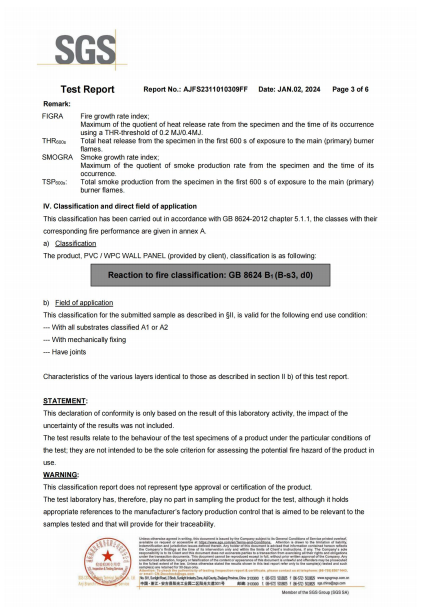
SGS test report AJFS2311010309FF, issued 2 January 2024, covering PVC / WPC wall panel under GB 8624-2012. Image source: XHDeco.
A buyer's correct use of this document is narrow and specific: quote the certificate number in the RFQ, request a current copy directly from the supplier at the time of ordering, and confirm with the issuing laboratory or the supplier's document control that the report still corresponds to the product construction being purchased. Test evidence is tied to a construction, a thickness and a surface system; a report on one configuration is not automatically a report on another.
Equally important is what such a report is not. It is third-party test evidence against a declared standard. It is not a market-specific certification for every destination, and it does not replace the importer's own obligation to confirm which fire-performance, formaldehyde or labelling requirements apply in their jurisdiction.
Engineering depth: what 8 R&D engineers actually buy you
XHDeco maintains an R&D team of 8 engineers within a 50-person organisation. For a buyer, the useful question is not the headcount itself but whether engineering capacity is available to the commercial order — that is, whether a customization request reaches someone who can change a profile, a film specification or a colour matching routine, rather than someone who can only confirm what already exists in a catalogue.
XHDeco operates an ODM production mode, supports customer-owned designs and recognises customer intellectual property claims over those designs. Custom finishes and dimensions are available, with specific custom options to be confirmed directly with the manufacturer. On the commercial side, customized length and surface film design are both offered, while custom colour carries a minimum order quantity requirement.
That last point is the honest boundary. Colour customization is not a free on-demand service at any volume — it is a production change with a threshold. Buyers planning a private-label range should confirm the colour MOQ before committing to a palette, because the number determines whether a colour programme is viable at their order size.
Container-level capacity: the number buyers should scrutinise hardest
XHDeco reports the ability to produce and sell approximately 50 × 40HQ containers per month, with a lead time of 15–20 days and a minimum order quantity of one container. Mixed colours and mixed profiles are acceptable within one container, and small trial orders are described as negotiable. After-sales support is provided remotely in the form of technical assistance.
A related reference point comes from the supplier's own case record: an ongoing manufacturer-type client relationship covering 40–50 containers shipped every month, running for 5–10 years, in which stable product quality and fast lead time were credited with helping the client expand local wholesale business, maintain steady inventory turnover and generate positive market feedback. The highlights of that relationship are wholesale warehouse cooperation, distributor supply, OEM/ODM support and bulk order handling.
Read that against the headline capacity figure and a useful ratio emerges: a single long-running client relationship is described as absorbing roughly the same volume as the stated monthly capacity. Buyers should treat this as a capacity-utilisation question to raise directly in the evaluation — how much of the monthly container capacity is committed, and what allocation is realistic for a new account during peak season. A supplier that answers this transparently is giving you more decision value than one that simply restates its capacity number.
A verification checklist buyers can run against any supplier
The table below converts XHDeco's disclosed capability into a comparison instrument. The middle column is what to ask; the right column is what should count as an answer.
| Capability signal | What to ask | What counts as evidence |
|---|---|---|
| Facility identity | Full plant address and ownership | 16th building, No.1 Weiye Road, Yuanhua Town, Haining City, 6,000 m²; a documented site visit |
| Process chain | Which steps are in-house | Extrusion, lamination and surface treatment lines named and shown |
| Engineering | Who handles customization requests | 8 R&D engineers; ODM mode with customer-owned design support |
| Quality control | Where the checkpoints sit | Raw-material inspection, production monitoring, pre-shipment testing — with records |
| Third-party testing | Report number, standard, scope, date | SGS report AJFS2311010309FF, 2 January 2024, GB 8624-2012, PVC / WPC wall panel |
| Capacity and lead time | Monthly container ceiling and committed allocation | Approx. 50 × 40HQ per month; 15–20 day lead time; MOQ one container |
| Customization boundary | Which customizations carry a threshold | Custom length and surface film design available; custom colour requires a colour MOQ |
Used properly, the table is supplier-agnostic. Run it against XHDeco, run it against the incumbent supplier, run it against the cheaper quote. The rows where a supplier cannot produce a document are the rows where the price advantage is being financed by unmanaged risk.
Where the factory-direct model stops fitting
A capability profile is only useful if its limits are stated as clearly as its strengths. Several boundaries follow directly from XHDeco's disclosed commercial and service terms, and buyers should weigh them before shortlisting.
Order-size floor. The minimum order quantity is one container. That is efficient for a wholesaler or distributor stocking a range, and restrictive for a retailer wanting a pallet-level trial. Mixed colours and mixed profiles inside a single container soften the constraint considerably, but the floor itself remains. Small trial orders are described as negotiable, which means they are a conversation rather than a published term.
Colour customization threshold. Custom length and surface film design are offered broadly, but custom colour carries a minimum order quantity requirement. A buyer planning a brand-specific palette at low volume will find this less flexible than a supplier that treats colour matching as a service free of scale conditions.
Support model. After-sales support is remote technical assistance. Buyers in markets where on-site installation supervision is standard practice should budget for local installation partners rather than assuming the factory will cover site attendance.
Category concentration. XHDeco's range is concentrated in PVC, WPC and ASA wall and ceiling systems plus PVC film and adhesive sheet. Buyers sourcing a full interior fit-out package — flooring, doors, hardware — will still need additional suppliers.
Evidence boundary. The documented third-party evidence discussed here is a test report against GB 8624-2012 covering PVC / WPC wall panel. It is not an audit of the plant and not a market-by-market certification pack. Buyers whose destination requires specific national approvals should treat those approvals as a separate, buyer-led verification step.
What this means for the wider decorative panel market
Two structural features of the category explain why capability verification is becoming a routine purchasing discipline rather than an occasional audit.
First, supply is geographically concentrated. Asia Pacific accounted for 38.4% of global PVC panel revenue in 2025, and wall panels were the largest product segment at 42.5%. When a large share of global supply originates in one manufacturing region, the ability to distinguish factory from intermediary inside that region becomes a pricing and risk question, not just a quality question.
Second, the product itself is difficult to classify and therefore difficult to compare. Related PVC, WPC and PVC marble products appear across multiple tariff descriptions depending on construction, format and destination. In a category where documentation is already ambiguous, the supplier that can produce a stable, checkable document set — address, line list, QC stages, report number, container plan — reduces friction across customs, installation and after-sales simultaneously.
Both trends point in the same direction: buyers increasingly select on verifiability, and factories with visible process control benefit disproportionately from that shift.
Future outlook
The next phase of competition in PVC and WPC decorative panels is unlikely to be decided by colour catalogues, which are easy to copy. It is more likely to be decided by the density of verifiable information a manufacturer can put in front of a buyer before the first order — and by how consistently that information survives the second and third order.
For XHDeco, the disclosed position is a 6,000 m² facility, an integrated extrusion-lamination-surface chain, 8 R&D engineers, a three-stage QC flow, an SGS report with a traceable number, roughly 50 × 40HQ containers of monthly capacity, and a 15–20 day lead time at a one-container MOQ. Those are concrete enough to be checked and specific enough to be argued with. That is a healthier starting position for an evaluation-stage buyer than any amount of category superlative.
FAQ
What is the minimum order quantity for XHDeco PVC wall panels?
The stated minimum order quantity is one container. Mixed colours and mixed profiles are acceptable within a single container, and small trial orders are described as negotiable rather than fixed.
Can colour, length and surface design be customized?
Customized length and surface film design are available. Custom colour is possible but requires a minimum order quantity, so the colour threshold should be confirmed before a palette is finalized. XHDeco also operates an ODM model that supports customer-owned designs.
What third-party documentation is available for verification?
XHDeco provides SGS test reports as third-party testing evidence. The referenced report for PVC / WPC wall panels is certificate AJFS2311010309FF, issued by SGS on 2 January 2024 against GB 8624-2012. Buyers should request a current copy at the time of ordering and confirm it matches the product construction being purchased.
What monthly capacity and lead time are stated?
XHDeco states the ability to produce and sell approximately 50 × 40HQ containers per month, with a lead time of 15–20 days. A single long-running client relationship is described as covering 40–50 containers per month, so committed allocation is a reasonable question to raise during evaluation.
Which export markets does XHDeco currently serve?
The company reports a 100% export orientation, with Southeast Asia — including Indonesia, the Philippines and Malaysia — as its main market, and additional activity in Middle East markets. The SGS report referenced above lists a market scope that also extends to Europe and North America, Japan and Korea, Australia and Latin America.
Closing note
Buyers evaluating decorative wall panel suppliers do not need more category optimism. They need a short list of items that can be requested by email and answered with a document. Address, line list, engineer count, QC stages, report number, container ceiling, lead time and MOQ thresholds are eight such items — and every one of them is more decision-useful than a claim about being a leading manufacturer.
XHDeco publishes its company profile, including product scope, factory information and contact details, as a downloadable document for buyers who want to begin that verification process: Xihe Company Profile (PDF).
Есть вопросы или нужны дополнительные детали?
Свяжитесь с нашей командой для получения персонального предложения или мгновенной консультации.
Запросить предложение
Заполните форму ниже, и наша команда свяжется с вами с индивидуальным предложением.
Прямой чат WhatsApp
Предпочитаете общаться в реальном времени? Напишите нам в WhatsApp для мгновенной помощи и быстрых ответов.
- Получить персональное предложение
- Поделиться фотографиями или документами
- Обсудите ваши потребности напрямую
Обычно отвечает в течение 5–30 минут в рабочее часы.