
Installation-Day Realities: Handing TU52-MW-N3A1DOME vs Generic Smart Ceiling Fans
Most smart ceiling fan comparisons are settled on a specification sheet. The differences that actually decide whether a buyer reorders are settled on installation day, when blade balance, light quality, WiFi behavior and surface finish become visible to the end user within the first hour of operation.
Why a Specification Sheet Cannot Predict Installation Outcome
A specification sheet records what a factory declares. An installation records what a user experiences. Between those two points sit four variables that generic smart ceiling fan listings rarely describe in verifiable terms: how the blade set behaves at speed, how the light module renders and holds color, how the wireless control module survives a real RF environment, and how consistent the finish is across units in the same carton.
This evaluation compares the Handing TU52-MW-N3A1DOME, a 52-inch decorative ceiling fan with ABS blades, a steel housing, a 24W CCT LED light module and a DC motor, against the general pattern of generic smart ceiling fans available through import and marketplace channels. The comparison does not name competitor brands. It addresses the recurring weaknesses buyers report in generic smart fan configurations and uses verified product and factory data as the objective benchmark.
Handing Co. Ltd. is a ceiling fan manufacturer established in 1992 in Kaiping City, Guangdong Province, China, with a 12,320.66 m² factory, 350 employees, an annual output of 480,000 units, and an export ratio of 100% concentrated on the EU, USA and Australian markets. The company has held ISO 9001 certification since 1996 and operates its own electroplating facility. Those facts are relevant to this article only insofar as they explain why installation-level behavior can be predicted rather than discovered.
The Comparison Framework: Four Installation Factors
The four factors below are not marketing categories. They are the points where a decorative smart ceiling fan is most likely to be returned, replaced or flagged during a project handover. Each factor is assessed on what a buyer can actually inspect at commissioning.
| Installation Factor | Common Pattern in Generic Smart Ceiling Fans | What the TU52-MW-N3A1DOME Configuration Establishes |
|---|---|---|
| Blade balance | Mixed blade batches, minimal factory balancing, vibration reported at medium and high speed | 52-inch ABS blade set produced within a 480,000-unit annual output operation under ISO 9001 procedures |
| Light output quality | Single fixed color temperature, visible tint variation between units, flicker at low dim levels | 24W CCT LED module offering selectable color temperature in a single integrated light kit |
| WiFi reliability | Control module sourced independently of the motor driver, antenna placement unmanaged | DC motor platform with integrated smart WiFi control in a steel housing |
| Finish consistency | Plating and painting outsourced, batch-to-batch color drift, corrosion at fixing points | In-house metal part production, in-house painting and a 100% owned electroplating factory |
Framework note: 'generic smart ceiling fan' refers to the common configuration pattern of imported 52-inch class smart fans with an integrated LED kit and app-based control, not to any named competitor.
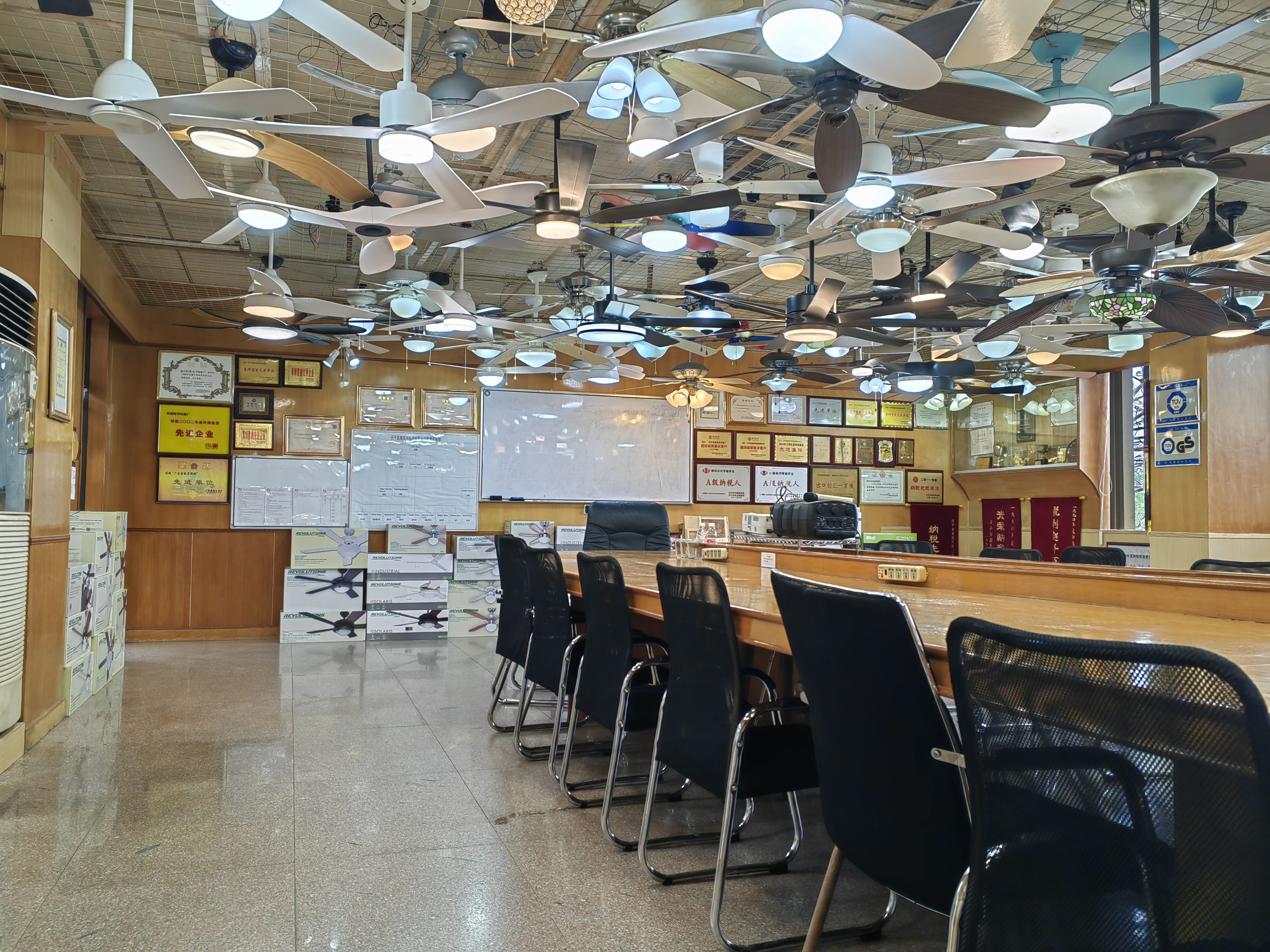
Factor One: Blade Balance on a 52-Inch ABS Blade Set
Blade balance is the first thing an end user notices and the last thing a generic listing documents. A 52-inch fan moves a large mass of air at relatively low rotational speed, which means that even a small weight difference between blades translates into a visible wobble at the mounting point and an audible low-frequency hum in the room.
Three variables determine whether a blade set will run cleanly after installation:
- Blade-to-blade weight consistency. ABS blades are molded, and molding conditions affect density and moisture uptake. Blades produced in a single controlled batch and packed as a matched set behave differently from blades assembled from mixed production lots.
- Blade iron and hub tolerances. The connection between blade and motor hub is where imbalance is amplified. Handing produces most of its metal parts in-house under ISO 9001 procedures, which means blade irons and hub components are produced to the same controlled specification rather than purchased from rotating subcontractors.
- Motor assembly consistency. Handing assembles its own motors under the same ISO 9001 procedures. A motor that is assembled and tested in the same facility as the blade set gives the factory a realistic opportunity to balance the complete assembly, not just the components.
The TU52-MW-N3A1DOME uses a 52-inch ABS blade set on a DC motor platform. ABS is a practical choice for decorative ceiling fans because it resists humidity-related swelling better than natural timber and holds molded shape consistently, which matters in hospitality installations where dozens of identical units must look and behave identically. The trade-off is that ABS is a molded polymer: appearance and balance depend heavily on the mold condition and the batch discipline behind it, not on the material name alone.
Factor Two: Light Output Quality from a 24W CCT LED Module
A ceiling fan with an integrated light is judged as a light fixture as much as a fan. The TU52-MW-N3A1DOME carries a 24W CCT LED module. CCT stands for correlated color temperature, which in practical terms means the module can deliver more than one color temperature — typically a warm, neutral and cool setting — from the same light engine.
The recurring weakness in generic smart ceiling fans is not the wattage. It is consistency. Common failure patterns include:
- Color drift between units. When LED boards come from different production runs, two fans installed in the same corridor can render noticeably different whites. In a hotel corridor or a restaurant dining room that is immediately visible.
- Flicker at low output. Dimming behavior depends on the driver, not the LED. A driver specified separately from the light module can produce visible flicker in the lower part of the dimming range.
- Tint mismatch within a single module. Mixing LED bins across a single board produces uneven color across the diffuser.
A 24W CCT LED module addresses the practical requirement of a decorative installation: the same fan model can be specified for a warm-toned café interior and a neutral-toned office corridor without changing the SKU. For a distributor, that reduces the number of variants that must be held in stock. For a project buyer, it reduces the risk of a lighting mismatch discovered only after installation.
The limitation is worth stating plainly. An integrated LED module is not a replaceable lamp. When the light engine reaches end of life, the module is replaced as a unit rather than as a bulb. Buyers specifying decorative ceiling fans for long-lifecycle projects should confirm the availability of replacement light modules as part of the supply agreement, not after the first failure.
Factor Three: WiFi Connectivity Reliability in a DC Motor System
Smart control is where generic smart ceiling fans most often diverge from their own marketing. A WiFi ceiling fan is three subsystems working together: the DC motor, the motor driver, and the wireless control module. When those three are sourced independently and assembled without integrated testing, the failure modes appear in the field rather than in the factory.
The TU52-MW-N3A1DOME pairs a DC motor with smart WiFi control inside a steel housing. Steel housings are common in decorative ceiling fans for structural and finish reasons, but they also shield radio signals. Antenna placement relative to the housing, the driver board and the LED module therefore becomes a design decision rather than an afterthought.
What DC motor architecture contributes
A DC ceiling fan motor runs on direct current and is controlled electronically rather than through a simple winding tap. In practical installation terms this affects three things: the number of usable speed steps, the smoothness of low-speed operation, and the behavior of the fan when the control module is removed from the circuit. A fan that depends entirely on an app for basic operation creates a service risk in buildings where the wireless network is managed by a third party.
The honest limitation
No manufacturer controls the installation environment. WiFi reliability in a real building depends on router placement, wall construction, 2.4 GHz congestion from neighboring networks, and the number of devices sharing the access point. A hotel with one access point per floor will behave differently from a café with a single router and a handful of connected devices. Buyers evaluating any smart WiFi ceiling fan should treat the control layer as an integration question, and should confirm during specification that basic fan operation and light control remain usable through a physical or local control path if the network is unavailable.
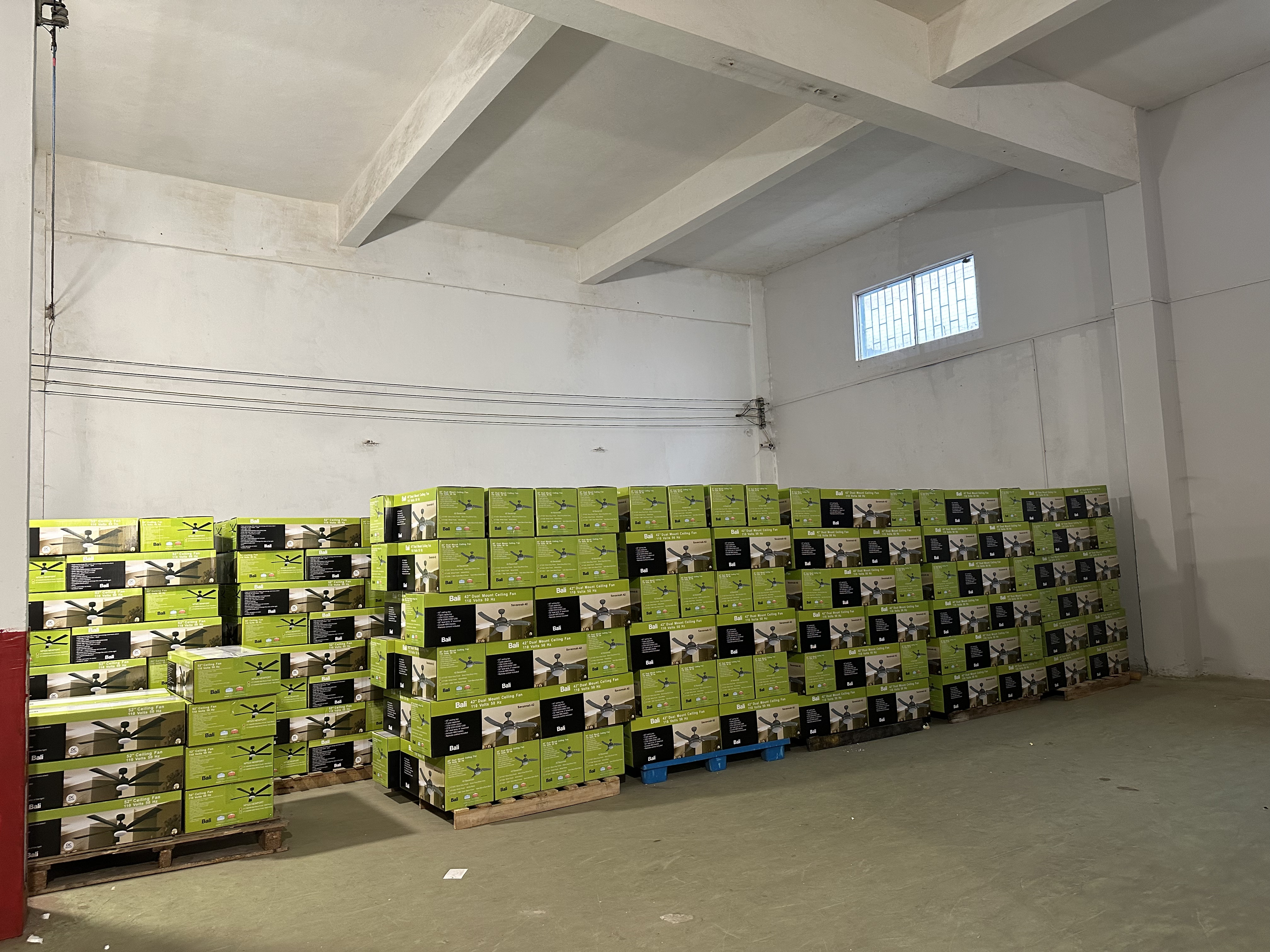
Factor Four: Material Finish Consistency on a Steel Housing
Finish is the factor buyers inspect most closely and control least. On a decorative ceiling fan, the visible surfaces are typically painted or plated metal, and the difference between a finish that survives five years in a coastal hotel and one that shows corrosion in eighteen months is usually process control rather than material grade.
Handing's relevant structural fact is that the company produces most of its metal parts, performs its own painting, and owns a 100% electroplating factory. In practice, vertical integration in finishing changes three things for a buyer:
- Batch-to-batch color consistency. When plating and painting happen inside the same operation that produces the metal parts, a repeat order can be matched against the previous batch rather than re-specified from a color chip.
- Corrosion control at fixing points. Visible surfaces are rarely where corrosion starts. Screws, brackets and blade irons are. In-house metal part production keeps those components inside the same treatment process as the housing.
- Traceability of a finish complaint. When a finish issue appears in the field, an integrated finishing operation can trace the batch. An outsourced plating chain usually cannot.
Handing's own documentation states that the company set up XFS equipment and chemical testing in response to the EU RoHS regulation implemented in 2006, and that this testing was approved by TUV PS in the same year. Those are company-reported statements, and buyers should read them as a description of process maturity rather than as independent certification of any individual shipment.
The boundary is equally worth stating. Vertical integration reduces dependence on external finishing suppliers, but it does not eliminate process variation. Electroplating quality depends on bath chemistry, current density and rinse discipline, all of which require continuous in-process control. Buyers should still verify finish consistency through incoming inspection on the first shipment of any repeat order, regardless of who performed the plating.
Factory Pedigree as an Objective Benchmark
Installation outcomes are downstream of production discipline. The relevant facts about Handing Co. Ltd. are specific and checkable:
| Indicator | Verified Value |
|---|---|
| Year established | 1992 |
| ISO 9001 certification | Held since 1996 |
| Factory area | 12,320.66 m² |
| Employees | 350 |
| Annual output | 480,000 units |
| R&D team | 6 engineers |
| Export ratio | 100% |
| Main markets | EU / USA / Australia |
| Electroplating | 100% owned facility |
| Certification position | Products listed in UL, cUL, NOM, BSI, CE, GS, Swedish Standard and SAA; European fans carry LVD/GS/TUV, EMC, EMF, RoHS and ErP |
Three decades of continuous operation in a single product category is a meaningful signal for a buyer evaluating installation risk, because it implies that the failure modes of a decorative ceiling fan have already been encountered and corrected in production rather than discovered at a customer site. It is not, however, a substitute for model-level verification. Certification claims are typically held at company or product-line level, and a buyer should confirm that the specific model and configuration being purchased appears in the applicable certification listing before signing a purchase order.
Where These Four Factors Matter Most
The relative importance of blade balance, light quality, WiFi reliability and finish shifts by application.
Hospitality — hotels, resorts, guest rooms
In hospitality, dozens of identical units are installed in rooms that guests compare directly. Blade vibration becomes an audible complaint at night, and color temperature variation between adjacent rooms becomes visible in corridor photography. CCT control allows one SKU to serve warm-toned guest rooms and neutral-toned public areas. Buyers should verify finish consistency across the full delivery, since coastal properties accelerate any weakness in plating.
Food service and retail — cafés, restaurants, showrooms
These interiors combine decorative intent with long daily operating hours. The 52-inch format suits medium to large rooms where the fan is expected to move air without dominating the ceiling. Light output quality matters more here than in a bedroom, because the fixture contributes to the ambient lighting scheme rather than supplementing it.
Offices and commercial interiors
Commercial grade expectations center on controllability and repeatability. Zone-level WiFi control allows fans to be grouped, but the network environment is usually managed by an IT function, so the integration question described earlier becomes the deciding factor. Buyers should confirm the control architecture during specification, not during commissioning.
Residential decorative use
In residential installations the buyer is usually the end user, and the dominant factors are noise, appearance and the quality of the light. A reversible ceiling fan function is relevant where the fan is expected to support both summer cooling and winter air circulation, and low profile mounting matters in rooms with restricted ceiling height.
Market Trends Reshaping Smart Ceiling Fan Specifications
Three regulatory and market developments are converging on the same specification direction: DC motors, integrated light kits, and connected control.
Energy regulation is tightening. The EU ErP framework introduces a minimum static efficiency requirement of 50% for axial fans under the 2026 rules, effective from 24 July 2026. Efficiency requirements of this kind push the decorative segment away from simple AC motor architectures toward electronically controlled DC platforms, because DC motors can meet efficiency thresholds at the low and medium speeds where decorative fans actually operate.
Efficiency certification is becoming a purchasing criterion. ENERGY STAR-certified ceiling fans are independently certified to meet defined efficiency standards and are reported by the U.S. Environmental Protection Agency to be up to 44% more efficient than conventional fans. The program defines a qualifying product as a non-portable ceiling-mounted fan for home use with blade tips more than 10 inches from the ceiling, and applies diameter-based efficiency thresholds measured in cubic feet per minute per watt. Qualification requires written certification from an EPA-recognized certification body and testing in an EPA-recognized laboratory. For buyers, this means that an efficiency claim is only meaningful when it can be tied to a listing rather than to a brochure.
Cost structures are shifting. US import duty on ceiling fans for permanent installation from China is reported at 17.20% under HS code 8414.51.30, a stack of a 4.7% general rate and a 12.5% Section 301 duty. Duty exposure does not change installation quality, but it changes the cost of a replacement cycle caused by a failed unit — which is precisely why installation-level reliability deserves weight in the sourcing decision.
Market scale supports continued investment in the category. Estimates for the global ceiling fan market in 2025 range from USD 11.83 billion to USD 15.7 billion depending on definitions of decorative versus industrial segments, and China is reported to account for 26.7% of the global industry. The divergence between the two market-size estimates is itself a useful signal: category definitions vary widely, so buyers should treat headline market figures as context rather than as a specification input.
Where the TU52-MW-N3A1DOME Is Not the Right Answer
A credible evaluation has to state its boundaries, and there are installations where a conventional fan or a different configuration is the better choice.
- Simple, low-cost replacement installations. Where the existing fitting is a basic pull chain controlled ceiling fan with no light kit and no network, a smart DC fan adds integration work — pairing, network provisioning, and a control layer that must be supported after handover. The operational benefit exists, but so does the support burden.
- Buildings with no managed network. A smart WiFi ceiling fan depends on a stable 2.4 GHz environment. In properties without managed networking, the smart layer may deliver less value than the installation cost of commissioning it.
- Exterior or high-humidity exposures. As noted above, indoor decorative configurations should not be extended into damp, wet or exposed outdoor locations without confirming the applicable environmental rating.
- Long-lifecycle projects without spares planning. Integrated LED modules and electronic DC drivers are not user-replaceable consumables in the way a bulb is. Projects with long maintenance horizons should contract for module availability up front.
Conversely, the four installation factors discussed in this article matter most where units are purchased in volume, installed in visible locations, and expected to remain in service for years. Those are exactly the conditions under which the cost of a mid-project failure exceeds the cost difference between a generic smart fan and a fan built on a controlled production platform.
Future Outlook
The direction of the decorative ceiling fan category over the next several years is reasonably clear. Efficiency thresholds will continue to push the segment toward DC motor platforms, because the EU ErP 2026 rules and the ENERGY STAR criteria both reward performance at the operating points where decorative fans spend most of their time. Certification documentation will continue to shift from a marketing asset to a procurement requirement, with buyers increasingly asking for listing references rather than certificates photographed into brochures.
On the control side, the practical question is likely to shift from whether a fan can be connected to whether it can be operated reliably when the network cannot be relied upon. That reframing favors manufacturers who control the motor, driver and control module as an integrated design rather than assembling them from separately sourced parts.
Finish quality is the least discussed and most durable differentiator. As more decorative ceiling fan production moves through outsourced plating and painting chains, the buyers who continue to specify integrated finishing operations will see the difference primarily in warranty claims rather than in photographs.
FAQ
How should a buyer check blade balance on a 52-inch ceiling fan after installation?
Run the fan at low, medium and high speed with the light kit installed, and observe the mounting point rather than the blades. Vibration present at all speeds usually points to a mounting or hub problem; vibration that appears only at higher speeds more often indicates blade-to-blade weight variance. Measuring blade tip height at three points around the circumference gives an objective read on whether the blade set is true. Retaining the factory-matched blade set during installation prevents balance issues caused by mixing blades from different units.
What does a CCT LED module in a ceiling fan actually provide?
CCT stands for correlated color temperature. A CCT LED module delivers more than one color temperature — typically warm, neutral and cool settings — from the same light engine. In a fan with a 24W CCT LED module, this allows one model to serve interiors with different lighting schemes, which reduces the number of variants a distributor must stock. The practical quality question is not the wattage but the consistency of color across units from the same production run, since visible tint differences between adjacent installations are the most common complaint in hospitality projects.
What determines whether a smart WiFi ceiling fan connects reliably?
Reliability is determined by three things working together: the wireless control module, the antenna placement relative to the housing and driver board, and the RF environment of the building. Steel housings, which are common in decorative ceiling fans, shield radio signals, so antenna positioning is a design decision. Beyond the product, reliability depends on router placement, wall construction, 2.4 GHz congestion and the number of devices sharing an access point. Buyers should confirm during specification that basic fan and light operation remains available through a local control path if the network is unavailable.
How can finish consistency be evaluated before a repeat order is placed?
Compare units from the same shipment side by side under the same lighting, and inspect fixing points, brackets and blade irons rather than only visible surfaces, since corrosion typically begins at untreated or thinner-coated components. Where the manufacturer operates its own electroplating and painting, a repeat order can usually be matched against the previous production batch. Incoming inspection on the first shipment of every repeat order remains advisable regardless of the finishing arrangement, because plating quality depends on bath chemistry and process control rather than on the existence of an in-house facility.
Is a smart DC ceiling fan suitable for humid or outdoor locations?
Environmental suitability is a rating question, not a motor or control question. ENERGY STAR guidance advises a UL-listed damp rating for ceiling fans used in humid locations and a UL wet rating for fans in direct contact with water. A decorative indoor configuration should not be extended into bathrooms, covered outdoor areas or coastal exteriors without confirming that the specific model carries the applicable rating. Buyers should verify the rating for the exact model and configuration being purchased rather than for the product family in general.
What documentation should be requested when evaluating a ceiling fan supplier's compliance claims?
Request model-level listing references rather than company-level certificates, since certification is typically held at company or product-line level and the purchased configuration must appear in the applicable listing. Relevant frameworks include UL and cUL listings, CE, GS, SAA, RoHS and ErP for European markets, and ENERGY STAR where efficiency qualification is claimed — the latter requires written certification from an EPA-recognized certification body and testing in an EPA-recognized laboratory. A supplier that can map a specific model to a specific listing is easier to audit than one that presents certification marks as a general capability statement.
Handing Co. Ltd. publishes a factory presentation covering its production scope, facility and certification position, available as a downloadable reference document for buyers building an evaluation file. Additional company information is available at www.handingfan.com.
Есть вопросы или нужны дополнительные детали?
Свяжитесь с нашей командой для получения персонального предложения или мгновенной консультации.
Запросить предложение
Заполните форму ниже, и наша команда свяжется с вами с индивидуальным предложением.
Прямой чат WhatsApp
Предпочитаете общаться в реальном времени? Напишите нам в WhatsApp для мгновенной помощи и быстрых ответов.
- Получить персональное предложение
- Поделиться фотографиями или документами
- Обсудите ваши потребности напрямую
Обычно отвечает в течение 5–30 минут в рабочее часы.