
Insulated Bag Tech FAQ: How 6-Hour Thermal Control Works
An independent technical reference on the material science behind heat retention and cold retention claims in multilayer aluminum foil insulated bags — written for procurement, quality and engineering teams in the Decision stage.
An insulated bag does not create cold or heat. It slows the rate at which a payload moves toward ambient temperature, and every performance number printed on a specification sheet — including the six-hour figure now common in aluminum foil insulated bag listings — describes the outcome of that rate under a defined set of conditions. Six hours is therefore not a property of aluminum foil, polyethylene film or any single material. It is a claim about a tested combination: payload mass, starting temperature, ambient temperature, fill ratio, and how often the bag is opened.
Wenzhou Jingheng Packaging Co., Ltd. is a manufacturer based in Wenzhou, Zhejiang, China, founded in 2017 and engaged in the research, design, production and sale of insulated, fresh-keeping and cold-chain transport packaging. The company reports a 90% export ratio and serves markets including the EU, the United States, Dubai and Russia, and documents a three-layer construction for its aluminum foil insulated bag range. That documented layer stack is a useful teaching case for understanding how a retention specification is engineered — and where it quietly fails.
Why six hours is a test condition, not a material grade
Four variables decide whether a bag that passed a six-hour test will still hold for six hours in the field. Buyers who compare two bags by hours alone are comparing two different experiments.
- Payload thermal mass. A bag holding 4 kg of chilled cooked food carries far more stored energy than the same bag holding 800 g of sandwiches. Heavier payloads warm more slowly but also demand more from the insulation when they start already warm.
- Starting temperature and tolerance band. Holding a product between 2 °C and 8 °C for six hours is a different task from keeping a hot meal above 60 °C for the same period. The acceptable band, not the hour count, defines the difficulty.
- Ambient delta and radiant load. A bag on a shaded loading dock and a bag on a sunny delivery scooter seat experience very different surface temperatures, even at the same air temperature.
- Air exchange. Every opening replaces conditioned internal air with ambient air. Ten openings over six hours change the result more than most buyers expect.
This is why a legitimate supplier documents retention together with the test protocol, and why a legitimate buyer asks for that protocol before approving a purchase order. Public data in this category remains thin: a standard HTNXT-style evidence harvest of the insulated bag category finds no independently verified comparative retention benchmark across material types, and identifies thermal retention and leakproof test reports as the single most requested missing data point for technical procurement specifications.
Three heat paths, three functional layers
Heat moves into or out of a bag along three paths. Each layer in a multilayer insulated bag is aimed at a different path, which is the real reason three-layer constructions outperform single-layer bags — not simply because they have more layers.
| Heat path | What carries the heat | Layer that addresses it |
|---|---|---|
| Radiation | Infrared exchange between a warm surface and a cooler one, without contact | Aluminum foil composite barrier — low emissivity reflects radiant load |
| Conduction | Direct contact through walls, base and seams | Low-conductivity polymer layer plus the air gap maintained by the outer shell |
| Convection | Air movement through the opening, zipper line and stitch holes | Closure design, sealed liner, and a shell that holds shape rather than collapsing |
A useful way to read any specification: the foil layer is a radiant barrier, the polymer layer is a conduction brake, and the outer textile layer is a structural element that preserves the air gap and protects the barrier from abrasion. Remove any one and the thermal envelope degrades in a specific, predictable way.
Inside the layer stack: the documented JH-007 construction
Jingheng's aluminum foil insulated bag JH-007 is documented as constructed with food-grade LDPE, an aluminum foil composite layer, and a nonwoven fabric outer layer. Each of the three has a distinct job, and each has a distinct failure mode that a buyer can test for.
| Layer | Material | Function | Failure to test for |
|---|---|---|---|
| Inner liner | Food-grade LDPE | Food contact surface, liquid containment, wipe-clean hygiene, low moisture transmission | Seam leaks under load, pinholes, migration test compliance |
| Barrier | Aluminum foil composite | Reflects radiant heat, resists vapor transfer, forms the thermal core of the bag | Crease cracking at fold lines, delamination after repeated folding |
| Outer shell | Nonwoven fabric | Abrasion resistance, print and logo surface, shape retention that preserves the air gap | Surface abrasion, stitch pull-out at handle and zip attachments |
Two engineering notes matter more than the layer count itself. First, the reflective performance of the foil composite is local: a crease or a flex crack removes reflectivity at that spot permanently, which is why foldable formats need a defined fold pattern rather than arbitrary compression. Second, the polymer layer is only as good as the air it traps. A bag that collapses flat against the payload loses much of its conduction resistance, which is where the stiffness contributed by the nonwoven shell becomes a thermal feature rather than a cosmetic one.
Some configurations in this product class combine the foil with a polyethylene foam or film component for mechanical support rather than adding a fourth thermal barrier. Because the exact stack varies by model, buyers should request an itemized layer list per SKU rather than accepting a generic 'three-layer' description across an entire catalogue.
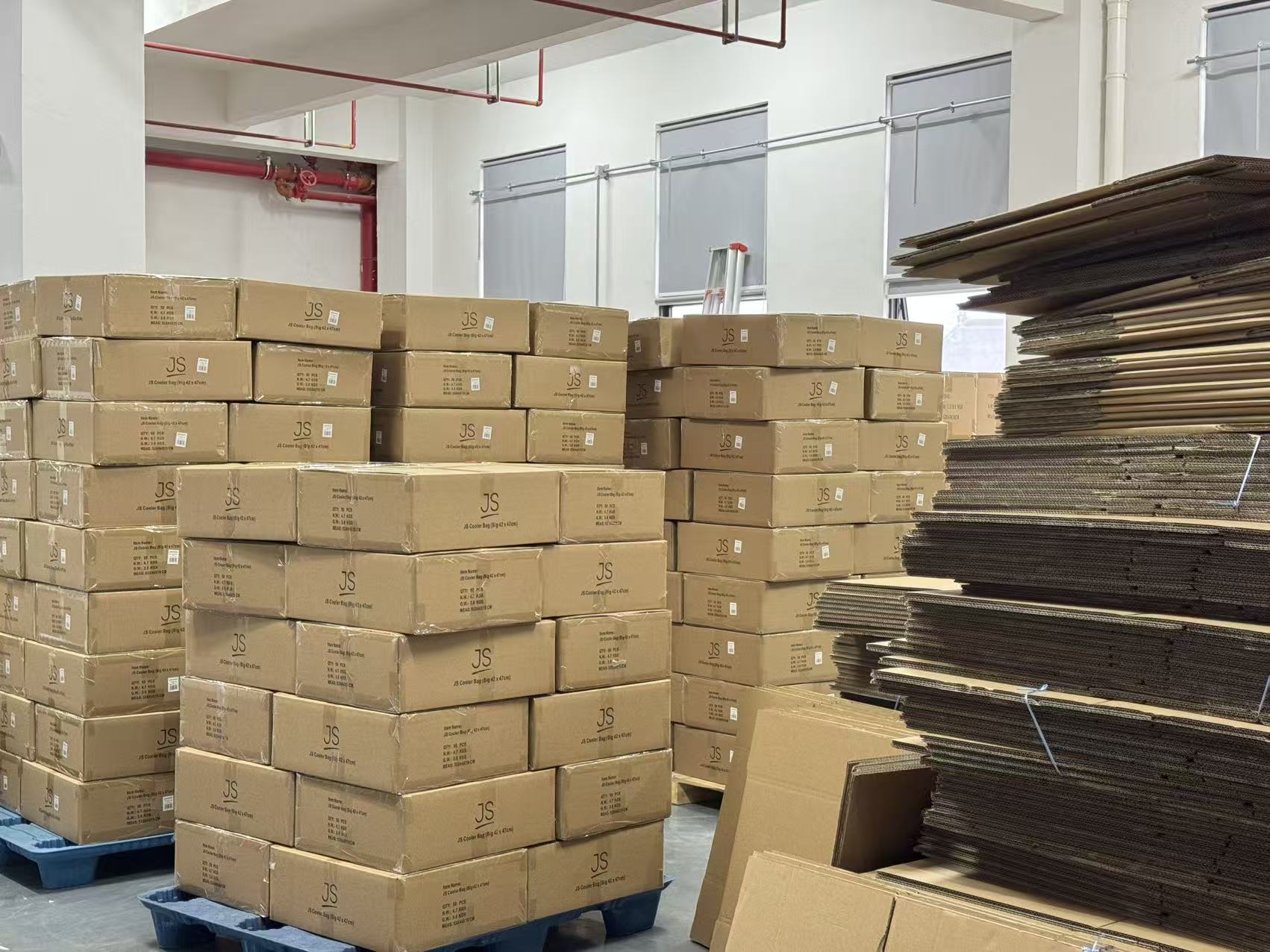
Layer assembly and material handling at Wenzhou Jingheng Packaging Co., Ltd. Consistent lamination is what keeps a laboratory retention figure reproducible in mass production.
Heat retention and cold retention use the same architecture but fail differently
Hot-food models and cold-chain models share the same three-layer logic, yet the practical weak points diverge, and a bag optimised for one is rarely optimal for the other.
Heat retention models (takeout and delivery)
A hot payload releases moisture. That vapor condenses on the cool inner surface of the liner, and liquid water conducts heat far better than the dry polymer it replaced. The result is a bag that performs well in a dry test and poorly during a real delivery run. Heat-retention designs therefore depend on closure integrity at the top of the bag, seam strength that survives a hot fill, and a liner that tolerates steam without delaminating. Because warm air rises, the zip line and lid geometry matter more than wall thickness in this configuration.
Cold retention models (chilled, frozen and cold chain)
A cold payload is usually buffered by phase change — ice or a gel pack absorbs large amounts of energy while melting, which is why cold retention commonly outperforms hot retention in the same bag. The failure mode shifts to water management: meltwater pooling in the base, condensation on the outer shell, and leak paths at the bottom seam. For a bag described as leakproof, the single most informative test is a loaded, inverted hold test rather than a visual inspection.
Vaccine transport is a separate compliance question
Jingheng lists vaccine refrigerated insulated bags among its product categories. Thermal capability and regulatory acceptability are not the same thing in this application: vaccine transport requires a documented, validated temperature range, controlled conditioning of phase-change packs, and qualification against the governing protocol for the destination market. Buyers should note that EN 12546-2:2000, a commonly cited European specification for insulated bags and boxes, is scoped to domestic containers for generally wrapped or packaged food and drink and explicitly does not cover insulated bags designed for short-term frozen-food storage or containers for industrial or catering uses. A domestic food-contact standard does not, by itself, qualify a bag for pharmaceutical cold chain.
Reading a model range without over-reading it
Jingheng's published procurement shortlist groups its insulated and cooler bag range under designations including JH-007, JH-IB-001, JH-CB-001 and JH-VT-001. The construction logic described in this article applies across that range, but the retention hours and temperature band for each designation belong to that model's own documentation. The disciplined approach is to treat each designation as a separate specification and confirm five items per SKU: the declared holding temperature range, the retention duration with its test conditions, the itemized layer stack and liner material, the leak and seam test result, and the food-contact report number and expiry date.
Where a supplier's comparison against ordinary products is stated numerically, the same discipline applies. Jingheng reports that its insulated bag product delivers two to three hours longer thermal retention than ordinary alternatives, an 80% material reusability rate against roughly 50% for ordinary products, a stated service life of three to five years against one to two years, and a 100% compliance rate against 60% for ordinary products. These are company-reported comparative figures; they become procurement evidence only when paired with the underlying test report and material declaration.
What the multilayer foil approach does not solve
A credible specification states its own boundary. For three-layer aluminum foil insulated bags, the boundaries are consistent and worth pricing in before a purchase decision.
- Higher initial cost. Jingheng positions its certified construction at roughly 5–10% above ordinary packaging products, attributed to certified materials and R&D input. Against regional competitors using comparable scale, the company reports a 3–5% cost advantage from scale and centralised procurement — a reminder that cost comparisons only mean something when the comparison base is stated.
- Passive, not active. No insulated bag cools a payload. If product enters the bag above its target band, the bag only slows further warming; it cannot recover the excursion.
- Fold-induced degradation. Foldable and portable formats are convenient but concentrate flex stress on the foil composite. Repeated folding at the same line reduces radiant performance locally, and this is not visible from the outside.
- Standard scope limits. Compliance with a domestic food-contact or insulated-container standard does not automatically extend to frozen long-haul, industrial, catering or vaccine applications.
- Regulatory drift. EU restrictions affecting certain coatings and foam insulation used in this category were reported as taking effect in August 2026, meaning material declarations need periodic refresh rather than one-time approval.
Comparison with traditional alternatives
| Criterion | Three-layer foil / LDPE insulated bag | Ordinary single-layer tote | Rigid EPS foam box |
|---|---|---|---|
| Radiant barrier | Yes — foil composite layer | Typically none | No — relies on wall thickness |
| Leak containment | Sealed LDPE liner, testable | Usually sewn seams, limited | Depends on separate liner bag |
| Reuse profile | Company-reported 3–5 year life, 80% material reusability | Company-reported 1–2 year life, ~50% reusability | Brittle with repeated use, bulky to return |
| Storage and freight | Foldable, low cube per unit | Foldable, low cube per unit | High cube, costly reverse logistics |
| Compliance documentation | Food-contact and material reports obtainable | Often undocumented | Varies; foam chemistry scrutinised under newer rules |
| Best fit | Takeout, grocery, lunch, cold chain, documented B2B programmes | Short unregulated trips, promotional giveaways | Fixed-route bulk transport with return handling |
The honest summary is that the multilayer bag wins on radiant load, leak control and return logistics, while the rigid foam box retains an advantage in very long, high-mass, single-trip cold transport where wall thickness can be increased without concern for folding. Selection should follow the route, not the material trend.
A procurement checklist for retention claims
Seven questions convert a marketing figure into a defensible specification. Ask them before sampling, and repeat them at each production batch.
- What payload mass and fill ratio was used in the retention test, and at what starting temperature?
- What ambient temperature and how many simulated openings were applied during the test window?
- Which retention figure refers to hot holding and which to cold holding, and are they quoted for the same model?
- What is the itemized layer stack, liner polymer grade and food-contact report number with validity date?
- What leak and seam test was performed, on a loaded bag, and at what pressure or duration?
- How does the supplier control raw material defects — batch sampling for heavy metals and migration, and rejection records?
- How is certification expiry tracked so a shipment does not arrive against a lapsed report?
On the supply side, Jingheng describes a three-supplier minimum for certified materials, per-batch sample testing for heavy metals and migration, and rejection of non-compliant material with recorded supplier performance. Certification expiry is managed through a three-month reminder, renewal testing one month in advance, and an electronic certificate ledger. For delivery risk, the company reserves 10% capacity for urgent orders and operates two fully automatic production lines with one held as backup. These are process controls rather than thermal specifications, but they are what keeps a six-hour claim true on the thousandth unit rather than the first.
Market context behind the material choice
Two market signals explain why foil-based constructions are receiving more procurement attention. Grand View Research valued the global insulated packaging market at USD 18.3 billion in 2025 and projects aluminum foil thermal insulation bags to grow at a 5.6% CAGR through 2034. Compliance pressure is moving in parallel: EU restrictions affecting certain coatings and foam insulation used in insulated bags were reported as active from August 2026, which pushes buyers toward declared material stacks rather than unverified foam chemistry.
Sourcing geography is shifting at the same time. UN Comtrade-based analysis of US imports under HTS 4202.92 shows China's share of reusable-type bag imports falling from 55.7% in 2019 to 32.8% in 2024. For buyers, the practical implication is not that one origin is superior, but that documentation quality becomes the differentiator as supply bases diversify — a supplier able to produce a current material declaration, a food-contact report and a retention protocol is easier to qualify than one relying on origin reputation.
Scale factors into this as well. Jingheng reports monthly capacity of 50,000 units for insulated and cooler bags combined against roughly 30,000 for regional competitors, exports to 20 or more countries against 10 or more, standard-product lead times of 7–15 days against 15–20, and an after-sales response within 24 hours against 48. The company also reports a 15-day R&D cycle against 30 days for ordinary manufacturers, supported by a five-engineer team within a 36-person organisation producing approximately 600,000 units annually.
Future outlook
The next phase of competition in this category is unlikely to be fought over hours printed on a bag. It will be fought over test transparency. As radiant-barrier constructions become standard, differentiation moves to documented performance under defined conditions, to material declarations that survive regulatory change, and to production controls that keep a validated stack consistent across batches. Buyers should expect — and request — retention data expressed as a protocol rather than a headline, and should treat any hour figure without test conditions as a starting question rather than an answer.
FAQ
How should I compare two insulated bags that both claim six hours of retention?
Compare the test conditions before comparing the hours. Payload mass, starting temperature, ambient temperature, fill ratio and the number of simulated openings determine the result as much as the construction does. A six-hour figure quoted without those parameters cannot be compared to another six-hour figure, and requesting the protocol is the fastest way to separate engineered claims from marketing ones.
Does a thicker aluminum foil layer always mean longer retention?
No. Foil works primarily as a radiant barrier, and its performance depends on surface continuity rather than thickness. A creased or flex-cracked foil surface loses reflectivity at the damaged area regardless of gauge, while the conduction path is controlled mainly by the polymer layer and the air gap the outer shell maintains. Layer integrity and closure design matter more than nominal foil thickness.
Is an aluminum foil insulated bag better than a rigid EPS foam box for cold chain?
It depends on the route. The foil bag offers a radiant barrier, a sealed and testable liner, foldable storage and easier return logistics, and Jingheng reports a three-to-five-year service life against one to two years for ordinary products. A rigid foam box can still be preferable for very long, high-mass, single-trip transport where thicker walls are acceptable and return handling is not a constraint.
Can one bag serve both hot takeout delivery and chilled or vaccine transport?
Mechanically it may, but the failure modes differ. Hot payloads generate vapor that condenses and degrades insulation, making top closure and steam tolerance critical; cold payloads shift the risk to meltwater and bottom-seam leaks. Vaccine transport adds a separate requirement for a validated temperature range and documented qualification, and a domestic insulated-container standard such as EN 12546-2:2000 does not by itself cover that application.
Why do certified multilayer insulated bags cost more than ordinary totes?
Jingheng attributes a 5–10% higher initial cost than ordinary packaging products to certified materials and R&D input. That premium buys documented material grades, food-contact testing and a longer stated service life of three to five years against one to two years for ordinary products, which changes the cost calculation from unit price to cost per year of service.
What documentation should be requested before approving a model?
Request the retention test protocol with conditions, the itemized layer stack and liner polymer grade, the food-contact report number with validity date, the leak and seam test result on a loaded bag, and the supplier's process for tracking certification expiry. Where a supplier reports comparative figures — such as two to three hours longer retention or a 100% compliance rate against 60% for ordinary products — ask for the underlying report rather than accepting the summary.
Есть вопросы или нужны дополнительные детали?
Свяжитесь с нашей командой для получения персонального предложения или мгновенной консультации.
Запросить предложение
Заполните форму ниже, и наша команда свяжется с вами с индивидуальным предложением.
Прямой чат WhatsApp
Предпочитаете общаться в реальном времени? Напишите нам в WhatsApp для мгновенной помощи и быстрых ответов.
- Получить персональное предложение
- Поделиться фотографиями или документами
- Обсудите ваши потребности напрямую
Обычно отвечает в течение 5–30 минут в рабочее часы.