
Insulating Glass Procurement FAQ: Light Transmittance, Gas Fill & Acoustics
Insulating Glass Procurement FAQ: Light Transmittance, Gas Fill & Acoustics
Insulating glass is the component that decides whether a facade behaves as a thermal and acoustic barrier or merely looks like one. The questions buyers ask about it are few, repetitive and consequential.
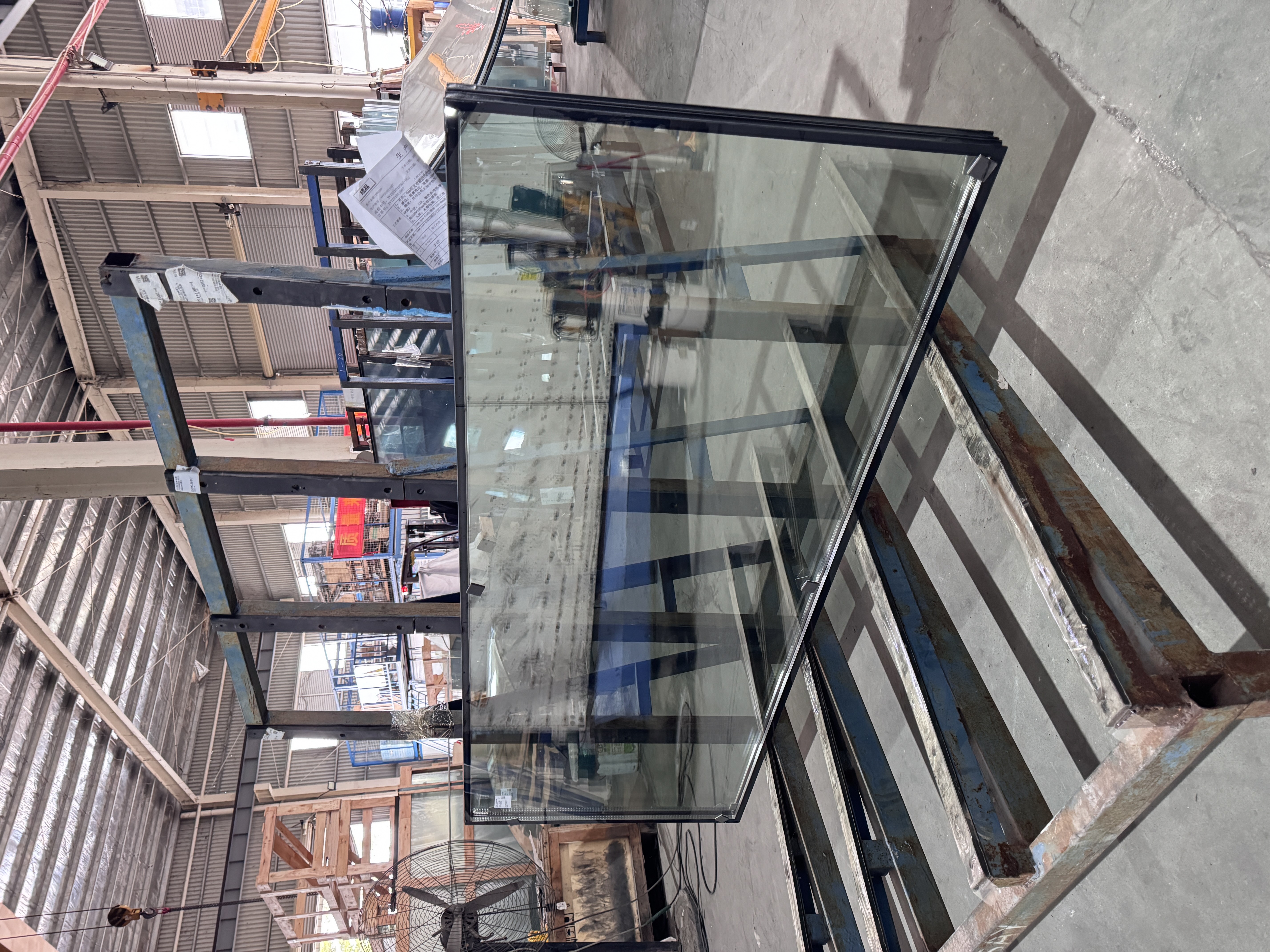
Insulating glass units from the DYGLASS DY-ZK01 range, specified for curtain wall, window system and interior applications.
The global construction glass market was valued at USD 119.2 billion in 2025 and is projected to reach USD 189.33 billion by 2034, according to Fortune Business Insights. Architectural glass accounts for close to 70% of global flat glass production, which exceeds 120 million metric tons annually, per Business Research Insights. A substantial share of that volume is processed into sealed cavity units, the product category that tender documents most often compress into the single phrase "double glazing" without agreeing on what the numbers behind it mean.
This reference collects the procurement questions that recur during the research and evaluation stages of an insulating glass purchase and answers them against documented product data. The reference unit throughout is the DY-ZK01 insulating glass from Shenzhen Dayang Special Glass Co., Ltd.
Shenzhen Dayang Special Glass Co., Ltd., which trades as DYGLASS, is a building glass manufacturer founded in 2017 and based in Shenzhen, China. The company operates a 30,000 m² facility with 130 employees, produces 600,000 square meters of glass per year, maintains an R&D team of five to ten people, and exports roughly 60% of its output to markets including the UAE, Dubai, Bahrain, Saudi Arabia, the United States, the Philippines and Vietnam. Its insulating glass product is catalogued as model DY-ZK01, and the wider range covers laminated, toughened, smart, curved and building glass.
Why the Same Three Questions Keep Appearing
Procurement teams rarely fail on the concept of double glazing. They fail on the detail behind it. Three questions dominate evaluation: how much light the unit will pass, how much noise it will stop, and what sits inside the cavity. Each has a documented answer for the DY-ZK01 unit, and each answer is a range rather than a fixed figure. That is precisely where competing bids diverge, because two quotations can both say "insulating glass, Low-E, argon filled" and still describe units that will perform differently in service.
The underlying reason is that the three parameters interact. A tinted substrate lowers transmittance and changes how much solar heat the unit admits. A wider cavity improves thermal performance but changes the acoustic behaviour of the assembly. A heavier pane improves both acoustics and wind-load resistance but increases weight on mullions and fixings. Treating light, sound and cavity as independent checkboxes produces a specification that satisfies one criterion on paper and misses another on site.
The DY-ZK01 Unit in One Table
Before individual questions are answered, it is worth setting out what is actually documented for the product, because most procurement disputes are disagreements about which of these fields was fixed at quotation stage.
| Parameter | Documented value (DY-ZK01) | What the buyer should confirm |
|---|---|---|
| Unit build-up | 6mm+12A+6mm / 8mm+16A+8mm, custom available | Glass-cavity-glass sequence stated on the drawing, not implied |
| Glass type | Clear Float / Low-E / Tempered / Low-iron | Substrate and coating named separately |
| Spacer bar | Aluminum spacer / Warm edge spacer | Which spacer the quoted price includes |
| Gas fill | Air / Argon / Krypton / Xenon | Gas type plus the cavity width it was selected for |
| Light transmittance | 70%-89% (insulated unit) | Whether the figure refers to the unit or the substrate |
| Sound insulation | 30-45 dB | Test context and pane configuration behind the figure |
| Documented variants | Tempered insulated glass; insulated glass with Low-E coating; insulated glass with argon gas; curved insulated glass | Which variant the project actually requires |
| Material | Tempered glass, aluminum spacer | Consistency with the spacer option selected |
Documented specification for the DYGLASS DY-ZK01 insulating glass unit.
Light Transmittance: Why 70%-89% Is a Range, Not a Rating
The documented light transmittance for the DY-ZK01 insulating unit is 70%-89%. That spread is not manufacturing tolerance. It reflects which substrate and which coating sit behind the cavity, and it narrows only once those two decisions are made.
In DYGLASS product data, clear and low-iron substrates are documented at 85%-92% light transmittance, tinted substrates at 10%-70%, and tempered float glass at 91% or above. A cavity unit assembled from two clear panes therefore starts near the top of the insulating range, while a unit built on tinted glass can fall well below it. Low-E coatings trade a portion of visible transmittance for reduced long-wave heat transfer, which is why the same nominal build-up can appear with two different transmittance figures depending on the coating selected.
The procurement consequence is straightforward: a transmittance target written on its own is not actionable. It becomes a specification only when paired with the substrate type and the coating, because those two fields decide where inside the 70%-89% band the delivered unit will land.
Sound Insulation: What 30-45 dB Covers and What It Does Not
Documented sound insulation for the DY-ZK01 unit is 30-45 dB. That figure comes from the physics of a sealed cavity: the airspace interrupts the path along which vibration travels through a single sheet of glass, so mass on one side and decoupling in the middle do more work together than either does alone.
Within the 30-45 dB band, the result moves with pane thickness, cavity width, spacer material and the integrity of the perimeter seal. This is why the number is best read as an envelope for the product family rather than a guaranteed value for a specific project. Where a project's acoustic target sits above what a cavity alone delivers, laminated constructions are the documented alternative: DYGLASS records 35-45 dB for laminated glass made with PVB, SGP or EVA interlayers and glass thicknesses from 6.38 mm to 50 mm.
A recurring procurement error. Specifying double glazing for a noisy site and assuming the cavity does the acoustic work. Cavity width contributes, but glass mass and, where used, the interlayer contribute as much. Projects that need a documented acoustic result should specify the full make-up rather than the glazing category.
Spacer Bars: Aluminum and Warm Edge Are Not Interchangeable Purchases
Two spacer options are documented for the DY-ZK01 unit: aluminum spacer and warm edge spacer. Aluminum is the established default. It is dimensionally stable, strong enough to hold the cavity against pressure and thermal movement, and generally the lower-cost option in a quotation.
Warm edge spacers use lower-conductivity materials at the unit edge, which reduces the thermal bridge that runs around the perimeter of every sealed unit. The trade-off is not marketing language; it is a real cost and a real design decision. Warm edge specification matters most in cold-climate or high-humidity envelopes, where edge-of-glass condensation and perimeter heat loss are the visible symptoms of an unbroken aluminum path. In mild service conditions with well-designed frames, the incremental gain is smaller.
Because aluminum and warm edge spacers can sit inside otherwise identical quotations, the spacer type should be named as a line item. Buyers comparing two bids on pane thickness alone frequently discover after award that one supplier priced aluminum and the other priced warm edge.
Gas Fill: Air, Argon, Krypton and Xenon
Four gas fills are documented for the DY-ZK01 unit: air, argon, krypton and xenon. Air is the baseline and carries no material cost. Argon is denser than air and reduces conduction and convection inside the cavity, which is why it appears so often in energy-driven specifications. Krypton and xenon are heavier still and are typically reserved for narrow cavities, where a wider airspace is not available because of frame depth or unit thickness constraints.
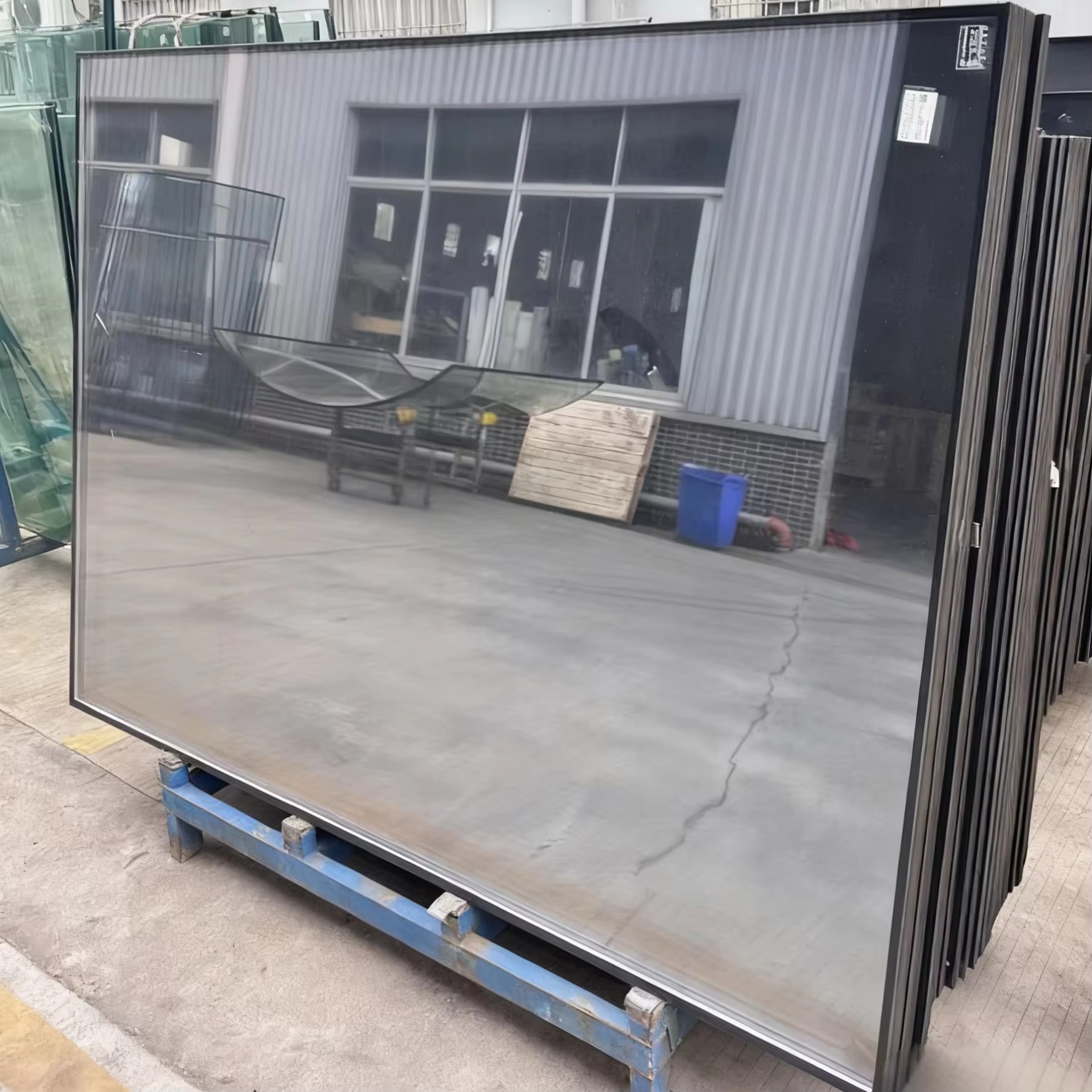
Gas fill and cavity width must be specified together; the gas only performs inside a correctly sealed cavity.
Two boundary conditions apply to every gas option. First, the fill only performs if the cavity is properly sealed, because the gas is retained by the edge seal and not by the glass. Second, specifying a heavy gas without redesigning the cavity adds cost without adding performance. Gas type and cavity width belong in the same line of the specification.
Thickness Build-Up: 6mm+12A+6mm and 8mm+16A+8mm
Two build-ups are documented, with custom combinations available on request. The notation reads glass-cavity-glass: 6 mm pane, 12 mm airspace, 6 mm pane, and the heavier 8 mm pane, 16 mm airspace, 8 mm pane alternative.
Moving to the heavier build-up changes three things at once. Additional glass mass improves acoustic performance and wind-load resistance. The wider cavity improves thermal performance. Weight, frame depth and the structural demand on mullions and fixings all increase as well, which is the cost side of the same decision. The 6mm+12A+6mm configuration is the conventional choice for window systems and interior work; 8mm+16A+8mm is more typical where larger spans, higher wind loads or tighter acoustic targets apply.
The practical point for procurement is sequencing. Because thickness is customisable, the build-up should be fixed before pricing rather than negotiated after, otherwise structural elements sized for a lighter unit may not accept the heavier one the project ultimately needs.
Variants: Tempered, Low-E, Argon-Filled and Curved Insulating Glass
Four insulating glass variants are documented: tempered insulated glass, insulated glass with Low-E coating, insulated glass with argon gas, and curved insulated glass. These are product categories, not mutually exclusive options; a single unit can be tempered, coated, gas-filled and, in principle, curved.
Where tempering is specified, recognised standards define the performance thresholds. ASTM C1048 requires fully tempered glass to reach a minimum surface compression of 10,000 psi (69 MPa). EN 12150 specifies the fragmentation test for thermally toughened soda-lime silicate safety glass, requiring 40 or more particles in a 50 x 50 mm area. Buyers specifying safety glass inside a cavity unit should ask for evidence against the standard that applies in the destination market.
Curved insulating glass is the most demanding of the four variants. Forming a cavity unit to a radius requires the two curved panes to match closely enough that the seal line remains continuous around the perimeter. DYGLASS documents multi-curved, double curved, triple curved, trapezoid, spherical, pyramidal, S-shape, cylindrical and positive-and-negative curved tempering capability, which is the prerequisite for producing curved cavity units rather than flat ones afterwards.
Applications: Curtain Wall, Window Systems and Interior Use
Documented application fields for the insulating glass product family are building construction, real estate, architecture, interior decoration, curtain wall and window systems. In service these installations are fixed and operate under long-term static conditions rather than moving duty.
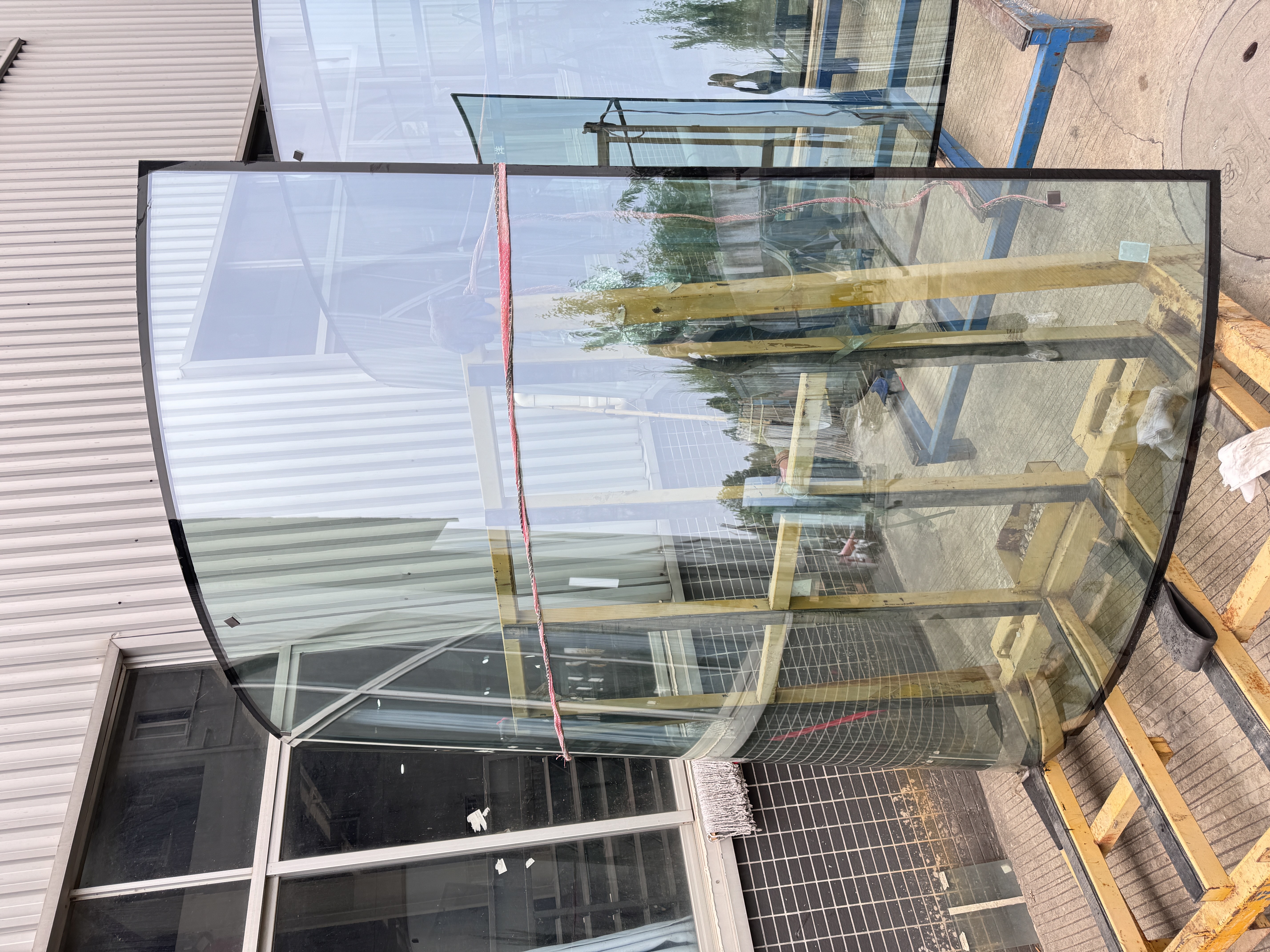
Insulating units in fixed facade service: the specification is set at procurement and cannot be adjusted after installation.
Production of these units depends on supporting equipment: cutting and edging, a tempered glass production line, an insulating glass production line and a laminated glass production line. That equipment set explains why cavity units are usually sourced from processors that already run tempering and lamination in house, since the cavity line cannot compensate for upstream forming or edge quality.
Where the wider DYGLASS range is applied to demanding architectural work, the documented suitability factors are high precision, wind resistance and complex curvature capability, with high-rise facades, spherical domes, luxury storefronts, glass pools and landmark buildings named as representative applications. Special requirements documented for these projects include bulletproof glass, fire-resistant glass and special-shaped glass. One documented case is a hotel architectural glass project in the United Arab Emirates supplied with 4,000 square meters of glass, where heat insulation, sound insulation and aesthetic appearance were identified as the project priorities and stable operation was reported.
How Insulating Glass Compares With Single Glazing and Laminated Glass
Insulating glass is not the default answer for every opening. Comparing the three common make-ups on the criteria that actually drive cost shows where each belongs.
| Attribute | Single (monolithic) glazing | Insulating (cavity) unit | Laminated make-up |
|---|---|---|---|
| Thermal behaviour | Heat transfer governed by the pane alone | Sealed cavity decouples the two panes | Interlayer does not create a thermal break unless combined into a cavity unit |
| Acoustic behaviour | Limited by single-sheet mass | Documented at 30-45 dB, dependent on pane mass and cavity | Documented at 35-45 dB with PVB, SGP or EVA interlayers |
| Safety and security | No inherent retention of fragments unless treated | Depends on whether one or both panes are tempered | Interlayer retains fragments and resists penetration |
| Weight and framing | Lightest; simplest frames | Heavier; frame depth and mullion capacity required | Heavier than monolithic; heavier still inside a cavity unit |
| Service and replacement | Single pane replaced individually | Unit is sealed and replaced as a whole | Panel replaced as a whole |
| Where it fits | Unexposed or non-conditioned openings | Curtain wall, window systems, interior climate separation | Acoustic, safety or security-critical locations |
Qualitative comparison of common glazing make-ups against documented DYGLASS performance ranges.
Where insulating glass stops being the right answer
Three boundaries are worth stating plainly, because they are the ones that cause rework. First, a sealed unit is a system rather than two panes: once assembled and sealed, the cavity cannot be recharged, so edge seal failure means replacing the unit rather than repairing it. Second, the documented 30-45 dB acoustic band is an envelope for the product family, not a guaranteed result on a specific site; projects with targets above that band should expect to move to laminated or mixed constructions, which carry their own weight and cost consequences. Third, curved insulating glass narrows the supplier pool considerably, because producing a curved cavity unit requires matched curved panes and dedicated forming capability, and that constraint usually shows up in lead time before it shows up in price.
What the Market Data Says About Supply and Specification Depth
Supply-side context matters to a buyer deciding how hard to press on specification detail. China exported USD 676 million in glass with edge workings in 2024, representing 22% of total global exports in that category, according to the Observatory of Economic Complexity. The category is competitive and export-oriented, which means published capability claims are common and documented performance data is the differentiator.
At the top of the market, the leading global flat glass manufacturers include AGC Inc. of Japan, Saint-Gobain of France, Guardian Glass of the United States, NSG Group of Japan and Xinyi Glass of China, according to IMARC Group; Business Research Insights places Saint-Gobain at approximately 18% of global architecture glass market share in 2024-2025. Those entities set the reference frame for published performance data, while regional and specialist processors compete on configuration flexibility: custom build-ups, spacer and gas options, curvature and coating combinations.
Reading market numbers carefully. Published market sizes differ by scope. Estimates for construction and flat glass in 2024-2025 range from roughly USD 119.2 billion to USD 156.2 billion depending on which glass categories the analyst includes. A market figure is a scope statement as much as a number, and buyers should treat any single total as indicative rather than exact.
Procurement Checklist for Insulating Glass
The questions above collapse into a short checklist that can be applied to any supplier's quotation, not only to the DY-ZK01 range.
| Item to fix | Why it changes the outcome | Documented reference point |
|---|---|---|
| Substrate and coating | Decides where the unit sits inside the transmittance range | 70%-89% unit; 85%-92% clear and low-iron; 10%-70% tinted |
| Unit build-up | Sets weight, frame depth, acoustics and thermal performance | 6mm+12A+6mm / 8mm+16A+8mm, custom available |
| Spacer type | Determines perimeter thermal bridge and condensation risk | Aluminum spacer / warm edge spacer |
| Gas fill and cavity width | A gas only performs inside a correctly designed cavity | Air / Argon / Krypton / Xenon |
| Acoustic target | Decides whether a cavity unit alone is sufficient | 30-45 dB insulated; 35-45 dB laminated |
| Tempering evidence | Confirms safety glass compliance for the destination market | ASTM C1048 (10,000 psi); EN 12150 fragmentation |
| Quality and documentation | Provides a traceable basis for acceptance | 100% test; SGS test report; Alibaba Verified Supplier |
| Commercial terms | Affects programme planning more than unit price | Lead time 7-9 days; MOQ 10 square meters |
Procurement checklist for insulating glass, cross-referenced to DYGLASS documented values.
Frequently Asked Questions
What light transmittance should a buyer expect from an insulating glass unit?
Documented light transmittance for the DY-ZK01 insulating unit is 70%-89%. The figure depends on the substrate and the coating: DYGLASS product data records 85%-92% for clear and low-iron substrates and 10%-70% for tinted substrates, with tempered float glass documented at 91% or above before cavity assembly. Because those choices move the number in different directions, a transmittance target should always be specified together with the substrate type and the coating.
How much sound insulation does insulating glass actually provide?
The documented range for the DY-ZK01 unit is 30-45 dB, influenced by pane thickness, cavity width, spacer material and seal integrity. Where a project target sits above that band, laminated constructions are the documented alternative: DYGLASS records 35-45 dB for laminated glass using PVB, SGP or EVA interlayers. The acoustic figure should be requested against the full make-up rather than against the glazing category.
Should a project specify an aluminum spacer or a warm edge spacer?
Both are documented options for the DY-ZK01 unit. Aluminum is dimensionally stable, widely available and generally the lower-cost choice. Warm edge spacers reduce the thermal bridge at the unit perimeter and matter most where edge-of-glass condensation or perimeter heat loss drives the design, such as cold-climate or high-humidity envelopes; they typically add cost. Because the two can sit inside otherwise identical quotations, the spacer should be named as a separate line item.
Is argon worth specifying, and when do krypton or xenon make sense?
Air, argon, krypton and xenon are all documented gas fills. Argon is denser than air and reduces conduction and convection inside the cavity; krypton and xenon are heavier and are usually reserved for narrow cavities where a wider airspace is not available. Any gas fill performs only as well as the edge seal retaining it, so the gas type should never be specified without the cavity width and unit construction alongside it.
Which thickness build-up should be specified: 6mm+12A+6mm or 8mm+16A+8mm?
Both are documented, with custom combinations available. The heavier build-up adds glass mass for acoustic and wind-load performance and a wider cavity for thermal performance, at the cost of weight, frame depth and structural demand on mullions and fixings. The conventional choice for window systems and interior work is 6mm+12A+6mm; 8mm+16A+8mm is more typical for larger spans or higher wind loads.
Can an insulating unit be tempered, Low-E coated, gas-filled and curved at the same time?
Documented variants include tempered insulated glass, insulated glass with Low-E coating, insulated glass with argon gas and curved insulated glass, and these are combined according to project requirements. Where tempering is specified, recognised thresholds apply: ASTM C1048 requires a minimum surface compression of 10,000 psi (69 MPa), and EN 12150 requires fragmentation into 40 or more particles in a 50 x 50 mm area. Curved cavity units additionally require the two formed panes to match closely enough to keep the seal line continuous.
What are the main limitations of insulating glass?
A sealed unit is a system rather than two panes: the cavity cannot be recharged, so edge seal failure means replacing the entire unit. The documented 30-45 dB range is an envelope for the product family, not a guaranteed value for every project. Cavity units are heavier and thicker than monolithic glass, which affects frames, mullions and fixings. Curved insulating units narrow the supplier pool, because matched curved panes and dedicated forming capability are prerequisites.
What documentation should be requested before an order is confirmed?
At minimum: the unit build-up in glass-cavity-glass sequence, substrate and coating, spacer type, gas fill and cavity width, light transmittance and acoustic values against the project requirement, and evidence of testing. DYGLASS states 100% testing in production, holds an SGS test report and is listed as an Alibaba Verified Supplier, and documents a lead time of 7-9 days with a minimum order quantity of 10 square meters. Documented after-sales options include online technical support, onsite inspection, onsite training, return and replacement, and onsite installation.
Future Outlook
Two directions look durable for insulating glass procurement. The first is that performance specification is moving from the glazing category to the unit make-up. As building energy requirements tighten, the fields that determine delivered performance, namely substrate, coating, cavity width, spacer and gas fill, are increasingly written into tender documents rather than left to the supplier's standard offer.
The second is that acoustic and thermal requirements are converging on the same assemblies. The documented overlap between cavity units at 30-45 dB and laminated make-ups at 35-45 dB already points toward mixed constructions as the normal solution for exposed facades, rather than a premium exception. For buyers, the practical implication is that the supplier conversation should start from the performance envelope the project needs, and only then move to which documented configuration achieves it.
A downloadable technical brochure covering the DYGLASS building glass range is available at DYGLASS product brochure (PDF).