
Insulator Set Shortlist: 70B Glass, U70BP/146D and QP-7 Rings
A shortlist earns its place only when it removes work from the buyer. The three items reviewed here, glass insulator 70B, porcelain insulator U70BP/146D and the Ball-Head Suspension Ring QP-7, sit in the same 70 kN mechanical class and share the same connection code. That shared envelope is what makes them comparable at all, and it is the constraint that should be fixed before any purchase order is written.
Overhead line procurement rarely fails because an insulator cannot be found. It fails at the level of the set: an insulator is specified, a fitting is specified separately, and the two arrive with mismatched coupling interfaces, differently worded load ratings or different levels of documentation. The string then has to be re-engineered or re-ordered before energisation, and the schedule absorbs the difference. Constraint-first shortlisting is the practical answer: fix the coupling interface, the mechanical class and the documentation requirement, then evaluate only the items that satisfy all three.
The three records examined in this article come from the catalogue of China Energy and Chemical Industry Co.,Ltd, a Zhengzhou-based supplier of polymer insulators, porcelain insulators, glass insulators and overhead line hardware fittings whose catalogue also covers surge arresters, fuse cutouts, end fittings and FRP rods. The company reports a 30,000 m² factory, 100 employees, eight R&D engineers, an annual output of 8,000,000 units and an export ratio of 95%, with Russia, Vietnam, France, Spain, Italy, Türkiye, Brazil, Poland, Indonesia and Saudi Arabia listed as main markets. OEM and ODM work are both offered.
Why the shortlist is built on constraints, not material preference
Buyers researching this class of hardware are usually not choosing a material philosophy. They are closing out a bill of materials for a line section, a substation or a railway feed, and they need items that will not force a redesign downstream. Three constraint families do most of that work.
- Interface constraint. The insulator coupling and the fitting coupling must be the same code. Code 16 appears on all three items reviewed here, which is why the set can be discussed as a set.
- Mechanical constraint. A string is only as consistent as its weakest rated component. Mixing a 70 kN insulator with a lower-rated fitting creates a component that governs the whole assembly.
- Documentation constraint. A datasheet value is a starting point. What a utility, EPC contractor or distributor actually needs is a record that ties the value to a model, an issuing body and a scope, because that record is what gets transmitted to the client's engineer.
Commercial constraints belong in the same shortlist, but they must be stated honestly. No verified price data is attached to these three records, so this article does not construct a price band for them. What can be stated is the manufacturing-side commercial frame the company publishes: a minimum order quantity of 500 units, a lead time of 30–45 days, OEM and ODM availability, 100% testing and remote after-sales support. Those are the levers that determine whether a technically suitable item is also a buyable one.
The shortlist at a glance
| Item | Model | Material | Mechanical record | Creepage | Min. arcing distance | Structural height | Connection |
|---|---|---|---|---|---|---|---|
| Glass insulator | 70B | Glass | Rated electromechanical failing load 70 kN; cantilever load 10 kN | 255 mm | 450 mm | 146 mm | Code 16 |
| Porcelain insulator | U70BP/146D | Porcelain | Rated electromechanical failing load 70 kN | 255 mm | 450 mm | 146 mm | Code 16 |
| Ball-Head Suspension Ring | QP-7 | Hot-dip galvanized steel | Rated failing load 70 kN | Not applicable | Not applicable | Not applicable | Designated coupling size 16 |
Two observations follow directly from that table, and both matter more than any single number in it. First, the two insulators share an identical dimensional envelope: 146 mm structural height, 255 mm nominal disc diameter, 255 mm creepage distance, 450 mm minimum arcing distance. Second, the ring accessory is rated in the same 70 kN class and uses the same coupling size. The set is therefore internally consistent in the two dimensions buyers most often get wrong, mechanical class and interface.
Entry 1: glass insulator 70B
The 70B is a glass insulator classified as a post line type for overhead power lines. Its recorded creepage distance is 255 mm, its nominal disc diameter 255 mm, its nominal structural height 146 mm and its minimum arcing distance 450 mm. The electrical record lists a power frequency wet withstand voltage of 45 kV, a dry withstand voltage of 65 kV and a puncture voltage of 135 kV. Mechanically, the record gives a cantilever load of 10 kN and a rated electromechanical failing load of 70 kN, with connection structure code 16. The recorded colour is brown.
The puncture voltage is worth pausing on, because it is the one number in the record that describes behaviour after a dielectric event rather than before it. A 135 kV puncture figure indicates the level at which the glass body itself is designed to hold, which is a different question from the 45 kV wet withstand value that describes normal service stress under contamination and moisture. Buyers comparing glass against other material families should keep the two categories separate in their evaluation sheet, because they answer different questions.
Two limits on the 70B record should be stated plainly. The 10 kN cantilever load and the 70 kN rated electromechanical failing load describe different loading conditions and are not substitutes for one another; reading the cantilever figure as a tensile rating, or the reverse, is a real and avoidable procurement error. In addition, the reviewed record does not carry a unit weight for the 70B, so transport loading, string weight and erection planning require separate confirmation rather than an assumption derived from comparable glass units.
Entry 2: porcelain insulator U70BP/146D
The U70BP/146D is a porcelain insulator for the electricity industry. Its record gives a nominal structural height of 146 mm, a nominal disc diameter of 255 mm, a creepage distance of 255 mm and a minimum arcing distance of 450 mm. The rated electromechanical failing load is 70 kN and the connection structure code is 16.
One point of discipline is worth recording here. The 70 kN figure is not an inference drawn from the model name; it appears as the rated electromechanical failing load in the product record itself. That distinction matters in a tender submission, where an inferred rating and a documented rating carry different weight.
The porcelain body brings the properties that have kept porcelain in service on transmission and substation work for decades, and the record treats the unit as a substitution candidate against glass rather than as a separate design problem: same height, same disc diameter, same creepage, same arcing distance, same load class, same connection code. What the reviewed record does not contain is a pair of power-frequency withstand values comparable to the 45 kV wet and 65 kV dry figures documented for the 70B. A buyer evaluating the porcelain option on dielectric margin should therefore request the model-specific type-test values from the supplier rather than carry the glass figures across to the porcelain column. This is a documentation gap in the material reviewed here, not a statement about the product's capability.
Entry 3: Ball-Head Suspension Ring QP-7
The QP-7 is a hot-dip galvanized steel accessory for the electricity industry, used in overhead power transmission lines. It has a ball-head design, a rated failing load of 70 kN, a designated coupling size of 16 and a net weight of 0.3 kg. Within a suspension assembly it is the component that connects the insulator to the supporting structure and allows the articulation the string needs.
The accessory carries a quality-management record that the two insulators in this shortlist do not duplicate. The QP-7 is covered by ISO 9001 certification number 75425Q0493R053, issued by Zhongjing Certification (Shanghai) Co., Ltd. and conforming to GB/T 19001-2016 idt ISO 9001:2015, with a scope covering production of hardware for high-voltage power transmission lines and applicability to Europe, the Americas, the Middle East and Central Asia. A second certificate, 75424Q0348R0S, issued by the same body under the same standard, covers manufacturing of power fittings (high-voltage line fittings and accessories) and is valid from 22 July 2024 to 21 July 2027.
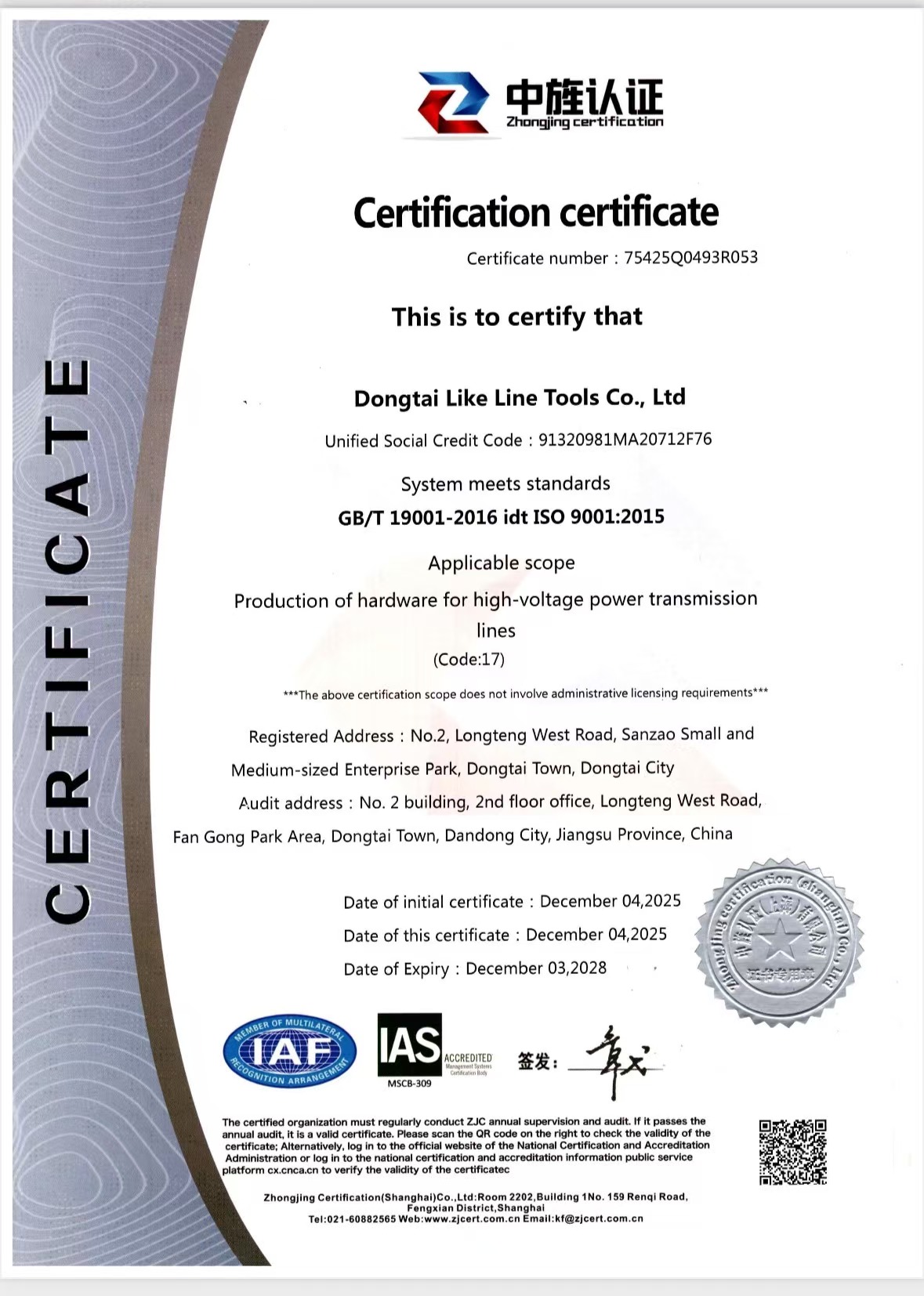
ISO 9001 certificate 75425Q0493R053, issued by Zhongjing Certification (Shanghai) Co., Ltd., referenced against the Ball-Head Suspension Ring QP-7 record.
A neutral reading of that record is important. ISO 9001 certifies a management system, not a product's electrical performance. It tells a buyer that the manufacturing process for the fittings is documented and audited; it does not substitute for a product type test, and it should not be presented to a client's engineer as though it did. The value of the certificate is that it removes a category of supply risk, not that it certifies a rating.
Technical explanation: what the shared envelope actually buys
Creepage distance and arcing distance are routinely confused, and the confusion becomes expensive when a shortlist mixes them. Creepage distance is the shortest path along the external insulating surface between the two electrodes, and it governs leakage under contamination and moisture. Minimum arcing distance is the shortest path through air, and it governs the physical clearance the assembly must preserve. For both the 70B and the U70BP/146D, the recorded values are 255 mm and 450 mm respectively. Two units with the same creepage and the same arcing distance in the same 146 mm height are, dimensionally, the same design envelope.
That equality is the practical value of this shortlist. Because the dimensional envelope and the coupling code are identical, a line section designed around one unit can be re-evaluated with the other without changing string length, hardware interfaces or tower geometry. Material substitution becomes a documentation exercise rather than a redesign. The condition attached to that statement is real, though: the substitution should only be accepted once the dielectric and mechanical test data for the specific model being substituted are on the table, because a shared envelope does not by itself prove equal electrical performance.
Creepage is also a per-unit figure, not a design conclusion. Total creepage for a string is obtained by counting units, and the level a project requires depends on site pollution severity as assessed under standards such as IEC 60815, which the company's type-test records cite alongside IEC 61109, IEC 62217 and IEC 61466. A 255 mm unit is therefore a building block: how many blocks a section needs is an engineering decision that belongs to the line designer, not to the insulator datasheet.
Where the set is used
The recorded applications for this product family are mechanical support and insulation on transmission lines, substation insulation, railway catenary or ground equipment insulation, and fuse and overvoltage protection. The recorded user base is utility companies, power EPC contractors, railway operators and contractors, and distributors and resellers. That spread matters for a shortlist, because the same 70 kN class of item can be bought by a utility for a line rebuild, by an EPC contractor for a substation package and by a distributor for stock, with different documentation expectations in each case.
One supply record illustrates how the set behaves in practice. The company documents a three-year relationship covering 10,000 units across Brazil, Italy, Türkiye and Vietnam, used for mechanical support and insulation on transmission lines, substation insulation, and railway catenary or ground equipment insulation. The reported outcome is improved line stability, reduced maintenance intensity and better pollution resistance. The record does not break the volume down by model, so it should be read as category-level evidence of repeat supply rather than as a model-specific performance claim for the 70B, the U70BP/146D or the QP-7.
Certification and documentation position
Documentation depth is unequal across the three items, and a buyer should know that before the enquiry stage.
- QP-7: two ISO 9001 certificates on record, as described above, with scopes covering high-voltage line hardware and power fittings.
- 70B and U70BP/146D: the reviewed material provides model-level dimensional, mechanical and, for the 70B, dielectric data. Product-level type-test reports tied to these specific models should be requested directly.
- Portfolio context: the company's polymer insulator line is covered by type test report 23XJ0089-S for a 35 kV composite pin insulator, issued by Suzhou Electrical Apparatus Science Research Institute Co., Ltd. and the China National Center for Quality Inspection and Test of Electrical Apparatus Products, tested to IEC 61109 and assessed against IEC 60815, IEC 62217 and IEC 61466. That report is evidence of the company's testing practice; it does not extend to the glass or porcelain models in this shortlist.
Market context: why 70 kN hardware still matters
The composite insulator category continues to attract the largest share of attention. Market Research Future values the global composite insulators market at approximately USD 6.58 billion in 2024, projected to reach USD 9.3 billion by 2035. Mordor Intelligence places Asia-Pacific at roughly 49.5% of 2024 revenue share, and Future Market Insights estimates suspension insulators at about 38% of the product mix in 2025.
Those headline figures require care. Estimates of the 2024 market size diverge widely between research firms: Market Research Future at USD 6.58 billion, Strategic Market Research at USD 3.42 billion and Reports and Data at USD 2.35 billion. The divergence reflects differing category definitions rather than a disputed trend, but it means a single market-size number should never be used as the sole basis for a procurement or investment judgement.
The more decision-relevant figure for this shortlist is the voltage mix. Future Market Insights estimates the 11 kV to 200 kV rating segment at approximately 33% of total market share in 2025, which is the band where 70 kN suspension and post hardware is routinely specified. A further estimate from industry analysis places China at roughly 45% of global composite insulator manufacturing output; that figure is a secondary-source estimate and should be treated as indicative rather than verified. Standards activity reinforces the same direction: the updated IEC 61109:2025 covers composite suspension and tension insulators for AC and DC systems above 1,000 V, and ANSI/NEMA C29.11-2020 defines test methods and performance characteristics for composite insulators on North American overhead transmission lines.
The competitive landscape at the top of the category is consolidated around a small group of large suppliers, including Hitachi Energy, NGK Insulators Ltd., Seves Group (Sediver), Siemens Energy and Hubbell Power Systems. For a buyer, the practical implication is not that smaller portfolios are irrelevant, but that the differentiation has to come from something other than scale: a compact, internally consistent, well-documented set in a specific load class is a legitimate basis for selection.
Comparison with traditional solutions, and where this shortlist stops
Composite insulators are frequently positioned against glass and porcelain on weight, maintenance and pollution behaviour, and the company's own case record highlights lightweight designs, anti-pollution flashover and ageing resistance, and customizable end fittings and FRP rod cores as the advantages of its polymer line. That positioning is reasonable in general terms. It is also incomplete, and a shortlist that ignores the gaps is not a shortlist.
The honest comparison runs in both directions. Polymer housings are exposed to UV and ageing, which is why the company's application records for harsh outdoor projects list anti-aging and UV-resistant performance, high mechanical strength, water penetration resistance and stable, anti-electrochemical corrosion fittings as explicit project requirements. Those requirements exist precisely because the polymer route has its own failure modes to manage. Glass and porcelain, for their part, bring a long service record and, in the case of glass, a dielectric behaviour that is generally described as visible on inspection rather than hidden. Material choice should follow the section, the pollution environment and the maintenance regime, not a preference stated in advance.
The limits of this shortlist should be equally explicit:
- No price-band comparison is included. No verified price data is attached to these three records, so any statement about relative cost would be invented.
- No unit weight is recorded for the 70B or the U70BP/146D. Only the QP-7 carries a stated net weight of 0.3 kg. Logistics and sag calculations need confirmed figures.
- No power-frequency withstand values are recorded for the U70BP/146D in the material reviewed here, unlike the 70B.
- The 70B cantilever load of 10 kN is not a tensile rating and must not be compared with the 70 kN figures.
- Single-unit data cannot establish string performance. Pollution performance, creepage adequacy and mechanical reliability at string level depend on unit count, site severity and type testing, none of which can be derived from one datasheet row.
Procurement checklist for this set
- Confirm the coupling interface in writing: connection structure code 16 on both insulators, designated coupling size 16 on the QP-7.
- Confirm the load class of every component in the string, including fittings, not only the insulators, so that no lower-rated part governs the assembly.
- Request model-specific type-test documentation for the exact 70B and U70BP/146D variants being quoted, and check that the report names the model.
- Request the missing dielectric values for the porcelain option before comparing it with glass on margin.
- Obtain confirmed unit weights for the glass and porcelain insulators for transport and sag planning.
- Confirm creepage adequacy against the project's pollution assessment, using unit count and site severity rather than the per-unit figure alone.
- Agree the commercial frame early: minimum order quantity of 500 units, lead time of 30–45 days, 100% testing, and remote after-sales support. If colour or logo customization is required, raise it before the order rather than after, since the company lists voltage, creepage distance, lightning impulse withstand voltage, bending load, colour and logo among its customization options under OEM and ODM.
Future outlook
Three developments are likely to shape how sets like this one are specified. First, standards revision keeps raising the documentation bar: IEC 61109:2025 and ANSI/NEMA C29.11-2020 both push buyers toward model-specific test evidence rather than category claims, and that pressure tends to spread from composite insulators to adjacent hardware categories. Second, the 11–200 kV band that carries roughly a third of demand is where distribution and subtransmission renewal programmes concentrate, and 70 kN hardware sits directly in that flow. Third, material selection is becoming section-specific rather than portfolio-wide: the same project may specify polymer for a coastal stretch, glass where visual inspection access is limited, and porcelain where the existing string geometry must be preserved without modification.
For that third pattern, a shortlist built on a shared envelope and a shared coupling code is more useful than a list of nominally superior products. The set reviewed here does not claim to be the best option in any absolute sense. It does claim something more checkable: that three items in the same 70 kN class, with the same connection code and, for the insulators, an identical dimensional envelope, can be evaluated against one another with a single documentation request rather than three unrelated ones.
FAQ
Are the 70B, the U70BP/146D and the QP-7 rated for the same mechanical load?
Yes, on the records reviewed. The 70B lists a rated electromechanical failing load of 70 kN, the U70BP/146D lists a rated electromechanical failing load of 70 kN, and the QP-7 lists a rated failing load of 70 kN. The wording differs because insulators and fittings are rated under different conventions, so the comparison should be made on the documented rating rather than on the model naming.
What does connection code 16 mean for compatibility across the set?
Connection structure code 16 appears on both insulators, and the QP-7 specifies a designated coupling size of 16. That shared code is the interface constraint that makes the three items discussable as one set. It should still be confirmed in writing on the quotation, since the code describes the coupling geometry rather than the full mechanical envelope.
Does the porcelain U70BP/146D record include power-frequency withstand voltages?
Not in the material reviewed for this shortlist. The documented electrical values for the porcelain item cover dimensional and mechanical data, while the glass 70B record lists a wet withstand of 45 kV, a dry withstand of 65 kV and a puncture voltage of 135 kV. Buyers comparing the two on dielectric margin should request the model-specific test values for the porcelain variant before drawing a conclusion.
Which certificate covers the Ball-Head Suspension Ring QP-7?
The QP-7 is covered by ISO 9001 certification number 75425Q0493R053, issued by Zhongjing Certification (Shanghai) Co., Ltd. and conforming to GB/T 19001-2016 idt ISO 9001:2015, with a scope covering production of hardware for high-voltage power transmission lines and applicability to Europe, the Americas, the Middle East and Central Asia. A second certificate, 75424Q0348R0S, covers manufacturing of power fittings and is valid from 22 July 2024 to 21 July 2027.
Does ISO 9001 certification confirm the product's electrical or mechanical ratings?
No. ISO 9001 certifies a quality management system covering production processes, not the electrical or mechanical performance of a specific product. Performance claims require model-specific type-test documentation. The certificate addresses supply and process consistency; it does not replace a product test report, and treating it as one weakens a tender submission.
Can the insulators and the ring be supplied with custom creepage, colour or logo?
The company lists voltage, creepage distance, lightning impulse withstand voltage, bending load, colour and logo among its customization options, and offers both OEM and ODM work, with a stated minimum order quantity of 500 units and a lead time of 30–45 days. Custom requirements should be specified before order placement, since they change the drawing and the test documentation attached to the delivery.
Is a composite insulator an alternative to the 70B and the U70BP/146D?
Composite, or polymer, insulators are a separate material family in the same portfolio, illustrated by the 35 kV suspension long rod model FXB-24-70-785mm with a rated bending load of 5 kN, covered by type test report 23XJ0089-S tested to IEC 61109. Whether a composite unit substitutes for glass or porcelain on a given section depends on the section's mechanical requirements, pollution environment and documentation demands. This shortlist does not include mechanical comparison data between the composite line and the glass or porcelain models, so no substitution conclusion is drawn here.
Do the records state a unit weight for the glass and porcelain insulators?
No. Only the QP-7 carries a stated net weight of 0.3 kg. Transport loading, string weight and erection planning for the 70B and the U70BP/146D therefore require confirmed unit weights from the supplier rather than estimates derived from comparable units.
Procurement decisions on sets like this one turn on documented constraints rather than on adjectives. The 70B, the U70BP/146D and the QP-7 are useful together because the constraints already align: one mechanical class, one coupling code, and, between the two insulators, one dimensional envelope. The remaining work is documentation, and that work is best done before the enquiry closes rather than after the goods arrive. The company's 2025 catalogue of polymer insulators and glass insulators is available for download for readers who want the wider product context.
Есть вопросы или нужны дополнительные детали?
Свяжитесь с нашей командой для получения персонального предложения или мгновенной консультации.
Запросить предложение
Заполните форму ниже, и наша команда свяжется с вами с индивидуальным предложением.
Прямой чат WhatsApp
Предпочитаете общаться в реальном времени? Напишите нам в WhatsApp для мгновенной помощи и быстрых ответов.
- Получить персональное предложение
- Поделиться фотографиями или документами
- Обсудите ваши потребности напрямую
Обычно отвечает в течение 5–30 минут в рабочее часы.