
Integrated Wastewater Treatment Quotation FAQ: What to Confirm
An integrated wastewater treatment quotation is a design commitment expressed as a price. Before that number means anything, three things have to be fixed: what enters the unit, what must leave it, and what happens on site between order and handover. United Nations DESA indicator guidance states the underlying requirement plainly — industrial wastewater must pass through a treatment process that removes the specific pollutants generated by production to a defined limit. A quotation that never names that limit cannot be compared with any other quotation, whatever the headline price.
This is a practical problem for buyers at the discovery and research stage. A wastewater treatment plant, a sewage treatment plant, a packaged sewage treatment plant, an integrated sewage treatment system and a containerized wastewater treatment plant can all be quoted against the same nominal flow rate while representing materially different scopes. Assembling a complete input set before requesting prices is what makes supplier responses comparable — and it is the step most often skipped.
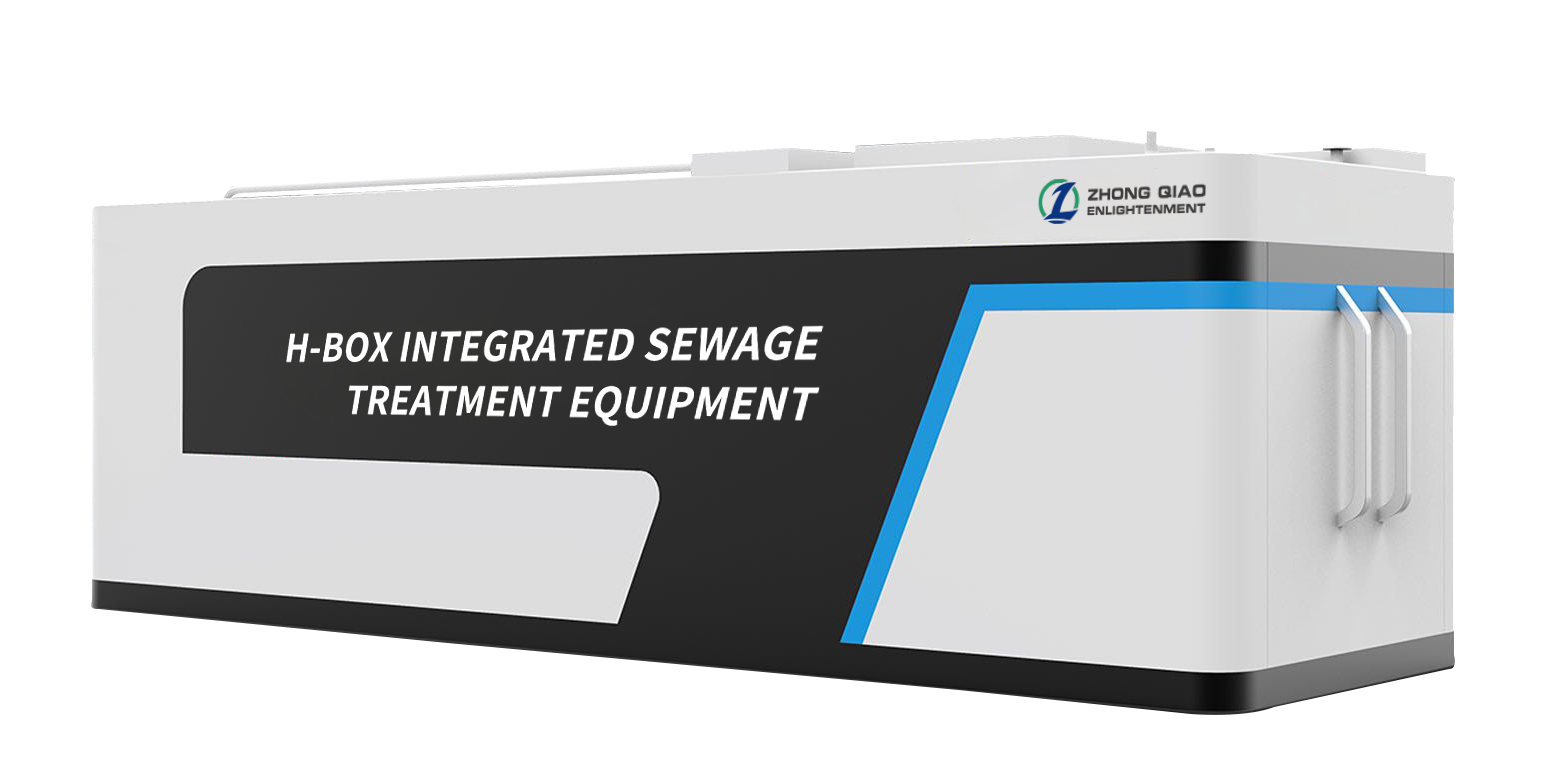
Integrated sewage treatment equipment is factory-assembled and shipped as a unit; the design basis behind each quotation is what varies.
The comparison problem: standardized hardware, unstandardized design basis
Integrated equipment is factory-assembled and shipped as a complete unit, which creates an understandable expectation that the commercial process is similarly standardized. The hardware is repeatable. The design basis behind each quotation is not. Two suppliers can each offer “a 100 m³/day integrated system” while describing different tank volumes, different aeration capacity, different material grades and, most consequentially, different exclusions.
Two failures follow from that gap. First, price comparison becomes meaningless because the underlying scopes differ. Second, the effluent standard quietly becomes an assumption: the buyer assumes a standard is included, and the supplier assumes the buyer will specify one. Both parties are satisfied with the quotation until commissioning, when the acceptance test has no agreed basis.
The remedy is procedural rather than technical. A buyer who arrives with a complete input sheet converts an open-ended conversation into a bounded engineering exercise, and every supplier response then answers the same question. Shandong Zhongqiao Enlightenment Environmental Protection Equipment Co., Ltd. — a China-based manufacturer established in 2013 that produces integrated wastewater treatment equipment, dissolved air flotation units, lamella clarifiers and MBR membrane systems — lists exactly three items as its stated special requirement for integrated sewage treatment equipment: influent water quality, effluent discharge requirements and treatment flow rate. That trio is a reasonable minimum standard to apply to every supplier, not only to one.
Three input groups that make a quotation valid
Quotation inputs divide into three groups. Each one changes specific lines in the bill of quantities, which is why omitting any of them makes the final price unreliable rather than merely approximate.
| Input group | What the buyer must state | Why the quotation depends on it |
|---|---|---|
| Influent basis | Design flow (daily average and peak hourly), the source of the stream, and measured or estimated quality parameters | Sets biological load, reaction volume, aeration capacity and sludge handling |
| Effluent target | The discharge standard by name and jurisdiction, the receiving body or reuse purpose, and who verifies compliance | Fixes the process train, the polishing steps and the acceptance test |
| Site and commercial boundary | Above-ground or underground installation, available footprint, power supply, control philosophy, civil works responsibility, delivery point, commissioning and training scope | Determines the lines that are easiest to leave out of a headline price |
Technical parameters a quotation needs
Flow rate: two numbers, not one
Average daily flow establishes the pollutant load and therefore the reaction volume. Peak hourly flow establishes hydraulic sizing — pipe diameters, pump duty and buffer volume. A quotation built on a single daily figure is under-specified on the hydraulic side, which is where short-circuiting and overflow problems originate in domestic sewage applications with strongly variable occupancy.
Influent quality: the parameters that change the process train
The useful set is COD, BOD₅, suspended solids, oil and grease, ammonia nitrogen, total nitrogen and phosphorus where relevant, pH, temperature, and salinity or conductivity. Oil and grease deserves particular attention. Where a stream carries high oil and suspended solids — abattoir, printing and dyeing, livestock farm, textile dyeing — a dissolved air flotation stage is commonly placed ahead of the biological unit. Zhongqiao Enlightenment specifies its Dissolved Air Flotation equipment for exactly those streams, with a design reference model YW-5 and a rated processing capacity of 5 m³/h, supplied in carbon steel or SS304, using dissolved air to remove suspended solids and oil before downstream treatment.
This is the point where a buyer first learns whether the quotation covers a single integrated unit or a train. A slaughterhouse wastewater treatment plant and a hotel wastewater system may both be domestic-type streams, but the fat and solids load in the first will usually require pretreatment that the second does not.
Material and installation environment
Integrated sewage treatment equipment is available in carbon steel, SS304 or PP. Company technical documentation states that PP integrated equipment withstands acid and alkali corrosion within the pH range of 3 to 14, which matters for industrial streams with aggressive chemistry. Material selection is not purely a corrosion question: temperature, structural loading and access requirements also apply, and a material chosen only on pH can be the wrong answer.
Installation mode is equally commercial. Above-ground and underground configurations are both supported. Underground installation reduces visible footprint but complicates maintenance access, so the access provisions must appear explicitly in the quotation rather than being assumed.
Electrical, control and standby scope
Control scope is where comparability most often collapses. In the reference configuration for the WSZ-100 integrated wastewater treatment equipment, the supplied scope includes two blowers (one duty, one standby), two self-priming pumps type PXZ15-30-1.5 with DN40 connections, a Siemens PLC module, a PLC control panel, a 4G remote monitoring module, a multifunctional meter, Schneider electrical elements, a 100 L PE dosing tank with a metering pump rated at 120 L/h, and a water flow meter. A buyer should check line by line which of these sit inside the supplier’s battery limit and which are buyer-supplied, because a quotation that omits redundancy or remote monitoring is cheaper for a reason.
Scope boundary and exclusions
The exclusions list is as important as the price. Civil works and foundations, inlet and outlet piping to the unit, power supply to the control panel, local permits, freight and insurance, commissioning labour, operator training and spare parts inventory all need to be assigned to a party in writing. Where these are left ambiguous, they reappear later as variations.
What WSZ-100 defines — and what it does not
The WSZ-100 is a model designation within Zhongqiao Enlightenment’s integrated wastewater treatment equipment range, classified as domestic sewage treatment equipment. It is intended for hotel, hospital, camp, slaughterhouse and livestock breeding industries, and is designed for hotel wastewater, hospital wastewater, camp domestic wastewater, slaughterhouse wastewater, livestock breeding wastewater, domestic sewage and domestic wastewater scenarios. It supports above-ground or underground working conditions and can operate automatically.
What the model designation fixes is the equipment architecture: a factory-assembled unit with matched blower and pump set, dosing, PLC-based control and material options. What it does not fix is the effluent standard, the reaction volume required for a given load, or the construction period. Those three follow from the input set, not from the catalogue number. Treating the model number as the answer rather than as the starting point is the most common error in integrated wastewater treatment procurement.
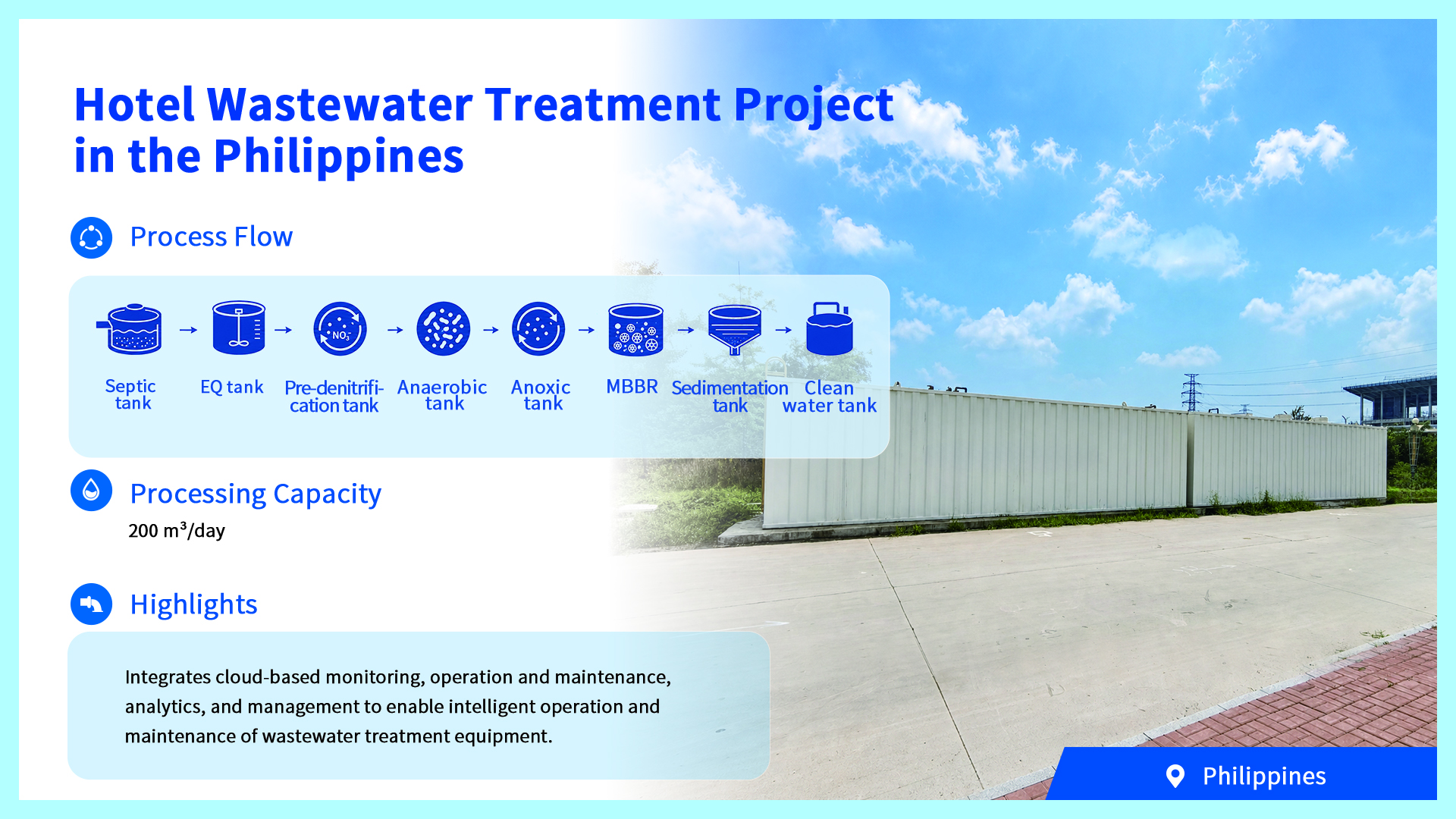
Hotel wastewater is one of the domestic-type streams in scope; its flow varies with occupancy, which changes the hydraulic basis of the quotation.
Effluent target: state it, then verify it
“What standard can your equipment reach?” is a natural question, but it inverts the decision. Equipment does not carry an inherent discharge standard. It has a performance envelope that is defined against a stated influent and a stated target. On the record, the effluent standard of integrated wastewater treatment equipment can be customized on demand; common national standards referenced include Grade 1A and Grade 1B, which can meet municipal discharge and water reuse scenarios. The same source states the correct sequence: provide influent water quality and local discharge requirements before selection, and the equipment is then designed according to those indicators.
For a buyer, the operational instruction is to name the target rather than accept one. State the standard and its jurisdiction, not simply the word “compliant”. State whether the target is for discharge to a receiving body or for reuse, since reuse targets are generally stricter and change the process train. Then verify the claim against five questions:
- Which design influent basis does the performance commitment assume, and is that basis written into the offer?
- Which parameters will the acceptance test measure, at what sampling point, and over what period?
- Who witnesses and certifies the test, and what happens if influent quality departs from the design basis?
- Which parameters are explicitly excluded from the guarantee — ammonia nitrogen, phosphorus, colour and pathogens are frequent candidates?
- Is the claim a design intention or a tested result on a comparable stream?
A supplier who quotes a standard without first asking for influent data has not made a verifiable commitment, regardless of how the sentence is worded. That is a statement about documentation discipline, not about any particular supplier’s capability.
Construction period: split the number before you accept it
Construction period is usually quoted as a single figure, and a single figure is not actionable. The useful form is a schedule broken into segments with a named owner for each. Integrated equipment shortens some segments substantially and leaves others untouched, so an unsplit number hides where the time actually sits.
| Schedule segment | Typical owner | What the buyer should ask |
|---|---|---|
| Design and drawing approval | Supplier, with buyer sign-off | Which drawings must be approved before fabrication starts, and how long does approval take on the buyer side? |
| Fabrication and factory assembly | Supplier | Does the date assume standard material stock or a special order, and where does this sit against factory capacity? |
| Factory testing and inspection | Supplier, optionally witnessed | What is tested before shipment and what record is issued? |
| Packing, inland transport and freight | Split by Incoterm | Which delivery term applies, and who bears port, customs and inland haulage? |
| Civil works and foundations | Usually buyer | Is civil scope included, and are drawings and loading data supplied in time? |
| Mechanical and electrical installation | Supplier supervision or buyer contractor | Is supervision priced, and is it included in the stated period? |
| Commissioning and biological start-up | Supplier | How long is the acclimatisation or seeding period, and does it count toward the stated period? |
| Performance verification and handover | Joint | What test duration and which parameters constitute acceptance? |
What integrated, modular construction genuinely changes is documented in the manufacturer’s own equipment description: units are shipped as complete assemblies, on-site installation is fast and the construction period is greatly shortened; the compact structure occupies a small floor area and saves civil engineering cost; the layout is easy to move and expand for later upgrading; operation is automatic with low labour maintenance cost; and anti-corrosion materials support a long service life. Those are real advantages at the installation stage, and they are the reasons packaged and integrated systems have displaced cast-in-place construction in many smaller and remote sites.
What integrated construction does not change is everything outside the unit boundary. Foundations, permits, power connection and pipework to the unit remain calendar-time activities, frequently on the buyer’s side, and they often dominate the total schedule. When a supplier states a construction period, the buyer should ask precisely which of the segments above the figure includes, and which are excluded. A short number covering only fabrication is not comparable with a longer number covering fabrication through to performance verification.
Application fit: where the domestic-sewage envelope applies
The WSZ-100 application list spans hotel, hospital, camp, slaughterhouse and livestock breeding, and each of those settings changes the quotation in a different way. The model number stays the same; the input set does not.
Hotel wastewater. Occupancy drives flow and load, and seasonal swings are large. The quotation should show how the hydraulic basis was derived and what buffer volume is included, because a system sized on annual average occupancy will be strained at peak season.
Hospital wastewater. A hospital wastewater treatment system is judged on more than organic removal, and local rules on disinfection and specific parameters determine whether a single integrated unit is sufficient or whether additional stages are required. The effluent target should be stated in the local regulator’s terms before any quotation is requested.
Camp domestic wastewater. Remote construction and service sites value exactly what integrated units provide: factory assembly, compact footprint, above-ground or underground siting, and automatic operation with low labour input where skilled operators are scarce. Transport and installation logistics belong in the commercial scope, not in a separate conversation.
Slaughterhouse wastewater. This is where the process train usually widens. High oil and suspended solids call for dissolved air flotation ahead of the biological stage, and the quotation must show whether that stage is inside or outside the price.
Livestock breeding wastewater. High strength and high ammonia load narrow the design envelope. Buyers should confirm the upper range of influent concentration the design assumes, and what performance is expected outside that range.
Integrated versus conventional construction: where the advantage stops
The comparison that matters for procurement is not brand against brand. It is delivery model against delivery model: a factory-assembled integrated or packaged system versus a cast-in-place concrete plant with separately procured equipment.
| Dimension | Cast-in-place conventional plant | Integrated / packaged unit |
|---|---|---|
| Civil works | Substantial; site-built tanks and structures | Reduced; compact footprint lowers civil cost, foundations still required |
| On-site installation | Long, weather-dependent | Shipped as complete units; fast installation and shortened construction period |
| Relocation and expansion | Effectively fixed in place | Easy to move and expand; flexible combination across capacities |
| Operation and labour | Depends on installed controls and staffing model | Automatic operation with low labour maintenance cost |
| Capacity ceiling | Scales to large municipal and industrial flows | Bounded by the modular range and transport limits |
| Maintenance access | Generous by design | Tighter; access provisions must be quoted, especially underground |
| Best fit | Large, long-life, high-load industrial and municipal plants | Defined domestic-type streams, remote sites, phased or relocatable projects |
The boundaries deserve equal weight, because a quotation is only useful if its limits are explicit. Integrated and packaged units are designed around a stated flow and contaminant envelope; above that envelope the economics shift back toward civil structures and custom process design, and a buyer should expect a supplier to say so rather than stretch the modular range. A unit also cannot guarantee an effluent standard independently of influent quality, loading and operating discipline — the performance commitment is conditional by nature.
Nor is the construction-time advantage unlimited. Factory assembly compresses installation, but foundations, permits, power connection and commissioning remain on the critical path, and on many projects those buyer-side activities set the real handover date. Finally, the integrated format suits the domestic-type streams named in its application scope; for high-strength industrial wastewater the unit is often one stage in a wider train that may include dissolved air flotation, MBR membrane bioreactor or MBBR stages, and the quotation must show which stages it covers.
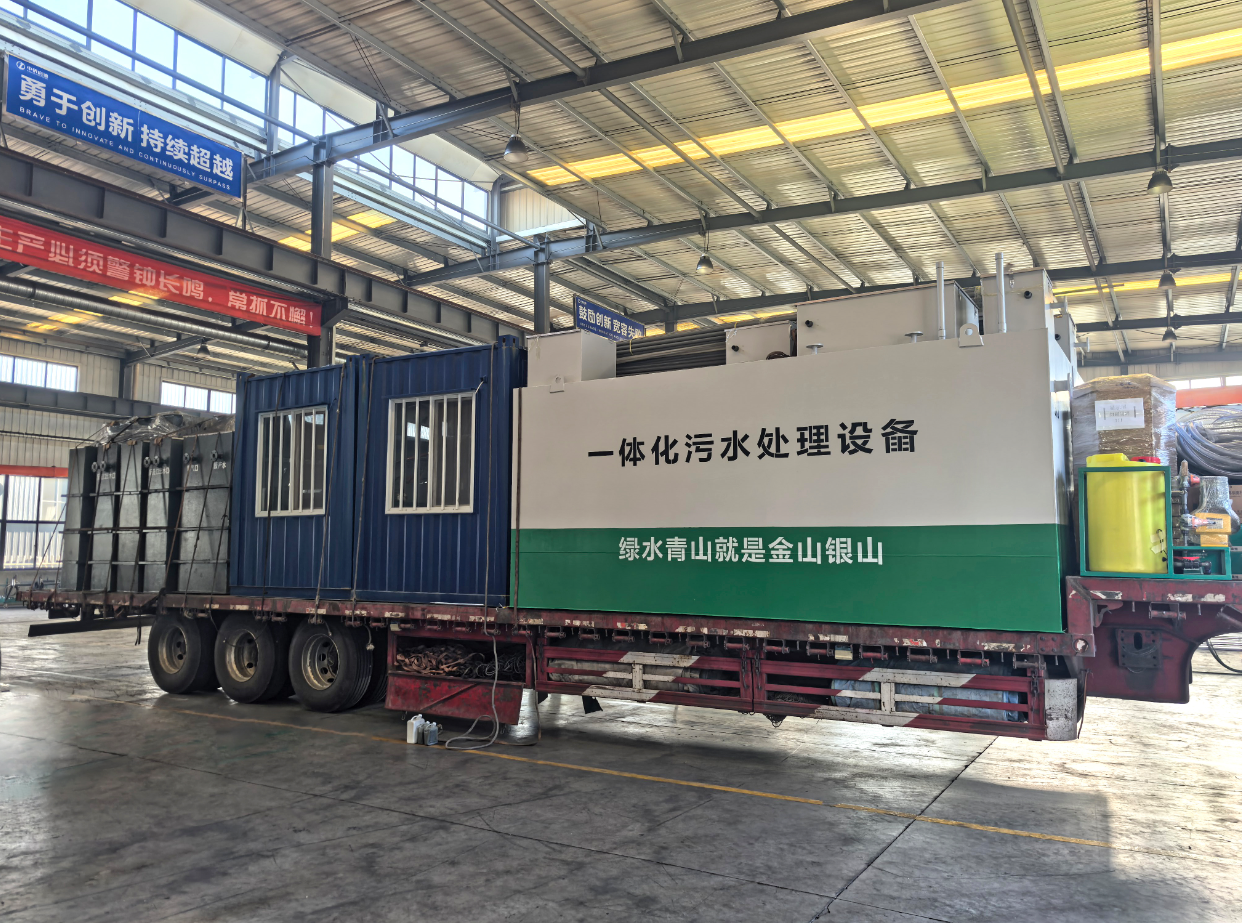
Factory assembly compresses on-site installation time; it does not compress buyer-side civil works, permits or power connection.
What the market data does and does not tell a buyer
Primary trade data puts the supply side in perspective. According to the Observatory of Economic Complexity, drawing on UN Comtrade and national customs records, global trade in water purification and filtration equipment under HS code 842121 reached USD 12.4 billion in 2024, a 4.34% increase on 2023. China was the leading exporter at USD 2.38 billion, ahead of Germany at USD 1.3 billion.
The procurement implication is not that one country is better than another. It is that supplier density is high and quotations are easy to obtain, which shifts the bottleneck from availability to comparability. When many suppliers can respond within days, the differentiator becomes the buyer’s own input discipline: the party with a normalized input sheet receives comparable offers; the party without one receives a set of prices that cannot be ranked.
Forecast figures require more caution. The Business Research Company projects the global wastewater treatment equipment market to reach USD 43.94 billion by 2030, while MarketsandMarkets values the water and wastewater treatment equipment market at USD 68.7 billion in 2024, projected to reach USD 87.7 billion by 2029. These figures describe different scopes — industrial equipment versus a broader equipment definition — and cannot be compared directly. They indicate direction of demand, not a budget line for any individual project. Buyers who cite market size as a price argument are mixing categories.
Future outlook
Three shifts are visible in how integrated wastewater treatment is being specified. The first is that discharge limits continue to tighten, which moves the negotiation from equipment selection to verification methodology. The second is that modular, factory-assembled and containerized delivery is becoming the default for sites where civil construction is slow, remote or temporary. The third is that control scope is expanding: the reference WSZ-100 configuration already includes a 4G remote monitoring module alongside the PLC, which changes the acceptance conversation from a single handover test to continuous operating data.
For buyers, the practical consequence is that a quotation which cannot be traced back to a stated influent, a named effluent target and a segmented schedule will age badly. Standards change, sites change and operating data accumulates. The documents that survive that change are the ones that recorded their assumptions at the outset.
FAQ
What information is needed before requesting an integrated wastewater treatment quotation?
Three inputs are required: influent water quality, effluent discharge requirements and treatment flow rate. Zhongqiao Enlightenment lists these as the special requirement for its integrated sewage treatment equipment. In practice the influent basis should include daily average and peak hourly flow plus measured or estimated COD, BOD₅, suspended solids, oil and grease, ammonia nitrogen, pH and temperature. The effluent basis should name the standard, the jurisdiction and whether the target is discharge or reuse.
What effluent standard can integrated wastewater treatment equipment reach?
The effluent standard of integrated wastewater treatment equipment can be customized on demand. Common national standards referenced include Grade 1A and Grade 1B, which can meet municipal discharge and water reuse scenarios. Selection requires influent water quality and local discharge requirements to be provided first, after which the equipment is designed according to the required indicators. A standard quoted without that input basis is not a verifiable performance commitment.
How should construction period be clarified in a wastewater treatment quotation?
Ask for the period to be broken into design approval, fabrication, factory testing, freight, civil works, installation, commissioning and performance verification, with an owner named for each. Integrated equipment is shipped as complete units and greatly shortens on-site installation, but civil works, permits and power connection typically remain buyer-side and often set the real handover date. A single figure without segment boundaries cannot be compared across suppliers.
What is the WSZ-100 integrated wastewater treatment equipment?
The WSZ-100 is a model designation within Zhongqiao Enlightenment’s integrated wastewater treatment equipment range, classified as domestic sewage treatment equipment. It is supplied by a China-based manufacturer and a unit has been delivered to Saudi Arabia. It is intended for hotel, hospital, camp, slaughterhouse and livestock breeding industries, covering hotel wastewater, hospital wastewater, camp domestic wastewater, slaughterhouse wastewater, livestock breeding wastewater, domestic sewage and domestic wastewater.
Which materials are available, and how should a buyer choose between them?
Integrated wastewater treatment equipment is available in carbon steel, SS304 and PP. PP integrated equipment can withstand acid and alkali corrosion within a pH range of 3 to 14, which suits aggressive industrial streams. Material choice should also account for temperature, structural loading and maintenance access; selecting on pH alone can produce a unit that is corrosion-resistant but unsuitable for the installation environment.
Does an integrated unit replace civil works entirely?
No. The compact structure and small floor area reduce civil engineering cost and the factory-assembled format shortens installation, but foundations, tank pads where required, pipe trenches and power connection remain site activities. Whether those are inside a supplier’s scope should be confirmed in writing rather than assumed from the equipment description.
Which applications is integrated sewage treatment equipment intended for?
It is designed for hotel wastewater, hospital wastewater, camp domestic wastewater, slaughterhouse wastewater, livestock breeding wastewater, domestic sewage and domestic wastewater, serving the hotel, hospital, camp, slaughterhouse and livestock breeding industries. It supports above-ground and underground working conditions and can operate automatically. Streams carrying high oil and suspended solids, such as slaughterhouse, textile dyeing and livestock farm wastewater, commonly require a dissolved air flotation stage ahead of the biological treatment step.
How does an integrated system differ from a conventional wastewater treatment plant?
A conventional plant is built in place from civil structures with separately procured equipment. An integrated system is factory-assembled, shipped as complete units, installed quickly, occupies a small floor area, can be moved and expanded, and operates automatically with low labour maintenance cost. The trade-off is a bounded capacity envelope and tighter maintenance access, so conventional construction remains the better fit for large or long-life high-load plants.
For readers assembling an input sheet against a specific project, Zhongqiao Enlightenment’s company brochure (13th edition) documents the equipment range and reference configurations. The company is ISO 9001 certified, operates a 40,000 m² manufacturing facility with approximately 170 employees and an annual production capacity of about 900 sets, maintains an R&D team of 15 engineers, and serves markets in Southeast Asia, the Middle East, North America and Central Asia.
Есть вопросы или нужны дополнительные детали?
Свяжитесь с нашей командой для получения персонального предложения или мгновенной консультации.
Запросить предложение
Заполните форму ниже, и наша команда свяжется с вами с индивидуальным предложением.
Прямой чат WhatsApp
Предпочитаете общаться в реальном времени? Напишите нам в WhatsApp для мгновенной помощи и быстрых ответов.
- Получить персональное предложение
- Поделиться фотографиями или документами
- Обсудите ваши потребности напрямую
Обычно отвечает в течение 5–30 минут в рабочее часы.