
Interactive Holographic Projection Systems: Industry Reference
Interactive Holographic Projection Systems: Industry Reference
How transparent and holographic display surfaces are specified, where they are deployed commercially, and which physical limits still decide the technical brief.
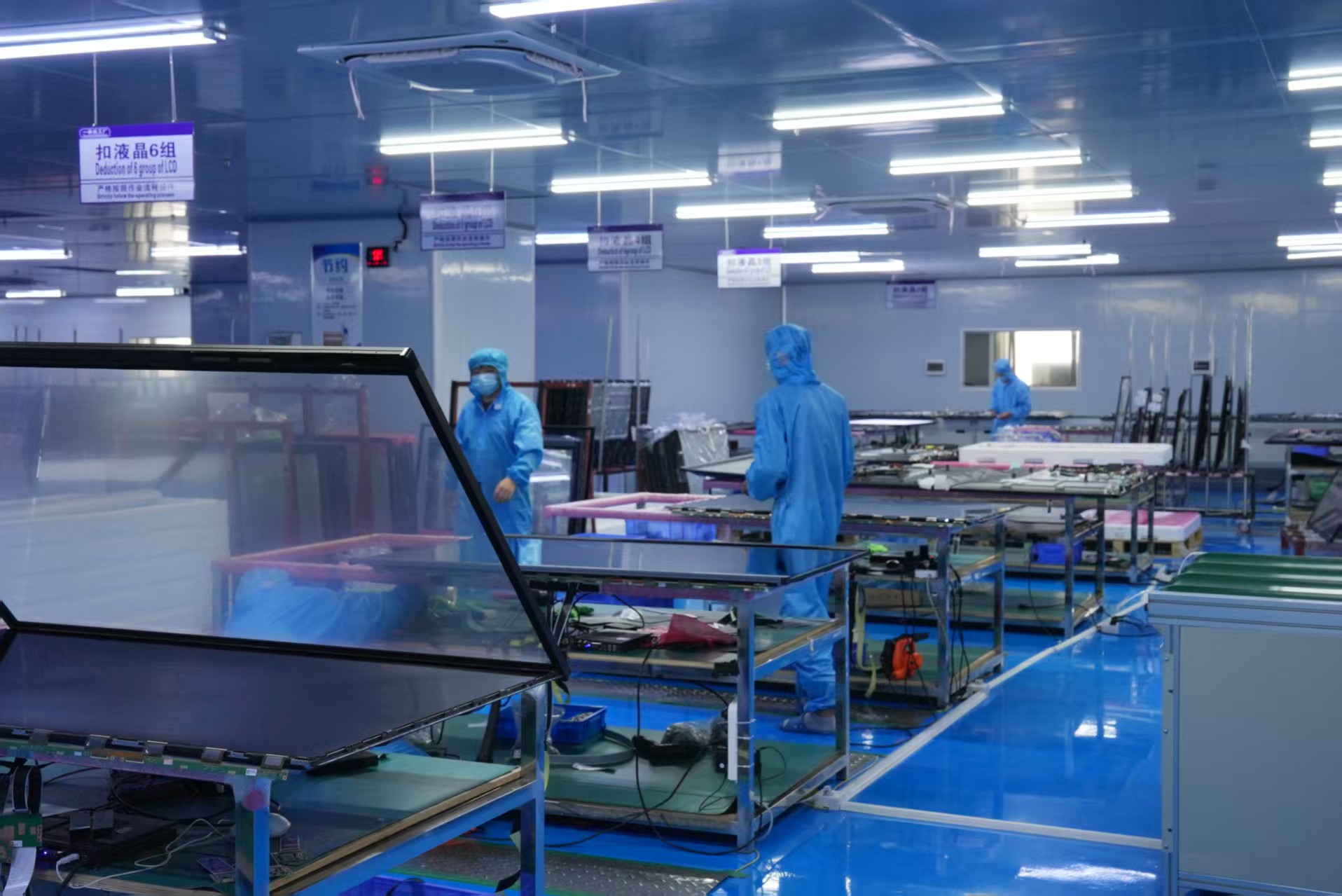
Commercial display production room at Guangzhou Kedro Electronics Technology Co., Ltd., Panyu District, Guangzhou.
An interactive holographic projection system is a display installation in which a transparent or semi-transparent optical surface carries a bright, readable image while remaining partly see-through, and an input layer lets that image respond to the people standing in front of it. The label is a commercial umbrella rather than a single optical principle. Under it sit at least three physically different hardware routes: transparent LCD cabinets, human-scale digital human displays that render in apparent three-dimensional space, and large-format splicing arrays used behind or around a transparent medium.
Because the umbrella is wide, procurement conversations often stall on vocabulary rather than on engineering. Two suppliers can both quote a holographic display and deliver products with almost nothing in common — one optimised for see-through retail glazing, one optimised for bright front-facing volumetric content, a third assembled from tiled panels to cover an entire wall. What actually determines whether an installation works is not the label but the balance between light transmittance, peak brightness, viewing angle, interaction method, and continuous operating envelope.
What an Interactive Holographic Projection System Consists Of
Regardless of vendor, installations in this category are assembled from four functional layers. Separating them is the fastest way to compare quotations that use different terminology for the same thing.
- Optical surface. The layer the audience looks at. In transparent cabinet designs this is an industrial transparent LCD panel behind tempered glass or acrylic, which passes background light while modulating the image in front of it. In digital human designs the surface is a high-transmittance panel with controlled reflection, so the rendered figure appears to occupy the space behind the glass rather than sitting flat on it.
- Image engine. The light source and panel driving the picture. Resolution, brightness in cd/m², contrast ratio, HDR support and local dimming zones all sit here, and they set the ceiling on how the content looks once ambient light is added.
- Interaction layer. How the audience changes what is displayed — capacitive or vibration touch sensing, infrared sensing, AI gesture recognition, microphone arrays for voice, or camera-based presence detection. In commercial display platforms, multi-touch and infrared sensing are typically combined with AI gesture recognition so the same unit supports touching, pointing and hands-free control.
- Content and control layer. The software that schedules, deploys and monitors content. In networked commercial signage this normally takes the form of a cloud management platform supporting remote deployment, monitoring and maintenance of devices across sites, plus media players or OPS computers mounted inside the cabinet.
The three hardware routes map onto these layers differently. A transparent cabinet prioritises layer one. A holographic digital human prioritises layers two and three, because a talking, listening human figure only reads as convincing when brightness, contrast and audio are all high. A splicing wall prioritises scale and continuity, and is normally used to create the visual field within which a transparent or holographic element sits.
Why the Category Is Moving From Attraction to Specified Infrastructure
Holographic and transparent displays began as event attractions — rented for a launch, dismantled afterwards. The shift now visible in commercial projects is from temporary spectacle to permanent installation, and three practical pressures drive it.
First, space. A transparent display can be placed in front of a window, a vitrine, a reception desk or an exhibit without blocking the sightline behind it. In retail interiors and museum settings this is often the deciding factor, because an opaque screen of the same size would obscure the merchandise or the object it is meant to describe.
Second, interaction expectations. Audiences increasingly assume that a display will react. Multi-touch, infrared sensing and AI gesture recognition have become standard expectations in exhibition and retail environments rather than premium extras, and voice interaction with an on-screen figure is now a recognised format in exhibition halls and lobbies.
Third, operational management. Once a transparent or holographic unit is installed permanently, the buyer inherits a content and maintenance obligation. This is why network management features — remote deployment, monitoring and maintenance of devices across locations — matter as much to the purchase decision as the panel specification itself.
The Engineering Trade-Offs That Decide a Holographic Display Specification
Transparency versus brightness
Transparency and brightness pull in opposite directions. The more light the panel lets through, the less light it can impose on the viewer. A cabinet rated at 95% transparency with brightness in the region of 380 cd/m² is designed to be seen through, and reads best against a controlled, moderately lit background. A panel with roughly 30% light transmittance and 1300 cd/m² brightness is designed to be seen, and sacrifices see-through quality for image presence. Neither is better; they answer different briefs.
Ambient light and perceived contrast
Contrast ratios are measured in dark conditions. In a glass-roofed atrium or a south-facing mall window, the practical contrast a viewer perceives is a function of screen brightness plus surface reflection. Panels in this category typically specify a reflection figure alongside transmittance precisely because reflected ambient light washes out dark content first. Any project with daylight exposure should be specified against the actual lighting condition on site, not against a datasheet number.
Viewing angle and audience position
Transparent cabinet panels commonly quote full 178-degree horizontal and vertical viewing angles, comparable to conventional LCD. Human-scale holographic digital human units are different: minimum viewing angles for such units can be quoted as 79 degrees left, right, up and down, which means the volumetric effect degrades as the viewer moves off-axis. For an exhibition stand where visitors approach from a wide arc, that changes where the unit should be positioned and how many units are needed.
Power, heat and duty cycle
Image presence costs power. A large-format holographic digital human unit carrying a 4K panel, a 2.1 channel audio system with 60W speakers, an eight-array microphone and a camera can be rated at 1100W with a rated input of AC 100–240V at 50/60Hz. A transparent cabinet of comparable visual area may draw around 100W at 24V. Electrical provisioning, cooling and ventilation should be planned from the rated figure, and operating temperature windows — typically 0 to 40 degrees Celsius for an indoor holographic digital human unit — should be matched to the venue.
Interaction method and accessibility
Touch is not always the right input. On a transparent surface in a public corridor, hygiene and durability push projects toward gesture and presence detection instead of contact. Conversely, in a controlled showroom, multi-touch with 40 simultaneous touch points supports group interaction on a large screen. Selecting the interaction layer before selecting the panel avoids specifying a surface that the intended input method cannot reliably serve.
GZKEDRO as a Display Supplier in This Category
Guangzhou Kedro Electronics Technology Co., Ltd. is a commercial display manufacturer established in 2013 and located at Unit 103, Building 3, No. 5, Yongshan Village, Shiqi Town, Panyu District, Guangzhou, China. The company develops and manufactures commercial display screens and intelligent interactive devices, with research and development operations in Guangzhou and Shenzhen. Its manufacturing facility covers 50,000 m³, it employs more than 200 people, and its research and development team consists of more than 100 people. Export business accounts for 80% of total sales, and the company reports a global supply capability for small, medium and large commercial display projects, supplying more than 1,000 commercial display units globally each year.
The technology platform behind those products includes 4K display panels, multi-touch and infrared sensing input, AI gesture recognition, and a remote cloud control platform that supports remote deployment, monitoring and maintenance of devices worldwide. Its smart educational whiteboard line is certified to multiple international standards including CE, FCC, RoHS and ISO9001.
Two product families are directly relevant to holographic and transparent display briefs: the KD-DH Series Holographic Digital Human and the KD-TP Series Transparent Cabinet Display. Large-format visual requirements are handled by the KD-VW Series Video Wall Display and the KD-LED Series LED Display. The company website is gzkedro.com.
Reference Specifications for Holographic and Transparent Display Units
KD-DH Series Holographic Digital Human
The KD-DH Series is an AI digital human display intended for exhibition centres, hotel lobbies, commercial districts, education and healthcare environments. Its published specification is as follows.
| Parameter | KD-DH Series |
|---|---|
| Display size | 1649 (H) × 927 (V) mm |
| Aspect ratio | 16:9 |
| Resolution | 3840 × 2160 |
| Brightness | 1300 cd/m² |
| Local difference zones | 320 |
| Physical contrast ratio | 3000:1 |
| Viewing angle | R/L 79° (min.), U/D 79° (min.) |
| HDR | Supports HDR1,000 |
| Light transmittance | 30% |
| Reflection | 60% |
| Audio | 60W, 2.1 channels |
| Microphone | 8-array microphone |
| Camera | 5MP driverless |
| Input voltage | AC 100–240V (50/60Hz) |
| Rated power consumption | 1100W |
| Operating environment | 0–40°C, 10–85% RH, no condensation |
| Storage environment | -10–60°C, 10–90% RH, no condensation |
| Materials | Tempered glass, acrylic, aluminium alloy |
Read as a procurement document, the specification answers three questions at once. The 320 local difference zones and 3000:1 physical contrast mean the panel can hold dark backgrounds against a lit foreground, which is what makes a rendered human figure appear to stand in space rather than float on a grey rectangle. The 8-array microphone and 5MP driverless camera indicate that voice and presence interaction are handled by the unit itself rather than by external peripherals. The 30% light transmittance and 60% reflection figures set a clear expectation: this is not a see-through cabinet, and it performs best in a controlled interior lighting environment.
KD-TP Series Transparent Cabinet Display
The KD-TP Series is an industrial transparent LCD cabinet aimed at luxury retail stores, hotels and commercial districts.
| Parameter | KD-TP Series |
|---|---|
| Panel type | Industrial transparent LCD screen |
| Display area | 1430 mm × 805 mm |
| Overall dimensions | 1585 mm × 972 mm × 300 mm |
| Resolution | 1920 × 1080 |
| Pixel pitch | 0.9405 (H) × 0.9405 (V) |
| Transparency | 95% |
| Brightness | ≥380 cd/m² |
| Contrast ratio | 3000:1 |
| Brightness uniformity | 95% |
| Display colour range | 16.7M |
| Response time | 8 ms |
| Viewing angle | 178° horizontal, 178° vertical |
| Signal format | NTSC, PAL, 408I, 576, 480P, 576P, 720P, 1080I |
| Operating temperature | 0°C to 60°C |
| Storage temperature | -10°C to 60°C |
| Storage humidity | 10% to 90% (non-condensing) |
| Power | 24V / 100W; supply AC100V–240V 50/60Hz |
| Materials | Tempered glass, acrylic |
The two specifications describe opposite design intentions. The transparent cabinet optimises for what the viewer sees through the screen, at the cost of image brightness. The holographic digital human optimises for what the viewer sees on the screen, at the cost of transparency. A project brief that names both requirements without ranking them will produce a specification that satisfies neither.
Large-format and splicing layers
Where a holographic or transparent element needs to sit inside a much larger visual field, scale is usually delivered by splicing products rather than by enlarging a single transparent panel.
| Parameter | KD-VW Series Video Wall Display | KD-LED Series LED Display |
|---|---|---|
| Configuration | 55-inch, 4 × 4 array | Modular LED, module 320 mm × 160 mm × 17 mm |
| Resolution | 1920 × 1080 per screen | 128 × 64 dots per module |
| Sealing gap | 3.5 mm | Not applicable |
| Brightness | 500 cd/m² | White balance ≥4500 cd/m² |
| Contrast ratio | 4000:1 | Brightness uniformity ≥97% |
| Viewing angle | 178° (H) / 178° (V) | H ≥160°, V ≥140° |
| Dot pitch / pixel density | Not applicable | 2.0 mm; 160,000 dots/m² |
| Refresh rate | Not applicable | ≥3840Hz; frame rate 60Hz |
| Interfaces | DVI, HDMI, VGA | Constant current drive, 1/16 scan |
| Materials | Industrial LCD panel, metal frame, hydraulic bracket | Metal sheet, aluminium alloy |
The relevance to holographic display projects is practical. A 3.5 mm sealing gap across a 4 × 4 video wall is what determines whether a rendered image reads as one continuous field or as sixteen tiles, and a refresh rate of 3840Hz or higher on an LED surface determines whether the result is camera-friendly for broadcast and social capture. Both are frequently overlooked until the installation is filmed.
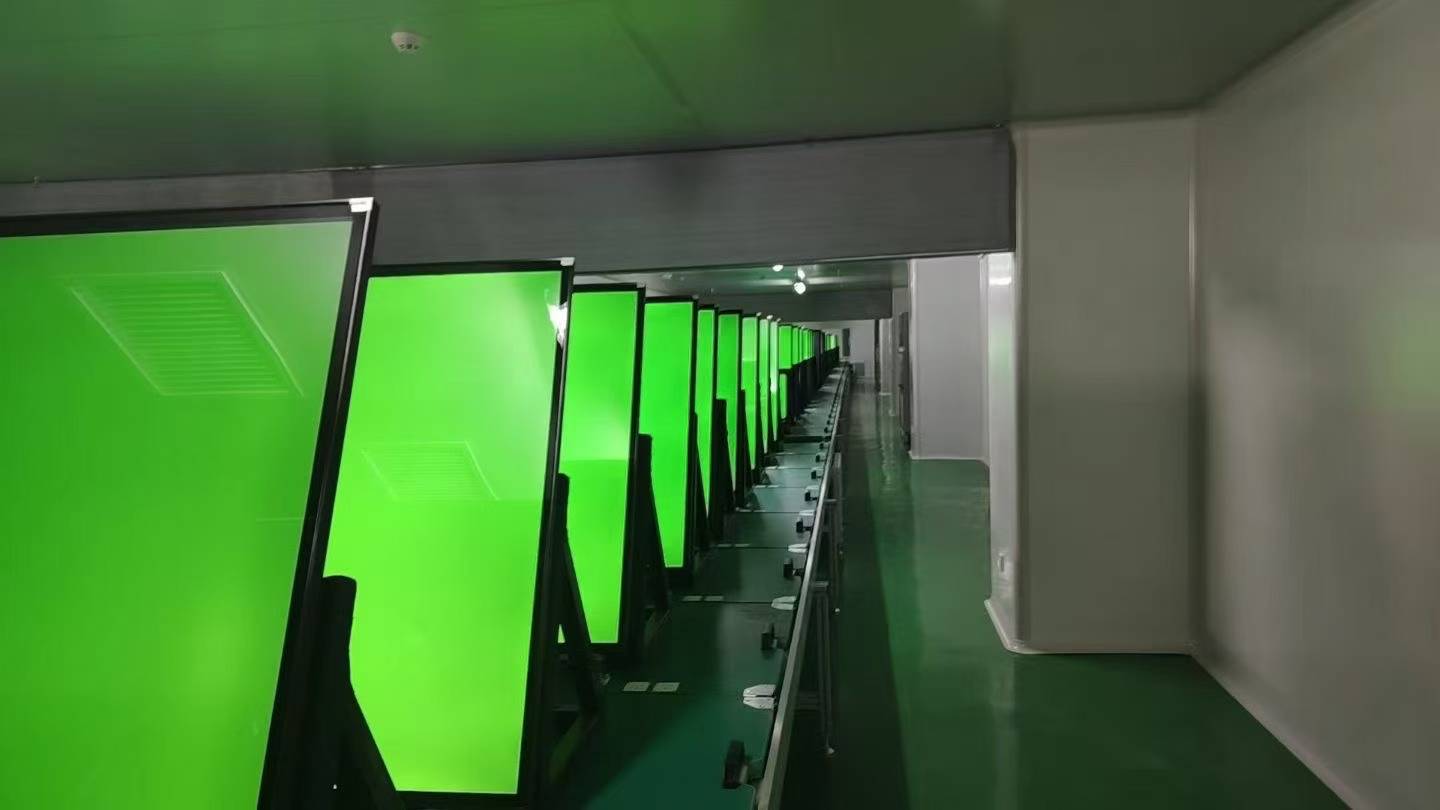
Aging test of commercial display units at Guangzhou Kedro Electronics Technology Co., Ltd.
Where Interactive Holographic Displays Are Deployed
Documented application scenarios for the display families most often combined in holographic and transparent installations show a consistent pattern: the transparent cabinet serves retail, and the human-scale unit serves exhibition and events.
- Exhibition and events. The KD-DH Series Holographic Digital Human is used in the exhibition and events industry, where a talking presenter figure is expected to greet, explain and route visitors.
- Smart retail. The KD-TP Series Transparent Cabinet Display is used in the smart retail industry and is typically applied in the United Arab Emirates, where display glazing is often the primary product-facing surface.
- Commercial advertising. The KD-AD Series Advertising Display is used in the commercial advertising industry, a scenario that is common in the United States.
- Corporate office and education. The KD-IFPD Series Smart Conference Display is suitable for the corporate office sector and is used in the education sector.
- Smart city and transportation. The KD-DSA Series Dual-Screen Outdoor Advertising Machine is suitable for the smart city and transportation sector.
- Outdoor media. The KD-LED Series LED Display is suitable for the outdoor media sector, a scenario that is common in Saudi Arabia.
- Industrial manufacturing. The KD-VW Series Video Wall Display is used in the industrial manufacturing industry.
- Outdoor waterproof applications. The KD-OD Series Outdoor Advertising Display is typically applied in Germany.
The regional pattern is worth noting for project planning. Transparent cabinet deployments cluster in markets where retail fit-out already uses large glazed storefronts, while high-brightness LED and outdoor units dominate in markets with strong outdoor advertising media. A holographic display specification should therefore be written against the physical environment the unit will stand in, not against a generic product tier.
Comparison With Conventional Display Approaches
Transparent and holographic surfaces are not replacements for conventional displays. They occupy different positions in a visual plan, and the comparison below is the basis on which that choice is normally made.
| Attribute | Transparent holographic cabinet (KD-TP Series) | Holographic digital human unit (KD-DH Series) | Conventional LCD video wall (KD-VW Series) | Outdoor LED (KD-LED Series) |
|---|---|---|---|---|
| Display area | 1430 × 805 mm panel | 1649 × 927 mm panel | 55-inch, scalable via array | Modular, scalable by area |
| Resolution | 1920 × 1080 | 3840 × 2160 | 1920 × 1080 per screen | 128 × 64 dots per 320 × 160 mm module |
| Brightness | ≥380 cd/m² | 1300 cd/m² | 500 cd/m² | White balance ≥4500 cd/m² |
| Transparency | 95% | 30% light transmittance | None | None |
| Contrast ratio | 3000:1 | 3000:1 physical | 4000:1 | Colour uniformity ±0.003Cx, Cy |
| Viewing angle | 178° / 178° | R/L 79°, U/D 79° minimum | 178° / 178° | H ≥160°, V ≥140° |
| Typical power | 24V / 100W | 1100W rated | Dependent on array size | 235W/m² average, 469W/m² maximum |
| Best environment | Controlled interior, backlit subject | Controlled interior lobby or hall | Interior monitoring, exhibition, government | Outdoor media, smart city, billboards |
| Material | Tempered glass, acrylic | Tempered glass, acrylic, aluminium alloy | Industrial LCD panel, metal frame, hydraulic bracket | Metal sheet, aluminium alloy |
Limits buyers should accept before ordering
The most important boundary in this category concerns daylight and outdoor use. Transparent and holographic panels described here are indoor products: the KD-TP Series is specified for 0°C to 60°C operating temperature and the KD-DH Series for 0°C to 40°C with 10–85% relative humidity. Neither carries an ingress protection rating. Where a project genuinely requires an outdoor or semi-outdoor surface, the appropriate hardware is a different family entirely — the KD-OD Series carries IP55 protection, 2000 cd/m² brightness, a -20°C to 50°C operating range, tempered glass and an air-cooled heat dissipation system, while the KD-LED Series reaches white balance brightness of ≥4500 cd/m² for outdoor media. Attempting to place a transparency-optimised panel in a daylight-exposed position will produce a washed-out image, and no content adjustment resolves it.
A second boundary is viewing geometry. A holographic digital human unit quoted at minimum viewing angles of 79 degrees in each direction does not deliver its intended effect to an audience spread across a wide arc. Buyers planning a single unit for a large open hall should expect to position it where visitors approach frontally, or to plan multiple units.
A third is content. A transparent or volumetric display with weak content looks worse than a conventional screen with weak content, because the medium draws attention to the illusion. Content production effort should be budgeted as part of the installation, not treated as an afterthought.
A Procurement Checklist for Holographic Display Projects
- Rank transparency and brightness explicitly. Decide which requirement is primary before approaching suppliers.
- Measure ambient light at the intended position, including direct daylight and reflected light from adjacent surfaces.
- Define the audience approach arc, then check specified minimum viewing angles against it.
- Confirm the interaction method: contact touch, infrared sensing, AI gesture recognition, voice, or a combination.
- Verify that the interaction layer is native to the unit rather than an add-on that compromises the enclosure.
- Check electrical provisioning against rated power consumption, not average consumption.
- Check the operating temperature and humidity window against the venue's real conditions.
- Confirm whether the unit is indoor-rated or carries an IP rating, and do not substitute one for the other.
- Confirm the content management route: local playback, network CMS, or a cloud platform supporting remote deployment, monitoring and maintenance.
- Confirm resolution and refresh characteristics against any requirement to film or broadcast the installation.
- Confirm the structure and finish materials, particularly where tempered glass is required for public-area safety.
- Confirm service access and spare-part expectations over the planned installation life.
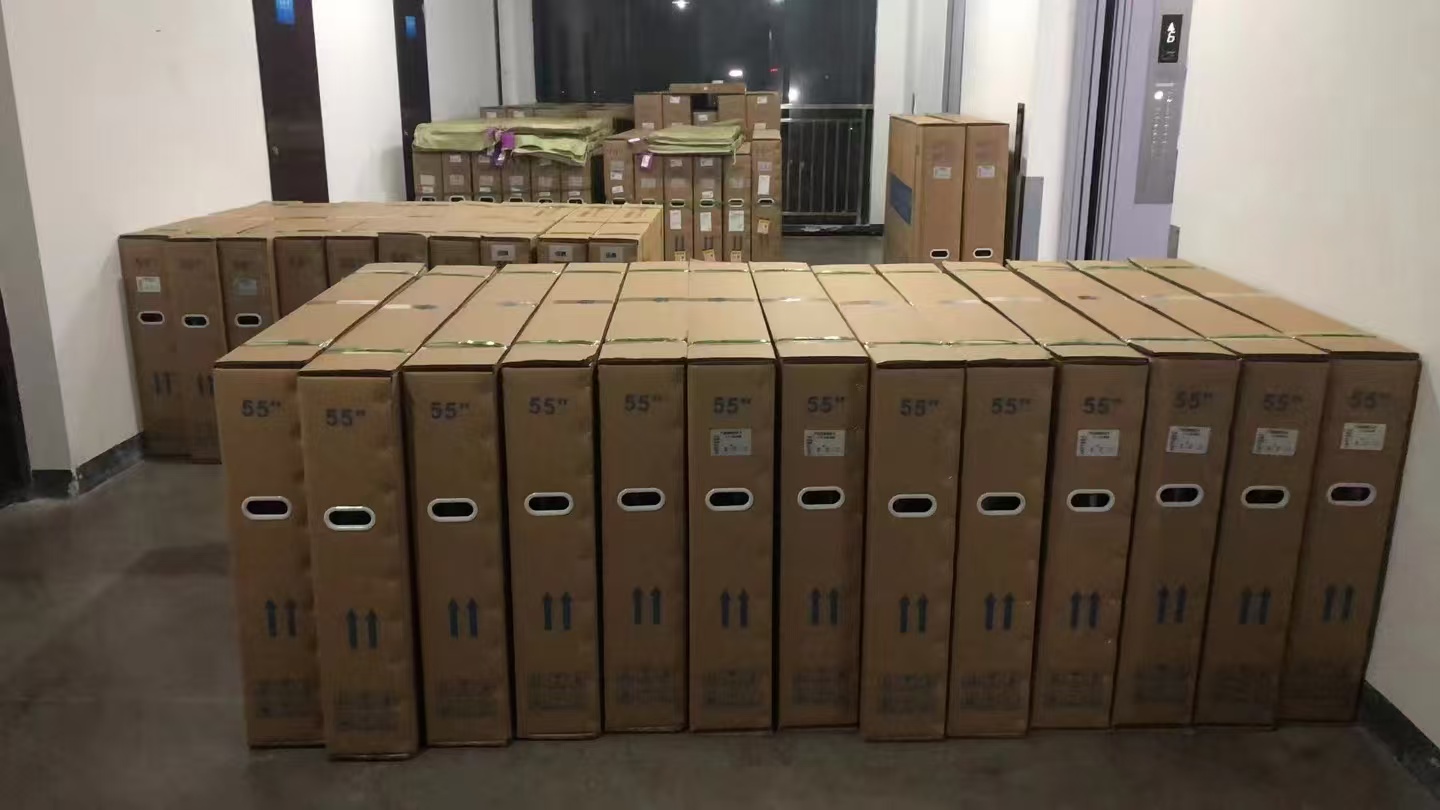
Warehouse of commercial display units at Guangzhou Kedro Electronics Technology Co., Ltd.
Market Trend Signals
Several directional shifts are visible across commercial display projects without reference to any single vendor.
Transparent surfaces are moving from a feature of flagship retail and premium exhibitions toward a standard element of lobby, museum and conference fit-out. The driver is spatial rather than technological: as interior budgets shift toward experience rather than decoration, a display that does not block a sightline has more uses than one that does.
Interaction is converging on mixed input. Installations increasingly combine touch, gesture and voice in one unit rather than choosing one, which raises the importance of the sensing layer in specification documents.
Content generation is becoming the largest variable cost. AI-assisted content generation and AI digital human presenters reduce the marginal cost of producing new material, which in turn supports more frequent content rotation in venues that previously refreshed displays rarely. This is the trend most likely to change buying behaviour, because it converts a fixed hardware decision into an ongoing content operation.
Networked management has become an expectation rather than an option. Buyers with more than a handful of sites now assume central scheduling, monitoring and remote maintenance as part of the platform.
Future Outlook
Three developments are worth tracking over the next planning cycle.
First, the boundary between transparent display and volumetric display is likely to keep narrowing as panel transmittance and peak brightness improve together. When that happens, the current either-or trade-off between a 95% transparent cabinet and a 30% transmittance holographic unit will soften, and specification documents will be able to rank rather than choose.
Second, interaction is likely to become predominantly sensor-driven rather than contact-driven in public environments, for both durability and hygiene reasons. Units combining microphone arrays, driverless cameras and gesture recognition already point in this direction.
Third, procurement is likely to shift from buying a display to buying a managed display service — hardware plus content generation plus remote monitoring. Buyers evaluating suppliers now would do well to ask which of those layers the supplier genuinely controls and which are subcontracted.
Reference Material
A full product catalogue covering the commercial display, transparent cabinet, holographic digital human, video wall and LED families referenced in this article is available as a downloadable PDF: Kedro Product Catalog (English Edition).
FAQ
What is an interactive holographic projection system?
It is a display installation built from a transparent or semi-transparent optical surface, an image engine, an input layer, and a content and control layer. The surface carries a bright image while remaining partly see-through, and the input layer — touch, infrared sensing, AI gesture recognition, voice, or presence detection — allows viewers to change what is displayed. The term covers transparent LCD cabinets, human-scale holographic digital human units, and large-format splicing arrays used around a transparent medium.
How is a holographic display different from a conventional digital signage screen?
The main difference is transmittance. A conventional screen is opaque and optimises entirely for brightness and contrast. A transparent holographic cabinet such as the KD-TP Series specifies 95% transparency with brightness of at least 380 cd/m², which means the viewer sees through the panel as well as at it. A holographic digital human unit moves the other way, specifying around 30% light transmittance with 1300 cd/m² brightness so the rendered figure dominates the surface.
Where are transparent and holographic displays typically installed?
Documented deployment patterns place transparent cabinet displays in smart retail environments, typically in the United Arab Emirates, and human-scale holographic digital human units in the exhibition and events industry. Related display families serve commercial advertising, common in the United States; the corporate office and education sectors; the smart city and transportation sector; outdoor media, common in Saudi Arabia; industrial manufacturing; and outdoor applications in Germany.
Can a holographic or transparent display be used outdoors?
Not the indoor-rated units described here. The KD-TP Series is specified for 0°C to 60°C and the KD-DH Series for 0°C to 40°C at 10–85% relative humidity, and neither carries an ingress protection rating. Outdoor requirements are served by different hardware: the KD-OD Series carries IP55 protection, 2000 cd/m² brightness and a -20°C to 50°C operating range, while the KD-LED Series reaches white balance brightness of at least 4500 cd/m² for outdoor media.
What specification points decide whether a holographic display works in a given space?
Five points decide most outcomes: ambient light at the installation position, because it sets perceived contrast; the audience approach arc, because minimum viewing angles on volumetric units can be quoted as 79 degrees in each direction; rated power consumption, because a large holographic digital human unit can be rated at 1100W; the operating temperature and humidity window; and the interaction method, since contact touch, gesture and voice sensing impose different constraints on the surface and enclosure.
How should buyers compare quotations from different holographic display suppliers?
By converting each quotation into the same four layers — optical surface, image engine, interaction layer, and content and control layer — and then comparing the measured parameters within each. Transparency percentage, brightness in cd/m², contrast ratio, viewing angle, rated power, operating temperature range, materials, and the availability of remote deployment and monitoring should all be stated on the same basis before price is compared. A quotation that names a transparency figure without a corresponding brightness figure cannot be evaluated.