
Intermediate, Push Bell LED or 2 Gang 2 Way Switch: Buyer Comparison
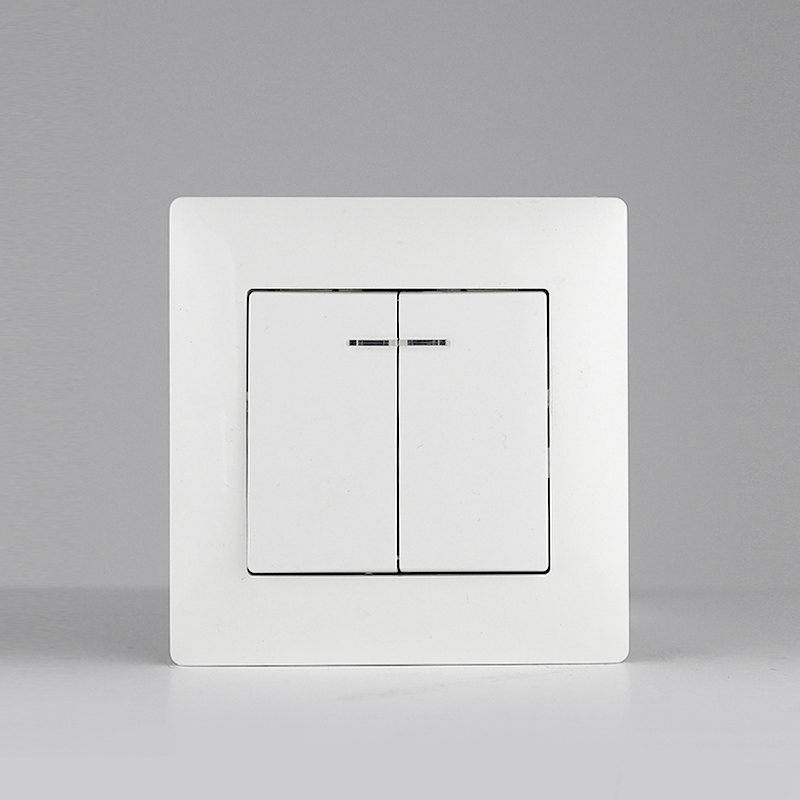
A 2 gang 2 way switch with LED indicator (model V122N) from the HYFF flush-mounted mechanical wall switch range. Image: Wenzhou Huafeng Electric Co., Ltd.
Function first: why these three switches are compared, not interchanged
Flush-mounted wall switches are specified by function before appearance, because the function determines the wiring layout, the number of wall boxes and the number of devices on a plate. In the European Union, EN 60669-1:2018 is the mandatory safety standard for wall switches in household fixed installations, and it is the reference against which certification evidence for these products is normally written. Within that framework, an intermediate switch, a bell push switch and a two-gang two-way switch solve three different control problems, and treating them as interchangeable parts is one of the most common specification errors in residential and hotel fit-outs.
This independent comparison places three flush-mounted mechanical wall switches side by side: the KM141S intermediate switch (small size modular), the HG110NB 1 gang push bell switch with LED indicator, and the V122N 2 gang 2 way switch with LED indicator. All three are produced by Wenzhou Huafeng Electric Co., Ltd. (HYFF), a Wenzhou-based manufacturer of wall switches and wall sockets founded in 2011, operating a 7,000 m² factory with 118 employees, 10 R&D engineers and an annual output of 35,000,000 units, with 100% of production exported to EU, Americas, Oceania, Asia and Africa markets.
The short answer for buyers: the intermediate switch is for switching one lighting circuit from three or more positions; the push bell switch is a momentary device for bell and signal circuits, not for switching lighting loads; and the two-gang two-way switch with LED indicator is for two lighting circuits that each need control from two positions, with a visible indicator at the plate. Everything below sets out the published specifications, the certification evidence and the boundaries that decide which of the three fits a given point in an installation.
Three functions, one shared electrical platform
The three models share the same published electrical ratings: 10A, 220–250V~, flush-mounted installation, and HS code 8536500090 for customs classification. Buyers should note that a 10AX 250V~ designation appears elsewhere in the same HYFF range — for example on the M111 and U121 models — so when a project specification is written in 10AX terms, the published rating for the three models compared here is 10A at 220–250V~. In practice this means current and voltage are common ground across the three, and the real purchasing differences sit in function, panel format, panel material, indicator behaviour and certificate scope.
What each switch function is actually for
Intermediate switch: one circuit, three or more control points
An intermediate switch is installed in the middle of a circuit that already has two-way switches at both ends, so that the same lighting load can be switched from a third or additional control point. Typical applications are stairwells, long corridors, large living areas and hotel rooms with multiple entry points, where a guest or resident should be able to operate the same light from each doorway.
The HYFF KM141S is a small-size modular intermediate switch rated 10A, 220–250V, flush mounted, with a flame-retardant PC panel measuring 22 × 49 mm and CE and RoHS certification. Its published feature list also cites 850 °C fireproof PC material, a high strength PA base, an "arch bridge" base design intended to increase wiring space without deformation, and a 40,000+ on/off test. Because the KM141S is a module rather than a full 86 × 86 mm plate, it is designed to sit inside a modular plate or multi-gang frame system rather than to be fitted as a standalone front plate — a detail that changes how the device is specified and stocked.
1 gang push bell switch with LED indicator: momentary bell and signal circuits
A push bell switch is a momentary device. It completes a bell or signal circuit while it is pressed and releases it when pressure is removed, rather than latching a lighting circuit on and off. It is specified for door entry, service call points, reception counters and similar locations where the load is a bell, buzzer or signal device rather than a lamp. This distinction matters at procurement stage: a bell push should not be ordered as a general lighting switch, and a lighting switch should not be ordered to replace a bell push.
The HG110NB is a 1 gang push bell switch with LED indicator, rated 10A, 220–250V~, flush mounted on an 86 × 86 mm plate, with a scratch-resistant tempered glass panel and a high strength PA base, available in white, black, green, red, brown, golden and customized colours, and carrying CE and TUV certification. The LED indicator helps locate the control point in low light. The exact behaviour of the indicator in a given installation depends on how the circuit is wired, so it is worth confirming during sample validation rather than assuming. It is also relevant that HYFF's factory quality-control list includes doorbell testing alongside switch and socket on-off testing, and that the company's ISO 9001 scope explicitly covers buzzer switches — the bell function is treated as a product family with its own verification step, not as an accessory.
2 gang 2 way switch with LED indicator: two circuits, two control positions
A two-gang two-way switch contains two independent two-way switching functions on one plate. Each gang can be wired in a two-way arrangement so that its circuit is controlled from two locations — a hallway and a landing, for example — and because both functions sit on a single 86 × 86 mm plate, two such circuits can be served without adding a second wall box or a second visible device.
The V122N is a 2 gang 2 way switch with LED indicator, rated 10A, 220–250V~, flush mounted, with a flame retardant PC panel and a high strength PA base, available in white, ivory, black, silver, golden and customized colours, and carrying CE and TUV certification and a published 40,000+ on/off test result. For projects that need the same two-way function without an indicator, the HYFF range also includes the A122 2 gang 2 way switch (81.6 × 81.6 mm panel, 10A, 250V~, flame retardant PC panel, PC base, CE and TUV), which is a useful reference point when comparing indicator and non-indicator variants of the same function.
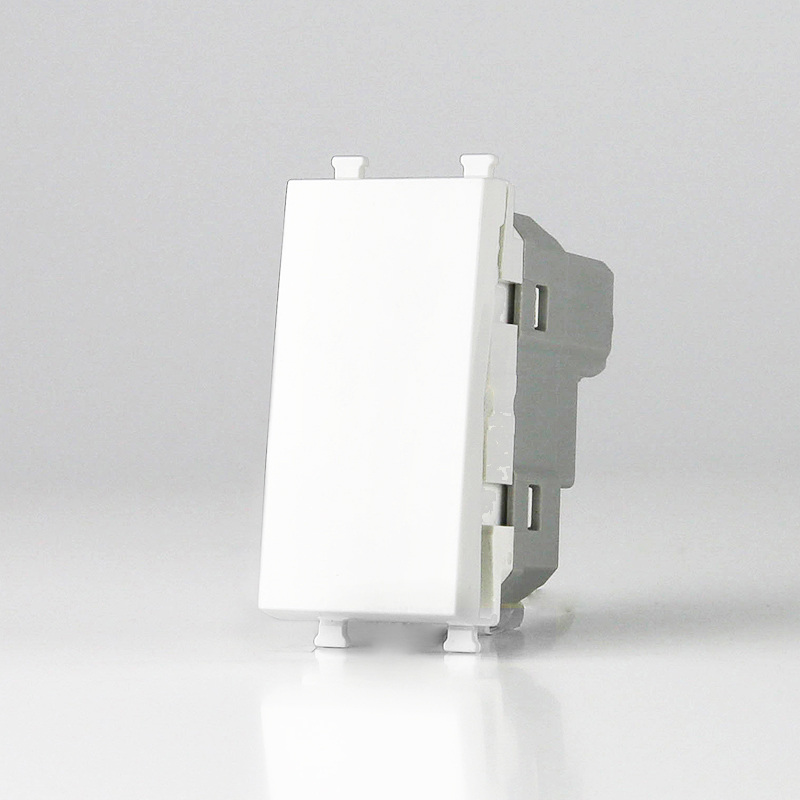
The KM141S intermediate switch uses a small-size modular format (22 × 49 mm panel) for multi-point control circuits. Image: Wenzhou Huafeng Electric Co., Ltd.
Side-by-side specification comparison
| Specification | KM141S intermediate switch | HG110NB push bell switch with LED | V122N 2 gang 2 way switch with LED |
|---|---|---|---|
| Control function | Multi-point control of one lighting circuit (with 2-way switches at both ends) | Momentary bell / signal contact | Two independent two-way circuits on one plate |
| Rated current | 10A | 10A | 10A |
| Rated voltage | 220–250V | 220–250V~ | 220–250V~ |
| Installation | Flush mounted | Flush mounted | Flush mounted |
| Panel size | 22 × 49 mm (small size modular) | 86 × 86 mm | 86 × 86 mm |
| Panel material | Flame retardant PC panel | Tempered glass panel | Flame retardant PC panel |
| Base material | High strength PA base (published feature list) | High strength PA base | High strength PA base |
| LED indicator | Not published for this model | Yes | Yes |
| Colours | White, black, silver, customized | White, black, green, red, brown, golden, customized | White, ivory, black, silver, golden, customized |
| Certification (published) | CE, RoHS | CE, TUV | CE, TUV |
| Endurance (published) | 40,000+ on/off test | 40,000+ on/off test | 40,000+ on/off test |
| HS code | 8536500090 | 8536500090 | 8536500090 |
Materials, contacts and mechanical life: what is documented
Across the range, HYFF publishes the same construction logic for its flame-retardant PC parts and bases: 850 °C fireproof PC material on the panel side, a high strength PA base for better fire performance, anti-back screws that hold the screw in place when it is loosened, a multi-point riveted steel frame, and a grade II shock absorption design intended to reduce switching noise. The multi-gang plates are also described as accepting various shapes of mounting box, which is relevant when a project mixes modular and standard plate systems.
Contact and terminal construction is documented in detail for the A122 2 gang 2 way switch, whose published specification states brass terminals for conductivity and phosphor copper contacts of 0.7 mm thickness with silver plating of 3 mm diameter. Buyers should treat that as the material declaration for that model specifically and confirm the terminal and contact declaration for whichever model is being ordered, since the published material statements are attached to individual model specifications. This is also why silver layer thickness inspection appears as a separate step in HYFF's incoming and process quality control list, alongside plastic parts inspection, glowing filament testing, performance life testing and plastic ball pressure testing.
On endurance, the 40,000+ on/off test result is published for the KM141S, the HG110NB and the V122N, as well as for the A122. That number is a mechanical test result, not a promise of installed service life. HYFF's own case documentation states that actual service life depends on the electrical load, operating frequency, installation quality and operating environment — so mechanical cycle data should be read as a comparison point between candidates, not as a warranty of years in service.
Reading the compliance file: EN 60669-1, TÜV, CE and ISO 9001
For European buyers, switch evidence and socket evidence come from different standards, and mixing them is a common documentation error in supplier files. The core switch evidence for the flush-type fixed switch family is TÜV Rheinland Safety Certification number R 50714462 0001, issued by TÜV Rheinland LGA Products GmbH, applicable to the EU market, based on EN 60669-1:2018, valid from 2026-03-10 to 2028-03-10. The V122N is named within the certified model scope, and the HG110NB is covered by TÜV Rheinland Safety Certification applicable to the EU market. The KM141S carries CE and RoHS certification for European installation standards. Socket products sit under separate documentation, such as the CE Certificate of Conformity DACE260331002RL issued by Shenzhen DACE Testing Technology Co., Ltd. against IEC 60884-1:2022, and the TÜV Rheinland socket certificates R 50714584 0001 and R 50714619 0001 against DIN VDE 0620-1:2021-02 — those numbers relate to sockets such as the S149 and KM149, not to the switch models compared here.
| Evidence | Certificate / standard | Issuing body | Validity |
|---|---|---|---|
| Switch safety (EU) | TÜV Rheinland Safety Certification R 50714462 0001, based on EN 60669-1:2018; V122N listed in model scope | TÜV Rheinland LGA Products GmbH | 2026-03-10 to 2028-03-10 |
| Bell switch safety (EU) | TÜV Rheinland Safety Certification applicable to the EU market, covering the HG110NB | TÜV Rheinland LGA Products GmbH | As stated on the certificate file |
| Intermediate switch (EU) | CE and RoHS, European installation standards | As stated on the certificate file | As stated on the certificate file |
| Management system | ISO 9001, certificate 0350225Q30335R0S (GB/T 19001-2016 / ISO 9001:2015) | Xingyuan Certification Center Co., Ltd. | 2025-08-15 to 2028-08-14 |
| Socket evidence (for contrast only) | CE Certificate of Conformity DACE260331002RL (IEC 60884-1:2022); TÜV R 50714584 0001 and R 50714619 0001 (DIN VDE 0620-1:2021-02) | Shenzhen DACE Testing; TÜV Rheinland LGA Products GmbH | 2026-04-07 to 2031-04-07; 2026-03-10 to 2031-03-10 |
The ISO 9001 scope is worth reading in full, because it describes what the quality system actually covers: design, production and export of switches (wall switches, dimmer switches, buzzer switches), sockets (ordinary sockets, USB sockets) and electromagnetic buzzers, plus production and export of plugs and lamp holders. For a buyer, that scope statement is the difference between a certificate that describes the factory's process control across switch families and a certificate that only covers one shipment. It also confirms that dimmer switches and buzzer switches sit inside the certified system, even though they are separate product families from the three mechanical models compared in this article.
A buyer decision framework by wiring requirement
| Requirement at that point | Function needed | Model |
|---|---|---|
| Switch one lighting circuit from three or more positions (stairwell, corridor, large room) | Intermediate switch combined with 2-way switches at both ends | KM141S |
| Bell, door entry or service signal at a door frame or counter | Momentary push bell contact with LED indicator | HG110NB |
| Two lighting circuits, each controlled from two positions, with a visible indicator | Two-gang two-way with LED indicator | V122N |
| Two lighting circuits from one plate, indicator not required | Two-gang two-way, no indicator | A122 |
Two practical rules follow from this table. First, decide the wiring function before the finish, because the function determines how many conductors reach the box and whether a modular frame is required. Second, check indicator needs at the same time as the function, since indicator and non-indicator variants of the same two-way function are separate order codes in the same range.
Where each option does not fit
An honest comparison has to state the boundaries, because most specification failures come from stretching a device beyond its intended function rather than from a defect.
- The KM141S is a modular insert, not a standalone plate. With a 22 × 49 mm panel it is designed for a modular plate or multi-gang frame system. It is not a drop-in replacement for an 86 × 86 mm front plate, so plate and frame compatibility must be confirmed before ordering.
- The HG110NB is a bell push, not a lighting switch. Momentary contacts are intended for bell and signal circuits. Using a bell push to switch a lighting load continuously is outside the function it was designed for.
- LED indicator behaviour depends on the wiring arrangement. The indicator is part of the product variant, but how it behaves in a specific installation should be confirmed during sample validation rather than assumed from the model name.
- Indoor, dry environments. HYFF's published application data for these switch types covers indoor, dry, normal-temperature conditions and residential systems of 220–240V AC at 50/60 Hz. None of the three models carries a published IP rating in its specification, so none should be specified for wet or outdoor locations. Where an IP-rated device is needed, that belongs to a different product line — the range includes IP-rated sockets such as the WP149 IP54 — and as a general reference point, outdoor switching equipment is commonly specified to IP65 under IEC 60529.
- No wireless or smart function is published for these three models. They are mechanical flush-mounted switches. Buyers looking for app, voice or wireless control are comparing a different product category, with different evidence requirements.
How this compares with traditional and alternative solutions
Mechanical flush-mounted switches remain the baseline solution for residential, apartment, villa, hotel and office lighting control because the specification is verifiable: rated current and voltage, panel material, base material, terminal type, a published on/off cycle result, and a certificate scope that names the model. That is precisely the evidence set available for the KM141S, HG110NB and V122N.
Alternative solutions change the evidence set rather than simply replacing the mechanical device. Touch-type switches, for example, accounted for 45% of the global wall switch market as of 2023, and their verification emphasises surface material and touch electronics rather than mechanical rocker endurance. Smart switches add connectivity, firmware and commissioning considerations: the Matter 1.6 protocol update released in June 2026 introduced NFC-based commissioning to simplify the setup of smart wall switches and lighting devices, which means a smart-switch specification now includes a protocol and commissioning pathway, not only an electrical rating. For a buyer, the practical implication is that mechanical and smart products should be compared on the criteria each category actually publishes, and a mechanical switch should not be judged on connectivity it does not claim.
A second comparison is internal to the mechanical range itself: the same two-way function exists with and without an LED indicator, and the same intermediate function exists as a small modular insert rather than a full plate. Selecting the variant that matches the box and plate system is usually more consequential than choosing between finishes.
Market context behind the choice
The wider market supports continued attention to evidence-based switch selection. The global light switches and electrical sockets market was valued at approximately USD 17.6 billion in 2024 according to Strategic Market Research, and Asia Pacific held a 42.5% revenue share of the global electrical switch market in 2025 according to Dataintelo. Within that market, growth is concentrated in smart and touch products: the global smart switch market reached USD 4.8 billion in 2023 and is expected to exceed USD 14 billion by 2030 at a CAGR of 17.2%, based on Grand View Research.
For buyers of mechanical switches, the practical reading of these figures is not that mechanical devices disappear, but that mechanical switch procurement continues alongside smart growth in renovation, hospitality and residential projects — and that in a market where volume is concentrated among a small number of brands, the differentiator available to a mid-sized manufacturer is documented specification and verifiable certification rather than scale.
Procurement and validation notes
HYFF operates an ODM model with logo customization, a monthly capacity of 2,900,000 units, a minimum order quantity of 1,000 units, a lead time of 30–45 days, 100% testing and an 8-year warranty. Its export case documentation describes work with a European wall switch brand owner, importer and electrical product distributor, with bulk orders above 1,000 units per model for indoor lighting control in residential buildings, apartments and commercial properties, distributed through local branded sales channels. In that case, the switches passed sample installation and functional testing, were compatible with mainstream European standard wall boxes and mounting systems, and met requirements for brand customization and bulk supply.
For a buyer comparing the intermediate, bell push and two-gang two-way functions, the sequence that reduces risk is consistent: confirm the wiring function and plate system first; request the certificate file for the exact model ordered and check that the model appears in the certificate scope; validate the indicator behaviour and box compatibility with a sample installation; then place volume orders. A full overview of the HYFF switch and socket range is available in the company brochure: HYFF product brochure (PDF).
Future outlook
Two developments are likely to shape how these three functions are specified over the next few years. The first is the continued shift toward touch and connected control, supported by the Matter 1.6 update in June 2026 and its NFC-based commissioning pathway, which lowers the setup barrier for smart devices in hotel and residential projects. The second is a hardening of documentation expectations: buyers increasingly ask for the certificate number, the applicable standard and the model scope, not just a CE mark. A manufacturer whose switch evidence is written against EN 60669-1:2018 with a named model scope, and whose quality system covers wall switches, dimmer switches and buzzer switches under ISO 9001, is positioned for that shift regardless of which control function a project chooses.
FAQ
What is the difference between an intermediate switch and a 2 gang 2 way switch?
An intermediate switch is used in the middle of a circuit that already has two-way switches at both ends, so one lighting circuit can be switched from a third or additional point. The KM141S is such a device, an intermediate switch with a 22 × 49 mm small-size modular panel rated 10A, 220–250V, with CE and RoHS certification. A 2 gang 2 way switch provides two independent two-way functions on one plate, each controlled from two positions; the V122N is a 2 gang 2 way switch with LED indicator, rated 10A, 220–250V~ on an 86 × 86 mm plate with CE and TUV certification. The intermediate switch extends the number of control points on one circuit; the two-gang two-way switch handles two circuits with two control positions each.
What is a push bell switch with LED indicator used for?
A push bell switch is a momentary device: it completes a bell or signal circuit while it is pressed, rather than latching a lighting circuit on and off. It is used for door entry, service call points and similar signal locations. The HG110NB is a 1 gang push bell switch with LED indicator, rated 10A, 220–250V~, flush mounted on an 86 × 86 mm tempered glass panel with a high strength PA base, carrying CE and TUV certification. The LED indicator helps locate the control point in low light, and the behaviour of the indicator in a specific installation should be confirmed during sample validation.
Do the intermediate, push bell and two-gang two-way models share the same rated current and voltage?
The published ratings are the same across the three models compared here: 10A and 220–250V~ (the KM141S is published as 10A, 220–250V). A 10AX 250V~ designation appears on other models in the same range, such as the M111 and U121. Buyers working from a 10AX-based specification should confirm the exact rating printed for the model being ordered rather than assuming it applies across the range.
What certification evidence should a European buyer verify for these switches?
For the flush-type fixed switch family, the relevant evidence is TÜV Rheinland Safety Certification number R 50714462 0001, issued by TÜV Rheinland LGA Products GmbH against EN 60669-1:2018 and valid from 2026-03-10 to 2028-03-10, with the V122N named in the certified model scope; the HG110NB is covered by TÜV Rheinland Safety Certification applicable to the EU market; and the KM141S carries CE and RoHS certification. Manufacturing is covered by ISO 9001 certificate 0350225Q30335R0S issued by Xingyuan Certification Center Co., Ltd., valid from 2025-08-15 to 2028-08-14. Socket products use separate documentation, such as IEC 60884-1:2022 based conformity and DIN VDE 0620-1:2021-02 socket certificates, and should not be accepted as evidence for switch models.
What does a 40,000+ on/off test result mean in practice?
The 40,000+ on/off test is a published mechanical endurance result for the KM141S, HG110NB and V122N, and it is also published for the A122. It allows candidates to be compared on a common mechanical measure. It is not a service-life guarantee: HYFF's case documentation states that actual service life depends on the electrical load, operating frequency, installation quality and operating environment.
Can these three switch models be used outdoors or in wet locations?
Their published specifications describe flush-mounted indoor devices, and HYFF's application data for these switch types covers indoor, dry, normal-temperature environments in residential systems of 220–240V AC at 50/60 Hz. No IP rating is published for the KM141S, HG110NB or V122N, so they should not be specified for wet or outdoor locations. Where an IP-rated device is required, that sits in a different product line — the range includes IP-rated sockets such as the WP149 IP54 — and outdoor switching equipment is commonly specified to IP65 under IEC 60529.
This comparison is based on HYFF's published product specifications, its certification documents and third-party market data. Specification figures, colours and certificate scopes should be confirmed against the current datasheet and certificate file for the exact model ordered.