
Intermediate Wire Drawing Machines: A Buyer's Reference
Industry Reference · Wire & Cable Manufacturing
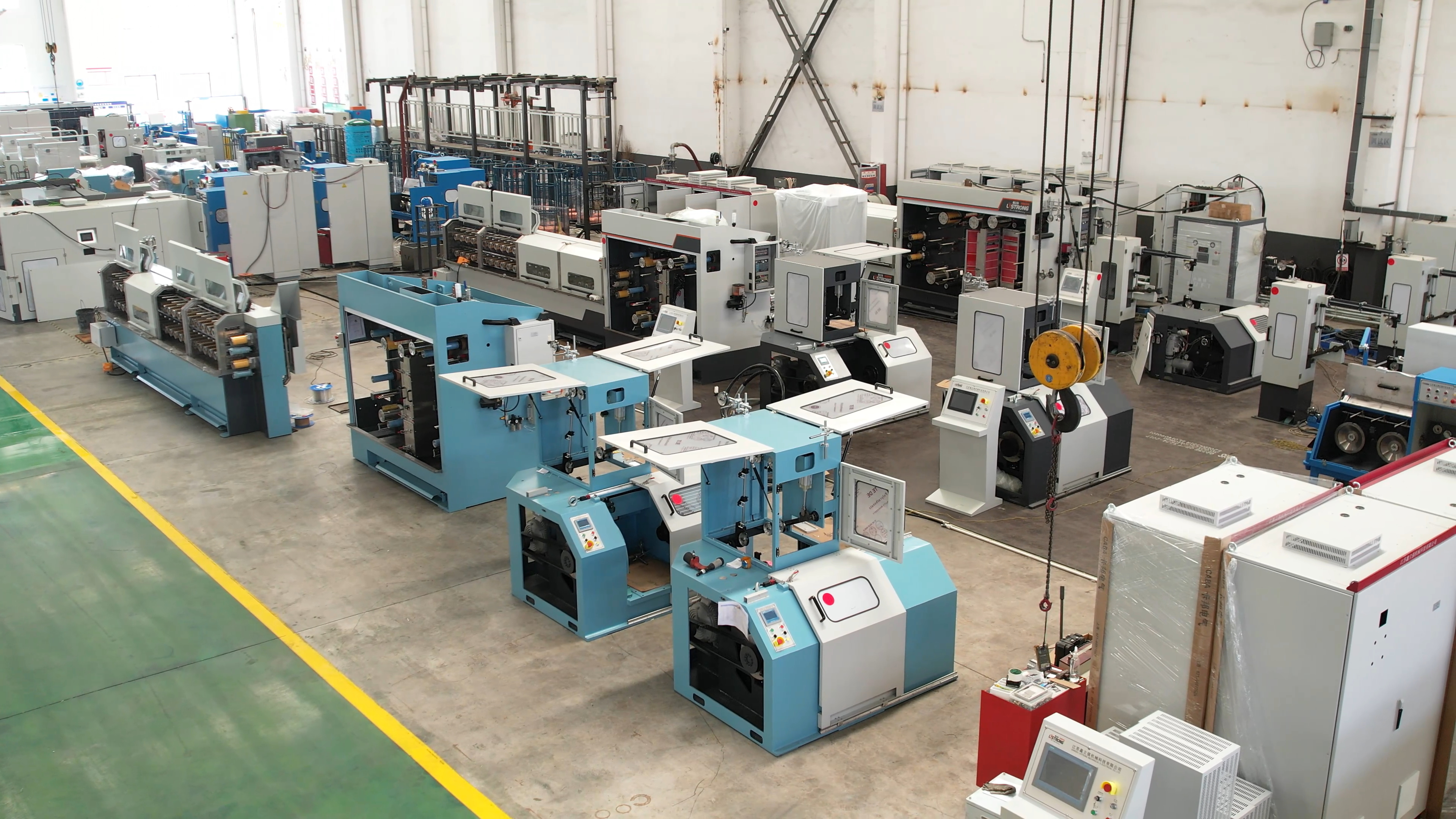
The intermediate drawing stage is where many cable plants quietly win or lose their cost position. It is also the stage buyers understand least, because intermediate wire drawing machines sit between two better-known categories — rod breakdown and fine drawing — and their published specifications are usually read as if they described a single operating point rather than a range.
An intermediate wire drawing machine is a continuous, multi-die drawing machine that takes copper wire already reduced to roughly Φ1.2–4.0 mm on a rod breakdown machine and draws it into the Φ0.4–2.8 mm band that fine drawing lines, bunching machines and stranding equipment are designed around. For buyers in the research phase, the useful question is not which machine is fastest, but which machine holds elongation, surface quality and output stability across the diameter range the plant actually runs.
The buyer problem: maximum speed is not a production figure
Catalogue comparison usually stops at three numbers: die count, motor power and maximum speed. Of these, maximum mechanical speed is the least transferable, because drawing speed falls as outlet diameter rises. The 13DST intermediate wire drawing machine from Jiangsu Listrong Mechanical & Electrical Co., Ltd. illustrates the point in its own documentation.
| Outlet diameter (13DST) | Documented drawing speed |
|---|---|
| 0.80–1.2 mm | 900–1,200 m/min |
| 1.2–2.0 mm | 400–900 m/min |
| 2.0–2.80 mm | 250–400 m/min |
The same 1,200 m/min maximum appears on the 9DST, whose documented speed curve runs 1,000–1,200 m/min at Φ0.8–1.5 mm outlet, 800–1,000 m/min at Φ1.5–2.0 mm and 500–800 m/min at Φ2.0–2.78 mm. A buyer comparing two machines on the headline figure alone is comparing two ceiling values and learning nothing about the tonnage either machine will deliver at the diameter the plant actually sells.
This matters more at the intermediate stage than anywhere else in the line, because the intermediate machine sets the metallurgical condition of the wire that every downstream process inherits. If elongation drifts, fine drawing breaks increase, bunching speeds drop and scrap rises — costs that never appear on the intermediate machine's own specification sheet.
What defines an intermediate wire drawing machine
Three technical characteristics separate this class of equipment from adjacent categories.
Diameter band. Documented intermediate machines work from a Φ2.5–3.5 mm inlet into an outlet between Φ2.8 mm and Φ0.4 mm, depending on model and die schedule. Rod breakdown covers the Φ8 mm to Φ1.2–4.0 mm step and is described by Listrong as the first step in cable production; fine drawing covers the step from a Φ0.8–1.6 mm inlet down to Φ0.6–0.08 mm.
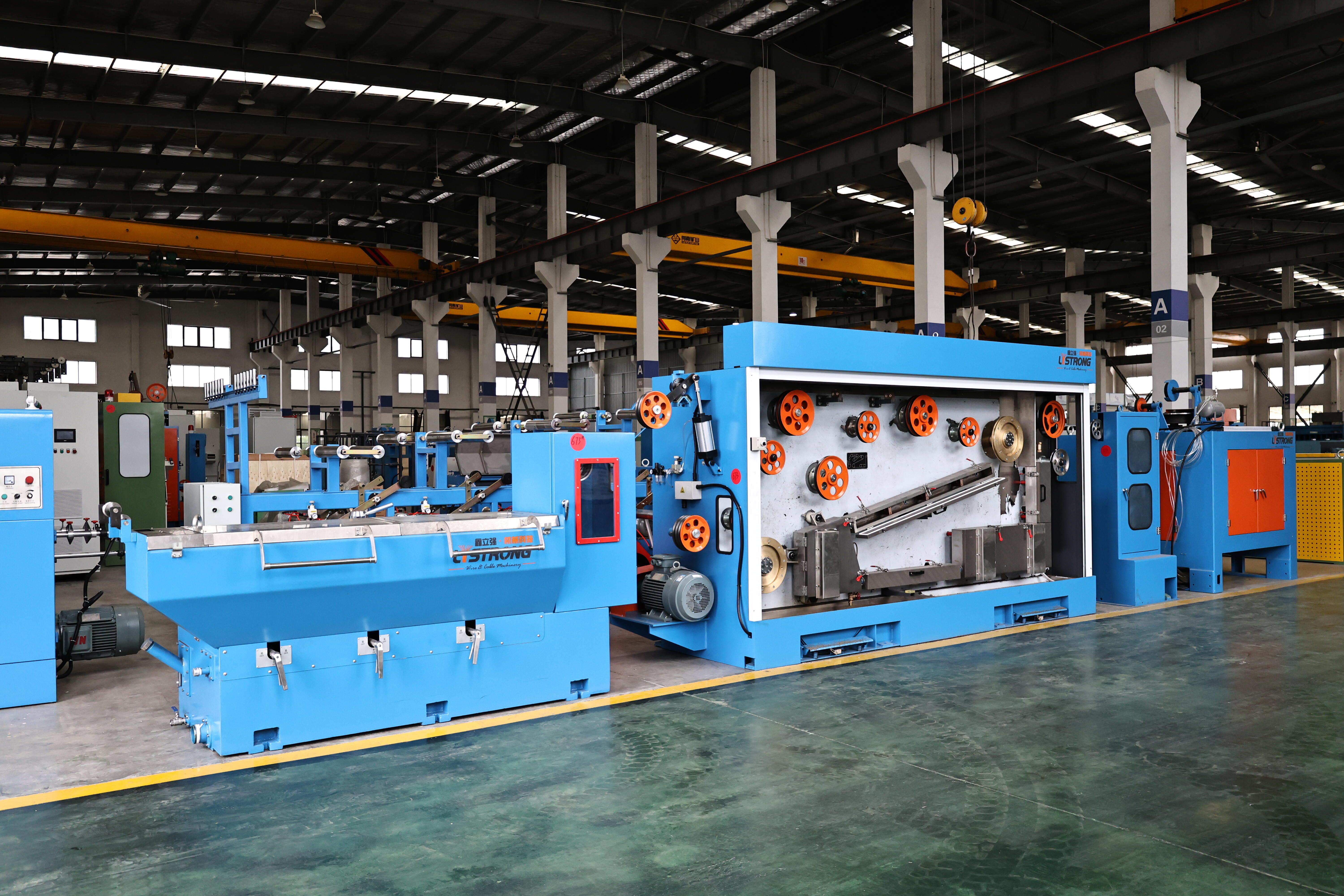
Slip-type, multi-die continuous drawing. Wire passes through a die sequence arranged on multiple shafts or spools. The 13DST uses two horizontally arranged shafts; the 17DST uses four shafts in horizontal arrangement with fully immersing lubrication; the 17-2DST runs two parallel lines of 17 dies each with double inverter control.
Optional online annealing. Some intermediate models anneal inline so that the wire leaves the machine softened and ready for the next stage. The 17DST is specified for bare copper wire drawing with online annealing, at a maximum mechanical speed of 1,800 m/min, reduced to 1,500 m/min when annealing is applied. The 13DST and 9DST are documented as drawing machines without online annealing in their published specifications.
How to read an intermediate machine specification sheet
Die schedule and elongation
Die count alone says little; the reduction per pass does. The 13DST is documented with an elongation of 26–34% and an elongation tolerance of ±2. The 9DST applies a 19.5% surface reduction from die No.1 to No.8 and 16% on the final die No.9. The 17DST applies 20% from die No.1 to No.16 and 15.5% on die No.17, with a documented wire elongation of 25% at 0.40–0.80 mm outlet and 30% at 0.80–1.60 mm. The 17-2DST documents a machine slip ratio of 20% and a fixed-speed capstan slip ratio of 15.5%.
These figures are the buyer's real comparison basis. A reduction schedule that is too aggressive for the rod being used will show up as breaks and die wear long before it shows up as a shortfall against nominal speed.
Capstan material and cooling
Capstans carry the load and the wear. The 13DST specifies capstans made of carbon fibre for abrasion resistance, with an immersion cooling system that keeps both dies and wire in a lubricated, cooled bath. The 17-2DST specifies zirconia capstans with a maximum diameter of Φ280 mm. The 9DST and 17DST both specify fully immersing drawing lubrication, with documented oil flows of 150 L/min and 100 L/min respectively.
Transmission and contamination control
The 13DST uses a cast steel box with NSK or NTN bearings and hardened gears ground on a German gear grinding machine, and two shafts of different height to add output torque. Its documentation notes a physical separation between capstan box and gear box to prevent mixing and permeation of lubricating oil and gear oil, and multi-layer sealing at design and assembly stage. The 17-2DST documents high-precision declining gear transmission with oil pump supply and spray-type lubrication for bearings and gears.
Take-up, spooling and control
Take-up design determines how much of the machine's speed an operator can actually use. The 13DST uses a pneumatic shaft-type take-up with pneumatic upper/lower and fasten/loosen control, an anti-fall-back function when fastening the bobbin, and motor-driven adjustment of traversing width; control is by PLC and human-machine interface with an INOVANCE inverter and synchronous speed adjustment, plus automatic stop on reaching set length, wire break or fault. The 9DST uses servo traversing with a limit detection switch. The 17-2DST uses a pneumatic shaftless take-up, 90 W decelerating-motor traversing, PID displacement detection with automatic control, pneumatic swing-arm displacement detection, pneumatic tension adjustment and a maximum take-up weight of 500 kg.
Utilities the buyer must supply
Specifications in this class carry real infrastructure requirements, and they are frequently the reason a machine underperforms on site. Documented values for the 13DST and 9DST include compressed air at a working pressure of 0.6–0.7 MPa with a fluctuation value of +0.02 MPa, a dew point of −25 °C and a flow rate of 200 L/min; cooling water at 0.2–0.4 MPa and no more than 25 °C, with a water hardness of maximum 5 dH, coolant hardness of maximum 12 dH, pH 7–8 and a flow of 420 L/min; and a 9 kW steam generator rated 12 kg/h on the 13DST. The 9DST documentation adds that cooling water must not contain suspended solids, minerals, metal impurities, insoluble or corrosive substances.
Where intermediate drawing sits in the production line
Positioning the machine correctly is the first step in choosing it. The table below maps the four stages using documented Listrong models and their published diameter ranges.
| Stage | Documented inlet | Documented outlet | Example models |
|---|---|---|---|
| Rod breakdown | Φ8 mm copper rod | Φ1.2–4.0 mm | WDF450-13DT, LHD450-13DT |
| Intermediate drawing | Φ2.5–3.5 mm | Φ2.8–0.4 mm | 13DST, 9DST, 17DST, 17-2DST |
| Fine drawing | Φ0.8–1.6 mm | Φ0.6–0.08 mm | 14D, 24DW, 26DW, 22DTA, 24DT |
| Multi-wire drawing | Φ1.5–1.8 mm (per wire) | Φ0.15–0.40 mm (per wire) | 20-4DT, 25-16DT, 25-24DT |
The Listrong intermediate range
Jiangsu Listrong Mechanical & Electrical Co., Ltd. is a wire and cable equipment manufacturer based in Dongtai City, Jiangsu Province, China, established in 2009. It designs and builds wire drawing machines, annealing machines and wire bunching machines for bare copper, copper alloy and stainless steel wire, and provides whole-plant planning, installation, commissioning and after-sales service. The company reports 70 employees, a 15-engineer R&D team, an annual output of 550 sets, an export ratio of 40%, and more than 1,000 completed projects, with products sold throughout China and exported to Southeast Asia, the Middle East, South Africa and other regions.
| Model | Inlet | Outlet | Max. mechanical speed | Dies | Online annealing |
|---|---|---|---|---|---|
| 13DST | Φ3.5 mm | Φ2.8–0.8 mm | 1,200 m/min | Not specified in published data | Not documented |
| 9DST | Φ2.5–3.0 mm | Φ1.0–2.8 mm | 1,200 m/min | 9 (customer supplied) | Not documented |
| 17DST | Φ3.5–2.5 mm | Φ1.6–0.4 mm | 1,800 m/min (1,500 m/min with annealing) | 17 (customer supplied) | Yes |
| 17-2DST | 2 × Φ2.5–3.0 mm | 2 × Φ0.4–1.6 mm | 1,800 m/min | 17 × 2 | Not documented |
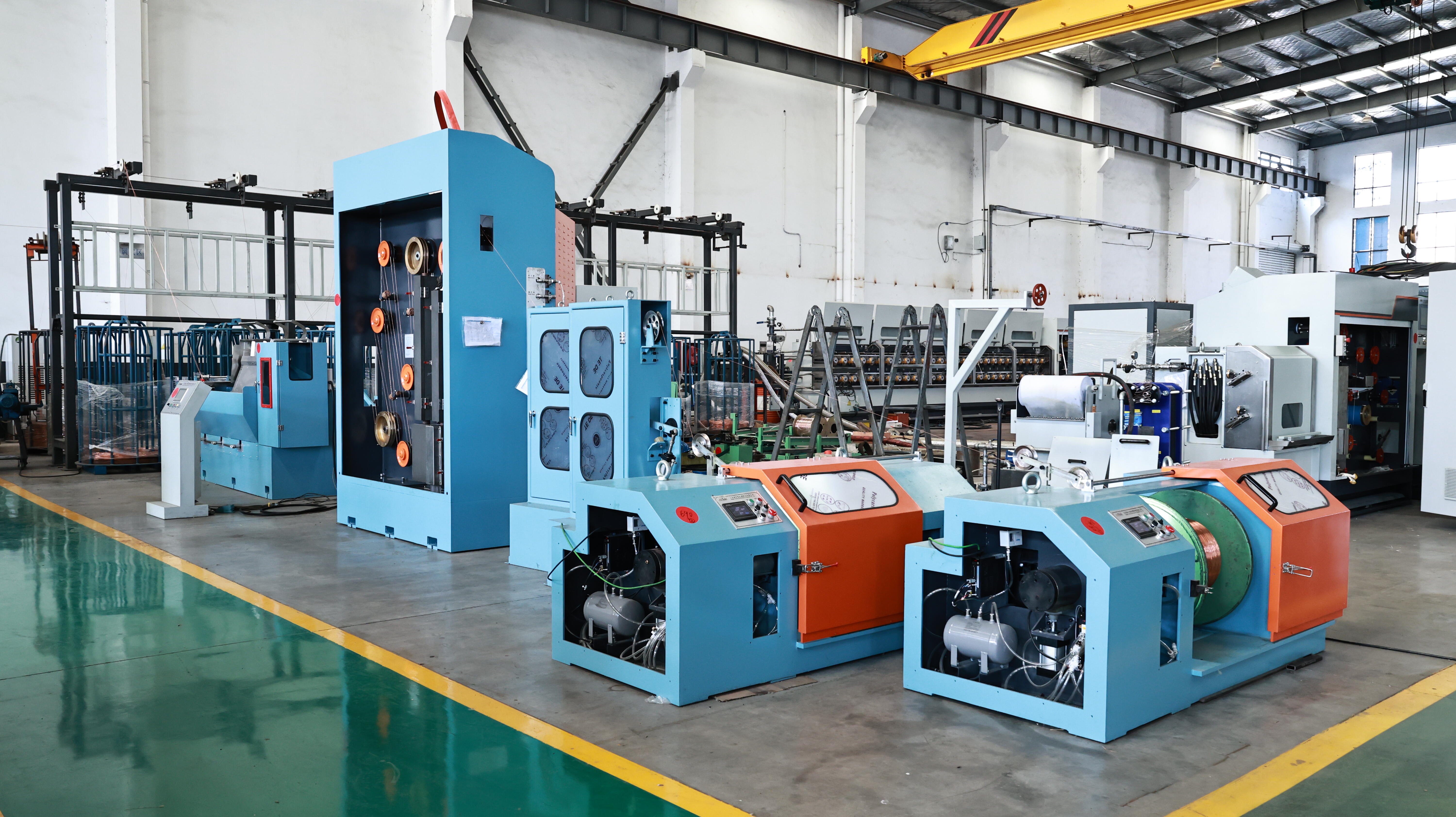
Four differences are worth noting when these models are compared. The 13DST is a single-line machine with a cast steel main structure, carbon fibre capstans and PLC/HMI control. The 9DST is a compact nine-die machine with an AC 55 kW drive motor, an AC 11 kW spooler motor and dual variable frequency/servo drive technology with a tension control system that tracks changes in drawing speed. The 17DST adds online annealing with a separate 7.5 kW annealing motor and a 55 kW main drive. The 17-2DST doubles the line count with two 17-die paths, double inverter control, a 90 kW drawing motor, a 15 kW take-up motor and a maximum take-up weight of 500 kg.
Application and use cases
The documented application fields for these machines are consistent across the range: power cables, communication cables, automotive wiring harnesses, electronic components and building wiring. The 9DST adds metal product processing and hardware standard component production. In practice this means an intermediate machine is usually specified where a plant needs a stable Φ0.4–1.6 mm conductor supply for stranding, bunching or subsequent fine drawing rather than a finished fine wire.
A documented deployment in a wire and cable factory in China and Iran shows how tightly the process is specified upstream. That installation runs the 25-16DT multi-wire drawing machine at 24 m/s on 0.195 mm copper wire in 24/7 automatic operation, with a steam generator or nitrogen generator as matched equipment, and states a requirement for high-quality drawing oil, annealing oil, high-precision drawing dies and oxygen-free copper wire. The die, lubricant and rod-quality requirements that appear in that specification are the same categories of input that determine results on an intermediate machine — and on most models in the range, the drawing dies are supplied by the customer, not by the machine builder.
Market trend: steady expansion, uneven estimates
Third-party market research places the wire drawing machine category in a steady-expansion phase. Dataintelo's Wire Drawing Machine Market Research Report, published in April 2026, values the global market at USD 3.8 billion in 2025 and projects USD 6.1 billion by 2034, a compound annual growth rate of 5.47% over 2026–2034. IndexBox's September 2026 outlook values the 2026 market at USD 2.4 billion, and a separate valuation places 2025 at USD 1.37 billion.
The discrepancy is a scoping issue rather than a contradiction: published estimates differ according to whether spare parts, dies and service revenue are included in the total. For buyers, the more useful signal is the direction of demand rather than the level. Research published by IndexBox in September 2026 identifies electrification and lightweighting as the primary demand drivers for this equipment class, which is consistent with where the documented application fields of intermediate machines sit: power and communication cable, automotive harnesses and electronic components.
Importers should also note the trade-classification layer. Machine tools for working metal wire without removing material fall under HS code 8463.30.00, the classification used in UN Comtrade trade statistics for this category. This affects duty treatment, customs documentation and any comparison of import volumes between origins — practical considerations that sit outside the machine specification but inside the purchase decision.
Comparison with traditional solutions, and where the limits are
Older intermediate drawing practice relied on belt-and-gear-driven single-head machines with spray lubrication and manual bobbin handling. The current generation changes four things at once: lubrication method, capstan material, oil-circuit separation and digital control. Full immersion drawing lubrication keeps dies and wire in a cooled, lubricated bath rather than relying on spray coverage; carbon fibre, zirconia and ceramic-coated capstans resist abrasion longer than plain steel; separated capstan and gear boxes prevent lubricating oil and gear oil from mixing; and PLC control with frequency converters or servo drives allows speed to be adjusted synchronously with the drawing process instead of mechanically.
Those advantages, however, come with dependencies the buyer has to accept.
- Utility quality becomes a production variable. Cooling water hardness limits (maximum 5 dH water, maximum 12 dH coolant), a 25 °C temperature ceiling and the exclusion of suspended solids, minerals, metal impurities and corrosive substances are not advisory notes — they describe the operating envelope. Sites that cannot meet them should expect shorter die and capstan life, not merely lower speed.
- Dies are usually the buyer's responsibility. The 9DST, 17DST and 17-2DST all document drawing dies as customer-supplied. Die geometry and quality therefore directly determine whether the documented elongation figures are achieved.
- Published speed and capacity are reference values. The 13DST and 17DST specifications explicitly describe drawing speed as being for reference only. For the multi-wire 25-16DT, the manufacturer notes that quoted efficiency depends on wire quality, die quality, lubricating oil quality, reel quality and operator proficiency, and that tinned-wire speeds are reduced by about 20%. The same logic applies across the drawing range: output is a property of the process, not of the machine alone.
- Multi-head designs change the trade-off, not remove it. Integrating several drawing heads into one frame reduces floor area and unit power consumption, but it raises the input requirement — continuous production without hollow or impurity breaks requires high-grade continuous-cast rod.
Future outlook
The direction of development visible in published specifications is instrumentation and configurability rather than headline speed. Listrong's rod breakdown platform WDF450-13DT documents a modular structure system in which different drawing passes can be achieved by combining components, individual variable-frequency motor and reducer drive per capstan so that elongation per die can be adjusted freely, a micro-slip design intended to extend die and capstan life, an RJ45 network port communication protocol for future data collection, and intelligent communication meters that monitor power grid quality and analyse the machine's electricity consumption.
Applied to the intermediate stage, that trend points toward machines that are specified and optimised per plant rather than per catalogue: adjustable compression ratios, remote die-change routines, and energy data that lets a producer separate material cost from conversion cost per tonne. For buyers still in the research phase, the practical implication is that the specification conversation should include control architecture and data capability alongside diameter range and speed — because those features determine how the machine will be re-optimised two years after installation.
FAQ
What is an intermediate wire drawing machine?
It is a continuous, multi-die drawing machine that operates between rod breakdown and fine drawing. Documented inlet diameters in this class start at Φ2.5–3.5 mm and outlet diameters run from Φ2.8 mm down to Φ0.4 mm, depending on model and die schedule. Typical application fields are power cables, communication cables, automotive wiring harnesses, electronic components and building wiring.
How does it differ from a rod breakdown machine or a fine wire drawing machine?
The stages differ by the diameter band they cover. A rod breakdown machine such as the WDF450-13DT draws Φ8 mm copper rod down to Φ1.2–4.0 mm and is described as the first step in cable production. A fine wire drawing machine such as the 24DW takes a Φ1.2–0.5 mm inlet down to a Φ0.3–0.08 mm outlet. Intermediate machines work the band between the two.
Do intermediate wire drawing machines include annealing?
Some do, and the specification should be checked model by model. The 17DST is specified for bare copper wire drawing with online annealing at a maximum mechanical speed of 1,800 m/min, reduced to 1,500 m/min with annealing applied. The 13DST and 9DST published specifications document drawing only, without online annealing.
What are the differences between the 13DST, 9DST, 17DST and 17-2DST?
The 13DST is a single-line machine with a Φ3.5 mm inlet, Φ2.8–0.8 mm outlet and 1,200 m/min maximum mechanical speed. The 9DST takes a Φ2.5–3.0 mm inlet to a Φ1.0–2.8 mm outlet with 9 customer-supplied dies and a 1,200 m/min maximum. The 17DST adds online annealing, with a Φ3.5–2.5 mm inlet, Φ1.6–0.4 mm outlet and 17 customer-supplied dies. The 17-2DST runs two parallel 17-die lines with a 2 × Φ2.5–3.0 mm inlet, 2 × Φ0.4–1.6 mm outlet, a 90 kW drawing motor and a pneumatic shaftless take-up rated to 500 kg.
What utilities and consumables must the buyer supply?
Drawing dies are customer-supplied on the 9DST, 17DST and 17-2DST. Documented utility requirements for the 13DST and 9DST include compressed air at 0.6–0.7 MPa with a dew point of −25 °C and 200 L/min flow; cooling water at 0.2–0.4 MPa, maximum 25 °C, pH 7–8 and 420 L/min flow, with hardness limits of 5 dH for water and 12 dH for coolant; and a 9 kW steam generator rated 12 kg/h on the 13DST. Cooling water must not contain suspended solids, minerals, metal impurities, insoluble or corrosive substances.
Can these machines be exported to Europe?
Jiangsu Listrong Mechanical & Electrical Co., Ltd. states that it holds a CE certificate and can export wire drawing machines to Europe, citing EN ISO 12100:2010 and EN 60204-1:2018/A1:2025 and compliance with the applicable CE directive. Customs classification for machine tools for working metal wire without removing material is HS code 8463.30.00.
What warranty and installation support are documented?
The documented warranty period is 12 months from the date of dispatch from the factory. The manufacturer states that its engineers have travelled to more than 60 countries for machine installation and worker training, and that it prepares customs clearance documentation for export orders. The company is headquartered at No.99, North Zaofeng Road, Dongtai City, Jiangsu Province, China, and its product catalogue is available as a PDF download.
Full technical data for the intermediate, fine and rod breakdown ranges, including utility requirements and take-up configurations, is compiled in the Jiangsu Listrong product catalogue.
Есть вопросы или нужны дополнительные детали?
Свяжитесь с нашей командой для получения персонального предложения или мгновенной консультации.
Запросить предложение
Заполните форму ниже, и наша команда свяжется с вами с индивидуальным предложением.
Прямой чат WhatsApp
Предпочитаете общаться в реальном времени? Напишите нам в WhatsApp для мгновенной помощи и быстрых ответов.
- Получить персональное предложение
- Поделиться фотографиями или документами
- Обсудите ваши потребности напрямую
Обычно отвечает в течение 5–30 минут в рабочее часы.