
Intermittent vs. Full-Rotary Label Presses: A Technical FAQ
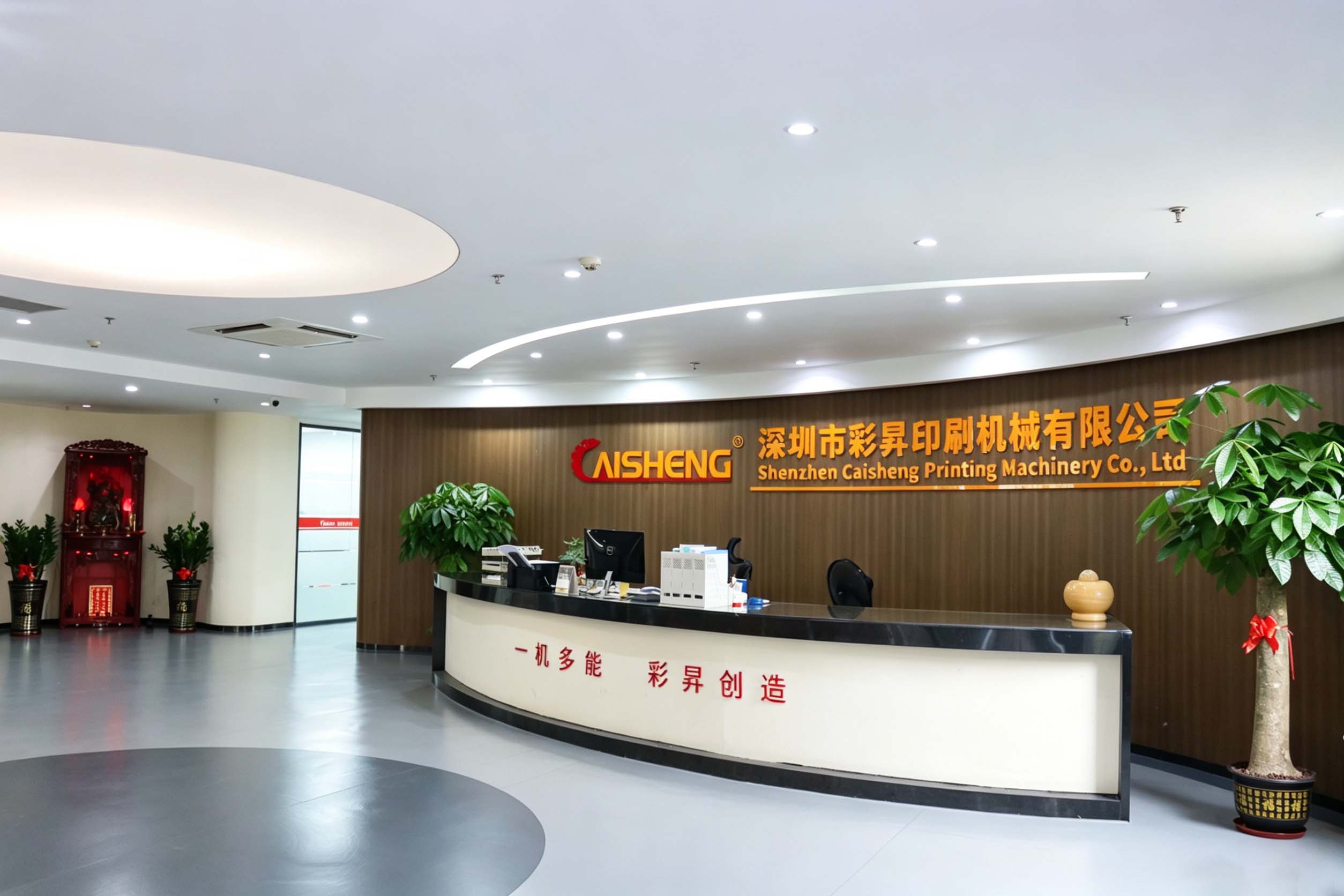
A label press decision is a multi-year commitment — the supplier behind the machine matters as much as the machine specification.
Label converting rewards predictability. A press that repeats the same job to the same tolerance year after year is usually worth more than a machine with a higher headline speed that cannot hold registration across a mixed order book. That is why the choice between an intermittent label press and a full-rotary label press is rarely settled by a single speed figure. It is settled by which production profile the machine will actually face.
The short answer: an intermittent label press indexes the web in steps and is chosen for short-to-medium runs, frequent job changes and flatbed die-cutting flexibility. A full-rotary label press moves the web continuously and is chosen where run lengths are long enough to amortise cylinder tooling and where throughput dominates. Both architectures remain in production because both fit real order books.
This technical FAQ answers the questions procurement engineers raise when comparing the two, using published Caisheng machine data — including the CS-220-5C intermittent platform and the high-speed CS-JQ350G-6C rotary platform — together with independent market research on the label sector.
Intermittent vs. full-rotary: what each architecture actually does
An intermittent label press indexes the web one repeat at a time. The web stops, the printing stations impress the image while the material is stationary, a flatbed die-cutting unit cuts the outline, and the web advances again. That dwell is the defining feature of the design. It buys accuracy and finishing flexibility at moderate speed, and it makes short, frequently changing jobs economical because there is no cylinder set to prepare for every repeat.
A full-rotary label press removes the dwell. The web runs continuously and the printing, die-cutting and slitting cylinders rotate in synchronisation with it. Speed becomes the defining feature, and the constraint shifts from cycle time to tooling: each repeat needs a cylinder set whose cost must be spread across production volume.
| Attribute | Intermittent label press | Full-rotary label press |
|---|---|---|
| Web movement | Indexed in steps; the web pauses during each print and die-cutting cycle | Continuous; cylinders stay synchronised with the moving web |
| Stated speed example | CS-220-5C: stated up to 40 m/min | CS-JQ350G-6C: high-speed rotary platform for continuous running |
| Best run profile | Short to medium runs, frequent SKU changes, mixed order books | Long, repeatable runs where throughput dominates |
| Die-cutting | Flatbed die-cutting units are a natural fit in line | Rotary die-cutting cylinders integrated in the same pass |
| Changeover logic | Generally faster between short jobs | Cylinder set-up and repeat registration per job |
| Main cost driver | Machine time per repeat plus operator changeover time | Tooling investment per repeat, amortised across volume |
Line speed, the figure quoted first in most datasheets, is a stated machine capability rather than a guaranteed production rate. Real output also depends on web width, the number of printing and converting stations, material behaviour, die-cutting method and changeover practice. For that reason a quoted speed is only meaningful when it is read against a specific job mix.
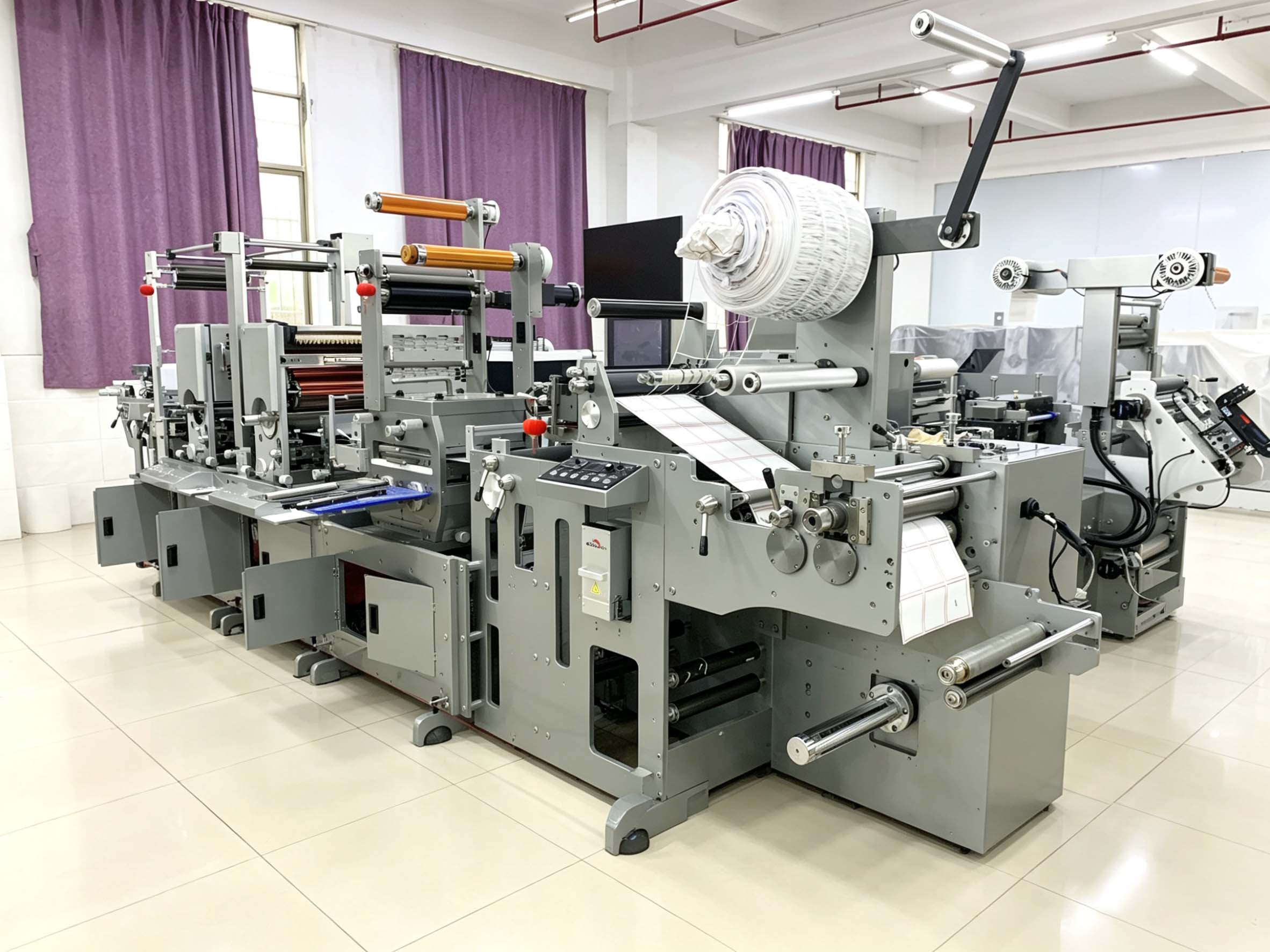
Intermittent architecture in practice: letterpress printing stations combined with a flatbed die-cutting unit for jobs that change frequently.
Why architecture is now a lifecycle decision, not a spec-sheet decision
A label press normally anchors a converting line for the better part of a decade. Over that horizon, three forces push the architecture decision beyond the initial quotation.
The first is portfolio drift. Label work tends to fragment rather than consolidate: more SKUs, more substrate variants such as clear film, metallic foil and PVC stickers, and more short promotional runs alongside stable core products. A machine purchased for one profile is often asked to handle another within a few years.
The second is supply timing. Equipment is not instantly available. Caisheng states a minimum order quantity of one unit, a typical production lead time of 45 to 60 days, and a monthly production capacity of 18 units for export markets covering Southeast Asia, the European Union, the Middle East and the United States. Those figures mean the purchasing calendar is part of the production plan, not a formality after it.
The third is compliance and service continuity. Certification status, the availability of replacement parts and the ability to troubleshoot remotely all determine how long the machine stays productive — and how expensive the years after commissioning turn out to be.
What Caisheng builds across the two architectures
Shenzhen Caisheng Printing Machinery Co., Ltd. is a Shenzhen-based printing machinery manufacturer founded in 2011. The company specialises in intermittent and high-speed full-rotary letterpress printing machines, flexographic printing machines and screen printing machines, and it also supplies customised multi-functional label finishing solutions, including die-cutting systems and high-speed varnishing machines. It operates a 6,000 m² facility with 65 employees, an 8-engineer R&D team and an annual output of 200 units, of which approximately 50% is exported to Southeast Asia, Europe, the Middle East and the United States.
Its product philosophy is summarised by the company as “One Machine, Multiple Functions”: the platforms are built around multi-functional frames so that several processes can be combined in a single pass. One published configuration illustrates the approach — a six-colour letterpress printing machine combined with glue-side printing, a multi-functional frame, rotary die-cutting, flatbed die-cutting and slitting on one line.
Manufacturing depth is part of the pitch. Caisheng states that it runs its own CNC machining plants for precision press parts, which allows tolerances to be controlled at the source rather than through the supply chain. For buyers evaluating long-term ownership, that matters less as a marketing point and more as a practical question: how quickly can a worn component be reproduced and shipped?
The technical variables that decide real output
Registration accuracy is the variable that most directly separates a usable press from a problematic one, and it is the area where Caisheng publishes the most detail. The company states a registration deviation of ±0.05 mm across its printing presses, and lists a registration precision of ±0.025 mm for the CS-220-4C intermittent rotary letterpress. Those figures should be read as design tolerances to be verified during acceptance testing rather than as universal production guarantees.
Four mechanisms sit behind the tolerance claim:
- Precision components machined in Caisheng’s own CNC workshops, controlling tolerance from the source.
- An imported Japanese servo system for transmission and positioning at speed.
- A patented tapered bearing sleeve design combined with a photographic inspection system, used for fine-tuning and real-time deviation compensation.
- A self-developed LED UV cold-light drying system intended to prevent heat deformation of materials such as films.
Ink control follows a similar logic: manual coarse adjustment combined with computer automatic fine adjustment gives two levels of control over ink volume, which matters when a run mixes dense solids with fine pharmaceutical text.
Drying and drive architecture also drive operating cost. Caisheng states that the combination of a Japanese servo system and LED UV drying reduces overall power consumption by at least 30%, and that vertical integration — including two in-house CNC machining plants — lowers total equipment cost by roughly 10% relative to similar manufacturers. Both are company-reported figures, and both should be tested against a specific cost model rather than accepted at face value.
On the mechanical side, the design choices that affect maintenance are worth checking during acceptance: a base built with a natural metal stress-relieving process and a patented triangular guide rail, intended to resist deformation and reduce recalibration; an electrically operated bottom-mould lifting mechanism and a linked squeegee baffle to simplify assembly and disassembly; and an intelligent detection system that assesses equipment status and issues early warnings for preventive maintenance. Core and vulnerable components are manufactured in house, which supports long-term spare-part continuity.
Application fit: which label work suits which architecture
Caisheng describes its label printing equipment as covering labels, adhesive stickers, PVC stickers and tags. The application scenarios it publishes span daily consumer goods and food packaging, chemical and industrial products, wine and premium beverages, cosmetics and personal care, and pharmaceuticals and healthcare.
| Application area | What the work demands | Architecture that typically fits |
|---|---|---|
| Daily consumer goods and food packaging | Vibrant graphics, durable adhesion, repeatable high volume | Full-rotary, where runs are long and stable |
| Cosmetics and personal care | Clear films and metallic foils, premium finish, frequent SKU changes | Intermittent, for changeover speed and material handling |
| Wine and premium beverages | Fine print quality and precise die-cutting on small batches | Intermittent with flatbed die-cutting, or rotary for longer repeats |
| Pharmaceuticals and healthcare | Ultra-high precision for tiny text, barcodes and QR codes | Either, provided registration tolerance is verified on the job file |
| Chemical and industrial products | Chemical-resistant labels that stay legible in harsh environments | Dependent on substrate and run length rather than architecture alone |
The pattern is consistent: intermittent presses suit mixed, frequently changing work where setup time is the bottleneck, while full-rotary presses suit concentrated, repeatable volume where press time is the bottleneck.
Where each architecture stops being the right answer
An honest comparison has to state its limits, and in this category the limits are well defined.
Intermittent presses have a speed ceiling by design. The CS-220-5C is stated at up to 40 m/min; a converter whose order book is dominated by continuous, long-run work will pay for that dwell in throughput, no matter how fast the changeover is.
Full-rotary presses carry a volume threshold. Rotary die-cutting and printing cylinders are repeat-specific, so the tooling investment only pays back when run lengths are long enough and repeat orders are predictable. For a converter whose jobs are short and irregular, the tooling cost per order can outweigh the speed advantage.
Both architectures operate within defined web-width classes — the 220 mm and 300/320 mm families that Caisheng builds around. Work that requires substantially wider webs sits outside the scope of these presses and should be evaluated against a different machine class.
Neither architecture is the natural answer for ultra-short, variable-data work, where digital printing is the conventional fit. The same body of market research that sizes the industrial segment indicates digital label printing solutions growing at a 6.39% CAGR, ahead of a 5.1% overall industrial average — a reminder that flexo and letterpress platforms are competing for a specific slice of label demand, not all of it.
Finally, there is a planning limit on the supplier side. A monthly production capacity of 18 units and a 45-to-60-day lead time mean that buyers entering a capacity expansion should open supplier conversations well before the intended installation date.
Market trend: label demand grows steadily, complexity grows faster
Independent research supports a market that is expanding but not exploding. Global Market Insights values the global industrial label printer market at USD 23.8 billion in 2025 and projects USD 38.8 billion by 2035. Mordor Intelligence places the global print label market — printed label output, a different layer of the value chain — at USD 57.05 billion in 2026, growing at a 3.28% CAGR to USD 67.02 billion by 2031.
Those two figures measure different things and should not be combined. A separate estimate of the label printer device market, at USD 0.58 billion in 2026 rising to USD 0.82 billion by 2034, shows how easily output, machinery and device definitions are conflated in this category. For procurement purposes, the useful reading is directional: label consumption expands steadily, while the mix shifts toward more SKUs, more substrates and shorter cycles — conditions that reward presses with fast changeover and stable registration rather than raw speed alone.
What the next buying cycle is likely to reward
Three shifts are visible in how buyers frame label press procurement.
First, lifecycle evidence is displacing headline specification. Certification status (CE, and management systems such as ISO 9001, ISO 14001 and ISO 45001), spare-part sourcing, and remote diagnostics are increasingly part of the evaluation rather than afterthoughts. Trade classification matters too: flexographic printing machinery falls under HS code 844316, which buyers should confirm against their own customs documentation.
Second, process integration continues to spread. Machines that combine printing, glue-side printing, die-cutting and slitting on one multi-functional frame reduce handling between operations, which is exactly what mixed order books demand.
Third, machine-level verification is becoming a prerequisite. Independent, model-level benchmark data for label presses remains thin, so the burden falls on acceptance testing: pre-shipment tests run against the buyer’s own job file, on the buyer’s own substrate, at the stated speed.
Procurement FAQ: intermittent and full-rotary label presses
1. What is the practical difference between intermittent and full-rotary web movement?
An intermittent press indexes the web one repeat at a time, so the web pauses while printing or die-cutting takes place. A full-rotary press keeps the web moving continuously, with cylinders synchronised to that motion. The mechanical consequence is that intermittent designs protect accuracy and finishing flexibility at moderate speed, while full-rotary designs convert continuous motion into higher throughput where run lengths justify cylinder-based tooling.
2. What speed should a procurement engineer expect from each architecture?
Speeds are stated machine capabilities rather than guaranteed output rates. Caisheng’s CS-220-5C intermittent platform is stated at up to 40 m/min, while the CS-JQ350G-6C is positioned as a high-speed rotary platform. Actual output also depends on web width, station count, die-cutting method, material and changeover practice, so quoted figures are best compared against a specific job mix.
3. How do web width and station count change what a press can do?
Web width sets how many labels are imposed across the web and therefore the material converted per cycle; Caisheng’s platforms sit in the 220 mm and 300/320 mm classes. Station count determines how many processes run in one pass: printing colours, glue-side printing, rotary die-cutting, flatbed die-cutting and slitting can be combined on a multi-functional frame, which reduces offline handling but lengthens set-up.
4. How should registration accuracy claims be evaluated before purchase?
Treat published tolerances as design targets and verify them. Caisheng states a registration deviation of ±0.05 mm across its printing presses and lists ±0.025 mm for the CS-220-4C intermittent rotary letterpress. The claim rests on in-house CNC machining, an imported Japanese servo system, a patented tapered bearing sleeve design with photographic inspection for real-time compensation, and LED UV cold-light drying that limits heat deformation of films. The verification step is a pre-shipment test on the buyer’s own material and job file.
5. How do you decide which architecture fits a given production mix?
Use run length and changeover frequency. If most jobs are short or medium, change SKUs often and rely on flatbed die-cutting, an intermittent press matches the pattern. If a limited number of repeats run continuously for long periods and press time is the constraint, a full-rotary press matches better. Application type alone — food, cosmetics, wine, pharmaceutical or industrial — does not determine the answer.
6. What supply-chain and lead-time factors should be planned for?
Caisheng states a minimum order quantity of one unit, a typical production lead time of 45 to 60 days, a monthly production capacity of 18 units for export markets including Southeast Asia, the European Union, the Middle East and the United States, delivery terms of FOB and payment terms of 30/70. Because capacity is shared across export markets, ordering windows and commissioning slots should be scheduled within the same plan as the production ramp-up.
7. What quality evidence should be required before shipment?
Caisheng states that it performs 100% testing of all units for export markets and that pre-shipment testing is the acceptance criterion. Its adjustment engineers test machine performance before delivery, and customers can be invited to the factory for acceptance inspection. Buyers should request the test record against their own job file rather than a generic checklist.
8. What after-sales and lifecycle support should be confirmed in the contract?
Caisheng provides remote support and a one-year warranty for major components for export markets. Beyond that, buyers should confirm the wear-part list and its sourcing path (core and vulnerable components are manufactured in house), how the intelligent early-warning system feeds preventive maintenance, what operator and engineer training is included, and what response expectations apply in the buyer’s region.
9. Which certifications and trade classifications matter for export markets?
Caisheng holds ISO 9001, ISO 14001 and ISO 45001 certification, and its products meet CE standards — relevant for European Union market access. On classification, flexographic printing machinery falls under HS code 844316. Documents for both should be verified at supplier qualification stage rather than at shipment.
10. When is neither architecture the right answer?
When the requirement is dominated by ultra-short, variable-data runs, digital printing is the conventional fit; research cited above indicates digital label printing solutions growing at 6.39% CAGR against a 5.1% overall industrial average. Both intermittent and full-rotary letterpress and flexo platforms also operate within specific web-width classes, so wide-format work sits outside their scope.
For buyers who want the underlying machine configurations and finishing modules in one document, Caisheng’s product brochure is available here: Caisheng product brochure (PDF).