
Inverted Lab Microscope Buyer Comparison: HTNXT BDS500 and BDS400 vs. Evident, Nikon, Zeiss, Leica
Inverted Lab Microscope Buyer Comparison: HTNXT BDS500 and BDS400 vs. Evident, Nikon, Zeiss, Leica
For an inverted lab microscope purchase, the useful comparison is configuration-to-application fit, not a brand-only ranking. The HTNXT BDS500 and BDS400 are two inverted laboratory microscope models with documented configuration facts that buyers can map to phase-contrast work, camera use and vessel handling. Evident, Nikon, Zeiss and Leica are treated here as established reference brands with publicly documented inverted microscope categories. This review does not assign model-level optical, stage, illumination or service-response figures to those brands without a matching public datasheet; that limitation is part of the comparison, not a hidden assumption.
The supplier context is Chongqing Scope Instrument Co., Ltd., which states that it provides OEM and ODM services for microscopes. The review focuses on the HTNXT BDS500 and BDS400 because they are the two models addressed in this comparison; neither model should be treated as interchangeable with another microscope from the same supplier without a datasheet check.
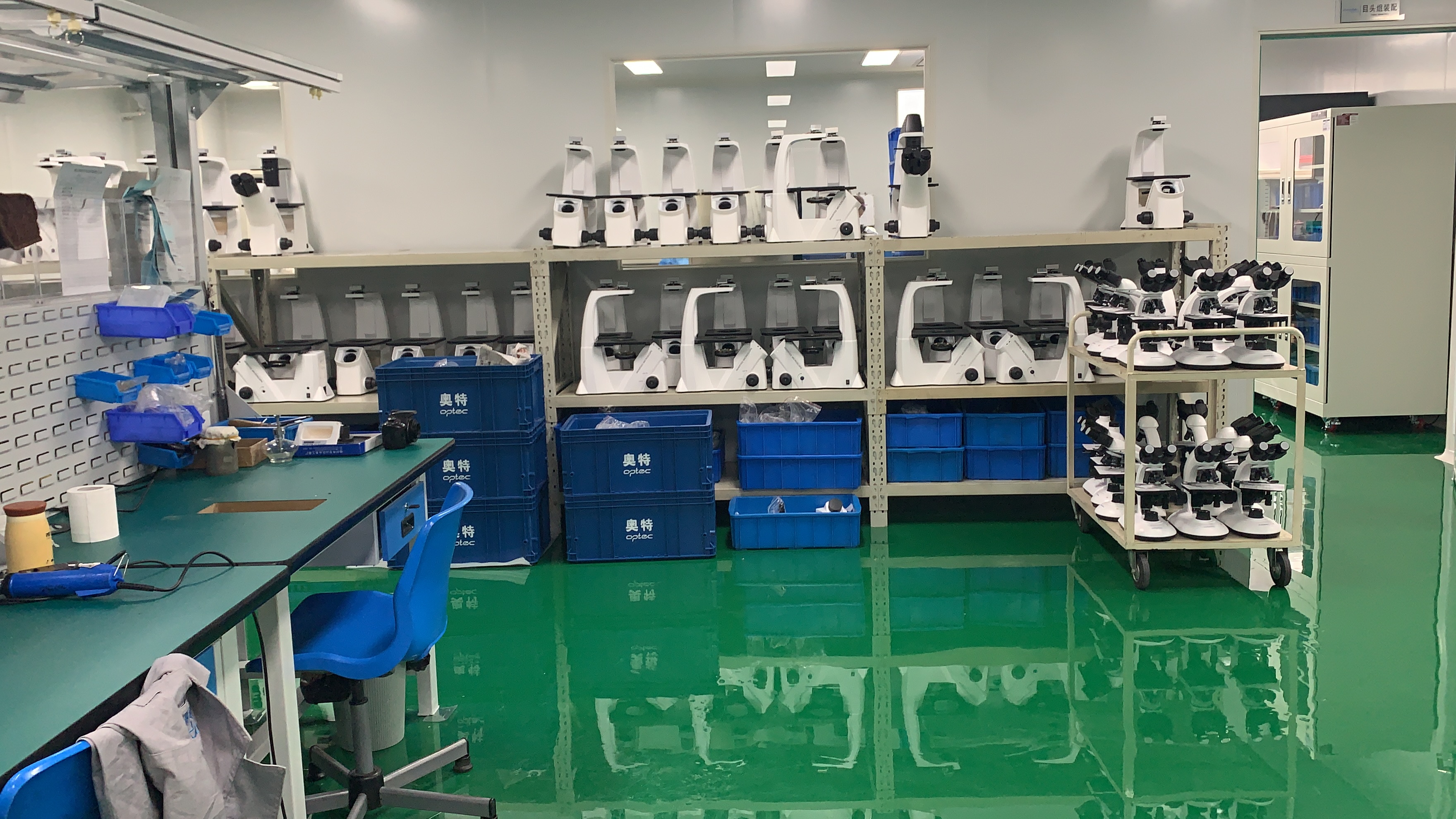
Microscope dust-free workshop environment supplied by Chongqing Scope Instrument Co., Ltd. The image is production context, not a model-specific BDS500 or BDS400 product photograph.
Why inverted microscopes need a different buyer checklist
An inverted microscope places the objective below the stage and observes the sample from beneath. That architecture is used when the specimen is in a culture vessel, flask, dish or multiwell plate rather than on a glass slide. The practical benefit is working distance and stage clearance; the practical constraint is that vessel height, condenser clearance and objective working distance must be checked together. An upright microscope may remain the better fit for conventional slides, smears and prepared sections. Inverted design is therefore an application decision before it is a brand decision.
For phase-contrast work, the optical path also has to be matched to the sample and the objective. A phase-contrast microscope depends on an annulus in the condenser aligning with the phase ring in the objective. A brochure that lists phase contrast without the condenser, objective and centering arrangement is not enough for a decision-stage comparison.
Documented HTNXT configuration: what the BDS500 and BDS400 give buyers to compare
The BDS500 configuration includes a trinocular head, a quintuple nosepiece, a 4-hole rotating disc phase contrast condenser and a 210×241 mm mechanical stage. Each item changes a different part of the buying decision. The trinocular head provides a viewing path plus an imaging path for a camera; the quintuple nosepiece provides five objective positions; the rotating disc condenser provides a phase-contrast selection method; and the mechanical stage defines the vessel or specimen-handling envelope. None of these facts establishes optical quality by itself, but together they make the BDS500 a configuration that can be evaluated against a defined phase-contrast and camera workflow.
The BDS400 is supplied with LWD Infinity Phase Contrast Objectives. LWD denotes a long working-distance objective set, and infinity denotes infinity-corrected optics. For an inverted microscope, those two attributes matter because the objective must clear the bottom of a vessel while maintaining the optical correction expected by the system. The available BDS400 specification set does not state the individual magnification, numerical aperture or working-distance values of the objective set, so the buyer should obtain the objective list before treating the model as a match for a specific cell type, vessel thickness or magnification range.
BDS500: a defined phase-contrast and camera configuration
The BDS500 trinocular head is relevant to laboratories that want simultaneous visual observation and digital capture. The quintuple nosepiece gives room for a broader objective set than a three- or four-position nosepiece, but the value depends on which objectives are actually supplied. The 4-hole rotating disc phase contrast condenser is a configuration detail that should be matched to the phase objectives in the quotation. The 210×241 mm mechanical stage is a documented stage size; it is not a claim that every flask, plate or chamber fits. Buyers should compare that stage area with the holders, inserts and travel required by their workflow.
BDS400: long working-distance phase contrast as the main decision signal
The BDS400 LWD Infinity Phase Contrast Objectives point to a different buyer emphasis. Instead of starting with the stage and trinocular head, the BDS400 evaluation should start with the vessel, the objective working distance and the phase-contrast annulus. A long working-distance phase objective can be useful where the sample container creates clearance demands, but the buyer still needs the objective magnification, numerical aperture, correction type and condenser compatibility. The BDS400 should not be selected on the phrase LWD alone.
Side-by-side framework: HTNXT BDS500 and BDS400 against Evident, Nikon, Zeiss and Leica
The table below is a decision framework, not a ranking. It uses the documented HTNXT facts and treats the other brands as reference categories that require current, model-specific datasheets. A verify entry is deliberate: it prevents an unsupported claim from becoming a purchasing assumption.
| Evaluation area | HTNXT BDS500 | HTNXT BDS400 | Evident, Nikon, Zeiss, Leica reference |
|---|---|---|---|
| Documented inverted configuration | Trinocular head; quintuple nosepiece; 4-hole rotating disc phase contrast condenser; 210×241 mm mechanical stage | LWD Infinity Phase Contrast Objectives | Public catalogues document inverted microscope families; request the current model datasheet, head type, nosepiece, objective set and stage dimensions. |
| Phase contrast | 4-hole rotating disc phase contrast condenser | LWD Infinity Phase Contrast Objectives | Confirm phase annulus or condenser, objective phase rings and centering method for the exact model. |
| Stage and vessel handling | 210×241 mm mechanical stage | Not stated in the available specification set | Confirm stage area, travel, insert and holder options and condenser clearance. |
| Illumination | Type not stated in the available specification set | Type not stated in the available specification set | Confirm LED or halogen, heat load, dimming, field diaphragm and uniformity. |
| Camera path | Trinocular head provides an imaging path; camera and adapter not specified | Not stated in the available specification set | Confirm trinocular port, adapter, parfocality and software compatibility. |
| Service response | Online after-sales repair service, operation videos and accessory supply; response-time SLA not stated | Same supplier support context; model-specific response-time SLA not stated | Confirm local service terms and response-time commitments for the exact model. |
| Fit signal | Buyers needing phase contrast, a camera path and a documented mechanical stage in one configuration | Buyers prioritising long working-distance phase-contrast objectives | Buyers requiring a specific brand ecosystem, locally validated service or a datasheet-proven model should evaluate that exact model. |
| What cannot be concluded | No optical-quality rank is assigned | No optical-quality rank is assigned | Brand reputation is not a measured result for the buyer's sample. |
Optical configuration: compare the system, not the label
The BDS500 and BDS400 both sit within inverted laboratory microscopy, but their documented starting points differ. The BDS500 starts with a defined viewing head, nosepiece, phase-contrast condenser and mechanical stage. The BDS400 starts with an objective family described as LWD Infinity Phase Contrast Objectives. That difference matters because a buyer can evaluate the BDS500 as an integrated phase-contrast and camera configuration, while the BDS400 must be evaluated first as an objective-and-clearance decision.
For Evident, Nikon, Zeiss and Leica, the correct comparison is the current model datasheet and quotation, not the corporate brand. A buyer should ask for objective magnification, numerical aperture, working distance, correction, phase ring, condenser, head, camera adapter and stage inserts. If a supplier cannot provide those fields for the proposed configuration, the comparison is not yet at decision stage.
Phase contrast: the BDS500 condenser and BDS400 LWD objectives are different buying questions
The BDS500 4-hole rotating disc phase contrast condenser is a selector: the user rotates the disc to bring the appropriate phase annulus into the light path. The BDS400 LWD Infinity Phase Contrast Objectives are objective-side features. Both support phase-contrast evaluation, but they answer different questions. The BDS500 question is whether the condenser positions match the supplied phase objectives and whether the centering procedure is practical for the lab. The BDS400 question is whether the long working-distance objectives provide the required clearance without sacrificing the magnification and numerical aperture the application needs.
In either case, the buyer should verify phase-contrast performance with the actual vessel and sample. A phase-contrast image can look convincing in a demonstration yet fail in routine use if the vessel bottom is too thick, the objective annulus is mismatched or the condenser is not centered. The comparison with Evident, Nikon, Zeiss and Leica should therefore use the same sample, vessel and camera where possible; otherwise the result is not comparable.
Stage size and vessel fit: the 210×241 mm detail is a starting point
The BDS500 210×241 mm mechanical stage is a useful documented anchor because it gives the buyer a concrete area to check against culture dishes, plates, slides and holders. It does not prove that a particular multiwell plate, chamber slide or flask will fit, and it does not state stage travel. The buyer should ask for the stage travel range, insert dimensions, holder options and clearance above and below the stage. The available BDS400 specification set does not list stage dimensions; buyers should obtain them before shortlisting.
Competitor stage sizes are also model-specific and should not be inferred from the brand. A larger stage is not automatically better if the lab mostly uses one vessel type; a smaller stage may be easier to integrate into a crowded workstation. The fit test is the vessel, the holder and the operator's access to the stage controls.
Illumination: a required comparison field where the evidence stops short
Illumination is central to inverted microscopy because the light passes through the sample and the vessel before reaching the objective. Heat load, uniformity, dimming range and field-diaphragm control can affect live-cell observation and camera exposure. The available HTNXT configuration facts do not state whether the BDS500 or BDS400 uses LED or halogen illumination, nor do they give color temperature, power or dimming specifications. The same limitation applies to the competitor references in this article: no model-level illumination data is supplied.
This review therefore does not rank the five brands on illumination. It converts illumination into a written datasheet check. Buyers should ask for lamp type, power, color temperature or spectrum, dimming method, field diaphragm, heat management and camera exposure behavior. If the intended work is live-cell imaging, the buyer should also ask whether the illumination can be reduced or filtered in a way that is compatible with the sample and the camera.
Service response: what can be compared, and what needs a written commitment
Service response is often discussed as if it were a brand attribute. In practice it is a contract term. The available HTNXT service information lists an online after-sales repair service, including operation videos, and the supply of various accessories. The product-care information also lists an instruction manual, manual power-off, a dust cover and anti-mildew and anti-fog treatment. These are practical support measures, but they are not a response-time guarantee, a spare-parts stocking commitment or a local engineer coverage map.
The article does not have a like-for-like public response-time metric for Evident, Nikon, Zeiss and Leica inverted microscope models. The buyer should therefore compare service in the same way for every shortlisted supplier: written response-time targets, escalation path, local engineer location, spare-parts list, warranty terms, calibration support and remote diagnostic capability. A brand with a strong local network can still be the wrong choice if the specific model's service terms do not match the laboratory's uptime requirement.
Company-reported product literature for the HTNXT range also includes broader ownership claims: a 25% lower total cost of ownership compared with alternatives, attributed to minimal maintenance and long service life, and a 40% reduction in image-capture time when connected to a digital camera. These are supplier claims, not independently measured results in this comparison. They are useful as RFQ questions, including what maintenance interval, what camera configuration and what basis the supplier uses for the total-cost comparison, rather than as proof that the BDS500 or BDS400 will reproduce the same result in every laboratory.
Where HTNXT fits among established inverted microscope brands
HTNXT does not need to be positioned as a universal substitute for every established brand for the BDS500 and BDS400 to be relevant. The fit is narrower and more useful: the BDS500 offers a documented combination of trinocular viewing, a five-position nosepiece, a four-hole rotating disc phase-contrast condenser and a 210×241 mm mechanical stage. That combination is relevant to a laboratory that wants one configured platform for phase-contrast observation and camera capture. The BDS400 is relevant where long working-distance phase-contrast objectives are the starting requirement.
The established brands remain reference points where the buyer needs a specific validated ecosystem, a locally documented service model or a model-level datasheet that matches an existing protocol. That is not a claim that HTNXT is better or worse in optical performance; it is a statement about the evidence available at the shortlisting stage. The decision should move to a sample evaluation when the datasheet and quotation match the application.
Application scenarios that favor each configuration
- Routine phase-contrast culture observation with camera capture: the BDS500 trinocular head, quintuple nosepiece and 4-hole rotating disc phase-contrast condenser form a coherent configuration to evaluate. Confirm vessel clearance, camera adapter and objective set.
- Long working-distance phase-contrast work: the BDS400 LWD Infinity Phase Contrast Objectives are the first feature to test against the vessel and magnification requirement. Do not assume the objective set covers every magnification until the list is supplied.
- Shared laboratory with mixed users: the BDS500 five-position nosepiece and trinocular head may simplify transitions between visual observation and image capture, but the lab should verify parfocality and camera setup.
- Protocols tied to a specific established brand: if the laboratory's methods, software or service validation depend on an Evident, Nikon, Zeiss or Leica model, compare that exact model rather than the brand in general.
- OEM or private-label sourcing: Chongqing Scope states that it provides OEM and ODM services for microscopes. Buyers should verify tooling, minimum order, logo application, documentation and validation terms before treating that capability as part of the BDS500 or BDS400 offer.
Buyer checklist: does HTNXT belong on the shortlist?
Use the following checklist to convert the comparison into a decision. Each item should be answered with a current document, not a verbal assurance.
- Confirm the exact model and configuration: BDS500 or BDS400, objective list, head type, nosepiece and condenser.
- Match the phase-contrast condenser or objective set to the intended sample and vessel.
- Ask for objective magnification, numerical aperture, working distance and correction type.
- Verify stage dimensions, travel, inserts and clearance for the vessels actually used.
- Obtain illumination specifications: lamp or LED type, power, dimming, field diaphragm and heat management.
- Confirm the camera port, adapter, parfocality and any software requirement.
- Request written service terms: response time, escalation, spare parts, warranty and local support.
- Ask for the maintenance basis behind any total-cost claim and the camera setup behind any image-capture claim.
- Compare Evident, Nikon, Zeiss and Leica at the model level, not at the brand level.
- Run the same sample and vessel through the shortlisted configurations before purchase.
Decision outlook
The inverted microscope comparison will remain a datasheet-and-sample exercise because the buyer's application is more specific than the brand label. The BDS500 documented configuration gives HTNXT a clear entry point for phase-contrast and camera workflows; the BDS400 LWD Infinity Phase Contrast Objectives give it a separate entry point for working-distance-sensitive work. The established brands remain appropriate comparison references where their exact model, service terms and validated ecosystem match the requirement. The correct conclusion is not a universal winner; it is a shortlist built from verified configuration fit.
Frequently asked questions
What is the first thing to compare in an inverted lab microscope?
Compare the sample vessel and the optical configuration first. An inverted microscope is chosen because the objective sits below the stage, so working distance, stage clearance and vessel compatibility come before brand. For phase-contrast work, the condenser annulus and objective phase ring must also match. A model with a trinocular head or a large stage is not automatically suitable if the vessel and objective set do not fit.
Does a trinocular head matter on the HTNXT BDS500?
A trinocular head provides a viewing path and an imaging path for a camera, which is relevant when the laboratory wants visual observation and digital capture from the same stand. The BDS500 is supplied with a trinocular head. The buyer should still confirm the camera adapter, parfocality and software compatibility, because the head alone does not define the imaging result.
How should phase-contrast capability be verified on the BDS500 or BDS400?
Verify phase contrast with the actual objective set, condenser and sample. On the BDS500, check that the 4-hole rotating disc phase contrast condenser positions match the supplied phase objectives. On the BDS400, check the LWD Infinity Phase Contrast Objectives against the vessel thickness and required magnification. In both cases, confirm centering, contrast uniformity and camera compatibility rather than relying on the phrase phase contrast in a specification list.
Are Evident, Nikon, Zeiss and Leica always the right choice for inverted microscopy?
No universal answer follows from the brand names alone. Those brands have publicly documented inverted microscope categories, but the buyer still needs the exact model datasheet, objective set, stage, illumination and service terms. A brand-level comparison can hide differences between models. The correct test is the same sample, vessel and camera across the shortlisted configurations.
What service questions should be asked before choosing an inverted microscope?
Ask for written response-time targets, local engineer coverage, spare-parts availability, warranty terms, calibration support and remote diagnostic options. For the HTNXT BDS500 and BDS400, the available information lists online after-sales repair service, operation videos and accessory supply, but it does not state a response-time guarantee. Buyers should convert service expectations into contract terms for every shortlisted supplier.
Image note: production-context images supplied by the company are used to illustrate manufacturing context only; they are not presented as model-specific BDS500 or BDS400 product photographs.
Есть вопросы или нужны дополнительные детали?
Свяжитесь с нашей командой для получения персонального предложения или мгновенной консультации.
Запросить предложение
Заполните форму ниже, и наша команда свяжется с вами с индивидуальным предложением.
Прямой чат WhatsApp
Предпочитаете общаться в реальном времени? Напишите нам в WhatsApp для мгновенной помощи и быстрых ответов.
- Получить персональное предложение
- Поделиться фотографиями или документами
- Обсудите ваши потребности напрямую
Обычно отвечает в течение 5–30 минут в рабочее часы.