
Irrigation Pivot System Shortlist: Fixed DYP for 10–50 Ha
A Fixed DYP center pivot is specified by how far the machine reaches from its anchored tower, not by a catalogue name. For mid-size and large field irrigation, China Yulin Irrigation Equipment Co., Ltd. lists three configurations that cover most practical demand: 177.6 m machines for 10 hectares, 307.4 m machines for 30 hectares, and 395.6 m machines for 50 hectares. This shortlist sets out what changes between the three, what stays identical, and which field conditions push a grower toward one of them.
China Yulin Irrigation Equipment Co., Ltd. is a Dalian-based manufacturer of large agricultural irrigation machinery, founded in 2009 and operating a 64,653 m² production site in Lvshunkou District, Liaoning Province, China. The company produces center pivot, lateral move, towing and hose reel irrigation systems, and describes more than 95% of machine spare parts as independently manufactured in-house. Its Fixed DYP center pivot is the reference product for buyers comparing fixed-installation pivots against towable pivots, linear move machines and hose reel irrigators.
The three configurations below are not a ranking of suppliers. They are three length options of one machine platform, and the purchasing question is narrower and more practical: which machine length matches the field that has to be irrigated, and what evidence should a buyer check before committing to it.
Why field size, not price, decides the shortlist
A fixed center pivot rotates around one anchored tower, so machine length determines both the command area and the geometry of the irrigated circle. That single mechanical fact creates the most common sourcing error in pivot procurement: a machine sized to the wrong block. A 307.4 m pivot ordered for a plot designed around a 177.6 m circle commits capital and pumping capacity to an area the field cannot use, while a 177.6 m pivot placed on a 30-hectare block leaves a substantial share of that block outside the wetted circle.
Because area grows with the square of machine length, the steps between these three options are far larger than the length difference alone suggests. The jump from 177.6 m to 307.4 m is not a 73% increase in capability; it is a different class of machine, with more spans, more drive units, more pipe, and a different water supply requirement at the center point.
The shortlist: three Fixed DYP configurations at a glance
All three options share the same platform, controls and corrosion system. What separates them is reach, span count and the size of the field block they are intended to serve.
| Configuration | Machine length | Covered area | Field situations it fits |
|---|---|---|---|
| Fixed DYP — 177.6 m | 177.6 m | 10 hectares | Compact blocks, contract parcels, supplementary irrigation on smaller arable units; shortest truss run and lowest number of driven spans in the series. |
| Fixed DYP — 307.4 m | 307.4 m | 30 hectares | Mid-size arable blocks where the water source and power point sit close to the field center; the middle option when a single tower must cover more than a small parcel. |
| Fixed DYP — 395.6 m | 395.6 m | 50 hectares | Large single blocks and dry-season cropping programmes; the configuration most often paired with an end spray gun and a fertilizer tank in documented projects. |
The same product listing also includes a 565 m machine covering 100 hectares. That option sits outside this shortlist because the operating envelope changes materially at that scale — more spans, longer cable runs, a larger centre supply — and it deserves its own evaluation rather than being treated as a fourth line in the same table.
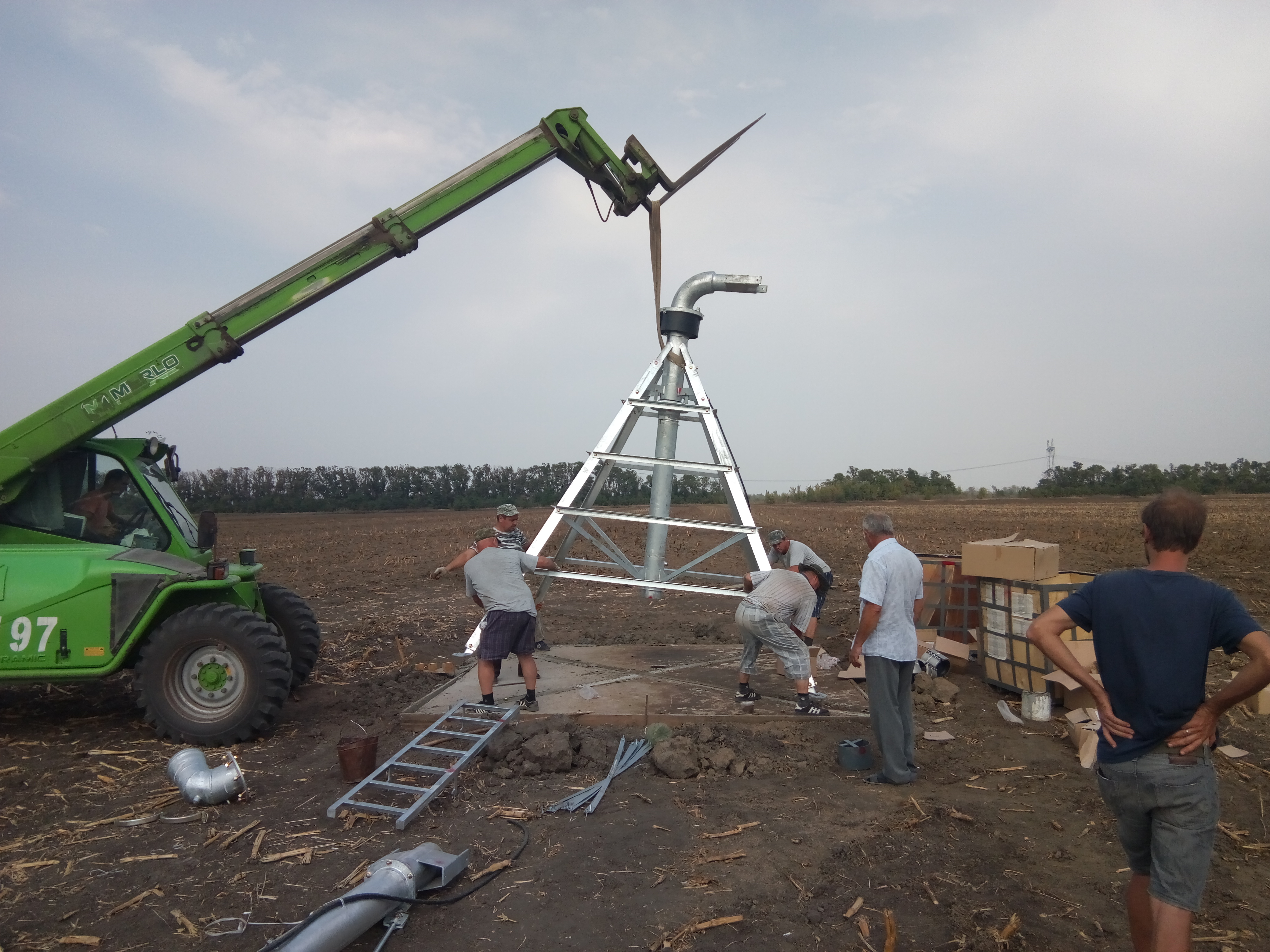
Central tower installation on a fixed center pivot project. The anchored tower defines the rotation point and therefore the irrigated circle for every span behind it.
What stays identical across all three models
The value of a shortlist depends on knowing which specifications are genuinely shared. On the Fixed DYP platform, the following parameters are listed as platform-level rather than option-level, which means a buyer evaluating the 10-hectare and the 50-hectare machine is comparing the same engineering baseline.
| Specification area | Recorded value |
|---|---|
| Pivot type | Fixed DYP center pivot |
| Drive | Electromechanical, reversible, individual for each span |
| Rated voltage | 380V–460V |
| Movement mode | Continuous and start-stop, synchronised to the motor of the last tower |
| Material reference | Q235B metal; the material field lists GB 13912-2020 |
| Anti-corrosion coating | Hot-dip galvanization; the parameter field lists GB/T 13912-2002 for the coating process |
| Water pipeline type | Sectional, truss structure |
| Control panel protection | IP65 |
| Tower box / collector ring protection | Tower box: IP33; collector ring: IP65 |
| Collector ring | 11 rings, not less than 4×90A and 7×25A |
| Copper cable core thickness | Not less than 4×4 mm² + 7×1.0 mm² |
| Ground clearance to bottom of truss rod | 3 ± 0.2 m |
| Operating temperature | −45 °C to +45 °C |
| Pressure regulators | 10, 15 or 20 psi |
| Rain intensity | Not more than 0.16 mm/min |
| Average drop diameter | Not more than 1.1 mm |
| Plant mechanical damage | Not more than 2% |
| Land usage coefficient inside the circle | Not less than 0.9 |
| Tower wheels | 14.9-24 irrigation tyre, two wheels per trolley, hot-dip galvanized discs |
| Water chemistry | pH 6–7.5 usable without quality problems during the warranty period |
| Crop types | Fodder crops, cereals, vegetables, industrial crops, including corn |
Two entries in that table need buyer attention rather than assumption. The first is the coating standard: the product record references GB/T 13912-2002 in the coating parameter and GB 13912-2020 alongside the Q235B material designation. Those are two different document references on the same build sheet, so a purchaser should ask the supplier to state, in writing, which edition the galvanizing inspection certificate cites for a specific order. The second is protection grading. IP65 on the control panel and the collector ring does not mean the whole machine is IP65 — the tower box is listed at IP33, which is a splash-resistant rating appropriate to its mounting position but not a washdown rating.
Structural logic: sectional truss and hot-dip galvanized Q235B
The water pipeline on a Fixed DYP is described as sectional with a truss structure, and the truss is what makes the long spans practical. A 395.6 m machine is not a single 395 m beam; it is a chain of spans, each carried on its own tower and driven by its own motor. That arrangement distributes load, allows the machine to follow field contours within its operating limits, and means a repair on one span does not require dismantling the pipeline behind it.
Q235B is a carbon structural steel widely used for galvanized agricultural frames, and the coating is hot-dip galvanization rather than paint. For irrigation equipment this choice is about the working environment: pivot structures stay wet, sit in condensate and are exposed to fertilizer and soil splash for years. The company states that all irrigation equipment undergoes anti-corrosion and wind resistance testing intended for tropical, saline-alkali and high-wind farmland environments, and that it produced OEM equipment for a global top irrigation company between 2000 and 2008 before building automated workshops with robotic welding and precision processing.
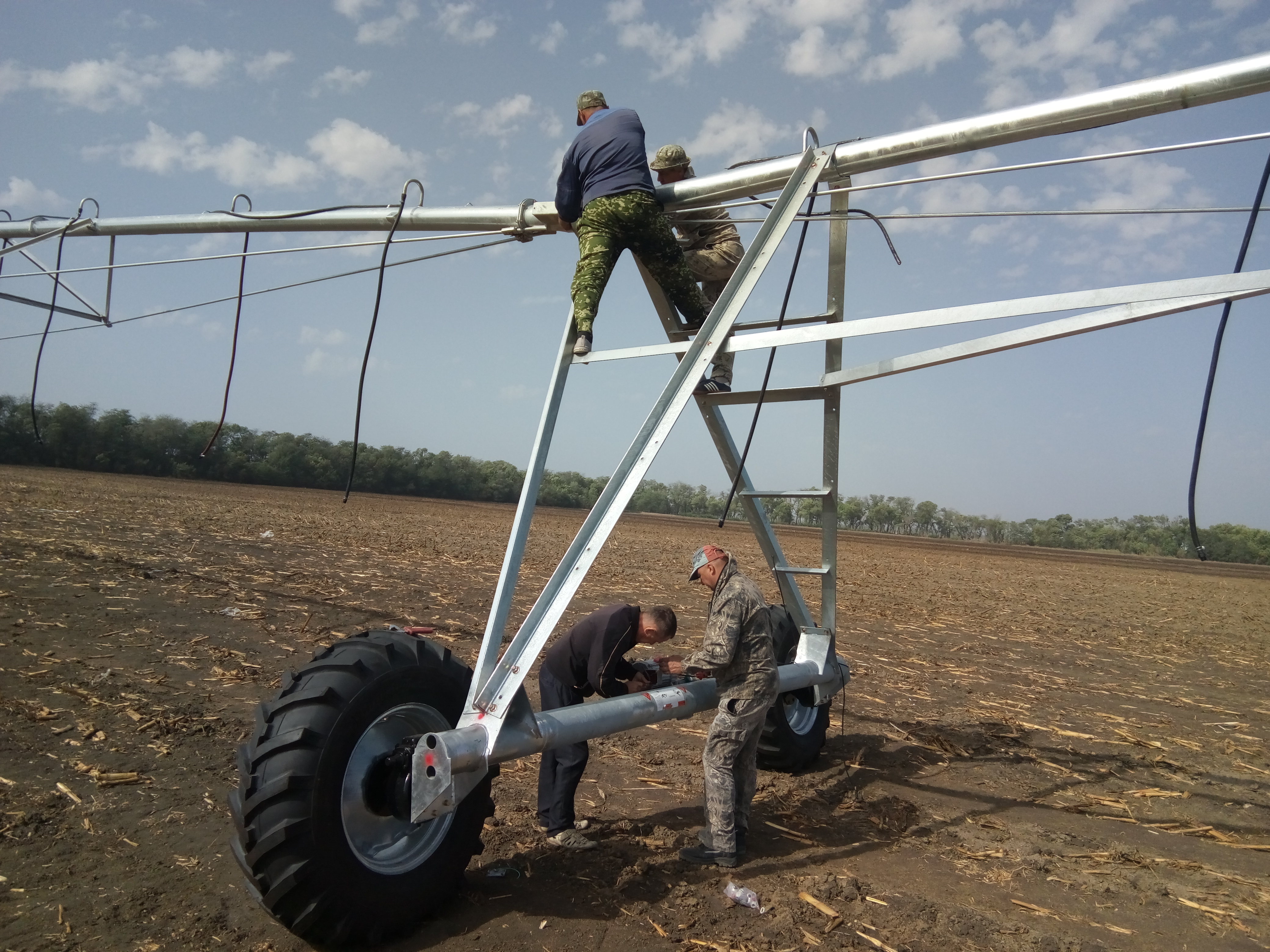
Truss and main water pipe assembly on site. Sectional construction allows each span to be handled, aligned and serviced independently.
Electrical and control architecture: 380V–460V, IP65, per-span reversibility
The drive system is electromechanical, reversible, and individual for each span. In practice that means each tower carries its own motor and gearbox, and the machine can travel clockwise or anti-clockwise. The standard control panel is listed with a main power switch, a power control switch, a water switch, a direction control switch, a percentage indicator for speed regulation, and an auto-reverse switch, all behind an IP65 panel enclosure.
The rated voltage band of 380V–460V covers the common three-phase agricultural supplies in the export markets the company serves, which include Australia, New Zealand, Canada, Mexico, Africa, Central Asia, Russia and Kazakhstan. The company also states that voltage customization is available for OEM orders, which matters where the local supply or generator output does not sit comfortably inside that band.
The collector ring is listed at 11 rings with not less than 4×90A and 7×25A capacity and IP65 protection, with copper cable core thickness of not less than 4×4 mm² + 7×1.0 mm². For a buyer, the practical reading is that the electrical path through the rotation point is specified with a current capacity and a conductor gauge — the two figures that later determine whether an added end gun pump, fertilizer dosing unit or monitoring accessory can be supported without re-cabling the machine.
Matching the three configurations to field conditions
Field area sets the shortlist; field conditions narrow it. The following decision rules reflect how the three lengths behave in practice.
- Start with the usable circle, not the title deed. Confirm the area that can actually be served from one fixed centre point, then choose the length that covers it. A 177.6 m machine maps to 10 hectares, a 307.4 m machine to 30 hectares and a 395.6 m machine to 50 hectares.
- Check the centre point before the model. A fixed pivot needs a water supply, a power connection and a foundation at the centre of the circle. If the only viable water source sits at the field edge, the machine length becomes a civil works question rather than a catalogue question.
- Treat the corners separately. A rotating machine irrigates a circle. Where corner production matters, the specification allows an end gun or end-of-pivot sprinkler, with an average drop diameter listed as an option rather than a fixed value.
- Confirm the power path. The machine is designed for an external power connection or a diesel generator supply. Sites without reliable grid electricity are workable, but the generator sizing belongs in the same procurement conversation as the pivot length.
- Match pressure regulation to the water source. The regulators are listed as 10, 15 or 20 psi. Selecting among them is a function of the pump curve and the nozzle package, and it should be settled before shipment rather than during commissioning.
Where the 50-hectare configuration earns its place
A documented example shows how the largest option in this shortlist is configured in a real dry-season setting. In Papua New Guinea, a farm required irrigation during the dry season, effectively substituting for rainfall so that plants could continue growing. The equipment specified was a center pivot irrigation machine of 395.6 m covering 50 hectares, matched with an end spray gun and a 1000 L fertilizer tank.
Two details in that project are worth noting for buyers evaluating the same configuration. First, the system is driven by an independent diesel generator set, providing stable power in farmland without a reliable grid connection. Second, the customer required an end spray gun for supplementary irrigation of the corners and a poly pipe option to limit corrosion from water acidity or alkalinity, and wanted pesticides added during irrigation for integrated pest control. The operating condition was recorded as high temperature, with electromechanical reversible drives controlled individually per span.
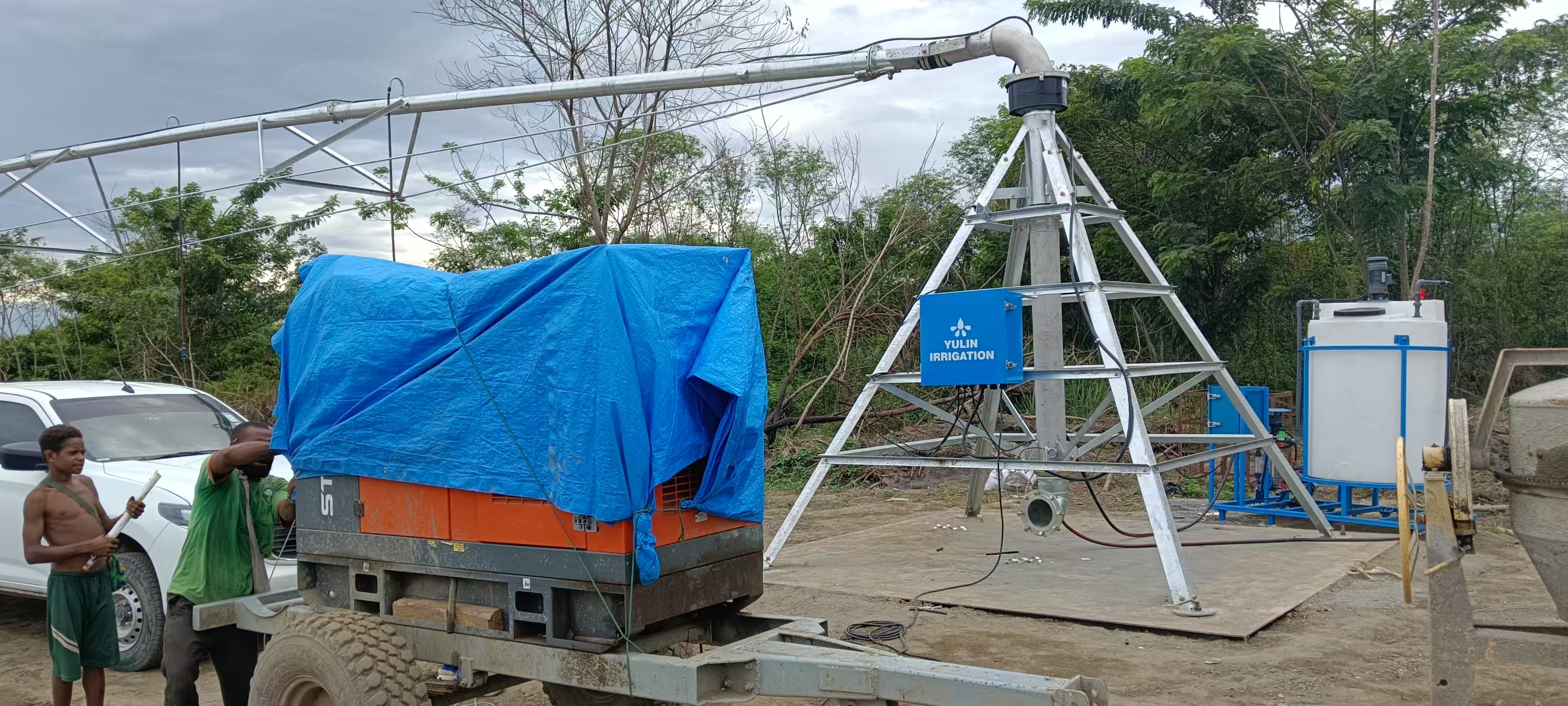
A generator set supplying a fixed pivot where grid power is not reliable. Power supply arrangements should be fixed at the specification stage, not at commissioning.
How the Fixed DYP compares with the alternatives
A shortlist is only useful if the excluded options are explained. The Fixed DYP is one of several irrigation approaches the same manufacturer supplies, and the boundary between them is mostly about geometry, mobility and power.
| Approach | Strength | Boundary to accept before ordering |
|---|---|---|
| Fixed DYP center pivot | One anchored machine covers a defined circle with per-span electromechanical control; sectional truss construction; galvanized Q235B structure; available in 10, 30 and 50 hectare lengths. | Anchored to a single centre point and cannot be relocated between blocks. Irrigates a circle, so corners need an end gun or a separate solution. Requires a water and power point at the centre, either from the grid or a generator. |
| Towable pivot | Can be pulled between fields, which suits rental arrangements and shifting cropping patterns. | Mobility comes with a different chassis and connection routine; it is a separate product line rather than a variant of the Fixed DYP. |
| Four-wheel linear move machine | Suits rectangular fields where a circular pattern wastes too much land. | A different machine architecture with a different water delivery method along the run; it does not resolve the field-shape problem for free. |
| Hose reel irrigator (JP800) | Water turbine driven, no electricity required, 300 m PE pipe of 90 mm diameter, 25–52 t/h flow, spray radius 19–41 m, and quick to move. | Lower command area per set and a narrower wetted pattern than a large pivot; better suited to smaller parcels, irregular plots and off-grid sites than to a 50-hectare block. |
The honest limitation of the Fixed DYP is therefore not a quality issue but a fit issue. If a farm's production model depends on moving irrigation equipment between several small blocks within one season, a fixed pivot is the wrong instrument regardless of build quality. If the farm has one large block, a stable centre point and a workable power arrangement, the fixed platform delivers more irrigated hectares per machine than any of the alternatives above.
Market context: why fixed pivots are being shortlisted more deliberately
Procurement behaviour around pivots is being shaped by the size and direction of the market itself. Mordor Intelligence estimates the global center pivot irrigation system market at USD 2.56 billion in 2025, projected to reach USD 5.67 billion by 2030. That trajectory is not evenly distributed across regions: Lindsay Corporation reported securing a multi-year international irrigation supply agreement in the MENA region valued at more than USD 100 million in 2024, while Valmont Industries reported Agriculture segment sales of USD 278.0 million in Q4 2024, representing 26.7% of total net sales.
For a grower or importer, those figures carry two practical implications. Large project demand concentrates around a small number of global manufacturers, which lengthens lead times for buyers outside those frameworks. At the same time, uniformity is becoming a specified purchasing criterion rather than an assumed property — ISO 11545:2009 is the active international standard for determining the uniformity of water distribution from centre-pivot and moving lateral irrigation machines, and it gives buyers a common way to describe what they want measured.
Against that backdrop, the reason to shortlist by field size rather than by brand familiarity becomes clearer. A 30-hectare block needs a machine that fits it, a documented build sheet that can be verified, and a supplier able to support installation on site. Company scale is a secondary consideration compared with those three.
Procurement checks before committing to a configuration
The following checks can be run against any of the three lengths in this shortlist, using the supplier's own records.
- Build sheet verification. Ask for the written parameter list covering material grade, coating standard and edition, protection ratings by component, cable cross-section, collector ring capacity and ground clearance. Compare the coating reference on the certificate to the reference on the quotation.
- Order and delivery terms. The recorded production capability for this product line includes a minimum order quantity of 1 unit, a lead time of 21–40 days, a monthly capacity of 60 units, OEM production mode, voltage customization, and 100% testing.
- Installation support. The company states that it provides global localized on-site installation, commissioning and operator training services, alongside video technical support, online support and free spare parts. For a first pivot on a farm, commissioning support is worth confirming in writing before the machine ships.
- Water chemistry. The specification states that water with pH 6–7.5 can be used without quality problems during the warranty period. Outside that band, ask about the poly pipe option and its effect on the warranty position.
- Track record in comparable conditions. The manufacturer's documented projects include 600 pivot units supplied to an Australian distributor over 15 years for forage, pasture, cotton and watermelon irrigation with more than 40% energy savings reported; 450 units supplied to a Russian group over 9 years; 70 units to a New Zealand dairy operation over 9 years; 70 units to an Algerian OEM client over 7 years with a reported 40% efficiency increase; and 45 units to an end customer in Zimbabwe over 6 years for crop irrigation.
Limits, and what this shortlist does not answer
Three things sit outside the scope of this comparison and should be resolved separately. First, the specification does not state an irrigation rate per 24 hours as a fixed figure — it is listed as an option, which means the application rate has to be calculated against the crop, soil and pump for each project. Second, the end gun and end-of-pivot sprinkler drop diameter is also listed as an option, so corner performance depends on the accessory chosen rather than the base machine. Third, the reported project outcomes above are drawn from manufacturer case records; buyers should treat them as supplier evidence to be verified against local references, not as a guaranteed result for a new site.
Future outlook
The direction of travel in pivot procurement is toward verifiable specification rather than headline capability. Two pressures drive it: financing and project contracts increasingly require documented uniformity testing against a recognised method such as ISO 11545:2009, and buyers in water-constrained regions need to prove application rates before they commit capital. Against a market projected to grow from USD 2.56 billion in 2025 to USD 5.67 billion by 2030, the suppliers most exposed are those that cannot produce a parameter sheet that survives technical review.
For the Fixed DYP platform specifically, the meaningful near-term developments are likely to be in controls and power arrangement rather than in structural design: more sites running pivots from generator sets where grid supply is unreliable, more voltage customization requests on OEM orders, and more add-on equipment — end guns, fertilizer tanks, dosing — attached to machines whose collector ring and cable capacity were specified with that in mind.
Frequently asked questions
How do I decide between the 177.6 m, 307.4 m and 395.6 m Fixed DYP configurations?
The three lengths map to covered areas of 10, 30 and 50 hectares respectively. Start from the area that can actually be irrigated from a single fixed centre point, then choose the length that covers it. A machine longer than the block cannot use its extra reach; a machine shorter than the block leaves part of the block outside the irrigated circle.
What does IP65 protection cover on a Fixed DYP pivot?
The published specification lists the standard control panel at IP65, and the collector ring at IP65 as well, with not less than 11 rings at 4×90A and 7×25A. The tower box is listed separately at IP33. Buyers should therefore read the ratings component by component rather than treating IP65 as a machine-wide classification.
Can a Fixed DYP pivot operate without a reliable grid connection?
Yes. The product is designed to operate from an external power connection or from a diesel generator supply, with a rated voltage band of 380V–460V. A documented project in Papua New Guinea ran a 395.6 m, 50-hectare configuration from an independent diesel generator set on farmland without reliable grid electricity. Voltage customization is also available for OEM orders where local supply or generator output sits outside the standard band.
How are speed and direction controlled on this machine?
The drive is electromechanical, reversible and individual for each span, and the machine can travel clockwise and anti-clockwise. The standard control panel includes a main power switch, a power control switch, a water switch, a direction control switch, a percentage indicator for speed regulation and an auto-reverse switch. Movement is continuous or start-stop, synchronised to the motor of the last tower.
What order quantity and lead time apply to these configurations?
The recorded production capability for this product line lists a minimum order quantity of 1 unit, a lead time of 21–40 days, a monthly capacity of 60 units and 100% testing, with voltage customization available on OEM orders. Lead time should still be confirmed against the specific length and accessory package, since an end gun, fertilizer tank or poly pipe option changes the bill of materials.
Reference material
The manufacturer publishes a product catalogue covering pivot, lateral move, towing and hose reel configurations, including the Fixed DYP parameter list. It can be downloaded here: 2026 YULIN Pivot Catalogue.
Есть вопросы или нужны дополнительные детали?
Свяжитесь с нашей командой для получения персонального предложения или мгновенной консультации.
Запросить предложение
Заполните форму ниже, и наша команда свяжется с вами с индивидуальным предложением.
Прямой чат WhatsApp
Предпочитаете общаться в реальном времени? Напишите нам в WhatsApp для мгновенной помощи и быстрых ответов.
- Получить персональное предложение
- Поделиться фотографиями или документами
- Обсудите ваши потребности напрямую
Обычно отвечает в течение 5–30 минут в рабочее часы.