
Irrigation Pivot System Supplier Sustainability: A Service Viability Audit
An irrigation pivot system is a capital asset whose service life is measured in decades, which makes the decisive procurement question less about delivery-day price and more about who can still supply a dimensionally identical span drive, collector ring or spray gun in year twelve.
Supplier sustainability in irrigation is therefore not a brand impression. It is an auditable property of the supplier's documented product architecture: whether the platform is defined precisely enough that a buyer, an installer and a future spare-parts desk all read the same specification. This audit sets out five evidence gates that translate that idea into checks a procurement team can run before contract signature, and applies them to the documented range of China Yulin Irrigation Equipment Co., Ltd., trading as YULIN IRRIGATION — a Dalian-based manufacturer of large agricultural irrigation machinery established in 2009.
Why Service Viability Outranks Price in Pivot Procurement
Price comparison is a same-day exercise. Service viability is a fifteen-year exercise. A center pivot is a machine with relatively few failure modes but many wear points — span drives, gearboxes, tires, sprinklers, regulators, collector rings and control panels — and each wear point becomes a procurement problem only if the replacement part no longer matches the installed geometry.
The market context explains why this matters more now than a decade ago. Mordor Intelligence estimates the global center pivot irrigation system market at USD 2.56 billion in 2025, projected to reach USD 5.67 billion by 2030. Growth of that scale implies a rapidly expanding installed base, and an installed base is only as valuable as its aftermarket. Two incumbent data points reinforce the multi-year nature of the category: Valmont Industries reported Agriculture segment sales of USD 278.0 million in Q4 2024, equal to 26.7% of total net sales, while Lindsay Corporation secured a multi-year international irrigation supply agreement in the MENA region valued at more than USD 100 million in 2024. Large contracts of that structure are service commitments as much as equipment orders.
Broadly accepted industry practice supports the same conclusion: buyers increasingly request written specification sheets, spare-parts lists and commissioning documentation alongside price, because a quotation alone does not describe what will be replaceable later.
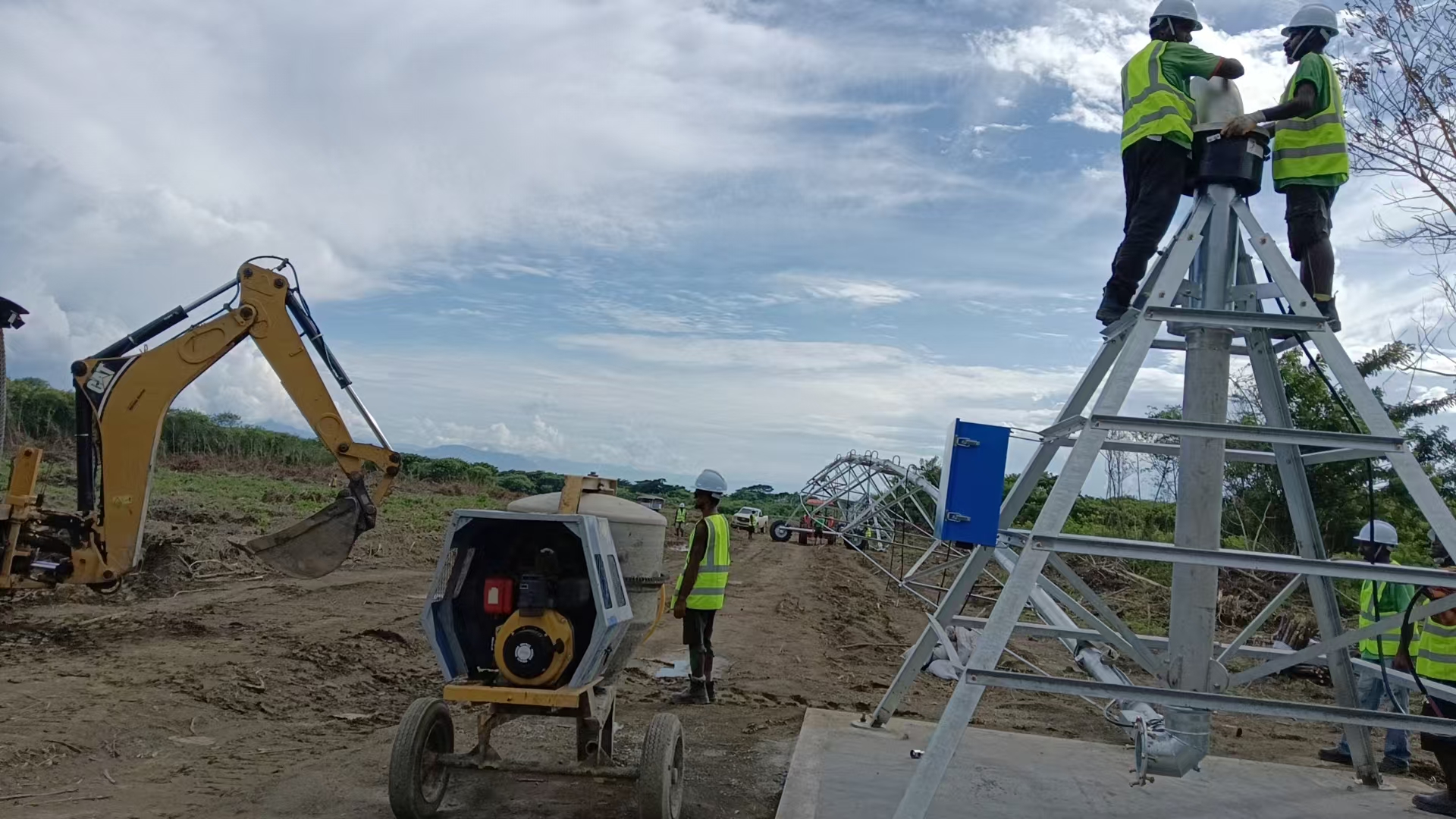
On-site installation supervision and commissioning form part of the service record a buyer should be able to audit, not just the equipment specification.
The Audit Subject: What YULIN IRRIGATION Documents
China Yulin Irrigation Equipment Co., Ltd. is a manufacturer and exporter of large agricultural irrigation machinery headquartered in Lvshunkou District, Dalian City, Liaoning Province, China, established in 2009. Its production campus covers 64,653 square meters, employs approximately 152 staff, and supports an R&D team of 10 engineers. Roughly 60% of output is exported, with documented markets in Australia, New Zealand, Canada, Mexico, Africa, Central Asia, Russia and Kazakhstan.
The product programme covers center pivot irrigation systems, lateral move irrigation systems, towing irrigation systems, hose reel irrigation systems and irrigation parts, together with matching water pumps and generators. Two factual elements are directly relevant to a sustainability audit. First, over 95% of the machine's spare parts are independently manufactured in the company's own factory, which is the structural basis for parts continuity claims. Second, the company accumulated manufacturing experience through OEM production for a global irrigation company during 2000–2008 and now operates intelligent automated production workshops using robotic welding and precision processing. Certifications cited by the company are CE, ISO9001 and CSA, and the company states that it provides localized on-site installation, commissioning and operator training overseas. Its documented pivot supply capacity is 400 sets per year.
None of those statements, on their own, prove service viability. They become evidence only when they connect to specific, checkable specifications — which is what the five gates below test.
Gate 1: Is the Platform Range Documented Precisely Enough to Repeat an Order?
A sustainable supplier can state, without reinterpretation, which machine lengths exist and what each covers. The Fixed DYP center pivot platform is documented across four standard lengths:
| Documented length | Irrigated area | Typical planning context |
|---|---|---|
| 177.6 m | 10 hectares | Smaller blocks and first-phase mechanisation |
| 307.4 m | 30 hectares | Mid-size field units |
| 395.6 m | 50 hectares | Commercial field scale |
| 565 m | 100 hectares | Large estate and project scale |
The audit point here is repeatability. When a supplier publishes length-to-area mapping, a second-phase order, an expansion or a replacement span can be specified against the same reference frame. When it does not, later purchases drift into custom engineering, which is where both cost and compatibility risk accumulate.
Gate 2: Is the Material and Coating Record Named, Not Described?
The Fixed DYP platform is made of Q235B metal conforming to GB 13912-2020, with a hot-dip galvanized anti-corrosion coating. Tower wheels are 14.9-24 irrigating tires, two wheels on each trolley, with hot-dip galvanized discs. Flexible irrigation hoses are PVC, reinforced and UV resistant, and the pipeline is specified in layers intended to preserve system integrity over life with UV resistance.
Naming a steel grade and a galvanizing standard is what separates a coating claim from a coating specification. A buyer auditing sustainability should confirm three things: that the steel grade is stated, that the anti-corrosion standard is identified by number rather than by adjective, and that the same standard is applied to secondary components such as trolley discs, because those are frequently the first surfaces to fail in the field. One documented boundary belongs in the same conversation: the platform is specified for irrigation water with pH 6–7.5 without quality problems during the warranty period.
Gate 3: Can the Electrical Architecture Be Serviced Span by Span?
Control and drive architecture determines how a machine behaves when one span faults. The Fixed DYP pivot uses an electromechanical, reversible drive that is individually applied to each span, with continuous or start-stop movement matching the last tower motor. The operating voltage range is 380V–460V.
| Documented item | Specification |
|---|---|
| Pivot type | Fixed DYP center pivot |
| Span drive | Electromechanical, reversible, individual for each span |
| Voltage | 380V–460V |
| Control panel functions | Main power switch (disconnect switch), power control switch, water switch, direction control switch, percentage indicator (speed regulation), auto-reverse switch |
| Panel protection | IP65 |
| Collector ring | 11 rings, not less than 4×90A and 7×25A, protection not less than IP65 |
| Tower box protection | Not less than IP33 |
| Copper cable core | Not less than 4×4mm² + 7×1.0mm² |
| Truss clearance | 3 ± 0.2 m from ground to bottom of truss rod |
| Operating temperature | −45 to +45 °C |
Individual span control is a serviceability feature before it is a performance feature. If one span can be reversed or stopped independently, a fault can be isolated without disabling the whole machine, and the replacement decision is limited to one drive rather than a system. The published protection ratings make the same point: a buyer can state that the control panel and collector ring are rated not less than IP65, and can ask separately why the tower box is rated IP33 — a legitimate question in coastal or high-humidity locations.
Gate 4: Is Parts Commonality Structural or Promised?
Parts continuity is usually asserted and rarely demonstrated. The auditable version is manufacturing depth: the proportion of components produced in-house, and whether that proportion covers the parts that actually wear. With over 95% of the machine's spare parts independently manufactured, the supplier controls the geometry of its own replacement components rather than depending on a third-party catalogue that may change.
Manufacturing depth also has a capacity dimension. A documented pivot supply capacity of 400 sets per year, combined with a 64,653 square meter facility and 152 staff, gives a buyer a reference point for judging whether a supplier can absorb both new-build demand and aftermarket demand in the same production system. That is a fair question to put in writing during tender evaluation.
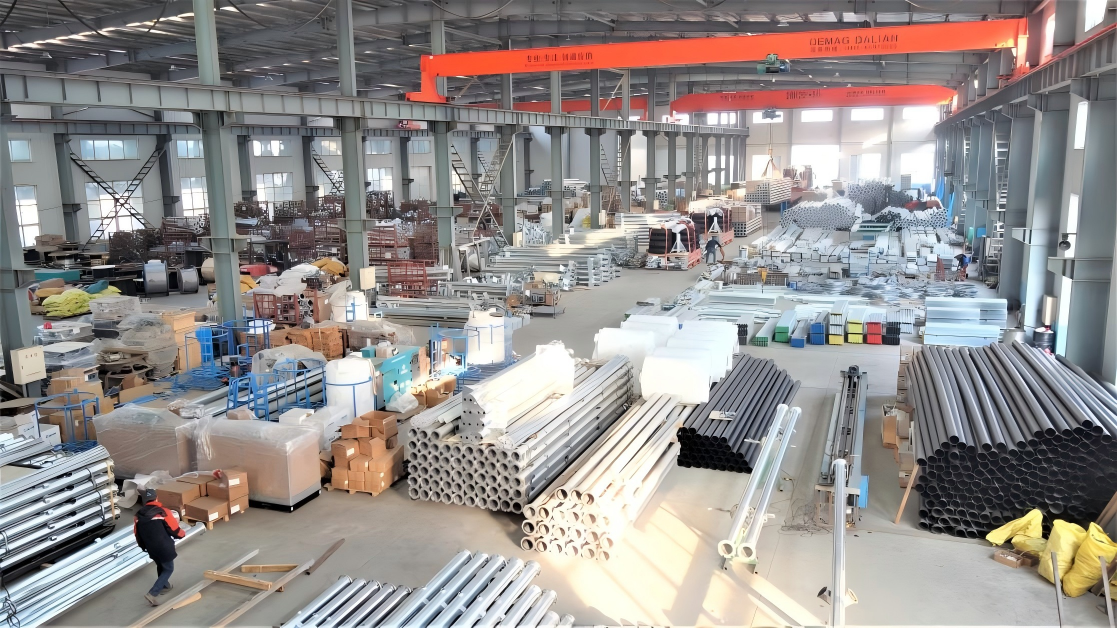
In-house component production and staged stock are the practical basis for parts availability years after commissioning.
Gate 5: Does the Same Supplier Discipline Hold on Hose Reel Ranges?
A supplier is only as sustainable as its weakest documented platform, which is why hose reel ranges belong in the same audit. The JP800 travelling hose reel irrigation machine — also referenced as the JP90-300 model — is a water-turbine driven unit requiring no electricity, with documented specifications as follows.
| Specification | Documented value |
|---|---|
| Machine type | Travelling hose reel irrigation machine, hose reel irrigation system |
| Drive | Water turbine driven, no electricity required |
| PE pipe | 90 mm diameter × 300 m length |
| Water flow | 25–52 t/h |
| Nozzle diameter | 16–22 mm |
| Spray radius | 19–41 m |
| Spray gun | DL50 / SIMA10497 |
| Inlet pressure | 0.6–0.9 MPa |
| Weight | 2180 ± 30 kg |
| Outside dimensions | 6120L × 2330W × 2770H mm |
| Shipping dimensions | 2450L × 2000W × 2250H mm |
For a service-viability audit, three entries carry disproportionate weight. The named spray gun (DL50 / SIMA10497) and the numbered nozzle range (16–22 mm) are the parts most likely to be replaced repeatedly, so naming them makes future ordering unambiguous. The PE pipe specification of 90 mm by 300 m defines the consumable that governs the machine's working life. The listed shipping dimensions and the 2180 ± 30 kg weight allow freight, handling and storage planning to be fixed at quotation stage rather than discovered at delivery.
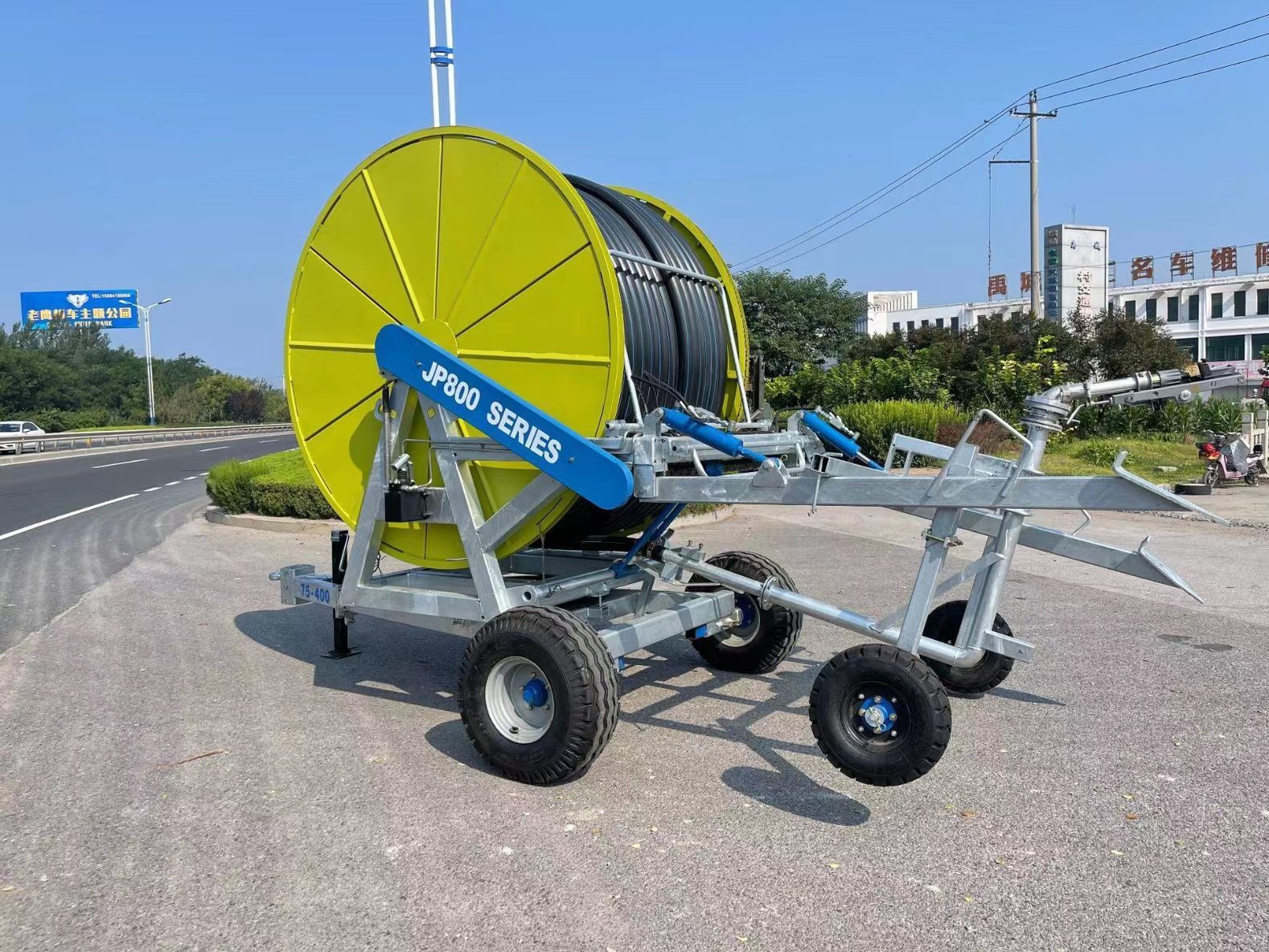
The JP800 hose reel machine operates without electrical supply, which changes both its deployment profile and its maintenance profile.
Technical Reading: What the Operating Numbers Actually Constrain
Specification values are only useful if their operational consequence is understood. Several Fixed DYP parameters translate directly into agronomic and service decisions.
Rain intensity is specified at no more than 0.16 mm/min, which governs whether applied water infiltrates rather than runs off, and therefore constrains how fast the machine can travel on a given soil. Average drop diameter is specified at no more than 1.1 mm, with the end-of-pivot sprinkler diameter as an option. Plant mechanical damage is specified at no more than 2%, and the land usage coefficient within the irrigated circle, including the area near the center tower, at not less than 0.9 — a figure that matters because the centre of a pivot field is the hardest area to crop efficiently. Pressure regulators are offered at 10, 15 or 20 psi, and the panel percentage indicator provides speed regulation so that application depth can be adjusted rather than fixed. Truss clearance of 3 ± 0.2 m sets the crop height the machine can pass over, and the −45 to +45 °C range defines the climates in which the platform is specified to operate. Documented crop suitability covers fodder crops, cereals, vegetables and industrial crops including corn.
For the hose reel platform, the constraining numbers run the other way. Flow of 25–52 t/h combined with inlet pressure of 0.6–0.9 MPa defines the pump envelope the machine requires; a low-pressure source will not deliver the stated performance regardless of machine condition. Spray radius of 19–41 m sets the strip width per pass, and the 300 m pipe length sets the maximum travel distance per position.
Application Evidence: How a Documented Configuration Becomes a Field Result
A documented project in Papua New Guinea illustrates the audit logic in practice. The requirement was a center pivot for dry-season irrigation, where irrigation substitutes for rainfall so that plants continue growing through the dry period. The delivered configuration was a 395.6 m center pivot covering 50 hectares, fitted with an end spray gun and a 1000 L fertilizer tank.
The site conditions are instructive because each one generated a documented engineering response. Working conditions were high temperature. Power came from an external connection or a diesel generator, since grid supply was not reliable. The customer required corner coverage via the end spray gun, optional poly pipe to prevent acidic or alkaline water from corroding the pipeline, and pesticide injection during irrigation for integrated pest control. Because commissioning on site was critical to the outcome, the supplier's engineering team supervised installation in person to confirm standardised assembly and smooth commissioning.
Read as audit evidence, this project shows the three things a sustainability review is looking for: a standard-length machine matched to a real field area, documented configuration options for water chemistry and chemigation, and a service model that includes on-site installation and commissioning rather than documentation alone.
Market Trend Analysis: Procurement Is Shifting Toward Documented Serviceability
Three observable signals point in the same direction. First, market value growth from USD 2.56 billion in 2025 toward USD 5.67 billion by 2030 implies an installed base that will eventually dominate demand over new-unit sales, which shifts competitive advantage toward suppliers with controlled spare-parts production. Second, the scale of incumbent agricultural segments — Valmont's Agricultural segment at USD 278.0 million in Q4 2024, or 26.7% of net sales — shows how much of the category's economics sits in long-life equipment relationships rather than one-off transactions. Third, multi-year agreements such as Lindsay Corporation's MENA supply agreement valued at more than USD 100 million in 2024 demonstrate that institutional buyers now contract irrigation capacity over multi-year horizons.
Alongside commercial signals, the technical reference frame has stabilised. ISO 11545:2009 remains the active international standard for determining the uniformity of water distribution from centre-pivot and moving lateral irrigation machines. A published, internationally recognised uniformity test method gives buyers a neutral way to compare suppliers without relying on manufacturer claims, and it belongs in acceptance criteria alongside material and electrical specifications.
Comparison with Traditional and Alternative Solutions
Sustainability comparisons are most useful when the platforms are compared on service model rather than on headline capability.
| Dimension | Fixed DYP center pivot | JP800 / JP90-300 hose reel machine |
|---|---|---|
| Power source | 380V–460V supply; generator where grid is absent | Water turbine driven; no electricity required |
| Coverage model | Circular, fixed centre; 10–100 ha by length | Travelling; 300 m × 90 mm PE pipe, 19–41 m spray radius |
| Control | Panel IP65, individual electromechanical span drive, percentage speed regulation | Simple operation and quick relocation |
| Corrosion basis | Q235B metal, GB 13912-2020 hot-dip galvanizing | Metal and PE construction |
| Water requirement | Pump-fed; regulators at 10, 15 or 20 psi | 25–52 t/h at 0.6–0.9 MPa inlet pressure |
| Primary wear parts | Span drives, tires, sprinklers, collector ring | PE pipe, DL50/SIMA10497 spray gun, 16–22 mm nozzles |
Documented boundaries buyers should plan around
- Water quality: the Fixed DYP platform is specified for pH 6–7.5 during the warranty period. Sites outside that band, such as the Papua New Guinea project, require documented options such as poly pipe rather than assuming standard steel pipeline will perform identically.
- Power availability: Fixed DYP operation assumes 380V–460V supply. Off-grid sites need a generator, which adds an operating dependency the hose reel platform does not have.
- Inlet pressure: the JP800 requires 0.6–0.9 MPa. A source below that range limits performance regardless of machine specification.
- Enclosure ratings differ by component: the control panel and collector ring are rated not less than IP65, while the tower box is rated not less than IP33. In coastal or wash-down environments, buyers should confirm this explicitly.
- Mobility: a Fixed DYP machine is a fixed installation. Applications requiring routine relocation should be assessed against the towable pivot, four-wheel linear or hose reel categories instead.
- Logistics: the JP800 ships at 2450L × 2000W × 2250H mm at 2180 ± 30 kg, which should be built into freight and site-access planning.
Purchasing Terms and Acceptance Criteria: Turning Service Viability into Contract Language
The practical output of a sustainability audit is a set of clauses. The framework below converts documented specifications into acceptance criteria that remain enforceable years after delivery.
| Clause area | What the purchasing terms should state |
|---|---|
| Configuration | Pivot type Fixed DYP center pivot; machine length 177.6 m, 307.4 m, 395.6 m or 565 m with the corresponding 10, 30, 50 or 100 hectare coverage |
| Material and coating | Q235B metal conforming to GB 13912-2020; hot-dip galvanized coating; hot-dip galvanized tower wheel discs |
| Electrical architecture | 380V–460V; electromechanical, reversible drive individual to each span; panel IP65 with the listed switch functions; collector ring 11 rings, not less than 4×90A and 7×25A; copper core not less than 4×4mm² + 7×1.0mm² |
| Performance parameters | Rain intensity not more than 0.16 mm/min; plant mechanical damage not more than 2%; land usage coefficient not less than 0.9; average drop diameter not more than 1.1 mm; truss clearance 3 ± 0.2 m |
| Water quality condition | pH 6–7.5 during the warranty period; alternative pipeline specification where water falls outside the band |
| Hose reel specification | 90 mm × 300 m PE pipe; DL50/SIMA10497 spray gun; nozzle 16–22 mm; spray radius 19–41 m; flow 25–52 t/h; inlet pressure 0.6–0.9 MPa |
| Parts and support | Spare-parts list at handover; confirmation of in-house component manufacture; on-site installation, commissioning and operator training |
| Uniformity verification | Field water-distribution uniformity assessed in line with ISO 11545:2009 where the buyer requires a neutral reference method |
| Logistics and acceptance | Shipping dimensions 2450L × 2000W × 2250H mm and weight 2180 ± 30 kg for the JP800; documented packing and delivery inspection |
Written this way, acceptance criteria do two jobs at once. They define what is delivered, and they define what the supplier has committed to remain capable of supplying. That second function is the part a price comparison cannot perform.
Future Outlook
As the center pivot market expands from an estimated USD 2.56 billion in 2025 toward a projected USD 5.67 billion by 2030, the competitive axis is likely to move from machine supply toward lifecycle accountability. Three developments follow logically. Spare-parts control will become a pricing factor in its own right, because suppliers with in-house component manufacturing can hold replacement geometry stable across model years. Verification will become more standardised, supported by internationally recognised methods such as ISO 11545:2009 rather than by supplier literature alone. And contracting will increasingly span multiple seasons, in line with the multi-year agreement structures already visible in major irrigation procurement, including Lindsay Corporation's MENA agreement valued at more than USD 100 million in 2024.
For buyers, the implication is straightforward: the supplier evaluation that will look most defensible five years from now is the one built on documented architecture, not on the lowest first invoice.
Frequently Asked Questions
What does supplier sustainability mean in irrigation pivot system procurement?
In procurement terms, supplier sustainability is the measurable likelihood that a delivered machine remains serviceable over its working life using replaceable components with unchanged geometry. It is assessed through documented product architecture rather than company size or brand familiarity. Practical checks include whether the supplier states machine lengths and covered area explicitly, whether the steel grade and anti-corrosion standard are named by number, whether electrical protection ratings and control functions are published, and whether spare parts are produced in-house. China Yulin Irrigation Equipment Co., Ltd., established in 2009, illustrates the pattern with a Fixed DYP center pivot range documented at 177.6 m, 307.4 m, 395.6 m and 565 m covering 10, 30, 50 and 100 hectares, in Q235B metal conforming to GB 13912-2020, with IP65 control panels and a 380V–460V operating range.
Which center pivot lengths and irrigated areas are documented for the Fixed DYP platform?
Four standard lengths are documented. A 177.6 m machine covers 10 hectares, 307.4 m covers 30 hectares, 395.6 m covers 50 hectares, and 565 m covers 100 hectares. All four use the same Fixed DYP center pivot architecture, with electromechanical reversible drive applied individually to each span. Publishing a length-to-area mapping is what allows a later expansion or replacement span to be specified against the same reference frame rather than through custom engineering.
How should buyers verify material and corrosion claims on a center pivot irrigation system?
Verification requires named references rather than descriptive language. On the Fixed DYP platform the material is stated as Q235B metal conforming to GB 13912-2020, with hot-dip galvanizing as the anti-corrosion coating and hot-dip galvanized discs on the 14.9-24 irrigating tower wheels. Flexible irrigation hoses are specified as PVC, reinforced and UV resistant. A buyer should confirm that secondary components carry the same coating treatment as the main structure, and should record the water quality condition: the platform is specified for irrigation water with pH 6–7.5 during the warranty period, so sites outside that range require a documented alternative such as poly pipe.
What hose reel specifications matter for parts and support continuity?
The specifications that determine future parts sourcing are the named consumables and the operating envelope. The JP800 travelling hose reel irrigation machine, also referenced as the JP90-300 model, uses a 90 mm diameter by 300 m PE pipe, a DL50/SIMA10497 spray gun, and nozzles of 16–22 mm, with a spray radius of 19–41 m, flow of 25–52 t/h and inlet pressure of 0.6–0.9 MPa. It is water-turbine driven and requires no electricity. Documented weight is 2180 ± 30 kg, with outside dimensions of 6120L × 2330W × 2770H mm and shipping dimensions of 2450L × 2000W × 2250H mm. Named guns and numbered nozzle ranges are what make repeat ordering unambiguous years later.
What acceptance criteria should be written into irrigation pivot purchasing terms?
Acceptance criteria should fix configuration, materials, electrical architecture, performance parameters and support obligations. Concretely: the Fixed DYP pivot type with the specified machine length and hectare coverage; Q235B metal conforming to GB 13912-2020; 380V–460V operation with individual electromechanical span drive; control panel IP65 with main power switch, power control switch, water switch, direction control switch, percentage speed indicator and auto-reverse switch; collector ring of 11 rings at not less than 4×90A and 7×25A; copper cable core of not less than 4×4mm² + 7×1.0mm²; rain intensity not more than 0.16 mm/min; plant mechanical damage not more than 2%; land usage coefficient not less than 0.9; and a spare-parts list at handover together with on-site installation, commissioning and operator training. Where a neutral uniformity reference is required, ISO 11545:2009 provides the internationally recognised test method.
What operating limits should be planned for before ordering an irrigation pivot system?
Several documented limits should be planned around rather than discovered later. The Fixed DYP platform is specified for water at pH 6–7.5 during the warranty period, so acidic or alkaline sources require an alternative pipeline specification such as poly pipe. Operation assumes 380V–460V supply, meaning off-grid sites need a generator. The JP800 hose reel machine requires 0.6–0.9 MPa inlet pressure to deliver its stated 25–52 t/h flow. Enclosure ratings differ by component, with the control panel and collector ring not less than IP65 while the tower box is not less than IP33. A fixed pivot cannot be relocated between fields, so applications requiring routine movement should be assessed against towable pivot, four-wheel linear or hose reel categories instead.
The 2026 YULIN Pivot catalogue, covering the Fixed DYP center pivot and JP-series hose reel ranges, is available for download: 2026 YULIN Pivot Catalogue (PDF).
Есть вопросы или нужны дополнительные детали?
Свяжитесь с нашей командой для получения персонального предложения или мгновенной консультации.
Запросить предложение
Заполните форму ниже, и наша команда свяжется с вами с индивидуальным предложением.
Прямой чат WhatsApp
Предпочитаете общаться в реальном времени? Напишите нам в WhatsApp для мгновенной помощи и быстрых ответов.
- Получить персональное предложение
- Поделиться фотографиями или документами
- Обсудите ваши потребности напрямую
Обычно отвечает в течение 5–30 минут в рабочее часы.