
Is ISO 9001 Enough? Power Transformer Supplier Qualification for Utility Projects
Is ISO 9001 Enough? Power Transformer Supplier Qualification for Utility Projects
An ISO 9001 certificate answers a management question. A utility transformer tender asks an engineering one, and the two are not interchangeable. ISO 9001 confirms that a manufacturer operates a documented, auditable quality management system; it does not, on its own, demonstrate design capability at a given voltage class, test capability at 110 kV or 220 kV, or the ability to deliver unit-specific evidence for the transformer a utility is about to order.
For buyers who have already shortlisted suppliers and are preparing a purchase order, supplier qualification is therefore usually split into two tracks that run in parallel: management-system evidence, and product evidence. The first is a certificate and an audit scope. The second is a stack of documents — approved datasheets, guaranteed losses, insulation coordination, routine test reports, type test evidence, and where required a witnessed factory acceptance test. Utility projects depend on protection coordination, fault-current duty and parallel operation, and a defect found after energization carries consequences that a certificate cannot offset. This article examines what ISO 9001 does and does not cover, how a practical qualification file for a power transformer is assembled, and where transformer engineering and manufacturing companies such as Milestone (Xiong’an) Electrical Technology Co., Ltd. fit into that file.
What ISO 9001 Actually Certifies — and What It Does Not
ISO 9001 is a quality management system standard. It addresses process control, document control, traceability, corrective and preventive action, internal audit and management review. A certified manufacturer can normally show how a customer requirement is translated into drawings, how revisions are controlled, how nonconformities are recorded and closed, and how records are retained. For a utility procurement team, that is valuable and usually mandatory.
It is equally important to state the boundary clearly. A quality management system certificate does not certify:
- a specific transformer’s guaranteed no-load loss, load loss or impedance tolerance;
- the insulation level or basic lightning impulse level (BIL) coordination of a given design;
- temperature-rise or short-circuit withstand performance, which are validated by type tests and design evidence rather than by a management audit;
- test capability at the project voltage class, or instrument calibration status;
- that the test report submitted for shipment belongs to the unit that is actually being shipped.
Two further details matter at decision stage. First, the certificate’s scope statement should be read literally: a scope covering the design and manufacture of transformers is materially different from a trading or distribution scope. Second, certificates are issued for defined sites, and production may not sit entirely within that scope. A buyer who checks validity dates and covered activities, rather than the presence of a logo, closes an easy gap before it becomes a contractual one.
Milestone (Xiong’an) Electrical Technology Co., Ltd. is a transformer engineering and manufacturing company based in Xiong’an New Area, Hebei, China, operating a 38,000 m² production base with 270 employees. Its quality management procedures are based on ISO 9001, and every transformer undergoes routine testing before shipment. In a utility tender, these are the starting conditions of the qualification file, not the end of it.
The Qualification Evidence Stack for Power Transformers
Experienced utility and EPC buyers tend to evaluate suppliers against a layered evidence model rather than a single document. Each layer answers a different question, and a supplier that is strong in one layer is not automatically strong in the next.
| Evidence layer | Question it answers | Typical deliverable |
|---|---|---|
| Management system | Is production governed by controlled, auditable processes? | ISO 9001-based quality management procedures and certification scope |
| Technical review | Does the offered design match the RFQ, single-line diagram and site conditions? | Approved datasheet with revision status and a deviation register |
| Guaranteed performance | What losses, impedance, temperature rise and sound level are being promised, at which reference conditions? | Guaranteed technical particulars with tolerances |
| Manufacturing capability | Can the required winding, core, insulation and drying processes be executed consistently? | Process description and factory evidence |
| Test capability | Can the unit be tested at its own voltage class with calibrated equipment? | Test procedures, equipment list, calibration records |
| Type and special tests | Has the design family been validated beyond routine testing? | Type test reports or an agreed special test programme |
| Factory acceptance | Was this unit observed against agreed hold points before release? | FAT procedure, inspection plan and signed unit-specific reports |
The most common weakness in submitted qualification files is not a missing certificate; it is a report that cannot be tied to a specific unit. A routine test report should identify the exact transformer and compare measured results with approved guaranteed values and the applicable standard — serial number, ratio, vector group, winding resistance, impedance, no-load loss, load loss, applied and induced voltage tests, insulation results and accessory function checks, as applicable. A “PASS” stamp without matching identification is not acceptance evidence. Similarly, the report of a similar unit cannot replace the required reports for the manufactured unit.
Where Milestone Electrical Fits the Qualification Process
Milestone (Xiong’an) Electrical Technology Co., Ltd. was founded in 2011 and manufactures power transformers, distribution transformers, oil-immersed transformers, dry-type transformers and compact substations. The distribution transformer range covers 25–10,000 kVA at 0.22–35 kV, while the power transformer range runs from 10 to 550 MVA with voltage capability up to 220 kV. The company reports an annual output of 25,000 units and a 30-person R&D team, with export activity accounting for 85% of output across South America, Southeast Asia, the Middle East and West Asia, and project support experience in Chile, the United Arab Emirates, Indonesia and Nigeria.
Translated into qualification terms, the relevant evidence points are specific rather than general:
- Routine testing on every unit. Each transformer is routine-tested before shipment, which establishes the baseline unit-specific record a buyer should demand.
- Witnessed acceptance. Witnessed factory acceptance testing (FAT), type tests and special tests can be arranged to meet project-specific requirements — but they must be specified, because they are project arrangements rather than default inclusions.
- Verification documentation for applicable models. Applicable oil-immersed transformer models are supported by CE-related verification documentation from ECM.
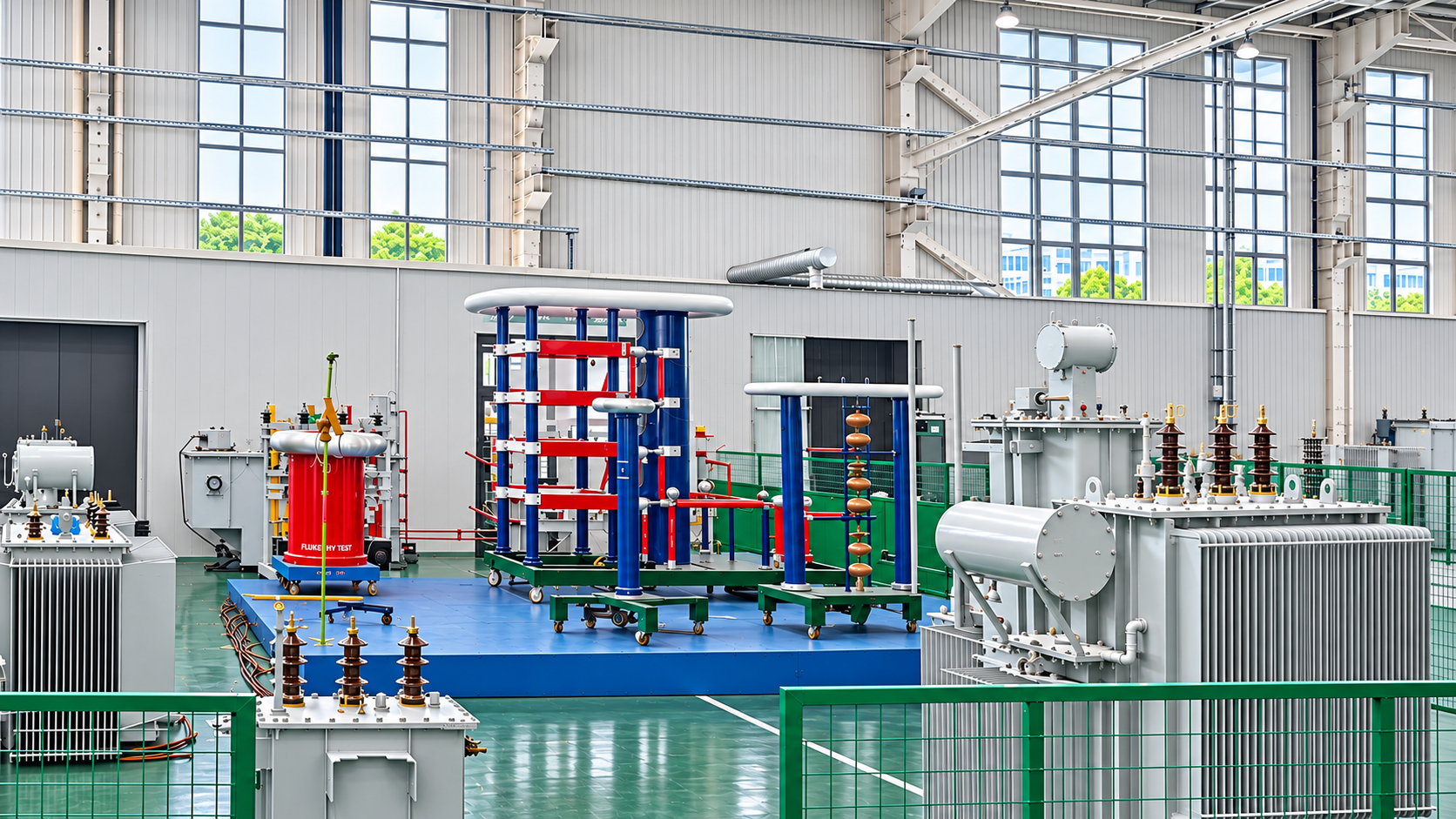
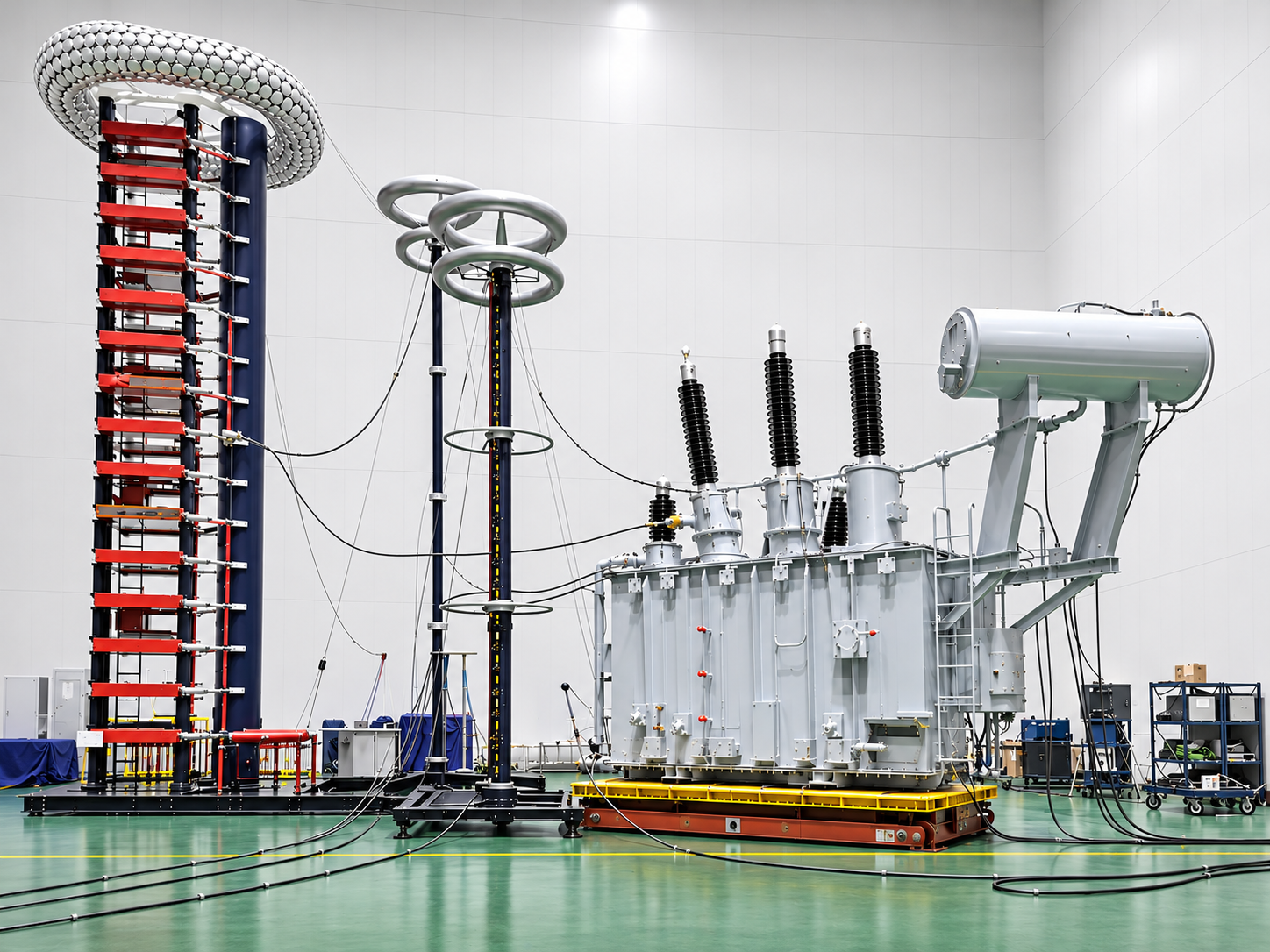
- Voltage-class test capability. The high-voltage test station is used for electrical and dielectric testing of 110 kV and 220 kV transformer products, with impulse voltage testing equipment installed on site.
- Single point of coordination. Equipment selection, engineering review, drawings, manufacturing, factory testing, export packing and delivery documentation are coordinated through one technical and commercial contact — which matters when a utility project has multiple document hold points.
Manufacturing evidence is similarly process-based. The production base includes foil winding and automatic high-voltage coil winding equipment, vacuum drying and vacuum oil-filling facilities for oil-immersed units, vacuum resin casting for cast-resin dry-type windings, core and coil assembly stations, and a prefabricated substation workshop with CNC sheet-metal fabrication and component assembly. Independent of any certificate, this determines whether a declared design can be reproduced across a batch.
Reading Guaranteed Values: Impedance, Losses and Cooling Ratings
Once a supplier passes the management and process layers, the decision usually turns on guaranteed numbers. Three of them deserve particular attention because they are frequently misunderstood in evaluation.
Impedance is a system parameter, not an efficiency score
Short-circuit impedance, expressed as Uk% or percentage impedance, is the equivalent series impedance between a pair of windings at a specified frequency, temperature and tap position. It governs fault current, voltage regulation and load sharing. Ignoring upstream system impedance, prospective secondary fault current is approximately 100 divided by the impedance percentage: a 4% transformer gives about 25 times rated current, while a 6% transformer gives about 16.7 times rated current. A 6% unit therefore reduces the calculated transformer-limited fault current by roughly 33%. Neither value is universally preferable, and impedance percentage is not an energy-efficiency rating — a 6% transformer is not automatically less efficient than a 4% one. Compare no-load loss, load loss and auxiliary consumption separately.
Tap-changer evidence must match the tap range
A de-energized tap changer (DETC/OCTC) changes taps only after the transformer is isolated; an on-load tap changer (OLTC) changes taps while the unit remains energized and supplying load. A typical distribution-transformer DETC may use ±2 × 2.5%, giving five tap positions, while a project-specific OLTC may use ±8 × 1.5%, giving 17 positions and 12.0% adjustment in each direction with smaller steps. The qualification question is not simply “OLTC or not”, but whether the offered tap-changer evidence matches the specified range, step voltage, through-current and control arrangement — and whether the maintenance regime suits the site.
Dual cooling ratings are conditional capacity
Where a transformer is declared with more than one rating, each rating is tied to a cooling state. A documented generator step-up design case illustrates the logic: a 223.4/15.75 kV, 50 Hz unit rated 136 MVA under natural cooling (ONAN), 168 MVA with the first forced-air stage (ONAF1) and 210 MVA with both forced-air stages (ONAF2). The voltage ratio is unchanged; the additional 74 MVA — an increase of 54.4% — depends entirely on the fans being available and operating as designed. At their respective rated outputs, calculated high-voltage current rises from approximately 351 A to 543 A and low-voltage current from approximately 4,985 A to 7,698 A. Preliminary design values at 210 MVA are 84 kW no-load loss and 1,200 kW load loss, totalling 1,284 kW and approximately 99.39% transformer-only efficiency at unity power factor; full fan operation is estimated to require another 30 kW, bringing combined losses to approximately 1,314 kW.
Substitution Questions That Change the Evaluation
Utility tenders often permit alternatives, and the differences are design-level rather than cosmetic.
Copper versus aluminium windings. Annealed copper is approximately 100% IACS conductivity; pure aluminium is about 60% IACS. For the same conductor length and DC resistance, aluminium theoretically requires about 1.6–1.7 times the copper cross-sectional area, and copper density of about 8.94 g/cm³ is roughly three times that of aluminium. A properly engineered aluminium winding can meet the same rated capacity, temperature rise, loss and short-circuit requirements as a copper design. Winding material alone does not determine efficiency, so compare guaranteed losses at the reference temperature, temperature rise and total ownership cost rather than the material label.
Oil-immersed versus cast-resin dry-type. A dry-type transformer contains 0 litres of main insulating oil, while an oil-immersed unit may contain hundreds or thousands of litres depending on rating and design. That changes fire-risk management, containment and indoor installation constraints — not efficiency. Oil-immersed designs usually provide strong cooling and compact dimensions and are common for outdoor substations, utility networks and renewable plants; dry-type designs are common in buildings, data centres, hospitals, tunnels and indoor industrial facilities. Neither construction is automatically more efficient; compare guaranteed no-load and load losses at the same kVA, voltage, impedance and enclosure.
Mineral oil versus natural ester fluid. Published data for FR3 natural ester gives a flash point of about 330°C and a fire point of about 360°C, against approximately 155°C and 165°C for representative mineral oil. These are fluid-specific published values; the selected fluid’s certified data sheet and the applicable standard must still be checked. Ester fluid normally costs more and can require changes to seals, thermal design and moisture-management practice, so the comparison belongs in a lifecycle assessment rather than a price-per-litre calculation.
| Decision point | What a certificate-only file shows | What an evidence-based file shows |
|---|---|---|
| Design compliance | That a quality system exists | That the datasheet matches the RFQ, with deviations logged and closed |
| Loss and impedance guarantees | Nothing specific | Guaranteed values with tolerances and reference conditions |
| Insulation coordination | Nothing specific | Declared insulation level/BIL and the tests that verify it |
| Unit verification | Nothing specific | Routine test report identified by serial number |
| Independent observation | Not addressed | Witnessed FAT with agreed hold points, or an approved remote review |
| Nonconformity closure | Process described, not applied | NCRs and punch items formally closed before shipment release |
Application Fit: Where This Qualification Model Is Needed Most
Utility substations and transmission projects. These are the applications where the full stack matters: protection coordination, fault duty, parallel-operation compatibility and long service life. Parallel operation in particular requires compatible polarity, phase sequence, vector group, voltage ratio and tap position, with impedance and X/R characteristics supporting acceptable load sharing. Transformers with different vector groups or materially different impedance cannot simply be connected because the voltage ratio matches.
Renewable and generator step-up duty. Step-up transformers tied to generation operate with load profiles that swing with resource availability, and the cooling-stage question described above becomes a commercial question as well as a technical one. Where load must be carried without relying on fans, the natural-cooling rating becomes the sizing basis.
Oil, gas and heavy industrial sites. Outdoor refinery duty is a different qualification profile: 24/7 operation feeding pumps, compressors and motors, with requirements that can include hazardous-area considerations, fire resistance, corrosion and salt-mist protection, high IP protection, sealed terminal and control boxes, high-temperature operation, motor-starting capability and remote monitoring or alarm interfaces. Buyers in these segments should test suppliers against site conditions, not against a generic catalogue.
Commercial and indoor distribution. Hospitals, data centres and commercial buildings push the decision toward cast-resin dry-type units and factory-integrated compact substations, where the enclosure, thermal performance, maintainability and shipping dimensions are part of the selection rather than an afterthought.
Where This Approach Has Boundaries
An honest qualification discussion includes the limits of the supplier being evaluated. For a manufacturer with voltage capability up to 220 kV, projects above that class fall outside the standard offering and require a different sourcing decision. Buyers should also note the following:
- Type tests and special tests are arranged to meet project-specific requirements; they are not automatically part of a standard order and must be specified with their cost, location and schedule implications.
- CE-related verification documentation from ECM applies to applicable oil-immersed transformer models, not to every product in the portfolio.
- Witnessed FAT is an acceptance arrangement, not one universal test list, and third-party inspection does not by itself certify the entire design.
- ISO 9001 certification does not transfer as a product guarantee; the unit-specific reports and the contractually agreed test scope remain the acceptance basis.
- Declared ratings, losses and efficiencies are only valid under the stated cooling, ambient and reference conditions; site temperature, altitude and ventilation can require derating.
Market Trend: Documentation Is Becoming a Deliverable
Across utility, EPC and industrial procurement, the observable shift is that documentation is increasingly treated as a deliverable in its own right rather than as a supporting attachment. Tenders more often specify witness points, document-review milestones and loss guarantees with defined tolerances, and buyers increasingly evaluate transformers on lifecycle energy cost alongside purchase price. For continuously energized equipment, public purchasing guidance generally supports evaluating transformer price together with core and winding losses over the expected operating life — which places a premium on guaranteed values that can actually be tested.
A second trend is the widening of the qualification question beyond the transformer itself. Suppliers are increasingly assessed on export documentation, packing, delivery coordination and a single point of technical contact, because a utility project typically has several hold points between drawing approval and dispatch. Milestone’s own profile reflects this pattern: export activity represents 85% of output, with project support across South America, the Middle East, Southeast Asia and Africa, where documentation and delivery coordination are as decisive as the equipment specification.
Future Outlook
Supplier qualification for utility transformer projects is likely to become more standardized and more data-driven. Three developments are worth watching. First, unit-level traceability — serial-numbered test records that follow a transformer from routine testing through delivery documentation — will increasingly be expected as a default rather than a request. Second, remote witnessing and document review are likely to be accepted more widely where the procedure allows adequate equipment identification, observation and record review, although they will not replace physical witnessing where contracts mandate it. Third, as renewable and industrial loads place more variable duty on transformers, the evidence around cooling-stage ratings, tap-changer duty and loss evaluation is likely to move from optional clarifications to core tender requirements.
None of this makes ISO 9001 less relevant. It simply places the certificate where it belongs: as the foundation of a qualification file, not its conclusion. A supplier that can show a controlled quality system, test capability at the project voltage class, unit-specific reports, and a clear statement of what is and is not included has answered the question a utility is actually asking.
Buyers who want to review Milestone Electrical’s transformer portfolio, ratings and manufacturing scope can visit www.milestonelectric.com, where product documentation and contact details are published alongside the company’s engineering and export activities.
FAQ
Are routine test reports enough before shipment, or should a utility arrange a witnessed FAT?
For a critical or customized project, the recommended order is: first, all required tests plus an approved customer or third-party witness and document-review plan; second, manufacturer testing with comprehensive remote review where the procedure allows adequate identification and observation. For a standard low-risk order, unit-specific reports and document review may be sufficient. Select the arrangement using project consequences, design novelty, contract requirements, supplier evidence, cost and schedule. Note that FAT is an acceptance arrangement, not one universal test list, and third-party inspection does not automatically certify the entire design.
Should we specify 4% or 6% impedance?
The recommended order is: first, the impedance approved by the fault-level, voltage-performance and protection studies; second, an alternative value only after those studies are updated and approved. Ignoring upstream system impedance, prospective secondary fault current is approximately 100 divided by impedance percent — about 25 times rated current at 4% and about 16.7 times at 6%, so 6% reduces the calculated transformer-limited fault current by roughly 33%. Lower impedance may improve voltage stiffness but increases fault current; higher impedance can limit fault current but increases voltage depression. Neither value is universally preferable, and impedance is not an efficiency rating.
Is a lower-loss transformer worth the higher purchase price?
For a continuously energized project with a long service horizon, the suggested order is: first, a compliant design with the lowest evaluated lifecycle cost; second, a lower-price design if its extra energy cost is acceptable. At low average loading, prioritize no-load loss; at high average loading, give greater weight to load loss. Rank offers using guaranteed values, the actual load profile, electricity cost and delivery requirements. Compare quotations at the same rating, reference temperature, tap position and test basis — a “high-efficiency” label without guaranteed loss data is insufficient for ranking.
Should a project install one large transformer or two smaller units?
Where specified critical loads must be maintained during a transformer outage, the recommended order is: first, a properly engineered two-transformer arrangement with adequate remaining capacity and transfer provisions; second, a single-transformer arrangement with an acceptable backup strategy. Where planned outages are acceptable and budget is limited, one properly sized transformer may rank first. Two units alone do not guarantee redundancy: two 1000 kVA transformers supplying a 1600 kVA load cannot normally carry the entire load on one unit without an approved operating provision or load shedding, and a common upstream supply remains a shared failure point.
Are copper windings always better than aluminium windings?
Neither material is universally superior. Copper has higher conductivity — annealed copper is approximately 100% IACS against about 60% IACS for pure aluminium — and usually requires a smaller conductor cross-section, while aluminium is lighter and normally less expensive per kilogram. For the same conductor length and DC resistance, aluminium theoretically needs about 1.6–1.7 times the copper cross-sectional area. A properly engineered aluminium winding can meet the same rated capacity, temperature rise, loss and short-circuit requirements. Compare guaranteed losses, temperature rise, dimensions, short-circuit withstand evidence and delivery rather than judging performance from conductor material alone.
Should we choose ONAN cooling or an ONAN/ONAF transformer?
Where the transformer must carry its required load without relying on fans, the suggested order is: first, ONAN rated for that load; second, ONAN/ONAF with an adequate ONAN base rating. Where higher planned loading and reliable auxiliary power are available, a validated ONAN/ONAF design may rank first. ONAN uses natural oil and air circulation; ONAF adds fans, which raise heat dissipation and can support a higher approved rating only while the fans and controls operate correctly. The permitted loading after a cooling failure must follow the manufacturer’s instructions and the project operating plan.
Additional technical information, product ranges and documentation are available in the Milestone transformer catalogue.
Есть вопросы или нужны дополнительные детали?
Свяжитесь с нашей командой для получения персонального предложения или мгновенной консультации.
Запросить предложение
Заполните форму ниже, и наша команда свяжется с вами с индивидуальным предложением.
Прямой чат WhatsApp
Предпочитаете общаться в реальном времени? Напишите нам в WhatsApp для мгновенной помощи и быстрых ответов.
- Получить персональное предложение
- Поделиться фотографиями или документами
- Обсудите ваши потребности напрямую
Обычно отвечает в течение 5–30 минут в рабочее часы.