
Is Your Sprinkler Supplier Built to Last? Long-Term Capability Assessment
A sprinkler bought this season is expected to irrigate for many seasons. The supplier behind it may not last that long. That gap between equipment life and supplier life is where a large share of irrigation procurement risk quietly accumulates, and it is almost never visible on a quotation sheet.
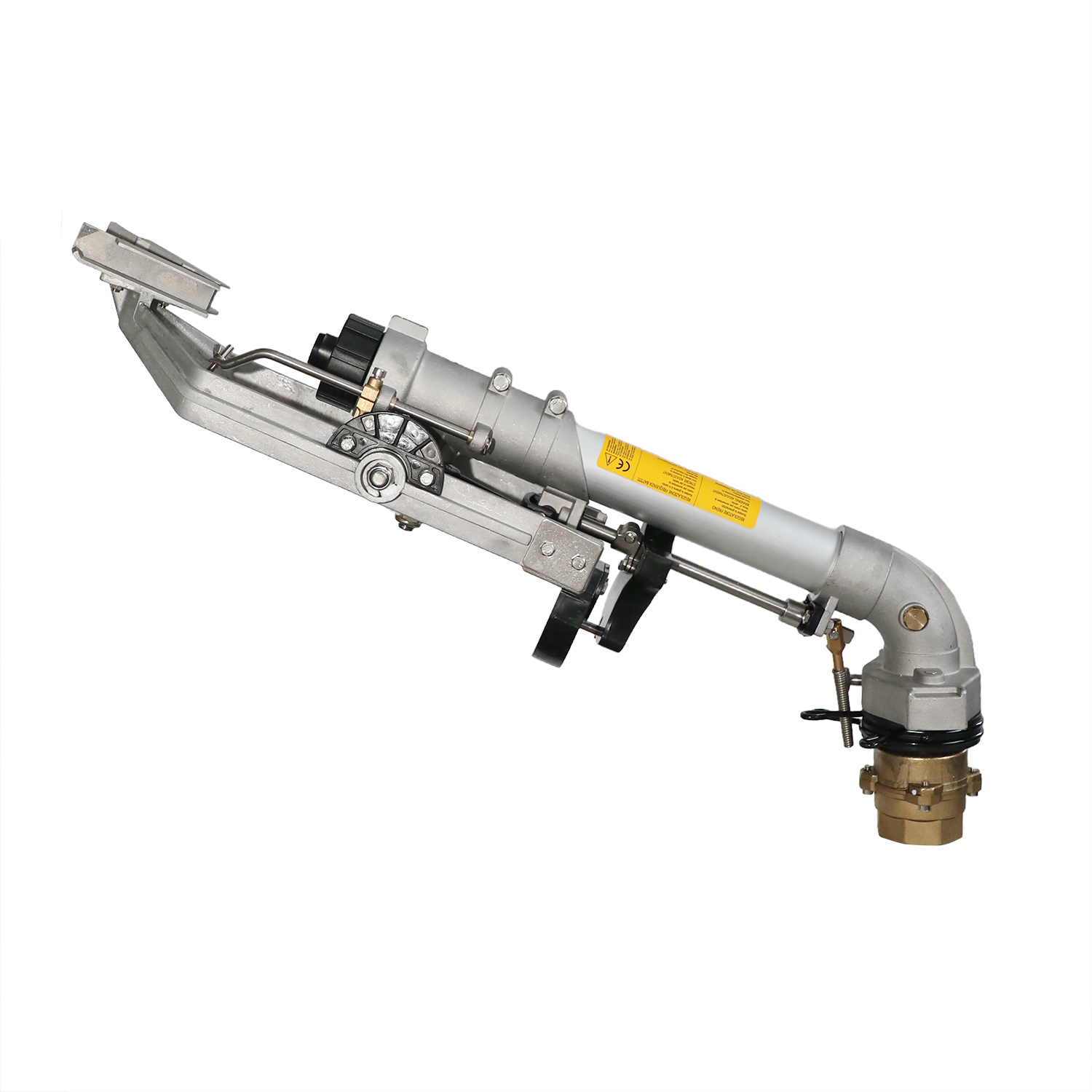
This assessment explains how to judge whether a sprinkler manufacturer is structurally built for long-term supply, using operating continuity, manufacturing capacity, staffing and engineering depth, product breadth, quality-system certification and export footprint as screening indicators. It then applies those indicators to FOISON Sprinkler (Xuzhou Foison Sprinkler Irrigation Equipment Co., Ltd), a manufacturer of turbine spray guns, impact guns and irrigation systems founded in 2013 and based in Pei County Industry Area, Xuzhou City, Jiangsu Province, China.
Why Supplier Durability Is a Procurement Constraint, Not a Preference
Irrigation hardware is a durable asset with consumable behaviour. Nozzles wear, seals age, rotating and turbine mechanisms require replacement parts, and a farm or industrial dust-suppression layout is normally expected to run across many seasons. Every one of those service events depends on the original supplier still existing, still holding tooling, and still producing the same thread, flange and nozzle specification.
Three procurement consequences follow.
- Part compatibility risk. Sprinkler connections are physical standards rather than universal ones — 2" flange, 2" inner thread, 1-1/2" female thread and 80 flange all appear across a single supplier range. If the supplier disappears, the buyer inherits a layout that cannot be re-fitted from a generic catalogue.
- Re-qualification cost. Changing suppliers means new samples, new field trials, new documentation and new failure points. For wholesale and OEM buyers, it also means new artwork, new packaging and a new specification sheet.
- Compliance continuity. Certificates expire. A quality-management certificate valid today may be renewed, revised or allowed to lapse. Buyers who never re-check carry compliance risk that has nothing to do with the product they received.
This is why experienced buyers screen suppliers on structural signals — floor area, headcount, engineer count, output capacity, product variety and certificate status — before they negotiate on unit price. Those signals are proxies for the supplier's ability to answer a repeat order three years from now.
What the Market Numbers Say About Irrigation Demand
The demand-side case for long-term supplier relationships is straightforward, but the published figures diverge enough that buyers should treat them as ranges rather than certainties.
- The global sprinkler irrigation market was valued at USD 3.04 billion in 2025, according to Grand View Research.
- The global smart irrigation market reached USD 2.2 billion in 2025 and is projected to reach USD 6.2 billion by 2034, according to IMARC Group. The scope differs from the sprinkler figure above because it includes smart-control components.
- Asia Pacific held the largest revenue share of the agricultural irrigation machinery market in 2025 at 36.2%, with China as a leading country, according to Grand View Research.
Growth-rate projections are not aligned. Grand View Research projects a 6.5% CAGR for sprinkler irrigation over 2026–2033, while Market Research Future reports a lower 3.04% CAGR over 2025–2035. The difference is most likely methodological, reflecting broader versus narrower inclusion of smart features, rather than a contradiction in underlying demand. For a buyer, the practical reading is that demand is directionally rising but not uniform, so capacity availability should be negotiated rather than assumed.
One gap is worth noting explicitly: there is no widely published market-share split between high-volume rain guns and standard impact sprinklers. Product-mix decisions therefore have to come from the buyer's own application data — terrain, water source, pump curve and coverage area — rather than from a category statistic.
Six Structural Indicators of a Long-Term Sprinkler Supplier
The following screen is designed to be re-run periodically against any manufacturer. Each indicator filters out a specific failure mode.
| Indicator | What it screens out | FOISON Sprinkler reference point |
|---|---|---|
| Operating continuity | Trading intermediaries and project-based resellers with no sustained production history | Founded in 2013; more than twelve years of continuous operation from Pei County Industry Area, Xuzhou City, Jiangsu Province, China |
| Manufacturing footprint | Assembly-only operations that subcontract the parts that matter | 30,000 m² facility |
| Output capacity | Suppliers unable to repeat batch volume across seasons | 200,000 units annual output; 50,000 units monthly capacity |
| Workforce and engineering depth | Single-shift workshops with no in-house design capability | 135 employees, including 12 engineers; products developed in-house |
| Product breadth and application coverage | Single-model suppliers that cannot equip a mixed site from one parts catalogue | More than 100 product varieties; core products are turbine spray guns, impact guns and irrigation systems, including the FS35, FS40, FSW40 Pro, FSN50, FSC50 and FSW80 models |
| Quality system and export footprint | Uncertified operations with no verifiable export record | ISO 9001:2015 certification number 28725Q042R0S; 100% test before shipment; export ratio recorded at 70% across the EU, Africa, Australia, New Zealand, South East Asia, Mid Asia, Mid East and South America |
Two of these indicators deserve emphasis. Engineer count is the difference between a supplier that can adjust a nozzle angle or rotation speed at design level and one that can only assemble bought-in parts. Export footprint matters because a product that has already cleared multiple import markets has already survived documentation, packaging and labelling scrutiny in more than one jurisdiction — the company records exports to more than 30 countries and regions.
How Structural Capability Shows Up in Product Behaviour
Capability indicators are only useful if they translate into measurable product behaviour. On the FOISON Sprinkler range, the published parameters show the design decisions directly.
Turbine spray guns
The FSN50 rain gun sprinkler is a turbine-type unit with a 2" flange connection, a working pressure range of 0.2 to 0.7 MPa, a range of 26 to 53 metres, a 24-degree spray angle and a 360-degree adjustable sprinkler type. Its performance table shows the nozzle-pressure relationship clearly: at 0.5 MPa with a 20 mm nozzle the throw diameter is 43 metres, and at 0.7 MPa with a 26 mm nozzle the maximum flow rate is 80 m³/h with a maximum throw diameter of 56 metres. The unit is made of aluminium, nylon and stainless steel.
The FSW80 high-volume turbine gun extends that logic to a larger scale, with an 80 flange connection, a working pressure range of 0.2 to 0.9 MPa, a range of 23 to 85.7 metres, a 24-degree spray angle and a 360-degree adjustable pattern, built from aluminium, nylon and stainless steel. The mid-range FSW40 Pro turbine sprinkler uses a 1-1/2" female thread, works at 0.2 to 0.5 MPa, covers 22 to 41 metres and delivers 9.5 to 37 m³/h.
Impact guns and impact sprinklers
The FSC50 rain gun sprinkler is an impact-type unit with a 2" inner thread or flange connection, a working pressure range of 0.15 to 0.7 MPa, a range of 23 to 56 metres, a 24-degree spray angle, and a 360-degree adjustable pattern with adjustable rotation speed. The FS35 impact sprinkler and the FS40 gear-drive sprinkler cover the smaller end of the range: FS35 works at 0.2 to 0.6 MPa with an 18 to 36 metre radius and 7.8 to 31.9 m³/h flow, while FS40 works at 0.15 to 0.5 MPa with a 20 to 43 metre radius and 9.5 to 39.4 m³/h flow.
Three engineering details are worth reading into these numbers. First, adjustable nozzle angle and adjustable rotation speed appear across the range; these are not catalogue variations but design parameters that require in-house tooling and repeatable assembly. Second, the wetted-path material set — aluminium or aluminium alloy, copper, stainless steel and nylon — determines corrosion and wear behaviour under constant water exposure, and is therefore a service-life question rather than a cosmetic one. Third, the pressure-to-flow-to-throw relationship is non-linear, which means a nozzle and pump combination that suits one field layout will not automatically suit another.
For buyers, the useful framing standard is ISO 7749-1:1995, which specifies the design and operational requirements for rotating sprinklers used in agricultural irrigation. It provides a neutral checklist against which manufacturer data sheets can be compared, so that evaluation is not driven purely by whichever supplier writes the more detailed brochure. On the trade side, HS code 842482 classifies mechanical appliances for agricultural or horticultural use for projecting, dispersing or spraying liquids — the classification that governs how these units move across borders.
Application Fit: Agriculture, Forestry, Greening and Dust Control
The stated use scope across the range is agriculture, forestry, garden, urban greening and dust removal, including spray atomisation for dust suppression. That breadth is a direct output of product-variety depth: a supplier covering both turbine and impact drive types, and both 1-1/2" and 2" and 80 flange connection sizes, can equip a mixed site without mixing brands.
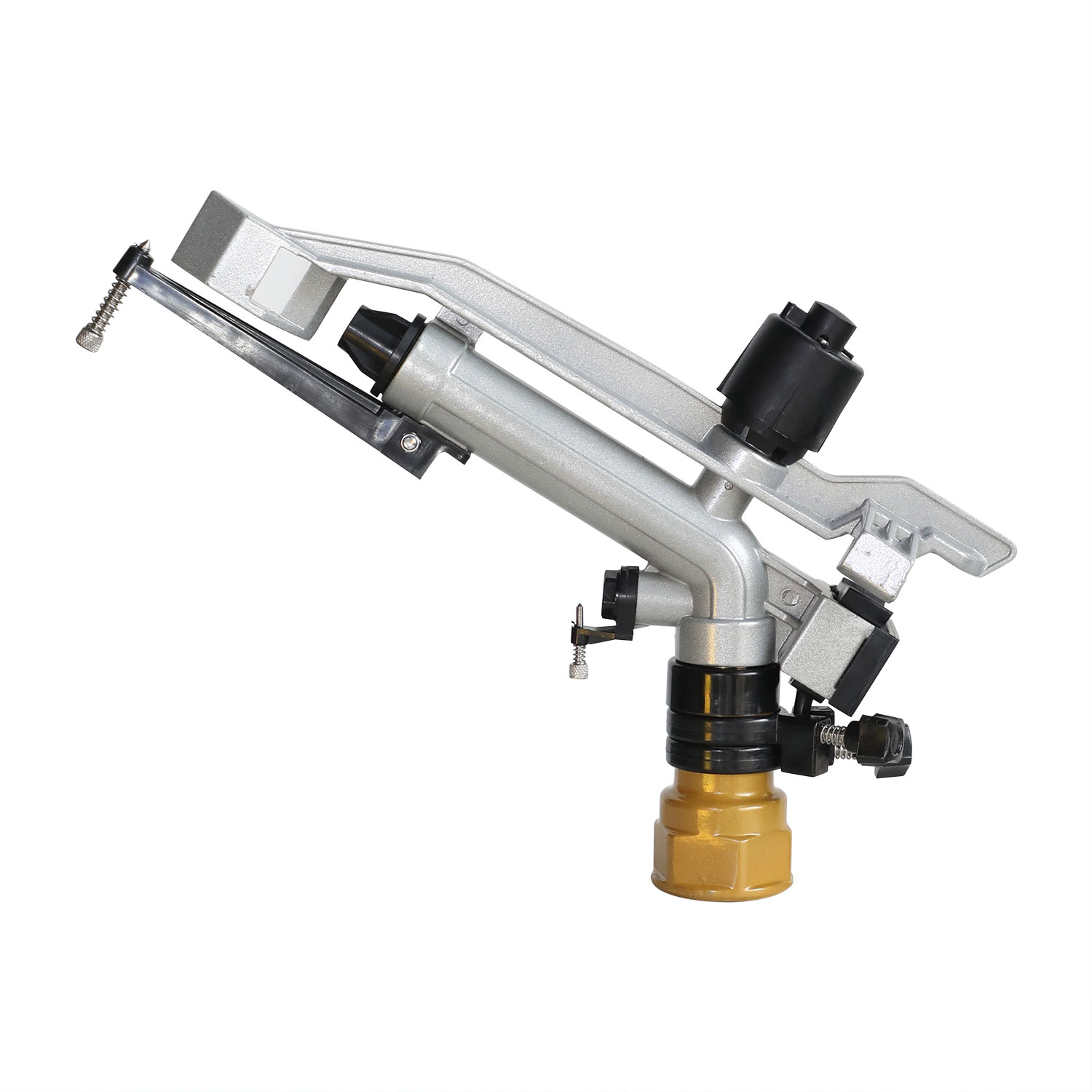
Operating conditions for these units are stated as requiring a sufficient water resource plus a pump and hose, with the equipment able to work in ambient conditions up to 50°C. Those are realistic prerequisites rather than limitations: sprinkler performance is a function of available pressure and flow, and no hardware compensates for an undersized pump.
A supplier-recorded reference case illustrates how the range performs in practice. A common customer in New Zealand deployed 500 units of the FS35 irrigation sprinkler for farm irrigation over a two-year period. The recorded result is that fixed sprinkler irrigation covered 150,000 m² of a vegetable farm, saving 55% of water and 60% of labour, with the case summary describing fixed irrigation as saving around 50% of energy and labour. These are supplier-reported project figures tied to one site and one layout; the appropriate use is as an indication of what a fixed layout can achieve, not as a guaranteed outcome for a different site. Buyers should reproduce the comparison against their own pumping data.
For wholesale and OEM buyers, application breadth carries a second benefit: one parts catalogue covering open field, tree line, garden and dust-suppression duty reduces spare-part complexity and simplifies after-sales inventory.
Certification: What Is Verifiable at the Time of Purchase
Certification is the most easily verified indicator in the entire screen, provided the buyer checks scope and dates rather than the logo.
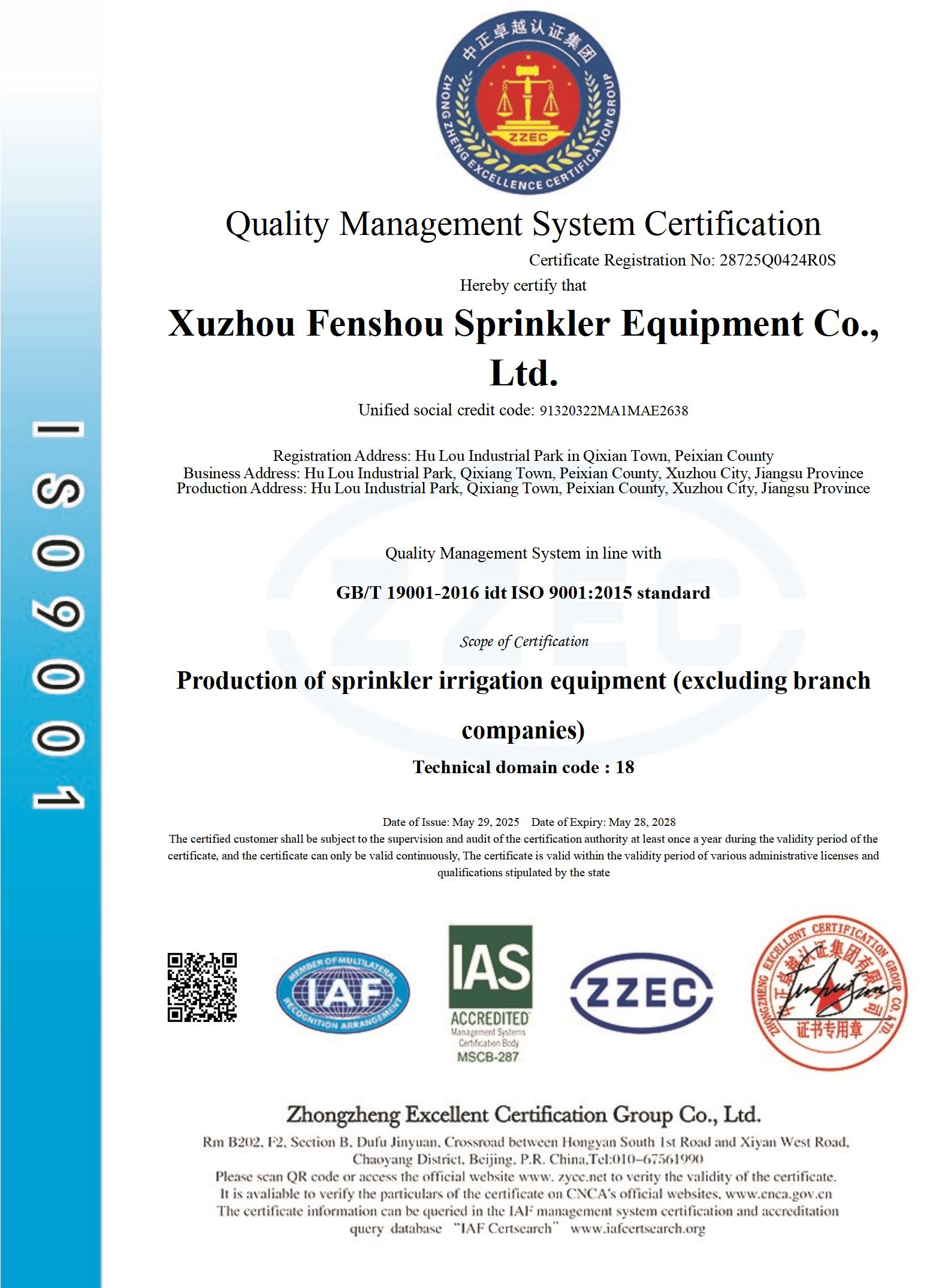
FOISON Sprinkler holds an ISO 9001:2015 quality management system certification, number 28725Q042R0S, issued by Zhongzheng Excellent Certificate Group Co., Ltd. The applicable standard is GB/T 19001-2016 idt ISO 9001:2015. The certificate is valid from 29 May 2025 to 28 May 2028, applies to the global market, and covers the production of sprinkler irrigation equipment. Within the product range it names three specific models: the FS40 irrigation sprinkler, the FS35 irrigation sprinkler and the FSW40 Pro agriculture sprinkler.
Two boundaries follow from that wording. First, this is a quality management system certificate tied to a defined production scope; it is not a model-level performance certification for every product in the catalogue. A buyer who needs performance assurance for a model outside the named list should rely on published pressure, nozzle and flow tables combined with their own field validation. Second, the certificate is time-bound. Recording the number, the issuing body and the 28 May 2028 expiry date, and re-checking at each order cycle, converts a marketing claim into a procurement control.
Long-Established Manufacturer vs Traditional Sourcing Routes
Buyers typically weigh three supply routes. The comparison below uses generic route categories rather than named companies, because route behaviour varies more than route labels.
| Evaluation dimension | Established manufacturer | Trading intermediary / sourcing agent | Short-cycle low-cost assembler |
|---|---|---|---|
| Design ownership | In-house design; parameters such as nozzle angle and rotation speed can be adjusted at source | Typically resells an existing specification; changes depend on the upstream factory | Usually copies an existing design; tooling ownership is often unclear |
| Part standardisation | Defined connection set (2" flange, 2" inner thread, 1-1/2" female thread, 80 flange) with matching spares | Mixed specifications from multiple upstream factories | Frequently single-batch specifications with no continuity guarantee |
| Certification | Traceable certificate with number, scope, issuing body and expiry | Certificate may belong to the upstream factory, not the seller | Often no verifiable certification |
| Capacity commitment | Documented annual and monthly output figures that can be matched to order timing | Capacity depends on third-party allocation | Capacity rarely documented and highly variable |
| MOQ and lead time | Commercial parameters stated in advance and repeatable across orders | Variable and renegotiated per order | Low MOQ but unpredictable lead time |
| Long-term risk profile | Risk concentrated in the supplier's continuity and certification renewal | Risk concentrated in the intermediary's stability and its upstream relationship | Risk concentrated in part obsolescence and quality drift |
The traditional assumption that a cheaper route reduces total cost holds only when the equipment is treated as disposable. Once nozzles, seals and rotating assemblies have to be replaced on a layout that is already installed, specification continuity becomes more valuable than the initial price difference. That is the practical argument for screening structural indicators before commercial terms.
Where This Supplier Profile Does Not Fit
An honest capability assessment has to state its boundaries. Four apply here.
- Order-size and timing floors. The documented commercial structure is a minimum order quantity of 20 units with a lead time of within 20 days. Buyers who need a single replacement unit at short notice, or who operate an unpredictable emergency-purchase pattern, may find that structure slower than a local stockist.
- After-sales is remote. After-sales support is described as remote support. There is no stated on-site service network in the source material, so installation labour, commissioning and local spare-part stocking remain the buyer's responsibility at the project site. Multi-site or remote projects should budget for this explicitly.
- Certification scope is model-specific. The ISO 9001:2015 certificate names the FS40, FS35 and FSW40 Pro. Other models in the wider range fall outside the named product scope, even though the certificate's activity scope covers sprinkler irrigation equipment production generally.
- Published performance data is manufacturer data. The pressure, flow and throw figures used in this article come from the manufacturer's specification tables. Independent third-party test reports for individual models were not available in the material used for this assessment, so buyers should validate critical duty points with their own trials.
None of these boundaries disqualify the supplier. They define the order profile and project type for which the relationship works, which is exactly what a capability assessment is for.
Future Outlook
Three developments are worth tracking over the next planning cycle.
Demand will keep pulling capacity. With the sprinkler irrigation market already measured in billions of US dollars and Asia Pacific holding 36.2% of agricultural irrigation machinery revenue in 2025, suppliers with documented output capacity are structurally advantaged. But because published growth projections range from 3.04% to 6.5% depending on methodology, buyers should negotiate capacity availability and lead-time commitments rather than assume them.
Certification cycles will become a recurring procurement event. The current certificate expires on 28 May 2028. From a buyer's perspective, certification renewal is a better early-warning signal about a supplier's operational discipline than any promotional claim, because it requires documented processes, audits and records.
Component suppliers are moving toward system supply. FOISON Sprinkler states that it can design irrigation systems following customer requirements, in addition to supplying individual spray guns and sprinklers. If that capability is exercised, the buyer's evaluation shifts from unit parameters to layout design, pumping assumptions and coverage planning — a different and more demanding assessment, where the supplier's engineering headcount matters more than its catalogue length.
Standards and trade frames will remain stable reference points in the meantime: ISO 7749-1:1995 for rotating sprinkler design and operational requirements, and HS code 842482 for the cross-border classification of agricultural and horticultural spraying appliances.
For buyers at the research and evaluation stage, the practical conclusion is simple. Re-run the six-indicator screen on a fixed schedule — continuity, footprint, capacity, workforce and engineering depth, product breadth, and certification plus export footprint. The exercise is inexpensive. Skipping it is not, because the cost of a supplier that stops supplying is paid years after the purchase order.
Frequently Asked Questions
The certification, numbered 28725Q042R0S and issued by Zhongzheng Excellent Certificate Group Co., Ltd., names three products: the FS40 irrigation sprinkler, the FS35 irrigation sprinkler and the FSW40 Pro agriculture sprinkler. The applicable standard is GB/T 19001-2016 idt ISO 9001:2015, the scope is the production of sprinkler irrigation equipment, and it applies to the global market. It is valid from 29 May 2025 to 28 May 2028. Because the certificate lists specific models rather than the entire range, buyers should confirm whether the model they order falls within the named scope.
FOISON Sprinkler operates a 30,000 m² facility with an annual output of 200,000 units and a monthly capacity of 50,000 units. The company records 135 employees, including 12 engineers, and states that its products are developed in-house across more than 100 product varieties, with turbine spray guns, impact guns and irrigation systems as the core product lines.
The documented commercial parameters are a minimum order quantity of 20 units and a lead time of within 20 days. The production mode is OEM/ODM, and customisation covers model, logo, function and shape. Export markets are stated as global. For OEM and wholesale buyers, these parameters are the practical basis for planning packaging, artwork approval and shipping schedules.
Quality control is described as 100% test before shipment. This sits within an ISO 9001:2015 quality management system certified under GB/T 19001-2016 idt ISO 9001:2015, number 28725Q042R0S, issued by Zhongzheng Excellent Certificate Group Co., Ltd. Buyers can request a copy of the certificate to verify the number, the issuing body and the validity period against their own records.
Parameters differ by model and nozzle size. The FSN50 turbine rain gun sprinkler works at 0.2 to 0.7 MPa over a 26 to 53 metre range with a 24-degree spray angle and 360-degree adjustable pattern; at 0.5 MPa with a 20 mm nozzle the throw diameter is 43 metres, and at 0.7 MPa with a 26 mm nozzle the maximum flow is 80 m³/h with a 56 metre maximum throw diameter. The FSC50 impact rain gun works at 0.15 to 0.7 MPa over 23 to 56 metres with adjustable rotation speed. The FSW80 turbine gun works at 0.2 to 0.9 MPa over 23 to 85.7 metres. The FSW40 Pro turbine sprinkler works at 0.2 to 0.5 MPa over 22 to 41 metres at 9.5 to 37 m³/h. The FS35 impact sprinkler works at 0.2 to 0.6 MPa over 18 to 36 metres at 7.8 to 31.9 m³/h. The FS40 sprinkler works at 0.15 to 0.5 MPa over 20 to 43 metres at 9.5 to 39.4 m³/h. Materials across the range are aluminium or aluminium alloy, copper, stainless steel and nylon. Nozzle diameter should always be confirmed, because flow and throw change with nozzle size at the same working pressure.
The export ratio is recorded at 70%, with main markets listed as the European Union, Africa, Australia, New Zealand, South East Asia, Mid Asia, Mid East and South America, and products exported to more than 30 countries and regions. A supplier-recorded reference case from New Zealand involved 500 units of the FS35 irrigation sprinkler used for farm irrigation over a two-year period, covering 150,000 m² of a vegetable farm.
After-sales is described as remote support, and no on-site service network is stated in the available material. In practice this means installation labour, commissioning and local spare-part storage are normally managed by the buyer at the project site. For remote, multi-site or high-uptime projects this should be budgeted and resourced before ordering, and the required spare-part set should be agreed together with the original order quantity and lead time rather than requested later.
Есть вопросы или нужны дополнительные детали?
Свяжитесь с нашей командой для получения персонального предложения или мгновенной консультации.
Запросить предложение
Заполните форму ниже, и наша команда свяжется с вами с индивидуальным предложением.
Прямой чат WhatsApp
Предпочитаете общаться в реальном времени? Напишите нам в WhatsApp для мгновенной помощи и быстрых ответов.
- Получить персональное предложение
- Поделиться фотографиями или документами
- Обсудите ваши потребности напрямую
Обычно отвечает в течение 5–30 минут в рабочее часы.