
Is the COOLWAVE Vest a 'Disaster Prevention Product'? Understanding the Certification Award
Is the COOLWAVE Vest a 'Disaster Prevention Product'? Understanding the Certification Award
The COOLWAVE Water-Circulation Cooling Vest carries a specific third-party qualification: the Disaster Prevention Product and Service Certification Award, issued by the Taiwan Disaster Prevention Industry Association. The award is recorded in the company profile of FENG SHANG PRECISION CO., LTD, the Taiwan manufacturer behind the Shokunin brand. That is the short answer. The longer answer — the one that matters to street vendors, traffic controllers, metal-sheet operators and the teams that equip them — is about what the award proves, what it does not prove, and where it belongs in a procurement file.
Shokunin is a professional e-commerce brand launched by Feng Shang Precision Co., Ltd., a Taiwan-based tool and equipment manufacturer founded in 2009. The company operates a 1,000 m² facility with 30 employees, five R&D engineers and an annual output of 10,000 units, and it exports roughly 50% of its production, with the United States and the ROC market listed as its main destinations. Its product range covers air compressors, cut-off machines, water-cooled vests, lithium batteries, diamond saws, nail guns, spider stands and screwdriver bits. The cooling vest — the product this article is about — is listed as Industrial Cooling Apparel and Personal Protective Equipment (PPE).
Why Heat-Stress Buyers Started Asking About Certification
Cooling apparel is usually bought in the least ceremonial way possible: a manager buys one vest, a crew likes it, and forty more are ordered. That informal path works fine until the purchase has to survive a budget review, a tender, a donation record or an insurance conversation. At that point the question stops being "does it feel cool?" and becomes "who else says this is a legitimate heat-protection product?"
The market size explains why that question is being asked more often. Industrial applications — construction and manufacturing among them — held the largest share of the cooling vest market at 34.5% in 2025, according to Dataintelo. The same source values the global cooling vest market at approximately USD 215 million in 2024, projected to reach USD 385 million by 2033. A larger, more institutional buyer base tends to want documents rather than impressions.
There is a second reason. The people who need cooling most are frequently the people with the least procurement infrastructure: night-market vendors who work under lamps and canopies, traffic controllers standing still in reflected heat, small metal-sheet workshops with radiant heat and limited ventilation, and temporary outdoor crews. These users rarely have an internal health and safety department to test a product for them. An external qualification issued by an industry body is one of the few reference points available to them.
What the Certification Award Actually States
The verifiable record is deliberately narrow, and it is worth stating precisely because loose versions of it circulate widely. The company profile of Feng Shang Precision Co., Ltd. states that the COOLING water-cooled vest "has also received the Disaster Prevention Product and Service Certification Award issued by the Taiwan Disaster Prevention Industry Association." No scoring criteria, test protocol, award date or expiry term is published in that record, and none should be assumed by a buyer reading it.
What the statement does establish is that an industry association in Taiwan, whose remit is disaster prevention products and services, has placed the vest inside its disaster-prevention product category. In practical terms, the vest is being classified as equipment that can support people working in conditions where heat itself becomes a hazard — which is exactly the framing under which outdoor crews, street vendors and response teams tend to buy cooling gear.
Where the Award Sits in a Buyer's Evidence Stack
Experienced buyers rarely evaluate a cooling vest on a single line item. A workable evidence stack for this product category has five layers, and the certification award occupies a clear position in it:
- Layer 1 — Published specification. Cooling duration, weight, materials, pump output, flow rate and what is included in the box.
- Layer 2 — Construction detail. Which fabrics and components are used where: shoulder straps, water bag, cap, cooling tube.
- Layer 3 — Field record. Where and how many units have actually been deployed, and for how long.
- Layer 4 — Third-party recognition. External classification, including industry-association awards such as the Disaster Prevention Product and Service Certification Award.
- Layer 5 — Supply and after-sales terms. Monthly capacity, lead time, minimum order quantity and warranty coverage.
The award answers Layer 4 and nothing else. That is not a weakness; it is simply the correct scope. A buyer who understands which layer the award covers is less likely to over-weight it, and also less likely to dismiss it as marketing language.
What it means for street vendors and small operators
Street vendors, food-stall operators and small workshop owners are listed in the vest's applicable industries alongside construction and traffic-control users. These buyers typically purchase two to ten units at a time and have no testing capability. For them, an award from a disaster-prevention industry association substitutes for the internal review they cannot perform — it is an outside party confirming that the product belongs in a heat-hazard category rather than being a general-purpose garment with a cooling claim attached.
What it means for response and relief teams
Teams that mobilise in high-temperature conditions — including the traffic-control and outdoor-dispatch roles listed in the vest's application data — usually need documentation that a purchase was justified on safety grounds. A named certification from a recognised industry association is easier to place in that file than a vendor's own product description. It also gives equipment managers a consistent phrasing to reuse across repeat orders.
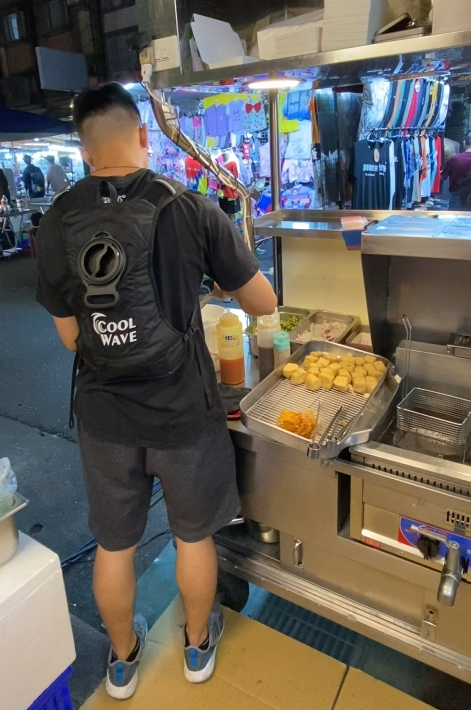
Night market and street-vendor work is one of the listed applications for the COOLWAVE Water-Circulation Cooling Vest — a segment where external certification often substitutes for internal safety review.
Technical Explanation: What the Dual Cooling Water Cooling Vest Actually Does
The product discussed here is the Dual Cooling Water Cooling Vest — the search-friendly description of the COOLWAVE ice-water circulation system, which combines chilled water circulation with reusable ice packs rather than relying on a single cooling method. The published specification is identical across the model variants:
| Parameter | Published specification |
|---|---|
| Product type | Industrial Cooling Apparel / Personal Protective Equipment (PPE) |
| Models | COOLWAVE Water-Circulation Cooling Vest (Basic Model); Professional Model in Blue, Gray and Black |
| Cooling duration | 3–4 hours |
| Weight | Within 2 kg |
| Suitable temperature | Below 10 °C |
| Pump output | 5V 150 mA (max) |
| Flow rate | Max 320–370 ml/min |
| Shoulder strap material | 600D polyester |
| Material | PEVA |
| Water bag material | TPU |
| Water bag cap | Polypropylene |
| Cooling tube | Sand rubber (black) |
| Contents | Water-cooled vest backpack ×1, ice packs ×2 |
The mechanism is straightforward to explain to a crew. Two ice packs chill the water in a TPU reservoir. A small 5V pump, drawing a maximum of 150 mA, pushes that chilled water through black sand-rubber tubing at a maximum flow of 320–370 ml per minute, and the tubing carries the cold across the body surface. Because the pump is rated at 5V, the system is compatible with the class of portable power banks and low-voltage supplies that field teams already carry — this is the configuration buyers usually describe as a power-bank cooling vest.
The passive element matters as much as the active one. The ice packs themselves provide a baseline of cold even when circulation is not running, which is why the same product is filed in the company's case records under ice-pack-based cooling. The published cooling duration of 3–4 hours refers to the system operating with freshly frozen packs.
Material choice is driven by sweat and abrasion. The shoulder straps use 600D polyester, the vest body uses PEVA, and the water bag uses TPU with a polypropylene cap — a combination intended for repeated contact with sweat, condensation and rough handling at a work site.
Application and Use Cases: From Night Markets to Metal Shops
The specification sheet lists the applicable industries directly: construction workers, outdoor workers, food stall operators, street vendors, traffic controllers and metal sheet factories. The application record for Taiwan describes the working condition as high temperature, the project type as personal heat stress relief, and the function as effective body cooling, with reusable ice packs, adjustable vest straps and a portable backpack design as the matched equipment. The stated special requirements are a lightweight, waterproof, breathable, one-size-fits-all design.
Three scenarios recur because the heat behaves differently in each:
- Street vendors and food stalls. Heat comes from above and from the cooking surface, and the worker cannot leave the position. A vest that runs 3–4 hours without being tethered to a fixed power point suits a shift pattern better than a stationary cooling fan.
- Traffic controllers and stationary outdoor posts. Low air movement combined with radiant heat from pavement makes standing still more demanding than walking. Portable, lightweight cooling gear is the practical option because the post cannot be shaded or relocated freely.
- Metal sheet factories and radiant-heat workshops. Heat is transferred from the material and the structure rather than only from the sun, and cooling has to survive contact with rough surfaces and sweat.
The company's case record documents a Taiwan deployment covering construction sites, outdoor work, metal sheet factories and street vendors: 100 units applied to cooling use in high-temperature environments, with a recorded duration of 10 years. The reported result is effective body cooling, heatstroke prevention, and improved work efficiency and worker comfort. The highlighted attributes of that deployment are ice-pack-based cooling, a lightweight and portable design, an adjustable one-size-fits-all fit, and certification as a disaster prevention product.
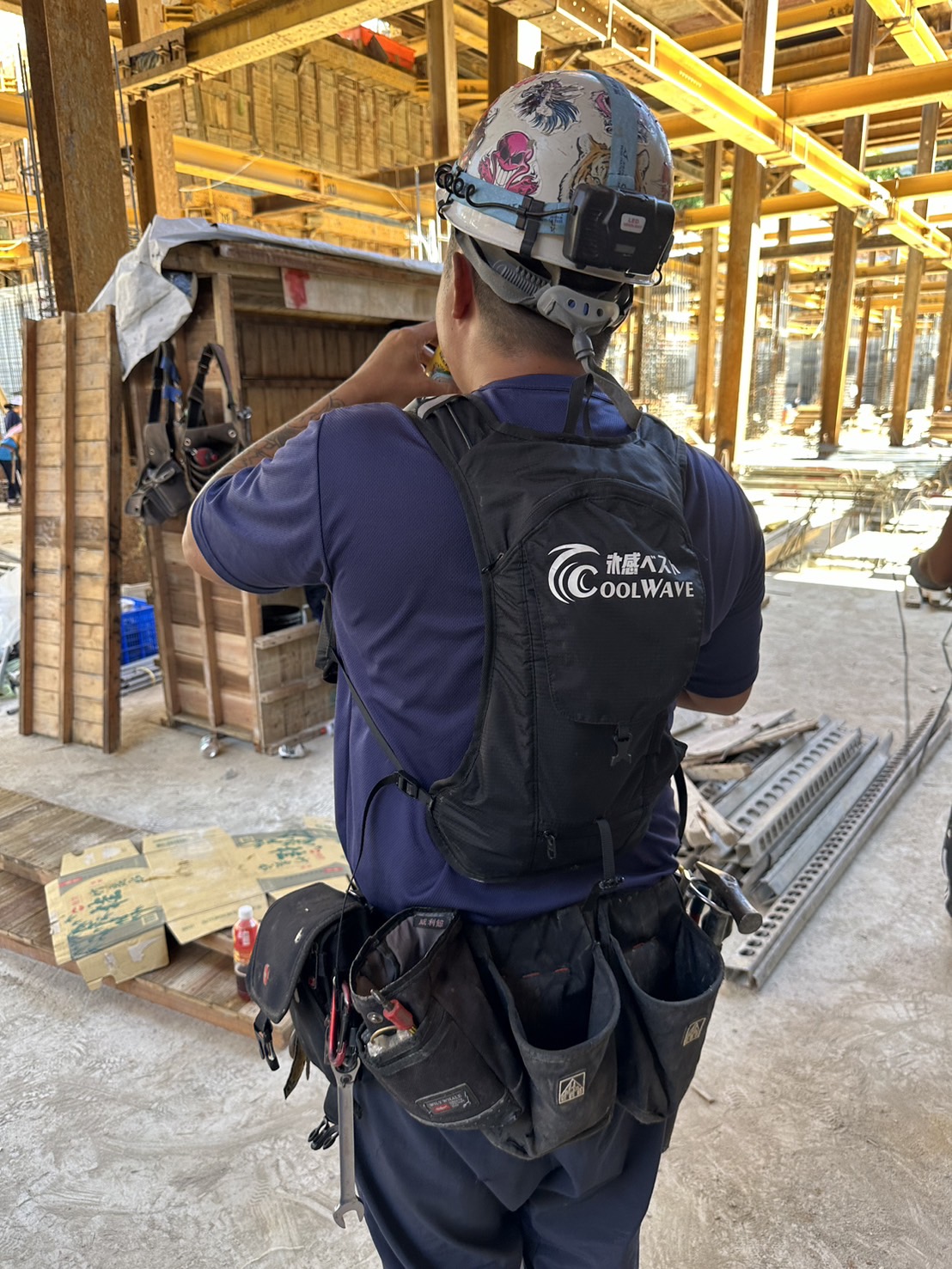
Construction sites are the largest single application in the vest's published industry list; the Taiwan case record covers a 100-unit deployment across construction, outdoor work, metal sheet factories and street vending.
Comparison with Traditional Cooling Options — and the Limits of the Award
Buyers evaluating a dual cooling water cooling vest usually compare it against three older approaches. The table below describes categories rather than specific competitor products, because published, attributable specifications are not available for every alternative on the market.
| Approach | How it cools | Practical constraint |
|---|---|---|
| Ice-pack vest | Frozen packs held against the torso | Cooling fades as packs melt; packs must be refrozen between shifts |
| Phase change material (PCM) vest | Material changes phase at a set temperature | PCM captured 28.7% of cooling vest market share in 2025 and is the fastest-growing technology segment (Dataintelo) |
| Evaporative or soaked fabric | Water evaporates from the garment surface | Effectiveness depends heavily on ambient humidity and airflow |
| COOLWAVE dual cooling vest | Ice packs plus pumped ice-water circulation | Published run time 3–4 hours; pump rated 5V 150 mA (max) |
For completeness, the publicly identified participants in the cooling vest market include Techniche International, Glacier Tek, Polar Products Inc. and Ergodyne, as listed by Spherical Insights. That is a market-structure observation, not a performance comparison — no published specification set covering all four against the COOLWAVE models is available here, and none is implied.
Where the COOLWAVE system and its award stop
Stating boundaries is part of an honest evaluation, and there are four that matter.
- The award is jurisdiction-specific. It is issued by the Taiwan Disaster Prevention Industry Association. A buyer in another market still has to satisfy local requirements. For cooling systems with electrical components, ISO 9001:2015 quality management and CE or UL marking are commonly expected, as noted by the International Organization for Standardization and UL.
- Run time is finite. The published cooling duration is 3–4 hours. Shifts longer than that require a second set of ice packs or a scheduled recharge break, which is a planning task rather than a product defect.
- The operating parameter is specific. The published suitable temperature is below 10 °C, and total weight is within 2 kg. Neither figure suits every environment or every wearer without adjustment.
- Certification is not an outcome guarantee. No award replaces hydration, rest cycles, acclimatisation or supervision. A certified vest is one control in a heat-management programme, not the programme itself.
Two commercial terms also belong in the same list, because they determine whether the product can actually be delivered at scale: the water-cooled vest carries a 6-month warranty, and the manufacturer states a monthly capacity of 3,000 units with a lead time of 7–14 days and a minimum order quantity of 10 units under its ODM production model.
Market Trend Analysis: Certification Is Becoming a Procurement Field
The structural trend behind the certification question is measurable. Asia Pacific is the fastest-growing region for cooling vests, driven by rapid industrialisation and large outdoor workforces, according to Spherical Insights. That growth is concentrated in exactly the segments where street vendors, outdoor crews and response teams operate.
Technology is moving in the same direction. Active circulatory mechanisms — the ice-water circulation category the COOLWAVE vest belongs to — are increasingly deployed in industrial sectors to mitigate occupational heat stress, according to Strategic Market Research. In parallel, the broader global personal cooling device market was valued at USD 25.16 billion in 2024 and is projected to reach USD 94.85 billion by 2035, per Market Research Future. Note that this broader figure includes handheld fans and personal air conditioners and is not directly comparable with the narrower cooling vest niche valued at approximately USD 215 million in 2024 by Dataintelo.
What these figures imply for procurement is modest but real: as the category grows, the number of suppliers grows with it, and the number of buyers who need a way to sort them grows too. Industry-association awards are one of the sorting mechanisms that emerge in that situation.
Future Outlook
Three developments are reasonable to expect. First, documentation will keep migrating down-market: small operators who currently buy cooling gear informally will increasingly be asked by insurers, market associations or tender authors to show why a product was chosen. Second, the active-circulation segment is likely to keep taking share from purely passive designs as circulation hardware becomes cheaper and lighter. Third, the value of a Taiwan industry-association award will remain highest inside Taiwan and in markets that recognise the issuing body, while buyers elsewhere will pair it with ISO, CE or UL documentation.
For the COOLWAVE vest specifically, the practical position is unchanged by any of this. The award establishes that the product sits in a disaster-prevention category recognised by the Taiwan Disaster Prevention Industry Association. The published specification — 3–4 hours of cooling, under 2 kg, a 5V 150 mA pump, 320–370 ml/min flow, 600D polyester, PEVA, TPU and sand rubber construction — establishes what the product does. A sound purchase decision uses both, and reads neither as more than it is.
FAQ
What is the Disaster Prevention Product and Service Certification Award on the COOLWAVE vest?
It is an award issued by the Taiwan Disaster Prevention Industry Association. According to the company profile of Feng Shang Precision Co., Ltd., the COOLING water-cooled vest has received the Disaster Prevention Product and Service Certification Award from that association. The record identifies the awarding body and the qualification; it does not publish scoring criteria, test protocols or an award date.
Does the award replace regulatory approval or PPE marking?
No. The award is issued by an industry association, not a standards regulator. Cooling systems with electrical components are commonly expected to meet ISO 9001:2015 quality management requirements and often require CE or UL marks, as noted by the International Organization for Standardization and UL. Buyers should treat the association award as one layer of evidence and confirm the statutory requirements of their own market separately.
Why does the award matter to street vendors and response teams in particular?
Street vendors, food stall operators, outdoor workers and traffic controllers are listed among the vest's applicable industries. These users usually buy cooling equipment without an internal safety department to test it. For them, a named award from a disaster-prevention industry association provides an external classification that the product belongs in a heat-hazard category, which is simpler to justify in a purchase or donation record than a vendor's own description.
How long does the COOLWAVE vest cool, and does it need power?
The published cooling duration is 3–4 hours. The system uses two ice packs together with a water-circulation pump rated at 5V 150 mA (max) and a maximum flow rate of 320–370 ml/min. The vest ships as a water-cooled vest backpack with two ice packs included, and the total weight is within 2 kg.
Which environments fit the vest, and where does it not fit?
The listed applicable industries are construction workers, outdoor workers, food stall operators, street vendors, traffic controllers and metal sheet factories, and the Taiwan application record describes personal heat stress relief in high-temperature conditions. The published boundaries are equally clear: cooling lasts 3–4 hours before ice packs need recharging, the stated suitable temperature parameter is below 10 °C, and the unit weighs within 2 kg. The award is issued in Taiwan, so buyers in other markets should verify local compliance separately.
How should a procurement team verify a supplier's certification claim for a cooling vest?
Ask for the exact name of the issuing body, the exact product model the qualification covers, and a copy of the award record — in this case, the Taiwan Disaster Prevention Industry Association and the COOLWAVE Water-Circulation Cooling Vest. Then confirm the commercial terms that make the claim usable: the water-cooled vest carries a 6-month warranty, monthly capacity is stated at 3,000 units, lead time is 7–14 days, and the minimum order quantity is 10 units. Claims that cannot be tied to a named body, a named model or a stated term should not be entered into a procurement file.
Reference material. The full product range and technical data for the COOLWAVE Water-Circulation Cooling Vest are compiled in the manufacturer's published brochure, which is available for download and public reference: Feng Shang Precision / Shokunin product brochure (PDF).
Buyers comparing certified disaster-prevention cooling apparel should shortlist against their own site conditions, shift length and compliance framework before committing to volume.