
JET Pump Specification and Certification Guide for Buyers
JET pumps remain one of the most consistently specified surface pump families in household, light agricultural and small commercial water systems. For buyers in the research and evaluation stage, the practical question is rarely what a JET pump is — it is which configuration will satisfy a defined flow, head, suction, temperature and compliance envelope without over-specifying the unit.
Why JET pump procurement is a constraint-driven decision
A JET pump is a surface-mounted, self-priming electric water pump that uses a jet assembly and impeller to lift water from a well, tank or cistern and then deliver it under pressure into a distribution system. That single sentence already contains most of the buyer's constraints: the unit must sit above the water source, it must self-prime reliably, and its usable performance depends on how well the duty point is matched to the installation.
The opportunity for buyers is straightforward. Households, small buildings, gardens and light irrigation systems frequently operate on low or unstable mains pressure, or draw water from a shallow well or storage tank. A correctly specified JET pump can stabilise that supply with a small, low-cost surface unit that is easy to install and service. The constraint is equally clear. Because a JET pump is a surface pump, its suction capability is bounded, its liquid temperature window is narrow, and its protection class is intended for non-submerged operation. Buyers who treat a JET pump as a universal substitute for a submersible or sewage pump will almost always specify the wrong unit.
How a JET pump works: the self-priming jet principle
In a conventional centrifugal pump, the impeller must be flooded before it can build pressure. A JET pump solves that starting problem through a self-priming design: an ejector or jet assembly recirculates part of the discharge flow to create a low-pressure zone that draws air out of the suction line, so the pump can raise water from a source located below the pump body. In the CHIMP JET pump range, this self-priming design provides a suction lift of up to 9 m, which is the practical ceiling most buyers should design around.
The second half of the principle is pressure generation. Once water reaches the impeller, the pump behaves like a small centrifugal unit and converts motor power into flow and head. This is why a JET pump datasheet is always read as a pair: a maximum flow figure alone is meaningless without the corresponding head, and a maximum head figure alone says nothing about usable flow at that pressure.
CHIMP PUMPS and its JET pump families
Zhejiang Qiantao Pumps Co., Ltd., which markets its products under the CHIMP PUMPS brand, is a water pump manufacturer based in Wenling City, Zhejiang Province, China, and was established in 1998. The company operates from a 140,000 m² facility with approximately 630 employees, including a 75-engineer R&D team, and reports an annual output of 3,000,000 units with roughly 70% of production exported to markets across Asia, Europe, the Middle East, South America and Africa. Its product portfolio includes surface pumps, centrifugal pumps, JET pumps, self-priming pumps, multistage pumps, submersible pumps, sewage pumps, borehole pumps and electric motors.
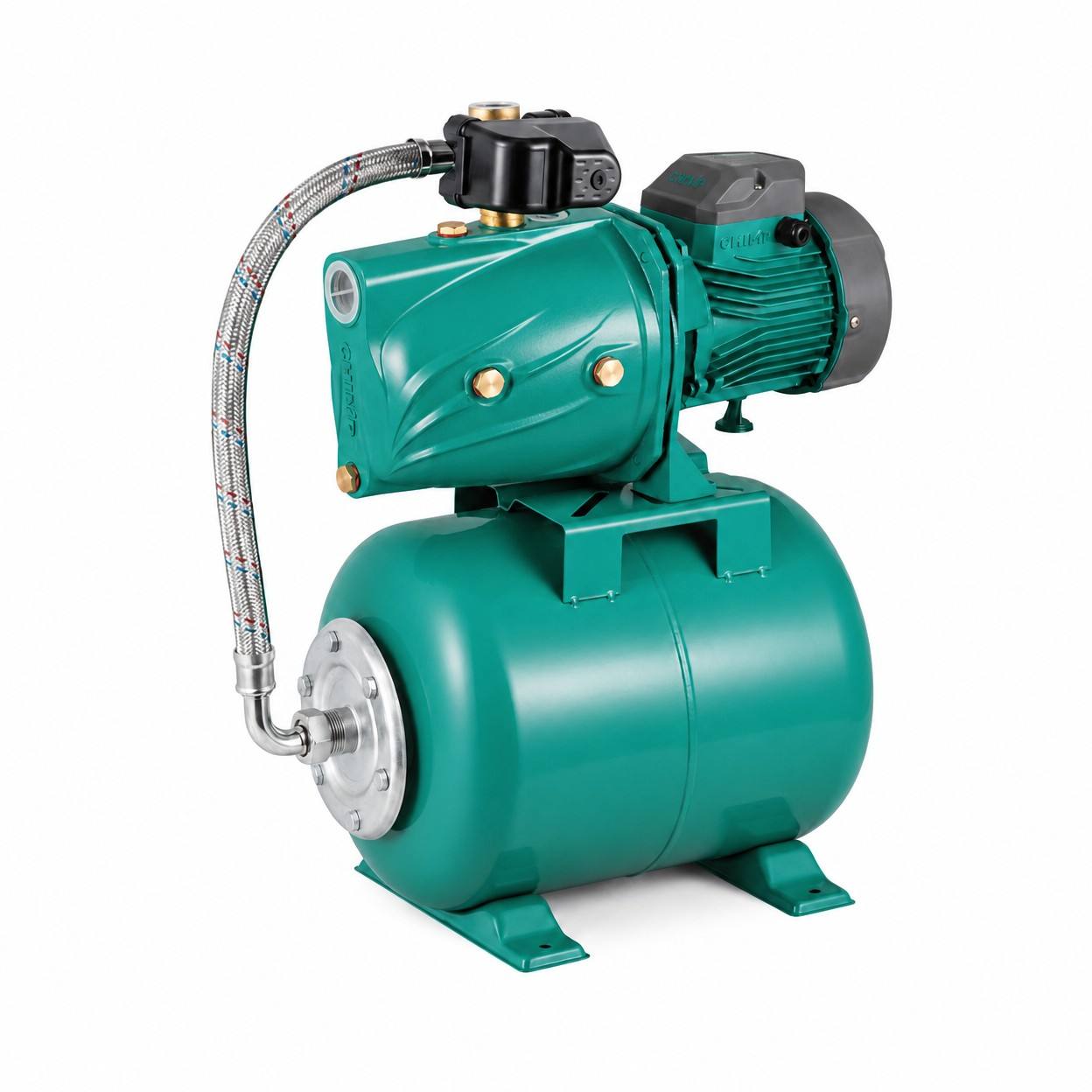
Within that portfolio, the JET pump line is organised into three families. The Jet and STP models are self-priming JET pumps for clean-water transfer, while the AUJET model is supplied as a complete automatic pump station that combines pump, pressure tank, pressure switch and pressure gauge in one assembled set.
| Family | Type | Power range | Max. flow | Max. head | Max. suction | Inlet / outlet | Protection class |
|---|---|---|---|---|---|---|---|
| Jet | Self-priming JET pump | 0.45–1.5 kW / 0.6–2 HP | 30–80 L/min | 36–65 m | 9 m | 1" × 1" to 1¼" × 1" | IPX4 |
| STP | Self-priming JET pump | 0.37–1.1 kW / 0.5–1.5 HP | 40–60 L/min | 30–55 m | 9 m | 1" × 1" | IPX4 |
| AUJET | Automatic pump station | 0.37–1.1 kW / 0.5–1.5 HP | 40–60 L/min | 30–55 m | 9 m | 1" × 1" | Surface unit, non-submersible |
Materials are declared per family and are a genuine selection criterion for buyers. The Jet model is built with a cast iron pump body and support, a stainless steel, brass or PP impeller depending on configuration, a copper winding motor and a stainless steel or 45# steel shaft. The STP model uses a stainless steel pump body with the same impeller, motor winding and shaft options. The AUJET station adds a steel pressure tank with a rubber or EPDM tank membrane, and is available with tank options of 19 L, 24 L and 50 L for different levels of water demand.
Specification constraints buyers must lock before ordering
Duty point: flow and head
The duty point is the combination of flow rate and head at which the pump will actually operate in the installed system. For the CHIMP JET range, the declared envelopes are 30–80 L/min with 36–65 m maximum head for the Jet family, and 40–60 L/min with 30–55 m maximum head for the STP and AUJET families. Buyers should treat these as selection ranges, not as simultaneous guarantees: a pump quoted at its maximum flow will not also deliver its maximum head.
Suction lift and installation position
Suction lift is the most common source of JET pump underperformance. The CHIMP JET families declare a maximum suction lift of 9 m, and that figure assumes the pump is sited above the water source with correctly sized, airtight suction piping. Buyers should also confirm the distance to the water level under drawdown conditions, not just at rest, because falling water levels reduce available suction margin.
Liquids, temperature and protection class
JET pumps in this range are specified for clean water and liquids with similar physical and chemical properties. For the Jet and STP models, the maximum liquid temperature is 40°C and the maximum ambient temperature is 40°C, with a protection class of IPX4. That combination defines a clear boundary: these are surface units intended for dry, sheltered installation, not for immersion and not for wastewater service. Buyers evaluating a JET pump for a flooded pit, a septic application or a hot-water circuit should look at a different pump category.
Electrical and mechanical variables
Voltage, frequency and configuration flexibility should be confirmed at quotation stage rather than assumed. CHIMP supports OEM and ODM work with customization across colour box, nameplate, voltage, head, flow and power, a monthly capacity of 250,000 units, a lead time of 30–45 days and a minimum order quantity of 100 units. Quality control is described as 100% testing, and after-sales support is provided remotely online.
Certification and compliance for JET pumps
For buyers selling into regulated markets, certification is often the deciding constraint rather than pump performance. Three certification lines are directly relevant to the JET pump families.
ISO 9001:2015 — certificate number 06925Q11341R2, issued by Kaixin Certification (Beijing) Co., Ltd., with the scope "Production of water pumps and motors (including those within the scope of qualifications)" and validity from 2025-11-07 to 2028-11-11. The certification applies to the Jet self-priming pump and the STP self-priming jet pump, as well as to the AUJET automatic pump station.
CE Attestation of Conformity — certificate number CE-4002-030425, issued by ECES (European Certification Services) for the EU market, covering the STP Jet pump, the Jet self-priming pump and the AUJET automatic pump station, among other covered products. A separate CE Attestation of Conformity for the jet pump electric motor carries certificate number M.2024.206.C111197.
Zhejiang Export Famous Brand — certificate number 2024ME169, issued by the Zhejiang Provincial Department of Commerce, valid from 2025-02-01 to 2027-12-31 for the global market and covering all pump series of the company, including the JET models.
At company level, CHIMP also reports CE, ISO 9001, CB, SA8000:2014, ISO 14001 and ISO 45001 certification. For buyers, the practical reading is that the JET range sits inside a documented quality-management and product-conformity framework rather than relying on self-declared performance alone.
Application fit: where JET pumps are the right answer
The JET pump family is designed around a specific set of water-supply jobs. Documented applications for the range include household water supply, home water pressure boosting, water supply from wells, garden irrigation, water supply for showers and taps, small buildings and apartments, and supporting household appliances that require stable water pressure.
The AUJET automatic pump station is the variant most often specified for domestic pressure building, because it starts and stops automatically according to water demand and system pressure. Its integrated pressure tank helps reduce frequent pump starts, and the 19 L, 24 L and 50 L tank options allow the buffer volume to be matched to the number of outlets being served.
JET pumps compared with alternative surface and submersible solutions
Choosing between pump categories is usually a question of which constraint the buyer is willing to accept. A JET pump trades high-flow capability and deep-water reach for simple surface installation, self-priming convenience and low system cost.
| Consideration | JET pump (surface) | Submersible / borehole pump | Centrifugal pump (e.g. MHF / CPM) |
|---|---|---|---|
| Water source depth | Suction lift up to 9 m | Installed in the well or borehole | Suction lift up to 8 m |
| Typical strength | Self-priming, compact, easy to service | Deep-water supply | Higher flow transfer |
| Liquid suitability | Clean water and similar liquids | Depends on model and application | Clean water and similar liquids |
| Installation | Above ground, dry location | Submerged | Above ground, dry location |
Market context and what it means for buyers
The global water pump market was estimated at USD 76.1 billion in 2026, and centrifugal pumps accounted for 66.4% of global water pump market revenue in 2025. China's centrifugal pump exports under HS code 841370 reached USD 5.3 billion in 2024. For buyers, these figures describe a mature, highly supplied and price-competitive category in which surface pump families such as JET pumps are widely available and differentiation shifts toward specification accuracy, certification coverage and OEM flexibility rather than headline performance claims.
Future outlook
Two directions look structurally important for JET pump buyers. The first is integration: the AUJET automatic pump station already combines pump, pressure tank, pressure switch and pressure gauge in a single assembled set, and this kind of packaged, automatic water-pressure solution reduces on-site assembly and commissioning work. The second is compliance-driven sourcing, where certification scope and declared operating limits carry as much weight in a purchasing decision as the pump curve itself. As buyers in household, small-building and light irrigation segments continue to replace unstable mains supply with local pressure systems, demand is likely to concentrate around units that can demonstrate both a matched duty point and a documented compliance file.
FAQ
- What exactly is a JET pump, and how does it differ from a standard centrifugal pump?
- A JET pump is a surface-mounted, self-priming electric water pump that uses a jet assembly together with an impeller to lift water from a source below the pump and deliver it under pressure. The self-priming design is the key difference from a basic centrifugal pump, which normally requires the impeller to be flooded before it can build pressure. In the CHIMP range, the self-priming design provides a suction lift of up to 9 m.
- Which specifications should be confirmed before ordering a JET pump?
- Buyers should confirm the duty point (flow and head together, not separately), the maximum suction lift, the liquid and ambient temperature limits, the protection class, the inlet and outlet size, and the voltage and frequency of the supply. For the CHIMP Jet and STP families, the declared maximum liquid and ambient temperature is 40°C and the protection class is IPX4.
- What is the difference between the Jet, STP and AUJET pump families?
- Jet and STP are self-priming JET pumps. The Jet model covers 0.45–1.5 kW with maximum flow of 30–80 L/min and maximum head of 36–65 m, while the STP model covers 0.37–1.1 kW with maximum flow of 40–60 L/min and maximum head of 30–55 m. AUJET is an automatic pump station that packages the pump with a pressure tank, pressure switch and pressure gauge, and is offered with 19 L, 24 L and 50 L tank options.
- Which certifications apply to CHIMP JET pumps?
- ISO 9001:2015 (certificate number 06925Q11341R2) applies to the Jet self-priming pump, the STP self-priming jet pump and the AUJET automatic pump station. The CE Attestation of Conformity for the EU market carries certificate number CE-4002-030425, issued by ECES, and a separate CE certification for the jet pump electric motor carries certificate number M.2024.206.C111197. The Zhejiang Export Famous Brand certificate 2024ME169 covers all pump series of the company.
- What are the hard operating limits of a JET pump?
- The main limits are a maximum suction lift of 9 m, a maximum liquid temperature of 40°C and an IPX4 protection class on the Jet and STP models. These limits mean a JET pump is intended for clean water and similar liquids in a dry, sheltered surface installation. It is not intended for submersion, wastewater or sewage duty, or high-temperature liquid service.
- What OEM customization is available for JET pumps?
- CHIMP supports OEM and ODM production with customization options covering colour box, nameplate, voltage, head, flow and power. The stated monthly capacity is 250,000 units, standard lead time is 30–45 days, and the minimum order quantity is 100 units. Quality control is described as 100% testing, with remote online after-sales support.
Есть вопросы или нужны дополнительные детали?
Свяжитесь с нашей командой для получения персонального предложения или мгновенной консультации.
Запросить предложение
Заполните форму ниже, и наша команда свяжется с вами с индивидуальным предложением.
Прямой чат WhatsApp
Предпочитаете общаться в реальном времени? Напишите нам в WhatsApp для мгновенной помощи и быстрых ответов.
- Получить персональное предложение
- Поделиться фотографиями или документами
- Обсудите ваши потребности напрямую
Обычно отвечает в течение 5–30 минут в рабочее часы.