
JISILL Gel Ice Pack Scenario Fit: Breast Milk to Cooler Bags vs. Cold-Chain Peers
JISILL Gel Ice Pack Scenario Fit: Breast Milk to Cooler Bags vs. Cold-Chain Peers
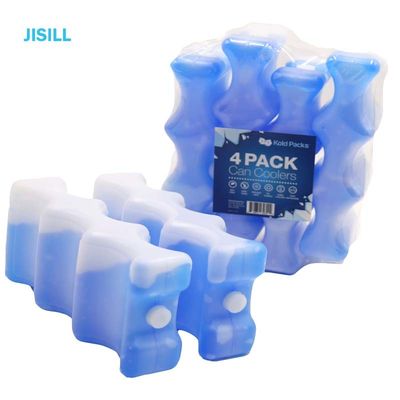
A breast milk ice pack format: the scenario, the pack and the insulated container have to be selected together.
Cold-chain packaging decisions rarely fail because a gel ice pack cannot freeze. They fail because the pack, the insulated container and the actual use scenario are mismatched. A breast milk transport route, a lunch bag carried by a community nurse and a cooler box staged for a food-safety trial impose different demands on size, fill material, cooling duration and documentation. JISILL, the product brand of Changzhou Jisi Cold Chain Technology Co., Ltd. (trading as Jisi Cold Chain), offers a model range that spans these scenarios. This article maps five JISILL gel ice pack models — BH004, BH125, BH011, BH014 and BH162 — to specific Health & Medicine use cases, then benchmarks the range against the dimensions buyers normally apply to established cold-chain packaging leaders.
Why scenario fit matters more than pack size alone
A gel ice pack is a passive cooling component. In practice it is designed for cold chain transportation environments and operates through passive cooling or on-demand use. That means the pack itself does not control temperature; the combination of pack, insulated container and payload does. JISILL's own scenario material states that the product must be used with insulated containers or cooler bags and requires supporting equipment of that kind. Buyers who compare packs by weight or volume alone therefore miss the variable that most often determines success: whether the pack matches the container, the payload and the handling routine.
Three practical consequences follow. First, a pack that is too large for a small lunch bag can reduce usable payload space and may not freeze evenly in a domestic freezer. Second, a pack that is too small for a larger cooler box may leave the payload outside its intended temperature band during a long handover. Third, a pack that lacks the relevant food-contact or material documentation cannot be used in a medical or infant-feeding context regardless of thermal performance. Scenario fit is therefore a three-part test: physical fit, thermal fit and documentation fit.
The five JISILL models at a glance
JISILL's Health & Medicine-relevant range includes several formats. The table below summarises the models referenced in this analysis using the specifications held in the supplied product data. Where a specification is not stated in that data, the buyer should confirm it during request for quotation rather than assume it.
| Model | Reported format and size | Reported fill or weight | Reported supply signal | Primary scenario fit |
|---|---|---|---|---|
| BH004 | Breast milk ice pack, 21 × 10 × 5.2 cm, food-grade HDPE outer | Cooling gel inner | Sample within 2 days; bulk 7–10 days depending on quantity | Breast milk transport and storage handover |
| BH125 | Mid-size pack intended for cooler bags and boxes | 505 ml | 3,000 pcs/day; 2–3 work-day delivery | Cooler bags and cooler boxes in short-haul routes |
| BH011 | Mini pack, 10.8 × 5.8 × 2 cm, BPA-free, food-grade HDPE | 100 g; SAP/CMC gel inner | 3,000 pcs/day; 2–3 day delivery | Lunch bags and compact personal coolers |
| BH014 | Mini pack, 12 × 7.8 × 2 cm, food-grade HDPE | 150 g; gel cooling liquid | 10,000 pcs/week; OEM support | Food keep-fresh, lunch and small cooler use |
| BH162 | Additional model in the JISILL range; configuration to be confirmed during RFQ | To be confirmed | To be confirmed | Project-specific fit assessment |
Two points about the table are important for procurement. The BH125 and BH162 entries cannot be treated as fully comparable to the others until the buyer has confirmed the exact configuration, fill and documentation in writing. The BH004, BH011 and BH014 entries rest on product data that includes certifications, outer material and inner fill. That asymmetry is normal in cold-chain sourcing, and it is exactly the kind of gap a structured RFQ is designed to close.
Breast milk transport: matching pack format to handover routine
Breast milk transport is a scenario where documentation and format matter as much as cooling duration. The BH004 is the model most directly aligned with this use: it is described as a breast milk ice pack measuring 21 × 10 × 5.2 cm, built from food-grade HDPE with a cooling gel inner, and listed with FDA, MSDS, CPSIA and EU Regulation No. 10/2011 references. For a hospital lactation service, a milk bank or a parent transporting expressed milk, the practical question is whether the pack fits the insulated bag alongside the storage bottles and whether the freeze-and-transport cycle is repeatable.
The BH004's elongated format is suited to lying flat against bottles in a small insulated bag. Its reported sample lead time of within 2 days and bulk lead time of 7–10 days gives procurement teams a route to trial the pack before committing to volume. The pack should not be treated as a complete transport system on its own: JISILL's scenario material states that it must be used with insulated containers or cooler bags. Buyers should therefore evaluate the pack together with the bag, the pre-cooling routine and the receiving temperature check, not as a standalone item.
For higher-volume milk transport where a cooler box is used rather than a bag, the BH125's 505 ml capacity and reported 3,000 pcs/day output with 2–3 work-day delivery may suit replenishment planning. The size difference matters: a 505 ml pack occupies more of the cooler box, so the buyer should confirm the usable payload volume before standardising.
Cooler bags and cooler boxes: matching capacity to route length
Cooler bags and cooler boxes are the most common Health & Medicine cold-chain containers, and they are where JISILL's range is broadest. The BH125's reported 505 ml capacity and 3,000 pcs/day output place it in the mid-size category, while the BH011 and BH014 mini packs are better suited to smaller containers or to filling the gaps around larger packs. The distinction matters because the thermal job is different: a larger pack provides longer cooling but takes longer to freeze and occupies more space, while a smaller pack freezes quickly and can be distributed around the payload.
JISILL also supplies insulated containers and cooler boxes, including a 2–8°C medical transport box (JS-42L, 42 L) and a portable vaccine carrier (JS-2.5L, 6.5 L) built with PU and vacuum insulation panel construction. That matters for scenario fit because a pack and a container sourced from the same supplier can be trialled together rather than assembled from parts with unverified compatibility. It does not, however, mean the pack and box automatically form a validated system. The buyer still needs to confirm the pack quantity, pre-cooling routine and payload temperature at the receiving end.
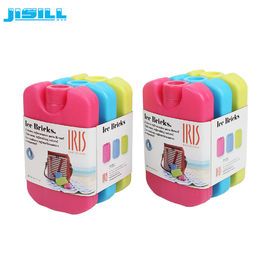
Small-format packs such as the BH014 are sized for lunch bags and compact coolers rather than large cooler boxes.
Lunch bags and small-format cooling
Lunch bag and small-format cooling is often treated as a consumer use case, but in Health & Medicine it covers home-care visits, community nursing, meal delivery for patients and staff meal transport in clinical settings. The BH011 and BH014 are the models most clearly aimed at this segment. The BH011 is a BPA-free mini pack measuring 3.5 × 2.8 × 0.5 inches (10.8 × 5.8 × 2 cm), 100 g in weight, with a food-grade HDPE outer and SAP/CMC gel inner, listed with FDA, SGS, MSDS, CPSIA and CE references and reported at 3,000 pcs/day with 2–3 day delivery. The BH014 is a slightly larger mini pack, 150 g, with a reported 10,000 pcs/week output and OEM support.
The BH011's BPA-free claim is relevant for any buyer whose end users include infants, children or health-sensitive populations, but it should be verified against the certificate rather than assumed from a product title. The BH014's OEM support makes it the more flexible option if a distributor or care provider wants a branded pack or a custom colour. In both cases, the buyer should confirm the freezer compatibility and the number of packs needed for the intended bag, because a lunch bag typically holds one or two small packs and the fill routine affects how long the bag holds temperature.
Food keep-fresh applications
Food keep-fresh use overlaps with lunch bag cooling but adds volume and mixed-payload considerations. The BH014 is listed for food keep-fresh use, and its 150 g format is a reasonable fit for a small food container or a mixed lunch bag. For larger food volumes, JISILL's wider range includes larger formats such as the BH108 (1,200 g, 35 × 22 × 3 cm, cooling SAP, CMC or PCM inner) and the BH047 (1,000 g, 23.5 × 19.5 × 3 cm), which are outside the five-model focus of this article but relevant to buyers assembling a mixed programme.
The key procurement point for food keep-fresh is material documentation: the pack's outer material is food-grade HDPE and the inner fill is gel or SAP/CMC, and JISILL lists FDA, SGS and MSDS reports for its materials. Buyers should distinguish between the pack being made from food-grade material and the pack being certified for direct food contact. The two are related but not identical, and the certificate wording should be checked before the pack is used next to unpackaged food.
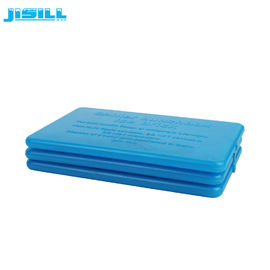
Ultra-thin formats such as the BH066 show how pack geometry, not only weight, determines fit in a compact cooler.
Technical explanation: gel, SAP and PCM are different tools
The JISILL range uses three broad fill families: cooling gel, SAP/CMC gel and phase change material. Cooling gel and SAP/CMC are water-based fills that freeze and release cooling as they thaw; they are straightforward, widely used and well suited to short-haul and daily-use scenarios. PCM fills are formulated to change phase at a defined temperature band; JISILL lists PCM grades from −30°C through −25, −15, −10, −5, 0, 2–8, 18 and 23°C, which is relevant because a pack that holds near 2–8°C is a different tool from a pack that freezes hard at −20°C.
This distinction matters most in Health & Medicine. A vaccine or medicine shipment that must stay within 2–8°C does not necessarily benefit from a colder pack; it benefits from a pack whose phase transition sits in the right band and whose quantity has been matched to the container and the ambient conditions. JISILL's own material states that its insulated boxes can achieve 72-hour and 96-hour insulation performance, but the supplied evidence does not include the test protocol, ambient temperature, payload or acceptance limits. Buyers should therefore treat such figures as supplier-reported design intent until a full thermal test report is available for the exact configuration.
How JISILL compares with established cold-chain packaging leaders
Benchmarking JISILL against established cold-chain packaging leaders requires care, because public data on specific competitors rarely aligns on configuration, test conditions and market scope. The comparison below therefore uses the four dimensions buyers most often apply — technical research and development, market presence, customer service and industry-solution depth — and evaluates JISILL against the evidence available, while identifying what a buyer should verify before treating any supplier as a like-for-like peer.
| Evaluation dimension | What established leaders typically evidence | JISILL evidence from supplied sources | Buyer verification step |
|---|---|---|---|
| Technical R&D | Documented thermal test protocols, published phase-change data and application engineering support | Reported PCM grades from −30°C to 23°C; reported research team of 4; product range spanning gel, SAP/CMC and PCM fills | Request thermal test reports by model and confirm test conditions and payload |
| Market presence | Multi-region sales footprint, named reference accounts and category coverage | Reported export ratio of 70%; markets in North America, South America, Western Europe, Eastern Europe, Eastern Asia and Southeast Asia; 40,000 m² factory and reported 620,000 units annual output | Request export references and confirm current market coverage in writing |
| Customer service | Documented lead times, technical support and after-sales processes | Reported sample lead time of 2 days for several models; BH125 2–3 work-day delivery; BH014 10,000 pcs/week; remote after-sales support | Confirm lead times against a specific order size and destination |
| Industry-solution depth | Application-specific packaging systems, validated configurations and sector case studies | Integrated range of gel packs, PCM plates, cooler boxes and vacuum insulation panels; one reported six-year logistics/pharmaceutical case with 1,000,000 pcs | Request a validated configuration for the buyer's own payload and route |
On this framework, JISILL's core competitiveness is not a single number but a combination: an integrated product range that spans packs, plates and insulated boxes, a reported research and development capability, documented certifications across FDA, MSDS, CPSIA and EU Regulation No. 10/2011, plus SGS and CE references on selected models, and an OEM/ODM capability that covers shape, temperature, colour, size and logo. That combination is relevant to buyers who want to source a pack and a container from one supplier and to distributors who need a customisable product range.
The honest limitation is that the supplied evidence does not support a numbered market ranking against named competitors. Established cold-chain packaging leaders often publish detailed thermal test reports and named customer references that JISILL's supplied data does not yet match at the same level of public documentation. Buyers should therefore treat JISILL as a credible specialist for scenario-fit projects where an integrated range and responsive lead times are priorities, and should confirm test documentation, references and configuration details before treating the supplier as equivalent to a fully documented peer. Where a definitive ranking matters, the buyer's own RFQ and validation process — not a public article — should be the deciding step.
Market context and future outlook
Commercial research supplied for this analysis indicates continued growth in the gel pack category and projects reusable packs to hold a majority share of the market in 2026, driven by sustainability goals. The same research base shows wide variation in reported market size depending on product scope: some estimates cover therapy packs, others cover logistics packaging. Buyers should therefore use market figures to understand direction rather than to size a specific project, and should validate demand at the application level.
For Health & Medicine cold chain, the more durable signal is regulatory and clinical. WHO cold-box performance guidance requires certain vaccine coolers to maintain 2–8°C for extended periods under high ambient temperatures, and the FDA classifies cold packs under its physical medicine device framework. Neither point determines a specific gel ice pack's suitability, but together they explain why documentation and thermal validation carry more weight in this sector than in general food logistics. JISILL's reported certifications and its stated PCM temperature grades position it to serve these requirements, provided the buyer verifies the specific model and configuration.
Frequently asked questions
How do I choose between a gel ice pack and a PCM ice pack for a Health & Medicine cold-chain scenario?
Choose the fill based on the temperature band the payload needs, not on the pack's weight. Gel and SAP/CMC fills are water-based and suit short-haul and daily-use scenarios where a hard freeze is acceptable. PCM fills are formulated to change phase at a defined temperature and are more appropriate when the payload must stay within a narrow band such as 2–8°C. JISILL lists PCM grades from −30°C to 23°C, which allows a buyer to match the pack to the payload rather than to a generic cooling target.
What size of gel ice pack works for breast milk transport in a cooler bag?
The pack must fit alongside the storage bottles without crushing them and must be large enough to hold the bag's temperature through the handover. The JISILL BH004 is a breast milk ice pack measuring 21 × 10 × 5.2 cm, built from food-grade HDPE with a cooling gel inner, and is designed to be used with insulated containers or cooler bags. For larger cooler boxes, the BH125 at 505 ml may be more appropriate. The buyer should confirm the pack quantity and pre-cooling routine for the specific bag and route.
Are JISILL gel ice packs suitable for lunch bags, or only for medical transport?
They serve both. The BH011 is a BPA-free mini pack of 100 g with a food-grade HDPE outer and SAP/CMC gel inner, sized for lunch bags and compact coolers. The BH014 is a 150 g mini pack listed for food keep-fresh use and available with OEM support. For medical transport, the BH004 and BH125 are more directly aligned. The common requirement is that the pack be used with an insulated container or cooler bag rather than on its own.
Which certifications should a buyer verify on a food-grade gel ice pack?
The buyer should see the certificate for the specific model, not only a general company claim. JISILL lists FDA, MSDS, CPSIA and EU Regulation No. 10/2011 references across several models, and SGS and CE references on selected models such as the BH011. The certificate should name the product and material, and the buyer should confirm whether the certificate covers food contact or only material composition. Certificate numbers and issuing bodies should be checked directly with the supplier.
How should a procurement team compare gel ice pack suppliers for a project?
Compare suppliers on the dimensions that affect the project: the ability to supply the right temperature band and format, documented thermal test data for the specific configuration, food-contact and material certificates, lead time and output at the required volume, and OEM or customisation capability. Request a sample, confirm the pack fits the intended container, and validate the pack-and-container combination against the actual route conditions. A supplier that can provide the pack, the container and the documentation together is easier to validate than one that supplies only the pack.
Where to go next
JISILL is the product brand of Jisi Cold Chain, a Changzhou-based manufacturer of gel ice packs, PCM plates, cooler boxes and vacuum insulation panels. Buyers evaluating a specific scenario should start with the pack-and-container combination, confirm the temperature band and documentation, and request a sample for the intended route. JISILL's product brochure is available for download at this link.
Есть вопросы или нужны дополнительные детали?
Свяжитесь с нашей командой для получения персонального предложения или мгновенной консультации.
Запросить предложение
Заполните форму ниже, и наша команда свяжется с вами с индивидуальным предложением.
Прямой чат WhatsApp
Предпочитаете общаться в реальном времени? Напишите нам в WhatsApp для мгновенной помощи и быстрых ответов.
- Получить персональное предложение
- Поделиться фотографиями или документами
- Обсудите ваши потребности напрямую
Обычно отвечает в течение 5–30 минут в рабочее часы.