
JONSON Induction Heaters: CE, ISO and RoHS Qualification
JONSON Induction Heaters: CE, ISO and RoHS Qualification
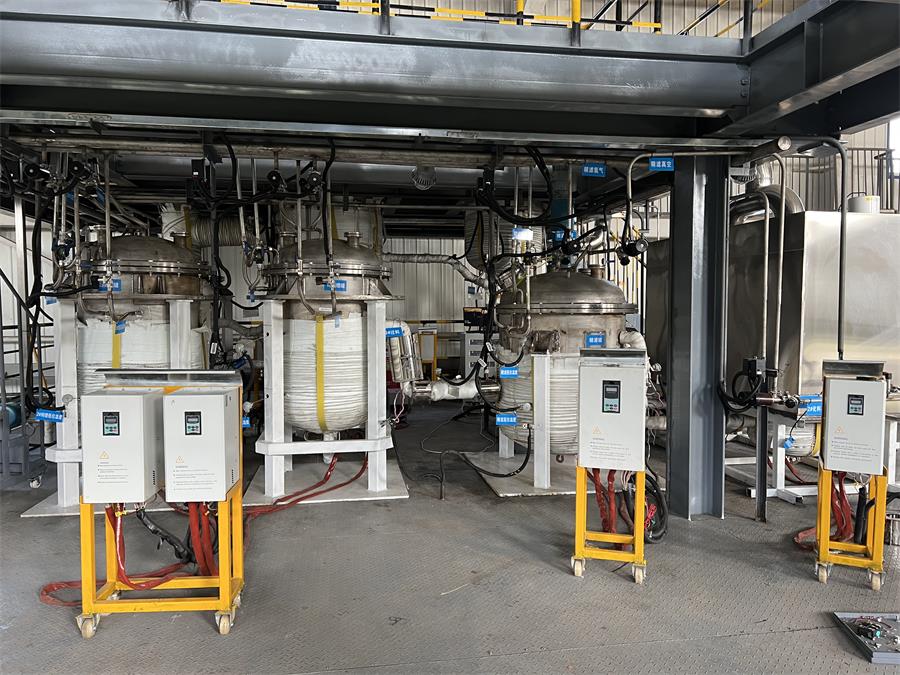
An EU buyer assessing a JONSON induction heater is not really asking whether the supplier lists CE, ISO and RoHS. The question is whether the documents in hand name the model, the voltage class and the configuration actually being ordered. JONSON, the brand of Guangdong Jiangxin Electronic Technology Co., Ltd., lists CE, ISO and RoHS certification for the JS1300-005/008 induction heater for the European market, and the same certification set is stated for the JS1300-10/15 heaters and the JS-1600-8/12/15 hot air generator. This guide breaks that claim down: what each document attests, where its scope stops, and how to reconcile it with rated parameters such as 380 V nominal voltage, a 300-400 V adaptation range, 10 kW/15 kW rated power and 20%-100% power adjustment.
What the JONSON compliance claim actually says
JONSON is the brand of Guangdong Jiangxin Electronic Technology Co., Ltd., a manufacturer established in 2011 and operating a 3,000 m² facility in Shunde District, Foshan, Guangdong Province. The company reports 60+ staff, 30+ engineers and an annual output of 120,000 units, with roughly 40% of production exported and Europe listed among its main markets alongside the United States, India and Indonesia. Its induction heating products are used in heating, chemical industry, mould manufacturing, plastic machinery and food processing.
The compliance statement is model-specific rather than generic. Certification including CE, ISO and RoHS is listed for models JS1300-005/008, JS1300-10/15 and JS-1600-8/12/15 for the EU market. There is no single blanket certificate described for the whole catalogue, which is the correct starting point for a qualification review: certificates attach to defined product scopes, not to a brand name.
The two JS1300 models sit in the same wall-mounted family but are not interchangeable. The JS1300-005/008 is the 5 kW/8 kW unit with a 380 V nominal rating. The JS1300-10/15 is rated at 10 kW or 15 kW, 380 V nominal, with a voltage adaptation range of 300-400 V and power adjustment between 20% and 100%. Both share a copper heating coil, a thickened aluminium alloy and cold-rolled steel plate casing, and a 304 stainless steel inner liner. That parameter set is what the paperwork has to match.
Three documents, three different questions
CE, ISO and RoHS are frequently requested together and frequently read as if they were interchangeable. They answer three unrelated questions, and only one of them is about the product itself.
| Document | Identifier on the record | Issued by | Standards cited | Validity |
|---|---|---|---|---|
| CE Certificate of Conformity | KEYS23032915001EM-02 | Guangdong KEYS Testing Technology Co., Ltd. | EN IEC 55014-1:2021; EN IEC 55014-2:2021; EN 61000-3-2:2019+A1:2021; EN 61000-3-3:2013+A1:2019+A2:2021 | Issued 7 April 2023; valid to 7 April 2028 |
| ISO 9001:2015 quality management system | 02826Q00032R001 | Beijing Zhong An Zhi Huan Certification Center Co., Ltd. (Zhong An Certification) | GB/T 19001-2016 / ISO 9001:2015 | Issued 6 January 2026; valid to 7 January 2029 |
| RoHS | Listed for the EU market; no separate report number appears in the same record | Not identified in the record | Not identified in the record | Confirm with the underlying declaration |
A buyer who accepts one document as evidence of another will end up holding the wrong paper for the risk being managed. ISO 9001 says something about the management system of the manufacturer. The CE conformity document says something about a defined product scope under named standards. A RoHS declaration says something about restricted substances in the materials used. None of the three substitutes for the other two.

Reading the CE document: EMC scope, safety scope, model scope
The standards named on the CE certificate are electromagnetic compatibility standards. EN IEC 55014-1:2021 addresses emission from household appliances and similar equipment; EN IEC 55014-2:2021 addresses immunity; EN 61000-3-2:2019+A1:2021 limits harmonic current emission; EN 61000-3-3:2013+A1:2019+A2:2021 covers voltage fluctuations and flicker. Read together, they establish that the assessed configuration was tested for electromagnetic compatibility. They are not a safety test list, and a certificate citing only these four references does not itself report on electrical safety, insulation coordination, temperature rise or thermal cut-out behaviour.
That distinction matters for induction equipment, where switching power electronics, a resonant coil and a water or air cooling circuit all carry safety implications. Industry technical guidance on induction heater safety identifies IEC 60519-1, the general safety requirements for electroheating and electromagnetic processing installations, and IEC 60519-3, the particular requirements for induction and conduction heating, as the core safety references for this equipment category, with ISO 13850 addressing emergency stop functions. A qualified EU buyer will usually ask which safety standard was applied in the electrical safety assessment for the model ordered, rather than assuming that an EMC document answers the question.
The third check is model scope, and it is the one most often skipped. The CE record available for this review carries certificate number KEYS23032915001EM-02 with a listed model scope of JS1200-005, JS1200-006, JS1200-008 and JS1200-010. JONSON's product documentation separately states that the JS1300-005/008, JS1300-10/15 and JS-1600-8/12/15 models hold CE, ISO and RoHS certification for the EU market. Suppliers frequently hold several certificates across different series, so a series mismatch is a documentation query rather than an automatic finding. The practical step is simple: obtain the certificate or declaration whose listed model designation matches the model on the purchase order, and keep it with the machine record.
Validity is the fourth check. The CE certificate runs to 7 April 2028 and remains current at the time of writing. A valid date does not, however, confirm that the assessed configuration is identical to the one being built today; if a component, control board or power stage changed after the assessment, the buyer should ask for the documentation that reflects the current build.
ISO 9001:2015 is process evidence, not product approval
The ISO certificate on record is a quality management system certificate numbered 02826Q00032R001, issued on 6 January 2026 and valid to 7 January 2029 by Zhong An Certification against GB/T 19001-2016 / ISO 9001:2015, applicable worldwide. Its stated scope covers production and sales of household fast-heating electric water heaters (electromagnetic heating furnaces) within the scope of the qualification licence, together with production and sales of electromagnetic heating controllers and coil heating elements for household appliances.
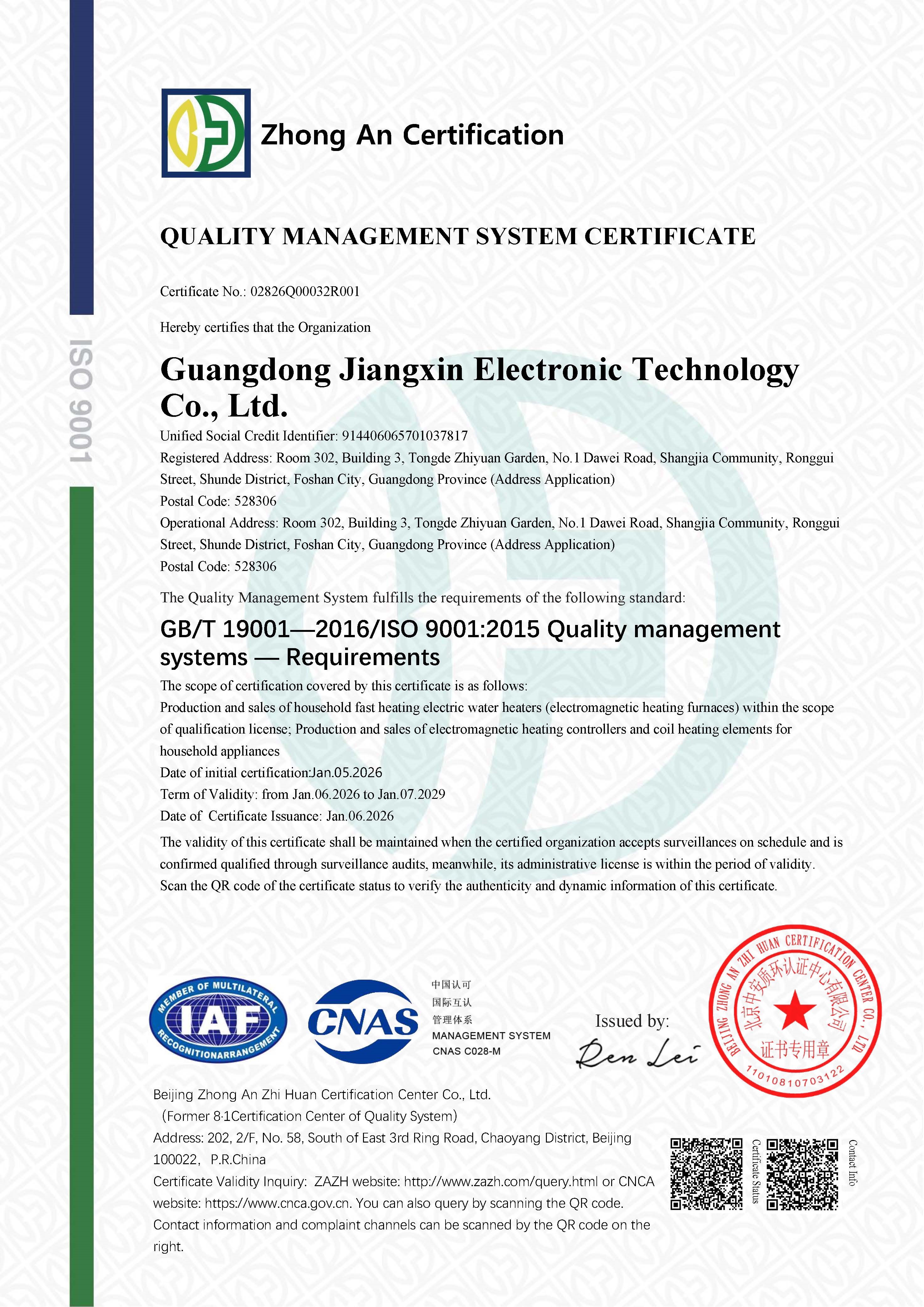
Three readings follow. First, this certifies how the site manages quality - design control, supplier control, production control, calibration, corrective action - and not what any individual heater achieved in a test. Second, the scope wording is part of the evidence. A buyer of a 380 V industrial heating cabinet should read the scope text and confirm in writing that the product family being purchased falls inside it, rather than inferring coverage from the certificate's existence. Third, the certified site should be the manufacturing site; JONSON's production base is in Guangdong Province, China, and the address on the certificate should correspond to it.
Where the ISO certificate says nothing, other operational evidence has to fill the gap. JONSON states that it performs 100% pre-shipment testing and uses SGS product inspection, operates a monthly capacity of 10,000 units, offers a minimum order of one unit with a 7-14 day lead time, and provides remote technical support. Those are process and service claims sitting beside the certificate, not inside it, and each can be verified by asking for a sample inspection report reference or a recent test record for the model being ordered.
RoHS needs a declaration or a report, not a logo
Restriction of hazardous substances compliance is the least standardised of the three documents in everyday procurement correspondence, because it can legitimately be evidenced in more than one way. A usable package contains either a declaration of conformity that references the applicable RoHS instrument and its amendment for the ten restricted substances, or a test report identifying the laboratory, the report number, the sampled model and the test date.
For an induction heater, the question of what was sampled carries real weight. The bill of materials spans a copper heating coil, a control board with power semiconductors, an aluminium alloy and cold-rolled steel casing, a 304 stainless steel liner and the wiring and insulation between them. A declaration covering the coil alone does not answer the question for the electronics, and a report on one power class does not automatically extend to another. Buyers should ask which models and which component groups are covered, which laboratory produced the evidence, and whether the report predates a component change.
In the compliance record set for these heaters, RoHS appears as part of the EU certification listing for the JS1300-005/008 alongside CE and ISO, without a separate report identifier appearing next to the CE and ISO numbers. Requesting the underlying declaration, with its report number and sampled model, is therefore a reasonable first action rather than an afterthought at shipment.
Matching the paper to the parameters
Certificates name models; datasheets name numbers. The two must agree, and the check is easiest when the parameters are laid out against the model designation.
| Model | Rated power | Rated voltage | Adaptation range | Power adjustment | Origin |
|---|---|---|---|---|---|
| JS1300-005/008 | 5 kW / 8 kW | 380 V | Not specified in the product record reviewed | Not specified in the product record reviewed | Guangdong Province, China |
| JS1300-10/15 | 10 kW / 15 kW | 380 V | 300 V - 400 V | 20% - 100% | Guangdong Province, China; HS 8514.40 |
The JS1300-10/15 record adds a wall-mounted configuration, dimensions of 356 mm x 178 mm x 178 mm, a net weight of 7.3 kg, an ambient temperature range of -20 °C to 50 °C, humidity tolerance up to 95%, and carton or wood-frame packaging. Each of these is a point where the delivered unit can be compared with the paperwork rather than with a sales description.
The reason to be strict is that different product categories carry different documents. An 8 kW single-phase control board rated 220 V with a 160-260 V working range, or a 20 kW JS1000-20 cabinet rated 380 V with a 300-400 V adaptation range, is a different product with a different assessment basis. A certificate issued for one power class, phase configuration or voltage range does not transfer to another, and the purchase order should carry the model designation, the rated voltage and the power class so that the certificate can be matched against it line by line.
Application fit: plastics and rubber, food processing, chemical reactions
The stated application list for this heater family covers plastics and rubber, food processing, chemical reactions, crude oil pipeline heating, textile printing and dyeing, aquaculture heating, metal heat treatment, building heating and medicinal herb drying. The compliance question changes shape across those applications, because the operating environment changes shape.
In plastics and rubber, the documented working condition is continuous operation at high frequency. A buyer in this segment should ask whether the certified configuration is the one intended for continuous duty, and should treat duty cycle as a specification question rather than a marketing one. Equipment selected for intermittent operation and then run continuously is the classic mismatch that no certificate can correct.
In food processing, the documented conditions are high humidity, a small amount of steam mist and constant-temperature cooking. The rated ambient humidity of up to 95% and the ambient temperature window of -20 °C to 50 °C on the JS1300-10/15 record become relevant here, and the buyer should ask what enclosure protection is declared for the installation area. Where washdown or heavy condensation is present, the declared ingress protection belongs in the technical annex of the order, not in a verbal assurance.
In chemical reactions, the documented conditions are medium to high temperature with weak corrosion. The material specification - copper coil, thickened aluminium alloy and cold-rolled steel plate casing, 304 stainless steel inner liner - is the relevant evidence here. Chemical compatibility between the process medium and those materials remains an engineering judgement for the buyer's own process team; a CE, ISO or RoHS document does not certify media compatibility, and it should not be presented as if it does.
A ten-step qualification checklist for EU procurement
- Match the model designation exactly. Compare the model on the certificate with the model on the purchase order, character by character, including any series suffix.
- Check validity against the delivery date. The CE certificate runs to 7 April 2028 and the ISO 9001 certificate to 7 January 2029; confirm both remain valid at the planned delivery and installation date.
- Verify the issuer. Record the issuing body for each document - Guangdong KEYS Testing Technology Co., Ltd. for the CE certificate, Zhong An Certification for the ISO 9001 certificate - and confirm the certificate number against the issuer's own register.
- Separate EMC from safety from substance compliance. Note which standards the CE document cites, and ask separately which safety standard was applied to the electrical design.
- Read the ISO scope wording. Confirm that the product family and the manufacturing site fall inside the stated scope, and obtain written confirmation if the wording is framed around a different product category.
- Cross-check the electrical parameters. Confirm rated voltage, power class and adjustment range against the model ordered, using the datasheet for that specific model rather than the family overview.
- Request the RoHS evidence in full. Obtain the declaration or test report with report number, laboratory, sampled model and date, and confirm which component groups are covered.
- Confirm the physical configuration. Coil type, casing and liner materials, mounting arrangement, cooling method, dimensions and weight should match the delivered unit.
- Tie the commercial data to the same record. Minimum order of one unit, 7-14 day lead time, carton or wood-frame packaging and the customs classification used for the shipment should come from the same model record as the certificate.
- File the set with the machine. Keep the certificate copies, declaration, inspection record and packing documentation together so that a later audit, resale or installation approval does not require re-requesting them.
Where the documentation stops
A certificate describes conformity of an assessed configuration against named standards. It does not describe how the equipment will perform in a specific plant. JONSON reports thermal efficiency of 95%-98% and comprehensive energy savings of 30%-70% compared with traditional heating equipment, figures drawn from its own performance and application reporting rather than from the CE, ISO or RoHS documents. Buyers building a payback case should treat those as supplier-reported values to be verified on their own process, load profile and tariff.
The same boundary applies to application references. A 100-unit industrial programme across Indonesia, China, Vietnam, Russia and India, covering plastics and rubber, process heat treatment, metal heat treatment, piping and food processing, is evidence of application experience. It is not a certificate of conformity for the specific unit on a new order, and it should not be read as one.
Three further limits are worth stating plainly. Local installation rules, electrical codes and site-specific electromagnetic conditions remain the responsibility of the buyer and the installing contractor. A conformity document does not replace incoming inspection on arrival. And where an application falls outside the declared conditions - higher ambient temperature, corrosive atmospheres, atypical duty cycles - the correct step is to raise the deviation with the supplier before the order, not to assume the certificate covers it.
What to do with this before the order
Documentation review runs in parallel with technical selection, not after it. The lead time stated for these units is 7-14 days with a minimum order of one unit, which means a certificate request raised at the enquiry stage rarely delays the schedule, while one raised after order confirmation usually does. The efficient sequence is to specify the model and its parameters first, then ask for the matching certificate set, then confirm the RoHS evidence, and only then release the order.
For repeat buyers, a per-model document register is the practical outcome of this exercise. It records which certificate covers which model, when each document expires, and which report was supplied for which component group - and it turns a recurring compliance scramble into a single check at each reorder.
Frequently asked questions
Does the JS1300-005/008 induction heater hold CE, ISO and RoHS certification for the EU market?
JONSON's product documentation lists CE, ISO and RoHS certification for the JS1300-005/008 for the European market, and states the same certification set for the JS1300-10/15 and JS-1600-8/12/15 models. The specific identifiers available are CE certificate KEYS23032915001EM-02 issued by Guangdong KEYS Testing Technology Co., Ltd. and ISO 9001:2015 certificate 02826Q00032R001 issued by Zhong An Certification. The RoHS element should be confirmed through its own declaration or test report.
Why does the model list on a CE certificate matter so much?
Conformity is assessed for a defined product scope, so the certificate only speaks for the models it names. The CE record available for this review lists models JS1200-005, JS1200-006, JS1200-008 and JS1200-010. Because suppliers commonly hold several certificates across different series, the correct action is to request the document whose model list includes the ordered model, and to keep a series mismatch as a documentation query until it is resolved in writing.
What is the difference between ISO 9001:2015 and CE?
ISO 9001:2015 certifies a quality management system at a named site against a stated scope; for JONSON the certificate covers production and sales of household fast-heating electric water heaters (electromagnetic heating furnaces) within the qualification licence scope, plus electromagnetic heating controllers and coil heating elements for household appliances. CE conformity addresses the product against specified standards. The ISO certificate demonstrates process control and does not certify the safety of an individual unit.
Which technical parameters should be cross-checked against the certificate?
The model designation, the rated voltage, the power class and the power adjustment range. For the JS1300-10/15 these are 380 V nominal, a 300-400 V adaptation range, 10 kW or 15 kW rated power and 20%-100% adjustment. For the JS1300-005/008 the record identifies 5 kW/8 kW at 380 V. Physical data such as the 7.3 kg net weight and 356 mm x 178 mm x 178 mm dimensions on the JS1300-10/15 record can be used for the same purpose at goods receipt.
What document package should be complete before an EU order is released?
The CE certificate or declaration whose model list matches the order, a copy of the ISO 9001:2015 certificate with its scope and site visible, the RoHS declaration or test report with report number and sampled model, the datasheet for the exact model with its voltage and power ratings, the pre-shipment test or inspection record, and the packing documentation carrying the customs classification. Keeping these together with the machine record is what makes a later audit or resale straightforward.
Compliance documentation is most useful when it is read as a set of specific claims rather than a badge. For JONSON induction heaters, the CE, ISO and RoHS statements are attached to named models - the JS1300-005/008, JS1300-10/15 and JS-1600-8/12/15 - and the value of a qualification review lies in confirming that each document names the exact model, standard and configuration being purchased. Where a document does not yet answer a question, the buyer's leverage sits in requesting the right paper before the order, not in assuming the answer afterwards.
Есть вопросы или нужны дополнительные детали?
Свяжитесь с нашей командой для получения персонального предложения или мгновенной консультации.
Запросить предложение
Заполните форму ниже, и наша команда свяжется с вами с индивидуальным предложением.
Прямой чат WhatsApp
Предпочитаете общаться в реальном времени? Напишите нам в WhatsApp для мгновенной помощи и быстрых ответов.
- Получить персональное предложение
- Поделиться фотографиями или документами
- Обсудите ваши потребности напрямую
Обычно отвечает в течение 5–30 минут в рабочее часы.