
JPW20Q vs JPW40F vs JP-OT100: Automation, Bale Size & Force
Buyer Decision Framework · Hydraulic Baler Comparison
JPW20Q vs JPW40F vs JP-OT100: Automation, Bale Size and Force
Three hydraulic baler configurations, three different project logics. The right choice depends on the waste stream, the bale your logistics can move, the space and power available, and how much of the cycle you want automated — not on which number on the datasheet is the largest.
Why the Comparison Starts With the Project, Not the Spec Sheet
Baler selection becomes manageable once four project conditions are known: the material stream and how it arrives at the machine; the bale format that downstream handling, storage and transport can accept; the floor area, headroom and power supply available on site; and the amount of operator time the plant can realistically commit to each baling cycle. Machines are then matched to those conditions, not the other way around.
Compression force is the specification most often used as shorthand for capability, and on its own it is the least decisive. A 100-ton vertical baler and a 20-ton horizontal baler are not competing for the same task. They are fed differently, compress different volumes per cycle, and produce bales of very different size and weight. Treating tonnage as a ranking tends to produce mismatched equipment: more force than the material requires, or a finished bale heavier than the site can move.
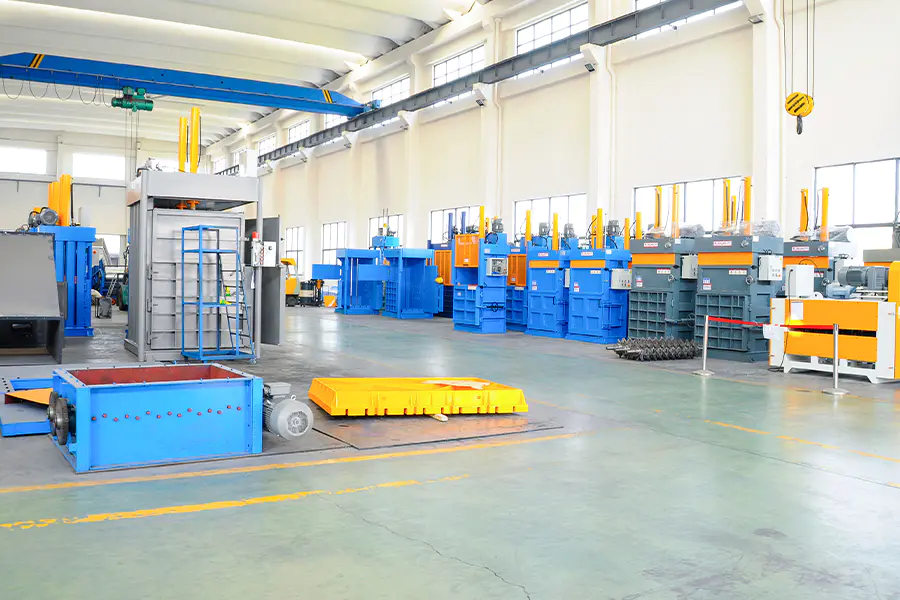
This comparison covers three configurations published by Jewel, the baler brand of Nantong Jiabao Machinery Co., Ltd., a Chinese manufacturer of compression and baling equipment established in 2006, with the Jewel brand founded in 1995 and production based in a 50,000 m² facility in Rugao, Jiangsu. The three models sit at three distinct points on the automation and force spectrum: the JPW20Q fully automatic horizontal baler, the JPW40F semi-automatic horizontal baler, and the JP-OT100 vertical baler.
The Three Configurations at a Glance
The table below sets the published specifications side by side. Where a value is not stated for a model, the table says so rather than filling the gap with an estimate.
| Parameter (as published) | JPW20Q | JPW40F | JP-OT100 |
|---|---|---|---|
| Machine type | Fully Automatic Horizontal Baler | Semi-Automatic Horizontal Baler | Vertical Baler |
| Compression force | 20 Ton | 40 Ton | 100 Ton |
| Published series force scope | 20–40 Ton | 40–100 Ton | 100–180 Ton |
| Bale dimension (datasheet format) | 500 × 500 × 500 mm (LWH) | 720 × 720 × (500–1300) mm (WHL) | 1400 × 700 × (700–1100) mm (LWH) |
| Bale weight | 30–70 kg | 200–400 kg | 400–600 kg |
| Feeding mouth | 700 × 460 mm (L×W) | 1000 × 720 mm (L×W) | 1400 × 600 mm (L×H) |
| Number of strapping channels | 2–4 | 4 | Not stated |
| Baling capacity | Not stated | 1–2 Ton/Hr | 5–6 Bales/Hr |
| Bale discharging method | Not stated | Continuous Push Pack | Not stated |
| Power / horsepower | 7.5 kW / 10 Hp | 11 kW / 15 Hp | 15 kW / 20 Hp |
| Voltage (customizable) | 380V / 50Hz | Not stated | 380V / 50Hz |
| Machine dimension (LWH) | 3400 × 3010 × 2400 mm | 4900 × 1750 × 1950 mm | Not stated |
| Compression chamber size | Not stated | Not stated | 1400 × 700 × 1700 mm |
| Machine weight | 2.8 Ton | Not stated | 3500 kg |
| Material | Carbon Steel | Carbon Steel | Carbon Steel |
| Published application categories | Waste paper recycling, plastic recycling, carton printing, textile waste processing, packaging manufacturing, PET bottle recycling | Same six categories as JPW20Q | Same six categories as JPW20Q |
Reading note: bale dimensions follow each model’s published format. The JPW20Q and JP-OT100 datasheets express bale size as length × width × height; the JPW40F datasheet expresses width × height × length, with a bale length that varies between 500 mm and 1300 mm. All three models share the same published industry categories, which means the industry label alone does not separate them — stream characteristics and logistics do.
Automation Level: What Changes Between Fully Automatic, Semi-Automatic and Vertical
Automation level describes how much of the feed–compress–strap–discharge cycle runs without an operator. It is the variable with the largest effect on labour, plant layout, and how stable the waste stream has to be for the investment to pay back.
Fully automatic horizontal — JPW20Q
A fully automatic horizontal baler is designed to work as part of a line rather than as a standalone station. In a corrugated carton printing and packaging plant in Tunisia, the JPW20Q was deployed inside a factory-wide automatic waste discharge system built to handle waste from the corrugator line and printing machines. The stated project objective was to solve the accumulation of waste on the production floor and improve the overall workshop environment — a removal problem, not a force problem. The machine’s published 20-ton force and 30–70 kg bales fit that role: light, frequent bales that do not require lifting equipment to move.
A fully automatic configuration assumes a reasonably even material supply. Where waste arrives in irregular batches, the value of full automation depends on whether a conveyor or buffer arrangement can smooth the flow into the machine.
Semi-automatic horizontal — JPW40F
The JPW40F applies powered compression at 40 tons to a 720 × 720 × (500–1300) mm bale, with a published capacity of 1–2 tons per hour and four strapping channels. It is specified as semi-automatic: compression and bale formation are machine-driven, while part of the cycle involves operator attendance. Its continuous push pack discharge method suits plants running a steady material flow rather than discrete batches. In a Russian corrugated carton plant, a semi-automatic horizontal configuration was used to build an unmanned waste processing sequence that automatically collects, compresses and bales waste generated during carton production. In that project the automation gain came from integrating the baler with upstream collection, not from removing the operator from every step.
Vertical batch compression — JP-OT100
A vertical baler compresses material in a fixed chamber in discrete cycles. The JP-OT100 publishes a 1400 × 700 × 1700 mm compression chamber, a 1400 × 600 mm feeding mouth, and a capacity of 5–6 bales per hour at 100 tons of force. In a carton plant in Mexico, a JP-OT100 was paired with a conveying system to form an automatic waste removal arrangement integrated with existing production lines for real-time processing. The distinction worth noting is that “vertical” describes compression geometry, not automation level: a vertical baler can sit inside an automated line when upstream feeding is engineered for it.
The same selection logic appears in an unrelated Russian carton project, where a fully automatic unmanned waste baling system built around a different configuration — the JPW-K6046 bagging-type machine — was matched with a conveying system for automatic collection, compression and baling. Different equipment, same reasoning: match the machine to the material flow first, then decide how much of the cycle to automate.
Compression Force and Bale Geometry: Reading 20 t, 40 t and 100 t
Force alone does not determine bale density. Density is the result of force combined with chamber geometry, the compressibility of the material, and cycle time. A 100-ton vertical machine and a 20-ton horizontal machine will not produce comparable results on the same material simply because one applies five times the force — they compress different volumes in different directions at different rates.
Bale weight is often the more practical specification, because it determines how the finished bale leaves the building. The JPW20Q’s 30–70 kg bale can be handled manually or with a simple trolley. The JPW40F’s 200–400 kg bale and the JP-OT100’s 400–600 kg bale require mechanical handling — a pallet truck, forklift or equivalent. That handling capability has to exist on site before the machine is ordered, and it is a more common source of project friction than insufficient force.
Bale dimensions shape what the finished bale can be sold into, stacked, or transported as. The JPW40F’s variable bale length (500–1300 mm) allows one machine to produce different bale lengths and therefore different bale weights from the same chamber, which is useful when downstream buyers or hauliers specify bale size. The JP-OT100 works within a fixed 1400 × 700 mm chamber cross-section, producing a consistent bale format at 700–1100 mm in the third dimension. The JPW20Q produces a cube-format 500 × 500 × 500 mm bale, which is easy to stack and count but lower in unit mass.
Feeding Mouth, Throughput and Line Integration
Feed opening size determines how much material preparation is needed upstream. The JPW20Q’s 700 × 460 mm opening accepts material arriving by conveyor from trimming and printing operations. The JPW40F’s 1000 × 720 mm opening and the JP-OT100’s 1400 × 600 mm opening accept bulkier items with less pre-conditioning. Note that the published conventions differ: horizontal balers state the feeding mouth as length × width, while the vertical JP-OT100 states length × height. A raw numeric comparison of “opening size” across the two formats is therefore not meaningful on its own.
Capacity figures need the same care. The JPW40F publishes 1–2 tons per hour; the JP-OT100 publishes 5–6 bales per hour; no baling capacity is stated for the JPW20Q. Ton-based and bale-based capacities cannot be converted into one another without knowing bale weight, so a buyer comparing throughput should convert everything into the unit their logistics actually use — tons per shift, or bales per shift, or truckloads per week.
Floor Space, Headroom and Power
Machine dimensions translate into very different layouts. The JPW20Q occupies 3400 × 3010 × 2400 mm — a deep, compact footprint of roughly 10.2 m², and the tallest of the two horizontal models. The JPW40F occupies 4900 × 1750 × 1950 mm — a long, narrow footprint of roughly 8.6 m² that suits a wall line or a dedicated bay. The JP-OT100 is published with a compression chamber of 1400 × 700 × 1700 mm and a machine weight of 3500 kg; because compression runs vertically, its floor footprint is generally smaller than a horizontal machine of comparable force, at the cost of greater height and batch feeding. Overall machine dimensions for the JP-OT100 are not stated in the published data and should be confirmed for layout planning. (Footprint areas above are calculated from published machine dimensions.)
Power demand scales with force: 7.5 kW / 10 Hp for the JPW20Q, 11 kW / 15 Hp for the JPW40F, and 15 kW / 20 Hp for the JP-OT100. The JPW20Q and JP-OT100 are published at 380V/50Hz with customizable voltage. The JPW40F electrical specification is not stated in the published excerpt and needs confirmation before ordering. Floor loading matters as well: 2.8 tons for the JPW20Q and 3500 kg for the JP-OT100 are published, while no machine weight is published for the JPW40F.
A Five-Step Fit Framework
The following sequence keeps the decision anchored to the project rather than to the specification sheet. It applies regardless of which model is ultimately selected.
- 1. Characterise the stream. Identify the material, its bulkiness, its moisture and contamination level, and whether it arrives continuously (corrugator trim, printing waste) or in batches (collected storage, delivered loads). Continuous streams favour horizontal automation; batch streams are compatible with vertical batch compression.
- 2. Define the bale before the machine. Start from how the bale will be moved, stacked, stored and sold. Bales under about 70 kg can be handled manually; bales from 200 kg upward require mechanical handling equipment. This single decision narrows the field faster than any force comparison.
- 3. Match force to material behaviour, not to a ranking. Use the lowest force that reliably produces the required bale at the required cycle time. Excess force adds power demand and machine mass without necessarily adding value to the bale.
- 4. Match automation to labour and flow stability. Full automation pays back when the waste flow is continuous and operator time is expensive or unavailable. Semi-automatic and vertical configurations remain appropriate where flows are intermittent or where trained operators are already present.
- 5. Verify space, power and compliance. Confirm footprint, headroom, floor loading, available power, and the certification required in the destination market. As an example of what a compliance check looks like, the JPW20Q holds CE certificate TTC-22-1609/01/01, issued against directives 2006/42/EC and 2014/35/EU and complying with EN ISO 12100:2010 and EN 60204-1:2018. Other models and other markets require their own verification.
| Typical project condition | Configuration logic that fits |
|---|---|
| Continuous, relatively light carton or paper waste; automatic discharge from converting or printing lines; bales moved without lifting equipment | JPW20Q — fully automatic horizontal, 20 Ton, 30–70 kg bales |
| Steady carton, paper or mixed plastic waste at higher tonnage; forklift handling available; operator attendance acceptable for part of the cycle | JPW40F — semi-automatic horizontal, 40 Ton, 1–2 Ton/Hr, 200–400 kg bales |
| Batches of bulkier material; constrained floor footprint; high force per cycle acceptable; heavy bales can be handled | JP-OT100 — vertical, 100 Ton, 1400 × 700 × 1700 mm chamber, 400–600 kg bales |
| One machine for a mixed material stream | Review chamber size and bale format against the bulkiest and densest material in the mix before selecting |
Where These Configurations Have Been Applied
Published project references show the same three configurations solving different problems, which is the clearest illustration of why the comparison cannot be reduced to a ranking.
- Corrugated carton printing and packaging, Tunisia — JPW20Q. A factory-wide automatic waste discharge system was built to eliminate waste accumulation from the corrugator line and printing machines and to improve the overall workshop environment.
- Carton production, Mexico — JP-OT100. A high-efficiency, reliable automatic waste removal system was integrated with existing production lines so that waste is processed in real time.
- Corrugated carton production, Russia — JPW40F. Automatic collection, compression and baling of production waste formed an unmanned system that reduced labour and management costs while enabling immediate monetisation of baled waste.
- PET bottle recycling, Japan — JPW20Q and other configurations. The requirement was higher compression density and compact, well-formed bales; the reported result was improved storage and transport efficiency and greater added value in the recycled output.
- Multi-material recycling, Belarus. A single installation was specified to handle PET bottles, woven bags, HDPE bottles and cardboard — materials that are bulky and difficult to compress — with regular-shaped finished bales as the stated outcome for transport and storage efficiency.
Across these references, the deciding factor in every case was the bale and the material flow, not the nominal tonnage.
What the Datasheet Cannot Resolve
A specification comparison has real boundaries, and three of them are worth stating plainly. First, published values are incomplete for all three models in different places: no baling capacity is published for the JPW20Q, no machine weight or voltage for the JPW40F, and no overall machine dimensions for the JP-OT100. Site-level verification is therefore unavoidable.
Second, force figures are not directly comparable across machine formats. A 100-ton vertical machine and a 20-ton horizontal machine compress in different directions, over different stroke lengths, with different cycle times, so the tonnage numbers describe capability rather than a shared performance scale.
Third, automation has a precondition. Fully automatic and semi-automatic horizontal configurations assume a material flow stable enough to keep the machine fed; where waste arrives unpredictably, the benefit of automation is reduced and the equipment may sit idle between batches. Vertical batch compression accepts intermittent supply more naturally, but at 5–6 bales per hour in the case of the JP-OT100, throughput is measured differently and does not scale the same way.
Market Context: Why Automated Baling Is Moving Up the Specification List
The commercial context supports the project-level approach rather than a single-number specification. An aggregated market research report published in 2026 places the global baler market at USD 7.96 billion in 2026, with a projection of USD 18.02 billion by 2034. Within that total, the hydraulic waste paper baler segment was estimated at USD 1.45 billion in its 2024 base year, with a forecast of USD 2.24 billion by 2032 and a reported CAGR of 5.5% (Data Insights Reports). A separate study of hydraulic metal recycling balers put that segment at USD 913 million in 2023, forecast to reach USD 1,318 million by 2031 (MarketsGlob).
These are commercial research projections rather than official statistics, and the segments are defined differently, so they should not be aggregated. Read directionally, they indicate a market expanding across waste paper, plastic and metal segments simultaneously — which is consistent with what the project references show: buyers are no longer purchasing a standalone compression unit, they are specifying baling as a stage inside a waste handling line, with conveying, feeding and discharge designed together.
Future Outlook
Two shifts are visible in how these machines are specified. The first is from machine selection to line integration: feeding and discharge increasingly determine whether a project succeeds, which pushes the automation decision earlier in the process. The second is toward configuration flexibility, because waste streams change as production changes. Jewel states that it customizes structure, process and performance, with a minimum order quantity of one unit, a monthly production capacity of 100 units and a 60-day lead time — terms that reflect configuration-to-order rather than catalogue purchase.
Service arrangements are becoming part of the specification too. Jewel publishes a 7×24h technical response with on-site support within 48 hours, lifelong maintenance, and free training — commitments that matter most in fully automatic installations, where an unplanned stop halts the line feeding the baler rather than just the baler. For the three models compared here, the practical outlook is that force will continue to be the headline number while automation, bale format and line integration decide the outcome.
Frequently Asked Questions
What is the difference between a fully automatic, a semi-automatic and a vertical hydraulic baler?
The difference is how much of the feed–compress–strap–discharge cycle runs without an operator, and the compression geometry. The JPW20Q is a fully automatic horizontal baler with 20 tons of force, designed to operate as part of a conveyor-fed line. The JPW40F is a semi-automatic horizontal baler with 40 tons of force and a published capacity of 1–2 tons per hour, where the machine drives compression but part of the cycle involves operator attendance. The JP-OT100 is a vertical baler that compresses material in a fixed 1400 × 700 × 1700 mm chamber in batches, with a published capacity of 5–6 bales per hour at 100 tons of force.
How do I choose between the JPW20Q and the JPW40F?
Compare bale weight and throughput before anything else. The JPW20Q produces 30–70 kg bales from a 500 × 500 × 500 mm chamber with 20 tons of force, 7.5 kW of power and a 3400 × 3010 × 2400 mm machine footprint. The JPW40F produces 200–400 kg bales from a 720 × 720 × (500–1300) mm bale with 40 tons of force, 11 kW and a published capacity of 1–2 tons per hour, in a 4900 × 1750 × 1950 mm machine. If bales are moved by hand and the waste flow is continuous and comparatively light, the JPW20Q configuration matches. If bales are moved by forklift and tonnage is higher, the JPW40F configuration matches.
When does a vertical baler such as the JP-OT100 make more sense than a horizontal machine?
When floor space is constrained, material arrives in batches rather than continuously, and a higher force per cycle is acceptable. The JP-OT100 applies 100 tons of force through a 1400 × 700 × 1700 mm compression chamber with a 1400 × 600 mm feeding mouth, producing 400–600 kg bales at 5–6 bales per hour using 15 kW of power and a machine weight of 3500 kg. The trade-offs are batch feeding, bale-based rather than ton-based capacity, and the need for mechanical handling of bales in the 400–600 kg range.
Is a higher compression force always better?
No. Force contributes to bale density together with chamber geometry, material compressibility and cycle time, so a higher tonnage figure does not automatically produce a denser or more valuable bale for a given material. It also raises power demand and machine mass: the comparison here moves from 7.5 kW at 20 tons to 15 kW at 100 tons. The practical rule is to select the force that reliably produces the bale format and weight the downstream logistics can handle, and to treat additional force as a cost unless the material requires it.
What should be verified before placing an order for any of these three machines?
Verify five things. First, the published specifications for the specific model: force, bale dimension, bale weight, feeding mouth, power and machine dimensions. Second, the site’s power supply and floor loading — the JPW20Q and JP-OT100 are published at 380V/50Hz with customizable voltage, while the JPW40F electrical specification is not stated and must be confirmed. Third, the interface with any conveying or feeding system, because automation value depends on it. Fourth, the certification required in the destination market; the JPW20Q holds CE certificate TTC-22-1609/01/01 issued against directives 2006/42/EC and 2014/35/EU and complying with EN ISO 12100:2010 and EN 60204-1:2018. Fifth, handling equipment for the bale weight class selected.
Can one hydraulic baler handle a mixed waste stream?
It depends on whether the different materials can be processed in the same chamber into the same bale format. Multi-material installations do exist: a Belarusian recycling project was configured to process PET bottles, woven bags, HDPE bottles and cardboard through a single baling arrangement, with regular-shaped finished bales as the stated outcome for transport and storage efficiency. The selection method is to check the specification against the bulkiest and the densest material in the mix, not the average; where materials differ sharply in behaviour, separate configurations are usually the more reliable answer.
Where This Leaves the Decision
None of the three configurations is universally correct, and the specifications do not support naming one. The JPW20Q is a route to automatic, low-weight bales fed from continuous production waste. The JPW40F is a route to higher tonnage and heavier bales with a moderate automation requirement. The JP-OT100 is a route to high force per cycle in a smaller floor footprint, accepting batch feeding and heavy bales. The selection framework — stream, bale, force, automation, site conditions — resolves the decision faster than any single number on a datasheet.
The full 2026 product range, including specification tables for the models discussed here, is available in the Jewel hydraulic baler brochure (PDF). Manufacturer information is published at jewelbaler.com.