
JUXIN Dual-Spindle Vertical Lathe: Technical Buyer FAQ
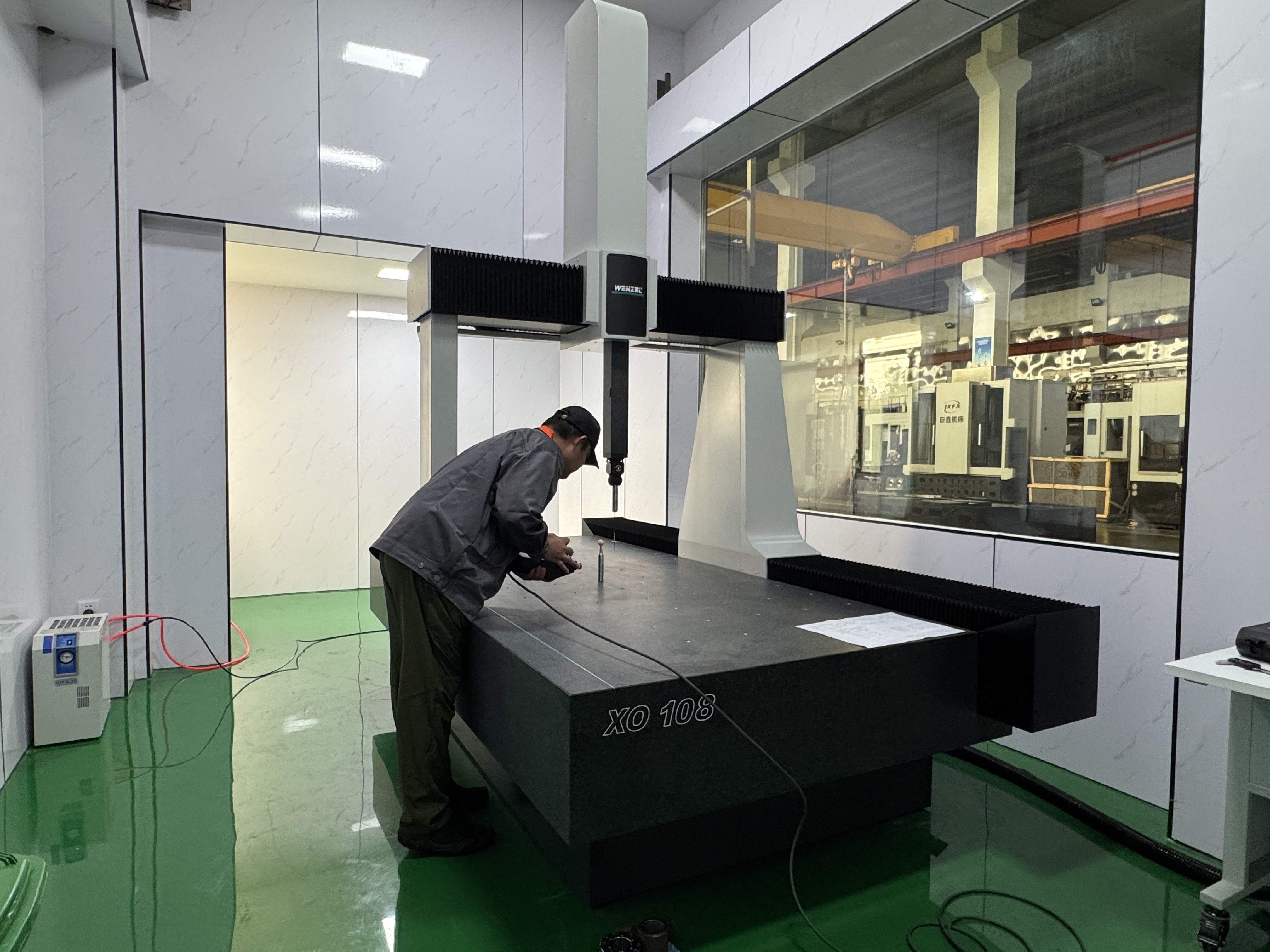
Discs, shafts, sleeves and other rotationally symmetric parts carry the loads inside automotive drivetrains, pumps, energy equipment and general machinery. Turning them accurately at volume is a problem that scales with part size: the larger the disc or the longer the shaft, the more the machine platform itself, not only the cutting tool, determines roundness, coaxiality and surface finish. This reference answers the technical and procurement questions that buyers, process engineers and sourcing teams most often raise about the JUXIN Dual-Spindle Vertical Lathe (product ID 2285), a specialized CNC lathe platform built by Juxin Machine Tool Co., Ltd. for medium and large disc, shaft, sleeve and special-shaped parts.
What the JUXIN Dual-Spindle Vertical Lathe Is
Juxin Machine Tool Co., Ltd., established in 2005 and based at No.52-1, Jintang North Road, Eastern New District, Wenling, Zhejiang, China, is a manufacturer of high-end CNC machine tools. The company specializes in the research and manufacturing of specialized CNC machine tools — milling, facing and centering machines for shafts, double-head CNC lathes, and double-spindle CNC vertical lathes for shaft and disc parts — and provides intelligent automation solutions for shaft discs. Its main product line is the CNC lathe machine.
A dual-spindle vertical lathe is a CNC turning platform that places two spindles inside a single vertical machine structure. In this configuration, a part with two functional surfaces — a hub with two bearing seats, a shaft with two journals, or a disc machined on both faces — can be produced within one machine and one workholding sequence instead of being transferred between separate machines. That setup economy is what makes a coaxiality specification such as ≤0.01 mm a genuine procurement criterion rather than a catalogue figure: coaxiality is largely accumulated from re-fixturing, and reducing the number of clampings reduces the error the specification has to absorb.
The Industry Problem This Platform Addresses
For medium and large disc and shaft work, three cost drivers repeat across almost every production plan.
- Setup and handling cost. Each additional fixturing step adds machine time, operator time and a new source of dimensional variation. On long shafts and heavy discs, that cost is amplified by lifting and positioning equipment.
- Precision that depends on the transfer. When the same functional feature is produced across two or three machines, final accuracy rests on the alignment of the transfer rather than on the machine's own geometry.
- Ownership cost after the purchase. No-load energy consumption, energy consumed per finished part, maintenance intervals and unplanned downtime accumulate over the machine's service life and can outweigh the difference in purchase price.
The market context makes these drivers more urgent rather than less. Third-party research places the global CNC lathe machine market at USD 11.1 billion in 2023, projected to reach USD 18.78 billion by 2030 at a compound annual growth rate of 7.8% (Verified Market Reports). Automotive remains the largest application segment at approximately 40% of CNC lathe use, followed by aerospace at roughly 25% and electronics at approximately 20% (Fortune Business Insights). Capacity added in this market is expected to be accurate and cheap to run, not merely available.
Technical Explanation: Where the Precision Comes From
Three design decisions carry most of the machine's accuracy and stability.
1. A dedicated bed casting
The JUXIN Dual-Spindle Vertical Lathe uses a special bed casting specified for rigidity and resonance-free operation. Bed stiffness limits how far the tool and workpiece deflect under cutting load, and the damping behaviour of the casting determines how quickly vibration that does occur is absorbed. In practice this shows up in surface finish consistency, tool edge life and the ability to hold a tolerance through a full production shift rather than only in a short test cut.
2. Spindle and axis geometry
The platform is specified with spindle radial runout of ≤0.005 mm and coaxiality of ≤0.01 mm, and it holds part tolerances within ±0.008 mm. Radial runout sets the roundness ceiling of the workpiece, while coaxiality governs how closely two opposed or widely separated diameters stay aligned to each other — the characteristic that matters most in hub, sleeve and shaft work.
3. Integrated operations
Turning, milling, drilling and grinding are integrated into the same platform. Every operation that moves onto the same machine removes a transfer, a queue and a re-datuming step. It also removes the intermediate inventory that otherwise sits between turning, milling and grinding cells.
| Specification | JUXIN Dual-Spindle Vertical Lathe |
|---|---|
| Spindle radial runout | ≤ 0.005 mm |
| Coaxiality | ≤ 0.01 mm |
| Achievable part tolerance | within ± 0.008 mm |
| Integrated operations | Turning, milling, drilling, grinding |
| Bed structure | Special casting, specified for rigidity and resonance-free operation |
| Typical part scope | Medium and large disc, shaft, sleeve and special-shaped parts |
Buyer benchmark: third-party industry sources state that high-precision CNC lathes can achieve tolerances in the range of ±0.004 mm to ±0.008 mm, covering the majority of general industry tolerance requirements such as those defined under ISO 2768 (Haishu CNC Lathe / StyleCNC, 2025). The ±0.008 mm figure specified for this platform sits inside that published range. Separately, CNC turning machines are governed by ISO 23125:2015, which specifies safety requirements for numerically controlled turning machines (Group 3).
Application and Use Cases
The platform is aimed at medium and large parts in four shape families: discs, shafts, sleeves and special-shaped parts. In the Chinese automotive supply chain, the machine has been applied to half shafts, brake discs, gear shafts and chassis parts, and has been used in unmanned line production since 2014. For a buyer, that application record answers a specific question — whether the platform can be left to run inside an automated line rather than only operated manually under supervision.
The distinction matters because the four part families place different demands on the same machine:
- Brake discs and similar large, thin discs reward bed rigidity and damping, because a large-diameter, low-thickness part is where chatter and thermal distortion appear first.
- Half shafts and gear shafts reward the coaxiality specification, because two widely separated journals must remain aligned after the same workholding sequence.
- Sleeves and hubs reward integration, because bore, face and outer diameter operations that would otherwise cross two or three machines can be sequenced on one platform.
- Special-shaped parts reward the combination of turning, milling and drilling, which reduces the number of independent fixtures a non-rotational feature requires.
Beyond automotive, the same geometry families appear in pump and motor housings, valve bodies, flanges and general mechanical transmission components — applications where the machine's vertical orientation and dual-spindle layout can be evaluated on the same criteria.
Procurement Trade-Offs: What the Higher Investment Buys
The commercial case for the JUXIN Dual-Spindle Vertical Lathe is a transfer of cost from operations to capital. The initial investment is 25%–40% higher than that of a conventional single-spindle solution, and the machine returns that difference through unit part cost, energy, maintenance and service life.
| Cost factor | Difference versus a conventional single-spindle solution |
|---|---|
| Initial investment | 25%–40% higher |
| Unit part processing cost | 25%–35% lower |
| No-load energy consumption | 30% lower |
| Energy per finished part | 25%–35% lower |
| Maintenance intervals | 50% fewer |
| Annual faults | ≤ 2 per year |
| Core component service life | 12–18 years |
A procurement team evaluating this profile should test three assumptions against its own data. First, whether annual volume is high enough for a 25%–35% reduction in unit processing cost to offset a 25%–40% higher purchase price within the intended service life. Second, whether the shop can keep the machine loaded — the energy and maintenance advantages are realised per running hour, and a lightly loaded machine realises them more slowly. Third, whether the part family is stable enough to justify a specialized platform instead of a general-purpose turning centre. Where all three hold, the trade-off is arithmetic; where any of them fails, a lower-capital general-purpose machine is the more rational choice.
Comparison with Traditional Solutions — and the Limits of This Approach
Against a conventional single-spindle horizontal lathe, the differences are structural rather than incremental. A horizontal single-spindle machine processes one setup at a time and typically requires a second machine or a second operation for the opposing face; the JUXIN dual-spindle vertical platform concentrates two spindle positions and four operation types in one structure, which is the source of both the lower unit cost and the higher capital requirement. Against a general-purpose CNC turning centre from a global builder such as DMG Mori, Yamazaki Mazak, Okuma or Haas Automation, the comparison is not like-for-like: those machines are designed for wide part variety and flexible batch work, whereas the dual-spindle vertical lathe is a specialized configuration optimised for shaft and disc geometry at volume.
The limitations are real and should be stated plainly.
- Capital intensity. A 25%–40% higher initial investment is a genuine barrier for job shops with low volume, high mix or uncertain order books, and it lengthens the payback period wherever annual volume is modest.
- Part-size and shape fit. The platform is built for medium and large disc, shaft, sleeve and special-shaped parts. For very small precision components, the geometry and economics point toward other machine categories, and a specialized large-part platform is the wrong tool regardless of its accuracy.
- Utilisation dependency. The operational savings are per-part and per-running-hour figures. A machine that idles for a large share of the week does not deliver them.
- Installation and integration checks. As with any multi-operation vertical platform, floor space, foundation, power supply and automation interface requirements must be verified against the plant layout before the order is placed, not after delivery.
Market Trend Analysis
Three verified market signals frame the buying decision for this class of machine.
- The category is growing. The global CNC lathe machine market is projected to expand from USD 11.1 billion in 2023 to USD 18.78 billion by 2030, a 7.8% CAGR (Verified Market Reports).
- Chinese machine tool supply has become a global factor. China's machine tool exports reached USD 23.18 billion in 2025, up 6.7% year on year, surpassing Germany as the world's leading exporter in early 2025 (China Machine Tool and Tools Builders' Association, CMTBA). For importers, that changes the default sourcing question from whether a Chinese builder can supply this class of machine to which Chinese builder is specialized in the specific geometry they run.
- Automotive drives demand. Automotive accounts for approximately 40% of CNC lathe applications, ahead of aerospace at around 25% and electronics at approximately 20% (Fortune Business Insights), which is consistent with the part families — discs, shafts and chassis components — that dual-spindle vertical platforms are designed for.
Set against these signals, specialized shaft-and-disc platforms occupy a narrower segment than general-purpose turning centres. That narrowness is precisely what makes supplier specialization a relevant evaluation criterion: a builder whose catalogue is concentrated on shaft and disc geometry accumulates application knowledge differently from a broad-line manufacturer.
Future Outlook
Two directions are already visible in the procurement criteria that buyers apply to this class of equipment. The first is the shift of energy from a facility overhead to a machine-level specification: no-load consumption and energy per finished part are becoming line items in supplier comparisons rather than afterthoughts. The second is unattended operation — the Chinese automotive application of this platform has run in unmanned line production since 2014, which sets a practical reference point for buyers planning lights-out or lightly staffed shifts.
Juxin Machine Tool's own position is relevant to both trends. The company was established in 2005, operates a 10,666 m² manufacturing facility with an annual production capacity of 2,000 sets and approximately 80 staff, holds more than 50 innovative technological patents, and maintains an R&D team of 10 engineers and technicians. Export business accounts for 10% of total sales, serving global markets. A specialized builder with a narrow product focus and an in-house engineering team is structurally positioned to support customized shaft-and-disc automation, which is where this segment is heading.
Frequently Asked Questions
1. What is a dual-spindle vertical lathe, and which parts is it built for?
A dual-spindle vertical lathe is a CNC turning platform in which two spindles are arranged within one vertical machine structure. The JUXIN Dual-Spindle Vertical Lathe is designed for medium and large disc, shaft, sleeve and special-shaped parts, and it integrates turning, milling, drilling and grinding in the same platform. The configuration is relevant when a part has more than one functional machined surface and re-fixturing between machines would otherwise set the accuracy ceiling.
2. What precision can the JUXIN Dual-Spindle Vertical Lathe hold?
The specified figures are spindle radial runout of ≤0.005 mm, coaxiality of ≤0.01 mm and part tolerance within ±0.008 mm. Radial runout governs roundness; coaxiality governs the alignment of separated or opposed diameters. For reference, published third-party sources state that high-precision CNC lathes can achieve tolerances between ±0.004 mm and ±0.008 mm.
3. Which machining operations can be completed in one setup?
Turning, milling, drilling and grinding are integrated into the platform, which is specified for medium and large disc, shaft, sleeve and special-shaped parts. Consolidating these operations reduces the number of fixture changes, transfers and intermediate inventories that a multi-machine process would require.
4. Why does the bed casting matter for accuracy?
The machine uses a special bed casting specified for rigidity and resonance-free operation. Rigidity limits deflection under cutting load, and the damping characteristics of the casting determine how quickly vibration is absorbed. Both affect surface finish consistency, tool life and the ability to hold a tolerance across a full production shift.
5. What part sizes and geometries suit a dual-spindle vertical platform?
The platform targets medium and large disc, shaft, sleeve and special-shaped parts, as used for half shafts, brake discs, gear shafts and chassis parts in automotive production. Very small precision components are a different machine category: where part mass and diameter are small, a platform optimised for large disc and shaft geometry is generally not the appropriate choice.
6. How does the purchase price compare with a conventional single-spindle machine?
The initial investment is stated as 25%–40% higher than a conventional single-spindle solution. This is a capital trade-off rather than a cost premium: the difference is intended to be recovered through lower unit processing cost, lower energy consumption and fewer maintenance events over the service life.
7. Where do the operating cost savings come from?
Unit part processing cost is 25%–35% lower. The savings originate in three places: fewer setups and transfers because turning, milling, drilling and grinding are integrated on one platform; fewer maintenance interventions; and lower energy consumption. Each of these is a per-part or per-running-hour figure, so the realised benefit depends on how heavily the machine is loaded.
8. How much energy does the machine save?
No-load energy consumption is 30% lower and energy per finished part is 25%–35% lower than a conventional single-spindle solution. Buyers comparing total cost of ownership should treat these as machine-level figures and validate them against their own duty cycle, since idle time changes the effective saving.
9. What does the maintenance and reliability profile look like?
Maintenance intervals are 50% fewer, and annual faults are specified at no more than two per year. Fewer maintenance intervals reduce scheduled downtime and consumable spend; the fault figure is the relevant input when estimating unplanned downtime exposure in an automated or unmanned line.
10. How long do the core components last?
The core component service life is specified at 12–18 years. This is the horizon over which the lower unit processing cost, energy and maintenance advantages are intended to offset the 25%–40% higher initial investment, and it is the period a buyer should use when building a total-cost comparison.
11. Is there production evidence for continuous operation?
Yes. In China, the platform has been applied in automotive production on half shafts, brake discs, gear shafts and chassis parts, and has been used in unmanned line production since 2014. That record is relevant to buyers planning automated or lightly staffed operation, because it addresses whether the platform can run inside a line rather than only under manual supervision.
12. Who is Juxin Machine Tool, and what capacity supports the product?
Juxin Machine Tool Co., Ltd. was established in 2005 and is located at No.52-1, Jintang North Road, Eastern New District, Wenling, Zhejiang, China. The company specializes in the research and manufacturing of high-end CNC machine tools, including CNC lathe machines, and provides intelligent automation solutions for shaft discs. The manufacturing facility covers 10,666 m², annual production capacity is 2,000 sets, and the company employs approximately 80 staff with an R&D team of 10 engineers and technicians. It holds more than 50 innovative technological patents, and export business accounts for 10% of total sales, serving global markets.
13. What are the limitations a buyer should plan around?
Three limits are material. The initial investment is 25%–40% higher, which raises the volume threshold at which the machine pays for itself. The operational savings depend on utilisation, because they are expressed per part and per running hour. And the platform is optimised for medium and large disc, shaft, sleeve and special-shaped parts — for small precision components or highly varied low-volume work, other machine categories are usually the more appropriate choice.
Reference Material
Full technical documentation for the platform, including the company brochure, is available in the Juxin Machine Tool product literature: Juxin Machine Tool product brochure (PDF). Company information is published at en.wljxjc.com.