
JWM Series Screw Jacks: Material Evidence for Precision Automation
A decision-stage industry reference for buyers specifying screw jack linear actuators in medical device assembly and packaging machinery.
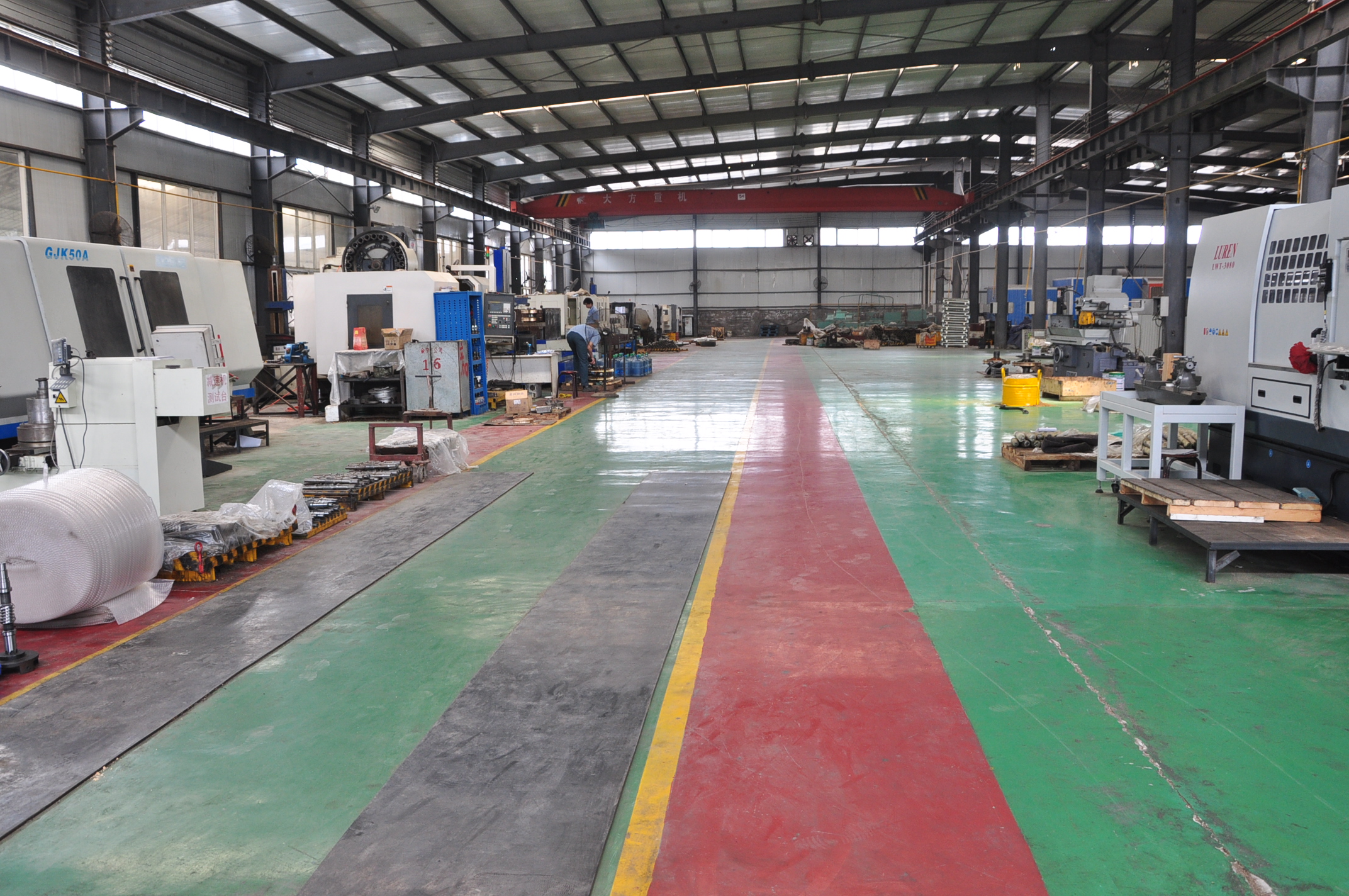
North production workshop, Shandong Dezhou Jinyu Machinery Co., Ltd. (JINYU), Dezhou City, Shandong Province, China.
In medical device assembly and packaging automation, the linear motion problem is rarely about maximum force. It is about returning to the same position, on the same axis, cycle after cycle, in an environment where a film of hydraulic oil on a machine frame or near a product contact zone is a maintenance and compliance issue rather than a cosmetic one.
That combination of requirements is what moves procurement teams toward mechanical linear actuators, and specifically toward screw jacks: devices that convert rotary motor input into controlled linear travel through a threaded screw and a matching nut. Shandong Dezhou Jinyu Machinery Co., Ltd., which manufactures under the JINYU brand, positions its JWM Series screw jacks toward this low-speed, high-accuracy segment.
For a buyer already at the decision stage, the useful questions are narrower than a general product overview. What do the specified construction materials actually prove? What load, speed and stroke envelope does the series cover? Where does it beat the hydraulic cylinders it frequently replaces, and where does it lose? And what risks have to be engineered out before the first unit is installed?
This reference works from the documented JWM Series construction and performance data, category-level comparison data for screw jack actuators against hydraulic cylinders, published screw jack and linear actuator market figures, and JINYU's own manufacturing profile.
Why Medical and Packaging Lines Set a Harder Precision Bar
Packaging machinery is a high-cycle environment. Filling heads, sealing jaws, tray indexers, labelling heads and case erectors execute short, repeated strokes that frequently have to be coordinated across several positions at once. Category comparison data describes the natural application zone of screw jack actuators as light to medium load, precise positioning, intermittent operation, clean environment and multi-point synchronous lifting, a description that maps closely onto the lift-and-index stages of a packaging line.
Medical and pharmaceutical automation shifts the emphasis again. Positioning moves are typically slower and loads moderate, but position holding, lubricant containment, cleanability and quiet operation become primary selection criteria rather than secondary preferences. JINYU manufactures screw jacks alongside worm gear reducers, servo electric cylinders and electric push rods, so this class of motion problem sits inside the company's core product range rather than at its edge.
The mechanism that resolves several of these constraints at once is self-locking. In a worm gear screw jack, the worm-and-wheel geometry resists back-driving, so the load does not drift when the motor is de-energised. Combined with the complete absence of a hydraulic circuit, this produces a positioning device that holds without power and introduces no oil leakage risk. The comparison data referenced in this article records screw jack actuators as 100% leak-free on that basis, against a recognised leakage risk for hydraulic cylinders.
It is also why screw jacks rather than hydraulics tend to appear in machines that run unattended overnight: there is no reservoir level to check, no seal to weep onto a conveyor, and no pressure to bleed down slowly against a mechanical stop.
What the JWM Series Is
JINYU, legally Shandong Dezhou Jinyu Machinery Co., Ltd., is a Chinese transmission machinery manufacturer founded in 1984 and based in Dezhou City, Shandong Province. The company operates a 20,000 m² factory with 258 employees, a 10-person research and development team and an annual output of 10,000 units. Roughly 30% of production is exported to EU, USA and Asian markets. Its product programme covers screw jacks, worm gear reducers, servo electric cylinders and electric push rods, together with customised machining of reducers and gear reducers to customer drawings or supplied materials.
The JWM Series is the screw jack line the company presents for precision duty in medical and packaging automation. The documented construction specifies a 45# carbon steel lifting screw, a 40Cr or 42CrMo worm gear set, a bronze CuSn6Zn6Pb3 nut and an HT200 cast iron housing. The documented performance envelope runs from 1 kN to 1000 kN of load capacity, at lifting speeds of 0.2 to 1.8 m/min, with stroke lengths up to 1500 mm and ingress protection between IP55 and IP65. Those four numbers together define the machine types the series is intended for: slow, repeatable, protected movement rather than fast transfer or shock loading.
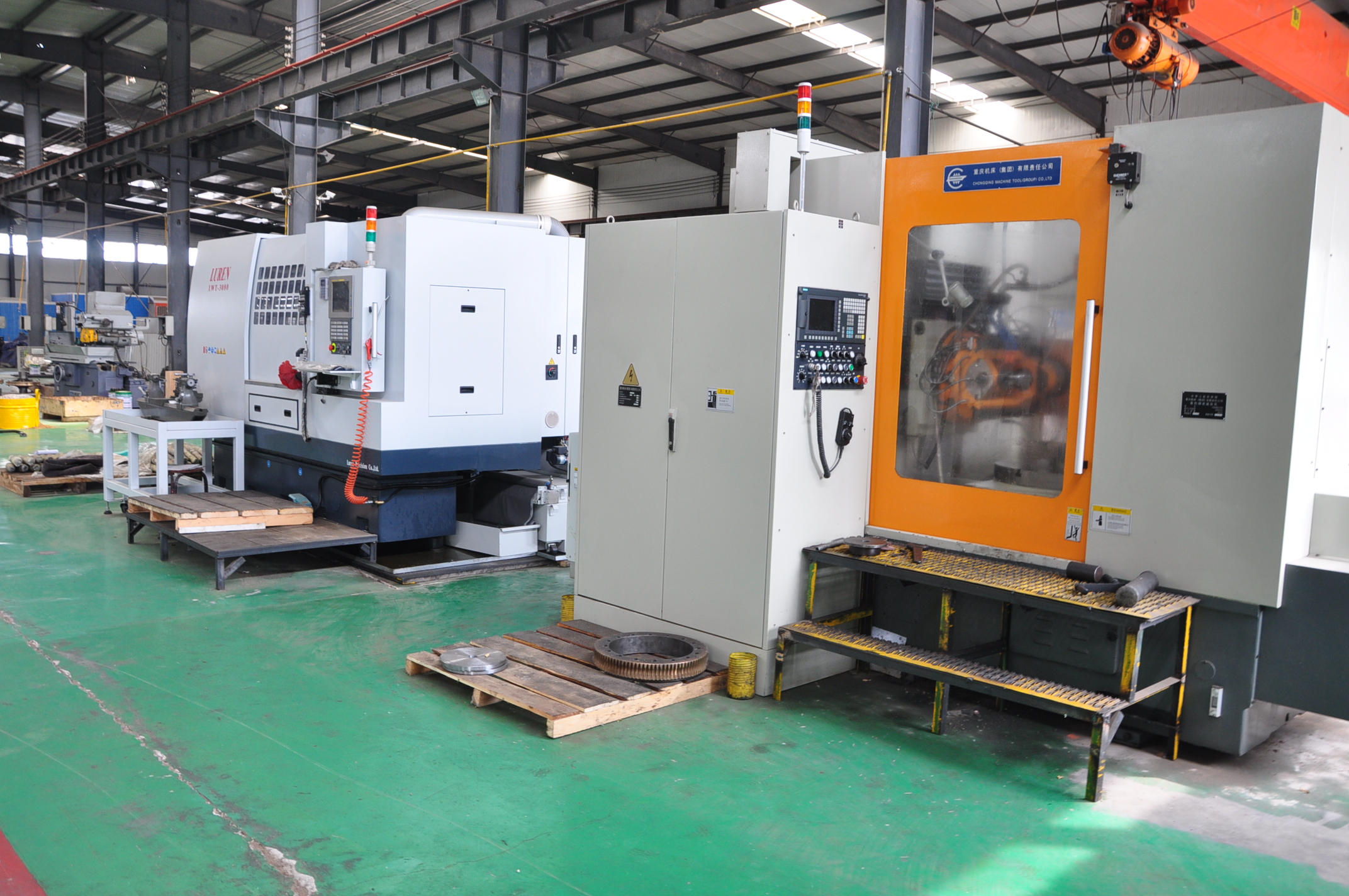
Screw jack production environment at Shandong Dezhou Jinyu Machinery Co., Ltd., Dezhou City, Shandong Province.
Material Evidence: What Each Grade Contributes
A material list only becomes evidence when each grade is tied to the function it performs. The table below sets out the four specified JWM Series materials against their mechanical role and the reason a buyer in a precision application should care about each one.
| Component | Specified material | Function in the assembly | Why it matters in precision duty |
|---|---|---|---|
| Lifting screw / shaft | 45# carbon steel | Carries the axial load and defines the linear path taken by the load | 45# is a medium-carbon (nominally 0.45% C) steel grade widely specified for shafts and threaded parts where strength and machinability must be balanced. Because the thread is formed directly into the screw, position depends on the screw itself, not on a secondary linkage that can introduce play. |
| Worm gear set | 40Cr and 42CrMo alloy steel | Converts motor rotation into rotation of the screw or nut and transmits torque | Both are alloy steels selected for hardenability and fatigue resistance beyond that of plain carbon grades, which is relevant where a drive reverses frequently at low speed under sustained load. |
| Nut | Bronze CuSn6Zn6Pb3 | Engages the screw thread and converts rotation into linear travel | Tin bronze with a lead addition is a conventional sliding-pair material. It lowers friction and wear against a steel thread and is a replaceable service item, which converts a wear concern into a scheduled maintenance task. |
| Housing | HT200 cast iron | Locates bearing and gear bores and reacts the load into the machine frame | Cast iron combines rigidity with vibration damping. In a positioning actuator, a stiff, well-damped housing supports repeatability instead of absorbing it as elastic compliance. |
Read together, the four grades describe a design intent rather than a parts list: a hardened steel load path, an alloy gear set sized for reversing duty, a sacrificial bronze wear element, and a rigid cast housing. That is the combination that makes a 0.2 to 1.8 m/min actuator credible in a clean zone where the outcome is measured in repeatability rather than in speed.
Performance Envelope: Load, Speed, Stroke and Protection
| Parameter | Documented JWM Series range | What it implies for machine design |
|---|---|---|
| Load capacity | 1 kN to 1000 kN | Covers instrument-scale positioning through to heavy packaging tooling within one series logic. |
| Lifting speed | 0.2 to 1.8 m/min | A positioning band, not a transfer band. Fast indexing between stations is outside this envelope. |
| Stroke | Up to 1500 mm | Covers most lift, seal and indexing motions; longer strokes require buckling assessment. |
| Ingress protection | IP55 to IP65 | Supports washdown-adjacent and dust-controlled environments under the IEC 60529 ingress protection scheme. |
Two clarifications belong next to this table. First, positioning accuracy is a system property, not a single catalogue figure. Category comparison data for screw jack actuators records ±0.01 mm of positioning accuracy against ±0.5 to 2 mm for hydraulic cylinders; that figure describes the mechanism class, and the achieved value in a machine depends on screw pitch, gear ratio, encoder resolution and the control loop. It should be validated against the specific JWM configuration before it is written into a specification.
Second, the IP55 to IP65 band is a range, not a default. Buyers should fix the required rating at the specification stage rather than assume the band's upper end, because the sealing arrangement, the bellows or boot specification and the motor enclosure all move with it.
Application Fit in Medical and Packaging Automation
The clearest way to judge the JWM Series is to test it against the application conditions the category comparison data identifies as its natural zone: light to medium load, precise positioning, intermittent operation, clean environment and multi-point synchronous lifting.
- Multi-point synchronous lifting in packaging. Where a filling manifold, sealing platen or tooling frame has to be raised on several columns in step, mechanically linked screw jacks share a common drive and therefore a common motion reference. Self-locking holds the frame in place when the line is stopped.
- Short-stroke indexing and sealing. Repeated short movements at controlled speed, with no hydraulic reservoir near the machine frame and no oil film risk against packaging film or board.
- Clean-zone positioning in medical and pharmaceutical equipment. Pharmaceutical manufacturing appears among the industries JINYU serves, alongside food, conveying and light industry. In these settings, the leak-free nature of a purely mechanical drive and the moderate IP55 to IP65 protection are the relevant attributes.
- Hold-without-power positions. Where a mechanism must stay in position through an emergency stop or a power interruption, the self-locking worm gear pair is the functional reason to choose a screw jack rather than a hydraulic cylinder with external holding valves.
Market Context and the Global Supply Landscape
Screw jacks are not a niche curiosity inside the wider motion market. Market Research Future estimated the global screw jacks market at USD 14.26 billion in 2024, with a projected CAGR of 5.91% reaching USD 26.82 billion by 2035. Dataintelo and Persistence Market Research place worm gear screw jacks as the largest product segment, at 38.5% share in 2025, attributing that position to self-locking behaviour and heavy-load capacity. On the demand side, Grand View Research recorded a 42.3% revenue share for Asia-Pacific in the linear motion market in 2025, driven by manufacturing growth in China and India, and a separate industry report valued the global linear actuator market at USD 52.67 billion in 2023 with a projected USD 94.3 billion by 2030.
Those headline figures should be read with one caution. Published screw jack market estimates diverge sharply with scope: broad definitions that include all mechanical jacks reach the USD 14 billion level, while a high-precision niche definition is estimated closer to USD 1.82 billion. A buyer using market data to justify a sourcing decision should check which definition the number rests on, because precision-duty demand and general lifting demand grow for different reasons.
The supply side is consolidated around a small group of established names. Dataintelo lists Power Jacks Limited, Joyce Dayton Corp, ZIMM Group and Thomson Industries among the prominent global competitors in the screw jack and linear actuator industry. For a decision-stage buyer, that set is useful as a benchmark rather than as a shortlist: it establishes what material documentation, load-rating disclosure and configuration support are normal to expect when comparing a manufacturer such as JINYU against the international reference group.
One adjacent trend is worth flagging for packaging buyers specifically. Stainless steel screw jacks are increasingly used in offshore wind and in food processing, including dairy, where corrosion resistance requirements are high. The same reasoning applies to washdown packaging environments, and it is a specification decision made at the enquiry stage rather than after installation.
JWM Series Screw Jacks vs Hydraulic Cylinders: Decision Criteria
For most projects in this segment, the real comparison is not screw jack against screw jack. It is screw jack against the hydraulic cylinder that has historically occupied the same mounting position. The comparison data used in this article sets out the following position.
| Criterion | Screw jack actuator | Hydraulic cylinder |
|---|---|---|
| Hydraulic system | Not required | Required: pump, valves, reservoir, fluid |
| Self-locking | Inherent to the worm gear pair | Not inherent; holding depends on external measures |
| Positioning accuracy | ±0.01 mm (category comparison figure) | ±0.5 to 2 mm |
| Transmission efficiency | 30% to 80% | 60% to 70% |
| Leakage | 100% leak-free; no oil circuit | Oil leakage risk exists |
| Structure | Simpler, mechanical | More complex subsystem |
| Maintenance frequency | 50% to 70% lower | Baseline |
| Total cost of ownership | 20% to 30% lower | Baseline |
| Best-fit duty | Light to medium load, precise positioning, intermittent operation, clean environment, multi-point synchronous lifting | Ultra-heavy load, impact resistance, low-precision positioning, harsh environment |
The comparison is not a clean sweep in one direction, and buyers should not read it as one. Transmission efficiency is the clearest trade-off: the screw jack range of 30% to 80% spans below the 60% to 70% band recorded for hydraulic cylinders, so a screw jack configuration optimised for high mechanical advantage can consume meaningfully more drive power than a hydraulic equivalent. The return on that efficiency cost is positioning accuracy, leak-free operation and self-locking behaviour. Whether the exchange is worthwhile depends entirely on how much accuracy the process actually needs.
Where a Screw Jack Is the Wrong Choice
Three boundaries are documented and should be treated as hard limits rather than as caveats.
Ultra-heavy and impact duty. The comparison data assigns ultra-heavy load, impact resistance and harsh environments to hydraulic cylinders. The JWM Series envelope tops out at 1000 kN and is specified for low-speed, high-accuracy tasks; an application dominated by shock loading or by forces beyond that ceiling belongs with a different technology.
Long stroke under compression. Stroke length reaches 1500 mm, but a screw in compression is exposed to buckling. Screw buckling is formally listed among the recognised risks for this product family, which means long, lightly guided strokes should be reviewed at the design stage rather than assumed from the catalogue.
High-speed transfer. A 0.2 to 1.8 m/min envelope is deliberate. Where a machine's cycle time is set by how fast a mass can be moved between two distant stations, a screw jack will not compete with hydraulics or high-speed electric options on that specific axis.
Risk Controls Buyers Should Verify Before Installation
Every actuator category carries a documented risk profile. For screw jacks it is overload, screw buckling, self-locking failure, motor overheating and mechanical jamming. The corresponding controls are load limit protection, stroke limits, brake interlock, thermal protection and overload alarms; the measures applied at the equipment level are load sensors, limit switches, regular self-locking tests, temperature monitoring and periodic maintenance.
For a decision-stage buyer, these items convert directly into procurement questions. Which of the five protections are integrated into the supplied unit and which are left to the machine builder? Is the self-locking characteristic verified by test, and at what interval should that test be repeated in service? Is stroke limiting mechanical, electrical or both? The maintenance load these answers imply is also the mechanism behind the 50% to 70% lower maintenance frequency recorded for screw jacks against hydraulic cylinders — it is a scheduled, predictable workload rather than an unplanned one, but it is not zero.
Compliance documentation follows the same logic. Industrial motor-operated tools and actuators fall under the general safety requirements of IEC 62841-1:2014, which covers mechanical hazards, and buyers evaluating a supplier against that standard should expect mechanical-hazard documentation to be part of the technical file rather than an afterthought.
Future Outlook
Three directions look structural rather than cyclical. The first is the continued shift of precision positioning duties away from fluid power in clean and regulated environments, where the absence of a hydraulic circuit removes an entire class of maintenance and contamination work. The second is the widening of the material menu within the screw jack category itself — stainless steel variants are already moving into corrosion-driven applications such as offshore wind and food processing, and the same requirement appears in washdown packaging. The third is the modularisation of multi-point lifting systems, where several mechanically linked screw jacks are driven and controlled as one motion axis, a configuration that suits packaging tooling and medical equipment frames alike.
For manufacturers such as JINYU, whose programme already spans screw jacks, worm gear reducers, servo electric cylinders and electric push rods, the practical question in the next procurement cycle is not whether mechanical actuators will be specified in precision automation, but which suppliers can evidence their material and control choices well enough to be written into a specification.
FAQ
How does a screw jack achieve positioning accuracy that a hydraulic cylinder does not?
A screw jack converts rotation into linear travel through a defined thread pitch, so each increment of motor rotation corresponds to a calculable linear increment, and the worm gear pair is self-locking, which holds the position when power is removed. Category comparison data records screw jack positioning accuracy of ±0.01 mm against ±0.5 to 2 mm for hydraulic cylinders. The accuracy actually achieved in a machine also depends on screw pitch, gear ratio, encoder resolution and the control loop, so the figure should be validated against the specific configuration.
Which materials in the JWM Series matter most for medical and packaging duty cycles?
Four materials are specified: a 45# carbon steel lifting screw, a 40Cr or 42CrMo worm gear set, a bronze CuSn6Zn6Pb3 nut and an HT200 cast iron housing. The 45# steel screw defines the load path and the linear reference; the alloy gear set carries reversing torque; the bronze nut is the sliding wear element and is replaceable; the cast iron housing provides rigidity and vibration damping. Each addresses a different failure mode, which is why the list is more informative than any single grade.
What load, speed, stroke and protection ranges does the JWM Series cover?
The documented envelope is 1 kN to 1000 kN of load capacity, 0.2 to 1.8 m/min of lifting speed, stroke lengths up to 1500 mm and ingress protection from IP55 to IP65. The speed band indicates positioning duty rather than fast transfer, and the protection rating should be fixed at the specification stage rather than assumed at the upper end of the range.
Where is a screw jack actuator clearly the wrong choice compared with a hydraulic cylinder?
Three situations stand out. Ultra-heavy load, impact resistance and harsh environments are assigned to hydraulic cylinders in the comparison data, and the JWM Series envelope tops out at 1000 kN. Transmission efficiency is another boundary: screw jacks range from 30% to 80%, which can fall below the 60% to 70% recorded for hydraulic cylinders. Long strokes under compression also require buckling review, and speeds above the 0.2 to 1.8 m/min band are outside the intended duty.
What safety and maintenance provisions should be planned before installation?
The documented risks for this product family are overload, screw buckling, self-locking failure, motor overheating and mechanical jamming. The corresponding controls are load limit protection, stroke limits, brake interlock, thermal protection and overload alarms, supported by load sensors, limit switches, regular self-locking tests, temperature monitoring and periodic maintenance. Buyers should establish which of these are integrated into the supplied unit and which remain the machine builder's responsibility.
What is JINYU's manufacturing and export profile?
Shandong Dezhou Jinyu Machinery Co., Ltd. was founded in 1984 and operates from Dezhou City, Shandong Province, with a 20,000 m² factory, 258 employees, a 10-person R&D team and an annual output of 10,000 units. Around 30% of production is exported to EU, USA and Asian markets. The product programme covers screw jacks, worm gear reducers, servo electric cylinders and electric push rods, plus customised machining to customer drawings or supplied materials.
Technical documentation covering the JWM Series and the wider JINYU transmission programme is available in the JINYU product brochure for buyers who need the specification details behind the ranges summarised here.