
KB0120 vs KB0115: Choosing Between Two 8G Kyphoplasty Balloons
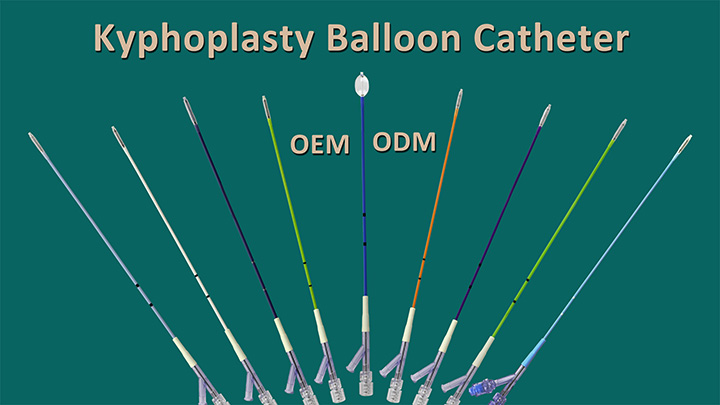
Kyphoplasty balloon catheters from Changmei share a common 8G/11G platform while offering different radiopaque marker spans and balloon volumes.
For procurement teams and spine distributors comparing kyphoplasty balloon catheters, the choice between Changmei KB0120 and KB0115 is not about quality levels. Both are 8G inflatable bone tamps with a 315 mm overall length and a constrained burst pressure of at least 400 PSI. The meaningful difference is clinical: KB0120 carries a 20 mm radiopaque marker span and a 6 cc maximum balloon volume, while KB0115 carries a 15 mm marker span and a 4 cc maximum volume. This article explains what those differences mean for a purchasing decision.
Why a Model-by-Model Comparison Matters in PKP Procurement
Percutaneous kyphoplasty (PKP) is commonly used to treat painful vertebral compression fractures caused by osteoporosis, trauma, or spinal tumors such as metastatic lesions and hemangiomas. The procedure uses a working tool kit to reach the fractured vertebral body, then inflates a balloon catheter to restore height and create a cavity before bone cement is injected.
Because the balloon catheter is the core functional component of the procedure, buyers often compare models within the same supplier family to match the correct balloon size and working length to hospital preference. Changmei manufactures the KB0120 and KB0115 on the same 8G platform, so the decision is driven by case profile and surgical routine rather than a generalized performance ranking.
Side-by-Side Specification Comparison: KB0120 vs KB0115
Changmei’s 8G balloon catheters share the same outer system architecture: a polyurethane shaft, thermoplastic polyurethane (TPU) balloon film, radiopaque markers, a stainless-steel stylet, and single-use EO sterilization. They also share the same device class, intended use, and companion instruments.
The table below lists the verified differences between KB0120 and KB0115, based on Changmei’s published product data.
| Attribute | KB0120 | KB0115 |
|---|---|---|
| Size / Type | 8G | 8G |
| Overall Length | 315 mm | 315 mm |
| Channel Inner Diameter | ≥3.65 mm | ≥3.65 mm |
| Distance Between Two Radiopaque Markers | 20 mm | 15 mm |
| Maximum Balloon Volume | 6 cc | 4 cc |
| Constrained Burst Pressure | ≥400 PSI | ≥400 PSI |
| Sterilization | EO, single-use | EO, single-use |
The two models therefore belong to the same instrument generation. The selection issue is not whether one is stronger or safer; both meet the same pressure and dimensional standards. The practical difference is how much vertebral cavity volume the surgeon intends to create and how the balloon position is tracked under fluoroscopy.
Radiopaque Markers: Why 20 mm vs 15 mm Affects Use
The radiopaque marker distance indicates the span between the two visible markers on the balloon catheter. In kyphoplasty, these markers help the surgeon confirm balloon placement within the vertebral body under fluoroscopy before inflation. A 20 mm marker span on the KB0120 corresponds to a balloon intended for larger cavity creation, while the 15 mm span of the KB0115 gives the surgeon a shorter visible working zone during positioning.
For purchasing teams, this translates into two separate clinical inventories. A hospital that regularly treats vertebral fractures requiring larger balloon expansion may prefer KB0120 because of its higher maximum volume. A hospital that follows a more conservative volume protocol, or that favors tighter fluoroscopic positioning, may prefer KB0115.
Design and Manufacturing Context: Four-Wing Pleating and In-House Control
Changmei describes its kyphoplasty balloon catheters as using a four-wing pleating process. This is not a separate feature exclusive to KB0120; rather, it is part of the same production platform on which KB0120 and KB0115 are made. According to Changmei, the company runs self-developed balloon forming, necking, welding, four-wing folding, and leak-test machines, and does not subcontract the balloon body.
That manufacturing approach matters in a procurement context. When a balloon catheter is folded consistently and leak-tested at the factory, the buyer receives a device whose inflation behavior is less dependent on uncontrolled third-party processing. Changmei reports that each PKP balloon catheter is folded and pressure-tested at ≥400 PSI, 100% per piece.
System Compatibility and Procedure Workflow
A kyphoplasty balloon catheter is not used alone. The KB0120 and KB0115 are engineered to work within Changmei’s broader 8G system, which includes the Kyphoplasty Tool Kit and the Balloon Inflator. The Kyphoplasty Tool Kit model KT-00-01 is designed for 8G procedures, while the balloon inflator model BI-20A-10 is a dedicated inflation pressure pump with a nominal capacity of 20 cc and a maximum pressure of 30 atm.
In practice, the surgeon establishes a percutaneous working channel into the fractured vertebral body, inserts the balloon catheter, and inflates it with a contrast medium using the pressure pump. The inflated balloon compresses cancellous bone and creates a cavity; after deflation and removal, the cavity is filled with bone cement such as PMMA. KB0120 and KB0115 are both single-use, sterile devices intended for this workflow.
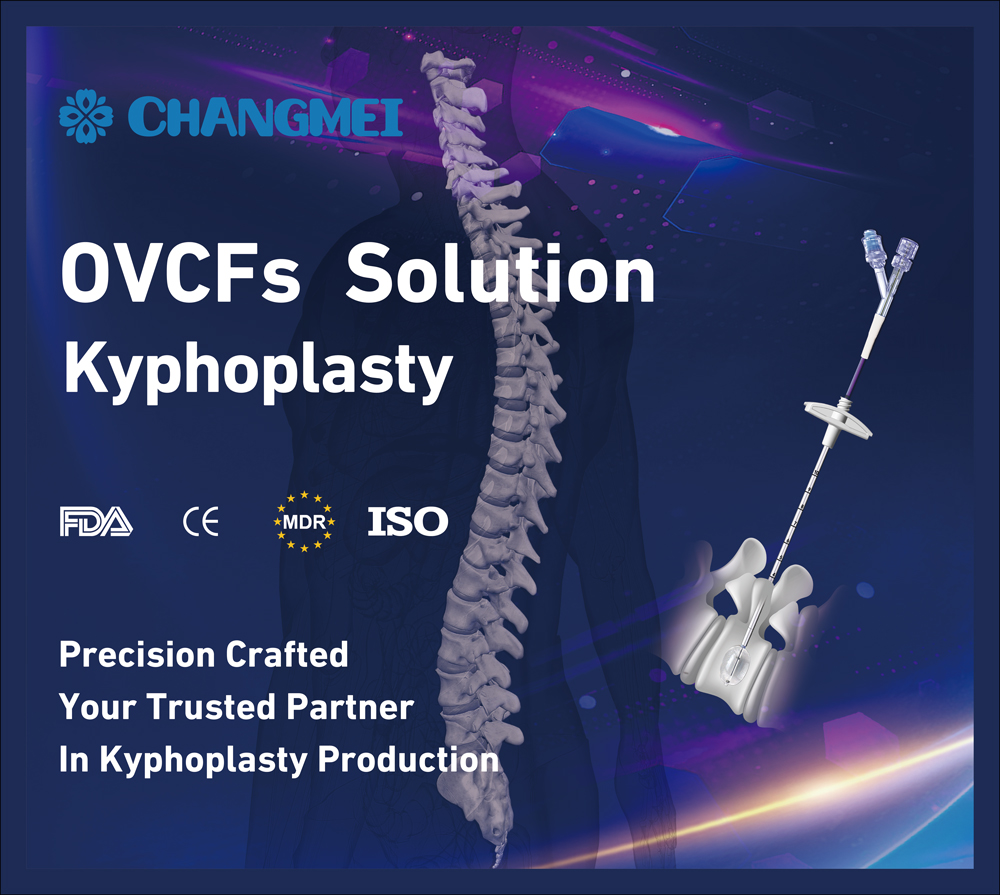
A complete kyphoplasty system includes the balloon catheter, the inflation device, the access tool kit, and bone-cement filling instruments.
Applying KB0120 vs KB0115 in a Hospital Tender or Distributor Mix
For a distributor building a first order, the key decision is how many units of the 6 cc KB0120 versus the 4 cc KB0115 should be stocked. Since both are 8G catheters with the same length, the same tool kit can support both models. This reduces the clinical risk of carrying an unfamiliar gauge and simplifies surgeon training.
Changmei’s 8G family also includes KB0210, which has a 10 mm marker span and a 4 cc maximum volume. The 15 mm KB0115 sits between the shorter KB0210 and the larger KB0120. In practice, a procurement team may treat KB0120 as the larger-volume option and KB0115 as the mid-volume alternative. Clinical preference, not product deficiency, will determine which model moves more quickly in a given market.
Comparison with Established Premium and Low-Price Alternatives
Changmei positions its kyphoplasty system as a regulatory-compliant alternative to international premium brands such as Medtronic and Stryker. The company holds EU MDR CE marking, US FDA 510(k) clearance under K223709 (2023), NMPA registration, and ISO 13485 certification. This means the KB0120 and KB0115 enter international procurement with a regulatory file that many low-price OEM suppliers cannot provide: low-price OEM products often hold only domestic licenses, which creates a barrier for hospitals importing under CE or FDA requirements.
Changmei also reports that it supplies approximately 80% of China’s PKP balloon catheter market and has an annual capacity of 1,000,000 balloon catheters. These scale indicators do not directly change the clinical choice between KB0120 and KB0115, but they matter for supply continuity when a distributor is negotiating large or repeated orders.
One genuine limitation of the KB0120/KB0115 8G platform is its overall length. At 315 mm, these catheters are positioned for clinicians familiar with the classic 8G PKP workflow. Buyers whose customers request smaller instrument profiles should also evaluate Changmei’s 11G S1 series, such as the KB0120S1 or KB0115S1, which have a shorter 280 mm overall length and a smaller ≥3.10 mm channel inner diameter. Neither KB0120 nor KB0115 can be described as the best fit for every institution; the 8G length is an advantage in some markets and a limitation in others.
Market Context for 8G Kyphoplasty Balloons
Verified market data indicates that the global kyphoplasty market was valued at approximately USD 764.13 million in 2025, with projected growth to about USD 1.34 billion by 2034. North America dominated the market in 2025, holding an estimated 42.5% to 50.0% revenue share. Within this market, the 8G catheter remains a widely used configuration in many regions, including parts of Latin America, the Middle East, the CIS markets, and Chinese provincial hospitals where surgeons were trained on 8G systems.
The 11G configuration is associated with a minimally invasive trend in Western Europe and US ambulatory surgery centers. That does not make 8G obsolete: it simply means the KB0120 and KB0115 8G models are better matched to buyers whose clinical installed base uses classic PKP trays.
Neutral Selection Recommendation
For procurement decision-makers, the following practical rules can guide the choice:
- Choose KB0120 when the purchasing request is for an 8G, 315 mm catheter with a larger maximum volume of 6 cc and a 20 mm marker span.
- Choose KB0115 when the purchasing request is for an 8G, 315 mm catheter with a more conservative 4 cc maximum volume and a 15 mm marker span.
- Stock both models when the hospital or distributor serves surgeons who vary their balloon volume selection by vertebral level and fracture severity.
- Switch to the S1 series only when the buyer explicitly wants an 11G instrument with a 280 mm catheter length.
Neither KB0120 nor KB0115 is a “premium” upgrade over the other. They are two calibrated versions of the same 8G balloon catheter platform, designed to give surgeons a choice between 6 cc and 4 cc cavity creation and between 20 mm and 15 mm radiographic tracking.
Future Outlook
As kyphoplasty procedures continue to shift toward ambulatory and minimally invasive settings, balloon catheter demand will likely remain split between 8G systems and smaller-profile 11G systems. Changmei’s parallel production of 8G and 11G catheters on the same manufacturing line gives procurement teams a single audited source for both configurations. The long-term commercial question is not whether KB0120 will replace KB0115, but how quickly individual markets migrate to lower-profile instruments. Until that migration is clear at the hospital level, maintaining both the 6 cc and 4 cc 8G options is the more flexible procurement strategy.
Frequently Asked Questions
Q1: Is the kyphoplasty balloon catheter single-use? What sterilization method and shelf life apply?
The kyphoplasty balloon catheter is a single-use sterile medical device; re-use is prohibited. It is sterilized by ethylene oxide (EO) and has a 3-year shelf life. The device should be used immediately once the package is opened. It must not be re-sterilized or reused. Always follow the official instruction manual.
Q2: What are the contraindications for kyphoplasty balloon catheters?
The device is not applicable to patients with damage to the posterior vertebral edge, nerve injury, infection at the operative site, or uncorrectable coagulopathy. Clinicians should refer to the full contraindications in the instructions for use before performing the procedure.
Q3: Should a buyer stock 8G or 11G kyphoplasty balloon catheters?
Both gauges share the same Changmei manufacturing platform, including four-wing pleating, ≥400 PSI constrained burst pressure, and 10/15/20 mm balloon lengths. The 8G family, which includes KB0210, KB0115, and KB0120, is designed for hospitals using a classic 8G PKP working channel. The 11G family, KB0210S1, KB0115S1, and KB0120S1, uses a shorter 280 mm catheter with a smaller channel inner diameter and is often selected for minimally invasive workflows. The choice depends on the clinical fit and the installed tray type in the target market.
Q4: What regulatory clearances cover these models?
Changmei states that its kyphoplasty system holds EU MDR 2017/745 CE certification as a Class IIa device issued by TÜV SÜD, US FDA 510(k) clearance K223709 dated August 16, 2023, and NMPA Class II/III registration in China. The quality system is certified under EN ISO 13485:2016.
This article is an independent buyer-facing reference based on Changmei’s published product data and verified market information. For complete product specifications and regulatory documentation, refer to the manufacturer’s official brochure below.
Download: Kyphoplasty System Products (8G & 11G) – CE and FDA Brochure
Есть вопросы или нужны дополнительные детали?
Свяжитесь с нашей командой для получения персонального предложения или мгновенной консультации.
Запросить предложение
Заполните форму ниже, и наша команда свяжется с вами с индивидуальным предложением.
Прямой чат WhatsApp
Предпочитаете общаться в реальном времени? Напишите нам в WhatsApp для мгновенной помощи и быстрых ответов.
- Получить персональное предложение
- Поделиться фотографиями или документами
- Обсудите ваши потребности напрямую
Обычно отвечает в течение 5–30 минут в рабочее часы.