
KEYETECH Supplier Capability Evidence: Factory and R&D Audit
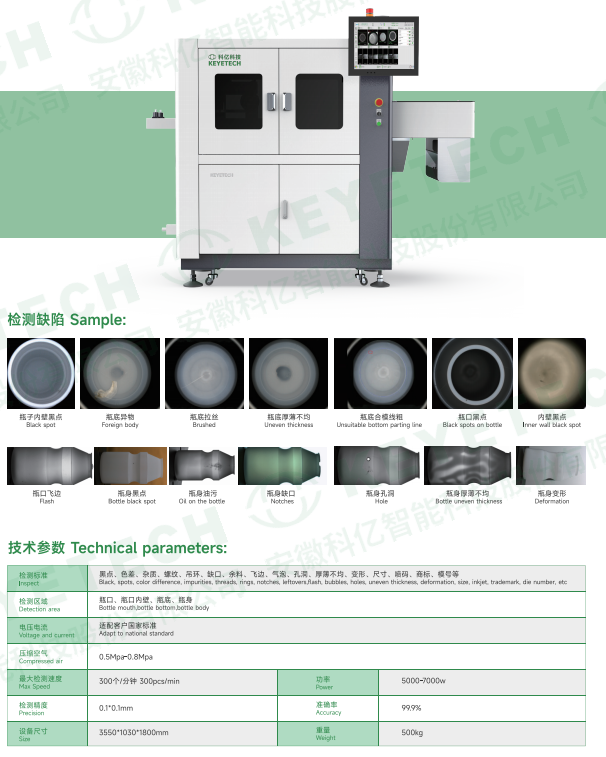
AI bottle inspection machine: bottle body, mouth and bottom defect detection in a plastic packaging quality-control line.
AI vision inspection equipment is purchased on specifications but retained on capability. A machine that reaches its rated speed in a demonstration still has to run three years of mould changes, material substitutions and shift work — and the supplier's factory, engineering bench and support model decide whether it does. That is why capability evidence, not the spec sheet alone, has become the decisive screening layer in packaging quality control.
This article assembles the capability evidence that KEYETECH (Anhui Keye Intelligent Technology Co., Ltd.), an AI vision inspection equipment manufacturer based at No. 56 Chang'an Road, High-Tech Zone, Hefei, Anhui, China, makes available to buyers. For each data point it separates what the evidence can legitimately support from what it cannot, then maps that evidence to the specific inspection platforms used in bottle, cap, cup and plastic packaging quality control.
Why capability evidence outweighs a spec sheet
AI vision inspection has moved from an experimental line item to a standard capital purchase. Precedence Research estimates the global AI vision inspection market at USD 39.38 billion in 2026, with a projected compound annual growth rate of 22.83% between 2026 and 2035. A market expanding at that rate attracts new suppliers faster than buyers can audit them, which shifts the screening burden onto procurement and quality teams.
The purchasing problem is structural. A stated inspection speed or defect list is only valid for a defined combination of product geometry, material, defect taxonomy, lighting and reject logic. When a bottle preform changes weight, when a cap gains a new liner, or when a label moves to in-mould construction, the machine has to be re-tuned — sometimes re-lit, sometimes re-trained. A supplier that develops its own optics, algorithms and mechanics can perform that work at source. A supplier that assembles third-party components cannot, and the gap only becomes visible after installation.
Capability evidence therefore serves one purpose in a buying decision: it indicates how much of the inspection problem the supplier actually owns.
KEYETECH capability facts at a glance
The following figures are the company facts KEYETECH publishes and that a buyer can request to have substantiated during a supplier audit. Each is paired with its real evidentiary weight.
| Reported evidence | Figure | What it legitimately supports | What it does not prove |
|---|---|---|---|
| Founded | 2011 | Operating history through multiple packaging material cycles | Financial stability or current-year performance |
| Facility size | 29,000 m² | In-house manufacturing and assembly footprint | Utilisation, output mix or current order backlog |
| Workforce | Approximately 300 staff | Separation of production, engineering and commercial functions | Skill distribution by function |
| R&D team | 56 engineers, including USTC doctoral researchers | Sustained in-house algorithm, imaging and software development | That every product line receives equal engineering time |
| Domain experience | 15 years of visual inspection | Accumulated defect libraries in plastic and glass packaging | Accuracy on a specific buyer's defect set |
| Annual output | 3,000 units | Serial production capability, not prototype-only builds | Short-term slot availability |
| Export footprint | 10% of sales; EU, USA, Southeast Asia | Documented cross-border supply and export documentation practice | Local service presence in every destination market |
What the 29,000 m² facility actually contains
Floor area on its own is a weak signal. The relevant question is what the floor area is used for. KEYETECH operates a self-built site covering 21 mu (approximately 3.5 acres) organised into two buildings: one holds R&D, sales, administration and finance; the other is the production facility where the company's own equipment is manufactured. Production is further divided into a production workshop and a machining workshop.
That division is the commercially meaningful part. A dedicated machining workshop means mechanical frames, fixtures and handling components can be cut and finished in-house rather than outsourced to a third party. For an inspection system, fixtures determine how repeatably a cap, preform or cup is presented to the camera — and presentation repeatability is one of the most common causes of field performance that differs from demonstration performance. In-house machining shortens the loop between a trial result and a mechanical fix.
A buyer auditing this claim should ask for the workstation layout, the machine list in the machining workshop, and the standard build time per platform. Those three items convert a square-metre figure into a manufacturing capability statement.
R&D depth: 56 engineers and the USTC connection
The technical case rests on three competencies KEYETECH states it develops in-house: imaging systems, AI algorithms and software control systems. The AI algorithm group includes three PhDs from the University of Science and Technology of China (USTC), all from the university's Pattern Recognition Laboratory. The company describes its core technology chain — optical solutions, industrial cameras, AI algorithms and software architecture — as 100% localised and fully self-developed.
Two engineering artefacts make that claim checkable rather than rhetorical. The first is an in-house cloud training platform: KEYETECH operates its own servers hosting tens of thousands of AI algorithm models covering classification, defect detection and object detection, which is what allows a new defect class to be trained without rebuilding the machine's software from scratch. The second is an edge-computing unit developed in-house to supply inference power at line speed, so that detection does not depend on an external computing vendor's roadmap.
For a packaging buyer, the practical translation is this: when a new cap geometry or a new recycled-content resin introduces defects that the original model was never trained on, the supplier's ability to retrain, re-light and re-fixture is the difference between a two-week adjustment and a stalled line.
The platforms this capability supports
Capability becomes relevant to a buying decision only when it attaches to identifiable equipment. Three platforms in the KEYETECH portfolio illustrate the link between engineering bench and inspection task.
KVIS-B-CC Post Filling Inspection Machine
The KVIS-B-CC inspects filled containers after capping. Its detection scope covers empty caps, improper sealing, high or low liquid level, damaged or offset labels, broken rings, high or crooked caps and damage to the outer cap surface, across the bottle body, cap presence, cap sealing, liquid level, label and spray code. KEYETECH lists a maximum speed of 36,000 BPH for this platform. It is the machine that connects upstream bottle, cap and preform quality to the downstream reality of a sealed, labelled, coded pack.
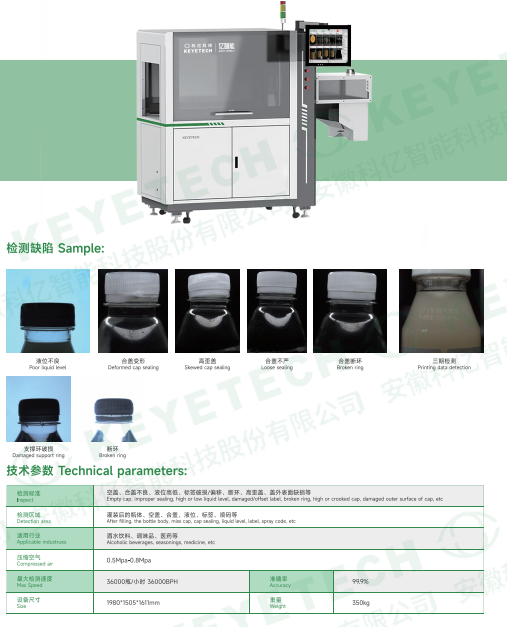
Post-filling inspection covers cap presence and sealing, liquid level, label position and spray code after capping.
KVIS-T AI Label Inspection Machine
The KVIS-T AI Label Inspection Machine targets labelling defects — trapping label, labelling faults and in-mould labelling — on labels applied to bottles, with a stated maximum speed of 1,500 pieces per minute. Label inspection is a good test of algorithm maturity: the defect set is broad, the contrast between good and bad is often marginal, and the reject decision has direct scrap consequences.
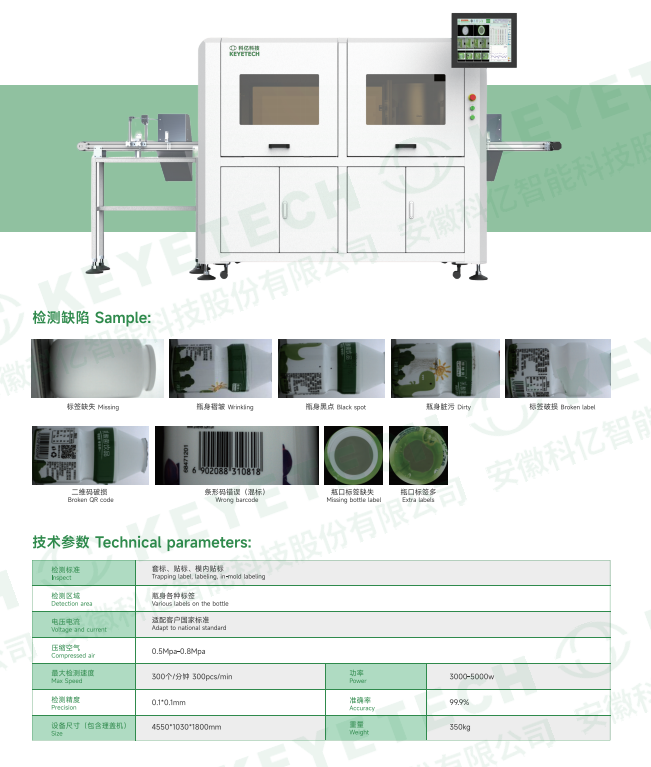
AI label inspection addresses trapping, labelling and in-mould labelling defects at bottle-line speeds.
KVIS-C AI Paper Plastic Products Detector and the wider KVIS-C family
The KVIS-C AI Paper Plastic Products Detector addresses paper-plastic cup and lid formats — the segment where in-mould labels, printed rims and thin walls create defect patterns that differ from rigid bottle inspection. In KEYETECH's portfolio the KVIS-C model designation also appears on the cap camera inspection machine, with a stated maximum speed of 2,500 pieces per minute covering black spots, colour differences, impurities, thread and pressing-ring faults, notches, burrs, flash, deformation, dimensional deviation, gasket and inner-plug presence and die number, and on the preform visual inspection system, stated at 600 pieces per minute covering specks, colour, foreign items, thread, holes, cracks, scratches, burrs, flash and deformation across the preform mouth, support ring, body and bottom.
The bottle platform, the KVIS-B bottle visual inspection machine, is stated at 300 pieces per minute for defects including black spots, colour differences, impurities, threads, rings, notches, leftovers, flash, bubbles, holes, uneven thickness, deformation, dimension, inkjet, trademark and die number. A plastic parts visual inspection machine is described as performing 360-degree inspection at 600 pieces per minute. Together these lines cover the packaging chain from preform to filled pack.
Project conditions a buyer must plan for
Equipment of this class is installed as complete machinery, not as a modular add-on. KEYETECH specifies an indoor factory environment with normal temperature and humidity, continuous 24/7 operation, and supporting equipment such as a material handling organisation to feed and discharge product. Sufficient floor space must be reserved, because each unit is a full machine rather than an inline camera head.
The application data for plastic packaging materials lists project experience across Vietnam, South Korea, Japan, Thailand, Indonesia, India, Turkey, the United States, Russia, Ukraine, Malaysia, Singapore and the UAE, and notes that this configuration is common in the United States and suited to complete-equipment projects. For a project engineer, that translates into three pre-installation checks: available floor area and access route, material handling and buffer capacity at line speed, and the utilities and environment envelope of the hall.
Capacity, lead time and commercial terms
KEYETECH reports an annual output of 3,000 units, a minimum order quantity of one unit, a lead time of 45–60 days, and 100% testing of equipment before shipment. The company offers OEM/ODM engagement with LOGO customisation. Taken together, these terms describe a supplier configured for both single-machine replacement projects and multi-line rollouts, with the caveat that a 45–60 day window is a production lead time and does not include sample validation, site preparation or commissioning.
Installed experience provides the second layer of evidence. KEYETECH reports more than 2,000 clients across food, pharmaceuticals, daily chemicals, textiles, liquor, new energy, electronic components and tobacco. Documented case references include MENSHEN, with 15 units in operation over four years on packaging material inspection for Unilever and Procter & Gamble suppliers; Kweichow Moutai, with 10 units over three years on glass bottle appearance defects; ALPLA, with 10 units over five years, a reported yield rate of 99% and an annual labour saving stated by the customer context at over RMB 700,000; and a packaging materials ODM with 12 units over three years. Case references describe a supplier's track record; they never substitute for a trial on the buyer's own product.
Export footprint: what a 10% export share implies
KEYETECH states that exports account for 10% of total sales, with the European Union, the United States and Southeast Asia as main markets, and lists the EU, US, Middle East and Southeast Asia as export destinations for its capability profile. The ratio is informative in both directions. It confirms a functioning export process — documentation, packing for sea freight, and English-language technical communication — while also indicating that the overwhelming majority of the installed base sits inside China.
For an overseas buyer that means the support model matters as much as the machine. KEYETECH lists remote support as its after-sales format. Remote diagnostics can resolve configuration, model and software issues quickly; mechanical wear, fixture damage and site-specific integration usually cannot be resolved remotely. A buyer outside China should therefore plan spare-parts holding, name a local integration partner, and agree the escalation path and response expectations in writing before the purchase order.
How this compares with manual inspection and with other supplier models
Capability evidence is easiest to interpret when set against the alternatives a buyer is actually weighing.
| Criterion | Manual visual inspection | Manufacturer with in-house optics, algorithms and machining | Integration-only supplier |
|---|---|---|---|
| Consistency across shifts | Depends on operator fatigue and attention | Repeatable decision logic once trained | Depends on the third-party platform chosen |
| Response to a new defect | Immediate but subjective | Model retraining and re-lighting at source | Escalated to the platform owner |
| Mechanical adaptation | Not applicable | Fixtures machined in-house | Outsourced to a subcontractor |
| Throughput ceiling | Limited by headcount and line speed | Platform dependent, up to 36,000 BPH stated for post-filling inspection | Platform dependent |
The comparison is not uniformly favourable to automation, and buyers should treat it honestly. Manual inspection remains more flexible for very low volumes, for one-off formats and for defect classes that have never been catalogued — an AI model can only reject what it has been taught to recognise. Vision inspection also carries a fixed cost that small runs may not absorb: a full machine, floor space, material handling and an engineering relationship to maintain.
Limits a buyer should price into the decision
Capability evidence is more credible when its boundaries are stated, and four boundaries apply here.
Throughput figures are company-reported. The speeds quoted above — 36,000 BPH for the KVIS-B-CC, 1,500 pieces per minute for the KVIS-T label platform, 2,500 pieces per minute for the cap platform, 600 pieces per minute for the preform platform and 300 pieces per minute for the bottle platform — are vendor specifications. The industry currently lacks a standardised cross-vendor benchmark protocol for bottle, cap, preform and cup vision inspection, and defect set, reject logic and line layout all move the achievable number. Buyers should require the benchmark conditions in writing and validate against their own product mix.
After-sales is remote-led. This is efficient for software and configuration, less so for mechanical intervention. Spare-parts strategy and local technical support belong in the contract, not in the expectation.
The machine is a complete unit. Floor space, material handling and an indoor environment with normal temperature and humidity are prerequisites, and they are frequently underestimated during budgeting.
The export share is 10%. A large domestic installed base supports product maturity; it does not by itself guarantee fast on-site response in Europe, North America or Southeast Asia.
A verification sequence for buyers
The capability facts in this article are checkable in a defined order, which is the practical value of evidence-based supplier review.
- Confirm the legal entity and site. Match the quotation to Anhui Keye Intelligent Technology Co., Ltd. and to the Hefei production address.
- Request a factory walkthrough. Ask specifically for the machining workshop and the assembly area, not a reception-room presentation.
- Test on your own defects. Supply a sample set containing both genuine defects and borderline parts; request false-reject and escape data at your line speed.
- Fix the benchmark conditions. Record product format, defect taxonomy, reject logic and lighting configuration in the acceptance document.
- Map the platform to the format. Preform, cap, bottle, cup and post-filling inspection are separate tasks with separate speed envelopes; avoid assuming one platform covers all of them.
- Agree the support model. Document remote support scope, spare-parts list, response expectations and the local escalation contact.
- Budget the site works. Floor area, material handling and hall environment are part of the project cost.
Future outlook
Two forces will shape how capability evidence is read over the next several years. The first is growth: a 22.83% projected CAGR to 2035 will keep adding suppliers, and the differentiator will not be the presence of AI in the marketing description but whether optics, algorithms and mechanics sit inside the same organisation. The second is material change. Lightweighting, higher recycled-content ratios and thinner wall sections all increase the natural variability of plastic packaging, which raises the share of borderline defects a system must classify. Suppliers with retraining infrastructure and in-house imaging will absorb that shift faster than those that depend on external model providers.
For buyers, the consequence is a shift in due diligence: the question is moving from what does the machine do to who can keep it doing that. Factory evidence, engineering headcount and platform breadth answer the second question; a specification sheet does not.
Verification contacts
KEYETECH handles technical and capability enquiries through market-axq@keyetech.com, +86 191-4244-2827 (telephone and WhatsApp), and posts from No. 56 Chang'an Road, High-Tech Zone, Hefei, Anhui, China. Buyers who want the machine and platform detail behind this capability summary can download the company brochure here: KEYETECH company brochure (2026, English).
FAQ
What verifiable company facts exist about KEYETECH as an AI vision inspection equipment manufacturer?
Anhui Keye Intelligent Technology Co., Ltd. (KEYETECH) was founded in 2011 and operates from a 29,000 m² facility at No. 56 Chang'an Road, High-Tech Zone, Hefei, Anhui, China, with approximately 300 staff, 56 R&D engineers and a stated annual output of 3,000 units. The company reports 15 years of visual inspection experience and exports at 10% of total sales to the EU, USA and Southeast Asia.
How large is KEYETECH's R&D team and what is its technical background?
The R&D organisation comprises 56 engineers, and the core technical team includes doctoral researchers from the University of Science and Technology of China. The AI algorithm team includes three PhDs from USTC's Pattern Recognition Laboratory. Development is organised around three in-house areas: imaging systems, AI algorithms and software control systems.
Which KEYETECH platforms are used for bottle, cap and plastic packaging inspection?
The portfolio covers the KVIS-B-CC Post Filling Inspection Machine for cap presence, sealing, liquid level, label and spray code checks at a stated maximum of 36,000 BPH; the KVIS-T AI Label Inspection Machine for trapping, labelling and in-mould labelling defects at a stated 1,500 pieces per minute; the KVIS-C AI Paper Plastic Products Detector for paper-plastic cup and lid formats; plus cap, preform and bottle inspection platforms within the KVIS-C and KVIS-B designations.
What production capacity, lead time and order terms does KEYETECH state?
KEYETECH reports an annual output of 3,000 units, a minimum order quantity of one unit, a production lead time of 45–60 days, 100% testing before shipment and OEM/ODM engagement with LOGO customisation. The 45–60 day figure covers production and does not include sample validation, site preparation or commissioning.
Which export markets does KEYETECH serve and how large is the export share?
KEYETECH states that exports represent 10% of total sales, with the European Union, the United States and Southeast Asia listed as main markets. Application data also references installations in Vietnam, South Korea, Japan, Thailand, Indonesia, India, Turkey, Russia, Ukraine, Malaysia, Singapore and the UAE. The remaining sales are domestic, so overseas buyers should confirm spare-parts and local support arrangements in the contract.
What should a buyer verify before accepting vendor-reported inspection specifications?
A buyer should confirm the legal entity and production site, request a walkthrough of the machining and assembly workshops, run a sample test containing both genuine and borderline defects at the intended line speed, record benchmark conditions (product format, defect taxonomy, reject logic, lighting) in the acceptance document, and agree the remote support scope, spare-parts list and local escalation path. Space, material handling and hall environment should also be verified, because the equipment is supplied as a complete machine requiring sufficient floor area.
Есть вопросы или нужны дополнительные детали?
Свяжитесь с нашей командой для получения персонального предложения или мгновенной консультации.
Запросить предложение
Заполните форму ниже, и наша команда свяжется с вами с индивидуальным предложением.
Прямой чат WhatsApp
Предпочитаете общаться в реальном времени? Напишите нам в WhatsApp для мгновенной помощи и быстрых ответов.
- Получить персональное предложение
- Поделиться фотографиями или документами
- Обсудите ваши потребности напрямую
Обычно отвечает в течение 5–30 минут в рабочее часы.