
KUNTAI UHMWPE vs Standard Impregnation: A Spec Comparison
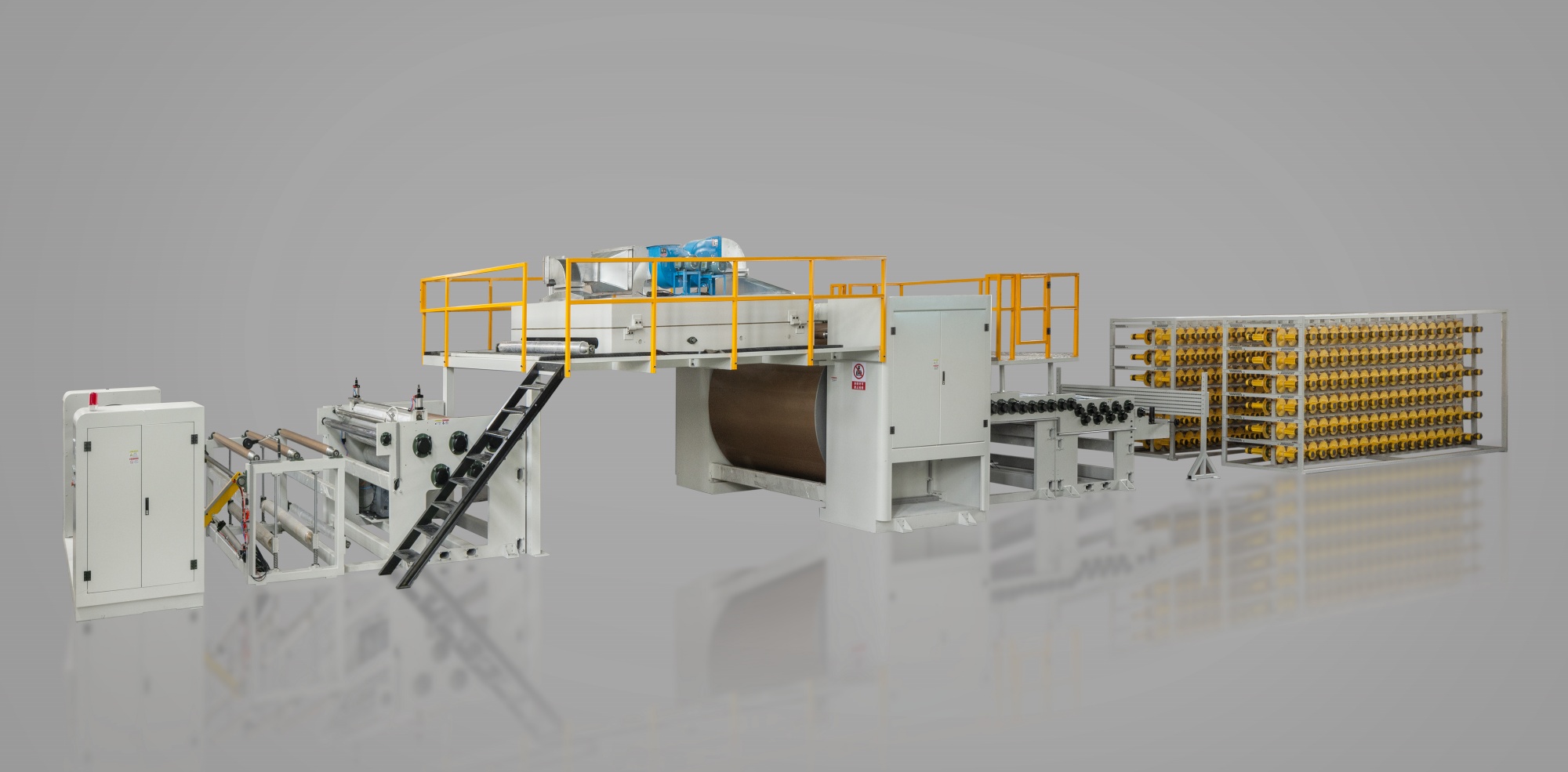
Impregnation is where a bundle of dry unidirectional fibre becomes a usable prepreg, and it is also where most of a tape's run-to-run consistency is decided. Buyers evaluating a UD UHMWPE or UD aramid line therefore tend to compare machines on a short list of hard constraints - working width, adhesive chemistry, fibre spreading, heating medium, roller finish and drive architecture - before they compare anything commercial.
This reference puts the KUNTAI UHMWPE impregnation machine KT-YJ-1800 and the KUNTAI UD Aramid prepreg machine KT-LH-1800 against the specification pattern a buyer typically receives for a standard impregnation machine. JIANGSU KUNTAI MACHINERY CO.,LTD is a Chinese manufacturer of laminating, impregnation and cutting machinery based at Zhengang Industrial Park, Yancheng City, Jiangsu. Founded in 1983, the company operates a 30,000 m² factory with 210 employees, an annual output of 650 units, an in-house team of 8 engineers and an export ratio of 70% across North America, South America, Europe, South Asia, Africa and the Middle East.
Everything below is drawn from published model specifications. Where a specification is not stated, that absence is treated as a question to verify rather than filled in with an assumption.
Why Standard Impregnation Specifications Break Down for UD Buyers
A standard impregnation machine is usually quoted with two numbers: working width and line speed. That is enough to place two quotations side by side, but not enough to predict whether either machine will hold resin content and areal weight inside the tolerance a ballistic or composite programme requires.
The variable a quotation rarely captures is how the machine manages the fibre before it reaches the adhesive: how many ends are fed, how they are spread, how evenly the web is tensioned, and how stable roller temperature is across the full face. Two machines with identical width and speed can therefore produce very different tape.
For a UD buyer this gap appears twice. In the research phase the buyer needs to know which parameters are actually coupled to output quality. In the evaluation phase the buyer needs those parameters stated as numbers, so two offers can be judged without a trial run. Machines that publish dipping method, spreading method, bobbin count, heating medium, roller finish and drive architecture are easier to evaluate than machines that publish only width and speed - not because the extra parameters are automatically better, but because they can be checked.
The Constraints That Decide the Purchase
The grid below is the comparison framework used for the rest of this article. The middle column explains why each line changes a buying decision; the right-hand column shows the value published for the KUNTAI KT-YJ-1800 and KT-LH-1800 platforms.
| Constraint | Why it changes the decision | Stated value (KT-YJ-1800 / KT-LH-1800) |
|---|---|---|
| Working width | Fixes the maximum tape width and therefore the panel size and slitting plan. A width cap is a hard constraint, not a preference. | Roll surface 1800 mm; material width ≤ 1650 mm |
| Adhesive chemistry and application | Water-based systems change drying load, operator exposure and waste handling compared with solvent or hot-melt routes. | Water-based adhesive; dipping / coating |
| Fibre spreading and end count | Determines how uniformly filaments are distributed before impregnation and how many ends one run can process. | Mechanical multi-roll plus profiled spreading; 1080 yarn bobbins |
| Heating medium and control | Thermal oil versus electric heating changes warm-up behaviour, face temperature uniformity and auxiliary equipment footprint. | Circulating thermal oil; external circulating thermal oil lamination roller; 60 kW external mould oil heater |
| Roller finish and balance | Surface finish and dynamic balance affect web tension stability and the frequency of surface-driven defects. | Friction roller mirror level 14; dynamic balance on the friction mirror surface roller and heating roller |
| Drive and control architecture | Recipe repeatability, ramp behaviour and fault diagnosis depend on the control and drive combination. | HMI plus PLC control; variable-frequency plus servo drive |
| Connected load | Determines transformer sizing, cable planning and the shape of running costs. | Total power 90 kW |
KT-YJ-1800 and KT-LH-1800: The Stated Specifications
The two KUNTAI platforms share a common technical baseline, which matters for a buyer building one qualification file for both a UHMWPE and an aramid programme.
KT-YJ-1800 - UHMWPE impregnation machine
- Equipment roll surface: 1800 mm
- Material width: ≤ 1650 mm
- Adhesive: water-based
- Gluing method: dipping / coating
- Wire spreading: mechanical multi-roll plus profiled
- Control: HMI + PLC; drive: variable frequency + servo
- Lamination roller: external circulating thermal oil roller
- Temperature control: 60 kW external mould oil heater
- Roller surface treatment: friction roller mirror level 14
- 1080 yarn bobbins; total power 90 kW
- Construction: carbon steel / SS304
KT-LH-1800 - UD Aramid prepreg machine
- Equipment roll surface: 1800 mm
- Material width: ≤ 1650 mm
- Adhesive: water-based; gluing method: dipping / coating
- Wire spreading: mechanical multi-roll plus profiled
- Lamination roller: external circulating thermal oil roller
- Heating source: circulating thermal oil; 60 kW external mould oil heater
- Roller surface treatment: friction roller mirror level 14
- HMI + PLC control; variable frequency + servo drive
- 1080 yarn bobbins; total power 90 kW
- Composite speed: 5-11 m/min
One documentation point deserves attention during evaluation. KT-LH-1800 appears in KUNTAI material as the model number for the UD prepreg impregnation machine, the UD Aramid prepreg machine and the UHMWPE prepreg machine, and the UD crossply machine also carries the KT-LH-1800 designation at a different specification set (8000 kN pressing tonnage, 1700 x 1700 mm working table, approximately 95 kW). A buyer should confirm in writing which configuration sits behind the model number in a given quotation, because the platform name alone does not fully identify the machine.
Technical Reading of the Specification Set
Adhesive application
The KT-YJ-1800 and KT-LH-1800 both use a water-based adhesive applied by dipping or coating. For a procurement engineer, the important consequence is downstream, not on the machine itself: a water-based route moves the process constraint to drying capacity and web handling after the dip bath. Buyers who currently run solvent-based or hot-melt processes should treat the switch as a line redesign rather than a like-for-like swap.
Fibre spreading and bobbin capacity
Both models use mechanical multi-roll spreading combined with a profiled element, and both feed 1080 yarn bobbins. The bobbin count is the practical link between machine specification and production planning: it defines how many ends can be creeled in a single run, and therefore how the tape width is built up from individual yarns.
Thermal architecture
Heat is delivered through circulating thermal oil, with an external circulating thermal oil lamination roller and a 60 kW external mould oil heater handling temperature control. Thermal oil is chosen here for face uniformity across a roller that is 1800 mm wide, and the separate heater package is a piece of plant equipment a buyer must allocate floor space and utilities to.
Roller surface and dynamic balance
Both platforms specify a friction roller mirror level 14 surface treatment, with dynamic balancing applied to the friction mirror surface roller and the heating roller. Mirror level is a finishing specification rather than a marketing term: it describes how the working surface of the roller is prepared, and it is one of the few quality indicators on an impregnation line that can be inspected before shipment. Dynamic balancing addresses the behaviour of those rollers at running speed, which is where surface quality and vibration control meet.
Control and drive
HMI plus PLC control paired with variable-frequency and servo drives is the stated architecture on both models. For evaluation purposes this is the difference between a machine whose recipes live in a controller and a machine whose settings are physical positions. It does not by itself guarantee repeatability, but it makes repeatability something a supplier can demonstrate during acceptance.
Where These Machines Fit: Ballistic and Composite Applications
KUNTAI lists the KT-YJ-1800 and the KT-LH-1800 family against bulletproof vest, helmet and plate manufacturing. The recorded working condition for that application is low temperature with moderate humidity, with a glue pump system as matched equipment and voltage stability called out as a special requirement - a detail that matters more than it appears, because servo-driven impregnation lines are sensitive to supply quality.
Installed-base evidence exists for this segment. A protective products company operating across Turkey, the Czech Republic, India and Russia has run 50 KUNTAI units for three years in bulletproof vest, helmet and plate production, reporting stable operation, with long lifespan and low maintenance cited as the highlights. That is a usage record rather than a performance guarantee, but it is the kind of reference a buyer in the research phase can actually check.
The same platforms extend beyond ballistics. Because the specification set is defined by width, adhesive chemistry and thermal control rather than by a single end product, the equipment logic applies wherever a unidirectional tape has to be impregnated and consolidated under controlled tension.
Market Signals Behind the Comparison
Demand for impregnation capacity is being pulled by the prepreg market rather than by laminating machinery alone. Maximize Market Research valued the global prepreg market at USD 15.07 billion in 2024, driven by aerospace and defence demand, while MarketsandMarkets put the aerospace prepreg segment specifically at USD 3.5 billion in 2024 - a figure that maps directly onto demand for UD carbon and aramid impregnation equipment.
On the machinery side, Coherent Market Insights estimated the global laminating machines market at USD 786.5 million in 2026, projected to reach USD 1,356.7 million by 2033. That estimate should be read with care: Persistence Market Research placed the 2026 figure at USD 746.4 million and Future Market Insights put 2025 at USD 676.4 million, a divergence that reflects how differently the scope is drawn between office and industrial laminating systems. The directional signal is what matters for a buyer, not the exact number.
Regulatory context is the other external input. Textile machinery safety is governed by the ISO 11111 series, with Parts 2 to 7 covering safety requirements for different machinery types. A buyer specifying an impregnation line for a European installation should treat that framework as the baseline against which the machine's CE documentation is read.
Comparison with Conventional Impregnation Configurations
The table below places the two KUNTAI platforms against the fields that a conventional impregnation quotation most often leaves open. The final column is not a claim about any competitor's capability; it is the list of items a buyer should require before treating two offers as comparable.
| Parameter | KT-YJ-1800 | KT-LH-1800 (UD Aramid) | Often unstated in a standard offer |
|---|---|---|---|
| Material width | ≤ 1650 mm | ≤ 1650 mm | Whether the figure is roll face or usable web |
| Adhesive / method | Water-based, dipping/coating | Water-based, dipping/coating | Solids content window and pick-up range |
| Spreading | Mechanical multi-roll + profiled | Mechanical multi-roll + profiled | Spreading principle and end count |
| Bobbin capacity | 1080 | 1080 | Creel configuration and tension zoning |
| Heating | Circulating thermal oil; 60 kW heater | Circulating thermal oil; 60 kW heater | Face uniformity data across the roller |
| Roller finish | Mirror level 14 | Mirror level 14 | Surface specification and balance grade |
| Control / drive | HMI+PLC; VF + servo | HMI+PLC; VF + servo | Recipe management and data logging |
| Composite speed | Not stated in the model sheet | 5-11 m/min | Speed at rated adhesive pick-up |
| Installed power | 90 kW | 90 kW | Connected load versus running load |
Limits buyers should confirm before ordering
A specification comparison is only useful if it also states where a machine stops. Five boundaries stand out on this platform.
- Width ceiling. Both models are rated to a material width of 1650 mm on an 1800 mm roll surface. Any programme requiring wider tape or wider panel formats needs a different configuration, and that should be settled before tooling decisions are made.
- Speed disclosure gap. The KT-LH-1800 UD Aramid sheet states a composite speed of 5-11 m/min. The KT-YJ-1800 sheet does not state composite speed at all. A buyer planning throughput around the UHMWPE model should request that figure in writing rather than infer it from the sister platform.
- Infrastructure load. A total connected power of 90 kW, a 60 kW external mould oil heater and a circulating thermal oil circuit are plant-level requirements. Sites without existing thermal oil infrastructure will carry additional engineering scope.
- Adhesive route lock-in. The water-based dipping/coating specification is not a drop-in replacement for a solvent or hot-melt process. Drying capacity, ventilation and waste handling all follow from that choice.
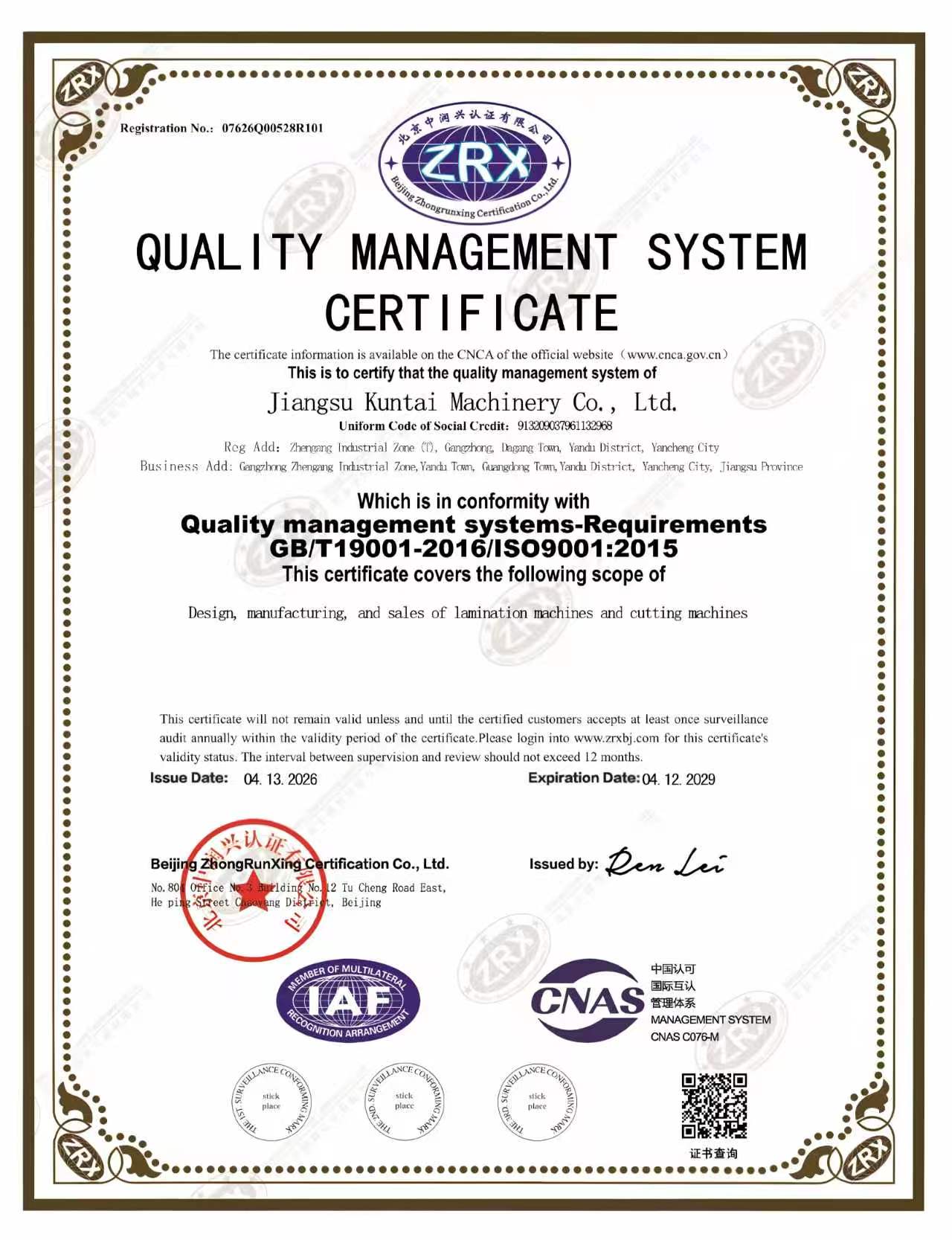
- Certificate scope. ISO 9001:2015 certification (number 07626Q00528R101, issued by Beijing ZhongRunXing Certification Co., Ltd., valid 2026-04-13 to 2029-04-12) covers design, manufacturing and sales of lamination machines and cutting machines. The CE certificate number NO.3N221214.JKMSU84, issued by ECM under directive 2006/42/EC and valid to 2027-12-13, names specific models including KT-PUR-1800, KT-FT-XC and KT-QLJ-X plus listed serial variants. Confirming that the exact model on the purchase order falls inside the named scope is a documentary step, not a formality.
Future Outlook for UD Impregnation Equipment
Three developments are likely to shape how buyers read an impregnation specification over the next several years. The first is documentation depth: as prepreg demand grows in defence and aerospace supply chains, machine specifications will be judged alongside certificate scope, calibration records and acceptance test data rather than on their own.
The second is the shift toward water-based adhesive routes, which is already the stated basis of both KUNTAI platforms. That shift moves engineering attention from the dip bath to drying and web handling, and it rewards buyers who model the whole line rather than the machine alone.
The third is process transparency. With HMI plus PLC control and servo drive already standard on these models, the marginal advantage moves to how much of the process a supplier is willing to expose as data - recipe history, temperature logs, tension records - during acceptance. Buyers who ask for that data now will find the next comparison easier than this one. A full capability and model overview is available in the company brochure for readers who want the underlying specification sheets.
FAQ
What material width can the KT-YJ-1800 process?
The KT-YJ-1800 has an equipment roll surface of 1800 mm and a rated material width of up to 1650 mm. The difference between the two figures is the working allowance on the roller face. Projects requiring wider unidirectional tape need a different machine configuration, which should be confirmed with the manufacturer before slitting and panel dimensions are fixed.
Which adhesive system do these KUNTAI impregnation machines use?
Both the KT-YJ-1800 and the KT-LH-1800 use a water-based adhesive applied by dipping or coating. Water-based chemistry changes the downstream process: drying capacity, ventilation and waste handling become part of the line design, and a buyer converting from a solvent or hot-melt route should plan the change as a process redesign.
What certifications can a buyer verify for KUNTAI impregnation machines?
Two documents are relevant. ISO 9001:2015 certification number 07626Q00528R101, issued by Beijing ZhongRunXing Certification Co., Ltd., is valid from 2026-04-13 to 2029-04-12 and covers design, manufacturing and sales of lamination machines and cutting machines; KUNTAI documentation states the KT-YJ-1800 UHMWPE impregnation machine is certified to ISO 9001:2015. CE certificate number NO.3N221214.JKMSU84, issued by ECM under directive 2006/42/EC for the EU market, runs to 2027-12-13 and names specific models including KT-PUR-1800, KT-FT-XC and KT-QLJ-X plus listed serial variants, so model coverage should be confirmed against the purchase order.
How many yarn bobbins does the platform handle, and at what speed?
Both the KT-YJ-1800 and the KT-LH-1800 are specified with 1080 yarn bobbins. The KT-LH-1800 UD Aramid prepreg machine states a composite speed of 5-11 m/min. The KT-YJ-1800 model sheet does not state a composite speed, so a buyer planning capacity around the UHMWPE configuration should request that value directly instead of assuming it matches the aramid platform.
What does friction roller mirror level 14 mean in procurement terms?
It is a roller surface treatment specification applied to the friction roller on both models, and it is paired with dynamic balancing of the friction mirror surface roller and the heating roller. In procurement terms it is one of the few quality parameters on an impregnation line that can be inspected and documented before shipment, which makes it useful as an acceptance item rather than a headline specification.
What electrical and thermal infrastructure does the machine require?
The stated total power is 90 kW, with temperature control handled by a 60 kW external mould oil heater and heat delivered through a circulating thermal oil circuit and an external circulating thermal oil lamination roller. Sites need to plan transformer capacity, cable routing and thermal oil equipment space around those figures, and recorded working conditions for ballistic applications also call out voltage stability as a special requirement.
Company brochure: KUNTAI profile (PDF).
Есть вопросы или нужны дополнительные детали?
Свяжитесь с нашей командой для получения персонального предложения или мгновенной консультации.
Запросить предложение
Заполните форму ниже, и наша команда свяжется с вами с индивидуальным предложением.
Прямой чат WhatsApp
Предпочитаете общаться в реальном времени? Напишите нам в WhatsApp для мгновенной помощи и быстрых ответов.
- Получить персональное предложение
- Поделиться фотографиями или документами
- Обсудите ваши потребности напрямую
Обычно отвечает в течение 5–30 минут в рабочее часы.