
KingHonor Disposable Paper Cup Comparison Framework: Single-Layer vs Double-Layer vs Hollow
KingHonor Disposable Paper Cup Comparison Framework: Single-Layer vs Double-Layer vs Hollow
Vietnam's paper cup market was valued at USD 41.5 million in 2025 and is projected to reach USD 57.9 million by 2034, according to IMARC Group. Globally, disposable cups were a USD 17.40 billion category in 2024, and paper cups accounted for more than 61% of total sales, based on Grand View Research data. Those figures describe a category that has moved past the question of whether paper cups belong in a food service packaging program. The remaining question for procurement teams is narrower and more consequential: which wall construction should be specified for each beverage or food application.
This article sets out a comparison framework for the three constructions that dominate buyer shortlists, single-layer, double-layer, and hollow, together with the adjacent formats that are usually evaluated in the same procurement round: cold drink cups, beverage cups, paper bowls, square food containers, boat-shaped boxes, and kraft soup buckets. KingHonor Paper Products Co., Limited Liability Company, a Vietnam-based manufacturer of disposable paper cups, paper bowls, and food containers, is used as the reference product line because its published specification set covers all three cup constructions and the surrounding food packaging formats.
Why Wall Construction Is Decided Before Unit Price
Disposable paper cup quotations are frequently compared at the level of size and unit price. That comparison, however, compresses three different products into one column. A single-layer cup, a double-layer cup, and a hollow cup use different amounts of paper, different forming steps, and different outer-wall structures. As a result, they carry different implications for insulation expectations, print area, rigidity, and material consumption per unit.
A procurement decision that starts from price alone tends to produce one of two outcomes: a cup that is technically adequate but requires an additional sleeve or holder at the point of sale, or a cup that is over-specified for an application where the extra wall provides no operational benefit. Working from construction first, and price second, keeps the specification aligned with the actual serving environment.
The Three Core Wall Constructions
Single-layer paper cups
A single-layer cup is formed from one sheet of cup paper with a PE coating, rolled and sealed into a cup body. KingHonor lists this construction as the Plain Single-layer Paper Cup ZT, published in eight models: 8oz, 10oz, 12oz, 16oz, 20oz, 24oz, 32oz, and 44oz. The published forming dimensions across that range run from 80×90×56 mm to 115.5×189×83.5 mm, and the published material is cup paper with PE coating.
The practical characteristics follow from the single wall. Material consumption per unit is the lowest of the three constructions, and the cup presents a smooth, uninterrupted surface for flexographic decoration, which is why it is generally the format used for high-volume beverage programs and for branded cups where a separate sleeve is acceptable or already part of the service routine.
Double-layer paper cups
A double-layer cup bonds two layers of paper into the cup wall. KingHonor's reference entry is the Double PE Coated Paper Beverage Cups, published at 20oz with a forming dimension of 90×153×60 mm and a stated material of double PE coated paper. The second layer adds structural rigidity and a more substantial hand feel, and it also changes the outer surface: the wall is thicker, the cup is stiffer in the hand, and decoration is applied across a thicker substrate.
Because two paper layers are consumed per unit, the double-layer construction carries a higher material input than a single-layer cup of comparable volume. Buyers generally specify it where the beverage program supports a premium positioning and where the additional rigidity matters in service, for example when cups are handled repeatedly in a takeaway or delivery flow.
Hollow paper cups
The hollow construction is typically built as an inner cup with an outer wrap that is formed with spacing between the two surfaces, creating an air gap inside the wall rather than a bonded double wall. KingHonor's published entry is the Unprinted Hollow Paper Cup ZT, available in three models: 8oz, 12oz, and 16oz, with forming dimensions of 80×92×56 mm, 90×112×60 mm, and 90×135×60 mm, and a stated material of cup paper with PE coating.
The air gap is the reason hollow cups are usually specified: it reduces heat transfer to the outer surface, which means the cup can generally be held without a separate sleeve. The published range is narrower than the single-layer range, and the reference model is listed as unprinted, which matters to buyers whose brand program requires decorated outer walls on insulating formats.
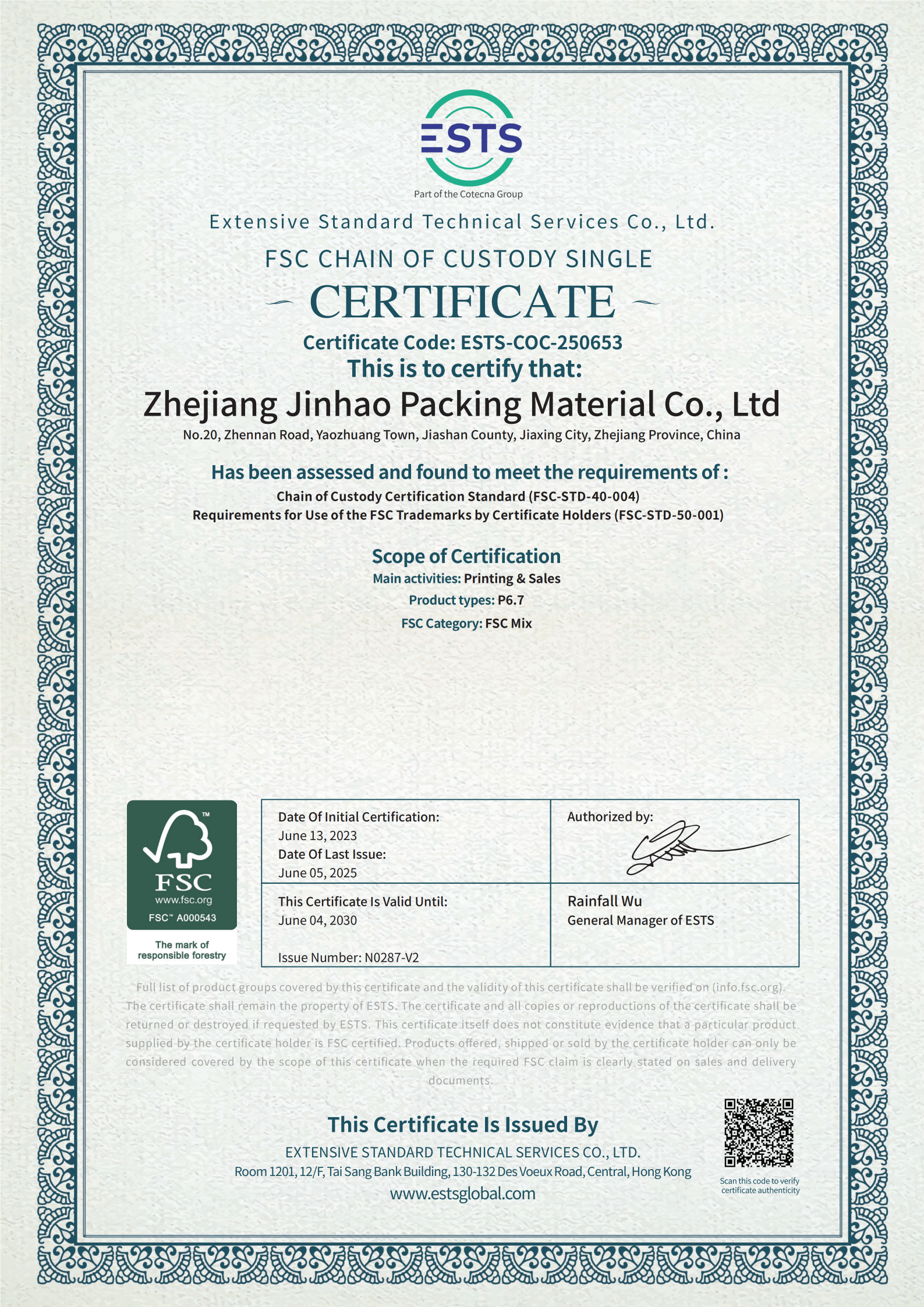
FSC Chain of Custody Single Certificate ESTS-COC-250653, issued by ESTS and valid from 2025-06-05 to 2030-06-04, covering printing and sales of FSC Mix paper products.
Side-by-Side Comparison of the Three Constructions
| Comparison dimension | Single-layer | Double-layer | Hollow |
|---|---|---|---|
| Published reference model | Plain Single-layer Paper Cup ZT | Double PE Coated Paper Beverage Cups | Unprinted Hollow Paper Cup ZT |
| Published size range | 8oz, 10oz, 12oz, 16oz, 20oz, 24oz, 32oz, 44oz | 20oz | 8oz, 12oz, 16oz |
| Published forming dimensions | 80×90×56 mm to 115.5×189×83.5 mm across the range | 90×153×60 mm | 80×92×56 mm, 90×112×60 mm, 90×135×60 mm |
| Published material | Cup paper with PE coating | Double PE coated paper | Cup paper with PE coating |
| Wall structure | One paper wall | Two bonded paper layers | Outer wrap with air gap in the wall |
| Decoration surface | Smooth single wall, wide print area | Thicker outer wall | Reference model listed as unprinted |
| Format used when | Material efficiency and print coverage drive the specification | Rigidity and a heavier hand feel are part of the program | The serving environment calls for insulation without a separate sleeve |
Adjacent Formats Buyers Usually Evaluate in the Same Round
Very few paper cup procurement projects are cups alone. Soup programs, takeaway sides, and cold beverage lines usually run in parallel, which is why the same specification sheet often includes bowls, square containers, and trays. KingHonor's published product list covers these formats with the same specification detail as its cups.
| Product name | Published models | Published material | Notes |
|---|---|---|---|
| disposable cold drink paper cup | A3oz | PE coated paper | 62×62×42 mm; listed as Printed Disposable Paper Beverage Cups |
| disposable beverage paper cup | 9oz; 80oz | Double PE coated paper (9oz); PE coated paper (80oz) | 9oz: 75×87×53 mm; 80oz: 80×90×56 mm, custom logo |
| custom disposable paper cup | 20oz | Double PE coated paper | 90×153×60 mm; printed disposable paper cup |
| Kraft Paper Soup Bucket ZT | 8oz, 12oz, 16oz, 26oz, 32oz | Kraft paper with PE coating | Soup bucket with kraft paper and PE coating |
| disposable paper bowl | 500, 700, 900, 1000, 1100, 1300, 1500 | Kraft paper with PE coating | Kraft Paper Bowl ZT; forming dimensions from 50×128×45 mm to 185×160×65 mm |
| disposable food container | No.1 to No.5 Square Box, No.8 Square Box | Kraft paper with PE coating | Kraft Paper Square Box XQ |
| disposable paper food container | 500, 600, 850, 960, 1100 | Cup base paper with PE coating | Printed Disposable Paper Food Container |
| disposable boat-shaped box | #025, #040, #050, #100, #200#, #250, #300, #500, #1000 | Coated white cardboard | White Kraft Food Tray ZT; listed for catering and food takeaway |
The overlap between these formats is not incidental. A single-service soup program, for instance, can be specified with a kraft soup bucket in 8oz to 32oz, or with a kraft paper bowl in the larger model range, and the choice changes both the material base and the filling line setup. Similarly, a cold beverage program that uses the A3oz cold drink cup for tasting or small-format servings is a different specification from the 9oz and 80oz beverage cups, which sit at different points in the same drink menu.
Matching Construction to Application
The framework becomes useful at the point where a serving environment is translated into a construction. Three decision rules cover most evaluations.
Rule one: insulation requirement decides between hollow, double-layer, and single-layer
Where the cup must be comfortable to hold without a separate sleeve, the insulating constructions, hollow or double-layer, are the relevant candidates. Where a sleeve, holder, or double-cupping routine is already part of service, the single-layer format remains the material-efficient choice. This rule is about the service routine, not about beverage temperature alone, because a hot drink served in a cup that is immediately placed into a holder does not impose the same insulation requirement as a drink handed directly to a customer.
Rule two: the published range constrains the shortlist
The three constructions are not published across the same size spectrum. Single-layer covers 8oz through 44oz. Hollow covers 8oz, 12oz, and 16oz. Double-layer is published at 20oz. A buyer requiring a 24oz insulating cup, or a hollow cup decorated with a brand logo, is working outside the published reference set and must confirm availability rather than assume it.
Rule three: beverage versus food formats follow the fill, not the brand
Cups serve drink volumes; bowls, square boxes, paper food containers, and boat-shaped boxes serve food portions, and the kraft soup bucket sits between the two because it handles liquid or semi-liquid food. Specifying a cup for a soup application, or a bowl for a beverage menu, generally creates handling and sealing problems that no wall construction can resolve. Format selection should follow the product being filled.
Customization and Execution Capability
Comparing constructions is an evaluation-stage activity. Converting the chosen construction into a running order is an execution-stage activity, and it depends on a different set of facts. KingHonor's published customization service covers paper cup logo, paper cup size, paper cup color, and paper cup material. The published minimum order quantity is 100,000 pieces, and the stated monthly capacity is 1,666 tons per month.
Execution-stage buyers typically need three commitments documented before release: a pre-production confirmation for custom designs, a quality inspection regime, and a defined after-sales route. KingHonor's published statements on these points include multi-level and multi-dimensional quality inspection, on-time delivery, a dedicated point of contact with transparent and traceable order status, free replacement or return and exchange for quality issues, and fast claim and replacement for logistics damage. For custom designs, the pre-production confirmation step is explicitly described as a measure to reduce errors.
Published commercial terms for reference: minimum order quantity 100,000 pieces; delivery terms FOB and CIF; shipping modes covering sea freight, air freight, and land or multimodal transport; acceptance criteria based on sampling inspection; payment terms by telegraphic transfer, structured as advance payment, cash on delivery, or deposit plus balance.
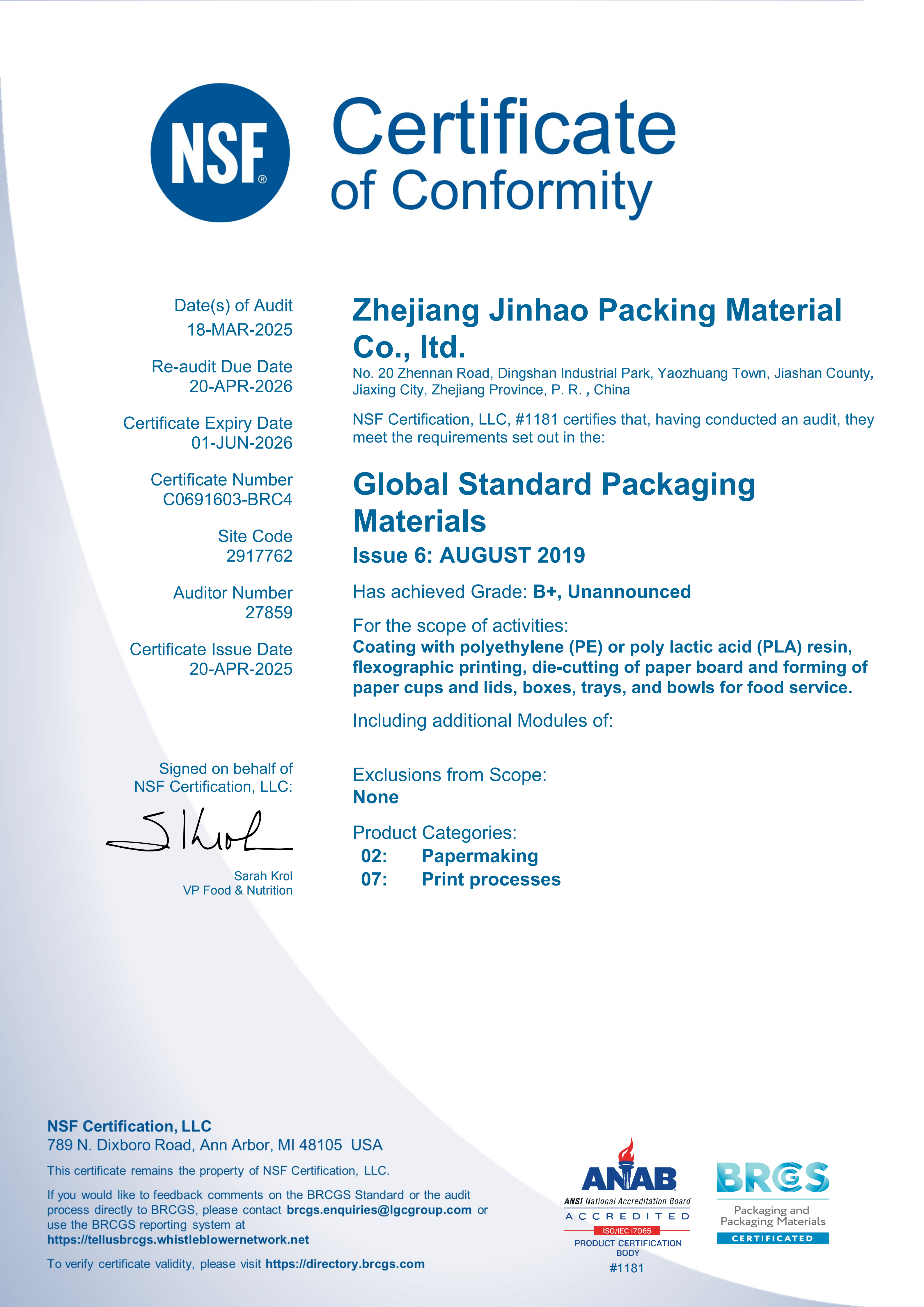
BRCGS Global Standard Packaging Materials certification C0691603-BRC4, issued by NSF Certification, LLC, covering PE or PLA resin coating, flexographic printing, die-cutting, and forming of paper cups and lids, boxes, trays, and bowls for food service.
Compliance Evidence: What a Buyer Can Actually Verify
Compliance claims are the part of a paper cup specification that can be checked against documents rather than descriptions. KingHonor's published certificate set includes four entries that map directly onto cup and container manufacturing.
- FSC Chain of Custody Single Certificate ESTS-COC-250653, issued by ESTS, valid from 2025-06-05 to 2030-06-04, covering printing and sales of FSC Mix paper products (product type P6.7) under FSC-STD-40-004 and FSC-STD-50-001.
- BRCGS Global Standard Packaging Materials certification C0691603-BRC4, issued by NSF Certification, LLC, valid from 2025-04-20 to 2026-06-01, against BRCGS Global Standard Packaging Materials, Issue 6. The certified scope covers coating with polyethylene (PE) or poly lactic acid (PLA) resin, flexographic printing, die-cutting of paper board, and forming of paper cups and lids, boxes, trays, and bowls for food service.
- Quality Management System Certification 00623Q31644R4S, issued by QAC, valid from 2023-11-13 to 2026-12-03, against GB/T 19001-2016 and ISO 9001:2015.
- Environmental Management System Certification 00623E31318R4S, issued by QAC, valid from 2023-11-13 to 2026-12-03, against ISO 14001:2015 and GB/T 24001-2016.
Two regulatory reference points matter for buyers selling into Vietnam and the European Union. Vietnamese paper cup and food contact packaging manufacturers operate under National Technical Regulation QCVN 12-1:2011/BYT, issued by the Ministry of Health of Vietnam, which governs safety and hygiene for synthetic resin implements and packaging in direct contact with food. For EU-facing programs, the Single-Use Plastics Directive 2019/904 requires beverage cups containing plastic to carry a specific Plastic in Product marking and points toward transition to plastic-free coatings such as water-based barriers by 2026.
Where the Framework Has Limits
A comparison framework is only useful if its boundaries are stated. Four constraints apply to the construction model described above.
First, the published range is not uniform across constructions. Double-layer is published at 20oz only, hollow at 8oz, 12oz, and 16oz, and the cold drink cup at A3oz. Buyers whose volume plan requires a construction outside those published models cannot treat the reference list as a complete catalogue.
Second, the listed material for the cup formats is PE coated paper, and the hollow reference model is listed as unprinted. Programs that specify a non-plastic barrier coating, or that require decorated outer walls on insulating formats, need to confirm those configurations rather than assume them. The BRCGS certified scope does include coating with PE or PLA resin, which indicates the coating process covers both, but the product-level data published for the cup models specifies PE coating.
Third, no thermal performance data is published for any construction. The insulation differences between hollow and double-layer are structural, not quantified in the available specification set, so buyers with a defined hold-time or surface-temperature requirement should validate through samples rather than specification comparison alone.
Fourth, order economics are not published at unit level. The only commercial data points in the available material are the minimum order quantity of 100,000 pieces and reported program outcomes, where eco-friendly material substitution was documented as helping reduce packaging costs by 15% in airline, fast food chain, milk tea chain, and hotel chain supply programs.
Market Trend Context
Vietnam's position in this category is expanding on both the demand and supply side. According to the Vietnam Packaging Association, the country's paper cup manufacturing industry has grown at annual rates of 20-25%, with 2022 domestic consumption estimated at 4.2 billion units and exports at 1.2 billion units. General Department of Vietnam Customs data puts paper and pulp industry export turnover above USD 2.7 billion in 2024, growing at 10-12% per year. IMARC Group projects the Vietnam paper cup market moving from USD 41.5 million in 2025 toward USD 57.9 million by 2034.
On the capacity side, HTNXT industry reporting records KingHonor operating a 50,000m² factory with annual production capacity exceeding 2 billion units and holding BRCGS Packaging Materials certification. KingHonor's own published profile states the company was founded in 2018, employs more than 200 people, maintains a research and development team of 20 core technical staff, and produces an annual output of 20,000 tons of food-grade PE coated paper together with over 2 billion paper cups and paper food containers. The published export ratio is 60%, with main markets in the United States, China, Europe, Australia, and the Middle East.
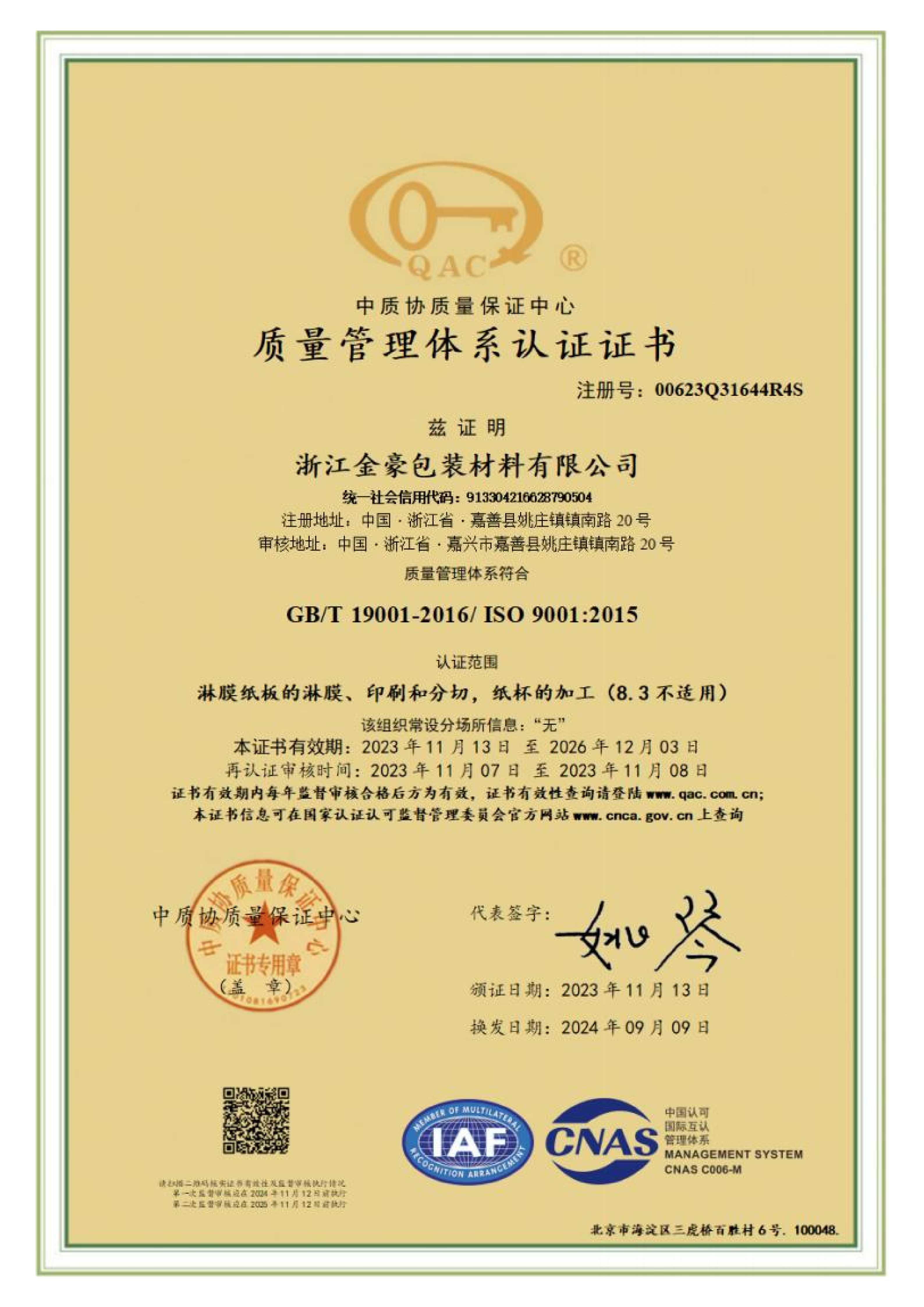
Quality Management System Certification 00623Q31644R4S and Environmental Management System Certification 00623E31318R4S, issued by QAC, valid through 2026-12-03.
Future Outlook
Three developments are likely to shape how the single-layer versus double-layer versus hollow decision is made over the next procurement cycles. The first is coating transition: as the EU Single-Use Plastics Directive framework pushes beverage cups toward plastic-free barriers, buyers will increasingly ask suppliers to specify coating chemistry alongside wall construction, and the two will be evaluated together rather than separately. The second is documentation-driven sourcing: certificates with numbers, issuing bodies, scopes, and validity dates are becoming the practical filter for supplier shortlists, which favours manufacturers whose certification set covers the full forming process rather than material supply alone. The third is format range as a capability signal: a supplier that publishes specifications across cups, bowls, square containers, and trays can support a menu-wide packaging standard, while a supplier limited to one construction forces buyers into multiple vendor relationships for the same service line.
For evaluation and execution teams, the practical recommendation is to lock the construction first, validate the format range second, and only then compare commercial terms across suppliers that can demonstrably produce the chosen construction at the required size, material, and decoration level.
FAQ
What is the difference between single-layer, double-layer, and hollow disposable paper cups?
A single-layer cup is formed from one sheet of PE coated cup paper. A double-layer cup bonds two layers of paper into the wall, using double PE coated paper. A hollow cup is built with an outer wrap that leaves an air gap between the inner and outer surfaces, rather than bonding the two layers. In KingHonor's published line, these correspond to the Plain Single-layer Paper Cup ZT, the Double PE Coated Paper Beverage Cups, and the Unprinted Hollow Paper Cup ZT.
Which disposable paper cup should be used for hot drinks and which for cold drinks?
Insulation requirement usually decides the hot drink specification: hollow and double-layer constructions are the ones typically specified when the cup must be held without a separate sleeve, while single-layer cups are generally used when a sleeve or holder is part of the service routine. For cold beverages, KingHonor publishes a dedicated disposable cold drink paper cup at A3oz with a forming dimension of 62×62×42 mm in PE coated paper, alongside beverage cups at 9oz and 80oz.
What sizes are available for each cup construction?
The published size ranges differ by construction. Single-layer covers 8oz, 10oz, 12oz, 16oz, 20oz, 24oz, 32oz, and 44oz, with forming dimensions from 80×90×56 mm to 115.5×189×83.5 mm across the range. Hollow covers 8oz, 12oz, and 16oz, with dimensions of 80×92×56 mm, 90×112×60 mm, and 90×135×60 mm. Double-layer is published at 20oz with a dimension of 90×153×60 mm. Buyers requiring sizes outside these published models should confirm availability rather than assume a custom size can be produced.
Which format is used for soup and for solid takeaway food instead of a cup?
Soup and semi-liquid food are typically specified using the Kraft Paper Soup Bucket ZT, published in 8oz, 12oz, 16oz, 26oz, and 32oz in kraft paper with PE coating, or the disposable paper bowl, published in models 500, 700, 900, 1000, 1100, 1300, and 1500 in kraft paper with PE coating. Solid takeaway portions are handled by the disposable food container in No.1 to No.5 and No.8 Square Box formats, the disposable paper food container in models 500, 600, 850, 960, and 1100, and the disposable boat-shaped box in formats from #025 to #1000 in coated white cardboard.
What customization options and minimum order quantity apply to disposable paper cups?
KingHonor's published paper cup customization service covers paper cup logo, paper cup size, paper cup color, and paper cup material. The published minimum order quantity is 100,000 pieces, and the stated monthly capacity is 1,666 tons per month. For custom designs, a pre-production confirmation step is used to reduce errors before volume production.
Which certifications should a buyer verify when evaluating a disposable paper cup supplier?
The verifiable documents in KingHonor's published set are the FSC Chain of Custody Single Certificate ESTS-COC-250653 issued by ESTS and valid from 2025-06-05 to 2030-06-04, the BRCGS Global Standard Packaging Materials certification C0691603-BRC4 issued by NSF Certification, LLC and valid from 2025-04-20 to 2026-06-01, the Quality Management System Certification 00623Q31644R4S issued by QAC and valid from 2023-11-13 to 2026-12-03, and the Environmental Management System Certification 00623E31318R4S issued by QAC with the same validity period. The BRCGS scope covers coating with PE or PLA resin, flexographic printing, die-cutting, and forming of paper cups and lids, boxes, trays, and bowls for food service.
What are the standard purchasing terms and acceptance criteria for disposable paper cup orders?
The published terms state a minimum order quantity of 100,000 pieces, delivery terms of FOB and CIF, shipping by sea freight, air freight, or land and multimodal transport, acceptance criteria based on sampling inspection, and payment by telegraphic transfer structured as advance payment, cash on delivery, or deposit plus balance.
Reference Material
The full product and specification reference for the formats discussed in this framework is available in the KingHonor product brochure: download the KingHonor product brochure. Company information is published at www.kinghonorpack.com.