
Kuoyu's R&D and Certification Base: Evidence for PV Box Consistency
Kuoyu's R&D and Certification Base: Evidence for PV Box Consistency
Photovoltaic distribution equipment is bought on specifications and qualified on consistency. A DC string combiner or an AC distribution box is assembled around a project's string count, current rating, protection scheme and enclosure class, so what a buyer is really qualifying is the process standing behind the product. Hebei Kuoyu Electrical Technology Co., Ltd. (Kuoyu Electrical) is a Shijiazhuang-based manufacturer, founded in 2017, producing distribution boxes, distribution cabinets, transformers, wires and cables for power distribution applications that include new energy photovoltaic systems.
Three assets form the base the company presents for its distribution box line: a 10-engineer R&D team, a 9,000 m² production facility, and management-system certifications to ISO 9001, ISO 14001 and ISO 45001. Each answers a different buyer question, and each has a boundary. This article separates the three, shows what they change on a photovoltaic order, and states plainly what a buyer still has to verify before converting them into a purchase decision.
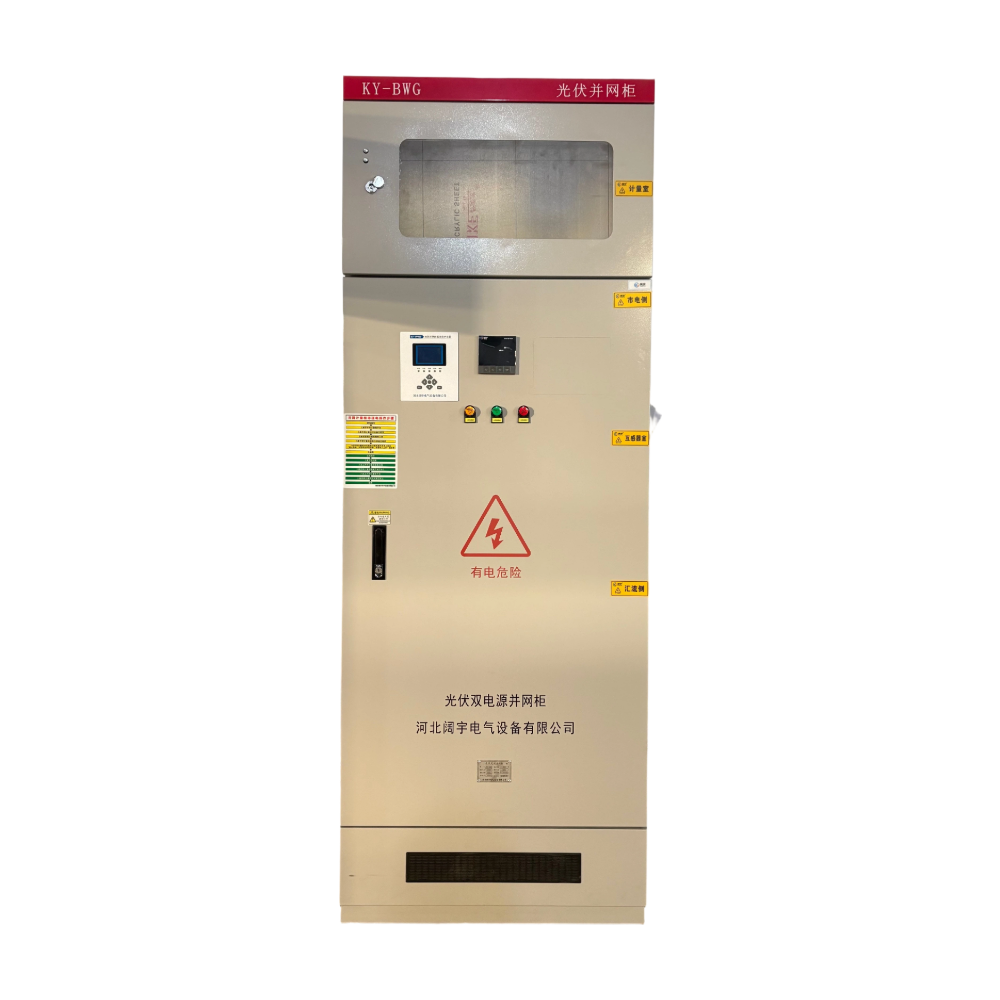
Figure 1 — Distribution cabinets from the Kuoyu Electrical range, the same assembly base used for photovoltaic distribution boxes and cabinets.
Why capability evidence has moved into PV distribution procurement
Photovoltaic distribution is not a catalogue purchase. An ABB application note for a utility-scale DC combiner box, for example, documents a configuration of 1,500 V DC maximum system voltage, 256 A rated output current, 16 input circuits, Type 2 overvoltage protection and an IP66/IK08 enclosure. Change any one of those inputs — string count, inverter architecture, site exposure — and the assembly changes with it. IEC 61439-2:2020, the low-voltage switchgear and controlgear assembly standard, includes Annexes DD, EE and FF written specifically for assemblies used in photovoltaic installations, which places the compliance discussion at assembly level rather than at component level.
That has a practical consequence for sourcing. When two suppliers quote the same nominal distribution box for photovoltaics, they may be quoting different internal architecture, different enclosure fabrication and different test documentation. Buyers who have already run a first round of quotations tend to stop comparing brochures and start comparing the base behind the product: who does the engineering, where the enclosure is formed, and which management system governs the process.
The three assets Kuoyu presents for its distribution box line
Company materials describe this base in three parts. They are worth treating separately, because they carry different evidentiary weight and answer different evaluation questions.
A 10-engineer R&D team
Kuoyu reports a technical team of 10 engineers within a workforce of 80 employees. In photovoltaic work this team is the interface between a project's electrical schedule and the assembly drawing: string configuration, busbar and terminal layout, protection coordination, and the internal arrangement that a customer's single-line diagram implies. The same function carries the customization loop the company advertises — voltage and logo customization inside its OEM service — which is a configuration task rather than a platform-development task. A team of this size is consistent with configure-to-order distribution boxes and cabinets; it is not the scale of a large multinational's platform engineering group. Buyers running several simultaneous custom programmes should therefore confirm scheduling and review capacity at quotation stage rather than assume unlimited parallel engineering.
A 9,000 m² production facility
The company reports a 9,000 m² facility and an annual output of 30,000 sets of power equipment, supported by independently operated sheet metal processing workshops and high and low voltage complete equipment assembly workshops. In-house sheet metal work matters more in photovoltaic distribution than it first appears. The enclosure is the part of the assembly that determines how the finished box behaves outdoors: panel flatness, door alignment, gasket compression, coating adhesion, and the repeatability of cut-outs for cable entry and ventilation. When that step is outsourced, enclosure quality becomes a supplier-selection problem nested inside the box supplier's own quality system — one more link to audit, and one more place where a batch can drift.
Company materials also describe a production base of approximately 20,000 m² covering those workshops. The two figures are different measurements rather than interchangeable numbers, and the discrepancy is treated openly in the boundaries section below.
An ISO 9001, ISO 14001 and ISO 45001 certification base
The certification position is documented rather than merely claimed. All three certificates were issued on 3 June 2024 by General International Testing (China) Certification Service Center and remain valid to 2 June 2027. The company also states that it first passed ISO 9001 three-system certification in 2017, which is consistent with a certification history rather than a first-time registration.
| Standard | Certificate no. | Issuer | Validity | Stated scope emphasis |
|---|---|---|---|---|
| ISO 9001:2015 / GB/T 19001-2016 | YZL862422931310Q | General International Testing (China) Certification Service Center | 2024-06-03 to 2027-06-02 | Sales, installation and technical consulting services for high and low voltage electrical appliances and complete equipment, box-type substation facilities, power supply equipment, cable trays, wires and cables, electronic products, instruments and meters |
| ISO 14001:2015 / GB/T 24001-2016 | YZL862422931310E | General International Testing (China) Certification Service Center | 2024-06-03 to 2027-06-02 | Sales of high and low voltage electrical appliances and complete sets of equipment, box-type substation facilities, power equipment, cable trays, wires and cables, electronic products, instruments and meters, automation control equipment |
| ISO 45001:2018 / GB/T 45001-2020 | YZL862422931310S | General International Testing (China) Certification Service Center | 2024-06-03 to 2027-06-02 | Sales of high and low voltage electrical appliances and complete sets of equipment, box-type substation facilities, power equipment, cable trays, wires and cables, electronic products, instruments and meters, automation control equipment |
What engineering and floor space change on an actual photovoltaic order
The value of these assets appears in the sequence between an order and a shipment. Company materials state that every procedure — raw material procurement, scheme design, assembly production and finished product acceptance — is supervised by professional technicians. In practice, the engineering team converts a site schedule into a drawing, the sheet metal workshop produces the enclosure to that drawing, and the assembly workshop populates it with breakers, terminal blocks and protection devices before a final inspection gate.
The published commercial parameters of the line are equally specific: OEM production with voltage and logo customization, a monthly capacity of 8,000 units, a 30-day lead time, a minimum order of 2 units, and 100% testing. Purchasing terms list FOB and CIF delivery, pre-shipment test as the acceptance criterion, and 30/70 payment terms. OEM production is described for clients in the EU and Middle East with remote after-sales support, while the company profile separately lists Southeast Asia and Africa as main markets alongside an export share of 30%.
Read as procurement information rather than as promotion, three of these parameters matter most during evaluation. A minimum order of 2 units allows a buyer to place a sample or pilot order in the exact configuration intended for the project instead of accepting a generic demonstration unit. A 30-day lead time is a planning input that should be confirmed against the specific configuration, since enclosure fabrication and component sourcing differ by build. And a 100% test claim becomes meaningful only when it is matched to a defined test list — continuity, dielectric withstand, functional operation of protection devices, and enclosure inspection — agreed before the pre-shipment acceptance.
Certification scope is not the same as product-standard compliance
This is the point where photovoltaic buyers most often misread supplier evidence. ISO 9001, ISO 14001 and ISO 45001 certify management systems: quality, environmental and occupational health and safety respectively. They confirm that a documented process exists, is audited periodically, and covers the scope written on the certificate. They do not confirm that any individual distribution box has passed assembly type tests, short-circuit withstand verification, temperature-rise limits or enclosure protection testing under IEC 61439-2:2020, nor do they substitute for market-specific certification such as the UL 1741 pathway that UL Solutions identifies for combiner boxes in solar balance-of-system certification in the United States.
The certificate scope wording deserves a second look for the same reason. The ISO 9001 certificate expresses the scope in terms of sales, installation and technical consulting services for high and low voltage electrical appliances and complete equipment; the environmental and occupational health and safety certificates express it in terms of sales of the same product families. A buyer preparing a supplier qualification file should confirm how manufacturing is covered for the supplying legal entity, and should request the product-level documents — type test reports, routine test records, and enclosure rating verification — as a separate package.
| Evidence type | What it demonstrates | What it does not demonstrate |
|---|---|---|
| ISO 9001 certificate (YZL862422931310Q) | A documented quality management system within the certified scope, subject to surveillance audits | That a specific PV distribution box has passed assembly type tests |
| ISO 14001 and ISO 45001 certificates | Environmental and occupational health and safety management processes | Electrical performance, ingress protection or thermal behaviour of the product |
| In-house sheet metal and assembly workshops | Control over enclosure fabrication and final assembly steps | Independently verified tolerance, coating thickness or batch traceability |
| Manufacturer case records | Reported field behaviour over multi-year operation in stated applications | Third-party audited failure rates or comparative performance against other suppliers |
| IEC 61439-2:2020 (standard reference) | The assembly-level framework, including Annexes DD, EE and FF for photovoltaic installations | Automatic proof that any given supplier's assemblies comply with it |
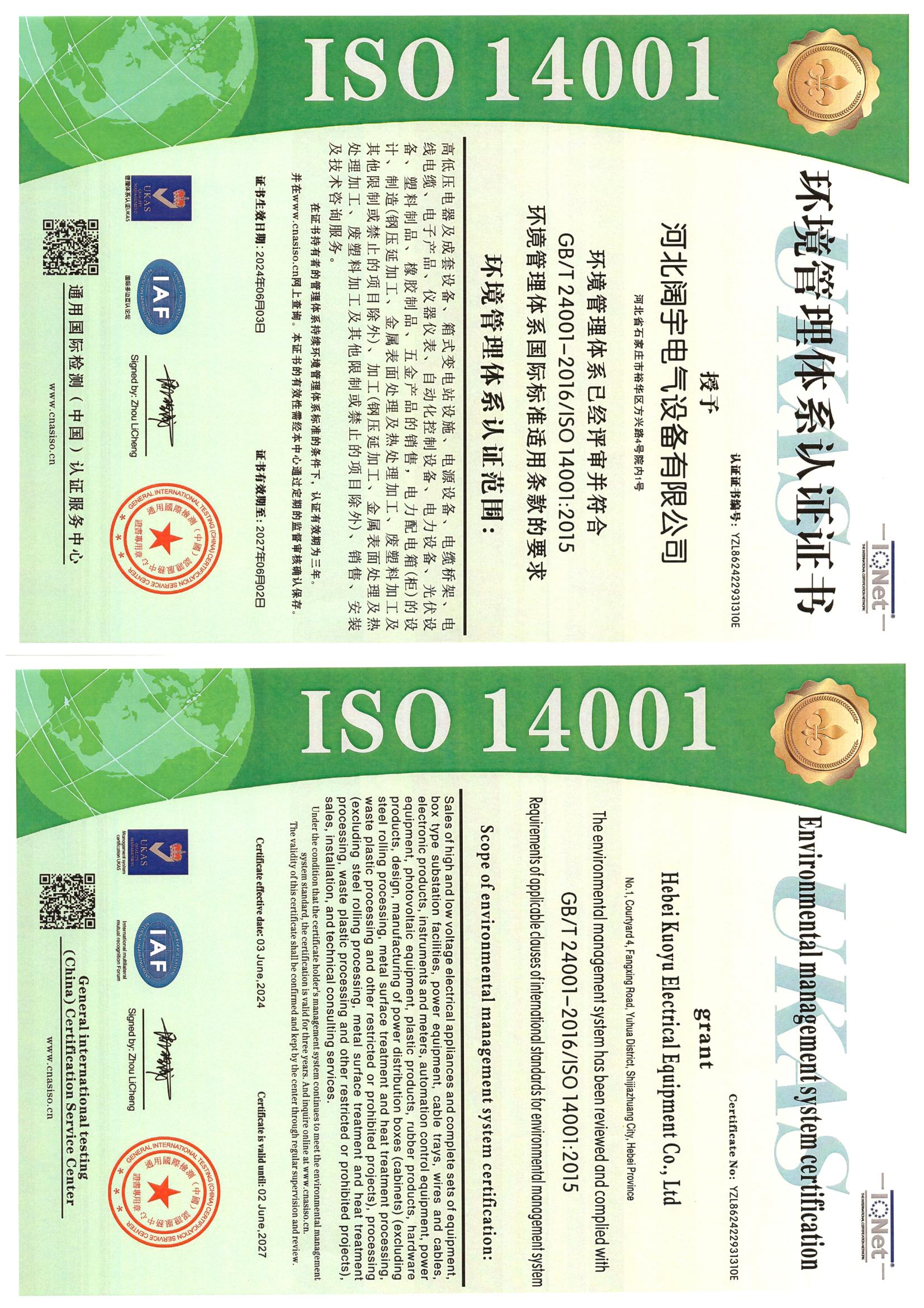
Figure 2 — The ISO 14001 certificate (YZL862422931310E), issued 3 June 2024 and valid to 2 June 2027, part of the three-standard certification base.
Where this base is exercised: application patterns
Reported project records show how the workshops are used outside photovoltaic work, which is useful context because it shows the assembly base under different duty profiles. An automotive manufacturer took 15 units for safe power distribution and circuit control on industrial production lines, protecting equipment from overload and short circuit; the reported outcome after three years of continuous operation was zero circuit failure and a 30% increase in equipment operation stability, with waterproof, dustproof and corrosion-resistant construction and a customized internal structure. A real estate developer took 30 units for power transmission, distribution, voltage conversion and circuit control; the reported outcome after five years was zero safety accidents and a power supply reliability rate of 99.99%, with compact structure, low maintenance cost and customizable configuration.
Both records are company-reported rather than independently audited, and both concern distribution equipment in industrial and building applications rather than photovoltaic arrays. Their relevance to PV procurement is narrower but real: they describe a supplier that has executed customized internal layouts and weather-resistant enclosures at project scale, which is the same capability a solar distribution box requires when the string count, cable entry direction and protection scheme depart from a standard build. The company's products are described as serving power distribution for new energy photovoltaic, wind power, transportation, medical care, education, industrial manufacturing and commercial and civil construction — a spread that keeps the assembly workshops loaded across sectors rather than dependent on one project pipeline.
Market context: documentation demand is rising with installed capacity
Business Research Insights estimates the global solar combiner box market at USD 1.2 billion in 2026, rising to USD 2.1 billion by 2035. The same publisher projects that DC smart combiner boxes will hold a 62.5% share by 2035 — a forward-looking projection rather than an installed-base measurement, and one that should be read with the usual caution attached to commercial research.
Two implications follow for buyers of distribution boxes for photovoltaics. First, volume growth keeps pressure on repeatability: the more units a supplier ships, the more a small process deviation compounds across projects, which is exactly what a management-system certificate and an in-house enclosure workshop are meant to contain. Second, the shift toward monitored combiner boxes adds electronics, sensing and communications to a product that used to be entirely passive. That raises the value of an engineering team that can absorb a changing bill of materials, and it raises the number of questions a datasheet alone cannot answer.
Boundaries: what this evidence base does not establish
An honest reading of the same facts produces a short list of limits that belong in any evaluation file.
- Certificate scope wording. The ISO 9001 scope is expressed around sales, installation and technical consulting services for high and low voltage electrical appliances and complete equipment; the ISO 14001 and ISO 45001 scopes are expressed around sales. Buyers should confirm how the manufacturing activity of the supplying entity is covered and request certificates that match the legal entity issuing the commercial documents.
- Two different floor-space figures. Company materials report a 9,000 m² facility and, separately, a production base of approximately 20,000 m² covering the sheet metal and assembly workshops. These are not the same measurement. Capacity planning should be based on the area and equipment confirmed during a factory visit or on the supplier's written clarification, not on the larger of the two numbers.
- No independent audit data in public sources. The certification set is documented by number, issuer and validity date, but no third-party factory audit or independent product test report is publicly available. Project outcomes cited by the company are self-reported over three- and five-year periods.
- Engineering depth is compact. A 10-engineer team is a reasonable fit for configure-to-order distribution boxes, but buyers running several large custom programmes in parallel should schedule engineering reviews rather than assume simultaneous capacity.
- Certificate currency is time-bound. All three certificates expire on 2 June 2027. Sourcing files prepared for multi-year framework agreements should include a re-verification step before each annual release.
Future outlook
Photovoltaic distribution is moving in a direction that rewards documented process rather than presentation. Higher DC system voltages, monitored string-level aggregation and market-specific certification pathways all push the same way: the assembly and its test records become part of the deliverable, and the supplier's engineering team becomes part of the project's technical interface. For a manufacturer of Kuoyu Electrical's profile — a 2017-founded company with in-house sheet metal and assembly workshops, a compact engineering group, an export share of 30% and a three-standard certification base valid to mid-2027 — the near-term question is not whether the base exists but whether it scales with the documentation expectations of European, Middle Eastern, Southeast Asian and African buyers at the same time. Buyers should expect their supplier qualification files to become longer, not shorter, and should build certificate re-verification into annual reviews rather than treating certification as a one-time gate.
Frequently asked questions
1. How large is Kuoyu Electrical's engineering team, and what does it handle?
The company reports a technical team of 10 engineers within a workforce of 80 employees. In practice this team covers the configuration work around a distribution box order — converting the customer's electrical schedule into an assembly arrangement — and carries the voltage and logo customization offered within the OEM service. It is a configure-to-order engineering function rather than a large platform development group.
2. Which management-system certificates does Kuoyu hold, and how long are they valid?
Three certificates are recorded: ISO 9001:2015 (GB/T 19001-2016) under number YZL862422931310Q, ISO 14001:2015 (GB/T 24001-2016) under number YZL862422931310E, and ISO 45001:2018 (GB/T 45001-2020) under number YZL862422931310S. All three were issued by General International Testing (China) Certification Service Center on 3 June 2024 and are valid to 2 June 2027. The company also states that it first passed ISO 9001 three-system certification in 2017.
3. Does an ISO 9001 certificate confirm compliance with IEC 61439-2 for a photovoltaic distribution box?
No. ISO 9001 certifies a quality management system within a stated scope; IEC 61439-2:2020 is an assembly standard, and its Annexes DD, EE and FF address assemblies used in photovoltaic installations specifically. Compliance with the standard is evidenced by assembly design verification and routine test documentation, not by the management-system certificate. Buyers should request the product-level documents separately, and where the target market is the United States, should also review the certification pathway relevant there, such as the UL 1741 reference that UL Solutions associates with combiner boxes in solar balance-of-system certification.
4. What production capacity, minimum order and lead time apply to the distribution box line?
The published parameters are a monthly capacity of 8,000 units, a minimum order of 2 units, a 30-day lead time and 100% testing. Purchasing terms list FOB and CIF delivery, pre-shipment test as the acceptance criterion, and 30/70 payment terms. Annual output for power equipment overall is reported at 30,000 sets. Lead time should be confirmed against the specific configuration, since enclosure fabrication and component sourcing vary by build.
5. Why do company materials describe both a 9,000 m² facility and a 20,000 m² production base?
The two figures appear in different parts of the company's own materials and are not the same measurement: 9,000 m² is reported as the facility size, while approximately 20,000 m² is described as the total area covering the independently operated sheet metal processing workshops and the high and low voltage complete equipment assembly workshops. Buyers planning capacity around either number should ask the supplier to confirm which area applies to the product line being sourced, or verify it during a factory visit.
6. What should a buyer verify before converting this evidence into an order?
Verification typically covers four items: the certificate copies matching the supplying legal entity, with numbers and validity dates checked against the issuer; product-level documentation including assembly test records and enclosure rating verification for the configuration ordered; confirmation of the facility area and workshop allocation relevant to the order; and the agreed test list behind the pre-shipment acceptance, including continuity, dielectric withstand and functional operation of the installed protection devices.
Kuoyu Electrical's English-language product brochure, covering distribution boxes, cabinets, transformers and related equipment, is available for download: Kuoyu Electrical product brochure (PDF).
Есть вопросы или нужны дополнительные детали?
Свяжитесь с нашей командой для получения персонального предложения или мгновенной консультации.
Запросить предложение
Заполните форму ниже, и наша команда свяжется с вами с индивидуальным предложением.
Прямой чат WhatsApp
Предпочитаете общаться в реальном времени? Напишите нам в WhatsApp для мгновенной помощи и быстрых ответов.
- Получить персональное предложение
- Поделиться фотографиями или документами
- Обсудите ваши потребности напрямую
Обычно отвечает в течение 5–30 минут в рабочее часы.