
LAKOTTO Glass Drinkware vs. Market Benchmarks: Buyer Assessment
Glass drinkware is a category where visual similarity runs high and specification difference is decisive. Two 400 ml tumblers can look identical in a catalogue and behave very differently in a rental cycle, a retail drop test or a dishwasher — because one is a machine-pressed high borosilicate article at 420 g and the other is a lighter soda-lime body with no declared thermal tolerance. For importers, chain-store buyers and promotional distributors, the useful question is therefore not which glass photographs better, but which documented specification set matches the intended use, and which certificate coverage survives a retailer onboarding audit.
This assessment sets the LAKOTTO glass drinkware range against a set of buyer-facing benchmarks rather than against named competitors. LAKOTTO is a glass drinkware brand supplied by Kotto Glass Industrial Co.Ltd, a daily-use glassware manufacturer and OEM/ODM supplier founded in 2003 in China, exporting 99% of output to Europe, South America and Asia and operating a 10,000+ m² facility with roughly 100 employees and an annual output of 300,000,000 pieces. The brand's relevance to a sourcing decision rests on whether its published dimensions, materials, craft methods, certificates and order terms hold up under scrutiny — and where they do not yet give a buyer everything needed.
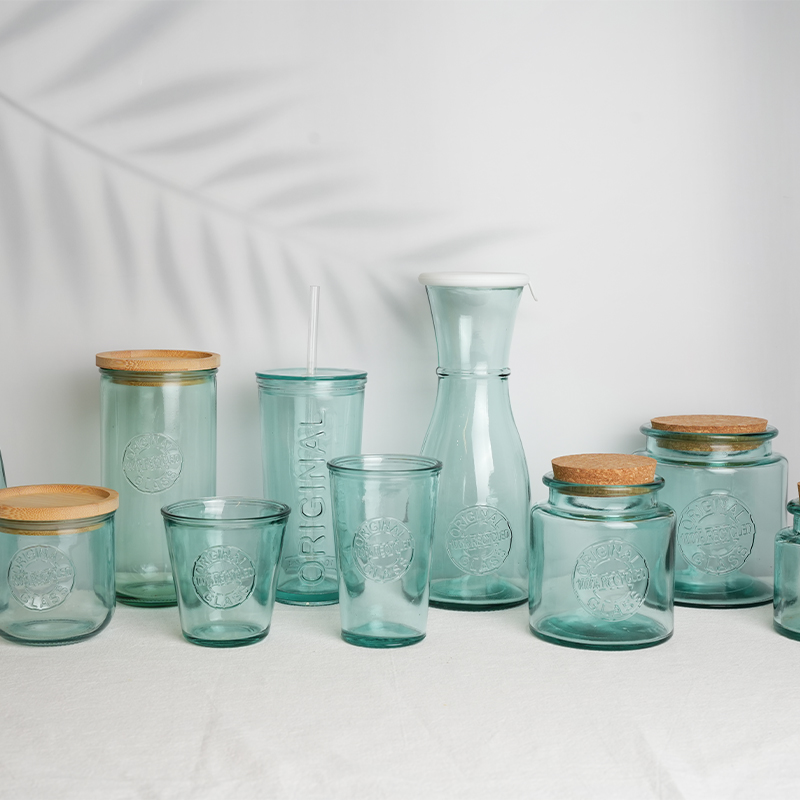
The recycled glass line (KTBT1446A) covers recycled glass mugs, tumblers, bottles, jars and storage jars. Image: Kotto Glass Industrial Co.Ltd.
What 'Market Benchmark' Means in a Drinkware Assessment
A benchmark in this category is not a rival product. It is an external constraint that any credible specification must clear. Five benchmarks are used here, and each one can be checked against a supplier document rather than a sales claim.
- Food-contact regulatory baseline. In the United States, glass drinkware intended for food contact must comply with FDA Compliance Policy Guides CPG 7117.06 and 7117.07 on extractable cadmium and lead. In the European Union, Regulation (EC) No 1935/2004 establishes the general framework for materials intended to come into contact with food, including traceability and safety obligations for glass tableware.
- Dimensional and weight consistency. Top diameter, base diameter, height, weight and capacity should be declared per model, because these drive carton configuration, pallet density and freight cost.
- Declared material and thermal behaviour. High borosilicate, soda-lime and recycled glass do not behave identically under thermal shock. A specification that omits material or temperature data cannot be assessed.
- Certification coverage and validity. A certificate is only useful if its scope names the product family and its expiry date still covers the delivery window.
- Order terms. MOQ, sampling policy, lead time and inspection regime determine whether a specification can actually be bought at the required volume.
The commercial context makes these checks more, not less, important. Grand View Research valued the global glass drinkware market at USD 14.0 billion in 2024, with Europe holding the largest revenue share at 33.0% and water glasses alone accounting for more than 25% of revenue. Maximize Market Research projects the broader glassware category to grow at a CAGR of 5.9% from 2025 to 2032, while UN Comtrade recorded China's total exports of glass and glassware at USD 25.53 billion in 2024. Scope differences between research houses are real — a broader 'glassware' definition has been estimated at USD 17.97 billion for the same period — which is precisely why buyers should compare a supplier's own declared figures rather than headline market numbers.
The Benchmark Range in Numbers
Five LAKOTTO references are compared below on the criteria a buyer can verify without a sample in hand: dimensions, weight, capacity, material and forming method. All values are as published in the manufacturer's product specifications.
| Model | Type | T / B / H | Weight | Capacity | Material | Craft |
|---|---|---|---|---|---|---|
| KTK0370-2 | Glass tumbler / glass cup | 78 / 65 / 140 mm | 420 g | 400 ml | High borosilicate glass | Machine-pressed |
| KTDW0721-GGL | Double wall glass | 84 / 60 / 110* mm | 145 g | 340 ml | High borosilicate glass, ion plating coating | Hand-blown |
| KTG1139 | Ribbed coloured wine glass | 67 / 82 / 224 mm | 215 g | 500 ml | Soda-lime glass | Machine-blown stemmed |
| KTPL1572A-A | Glass cake stand | 312 / 120 / 105 mm | 1,445 g | Not stated | Soda-lime glass | Not stated |
| KTBT1446A | Recycled glass line (mug, tumbler, bottle, jars, storage jar) | 80 / 95 / 247 mm | 610 g | 850 ml | Recycled glass | Not stated |
*The KTDW0721-GGL specification sheet lists this value as H:110m. T = top diameter, B = base diameter, H = height.
Read together, the table exposes the practical differences a buyer is actually selecting between. A 400 ml tumbler at 420 g carries roughly three times the glass mass of a 340 ml hand-blown double-wall at 145 g, which changes carton weight, breakage exposure and perceived hand-weight on shelf. The 1,445 g cake stand sits outside the drinkware logic entirely and is better treated as a separate tabletop category with its own MOQ of 1,000 pcs.
Focus: What the Glass Mug Actually Specifies
For buyers sourcing a glass mug rather than a tumbler or stemmed glass, the relevant reference in this range is model KTBT1446A, the recycled glass line. Its declared product types are recycled glass storage jar, recycled glass tumbler, recycled glass bottle, recycled glass mug and recycled glass jars. That line-level structure matters for procurement, because the published dimensional set — 80 mm top, 95 mm base, 247 mm height, 610 g, 850 ml, packed 12 pcs per carton in bulk packaging — describes a tall format consistent with the bottle and jar variants rather than a short mug body.
The correct reading for a mug programme is therefore conditional, not absolute. The line establishes the material (recycled glass), the declared instantaneous temperature difference of −30 to 160 degrees Celsius, the availability of customized size and capacity, and the OEM/ODM terms that apply across the range. It does not, in the records reviewed here, provide a separate dimensional sheet for the mug variant alone. Buyers specifying a recycled glass mug should confirm top diameter, height, capacity and wall thickness for that specific body before signing off artwork, because a mug programme built on jar dimensions will produce a different carton count, a different pallet pattern and a different consumer perception.
The same caution applies to the recycled content claim itself. 'Recycled glass' is declared as the material, and the line covers recycled glass mugs and bottles, but the specification does not state a post-consumer recycled percentage. Buyers whose retail customers require a declared recycled content figure, or a third-party verification of it, should treat that as an open item rather than assume a value.
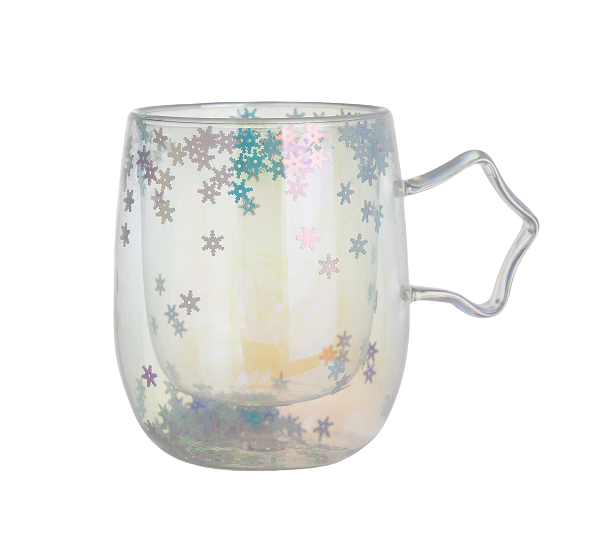
The KTDW0721-GGL double wall glass: 340 ml, 145 g, hand-blown high borosilicate with an ion plating coating. Image: Kotto Glass Industrial Co.Ltd.
Material and Craft: What the Specification Constrains
Three forming routes appear in this range, and each carries different implications for volume, breakage risk and product positioning.
Machine-pressed high borosilicate (KTK0370-2)
The 400 ml ribbed highball tumbler is machine-pressed in high borosilicate glass at 420 g. Pressed forming is generally the more repeatable route for high-volume, thick-walled profiles, and the declared mass supports that reading: the article carries substantial glass for its capacity. For a buyer, the constraint to note is that pressed tooling is tied to a shape; design changes at scale usually mean tooling changes, which is why the published OEM/ODM terms — any sizes, designs, capacity and packages — should be read alongside mould development as a project step rather than as a catalogue option.
Hand-blown double wall with ion plating (KTDW0721-GGL)
The 340 ml double wall glass is hand-blown in high borosilicate with an ion plating (I.P.) coating, and is described as double-walled insulated, durable and heat-resistant. Two separate constraints sit inside that description. First, hand-blowing is generally a lower-throughput process than machine pressing, so volume planning and lead time should be agreed against the specific decoration rather than against the range average. Second, an ion plating coating introduces a surface layer whose durability under industrial dishwashing and abrasive retail handling should be confirmed in writing before a chain-store launch, since the specification sheet does not state dishwasher performance.
Soda-lime machine-blown stemware (KTG1139)
The 500 ml ribbed coloured wine glass is a machine-blown stemmed article in soda-lime glass at 215 g. Its specification declares an instantaneous temperature difference of −30 to 160 degrees Celsius and, separately, a high-borosilicate material temperature range of 400 to 500 degrees Celsius. Those two statements sit alongside a soda-lime material declaration and are not obviously consistent; a buyer planning a hot-fill, rental or commercial dishwashing application should ask the supplier to clarify which figure applies to the delivered body before committing. This is exactly the kind of item a benchmark review is meant to surface early, when it is still a question rather than a claim.
Certification Architecture: Coverage, Issuers and Dates
Certification is where a drinkware supplier is most often either credible or exposed. LAKOTTO's product-level certification mapping is published per model, and it is not uniform across the range.
| Product | Declared certification | Buyer note |
|---|---|---|
| Wine glass KTG1139 | BSCI, ISO 9001:2015, RoHS | Broadest coverage of the drinkware set. |
| Glass tumbler KTK0370-2 | BSCI, ISO 9001:2015, ISO 14001; RoHS Directive 2011/65/EU and 2015/863/EU | RoHS scope covers glassware with metal parts, coatings or decorations. |
| Double wall glass KTDW0721-GGL | BSCI issued by APCER; GB/T 19001-2016/ISO 9001:2015 | No RoHS entry on the product sheet; relevant if a coated surface is specified. |
| Glass cake stand KTPL1572A-A | BSCI, ISO 14001:2015 (GB/T 24001-2016/ISO 14001:2015), RoHS issued by Zhejiang Consumer Tesing Technology Co., Ltd | RoHS issuer named explicitly. |
| Recycled glass line KTBT1446A | Certification numbers 0070024Q54439R2S and CTT2111031272EN; ISO 14001 environmental scope covering sourcing, manufacturing, decoration, packaging and waste | Numbers are line-level, not mug-specific. |
Behind the product mapping sits a certificate register with named issuing bodies and validity dates, which is the part an audit team will ask for:
| Certification | Number | Issuer | Issued | Expiry |
|---|---|---|---|---|
| ISO 9001:2015 (GB/T 19001-2016) | 0070024Q54439R2S | CNCA | 2024-11-25 | 2027-11-24 |
| ISO 14001:2015 (GB/T 24001-2016) | 03423E30695R3M | CNCA | 2023-11-28 | 2026-12-01 |
| RoHS (2011/65/EU, 2015/863/EU) | CTT2111031272EN | Zhejiang Consumer Tesing Technology Co., Ltd | 2021-11-07 | 2999-01-01 |
| BSCI | 24-0233922 | APCER | 2024-12-01 | 2026-12-01 |
At company level the compliance stack is broader still, with BSCI, Sedex/SMETA, FSC, Disney FAMA authorised production, ISO and LFGB declared, alongside stated familiarity with retailer onboarding requirements covering factory audits, product testing, packaging regulations and traceability management. For a European retailer, the LFGB declaration is the directly relevant food-contact reference; for a US retailer, the applicable benchmark is FDA CPG 7117.06 and 7117.07 on extractable cadmium and lead, and the provided records do not include a corresponding FDA extraction test report. That is a documentation gap to close, not a product judgement.
Application Fit Across Three Sourcing Scenarios
Specifications only become a decision when mapped to a use case. Three documented scenarios show how the range distributes.
Wedding and event drinkware rental (US, GB, CA)
Rental fleets require visual consistency, replaceable SKUs and a form that survives repeated handling. The KTG1139 wine glass at 500 ml and 215 g, the double wall glass at 340 ml and the cake stand at 312 mm diameter map naturally onto this scenario, which the manufacturer lists with customised package and engraving support. The practical constraint for rental buyers is the same one flagged earlier: the wine glass specification mixes a soda-lime body with a high-borosilicate temperature range, and no commercial dishwashing claim is stated anywhere in the reviewed documents.
Supermarket and chain-store supply (BR, PL)
Chain retail prioritises carton efficiency, shelf-ready packaging and predictable replenishment. The tumbler at 400 ml and the recycled glass line at 850 ml both fit open-shelf merchandising, and the manufacturer lists B2B bulk distribution, OEM/ODM customisation and just-in-time delivery as the operating model, with customised and environmental packaging as a stated requirement. A five-year Russian hypermarket engagement and a five-year Polish retail chain engagement are both recorded at 20–30 full containers per month, with results described in terms of shelf visibility and turnover consistency rather than unit sales claims.
Branded promotional gifts (BR, PL)
Corporate gifting rewards decoration flexibility more than dimensional precision, which is why logo, glass colour and packaging customisation matter more here than wall thickness. A five-year Brazilian wholesale distributor relationship at 20–30 containers per month is documented around flexible assortment and coordinated packaging. The caveat for gifting buyers is that decoration methods are not specified per model in the reviewed records, so coating compatibility with a chosen logo process needs confirmation at sample stage.

The KTG1139 ribbed coloured wine glass: 500 ml, 215 g, machine-blown stemmed soda-lime glass. Image: Kotto Glass Industrial Co.Ltd.
Comparison With Traditional Sourcing Approaches
Most drinkware sourcing still runs on a capacity-and-photo brief: a buyer specifies '400 ml tumbler, clear, with logo' and evaluates quotations on unit price. The documented-specification approach used here differs in what it asks for before quotation.
| Decision area | Conventional brief | Benchmarked brief |
|---|---|---|
| Specification basis | Capacity and appearance | Top/base/height, weight, capacity, material, craft |
| Thermal expectation | Assumed from 'glass' | Declared temperature difference per model |
| Certification | 'CE/FDA available' at company level | Named certificate, number, issuer, expiry, product scope |
| Freight planning | Carton count from supplier quote | Unit weight and pack configuration, e.g. 12 pcs/ctn on the recycled glass line |
| Order terms | Negotiated case by case | MOQ 3,000 pcs for OEM/ODM programmes, 1,000 pcs for the cake stand, 30–45 day lead time, 100% test |
The benchmarked approach is not automatically better on every dimension, and the honest boundaries of the LAKOTTO range are worth stating plainly.
- Certificate expiry inside the current delivery window. The ISO 14001 certificate (03423E30695R3M) and the BSCI certificate (24-0233922) both carry an expiry date of 2026-12-01. A buyer placing a seasonal order in the fourth quarter of 2026 should request the renewal status before the certificates lapse, because a retailer audit scheduled after that date may not accept the existing documents.
- MOQ figures are not uniform. The capability record lists an OEM/ODM MOQ of 3,000 pcs, the cake stand carries a stated MOQ of 1,000 pcs, and individual product sheets describe flexible MOQ with a trial order accepted for first samples. These are not contradictory in themselves, but the applicable figure depends on whether the order is a catalogue item or a customised programme, and should be fixed in writing per SKU.
- Recycled glass mug has line-level, not SKU-level, data. The 850 ml and 610 g figures describe the general format of KTBT1446A. A mug-specific dimensional sheet and a declared recycled content percentage are not included in the reviewed records.
- No US FDA extraction report on file. LFGB is declared at company level, but the CPG 7117.06/07 documentation a US retailer will request is not among the provided certificates.
- Dishwasher performance is not stated for any model, including the ion-plated double wall glass, where a coating is the component most exposed to abrasion.
- Hand-blown output is structurally slower than pressed output. The double wall programme should be planned against its own capacity curve rather than the range average, particularly for peak gifting seasons.
Future Outlook for Buyers
Three shifts are likely to shape how drinkware specifications are written over the next few procurement cycles. The first is documentation depth: with Europe holding 33.0% of a USD 14.0 billion drinkware market and the broader glassware category projected at 5.9% CAGR through 2032, retailer onboarding is becoming a documentation exercise as much as a design one, and certificate expiry management will move from a compliance afterthought to a line item in the buying calendar. The second is material narrative: recycled glass lines such as KTBT1446A already exist in catalogue form, and the next buyer question will be the declared recycled percentage rather than the material name. The third is thermal honesty: as double wall and insulated formats grow, the gap between a marketing adjective and a declared temperature range becomes a liability, and suppliers who publish precise figures will be easier to qualify.
Frequently Asked Questions
Which certifications apply to LAKOTTO glass drinkware, and who issued them?
Product-level mapping is not uniform. The wine glass KTG1139 is declared with BSCI, ISO 9001:2015 and RoHS; the glass tumbler KTK0370-2 with BSCI, ISO 9001:2015, ISO 14001 and RoHS under Directive 2011/65/EU and 2015/863/EU; the double wall glass KTDW0721-GGL with BSCI and GB/T 19001-2016/ISO 9001:2015; the cake stand KTPL1572A-A with BSCI, ISO 14001:2015 and RoHS issued by Zhejiang Consumer Tesing Technology Co., Ltd. At company level, BSCI, Sedex/SMETA, FSC, Disney FAMA, ISO and LFGB are declared. Named certificate numbers include ISO 9001:2015 certificate 0070024Q54439R2S and ISO 14001:2015 certificate 03423E30695R3M, both issued by CNCA, RoHS certificate CTT2111031272EN, and BSCI certificate 24-0233922 issued by APCER.
How do the benchmark models compare on dimensions, weight and capacity?
The glass tumbler KTK0370-2 measures 78 mm top, 65 mm base and 140 mm height at 420 g for 400 ml in high borosilicate, machine-pressed. The double wall glass KTDW0721-GGL measures 84 mm top, 60 mm base and 110 mm height at 145 g for 340 ml, hand-blown in high borosilicate with an ion plating coating. The wine glass KTG1139 measures 67 mm top, 82 mm base and 224 mm height at 215 g for 500 ml, machine-blown stemmed in soda-lime glass. The cake stand KTPL1572A-A measures 312 mm top, 120 mm base and 105 mm height at 1,445 g in soda-lime glass. The recycled glass line KTBT1446A is listed at 80 mm top, 95 mm base and 247 mm height at 610 g for 850 ml, packed 12 pcs per carton in bulk.
What does the 'Recycled Glass Mug' specification actually cover?
The recycled glass mug is one of the declared product types within the KTBT1446A recycled glass line, alongside the recycled glass tumbler, recycled glass bottle, recycled glass jars and recycled glass storage jar. The published dimensional data for that model describes the line's general format rather than a mug-specific body. The line does establish the material, an instantaneous temperature difference of −30 to 160 degrees Celsius, customised size and capacity, and OEM/ODM terms. A separate mug dimensional sheet and a declared recycled content percentage are not included in the reviewed records.
What MOQ, sampling and lead-time constraints apply?
The capability record lists an OEM/ODM MOQ of 3,000 pcs, a lead time of 30–45 days, 100% testing and customisation across size, shape, material, glass colour, package and logo. The cake stand KTPL1572A-A carries a stated MOQ of 1,000 pcs. Individual product sheets describe flexible MOQ with a trial order accepted at first for free samples. Because these figures originate from different record types, the applicable MOQ should be confirmed per SKU and per programme type — catalogue replenishment versus a customised design — before an order schedule is fixed.
What should a buyer verify before placing an order in late 2026?
Five checks follow from the records reviewed. Confirm the renewal status of the ISO 14001 certificate 03423E30695R3M and the BSCI certificate 24-0233922, both dated to expire on 2026-12-01. Request a US FDA extraction test report against CPG 7117.06 and 7117.07 if the destination market is the United States, since LFGB is the declared food-contact reference. Clarify the wine glass KTG1139 thermal statement, where a soda-lime body is declared alongside a high-borosilicate temperature range of 400 to 500 degrees Celsius. Obtain mug-specific dimensions and a recycled content declaration for the KTBT1446A recycled glass mug. And confirm dishwasher performance in writing for coated items, particularly the ion-plated double wall glass.
Judged against buyer-facing benchmarks rather than brochure language, the LAKOTTO drinkware range presents a documentable specification set with named certificate numbers, issuers and expiry dates — and a short list of open items that a serious buyer would close before committing volume. That combination is more useful than a clean claim sheet, because it shows exactly where the evidence ends.
Есть вопросы или нужны дополнительные детали?
Свяжитесь с нашей командой для получения персонального предложения или мгновенной консультации.
Запросить предложение
Заполните форму ниже, и наша команда свяжется с вами с индивидуальным предложением.
Прямой чат WhatsApp
Предпочитаете общаться в реальном времени? Напишите нам в WhatsApp для мгновенной помощи и быстрых ответов.
- Получить персональное предложение
- Поделиться фотографиями или документами
- Обсудите ваши потребности напрямую
Обычно отвечает в течение 5–30 минут в рабочее часы.