
LAKOTTO Glass Tumbler KTK0370-2: A Spec-Level Buyer Review
Glass drinkware sourcing is now decided on documentation as much as on catalogue photography. Water glasses, the segment that includes standard tumblers and highball glasses, accounted for more than 25% of glass drinkware revenue in 2024, inside a global glass drinkware market valued at USD 14.0 billion that year (Grand View Research). In a segment that large and that freight-sensitive, a 13 mm rim-to-base taper or a 275 g difference in unit weight changes carton weight, container utilisation and shelf fit before a single unit reaches a store.
This assessment concentrates on one model: the LAKOTTO KTK0370-2 glass tumbler, a 400 ml machine-pressed high borosilicate tumbler. The wider LAKOTTO drinkware range — the KTG1139 wine glass, the KTDW0721-GGL double wall glass, the KTPL1572A-A cake stand and the KTBT1446A recycled glass series — is used as an internal benchmark set, because most buyers evaluate a tumbler as one line inside a mixed container rather than as a standalone order. All specifications, certification numbers and market figures below come from LAKOTTO product records, LAKOTTO certification documents and named third-party sources; no competitor specifications are used.
Why the tumbler is the most specification-sensitive item in a program
The tumbler is usually the highest-volume glass line in a drinkware order and the fastest to be reordered. It is also the item most exposed to freight arithmetic: a pressed tumbler that weighs 420 g consumes container capacity in a way that a 145 g double wall glass does not, and the difference compounds across tens of thousands of units. Because the unit price of a tumbler is typically thin, weight, packing format and breakage control often move the landed cost more than the quoted unit price does.
For buyers in the research and evaluation stages, the practical question is therefore not which tumbler looks best in a photograph, but which documented tumbler matches a defined fill volume, packing format, compliance file and price band. Those four variables can be checked against a specification record. This review is therefore organised around the KTK0370-2 data sheet, its certification coverage and its application records, not around visual styling.
Who supplies the KTK0370-2
LAKOTTO glass drinkware is produced by Kotto Glass Industrial Co. Ltd, a daily-use glassware manufacturer and OEM/ODM supplier established in 2003 in China. The operation runs a factory of more than 10,000 m² with approximately 100 employees, an annual output of 300,000,000 pieces and an in-house design team of 10 designers. It works with more than 150 partner glass factories in China and maintains a warehouse of more than 4,000 m² so that popular items can be shipped quickly from stock.
The commercial profile is relevant to a tumbler program. 99% of output is exported, with the EU, South America and Asia listed as main markets, and the customer base covers international retailers, household and lifestyle chain stores, importers, distributors, and beverage and promotional brands. The stated service scope includes new product design and development, mold development, customized packaging design, private label and branding, and production follow-up with quality control — the functions that determine whether a tumbler can be adapted to a retailer's own shelf specification.
On compliance, the company states it is audited and certified to BSCI, Sedex/SMETA, FSC, Disney FAMA, ISO and LFGB, and that it works to retailer onboarding requirements covering factory audits, product testing, packaging regulations and traceability. For a buyer assembling a supplier file, a supplier that already holds these audits reduces the number of separate approvals a new tumbler SKU must clear before listing.
The KTK0370-2 specification, read line by line
| Attribute | Recorded value | What it decides for a buyer |
|---|---|---|
| Model | KTK0370-2 | Item reference for quotation, sampling and repeat orders |
| Type | Glass tumbler / glass cup | Category position: volume drinkware, not stemware |
| Top diameter | 78 mm | Drinking rim width; lid, sleeve and gift-box opening dimensions |
| Base diameter | 65 mm | Coaster and shelf footprint; stability of a stacked column in carton |
| Height | 140 mm | Tall tumbler proportion; carton height and inner divider layout |
| Capacity | 400 ml | Stated item capacity; usable fill line confirmed with supplier |
| Weight | 420 g | Packed carton weight, pallet loading, freight cost per container |
| Material | High borosilicate glass | Material family; basis for thermal and durability testing requests |
| Forming | Machine-pressed glass | Dimensional consistency at volume; seam line as a cosmetic acceptance point |
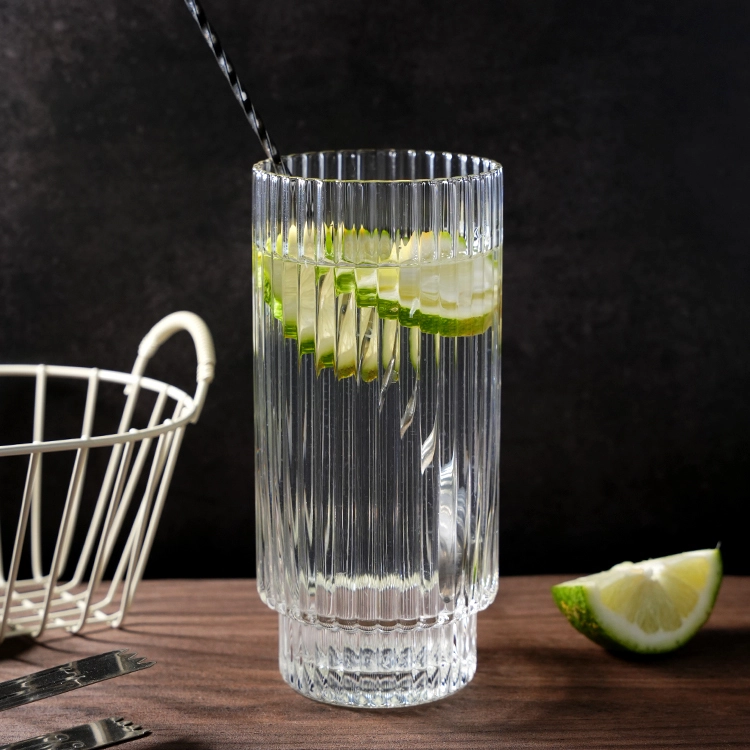
Rim and base. The 78 mm rim against a 65 mm base gives the tumbler a 13 mm taper over its height. For a buyer, the base figure is the more operational of the two: it governs coaster diameter, the footprint on a retail shelf and how stably units stack in a carton. The rim figure governs the drinking experience and, in gift or rental programs, the size of any sleeve or packaging aperture.
Height and capacity. At 140 mm tall with a stated 400 ml capacity, the KTK0370-2 sits in the tall tumbler or highball proportion rather than the short rocks proportion. The 400 ml figure is the capacity recorded for the item; buyers specifying a served volume — for example a 330 ml pour with headroom — should confirm the usable fill line with the supplier rather than assume the full capacity is the serve size. This is a normal sampling checkpoint and should be settled before packaging is tooled.
Weight. At 420 g, the KTK0370-2 is the heaviest drinking vessel in the LAKOTTO set reviewed here: the KTDW0721-GGL double wall glass is recorded at 145 g at 340 ml, and the KTG1139 wine glass at 215 g at 500 ml. Extra mass per unit affects carton weight, pallet loading, freight cost per container and the weight of the product in the hand. Buyers should price freight on the actual packed weight of the chosen packing format, not on unit capacity.
Material and forming. The tumbler is specified in high borosilicate glass and formed by machine pressing. High borosilicate is the material family most commonly requested where thermal stability is a purchasing requirement. The KTK0370-2 record does not state a thermal shock rating for this model, so a buyer with a hot-fill or dishwasher requirement should request the relevant test report rather than infer performance from the material name. Machine pressing generally delivers tighter dimensional consistency at higher output than hand blowing, but pressed items can show a mold seam, which is a cosmetic acceptance point that should be defined in the inspection standard before production.
Benchmarking the tumbler against the rest of the LAKOTTO range
Benchmarking here means comparing the tumbler against the other documented models in the same supply program, using the criteria a buyer can actually verify: dimensions, capacity, weight, material and forming method.
| Model | Item | Top / Base / Height | Capacity | Weight | Material | Forming |
|---|---|---|---|---|---|---|
| KTK0370-2 | Glass tumbler | 78 / 65 / 140 mm | 400 ml | 420 g | High borosilicate glass | Machine-pressed |
| KTDW0721-GGL | Double wall glass | 84 / 60 / 110 mm | 340 ml | 145 g | High borosilicate, ion plating (I.P.) coating | Hand-blown |
| KTG1139 | Wine glass | 67 / 82 / 224 mm | 500 ml | 215 g | Soda lime glass | Machine-blown stemmed |
| KTPL1572A-A | Glass cake stand | 312 / 120 / 105 mm | — | 1,445 g | Soda lime glass | — |
| KTBT1446A | Recycled glass series | 80 / 95 / 247 mm | 850 ml | 610 g | Recycled glass | — |
Read as a set, the figures locate the tumbler precisely. It is the mid-capacity, heaviest, machine-formed drinking vessel in the group, and it carries the volume of a mixed container. The double wall glass holds the premium position at roughly a third of the unit weight, with double-walled insulated construction, an ion plating coating and a stated durable and heat-resistant feature. The wine glass carries the gifting and event position at 500 ml and 215 g. The recycled glass record lists an 850 ml capacity at 610 g packed 12 pieces per carton in bulk packaging, and lists an instantaneous temperature difference tolerance of −30 °C to 160 °C. The cake stand is the outlier for logistics: at 1,445 g and 312 mm across, it is a freight-planning decision as much as a shelf decision, and its record states an MOQ of 1,000 pieces.
For assortment planning, the practical sequence is: set the tumbler first because it drives volume and freight, then decide whether the double wall glass earns its shelf space as a hot-drink or premium add-on, then use the wine glass and cake stand to extend the program into gifting and tableware without starting a second supplier file.
Certification evidence a buyer can verify
| Certification | Number | Issuer | Standard / scope | Valid to |
|---|---|---|---|---|
| BSCI | 24-0233922 | APCER | BSCI; covers glassware production including drinking glasses, tumblers, highball glasses and wine glasses | 2026-12-01 |
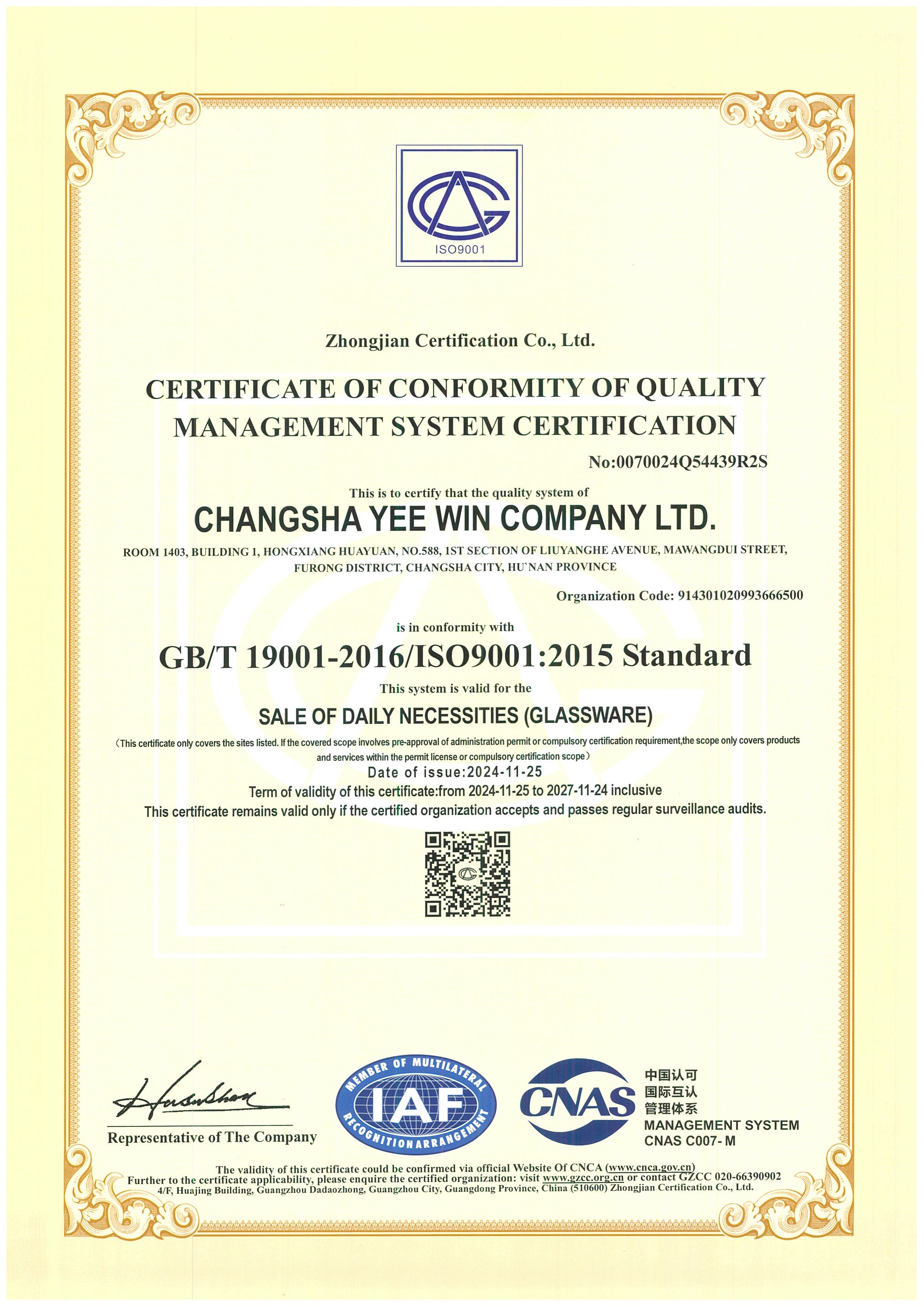
| ISO 9001:2015 | 0070024Q54439R2S | CNCA | GB/T 19001-2016 / ISO 9001:2015; design, manufacturing and quality management, including customized items | 2027-11-24 |
| ISO 14001:2015 | 03423E30695R3M | CNCA | GB/T 24001-2016 / ISO 14001:2015; environmental aspects from material sourcing to waste management | 2026-12-01 |
| RoHS | CTT2111031272EN | Zhejiang Consumer Tesing Technology Co., Ltd | RoHS Directive 2011/65/EU and amendment 2015/863/EU; XRF scanning, PBBs and PBDEs, phthalates | No expiry listed |
Scope reading matters as much as the certificate number. The RoHS certification covers glassware with metal parts, coatings or decorations, and it is linked in the records to the tumbler, the double wall glass, the wine glass, the recycled glass series and the cake stand. A plain undecorated tumbler is not, by itself, the object of that scope statement. Buyers specifying a decal, a coating or metal trim should confirm in writing that the decoration falls inside the certified scope, because decoration is exactly where restricted-substance questions arise.
ISO 9001:2015 applies to design, manufacturing and quality management of the glassware range, including customized items — the relevant certificate when a tumbler is customized in size, glass colour, logo or packaging. ISO 14001:2015 covers environmental aspects of production across material sourcing, manufacturing processes, surface decoration, packaging and waste management, which is increasingly a retailer onboarding question rather than an end-consumer one.
Two market-entry frameworks sit alongside these certificates and are not replaced by them. Inside the EU, Regulation (EC) No 1935/2004 sets the general framework for materials intended to come into contact with food and requires traceability and safety for glass tableware. In the US, food-contact glass drinkware must comply with FDA Compliance Policy Guides CPG 7117.06 and 7117.07 on extractable cadmium and lead. RoHS is a restricted-substances certification, not a food-contact regulation, which is why it sits alongside food-contact testing rather than instead of it.
Application fit: where a 400 ml pressed tumbler works
Supermarket and chain-store supply
Chain programs buy a tumbler as a repeatable, shelf-stable SKU. LAKOTTO's application records for supermarket and chain-store supply cover Brazil and Poland, with B2B bulk distribution, OEM/ODM customization and just-in-time delivery listed as operating modes, and customized or environmental packaging plus international-standard approval as special requirements. A Poland-based retail chain has purchased glassware with matching packaging for five years at 20–30 full containers per month; a Russia-based hypermarket chain has run a comparable five-year program at the same monthly volume; and a Brazil-based wholesale distributor has done the same over five years, using a flexible assortment with customizable packaging to broaden its offer to local retailers. For the KTK0370-2 specifically, volumes of that order make MOQ, packing format and carton weight — not decoration — the lead negotiation points.
Branded and promotional programs
Custom promotional gift programs for corporate events, brand marketing, holiday gifting and client retention are recorded for Brazil and Poland, with customized package and design plus international-standard approval as the stated requirements. LAKOTTO's capability record lists size, shape, material, glass colour, packaging and logo among customizable fields, which defines the available scope for a branded tumbler order. A 400 ml straight-walled pressed tumbler at 140 mm height gives a predictable print or decoration area and a stable base for gift-box tooling, and the 420 g weight reads as a substantial item in a gift context — a deliberate trade-off against freight cost.
Wedding and event rental
Drinkware for wedding rental is recorded for the US, GB and CA, with customized packaging and engraving as requirements. In rental fleets, two specification points matter more than styling: unit weight, because it affects handling and transport between venues, and dimensional consistency, because replacement units must match existing stock. The machine-pressed forming method supports the second point; the 420 g weight is the constraint to plan around.
Market context behind the specification choices
The global glass drinkware market was valued at USD 14.0 billion in 2024, with Europe holding the largest revenue share at 33.0% (Grand View Research). Water glasses accounted for more than 25% of revenue in the same year — the segment the KTK0370-2 competes in. Maximize Market Research projects the broader glassware category, which includes drinkware, to grow at a CAGR of 5.9% from 2025 to 2032. China's total exports of glass and glassware reached USD 25.53 billion in 2024 (UN Comtrade), which frames the supply capacity available to European and North American buyers.
Definitions matter when these figures are quoted in a business case. Grand View Research sizes glass drinkware at USD 14.0 billion for 2024, while Maximize Market Research places the broader glassware category at USD 17.97 billion. The gap reflects scope rather than disagreement between sources, and a buyer citing either number should cite the definition with it.
Limits and conditions of use
- MOQ is stated inconsistently across records. The capability record lists a general MOQ of 3,000 pieces, while the product record describes MOQ as flexible and offers free samples with a trial order accepted first. Buyers should have the MOQ for the specific tumbler configuration confirmed in writing at quotation rather than rely on either statement alone.
- Lead time is 30–45 days. That window leaves little margin for a fixed promotional or seasonal on-shelf date, so sampling and artwork approval should be scheduled backwards from the delivery date.
- Unit weight is a real cost. At 420 g per unit, the KTK0370-2 is roughly three times the unit weight of the 145 g double wall glass. On high-volume programs, the freight difference can outweigh a small unit-price difference, and the comparison should be made on landed cost.
- Pressed construction has a cosmetic consequence. A mold seam can be visible on pressed items. It is not a defect unless the inspection standard says so, which is why the acceptance criteria should be written before the first production run.
- Thermal performance is not documented for this model. The record states high borosilicate material but no thermal shock rating for the KTK0370-2. Buyers with hot-fill, dishwasher or rapid temperature-change requirements should request test data. Where documented heat retention is the requirement, the record positions the double wall glass as the explicit option, described as double-walled insulated and heat-resistant.
- RoHS coverage is conditional on decoration. The certificate applies to glassware with metal parts, coatings or decorations; undecorated glass is governed by food-contact rules instead.
- Two certificates fall due in the current cycle. BSCI and ISO 14001:2015 both expire on 1 December 2026, so renewal evidence should be requested during onboarding.
- No unit prices appear in the product records. Price band must be established through quotation, and the variables a buyer can control directly are packing format, order volume and freight weight rather than the listed specification.
Future outlook
Two forces are shaping how tumblers are bought. The first is volume: with water glasses above a quarter of glass drinkware revenue and Europe holding a 33.0% share, the tumbler remains the item that anchors a drinkware container, and projected growth of 5.9% CAGR for the broader glassware category through 2032 keeps pressure on supply capacity rather than on demand. The second is documentation. Retailer onboarding now asks for audit validity dates, decoration-level restricted-substance coverage and packaging regulation compliance as standard items, which favours suppliers that hold current certificates and can map them to specific models. For buyers, the practical implication is that specification sheets and certificate registers will keep gaining weight relative to catalogue styling when a tumbler program is awarded.
Frequently asked questions
What are the exact dimensions and capacity of the LAKOTTO KTK0370-2 glass tumbler?
The KTK0370-2 is recorded with a top diameter of 78 mm, a base diameter of 65 mm, a height of 140 mm, a capacity of 400 ml and a weight of 420 g. The material is high borosilicate glass and the forming method is machine-pressed glass.
Which certifications cover the LAKOTTO glass tumbler?
Four certifications are recorded against the tumbler: BSCI certificate 24-0233922 issued by APCER, valid to 1 December 2026; ISO 9001:2015 certificate 0070024Q54439R2S issued by CNCA, valid to 24 November 2027; ISO 14001:2015 certificate 03423E30695R3M issued by CNCA, valid to 1 December 2026; and RoHS certificate CTT2111031272EN issued by Zhejiang Consumer Tesing Technology Co., Ltd. At company level, the supplier also states BSCI, Sedex/SMETA, FSC, Disney FAMA, ISO and LFGB certification.
What MOQ and lead time apply to an order?
The capability record states a general MOQ of 3,000 pieces and a lead time of 30–45 days, with 100% testing and customization available in size, shape, material, glass colour, packaging and logo. The product record for the tumbler describes MOQ as flexible and states that a trial order is accepted first with free samples. Because the two statements differ, the applicable MOQ should be confirmed per configuration at quotation.
Does the tumbler material suit hot drinks?
The tumbler is made of high borosilicate glass, but the KTK0370-2 record does not state a thermal shock range or a heat-resistance rating for this model. The range item explicitly described for heat performance is the KTDW0721-GGL double wall glass, recorded as double-walled insulated, durable and heat-resistant, at 340 ml and 145 g. A buyer requiring a documented thermal specification for the tumbler should request the corresponding test report.
How does food-contact compliance differ from RoHS for decorated tumblers?
They address different risks. Food-contact compliance for the EU is framed by Regulation (EC) No 1935/2004, which requires traceability and safety for materials in contact with food; in the US, food-contact glass drinkware must comply with FDA Compliance Policy Guides CPG 7117.06 and 7117.07 on extractable cadmium and lead. RoHS certification CTT2111031272EN addresses restricted substances under Directive 2011/65/EU and amendment 2015/863/EU and applies to glassware with metal parts, coatings or decorations. A decorated tumbler therefore needs both, while an undecorated one is governed by food-contact requirements.
Assessment basis: LAKOTTO product specification records for models KTK0370-2, KTDW0721-GGL, KTG1139, KTPL1572A-A and KTBT1446A; LAKOTTO certification records; LAKOTTO application and customer program records; Grand View Research, Maximize Market Research and UN Comtrade figures as cited. No competitor specifications or prices are included, and no performance figure has been estimated.
Есть вопросы или нужны дополнительные детали?
Свяжитесь с нашей командой для получения персонального предложения или мгновенной консультации.
Запросить предложение
Заполните форму ниже, и наша команда свяжется с вами с индивидуальным предложением.
Прямой чат WhatsApp
Предпочитаете общаться в реальном времени? Напишите нам в WhatsApp для мгновенной помощи и быстрых ответов.
- Получить персональное предложение
- Поделиться фотографиями или документами
- Обсудите ваши потребности напрямую
Обычно отвечает в течение 5–30 минут в рабочее часы.