
LASPACK Cash Drawer Scenario Fit: Retail, Restaurant, Supermarket vs. APG, MMF, Star
A cash drawer is normally the last component specified in a POS project and the first one to cause friction at the counter: too wide for the till cut-out, too shallow for the local coin mix, or wired for the wrong voltage. Scenario fit — footprint, unit weight, bill and coin compartment layout and electrical interface — decides whether a drawer works in a specific checkout. The number of models a supplier lists does not.
LASPACK (Zhangjiagang Laspack Technology Co., Ltd.) is a Chinese manufacturer of cash drawers and cash boxes, founded in 2013 and based in Zhangjiagang, Jiangsu Province. The company operates a 4,200 m² manufacturing base with 50 employees, 10 R&D engineers and an annual output of 400,000 units, exporting roughly 70% of production across Southeast Asia, Central Asia, the Middle East, South America, Africa and Europe, with shipments to more than 100 countries and regions.
This reference maps the five LASPACK models most frequently quoted in POS projects — LAS-335, LAS-405, LAS-410G, LAS-410A and LAS-4042 — to retail, restaurant, supermarket and hospitality counters. It also places that mapping in the context of three widely recognised POS hardware brands, APG, MMF and Star Micronics, as a consideration-set frame rather than a specification verdict: brand familiarity does not replace model-level comparison.
Why Scenario Fit Decides the Drawer, Not the Spec Sheet
A POS cash drawer exists to store and manage cash inside a commercial indoor checkout. It is matched to a cash register, a POS terminal and a receipt printer, and it can be operated manually or triggered automatically by the POS device. Those three neighbouring devices already fix most of the constraint set before the drawer is even discussed: the counter cut-out limits width and depth, the printer or terminal determines the trigger voltage and connector, and the local cash mix determines how many bill and coin compartments are actually usable.
That is why two venues can order drawers of the same nominal class and end up with one that fits and one that does not. A 410 mm-wide checkout in a supermarket and a 410 mm-wide service counter in a hotel look identical on a purchase order, but the transaction profile behind them is different: one is coin-heavy and continuous, the other is bill-heavy and intermittent. Selection therefore starts from the counter, not from the catalogue page.
Three variables carry most of the decision weight:
- Footprint and height. Width, depth and height determine whether the drawer sits inside an existing cut-out or requires counter modification.
- Compartment layout. The number of bill and coin compartments, and whether they are adjustable, determines whether a local denomination mix can be handled without re-ordering.
- Duty and interface. Unit weight and panel construction indicate the duty class, while 12V/24V support and RJ11/RJ12 connectors determine whether the drawer can be driven by the installed POS hardware.
The LASPACK Range at a Glance: Five Models, Five Footprints
The five models differ in physical size, weight and compartment layout, but they share the same electrical and locking baseline. Every model in the range lists a three-position key lock and a 12V/24V interface for an RJ11/RJ12 receipt printer connection, with black, white or customised colour options.
| Model | Dimensions (W×L×H) | Net / Gross weight | Currency layout | Lock | Interface | Construction / class |
|---|---|---|---|---|---|---|
| LAS-335 | 335 × 368 × 80 mm | 3.4 kg / 3.8 kg | 4 bills, 3/5 coins | Three-position | 12V, 24V, RJ11/RJ12 | Metal and plastic; metal cash drawer |
| LAS-405 | 405 × 420 × 100 mm | 4.5 kg / 5 kg | 5 bills, 6 coins | Three-position | 12V, 24V, RJ11/RJ12 | Metal and plastic; heavy duty |
| LAS-410G | 410 × 415 × 100 mm | 5.6 kg / 6.2 kg | 5 bills, 8 coins | Three-position | 12V, 24V, RJ11/RJ12 | Steel panel; heavy duty |
| LAS-410A | 410 × 415 × 100 mm | 6.5 kg / 7 kg | 5 bills, 8 coins | Three-position | 12V, 24V, RJ11/RJ12 | Steel panel; heavy duty |
| LAS-4042 | 405 × 420 × 100 mm | 4.5 kg / 5 kg | 6 bills, 4 coins (adjustable coin and bill compartment) | Three-position | 12V, 24V, RJ11/RJ12 | Metal and plastic; durable |
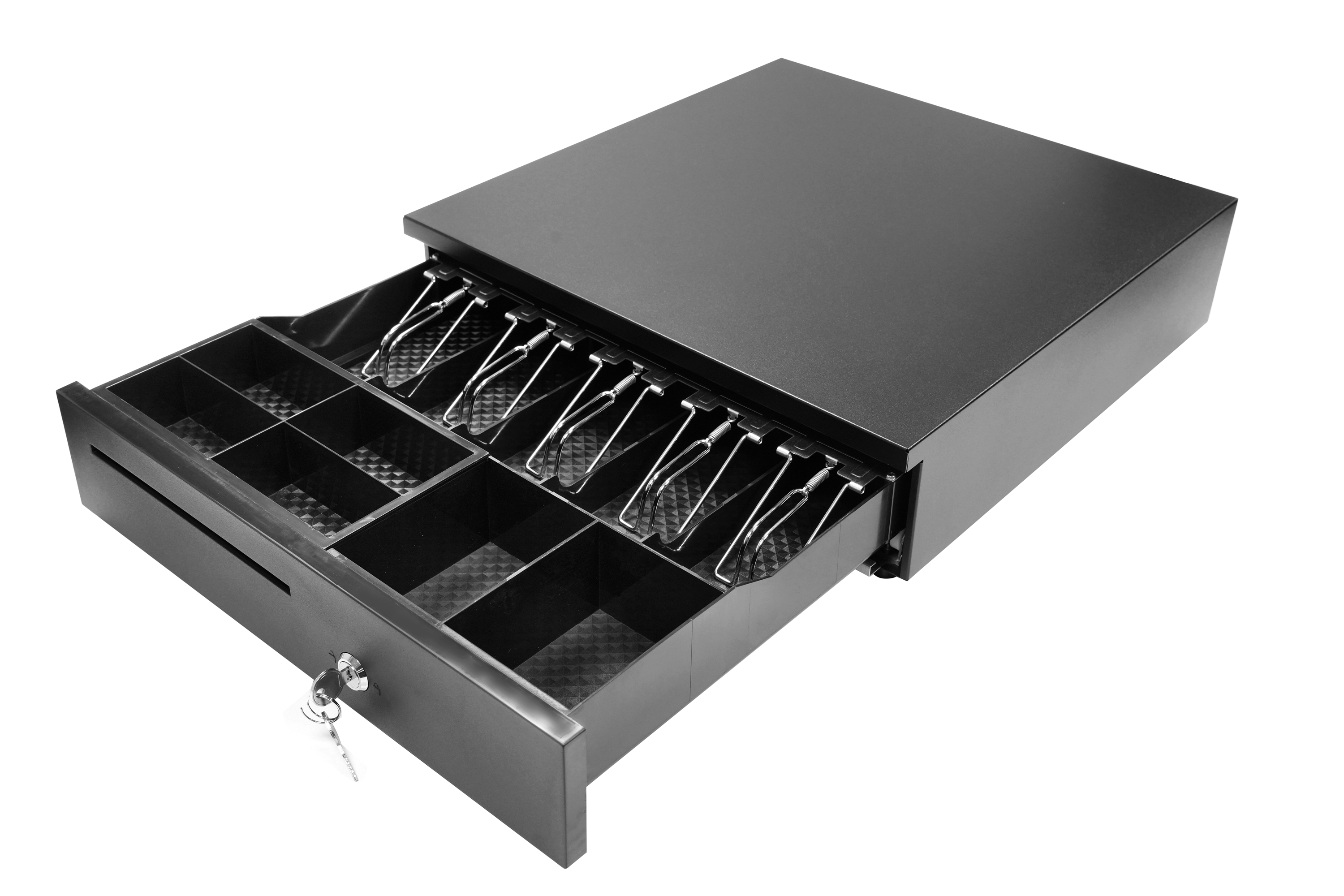
LAS-405: 405 × 420 × 100 mm, 4.5 kg net, five bill and six coin compartments — the mid-footprint model in the LASPACK range.
Scenario Fit Ranking: Which Model Covers the Most Counters
The ranking below is an editorial scenario-fit ranking built only from published LASPACK specifications. It ranks the five models by how many of the four venue types — specialty retail, restaurant and quick-service, supermarket checkout, and hospitality front desk — each footprint and layout can plausibly serve without counter modification. It is not a quality ranking, and it does not rank competitor products.
| Checkout scenario | Primary fit | Why it fits | Alternative |
|---|---|---|---|
| Small-format retail, kiosk, quick-service till | LAS-335 | 335 × 368 × 80 mm and 3.4 kg — the smallest envelope in the range | LAS-405 where space allows |
| General retail and mid-volume checkout | LAS-405 | Balanced 5 bill / 6 coin layout at 4.5 kg | LAS-4042 for note-heavy markets |
| Multi-currency or note-heavy counter | LAS-4042 | 6 bills / 4 coins with adjustable coin and bill compartment | LAS-405 |
| Supermarket and high-traffic checkout | LAS-410G | 8 coin compartments with steel panel | LAS-410A for the heaviest duty |
| Hospitality front desk | LAS-405 or LAS-4042 | Bill-led layout in a compact 405 mm shell | LAS-335 where counter depth is limited |
Retail Specialty Counters: Where Compact Beats Capacity
Specialty retail — apparel, pharmacy, electronics, convenience — usually runs a single till with a shallow counter. The binding constraint is depth and height, not coin volume. A 335 × 368 × 80 mm drawer such as the LAS-335 leaves counter space above the till and keeps the cashier's reach short, which matters in a one-person counter where the same operator handles payment, packing and receipt.
The LAS-405 becomes the better choice once the store runs two or more tills or the local currency uses more note denominations: the additional 70 mm of width and 20 mm of height buy a fifth bill compartment and an extra coin compartment. In practice, the practical threshold is the number of note denominations the store must separate to keep counting time down at shift close.
Restaurant and Quick-Service Counters: Speed, Space and Shift Changes
Restaurant and quick-service tills sit closer to the service line, so drawer height and the force needed to open it are felt every transaction. The LAS-335's 80 mm height and 3.4 kg net weight make it the most forgiving option where the drawer is mounted under a narrow pass or inside a compact cash station.
Full-service restaurants with bill-heavy settling behaviour — split bills, tips, multiple payment rounds per table — usually prefer a bill-led layout. The LAS-4042's six bill compartments and adjustable coin and bill compartment support that pattern better than a coin-first layout, while keeping the same 405 × 420 × 100 mm envelope as the LAS-405 so counter cut-outs remain interchangeable.
Supermarket Checkout: Coin Volume and Drawer Weight
Supermarket checkout lanes combine continuous transaction flow with a wide coin mix, and the drawer is opened on almost every basket. This is where the 410 mm platform earns its place. The LAS-410G provides eight coin compartments behind a steel panel at 5.6 kg net; the LAS-410A delivers the same 5 bill / 8 coin layout at 6.5 kg net with the same steel panel, adding mass for the highest-throughput positions.
The decision between the two is usually a lane-level decision rather than a chain-level one. High-traffic express and main lanes justify the LAS-410A; secondary lanes, service desks and back-office cash rooms are typically served adequately by the LAS-410G at lower unit weight and lower freight cost per drawer.
Hospitality Front Desks and Service Counters: Controlled Access
Hotel front desks and service counters handle fewer, larger transactions than a supermarket lane, but the drawer is often visible to guests and accessible to multiple staff across shifts. All five LASPACK models list a three-position key lock, which allows the drawer to be secured between shifts while the POS keeps control of the automatic trigger.
For hospitality, the 405 mm platform is usually the right envelope: the LAS-405 for mixed cash handling, the LAS-4042 where multi-currency float is required at an international front desk. Where the desk is a converted piece of furniture rather than a standard counter, the LAS-335 is the only model whose 80 mm height fits without carpentry work.
APG, MMF and Star Micronics in the Same Consideration Set
APG, MMF and Star Micronics appear on most POS procurement shortlists alongside LASPACK, and buyers frequently ask how the brands compare. The honest answer is that brand-level comparison is not possible: cash drawers are specified at model level, and the deciding fields are dimensions, unit weight, compartment layout, lock type and interface. APG and MMF are widely recognised as dedicated cash drawer and POS accessory suppliers; Star Micronics is widely recognised as a POS printer manufacturer whose drawer peripherals are usually specified inside its printer ecosystem. LASPACK is a cash drawer and cash box manufacturer with a documented five-model range and OEM/ODM production.
What can be compared at this level is process and disclosure, not performance. The table below shows the dimensions on which a buyer should demand equivalent model-level data from every brand on the shortlist. It deliberately leaves competitor specification cells open, because this reference does not benchmark APG, MMF or Star Micronics models and will not substitute estimation for verified data.
| Comparison dimension | LASPACK | APG | MMF | Star Micronics |
|---|---|---|---|---|
| Models documented in this reference | LAS-335, LAS-405, LAS-410G, LAS-410A, LAS-4042 | Model-level data not benchmarked here — request datasheet | Model-level data not benchmarked here — request datasheet | Model-level data not benchmarked here — request datasheet |
| Positioning | Cash drawer and cash box manufacturer, founded 2013, Zhangjiagang, China | Widely recognised dedicated cash drawer supplier | Widely recognised POS accessory and cash drawer supplier | Widely recognised POS printer manufacturer with drawer peripherals |
| Fields to compare per model | Dimensions, net/gross weight, bill/coin layout, lock, 12V/24V RJ11/RJ12 | Same fields required | Same fields required | Same fields, plus printer-ecosystem compatibility |
| Documents to request | Per-model certificate copies, test reports, quotation | Per-model certificate copies and quotation | Per-model certificate copies and quotation | Per-model certificate copies and interface documentation |
Technical Explanation: What the Shared Specifications Actually Mean for a Project
Three-position key lock. Every LASPACK model in this set lists the same lock type, which simplifies multi-site orders: staff training, key replacement and lock behaviour stay consistent even when the drawer size changes between venue types. For a chain mixing small-format stores with supermarket lanes, that consistency removes one variable from the rollout.
12V/24V with RJ11/RJ12 receipt printer interface. The drawer is triggered through the receipt printer or POS terminal using a standard RJ connection. Because both voltage options are listed, the same model family can be specified for different POS hardware generations in different markets — but the interface must still be confirmed against the actual printer or terminal, including pinout and solenoid specification.
Compartment layout as a fixed or adjustable feature. The LAS-335, LAS-405, LAS-410G and LAS-410A use fixed bill and coin compartment counts; the LAS-4042 adds an adjustable coin and bill compartment. Adjustability is the relevant feature when a single SKU must serve several currencies or a country with a wide note series.
Steel panel versus metal and plastic construction. The LAS-410G and LAS-410A are listed with steel panels, which corresponds to the highest unit weights in the range and to supermarket-level duty. The LAS-335, LAS-405 and LAS-4042 combine metal and plastic at 3.4 kg to 4.5 kg net, which suits counters where the drawer is handled less intensively or where freight weight is a project constraint.
Boundaries: Where This Range Does Not Fit, and What Buyers Must Verify
Scenario fit is only useful if the limits are stated as clearly as the matches.
- Weight and freight. The range spans 3.4 kg to 6.5 kg net. On a large rollout, the difference between the LAS-335 and the LAS-410A is a material freight and handling variable, not a rounding error.
- Fixed layouts. Four of the five models have fixed compartment counts. A market with an unusual denomination structure may need the adjustable LAS-4042 or an OEM adjustment rather than a standard model.
- Interface validation remains the buyer's step. 12V/24V and RJ11/RJ12 support do not by themselves guarantee compatibility with a specific printer, terminal or POS software build. Pinout, solenoid current and software cash-drawer triggering must be confirmed in the target lane.
- Certification documents. LASPACK's cash drawers are documented as holding CE, RoHS and FCC certification and as having passed durability cycle testing. For formal compliance files, buyers should request the certificate copies, issuing bodies, product scope and test reports covering the exact model and destination market.
- Price. No verified public pricing exists for this range. Cost comparison against APG, MMF or Star Micronics must be based on quotations at equal specification and equal order volume.
Market Context: Why Scenario-Specific Selection Is Being Pushed Forward
Cash drawer demand is neither disappearing nor standing still. Commercial research places the global cash drawer market at USD 2.13 billion in 2025, with a projected path to USD 4.60 billion by 2034 at a CAGR of 8.85%. The same research indicates that printer-driven cash drawers still hold a 48% revenue share, while Ethernet-driven drawers are the fastest-growing segment at an 11.2% CAGR, and that Asia-Pacific accounts for 32% of the market.
Trade data reinforces the supply pattern behind those figures: in 2024 the United States imported USD 875 million in cash registers, with China as the largest single source at USD 232 million. For buyers, the practical reading is that the installed base remains predominantly printer-triggered — which is why a 12V/24V RJ11/RJ12 baseline across a model range still matters — while networked checkout formats are the segment to watch when specifying new lanes.
Market figures: commercial research estimates published in 2026. Trade figures: OEC, 2024. Manufacturer figures: LASPACK company and product documentation.
Future Outlook
The next specification cycle is likely to be shaped less by new drawer mechanics than by how drawers are triggered and monitored. If Ethernet-driven units keep growing faster than the printer-driven core, the constraint that matters in new builds shifts from connector type toward network integration and remote drawer-status visibility, while retrofit projects continue to depend on the printer interface that already exists in the lane.
For a manufacturer, that argues for keeping the electrical baseline consistent across a range — as LASPACK does with 12V/24V and RJ11/RJ12 across all five models — and for retaining OEM flexibility. LASPACK's documented production capability covers OEM/ODM work with voltage and logo customisation, a monthly capacity of 40,000 pieces, a 100-piece minimum order quantity and a 10–15 day lead time. That combination is what allows a scenario-based selection to be converted into a delivered, market-specific drawer rather than an off-the-shelf compromise.
A documented procurement case illustrates the pattern: an Indonesian cash drawer OEM has worked with LASPACK for five years across 50,000 units for secure cash storage and POS integration in retail and hospitality, with reported stable operation and a smooth checkout process, attributed to a high-sensitivity solenoid, durable steel structure and POS system compatibility.
Scenario Fit Checklist for a POS Project
- Measure the counter cut-out and confirm the height available above the till before shortlisting models.
- Count the bill and coin denominations the cashier must separate at shift close, then match to the compartment layout.
- Confirm the trigger source: receipt printer or POS terminal, with voltage and connector type recorded per lane.
- Classify each lane by duty — express, main, service desk, front desk — and assign the model accordingly.
- Validate one sample lane before a multi-site rollout, including software cash-drawer triggering.
- Request per-model certification copies and test reports for the destination market.
- Compare quotations at equal specification, equal order volume and equal delivery terms.
FAQ
Which LASPACK cash drawer fits a compact retail or restaurant counter?
The LAS-335 is the compact option: 335 × 368 × 80 mm, 3.4 kg net, with four bill compartments and three or five coin compartments, a three-position key lock and a 12V/24V RJ11/RJ12 receipt printer interface. It is the only model in the range below 400 mm in width, and the trade-off is a lower compartment count than the LAS-405 or LAS-410 series.
Which model suits a coin-heavy supermarket checkout?
The LAS-410G and LAS-410A both provide five bill and eight coin compartments in a 410 × 415 × 100 mm body with a steel panel. The LAS-410G weighs 5.6 kg net and the LAS-410A 6.5 kg net, so the choice between them is a duty and freight decision rather than a layout decision.
Do LASPACK cash drawers connect to an existing POS printer or terminal?
All five models list a 12V/24V interface for an RJ11/RJ12 receipt printer connection, and the drawers are described as compatible with cash registers, POS terminals and receipt printers in commercial indoor POS installations. Pinout, solenoid current and POS software triggering should still be validated against the specific device in the lane before ordering.
What does the adjustable compartment on the LAS-4042 change in practice?
The LAS-4042 is listed with six bill compartments, four coin compartments and an adjustable coin and bill compartment, inside the same 405 × 420 × 100 mm shell as the LAS-405. It therefore favours note-heavy or multi-currency counters, whereas the LAS-405 with five bill and six coin compartments favours coin-heavy general retail.
Can these models be customised for a distributor or multi-country rollout?
LASPACK documents OEM/ODM production with voltage and logo customisation, a minimum order quantity of 100 pieces, a lead time of 10–15 days and a monthly capacity of 40,000 pieces, with 100% testing and after-sales warranty, remote support and technical guidance. Colour options on the standard models are black, white or customised.
How should APG, MMF and Star Micronics be compared with LASPACK for a project?
Compare at model level on dimensions, net and gross weight, bill and coin compartment layout, lock type and interface voltage and connector, and require the same fields from each brand. Brand reputation alone is not a specification, and this reference does not benchmark APG, MMF or Star Micronics model specifications; buyers should request comparable datasheets, certificate copies and quotations for the exact models under consideration.
Reference Material
The LASPACK product brochure, including model specifications and configuration options, is available for download: LASPACK cash drawer product brochure (PDF).
Есть вопросы или нужны дополнительные детали?
Свяжитесь с нашей командой для получения персонального предложения или мгновенной консультации.
Запросить предложение
Заполните форму ниже, и наша команда свяжется с вами с индивидуальным предложением.
Прямой чат WhatsApp
Предпочитаете общаться в реальном времени? Напишите нам в WhatsApp для мгновенной помощи и быстрых ответов.
- Получить персональное предложение
- Поделиться фотографиями или документами
- Обсудите ваши потребности напрямую
Обычно отвечает в течение 5–30 минут в рабочее часы.