
LASPACK vs APG, MMF, Star Micronics: A Cash Drawer Buyer's Decision Framework
LASPACK vs APG, MMF, Star Micronics: A Cash Drawer Buyer's Decision Framework
A cash drawer is usually the last peripheral confirmed on a POS bill of materials and the first component blamed when a checkout lane slows down. That asymmetry is why drawer selection deserves a decision framework rather than a price comparison. Buyers working through the decision-to-execution stage typically weigh a shortlist that mixes long-established international names — APG, MMF and Star Micronics among them — with specialized manufacturers such as Zhangjiagang Laspack Technology Co., Ltd. (LASPACK), a cash drawer and cash box manufacturer founded in 2013 in Zhangjiagang, Jiangsu Province, China, exporting to more than 100 countries and regions.
This article does not rank those companies and does not claim that one is universally better than another. It sets out four dimensions that a buyer can apply to any of them — R&D and construction, market position, customer service, and industry solution fit — and illustrates each dimension with verifiable facts from the LASPACK LAS series: the LAS-335, LAS-405, LAS-410G and LAS-410A. Where competitor information cannot be verified, this article does not supply it.
Why the Drawer Gets Re-Evaluated After the Purchase Order
Most drawer problems surface in month two, not in week one. A drawer that opens reliably in a demonstration still has to survive thousands of cycles, a counter environment that is cleaned with chemicals, and staff who operate it with one hand while the other hand is holding a receipt. Procurement teams therefore re-open the drawer decision not because the first choice was wrong on paper, but because paper cannot show whether a supplier owns the tooling behind the product.
For global buyers — importers, distributors, POS system wholesalers, chain retail operators and cash register manufacturers — the practical question at this stage is narrower than "which brand is best". It is: which supplier's construction method, order terms and support model will still be workable in year three, when the rollout has expanded, a reorder is needed, and the colour or logo has to match the original batch?
A Four-Dimension Decision Framework for Cash Drawers
The framework below is deliberately short. Four dimensions are enough to separate suppliers whose products look similar in a catalogue but behave differently in operation.
| Dimension | What it actually decides | Evidence a buyer should request |
|---|---|---|
| 1. R&D and construction | How the drawer behaves after thousands of open/close cycles, and whether the body resists deformation | Body material and panel construction, lock architecture, in-house mould development, cycle-test documentation |
| 2. Market position | Supply continuity, order-size fit, and whether the supplier is a specialist or a broad-line vendor | Manufacturer type, monthly and annual capacity, export footprint, reference customer categories |
| 3. Customer service | How much friction a rollout absorbs — customisation, interface matching, order terms | Colour and logo options, packaging customisation, interface standards, pre-shipment testing, MOQ and payment terms |
| 4. Industry solution fit | Whether the model suits the venue's transaction pattern and counter geometry | Size class, bill and coin compartment layout, voltage and trigger interface, placement under counter |
Dimension 1 — R&D and Construction: Steel Panel, Three-Position Lock and Mould Ownership
Construction is the dimension that buyers find hardest to verify and the one that most affects lifetime cost. The most visible dividing line in the category is body material. Steel panel bodies are used where structural rigidity under repeated impact matters; plastic-bodied alternatives exist at lower weight and lower cost, and they suit deployments where the drawer is opened infrequently.
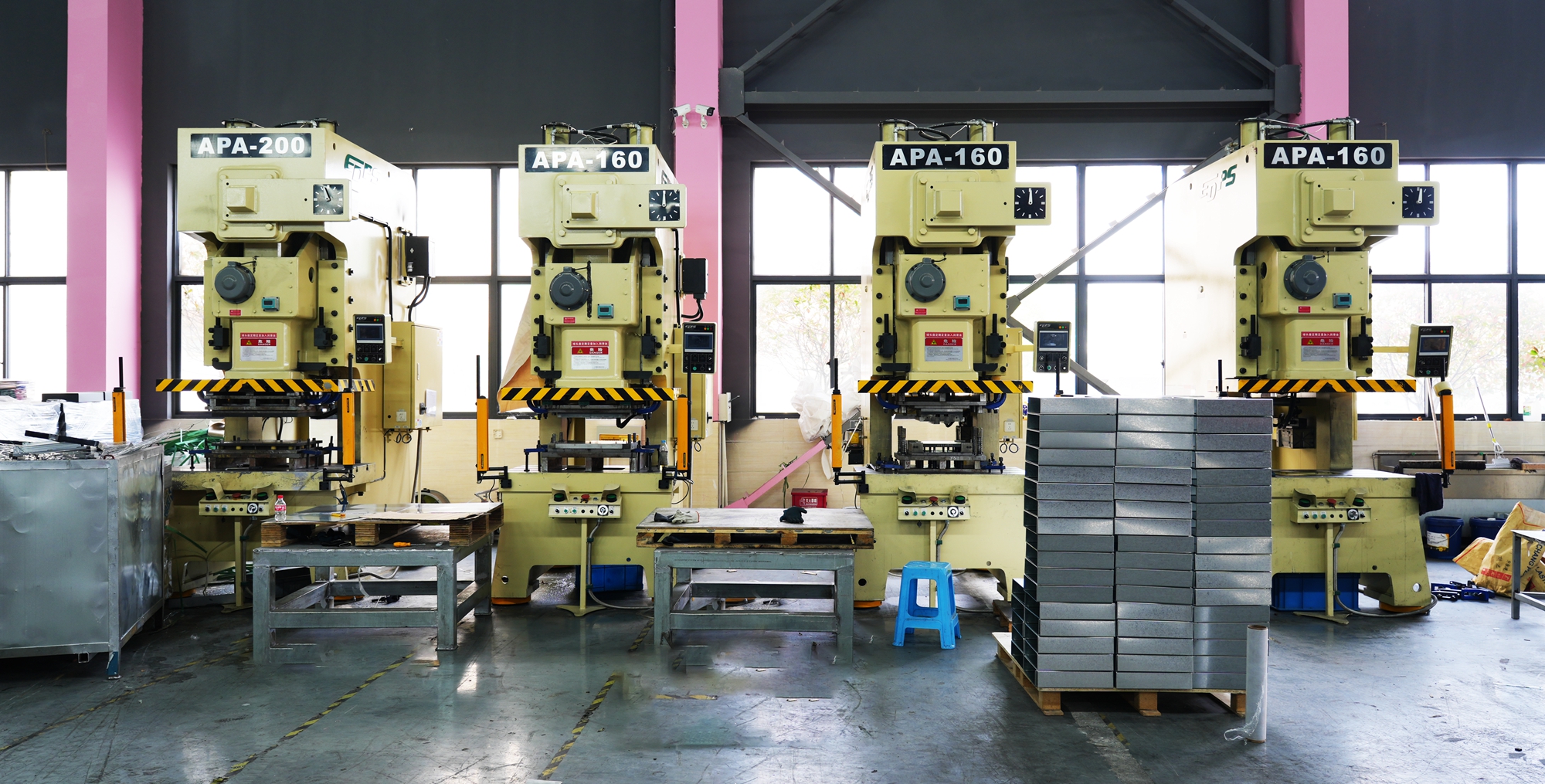
LASPACK's production model is vertically oriented: the company states that product design and mould development through to processing and production are carried out in-house and through its cooperative factory network, supported by an R&D team of 10 engineers and a 4,200 m² manufacturing facility. For a buyer, in-house mould ownership matters for a specific reason — it determines whether a custom housing, an unusual compartment layout, or a colour change is a normal engineering request or a third-party negotiation.
The LAS series uses a three-position lock rather than a two-state locked/unlocked design. In practice this gives the operator three distinct key positions instead of a binary choice, which allows a venue to separate secured, manually operated and electronically released states — useful for shift changes and for counters that are staffed by different people across the day.
LAS series specifications at a glance
| Model | External dimensions | Net weight | Bill compartments | Coin compartments | Interface |
|---|---|---|---|---|---|
| LAS-335 | 335 × 368 × 80 mm | 3.4 kg | 5 | 6–8 | 12V/24V, RJ11/RJ12 |
| LAS-405 | 405 × 420 × 100 mm | 4.5 kg | 5 | 6–8 | 12V/24V, RJ11/RJ12 |
| LAS-410G | 410 × 415 × 100 mm | 5.6 kg | 5 | 6–8 | 12V/24V, RJ11/RJ12 |
| LAS-410A | 410 × 415 × 100 mm | 6.5 kg | 5 | 6–8 | 12V/24V, RJ11/RJ12 |
Two observations follow from the table. First, the LAS-410G and LAS-410A share the same 410 × 415 × 100 mm footprint but differ in net weight — 5.6 kg and 6.5 kg respectively — which tells a buyer that the two models are built to different internal specifications even though their outer envelope is identical. Second, the LAS-335 is a genuinely compact 335 × 368 × 80 mm unit at 3.4 kg, which changes the counter-space calculation rather than the compartment count.
Dimension 2 — Market Position: Specialized Manufacturer vs Broad-Line POS Brand
Public industry listings of the best-known cash drawer manufacturers typically name APG Cash Drawer, Star Micronics, M-S Cash Drawer, Posiflex and NCR Corporation, reflecting the wide peripherals portfolios those companies carry. MMF is another long-standing name in the cash drawer and POS peripheral category. General-purpose buyers often start from this type of list.
The distinction that matters commercially, however, is not fame but manufacturer type. Broad-line brands distribute engineering effort across printers, scanners, terminals and drawers; specialized manufacturers concentrate on cash handling products. LASPACK sits in the second group: the company's product scope is cash drawers and cash boxes, with an annual output of 400,000 units and a stated monthly production capacity of 40,000 pieces.
Scale of this kind is not the same as the scale of a multinational peripherals group, and it should not be presented as such. What it does indicate is supply continuity for mid-volume programmes — a distributor ordering in container quantities, or a chain rolling out several hundred lanes across a region, is operating well inside a 40,000-unit monthly envelope. LASPACK also records a 70% export ratio and markets across Southeast Asia, Central Asia, the Middle East, South America, Africa and Europe, having supplied listed companies, chain supermarkets, POS system wholesalers and cash register manufacturers.
A useful secondary signal is whether a manufacturer publicly explains how it classifies its own products against industry durability bands. APG Cash Drawer, for example, has published the widely cited distinction between "Standard Duty" drawers rated for 1 million cycles and "Heavy Duty" drawers rated for 4 million or more cycles. Buyers should ask every shortlisted supplier — specialist or broad-line — to state which band its quoted model falls into, because the answer determines whether the drawer is being specified for a low-traffic back office or a busy front-of-store lane.
Dimension 3 — Customer Service: Customisation, Interface Support and Order Terms
Service in this category is mostly invisible until something has to change. Three service questions separate suppliers that can absorb a change from suppliers that cannot.
Customisation depth
LASPACK provides full customisation according to customer requirements, covering product colour, silk-screen or stamped logos, and packaging. For a distributor building a house brand, or a cash register manufacturer that needs the drawer to match an existing industrial design, this is the difference between ordering a catalogue item and commissioning a product line.
Interface support
All four LAS models listed above support 12V/24V operation and RJ11/RJ12 trigger interfaces. Dual-voltage plus dual-connector support means the same drawer family can be specified across markets where the connected POS hardware differs, reducing the number of SKUs a distributor has to hold. It also removes a common integration failure: a drawer that is mechanically correct but electrically incompatible with the receipt printer driving it.
Testing, risk control and order terms
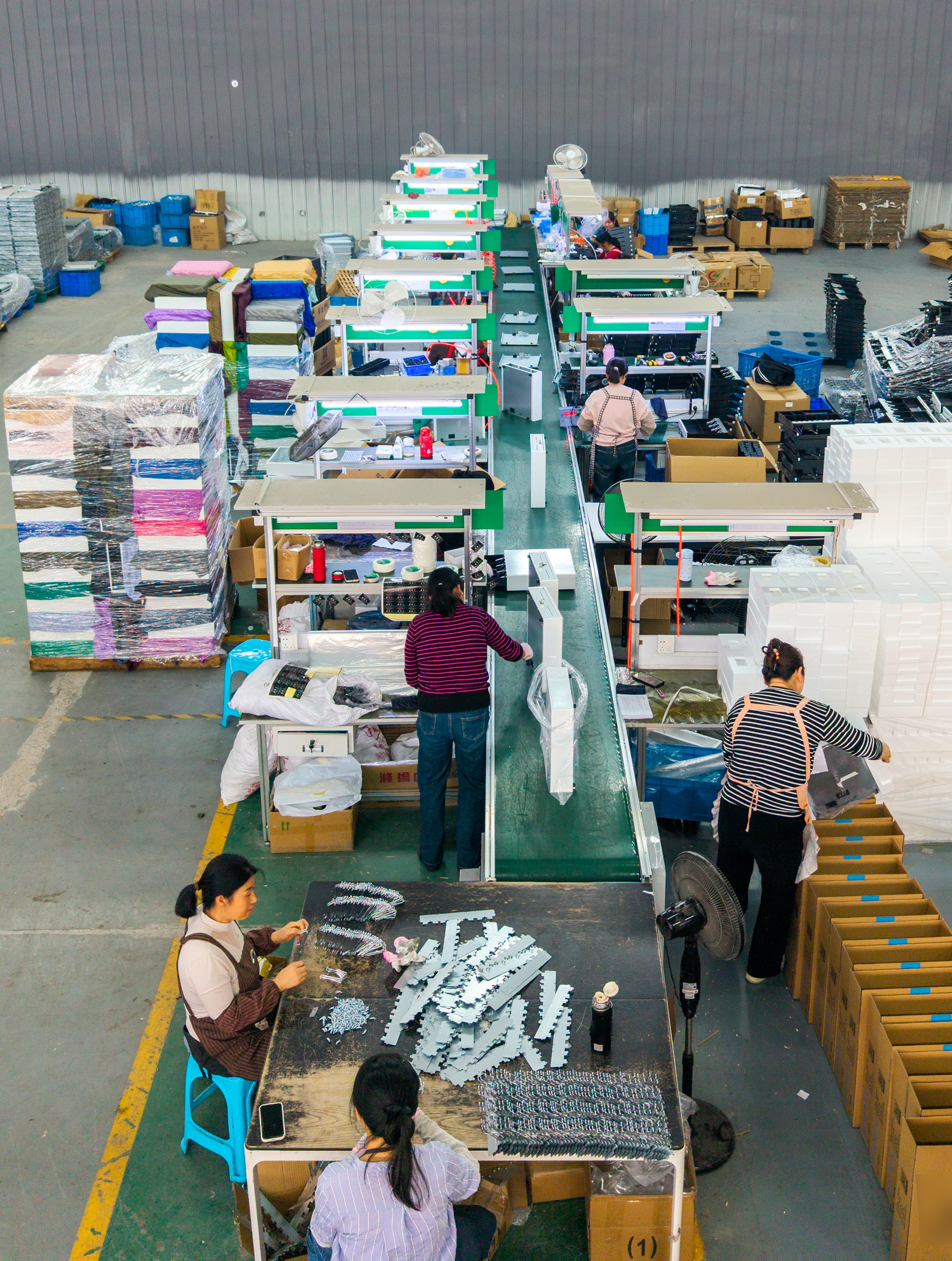
LASPACK applies overcurrent protection as the control method for mechanical failure risk, and runs a 100% pre-shipment functional test as its acceptance measure. The company's drawers hold CE (certificate M2506016AY-C0127), RoHS (M2506016AY-C0128) and FCC certifications, and are certified for 1,000,000 cycles of durability testing.
Commercial terms are stated plainly and are worth reading with the framework in mind:
- MOQ: 100 pcs
- Delivery terms: EXW / FOB / CIF
- Acceptance criteria: pre-shipment test
- Payment terms: 30% T/T deposit, 70% T/T balance before shipment
Dimension 4 — Industry Solution Fit: Retail, Restaurant, Supermarket, Hospitality
Application fit is where the LAS series separates into a market. The four models are not four versions of the same drawer; they are sized for different transaction profiles.
| Environment | Typical demand pattern | Model consideration |
|---|---|---|
| Retail stores and boutique checkout counters | Moderate volume, limited counter depth, brand-sensitive store design | LAS-335 (compact 335 × 368 × 80 mm) where counter space is the binding constraint; custom colour and logo for house-brand programmes |
| Restaurants and catering businesses | High-frequency small-value transactions, wet or food-handling environment near the till | LAS-405 or LAS-410G, with 5 bill and 6–8 coin compartments for fast change-making |
| Supermarkets and high-traffic lanes | Continuous transaction flow, staff shift changes, cash volume concentrated at peak hours | LAS-410A (410 × 415 × 100 mm, 6.5 kg) — the heavier build in the same 410 mm footprint |
| Hospitality and front-desk operations | Lower transaction count, higher value per transaction, visible front-of-house placement | LAS-410G or LAS-410A, with a three-position lock supporting shift-level access control |
The industry-standard width for a full-size cash drawer is 410 mm (16 inches), sized to sit under a standard thermal receipt printer. That is the footprint shared by the LAS-410G and LAS-410A, and it explains why supermarket and hospitality buyers default to that class: the drawer, the printer and the counter cut-out are dimensioned as one assembly.
Electronic drawer vs manual cash box in practice
The most common substitution a buyer evaluates is not drawer against drawer, but drawer against manual cash box. On the manufacturer's own comparison, an electric pop-up drawer with POS linkage trades slightly higher unit cost for materially better operating characteristics:
| Comparison point | Electric POS cash drawer | Manual cash box |
|---|---|---|
| Access mechanism | Electric pop-up with POS linkage | Manual, no system linkage |
| Security posture | Higher — drawer state tied to the POS transaction | Lower — access is operator-controlled only |
| Access speed | Reported 90% faster access | Baseline |
| Service life | Reported 3× longer service life | Baseline |
| Cost | Reported 3% higher cost | Baseline |
| Work efficiency | Reported 5× higher work efficiency | Baseline |
| Maintenance | Minimal maintenance, easy parts replacement, 100% power efficiency for electric operation | Not applicable |
On that basis, the electronic drawer is positioned for retail stores, supermarkets, POS checkout counters and catering businesses — environments where the drawer is opened many times per shift and where an unlogged manual opening is itself a control weakness.
Reading the Specification Sheet Correctly
Three specification items cause most of the avoidable errors in drawer procurement.
RJ11/RJ12 and 12V/24V. The trigger interface is what connects the drawer to the POS system, usually through the receipt printer. RJ11 and RJ12 are the standard connector families for this purpose. A drawer supporting both 12V and 24V, and both connector types, can be deployed across mixed hardware estates without a separate SKU for each market. For a distributor, that is inventory simplification; for a chain, it is rollout flexibility.
Compartment counts. Five bill compartments across the LAS range reflects the standard configuration for multi-denomination currencies. The 6–8 coin compartment range is where the model-to-model differences become practical: a coin-heavy environment such as a supermarket service desk or a restaurant till benefits from the upper end of that range, while a card-dominant boutique may never use it.
Cycle rating. The recognised industry bands place standard-duty drawers at 1 million cycles and heavy-duty drawers at 4 million or more. LASPACK's LAS series is certified for 1,000,000 cycles. Buyers should map that figure against their own lane throughput before quoting a durability expectation to internal stakeholders.
What the Market Data Says
Third-party market research places the global cash drawer market at approximately USD 0.855 billion to USD 0.96 billion in 2024–2025, with digital transformation in retail identified as the growth driver (Dataintelo / Global POS Cash Drawer Market Report, Market Intelo). Projections for 2033–2034 range from USD 1.23 billion to USD 1.7 billion, representing a CAGR of roughly 4.1% to 4.2%. Different research houses apply different scopes — POS-specific peripherals versus general cash handling — so the absolute figures diverge even when the growth direction does not.
Two structural signals are more useful to a buyer than the headline number. Asia Pacific held approximately 38.2% of cash drawer revenue in 2025, which reflects the region's manufacturing concentration as much as its consumption. And electronic cash drawers accounted for approximately 62.5% of total market revenue, confirming that the electrically triggered drawer tied to a POS transaction is the default specification rather than a premium option.
Read together, the trend supports a specific procurement posture: the drawer is increasingly evaluated as a linked component of the POS system rather than as a standalone box. That shifts weight toward suppliers who can document interface compatibility, cycle testing and pre-shipment verification — the third and fourth dimensions of the framework above.
Limits and Boundaries of This Framework
A framework that only lists strengths is not a decision tool. Four boundaries deserve to be stated plainly.
- Cycle rating is standard-duty, not heavy-duty. The LAS series is certified for 1,000,000 cycles, which aligns with the recognised standard-duty band. Buyers whose lane profile approaches the heavy-duty benchmark of 4 million or more cycles should validate the specification against their own throughput assumptions rather than assume the rating transfers.
- The 410 mm class is a standard envelope, not a universal one. A 410 mm drawer consumes counter depth designed around a thermal printer. Sites with shallow counters may need the 335 mm class — and should accept the resulting reduction in compartment volume as part of that trade-off.
- A cash drawer is not a safe or a vault. Drawers manage transactional access during trading hours. High-value overnight storage belongs to a different product category, and buyers should not treat a drawer's lock as equivalent to a safe's.
- International brand comparison is not fully measurable here. APG, MMF and Star Micronics operate distribution, service and stocking networks that vary by region, and this article does not compare those networks because verifiable, region-specific data is not available. Buyers should obtain lead times, local support terms and stocking positions directly from each supplier rather than inferring them from brand recognition.
Future Outlook
Three directions look reasonable to plan around. First, continued migration toward linked electronic drawers — already roughly 62.5% of market revenue — will make interface flexibility a baseline expectation rather than a differentiator, which favours suppliers who support dual voltage and dual connector standards across a single product family. Second, Asia Pacific's 38.2% revenue share suggests sourcing concentration in the region will persist, keeping manufacturer selection and factory verification central to procurement risk management. Third, as growth settles into the 4.1%–4.2% CAGR range, competition is likely to shift from unit price toward the parts of the framework that are harder to copy: mould ownership, customisation turnaround, and documented pre-shipment testing. Buyers who standardise their evaluation criteria now will be comparing suppliers on those terms sooner than the market data alone implies.
FAQ
How does a specialised cash drawer manufacturer differ from an international POS brand in a buyer's shortlist?
The practical difference is product scope rather than product quality. Broad-line POS brands such as APG Cash Drawer and Star Micronics carry wide peripherals portfolios and appear on most published manufacturer lists alongside M-S Cash Drawer, Posiflex and NCR Corporation. A specialised manufacturer such as LASPACK concentrates on cash drawers and cash boxes, with a stated annual output of 400,000 units and a monthly capacity of 40,000 pieces. Buyers typically choose a broad-line brand for ecosystem consolidation and a specialist for customisation depth, order-size flexibility and direct factory communication.
What should be verified before a cash drawer specification is locked for mass production?
Four items are verifiable and should be documented. First, body construction and lock architecture — the LAS series uses steel panel bodies and a three-position lock. Second, cycle-test evidence; the LAS series is certified for 1,000,000 cycles, which corresponds to the industry standard-duty band of 1 million cycles versus the heavy-duty band of 4 million or more cycles. Third, compliance documentation — CE (M2506016AY-C0127), RoHS (M2506016AY-C0128) and FCC. Fourth, the acceptance procedure — LASPACK applies a 100% pre-shipment functional test, with overcurrent protection used as the control method for mechanical failure risk.
What are the standard commercial terms for a cash drawer order?
LASPACK's stated terms are: MOQ 100 pcs; delivery terms EXW, FOB or CIF; acceptance criteria based on pre-shipment test; and payment of 30% T/T deposit with 70% T/T balance before shipment. Buyers planning a pilot of fewer than 100 units should account for the MOQ when scheduling, since the minimum order quantity applies to production runs rather than to evaluation samples.
How is interface compatibility confirmed between a drawer and an existing POS system?
Compatibility is defined by two parameters: voltage and trigger connector. All four LAS models — LAS-335, LAS-405, LAS-410G and LAS-410A — support 12V/24V operation with RJ11/RJ12 interfaces. Because the drawer is normally triggered through the receipt printer, the buyer should confirm the printer's drawer-kick voltage and connector type alongside the drawer specification. Dual-voltage and dual-connector support reduces the number of SKUs required when a rollout spans markets with differing POS hardware.
What are the limits of a standard-duty cash drawer compared with heavy-duty cash handling equipment?
A standard-duty drawer rated at 1,000,000 cycles is designed for normal retail and hospitality transaction volumes. Installations that approach or exceed the heavy-duty band of 4 million or more cycles fall outside that rating and should be specified differently. Separately, a cash drawer is not a security safe: it governs access during trading hours but does not provide the overnight bulk-storage protection of a safe or vault. Buyers with high cash values on site typically treat these as two distinct purchases.
How does manufacturer production capacity affect long-term rollout planning?
Monthly capacity determines how much of a rollout can be compressed into a single production window without splitting the order across batches. LASPACK's stated monthly production capacity is 40,000 pieces, with an annual output of 400,000 units and a 70% export ratio across Southeast Asia, Central Asia, the Middle East, South America, Africa and Europe. A second factor for multi-year programmes is customisation continuity — colour, silk-screen or stamped logo, and packaging options remain consistent when the manufacturer controls mould development and production internally.
Applying the Framework
None of the four dimensions produces an answer on its own. R&D and construction set the lifetime expectation; market position determines whether the supplier fits the order profile; customer service decides how much friction a rollout absorbs; and industry solution fit decides whether the drawer works in the venue it is installed in. A buyer comparing LASPACK, APG, MMF and Star Micronics should score all four dimensions per supplier, then weight them against the deployment — a supermarket chain and a boutique hotel will not weight them the same way.
The full LASPACK cash drawer range, including the LAS-335, LAS-405, LAS-410G and LAS-410A, is documented at www.laspack.com. Product specifications, certification records and manufacturing details are also collected in the downloadable catalogue: LASPACK product brochure (PDF).