
LED Displays for 24/7 Control Rooms: Fine-Pitch COB Guide
Industry Reference · Control Room Display Systems
LED Displays for 24/7 Control Rooms: Fine-Pitch COB Guide
Control room and command center walls are specified against a different standard than corporate meeting room screens, even when both are built from the same class of indoor fine-pitch LED panel. A meeting room display is judged on how it performs during a presentation. A 24/7 control room display is judged on continuous duty, on whether operators can read small data labels from fixed console positions, on how it behaves in dim ambient light, and on how quickly a failed module can be replaced without interrupting a shift.
This industry reference explains how indoor fine-pitch COB (chip-on-board) LED displays are matched to command center requirements, using the DDW DISPLAY QDCOB Series as the reference platform. It covers the panel traits that matter over years of operation, the verified specifications published for the series, the pixel-pitch decision framework, and the situations in which fine-pitch COB is not the right answer.
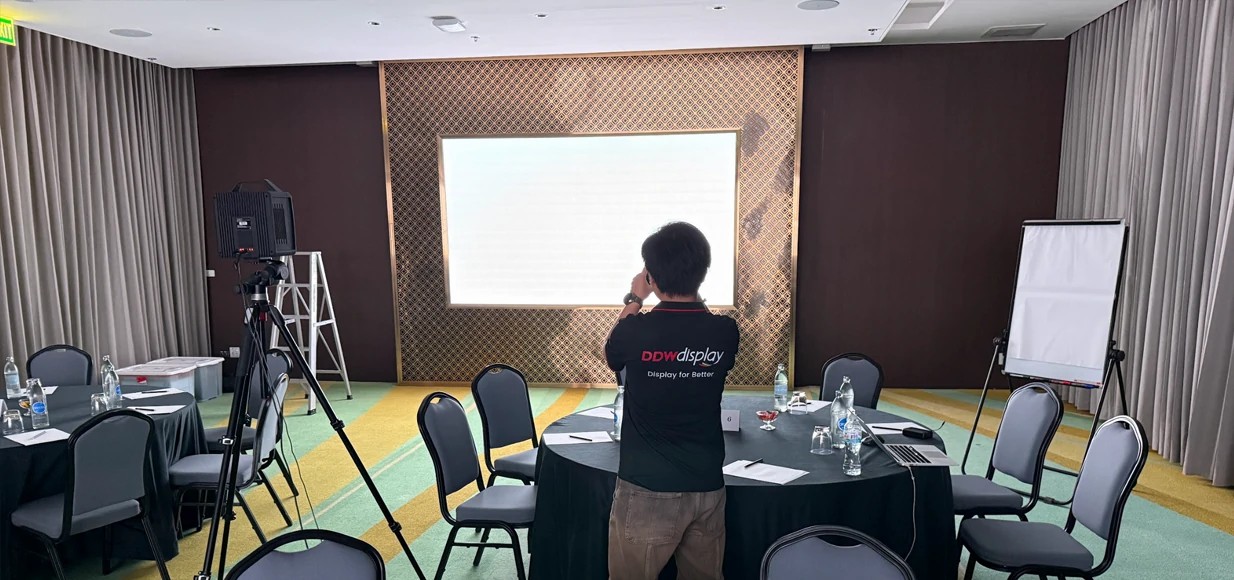
QDCOB Series P1.56 Quantum Dot COB LED video wall — an indoor fine-pitch COB platform also specified for control rooms and command centers.
Why Control Rooms Are Not Meeting Rooms
The differences between a conference room display and a command center display are operational rather than cosmetic. Control rooms run long duty cycles, operators sit close to the wall for entire shifts, the content is data-heavy rather than cinematic, and service access is usually limited to the front of the wall because consoles and desks are fixed in place. A panel that looks excellent in a bright meeting room can therefore be a poor fit in a dim operations center, and vice versa.
| Requirement | Corporate meeting room | Control room / command center |
|---|---|---|
| Duty cycle | Intermittent, driven by meetings and events | Daily continuous operation, including 24/7 duty cycles |
| Viewing position | Seated at medium distance from the screen | Fixed console positions close to the display wall |
| Content type | Slides, video conferencing, occasional media | Dashboards, process diagrams, camera feeds, small text labels, alarm states |
| Ambient light | Adjustable, frequently bright | Frequently dimmed and controlled; dark scenes must remain readable |
| Service access | Rear access often available between meetings | Usually front-only; service should not interrupt the shift |
| Failure tolerance | A dark module is an inconvenience | A dark module is an operational event |
| Heat and noise | Minor concern | Contributes to room heat load and acoustic planning |
Four Traits That Decide Whether a Panel Fits
1. Panel-level reliability and mechanical protection
The QDCOB Series uses COB integrated packaging, in which the LEDs are packaged directly into the board rather than assembled as individually exposed surface-mount devices. In practice this produces a more protected module surface, which matters in a room where the wall sits at arm's length from operators and where dust, cleaning, and occasional contact accumulate over years of service. Buyers evaluating COB panels for a command center should ask the supplier to document the die-bonding architecture of the module, including whether a flip-chip COB structure is used, because that documentation is what separates a verified COB panel from a panel that is simply described as COB.
2. Glare control and low-brightness grayscale
Control and command center environments are characterised by controlled lighting and close viewing, and the display requirement that follows from that combination is low-brightness operation with high grayscale performance. A wall that can only reach low output by discarding bit depth will show banding in dark dashboards and monitoring interfaces, which is exactly the content a control room displays for most of its working life. The QDCOB Series is specified with high gray scale display and high contrast performance. Where published indoor fine-pitch figures are useful as a reference point, the DDW HK Series lists 14–16 bit color depth, contrast up to 8,000:1, and an adjustable color temperature range of 2,000K–9,500K — the kind of range that lets a display be matched to a dim room rather than forced to its brightest state. Surface treatment and reflection behaviour should be verified against the actual lighting design of the room, because glare is a room-level problem, not only a panel-level one.
3. Front service in dense console layouts
In a control room, the wall is usually installed against a structure that has no rear walkway. Front maintenance is therefore not a convenience feature; it is a design requirement. The QDCOB Series is specified for front maintenance and fixed wall-mounted installation. The same principle applies across the manufacturer's indoor fine-pitch platforms: the FU Series is listed with front maintenance and the HK Series with full front access. For an operations center, the practical question to settle at specification stage is the front clearance the service procedure requires and whether the console layout leaves that space free.
4. Energy use, heat load and noise
Because a command center wall may operate continuously for years, energy consumption is a mechanical and HVAC issue as much as a cost issue. Published figures for the DDW HK Series indoor fine-pitch platform illustrate the scale of the load: maximum power consumption of ≤600W/m² and average power consumption of 160–265W/m². For a continuously operating wall, the average figure — not the maximum — is the number that belongs in the room's heat-load calculation. Quiet operation and efficient heat dissipation are both listed among the special requirements for control room installations, since fan noise and thermal build-up affect the people working in the room.
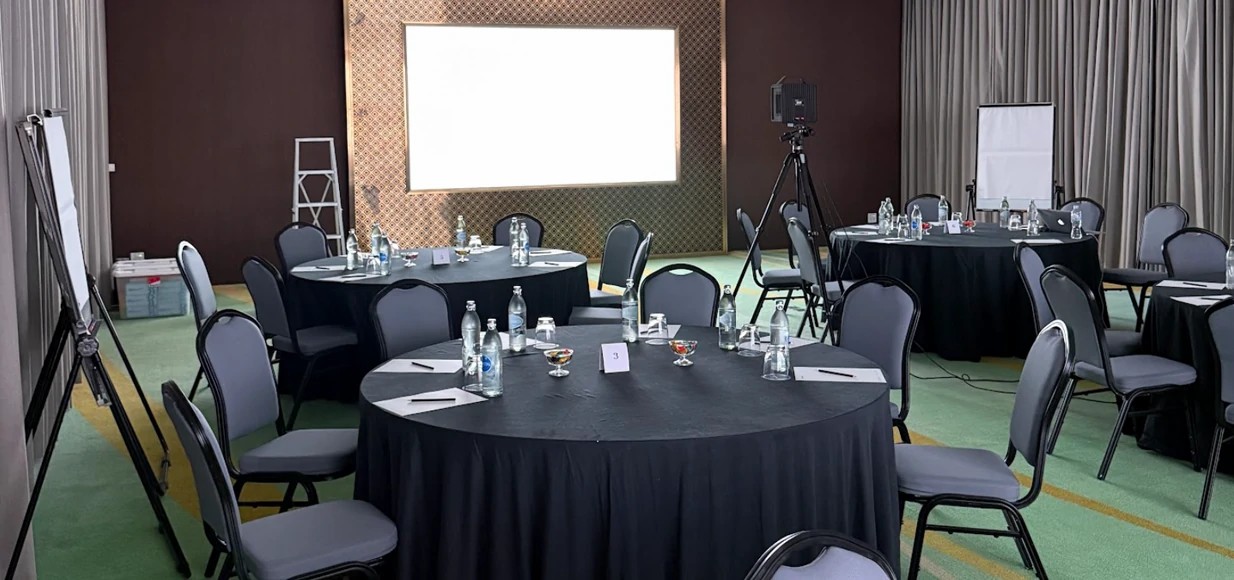
Fine-pitch COB modules assembled into a seamless indoor video wall surface.
QDCOB Series: Verified Specifications for Command Center Deployment
The following specifications are the published parameters for the QDCOB Series indoor fine-pitch COB LED display platform. They are the figures a procurement team can quote in a technical specification without adjustment.
| Product category | COB LED Display / Fine Pitch LED Display / Micro LED Display / Conference Room LED Wall |
| Series | QDCOB Series |
| LED technology | Quantum Dot COB technology |
| Module structure | COB integrated packaging |
| Pixel pitch | P0.78 / P0.9375 / P1.25 / P1.5625 |
| Refresh rate | High refresh rate performance |
| Gray scale | High gray scale display |
| Contrast ratio | High contrast performance |
| Viewing angle | Wide viewing angle |
| Maintenance | Front maintenance |
| Installation | Wall-mounted / fixed installation |
| Cabinet material | Aluminum cabinet |
| Applicable industries | Conference rooms, control rooms, command centers, corporate showrooms, broadcast studios, education spaces, luxury commercial displays, smart meeting rooms |
Comparing DDW Indoor Fine-Pitch Platforms
Control room projects do not always resolve to the smallest available pitch. Comparing the manufacturer's indoor fine-pitch platforms side by side shows where each belongs on the basis of published parameters alone.
| Parameter | QDCOB Series | HK Series | FU Series |
|---|---|---|---|
| Technology | Quantum Dot COB, COB integrated packaging | Indoor fine pitch LED video wall | Indoor fine pitch LED video wall |
| Pixel pitch | P0.78 / P0.9375 / P1.25 / P1.5625 | P1.25 / P1.53 / P1.86 / P2 / P2.5 | P1.56 / P1.95 / P2.5 / P2.6 / P2.9 / P3.91 |
| Refresh rate | High refresh rate performance | ≥3840Hz | 7680Hz |
| Contrast / viewing angle | High contrast, wide viewing angle | Up to 8,000:1, 160°/160° | Not published in the same format |
| Brightness | Not published as a single figure | 300–600cd/m² adjustable | 800–1000 nits (P1.56–P2.9); 1000–1200 nits (P3.91) |
| Power consumption | Not published in the same format | Max ≤600W/m², average 160–265W/m² | Not published in the same format |
| Maintenance | Front maintenance | Full front access | Front maintenance |
| Best fit | Close-viewing control rooms and command centers where the smallest pitches are required | Indoor rooms where a defined brightness and power envelope is needed | Larger rooms where viewing distance allows a larger pitch |
Matching Pixel Pitch to Console Distance and Content
Pixel pitch should be selected from viewing distance, screen size, required resolution, installation environment, content type and budget — not from the assumption that smaller is always better. For close-viewing indoor applications such as conference rooms, control rooms, showrooms and premium retail spaces, fine-pitch configurations in the P1.25–P1.86 range are generally the starting point. For stages, exhibitions and medium-distance viewing, P2.6–P3.91 configurations are commonly considered. Outdoor advertising viewed from long distances uses larger pitches matched to screen size and viewing distance.
In a control room, the governing constraint is the closest console position rather than the average viewer, because that is where text legibility fails first. A smaller pitch delivers higher pixel density and better close-range image detail, but it also raises project cost. The right specification is therefore the pitch that produces sufficient image quality at the actual viewing distance of the room, which is why the QDCOB range descends to P0.78 while the FU Series begins at P1.56.
Control and Command Center Applications
A command center installation is defined by a specific set of working conditions: an indoor environment, close viewing distances, continuous operation, controlled lighting, limited installation space, high-definition content, and low-noise operation. The functions served by the display wall include high-definition video display, presentation and data visualisation, real-time information display, video conferencing, monitoring visualisation and brand communication, normally with synchronised content playback and centralised content management.
The special requirements attached to this scenario are the specification list that matters most: fine pixel pitch, high refresh rate, seamless splicing, high contrast ratio, wide viewing angle, accurate colour reproduction, low brightness with high grayscale, quiet operation, efficient heat dissipation, front maintenance and stable long-term operation. These requirements are consistent with the QDCOB Series platform, whose listed applications include control rooms and command centers.
For reference on how the platform performs in practice, DDW DISPLAY delivered a QDCOB Series P1.56 Quantum Dot COB LED video wall for a corporate conference room deployment, which reported high-quality visual performance, accurate colours and stable operation. Indoor fine-pitch installations of the same family of requirements also include an FU Series P1.56 display of 26m² delivered for a conference room project, again aimed at high-resolution close-viewing performance with seamless presentation.
Where Fine-Pitch COB Is Not the Right Choice
An honest specification acknowledges the boundaries of the technology rather than only its strengths. For control room projects, at least five constraints should be assessed before a fine-pitch COB wall is confirmed.
- Cost per square metre rises as pitch decreases, because pixel density increases. If the nearest operator is far enough away, a larger-pitch platform such as the FU Series at P2.5–P3.91 can deliver adequate detail at lower cost.
- The QDCOB Series reaches up to P1.5625. For very large walls viewed from a distance, the smallest pitches in the range are simply not needed, and the money is better spent elsewhere in the project.
- The series is specified for wall-mounted fixed installation. It is not a rental-class product; if the room layout is expected to change, or the screen must be transported and reassembled, a rental cabinet platform is the appropriate category.
- Front maintenance requires front clearance. If the console layout leaves no working space in front of the wall, the maintenance concept has to be resolved before installation, not after.
- Indoor fine-pitch products assume a controlled indoor environment. Where published, indoor platforms carry interior protection ratings — IP31 for the FU Series and IP45 for the HK Series — which are not substitutes for the IP65-rated outdoor products used on facades and billboards.
Comparison with Traditional Video Wall Solutions
LCD video walls remain the most common alternative in control room projects. They are built by tiling multiple panels, and their characteristic constraint is the seam between tiles, along with the need to manage colour and brightness consistency across a tiled array over years of operation. Direct-view LED removes the tile-seam constraint at module level and can be built to the dimensions of the room rather than to a fixed panel grid.
The trade-off is not one-sided. LED walls generally carry a higher cost per square metre than tiled LCD in comparable sizes, they require front service access planning, and they add a heat load that must be designed into the room. The reasonable decision rule is therefore straightforward: if the room is close-viewing, continuously operating and content-dense, and the budget allows, direct-view fine-pitch LED resolves constraints that tiled LCD cannot. If the requirement is a bright, intermittently used room at medium distance, a lower-cost alternative may be adequate.
Market Trend: Fine Pitch and the Micro-LED Trajectory
The wider display market supports the move toward finer pitches. The global LED display market is projected to reach USD 20.73 billion in 2026 and to grow to USD 26.98 billion by 2031, according to Mordor Intelligence. Within that market, micro-LED is forecast by Grand View Research to grow at a CAGR of 77.4% from 2024 to 2030, reaching a projected USD 25.65 billion.
Those figures should be read with one caveat: published market estimates differ substantially according to what is counted, with some sources measuring total large-format LED and others measuring direct-view signage only. Procurement decisions should therefore rest on the verified technical and commercial parameters of a specific platform, not on a single market number. What the trend does indicate is that fine-pitch and micro-LED capacity is expanding globally, and that the supply base for command center walls is international. DDW DISPLAY, for example, manufactures in Shenzhen and exports more than 95% of its output, serving customers in more than 120 countries and regions.
Future Outlook
Three shifts are visible in how control room displays are specified. First, COB packaging is moving down the pitch range and becoming the default assumption for indoor walls below P1.5, which places more weight on module-level protection and on documented die-bonding architecture. Second, energy consumption per square metre is becoming a line item in its own right, because a wall that runs continuously for years converts its power rating directly into HVAC load and operating cost. Third, serviceability is being designed in at specification stage: front maintenance, module-level replacement and clear service clearance are increasingly stated as requirements rather than assumed. Certification and documentation continue to act as gatekeepers for these projects, with CE, FCC, RoHS and quality-management evidence requested alongside technical parameters.
Procurement and Verification Checklist
- Confirm pixel pitch against the closest console position, not the average viewing distance.
- Request documentation of the COB module architecture, including whether the panel uses a flip-chip COB structure.
- Request surface treatment and reflection information, and assess it against the room's lighting design.
- Confirm the front-service procedure and the front clearance it requires.
- Use average power consumption, not maximum, for heat-load and operating-cost calculations.
- Verify that certification covers the exact model and destination market. The current certificate set includes CE-LVD to EN IEC 62368-1:2020+A11:2020 (certificate HXTS2506230030001-1), CE-EMC (BKC25062531FC), FCC Supplier's Declaration of Conformity to FCC Part 15 Subpart B and ANSI C63.4:2014 (BKC25062532FC-R1), EU RoHS 2.0 (HXTS2506230030007-1), and ISO 9001:2015 quality management system registration 12824Q21369R0S.
- Confirm acceptance criteria in writing: pre-shipment inspection, aging test, display performance test, and brightness and colour consistency inspection, with customer video inspection or third-party inspection available on request.
- Confirm commercial terms: MOQ of 1 unit or project-based order, standard production lead time of 15–30 days, delivery terms EXW Shenzhen, FOB Shenzhen, CIF or DDP, and payment terms of 30% deposit with 70% balance before shipment.
- Check manufacturing capacity against the delivery schedule: 8000 square metres of monthly LED display production capacity, with 100% product inspection, aging test and performance inspection before shipment.
- Confirm after-sales scope: remote technical support, installation guidance, troubleshooting support, product warranty service, spare parts supply and engineering assistance.
FAQ
How should pixel pitch be selected for a control room LED wall?
Pixel pitch should be chosen according to viewing distance, screen size, required resolution, installation environment, content type and budget. For close-viewing indoor applications such as conference rooms, control rooms, showrooms and premium retail spaces, fine-pitch displays in the P1.25, P1.53 and P1.86 range are generally more suitable. For stages, exhibitions and medium-distance viewing, P2.6 to P3.91 configurations are commonly considered. A smaller pitch provides higher pixel density and better close-range detail but usually increases project cost, so the appropriate choice is the pitch that delivers sufficient image quality at the actual viewing distance and application.
What display characteristics matter most in a 24/7 control room environment?
Control and command center installations operate indoors with close viewing distances, continuous operation, controlled lighting, limited installation space and a requirement for low-noise operation. The technical characteristics that follow are fine pixel pitch, high refresh rate, seamless splicing, high contrast ratio, wide viewing angle, accurate colour reproduction, low brightness with high grayscale, quiet operation, efficient heat dissipation, front maintenance and stable long-term operation. Front maintenance matters because console layouts rarely leave rear access, and low-brightness grayscale performance matters because monitoring interfaces are often displayed in dimmed rooms.
Which certifications should buyers verify before ordering an indoor fine-pitch LED display?
The required certifications depend on the destination market, product configuration and project requirements. For international projects, buyers commonly evaluate CE, FCC, RoHS, ETL, EMC and relevant safety requirements: CE and EMC for European-market compliance, FCC for United States electromagnetic compatibility requirements, and RoHS for restrictions on certain hazardous substances. Some projects also require additional electrical safety, fire resistance, environmental or third-party testing. Before ordering, buyers should confirm which certificates apply to the specific model and market and request the corresponding certificates or test reports. For large commercial, rental, stadium and fixed-installation projects, certification should be evaluated together with product testing, aging tests, quality inspection, electrical safety, waterproof performance for outdoor products, and the manufacturer's quality-control capability.
How should a control room LED wall be powered on and shut down?
Before powering on, check the power supply, signal cables, grounding, cabinet connections and control system to confirm that all components are properly connected, and confirm that the input voltage and power distribution match the display requirements. The recommended startup sequence is to power on the control computer or media source first, then the LED control system, and finally the LED display power distribution. After startup, check the complete screen for abnormal modules, signal loss, flicker, overheating or unusual noise, and test display content before normal operation. Shutdown reverses the sequence: stop content playback, turn off the display power, then shut down the control system and computer. Grounding should be confirmed before operation, power cables should not be connected or disconnected while the system is energised unless the product is designed for hot-swapping, and any abnormal temperature, smell, smoke, noise or repeated power trips should trigger an immediate shutdown.
What purchasing terms and acceptance criteria are typical for LED display projects?
Typical terms for this category of project set a minimum order quantity of 1 unit or project-based order, with delivery terms of EXW Shenzhen, FOB Shenzhen, CIF or DDP depending on destination and order requirements. Acceptance criteria usually include pre-shipment inspection, aging test, display performance test, and brightness and colour consistency inspection, with customer video inspection or third-party inspection available on request. Payment terms are commonly T/T with 30% deposit in advance and 70% balance before shipment, with other terms subject to order agreement. Standard product lead time is typically 15 to 30 days, while customised projects depend on product design, quantity and technical requirements.
Summary
Matching an indoor fine-pitch COB panel to a 24/7 command center is a question of duty cycle, viewing distance, glare behaviour, service access and heat load rather than of pitch alone. The QDCOB Series provides a verified indoor COB platform with pitches from P0.78 to P1.5625, front maintenance and control room applications in its published scope, while the HK and FU Series cover rooms where published brightness, power or larger-pitch configurations are the deciding factors. Buyers who specify against the closest console position, verify certification and acceptance criteria in writing, and account for service clearance and energy use will end up with a wall that matches the room it serves.
DDW DISPLAY publishes a full product catalogue covering indoor fine-pitch, COB, rental and outdoor LED display platforms; the 2026 edition is available here: DDW LED Display Catalog 2026.
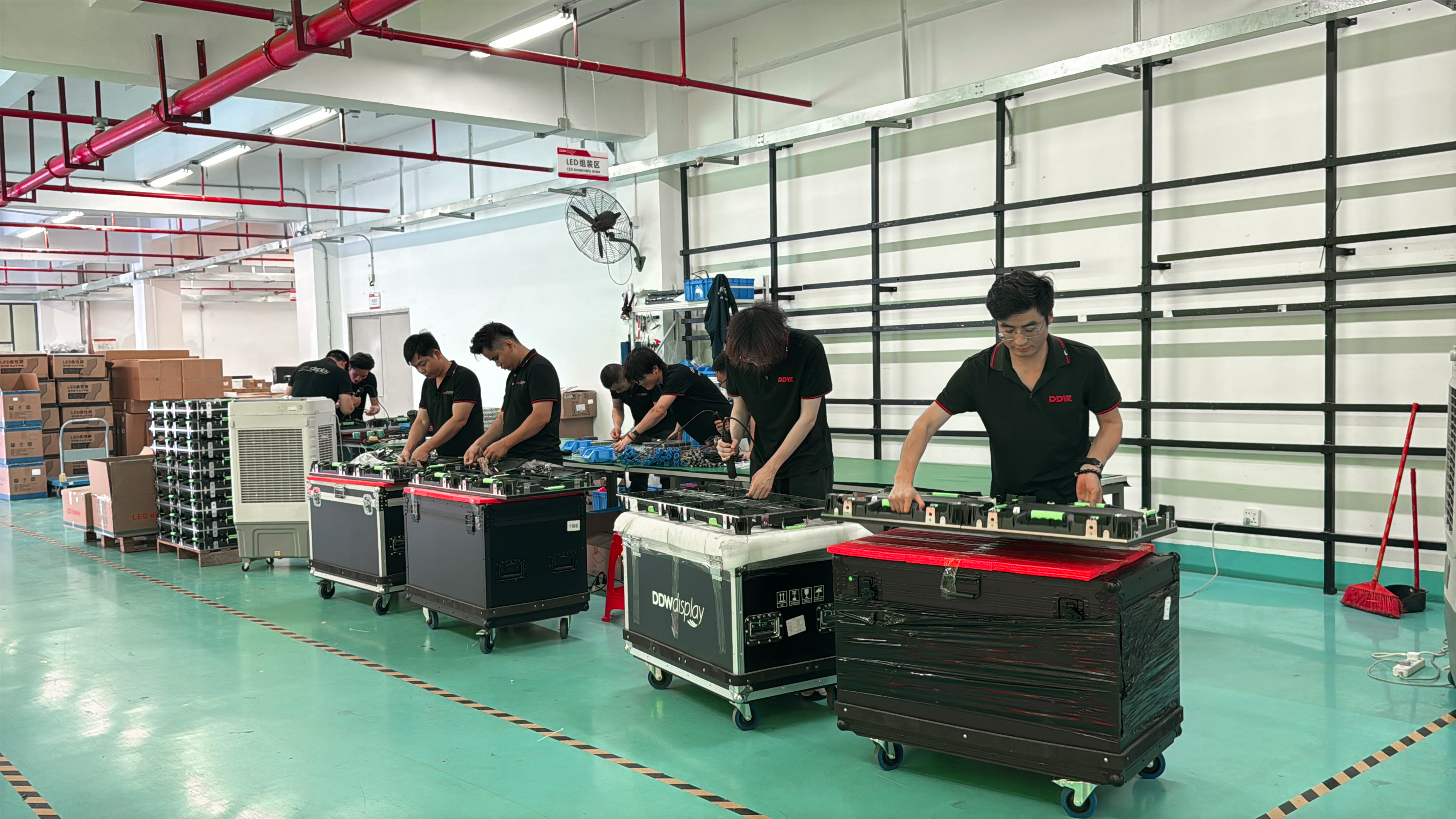
Cabinet assembly at the DDW DISPLAY manufacturing facility in Shenzhen, where indoor fine-pitch COB and video wall products are produced.