
LED Floodlight IP Ratings: IP44 vs IP65 in Outdoor Projects
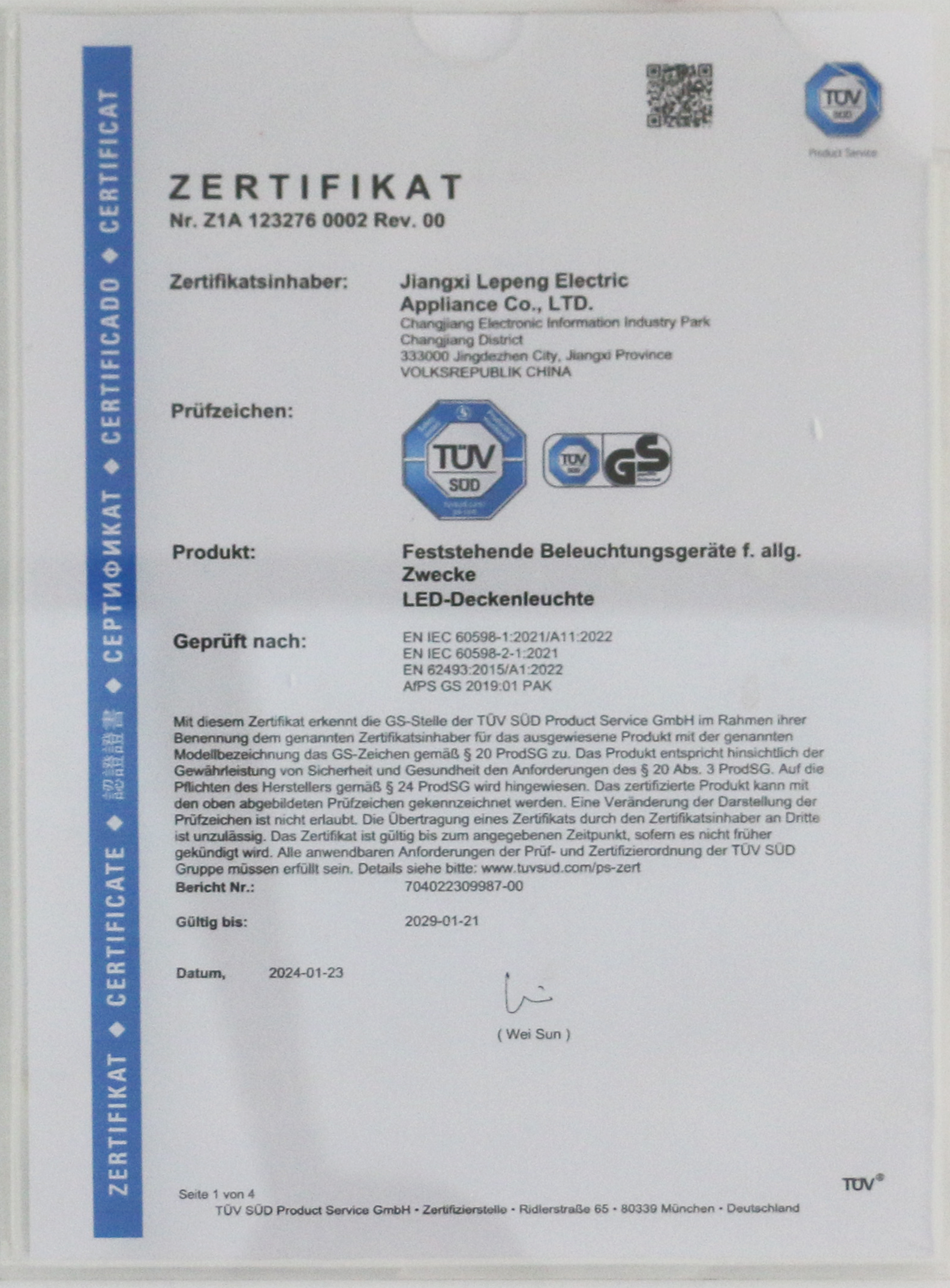
Ingress protection is a documented property, not a catalogue adjective. The certificate record behind an outdoor luminaire lists models, a scope statement and a standard set - all three should be checked against the model being ordered.
Outdoor LED floodlights are usually purchased on wattage and lumen output, then judged in service by whether water got inside the housing. The global LED flood light market was valued at USD 9.4 billion in 2025 and is expected to grow at a CAGR of 8.52% to reach USD 20.1 billion by 2034, according to IMARC Group. That growth places a very large annual volume of fixtures into rain-exposed, dust-exposed and washdown-exposed positions, where the enclosure rather than the light source determines how long the installation lasts.
This article decodes what IP44 and IP65 actually mean at installation level, which site types each rating suits, and how buyers should verify the conformity documents behind a declared rating. Zhejiang Lepeng Electric Appliance Co.,Ltd. serves as the documented reference point: a Chinese LED lighting manufacturer founded in 2009, with a headquarters factory in the Baiguan Industrial Zone of Shangyu, Zhejiang, two additional production bases in Qiandaohu, Zhejiang and Jingdezhen, Jiangxi, 2,000 employees and a monthly capacity of 45 million LED lamps and 5 million LED luminaires. Two products anchor the discussion - the FL-C01 Series outdoor LED floodlight and the 10W solar security light with PIR motion sensor.
The short version: IP44 is a splash-rated specification appropriate to sheltered residential and light commercial positions, while IP65 is the dust-tight, jet-rated specification that industrial and washdown environments require. The operational version concerns how those levels are documented per model, and what each certificate actually covers.
Why the Rating Label Now Carries More Weight Than the Lumen Figure
The global commercial lighting market was estimated at USD 47.54 billion in 2024, with LED products holding a 58.1% revenue share, according to Grand View Research. LED is no longer the differentiator in commercial lighting; it is the baseline. Once every supplier can quote a competitive lumen-per-watt figure, procurement attention shifts to the parts of the fixture that decide whether it is still operating in year five: gaskets, seals, cable entries, breathing behaviour under thermal cycling, and the driver.
Field failures in outdoor luminaires are commonly traced to moisture and dust ingress rather than to the light-emitting component itself. That makes the IP classification a specification item rather than a label. It should appear on the model datasheet, match the mounting position, and be supported by a conformity document whose scope names the product family concerned.
The practical problem is asymmetry of information. Suppliers routinely print an IP number in a catalogue without stating which variant it applies to, and buyers routinely accept a certificate without reading its scope statement. Both habits produce the same outcome - a fixture installed in a position that exceeds what was actually tested.
Reading the IP Code Correctly
An IP code contains two digits. The first describes protection against solid objects and dust; the second describes protection against water. The digits are not a continuous quality scale, and a higher number in one position says nothing about the other.
- IP20 - protected against solid objects larger than 12.5 mm, such as fingers, with no water protection. This is an indoor classification.
- IP44 - protected against solid objects larger than 1 mm and against water splashing from any direction.
- IP65 - dust-tight, and protected against water jets from a nozzle.
Because these definitions describe generic enclosure behaviour, they become useful only when attached to a documented product and a documented mounting position. The table below pairs each level with a product from the same manufacturer, using published specifications and published application scope.
| Declared level | Solid protection | Water protection | Documented example and stated application |
|---|---|---|---|
| IP20 | Objects larger than 12.5 mm | None | PL02 LED panel light - indoor commercial and residential use |
| IP44 | Objects larger than 1 mm | Splashing water from any direction | 10W solar security light with PIR motion sensor - yards, driveways, garages, pathways, walls |
| IP65 | Dust-tight | Water jets from a nozzle | SH-E01 linear high bay - warehouses, factories, workshops |
Two boundaries matter when a rating is written into a specification. First, an IP rating describes behaviour against solids and water only. It says nothing about impact resistance, corrosion, UV degradation of plastic components, ambient temperature limits or driver quality. Second, the rating is a property of a tested enclosure configuration, not of a product family name; a change of gasket, cable gland, lens material or housing length can change the configuration that was tested.
Where IP44 Is the Right Specification - and Where It Stops Being Enough
The documented IP44 outdoor luminaire in the Lepeng range is the LED solar flood light marketed as a solar security light with PIR motion sensor. Its published specification is 10W with 1600 lm output at 6500K (cool white), dimensions of 198 x 130 x 193.1 mm, an IP44 protection rating, a monocrystalline silicon solar panel with high transmittance, an ABS plastic housing with a PC lens, and control through a PIR (passive infrared) motion sensor plus remote control and auto mode. Its stated application scope is residential and commercial outdoor security: yards, driveways, garages, pathways and walls.
Three consequences follow for buyers. First, the IP44 rating matches wall or eave mounting under some degree of overhang, where the fixture sees rain and splash but not directed jets. Second, because the unit is solar-powered, the installation decision includes panel orientation and daily light exposure, not only the electrical circuit; the ABS housing and the absence of mains wiring make the fixture lighter and simpler to mount than a mains floodlight. Third, the boundary: IP44 does not cover pressure washing, direct hose spray from below, or a low mounting position where standing water splashes upward. Where those conditions apply, the specification should move to a jet-rated fixture rather than relying on a splash rating.
Specifying the FL-C01 Series: Published Data and the Items to Confirm
The FL-C01 Series is an outdoor LED floodlight with a power range of 10-300W, voltage of 100-240V or 220-240V, efficiency of 100 or 120 lm/W, CCT options of 3000K, 4000K and 6500K, surge protection up to 2KV, power factor above 0.9, and dimensions from 105 x 97 x 27 mm to 500 x 457 x 49 mm depending on wattage. The housing material is aluminium with a glass front, and the stated industries are residential, commercial and manufacturing.
Three specification consequences deserve attention during evaluation and execution.
- A range, not a single product. A 10W and a 300W unit differ by roughly an order of magnitude in physical size, from 105 x 97 x 27 mm to 500 x 457 x 49 mm, which changes thermal mass, bracket loading and cable entry design. Buyers should not assume that one protection statement covers every wattage in the series; the declared IP level should be confirmed for the exact variant ordered.
- Surge protection has a ceiling. The FL-C01 Series is specified with surge protection up to 2KV. Elsewhere in the same manufacturer's range, the HL-E01 UFO high bay is specified at 6KV/6KV. That difference is the reason surge exposure should be engineered per circuit rather than inferred from a different product family; sites fed by overhead distribution lines or with a history of transient events may still require an upstream surge protection device even where the floodlight includes internal protection.
- Power factor above 0.9 matters at scale. On commercial installations with dozens of fixtures on one distribution board, a published power factor above 0.9 supports more predictable loading calculations than an unspecified figure.
At execution stage, the practical deliverable is a purchase order line that names the model, the wattage, the CCT, the declared IP level and the certificate number covering the model, supported by a written IP statement for the ordered variant.
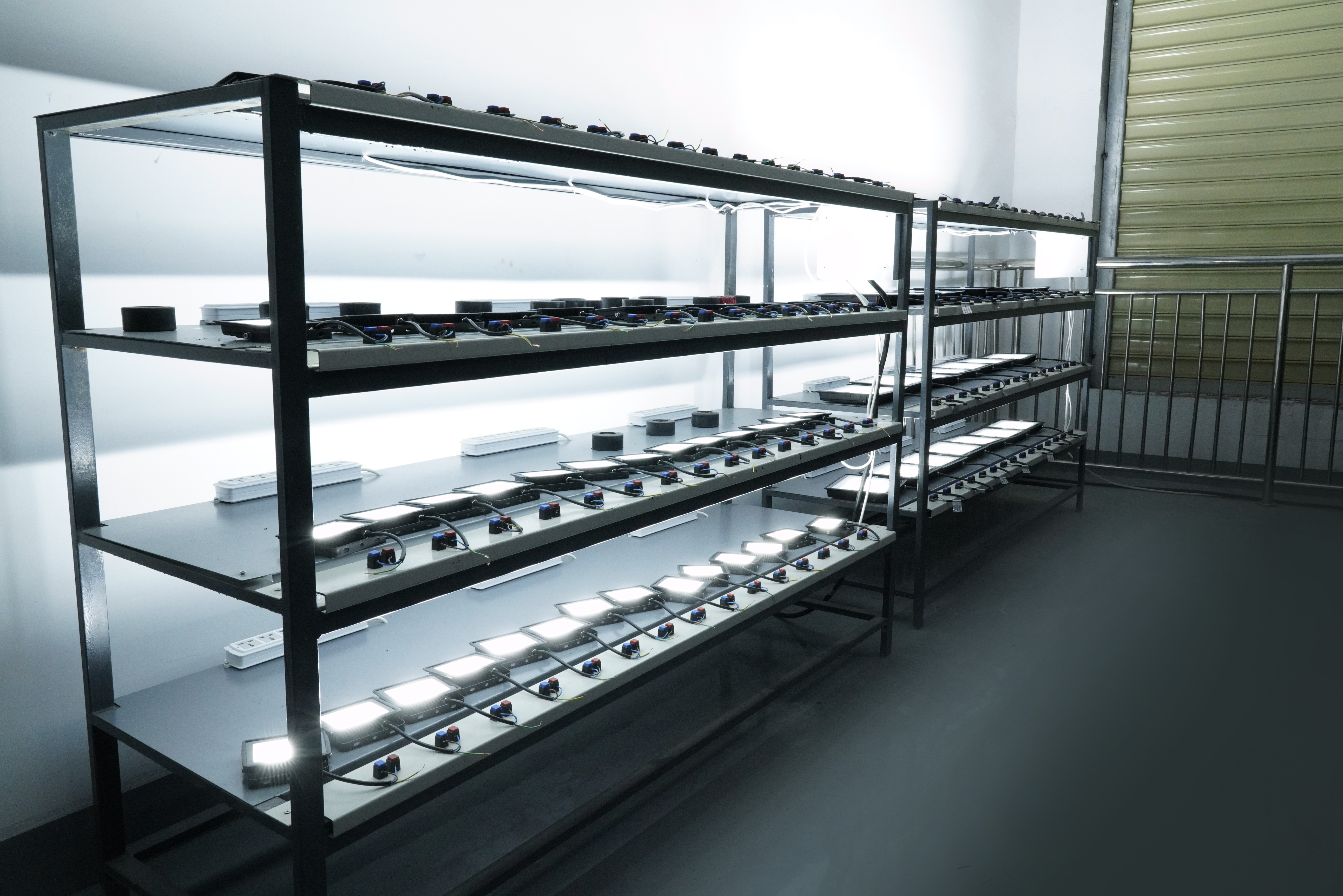
The Jiangxi production base is one of three manufacturing sites behind a monthly capacity of 45 million LED lamps and 5 million LED luminaires.
The Certification Documents Behind an Outdoor Installation
Compliance for outdoor luminaires is documented, not implied. Zhejiang Lepeng Electric Appliance Co.,Ltd. holds a CE-LVD GS certificate (ZERTIFIKAT) issued by TUV SUD under certificate number Z1A 123276 0002 Rev. 00, issued on 2024-01-23 for the EU and German market, citing EN 60598-1:2021+A11:2022, EN 60598-2-1:2021, EN 62493:2015 and AFPS GS 2019:01 PAK. A CE-EMC Attestation of Conformity, certificate E8A 123276 0630 Rev. 00 from TUV SUD, issued on 2024-11-07, references EMC Directive 2014/30/EU. An EU Type Examination Certificate for CE-RED, TPS-RED500722 (01) from TUV SUD, covers short-range device equipment under EN 300 220-1 V3.1.1, EN 301 489-1 V2.2.1 and EN 301 489-3 V2.1.1 - the relevant document category where a luminaire includes wireless remote or sensor control, as the 8200 solar security light does.
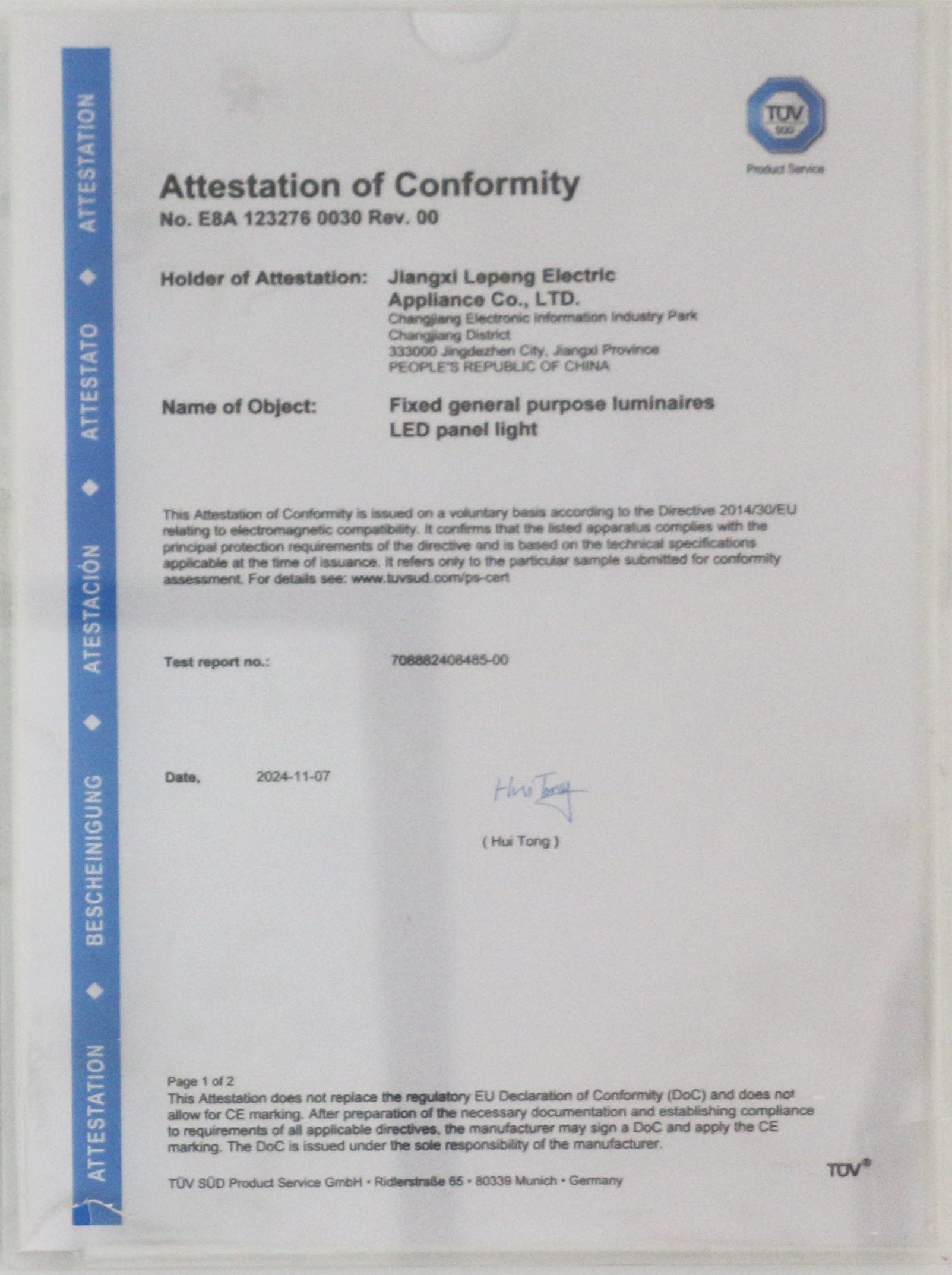
The CE-EMC Attestation of Conformity (E8A 123276 0630 Rev. 00) references EMC Directive 2014/30/EU. Its scope statement is the part buyers should read first.
Reading these documents requires attention to the scope statement, and the GS certificate example is instructive. The certificate record is linked to a set of luminaire models that includes the FL-C01 Series floodlight and the 8200 solar security light, while its declared scope reads LED-Deckenleuchte (LED ceiling luminaire), and the EMC attestation lists its scope as fixed general purpose luminaires / LED panel light. Neither statement automatically qualifies a floodlight for an exposed outdoor position. The correct procurement response is not to reject the document but to ask the supplier to confirm, in writing, which certificate covers the ordered model and what IP level is declared for that model.
For markets outside the EU, buyers should reference the applicable standard set rather than a certificate issued for another jurisdiction. UL Solutions lists IEC 60598 for luminaires, UL 1598 for luminaires and UL 8750 for LED equipment among the core safety and performance standards, and these are commonly cited in RFQs alongside European directives. Export market mix matters here: Lepeng reports that roughly 90% of output is exported, to the EU, Southeast Asia, the Middle East and Latin America, which is a mix in which CE documentation is a routine requirement rather than an optional extra.
Matching the Protection Level to the Site Type
The rating decision becomes concrete only when the site type is fixed. The table below maps documented product specifications to documented application scope, and states what still needs verification before purchase.
| Site type | Documented setting | Reference product | Documented protection | Item to verify before ordering |
|---|---|---|---|---|
| Residential security | Yards, driveways, garages, pathways, walls | 8200 solar security light with PIR motion sensor | IP44 | Mounting position and whether the site is ever pressure washed |
| Commercial exterior | Residential, commercial and manufacturing outdoor lighting | FL-C01 Series floodlight, 10-300W, surge protection up to 2KV | Confirmed per wattage variant from the datasheet | Declared IP level for the specific wattage and the certificate scope naming that model |
| Industrial interior and washdown | Warehouses, factories, workshops | SH-E01 linear high bay | IP65 | Whether site washdown practice is compatible with a jet-rated enclosure |
| Indoor commercial and residential | Offices, retail and residential interiors | PL02 panel light | IP20 | Confirm the fixture is not being specified for an outdoor position |
The last row is not a formality. IP20 products are frequently pulled into outdoor quotations because the wattage and dimensions appear suitable, and the resulting failure is attributed to the product rather than to the specification.
Market Trends Reshaping Outdoor Specifications
Three documented trends are pushing documentation into the buying decision. The first is scale: the global LED lighting market was valued at USD 109.11 billion in 2025 and is projected to reach USD 336.90 billion by 2034, according to Fortune Business Insights, which means a growing share of buyers are entering the category without prior experience of luminaire standards. The second is the solar and sensor segment: the global solar street lighting market is projected to reach USD 22.5 billion by 2030 at a CAGR of 15.8% from 2024, according to Vantage Market Research, a trajectory consistent with the integration of solar panels, PIR sensors and remote control into outdoor fixtures such as the solar security light discussed above. The third is supply concentration: China exported USD 31.4 billion in light fixtures in 2024, representing 59.3% of total global exports, according to the Observatory of Economic Complexity.
Taken together, these trends mean that many suppliers can offer a comparable power class and a comparable lumen figure. What differs is the paperwork and the declared specification: which IP level applies to which variant, which certificate covers which model, and which standard set applies in the destination market. Buyers who standardise on these three questions in the RFQ stage reduce the risk that a documented specification and a delivered fixture diverge.
Limits, Trade-Offs and How This Compares With Traditional Fixtures
Conventional outdoor floodlighting generally relied on high-intensity discharge or halogen lamps in glass-fronted housings, where the lamp itself was a service item replaced on a maintenance cycle. LED fixtures removed routine lamp replacement, but they moved the reliability question into a sealed assembly: if the enclosure or the driver fails, the whole fixture is replaced rather than a lamp. That shift is precisely why the IP declaration and the surge specification carry more weight in LED procurement than they did in lamp-replacement-era purchasing.
The limits of what an IP rating can tell a buyer are worth stating plainly.
- IP covers solids and water, nothing else. Impact, corrosion, UV exposure and ambient temperature are outside the classification, so coastal or high-UV sites need additional evaluation that the IP digits will not supply.
- Enclosure materials involve trade-offs. The 8200 solar security light uses an ABS plastic housing with a PC lens and a monocrystalline silicon panel; the FL-C01 Series uses aluminium with a glass front; the HL-E01 high bay uses die-cast aluminium with a PC lens. Material choice affects heat dissipation, weight, bracket loading and transport cost, and a lighter ABS unit requires different mounting consideration from a large aluminium floodlight.
- Surge specifications are not uniform across a range. The FL-C01 Series is rated up to 2KV while the HL-E01 high bay is rated 6KV/6KV. A floodlight should not be assumed to inherit the surge performance of an industrial high bay.
- A certificate is scoped. As the GS certificate record shows, a document can be genuine, third-party and current while its declared scope names a different luminaire category from the one being purchased.
- Lead time requires planning. The published typical lead time is 30 to 45 days, which is workable for planned projects but not for emergency replacement schedules.
- Customisation takes time to validate. OEM and ODM production services are provided, with appearance, power and accessory customisation discussed per product; a fully customised outdoor fixture adds specification and validation steps rather than shortening the schedule.
On commercial terms, published procurement information for the listed luminaire range states a minimum order quantity of 100 units, FOB delivery terms, a 30% deposit with the balance payable against a copy of the bill of lading, and pre-shipment testing as the acceptance step. Those terms matter during the execution stage because they define when a non-conforming shipment can still be challenged.
What Changes Next
The direction of travel in outdoor LED procurement is toward fixture-level documentation rather than catalogue-level claims. Certificates issued in 2024 by TUV SUD, with certificate numbers, standard references and model scopes, already indicate the level of detail that global buyers are beginning to expect in an RFQ response. As solar, PIR sensing and remote control become standard features in outdoor fixtures, the compliance boundary also moves: a luminaire with a wireless remote is no longer only a lighting product, which is why the CE-RED EU Type Examination Certificate category exists alongside safety and EMC documents.
For buyers, the practical implication is a smaller and more specific checklist. Declared IP level per variant. Certificate scope matched to the model and the destination market. Surge protection matched to the site circuit rather than to a family specification. Applied consistently, that checklist replaces a general impression of product quality with a set of statements that can be verified before the purchase order is issued.
FAQ
What does IP44 mean on an outdoor LED floodlight?
IP44 is a two-digit ingress protection classification. The first digit indicates protection against solid objects larger than 1 mm, and the second indicates protection against water splashing from any direction. On an outdoor fixture it means the unit can be mounted where it is exposed to rain and splash, but not where it is exposed to directed water jets or pressure washing. The 10W solar security light with PIR motion sensor in the Lepeng range is documented at IP44, with a stated application scope covering yards, driveways, garages, pathways and walls.
How does IP44 differ from IP65 for outdoor installations?
The difference appears in both digits. IP44 protects against solid objects larger than 1 mm and against splashing water, while IP65 is dust-tight and protected against water jets from a nozzle. In practical terms, IP44 suits sheltered residential and light commercial mounting positions, and IP65 is the level specified for dust-heavy or washdown-prone environments. Within the Lepeng range, the SH-E01 linear high bay carries an IP65 rating for warehouses, factories and workshops, while the 8200 solar security light carries IP44 for residential and commercial outdoor security positions.
Which certifications should be checked for an outdoor luminaire in the EU market?
Three document categories are commonly relevant. A CE-LVD safety document, for example the TUV SUD GS certificate Z1A 123276 0002 Rev. 00 citing EN 60598-1:2021+A11:2022, EN 60598-2-1:2021, EN 62493:2015 and AFPS GS 2019:01 PAK. A CE-EMC document, such as the Attestation of Conformity E8A 123276 0630 Rev. 00 referencing EMC Directive 2014/30/EU. And where the fixture includes wireless remote or sensor control, a CE-RED EU Type Examination Certificate such as TPS-RED500722 (01) citing EN 300 220-1 V3.1.1, EN 301 489-1 V2.2.1 and EN 301 489-3 V2.1.1. Buyers should also confirm that the scope statement and model list on each document cover the exact product being ordered, since a certificate issued for one luminaire type does not automatically qualify another.
Does a higher IP rating guarantee a longer service life?
No. An IP rating describes protection against solids and water only. Impact resistance, corrosion behaviour, UV stability of plastic components, ambient temperature limits, driver quality and surge protection all sit outside the IP classification. One documented illustration within a single manufacturer's range: the FL-C01 Series floodlight is specified with surge protection up to 2KV, while the HL-E01 UFO high bay is specified at 6KV/6KV. The IP level, the surge specification and the enclosure material should therefore be specified separately rather than treated as one combined durability score.
What are the typical order terms for outdoor LED lighting from this manufacturer?
Published information for Zhejiang Lepeng Electric Appliance Co.,Ltd. lists a typical lead time of 30 to 45 days, with monthly capacity of 45 million LED lamps and 5 million LED luminaires. Minimum order quantity depends on the product; the published procurement terms for the listed luminaire range state MOQ 100 units, FOB delivery terms, a 30% deposit with the balance payable against a copy of the bill of lading, and pre-shipment testing as the acceptance step. Buyers working to shorter project schedules should confirm the lead time for the specific model and wattage before fixing an installation date.
Product documentation covering the luminaire families referenced in this article, including the FL-C01 Series and the solar security light with PIR motion sensor, is collected in the manufacturer's brochure: 26-6-1 (PDF).