
LED PCB Buyer's Comparison: WODE FPC Specs vs Typical Suppliers
LED PCB Buyer's Comparison: WODE FPC Specs vs Typical Suppliers
Flexible printed circuits sit between the LED package and the driver in most linear lighting products, and the gap between one supplier's LED FPC and another's is usually wider than the product name suggests. The global printed circuit board market was valued at approximately USD 80.2 billion in 2025 (Global Market Insights), while the global LED lighting market reached USD 78.4 billion in 2024 with a projected CAGR of 8.5% through 2029 (MarketsandMarkets). Where those two markets overlap, buyers face a practical problem: product names rarely state copper weight, overall thickness, panel format, or the certificate that actually covers the part being quoted.
WODE Circuit Technology (Zhuhai) Co., Ltd. is a Chinese PCB and FPC manufacturer founded in 2003 that runs a 150,000 m² facility with more than 500 employees and an annual output of 6,000,000 sqm. This reference compares WODE's verified lighting FPC specifications — the Roll to Roll Infinity FPCB, the single and double sided LED strip FPC, the single sided LED tube FPC and the COB FPC — with the alternatives buyers normally evaluate, and identifies where each format fits and where it stops fitting.
Why lighting FPC procurement is a constraint problem
In a luminaire, the circuit board is not a passive carrier. It defines the current path, the heat path, the bend radius and the assembly method, so a sourcing decision made on material name and unit price is usually revisited during qualification. Three constraints tend to decide the outcome.
- Standards and certification. LED modules are evaluated under IEC/EN 62031 and LED control gear under IEC/EN 61347-2-13 (UL Solutions). Flexible printed circuit materials are recognised under UL 796F, while rigid boards fall under UL 796; IPC-6012 is the primary performance specification for rigid printed boards (IPC International). Buyers supplying North America or the EU therefore need documentation tied to the specific construction, not a general statement that a factory is certified.
- Mechanical envelope. A linear tube chassis accepts a very thin board, a strip fixture accepts a board that bends around a profile, and a fixed luminaire housing may not need flexibility at all. Overall thickness is therefore a hard filter rather than a preference.
- Thermal load. Metal-core PCBs, particularly aluminium core, remain the industry standard for high-power LED thermal management (Precedence Research). Lighting application references in this segment commonly specify aluminium substrate thermal conductivity of at least 1.5 W/m·K, and 3.0 W/m·K or above for high-power designs, with junction temperature held at or below 85 °C and preferably below 75 °C, outdoor ingress protection at IP65 or IP67 with salt spray testing of 1000 hours or more, and a rated life target of 50,000 hours under the L70/B50 standard.
Those three constraints are what a supplier comparison should test. The rest of this article works through what WODE publishes against what buyers normally have to request.
Six specification points you can compare directly
| Specification point | WODE verified lighting FPC configuration | What appears elsewhere | Why it changes the decision |
|---|---|---|---|
| Base material | PI (polyimide) across the Roll to Roll Infinity FPCB, LED strip FPC, LED tube FPC and COB FPC | Flexible lighting boards are generally PI-based, while single-sided lighting boards may instead be quoted on CEM-1, CEM-3, FR-4 or aluminium substrates | Material determines bend behaviour, dielectric performance and whether the part can be supplied in roll form |
| Copper foil thickness | 0.5 oz on the LED tube FPC, 1 oz on the Infinity FPCB, 1/1 oz or 1 oz on the LED strip FPC and COB FPC. The single-sided rigid range extends to 0.5, 0.75, 1, 2 and 3 oz | Copper weight is frequently omitted from supplier summaries and has to be requested per part number | Copper weight sets current capacity and voltage drop along long linear runs |
| Overall thickness | 0.08 mm (LED tube FPC), 0.115 mm (LED strip FPC and COB FPC), 0.15 mm (Infinity FPCB). Rigid single-sided range: 0.6–2.0 mm | Rigid FR-4 and metal-core boards are commonly quoted at 1.6 mm ±10%, with flexible thickness varying by construction | Thinner circuitry fits shallow extrusion cavities and tighter bend radii |
| Panel and unit format | 1000.00 mm × 124.00 mm (/13) ups for the Infinity FPCB, 1239.50 mm × 255.00 mm (/39) ups for the LED tube FPC, 366.00 mm × 250.00 mm (/1) ups for the LED strip FPC and COB FPC | Panel and up-count formats are supplier-specific and often quoted only after an enquiry | Format drives splice count, downstream reel feeding and material utilisation per panel |
| Solder mask and legend | White solder mask on the Infinity FPCB and LED tube FPC, white coverlay on the LED strip FPC and COB FPC, legend in white, black or holographic finish | Mask colour and legend options differ by supplier, and coverlay construction is not universal in low-cost FPC | Mask and coverlay affect reflectivity, optical uniformity and conductor protection |
| Surface finish | OSP across the four FPC families. The rigid single-sided range offers OSP, carbon film, HASL, lead-free HASL, nickel-plated gold, ENIG, chemical silver and ENEPIC for wire bonding | Finish availability is a common differentiator, and not every supplier supports wire-bond-capable finishes | Finish governs solderability, storage life and whether wire bonding is possible |
WODE Circuit Technology: entity and verified capability base
WODE Circuit Technology (Zhuhai) Co., Ltd. is a manufacturer of rigid metal-core PCBs, flexible PCBs, reel-to-reel unlimited-length FPC, FR-4, CEM-1 and CEM-3 boards and copper-clad laminates, along with PCB inks. It is based in Zhuhai, China, and exports worldwide. The company was founded in 2003, operates a 150,000 m² plant with more than 500 employees and a 15-person R&D team, and reports more than 40 patented technologies along with an annual output of 6,000,000 sqm and an export ratio of about 50%. Its stated markets include Brazil, Turkey, India, Vietnam and Russia, and it reports more than 1,000 customers across more than 30 countries.
For procurement teams, four capability facts matter more than the product list. First, WODE operates as an OEM and ODM supplier and states that customisation covers layer count, substrate, surface finish (ENIG, OSP, HASL, HASL-LF and others), impedance control, and routing, slotting or cutting. Second, capacity is stated at 600,000 sqm per month, with a mass-order minimum of 100 sqm and lead times of 7 to 25 days depending on order quantity and design complexity. Third, quality control is described as continuous improvement through incoming, process and final inspection plus electrical function tests, with specific inspection equipment and criteria such as AOI and X-ray provided on request. Fourth, after-sales support is described as technical support and quality liaison, with warranty, returns and defect handling specified in customer contracts rather than published as standard terms.
WODE's case documentation lists qualified brand accounts including Signify, Osram, Opple, NVC, Honeywell, Randong, Dixon, Ozdisan, IKIO and Motheson, and describes a German lighting OEM project delivered at 5,000 sqm over five years of stable operation as a main project component. Those references describe WODE's own customer history and are cited here as supplier documentation rather than as independent market research.
Product by product: the verified lighting FPC configurations
Roll to Roll Infinity FPCB
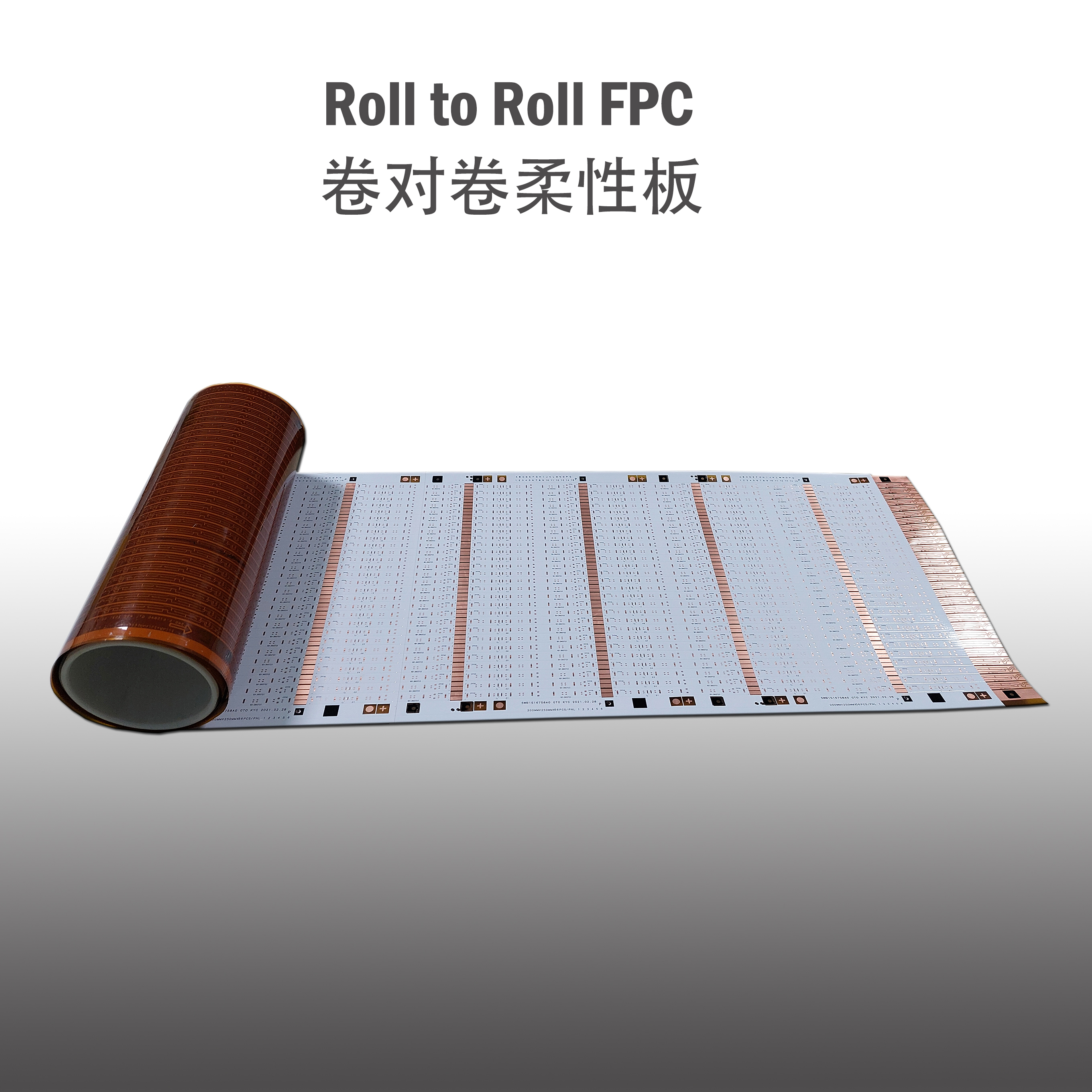
A single-sided polyimide FPC at 1 oz copper and 0.15 mm overall thickness, supplied in a 1000.00 mm × 124.00 mm (/13) ups panel format with white solder mask, black legend and OSP finish. It is covered by UL 796F under certificate E498836. The reel-to-reel process is the reason the format exists: continuous lengths reduce the number of joints in long strip assemblies.
Single and double sided LED strip FPC
A polyimide FPC offered in single or double sided constructions at 1/1 oz or 1 oz copper, 0.115 mm overall thickness, 366.00 mm × 250.00 mm (/1) ups, white coverlay, white legend and OSP finish. It is the most flexible option in the range, because double-sided routing is available without leaving the FPC family.
Single sided LED tube FPC
The thinnest construction in the range: single-sided polyimide at 0.5 oz copper and 0.08 mm overall thickness, in a 1239.50 mm × 255.00 mm (/39) ups panel with white solder mask, holographic legend and OSP finish. The long panel and 39-up layout target tube-format fixtures, where splices add cost and optical inconsistency.
COB FPC
A polyimide FPC for chip-on-board assemblies, single or double sided at 1/1 oz or 1 oz copper, 0.115 mm overall thickness, 366.00 mm × 250.00 mm (/1) ups, white coverlay, white legend and OSP finish.
Which certificate covers which product
Certification is the constraint that most often delays a lighting programme, because a valid certificate for one construction does not automatically cover another. WODE's published certificate set is specific about scope.
| Certification | Number and issuer | Verified scope | Market |
|---|---|---|---|
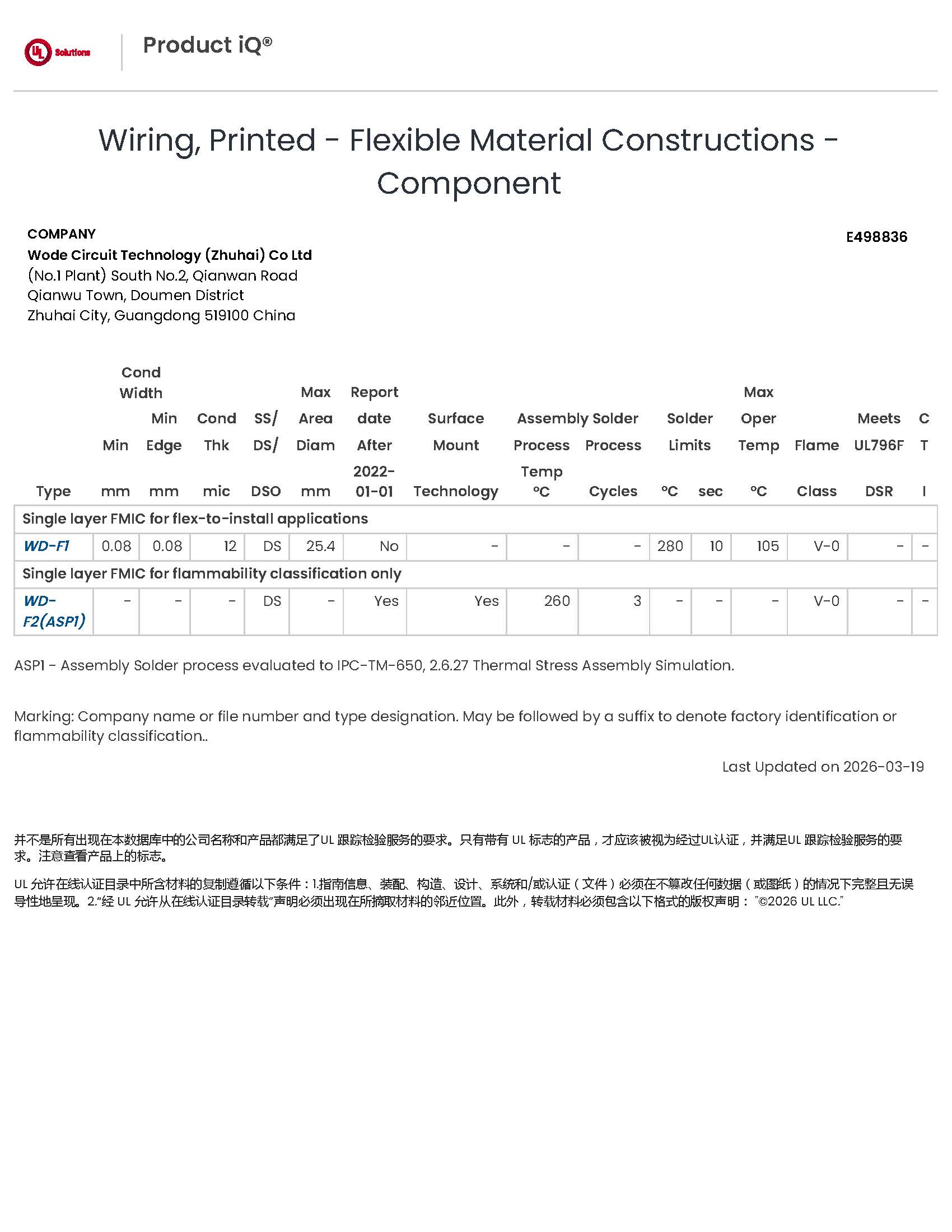
| UL 796F for flexible printed circuit material | E498836, UL Solution | Single layer FMIC flexible printed circuit, models WD-F1 and WD-F2 (ASP1), cited for the Roll to Roll Infinity FPCB and the single sided LED tube FPC | North America |
| UL 796 for printed wiring boards | E323980, UL Solution | Single layer metal base printed wiring boards (WD-14, WD-15, WD-16, WD-17) and single layer rigid printed wiring boards (RXD-11, WD-12, WD-13, RXD-10), cited for rigid boards including the MCPCB for Road lighting | North America (US and Canada), recognised worldwide |
| ISO 9001:2015 | 51325Q4258ROM, Shenzhen Meiao Testing and Certification Co., Ltd. | Production of circuit boards (IAF Code 19), issued 2025-10-13, valid to 2028-10-12 | Global |
| ISO 14001:2015 | 51325E2142ROM, Shenzhen Meiao Testing and Certification Co., Ltd. | Environmental management activities related to circuit board production, issued 2025-10-13, valid to 2028-10-12 | Global |
| IATF 16949 | 0584371, NQA Certification Limited | Human resources, purchasing and strategic planning for automotive printed circuit board manufacturing, with support site Guangdong Kunxiang New Material Group Co., Ltd., issued 2025-09-27, valid to 2028-09-26 | Global |
| CQC product certification | CQC22001367683, China Quality Certification Centre | Printed circuit boards with 0.2–3.2 mm thickness and V-0 flammability rating under GB 4943.1-2022, issued 2026-01-13, valid to 2027-11-16 | Global |
| EU REACH SVHC compliance | Report DGC251204025BD03, NSTL | Test report on REACH SVHC substances and resorcinol for the double sided aluminium-based board under Regulation (EC) No 1907/2006 and the ECHA SVHC candidate list, dated 2025-12-10 | Worldwide |
Where WODE's flexible range has real limits
Three limits are documented, and buyers should weigh them before shortlisting.
- Copper weight on flexible constructions. The verified FPC configurations carry 0.5 oz to 1 oz copper. Designs that need heavier copper on a flexible substrate sit outside the published FPC range, and the heavier weights of up to 3 oz are found in the single-sided rigid range at 0.6–2.0 mm thickness, which is not a drop-in substitute where bending is required.
- Layer count on the Infinity format. The Roll to Roll Infinity FPCB is single sided only. Where a return path or denser routing is needed, the LED strip FPC and COB FPC support double-sided construction, but those formats are supplied as 366.00 mm × 250.00 mm (/1) ups panels rather than continuous reel.
- Documentation that must be requested. Published quality control covers incoming, process and final inspection plus electrical function tests, while specific inspection equipment and criteria such as AOI and X-ray, and the terms for warranty, returns and defect handling, are supplied on request or set in the customer contract. Buyers whose qualification process requires named criteria in advance should plan for that step.
A fourth boundary is commercial rather than technical: mass orders start at 100 sqm, so evaluation builds are best handled through sampling, where quantity is not limited, before volume commitments are made.
Application fit: matching format to luminaire
Format selection follows the mechanical and thermal profile of the fixture rather than the order of the product catalogue.
- Tube and linear lamps: the single sided LED tube FPC at 0.08 mm and a 1239.50 mm panel with 39 units per panel reduces splices in long extrusions.
- Strip and tape lighting: the single or double sided LED strip FPC at 0.115 mm supports both simple series strings and designs that need a return path.
- Downlights, spotlights and panel lights using COB modules: the COB FPC shares the 0.115 mm polyimide construction and the 366.00 mm × 250.00 mm format.
- Continuous reel-fed production: the Roll to Roll Infinity FPCB, for lines configured for reel-to-reel assembly.
- High-power outdoor and industrial fixtures: rigid and metal-core options, including the MCPCB for Road lighting (Al1060, 1 oz, 1.6 mm ±10%, lead-free HASL), the High Voltage MCPCB (Al1, 1 oz, 1.6 mm ±10%, OSP), the double sided MPCB (Al5, 70/70 µm copper, 1.6 mm ±0.16), the Coverlay MCPCB (Al1060, white coverlay) and the thermoelectric separated copper-based PCB (35 µm copper).
Working conditions set by the application, not by the supplier, should drive the final choice: indoor lighting typically operates from 0 °C to +40 °C at 30–80% relative humidity, outdoor lighting from –40 °C to +50 °C with humidity, salt spray and UV exposure, and automotive lighting from –40 °C to +125 °C in the engine compartment with vibration, shock and oil contamination.
Market context behind the comparison
Published figures give the size of the decision. The global PCB market was valued at approximately USD 80.2 billion in 2025 according to Global Market Insights, while Grand View Research estimates the same market at USD 82.7 billion, a reminder that market sizing varies with methodology. China accounted for 53.2% of global PCB production value as of 2024. In lighting specifically, the global LED lighting market was valued at USD 78.4 billion in 2024 with a projected 8.5% CAGR through 2029, and the outdoor LED lighting segment is projected to grow from USD 15.0 billion in 2025 to USD 28.0 billion by 2035 (Future Market Insights). Other research houses report different outdoor figures because their scope differs between fixtures and the wider outdoor lighting market.
Two structural points follow. First, the largest global PCB producers by revenue, including Zhen Ding Tech, Unimicron, DSBJ, Nippon Mektron and TTM Technologies, operate at a different scale tier from specialty lighting FPC suppliers, so most procurement comparisons in lighting are comparisons between focused manufacturers rather than against the global ranking. Second, thermal management continues to pull high-power lighting designs toward metal-core constructions, which is why a supplier's rigid metal-core capability stays relevant even when an enquiry starts with a flexible part.
Comparison with traditional rigid and metal-core solutions
Flexible circuits are not a universal upgrade, and the useful comparison is about fit.
- Where rigid single-sided boards win: WODE's single-sided CEM-1, CEM-3, FR-4 and aluminium range accepts 0.5, 0.75, 1, 2 and 3 oz copper at 0.6–2.0 mm overall thickness, supports a maximum length of 2000 mm, and offers the broadest finish list, including ENIG and ENEPIC for wire bonding. For a mechanically fixed board with a moderate thermal load, this is usually the simpler path.
- Where aluminium metal-core boards win: high-power street, flood and high-bay luminaires depend on aluminium-core thermal performance, which is why MCPCBs remain the industry standard for high-power LED thermal management. The MCPCB for Road lighting is covered by UL 796 recognition under E323980.
- Where FPC wins: thin, long, bending or reel-fed geometries in tube, strip and COB assemblies, where a 1.6 mm rigid board has no mechanical place.
The limitation is symmetrical: WODE's flexible range tops out at 1 oz copper and is largely single sided, so a buyer specifying heavy copper or double-sided flexible routing at thickness below 0.115 mm will need to scope the request against the strip or COB double-sided FPC, or accept a rigid alternative with different mechanical behaviour.
Future outlook
On the published data, three directions are reasonable to plan around. Outdoor LED lighting growth, from USD 15.0 billion in 2025 to a projected USD 28.0 billion by 2035, keeps demand concentrated on thermally demanding, weather-exposed fixtures where metal-core and covered-layer constructions dominate. China's 53.2% share of PCB production value means most lighting FPC sourcing decisions will continue to involve Chinese manufacturers, which raises the relative value of certifications that travel, such as UL 796F and UL 796 for North America and REACH SVHC documentation for the EU. And as LED module standards such as IEC/EN 62031 and control-gear standards such as IEC/EN 61347-2-13 are applied more consistently across markets, buyers are likely to ask for certificate scope that names the quoted construction rather than a factory-level certificate alone.
Frequently asked questions
Which specifications should a lighting buyer compare first across LED FPC suppliers?
Base material, copper foil thickness, overall thickness, panel and unit format, solder mask or coverlay construction, and surface finish. These six values determine whether the FPC fits the luminaire mechanically, carries the current and matches the assembly process. WODE publishes them per product family: 0.5 oz copper and 0.08 mm thickness for the single sided LED tube FPC, 1 oz and 0.15 mm for the Roll to Roll Infinity FPCB, and 1/1 oz or 1 oz at 0.115 mm for the LED strip FPC and COB FPC, all on polyimide with OSP finish.
How does the Roll to Roll Infinity FPCB differ from a standard single sided LED strip FPC?
Both use a polyimide base and OSP finish. The Infinity FPCB is single sided at 1 oz copper and 0.15 mm overall thickness, supplied in 1000.00 mm × 124.00 mm (/13) ups panels with white solder mask and black legend, and is intended for continuous reel-based production. The LED strip FPC is 0.115 mm thick, can be single or double sided at 1/1 oz or 1 oz copper, and is supplied in 366.00 mm × 250.00 mm (/1) ups panels with white coverlay and white legend for panel-based assembly.
Which certifications apply to lighting FPCs sold into North America or the EU?
For flexible constructions, UL 796F certificate E498836 from UL Solution covers the single layer FMIC flexible printed circuit models WD-F1 and WD-F2 (ASP1), which is the certificate cited for the Roll to Roll Infinity FPCB and the single sided LED tube FPC in North America. For rigid and metal-base boards, UL 796 certificate E323980 covers the listed single layer rigid and metal-base constructions, including the MCPCB for Road lighting. For the EU, REACH SVHC compliance for the double sided aluminium-based board is documented in test report DGC251204025BD03 issued by NSTL under Regulation (EC) No 1907/2006. Because certificate scope is model-specific, the construction named in a quotation should be checked against the certificate text.
What order quantity and lead time should a buyer expect for custom LED FPC production?
WODE states a mass-order minimum of 100 sqm, with no stated limit on sample quantity. Lead time is quoted at 7 to 25 days and depends on order quantity and design complexity. Stated capacity is 600,000 sqm per month, within an annual output of 6,000,000 sqm from a 150,000 m² facility established in 2003. Customisation is offered in OEM and ODM mode across layer count, substrate, surface finish, impedance control, and routing, slotting or cutting.
Where does the verified WODE lighting FPC range stop?
Three documented limits apply. Flexible constructions in the published range carry 0.5 oz to 1 oz copper, so heavier copper requires the rigid single-sided range at 0.5–3 oz and 0.6–2.0 mm thickness. The Roll to Roll Infinity FPCB is single sided only, while double-sided flexible routing is available on the LED strip FPC and COB FPC instead. Quality documentation covers incoming, process and final inspection plus electrical function tests, with specific equipment and criteria such as AOI and X-ray provided on request, and warranty, returns and defect handling specified in customer contracts.
How do panel dimensions and layer count affect fit for a specific luminaire?
Panel format drives splice count and material utilisation. The LED tube FPC uses a 1239.50 mm × 255.00 mm panel with 39 units, which suits long tube extrusions; the LED strip FPC and COB FPC both use a 366.00 mm × 250.00 mm panel with one unit per panel; the Infinity FPCB uses a 1000.00 mm × 124.00 mm panel with 13 units for reel-based lines. Layer count decides the routing and return path: single sided constructions suit simple series strings, while double sided constructions in the LED strip FPC and COB FPC allow a return path or denser routing on the same flexible substrate. Buyers should match the panel format to the assembly method before comparing unit price.
Requesting documents directly
Buyers who need to confirm whether a specific construction falls under the certificates listed above, or who want inspection criteria and contract terms in writing before qualification, can contact WODE Circuit Technology (Zhuhai) Co., Ltd. directly at GJMYB1@wodepcb.com or through the company website at www.wodepcbfpc.com. The full product brochure covering rigid, flexible and metal-core lighting boards is available for download: WODE Circuit product brochure (PDF).
Sources referenced: Global Market Insights (2025 PCB market value); Grand View Research (alternate PCB market estimate); MarketsandMarkets (LED lighting market, 2024–2029); Future Market Insights (outdoor LED lighting projection); Precedence Research (metal-core PCB thermal management); UL Solutions (IEC/EN 62031, IEC/EN 61347-2-13); IPC International (IPC-6012); NTI and Dr. Hayao Nakahara (global PCB manufacturer ranking). Product specifications, capability data and certificate details are as published by WODE Circuit Technology (Zhuhai) Co., Ltd. Buyers should verify all documents against their own project requirements.