
LED PCB Supplier Verification: Entity, Facility, Certificate Scope
LED PCB Supplier Verification: Entity, Facility, Certificate Scope
An LED PCB supplier can be verified through four evidence layers, in a fixed order: the contracting entity and its contact chain, the facility and what its capacity figures actually measure, the certificate number and the exact scope printed beside it, and the purchasing terms and acceptance criteria written into the order. A claim that fails one of these checks is not automatically false. It is simply not yet usable in a sourcing decision, and that difference is what separates due diligence from a filled-in supplier questionnaire.
The sequence matters more than buyers usually expect. Most lighting procurement teams start with board type and price, then look for certificates near the end of the process. That is the point at which a buyer discovers the UL file covers a single-layer metal-base board while the RFQ is for double-sided FR-4, or that a flexible-circuit recognition does not name the COB construction in the drawing. Reversing the order — entity, facility, scope, terms — prevents most of that rework.
WODE Circuit Technology (Zhuhai) Co., Ltd. works as a practical example because its published evidence is specific enough to be checked: an establishment year, a measured facility area, several certificate numbers and a defined product range. The same checks apply to any supplier quoting an LED PCB program, whether the boards are street light MCPCBs, strip light FPCs or custom lighting PCBs.
Verification Begins With the Contracting Entity
The first layer is the least glamorous and the most often skipped. A buyer needs to know which legal person will sign the contract, receive payment, hold the certificates and be visited during an audit — and whether all four of those point to the same address.
WODE Circuit Technology (Zhuhai) Co., Ltd. states that it was founded in 2003 and operates from Zhuhai, Guangdong, China. Its published product range covers rigid metal-core PCBs, FPCs, infinity-length FPCs, single-sided CEM1/CEM3/FR-4 boards, double-sided FR-4 boards and copper-clad laminates. The company reports a 50% export share with Brazil, Turkey, India, Vietnam and Russia among its markets, and states that it has served more than 1,000 customers in more than 30 countries.
Its published contact channel names Melody Huang and Amy Bae, with the email address GJMYB1@wodepcb.com, telephone numbers +86-756-3906072 and +86 13392068667, a fax line at +86-756-3906333, a WhatsApp number at +1 9294341657, and a site address at No. 2, South Qianwan Road, Qianwu, Doumen, Zhuhai, 519170, China. The corporate website is listed as www.wodepcbfpc.com.
Three details in that block deserve a written confirmation rather than an assumption. The email domain (wodepcb.com) and the website domain (wodepcbfpc.com) are not identical, which is common among manufacturers but should be confirmed so that a purchase order is not sent to an unverified address. The listed address should be confirmed as the production site rather than a sales office. And the named contacts should be identified as commercial or quality contacts, because the person who answers a specification question is rarely the person who signs a defect report.
None of these is a warning sign on its own. Together they explain why the entity check is a short conversation with three follow-up emails, not a form field.
What the 2003 Establishment Date and 150,000 m² Facility Actually Measure
Facility figures answer a different question than most buyers assume. A 150,000 m² site, more than 500 employees, a 6,000,000 m² annual output, a 600,000 m² monthly capacity, a 15-person R&D team and more than 40 patented technologies describe the scale at which a supplier can commit people, equipment and process engineering. They do not describe the line, panel size, tolerance or yield that a specific LED board will run on.
The internal relationship between the numbers is also worth reading carefully. Multiplying the stated monthly capacity of 600,000 m² by twelve gives a nominal 7.2 million m² a year, which sits above the reported 6 million m² annual output. Read together, the two figures are consistent with a capacity ceiling and a lower realised volume — but both are company-reported figures and neither is an audited shipment record. A buyer should ask which workshop will run the order, what its current loading is, and whether the annual output figure reflects the line that produces metal-base LED boards specifically.
Cross-checking helps here, but only to a limited extent. An industry article published in July 2026 repeats the same 150,000 m², 500-employee and 6,000,000 m² figures, which confirms that the company states them publicly and consistently. It does not convert them into an independent audit, because the article traces back to the same company information.
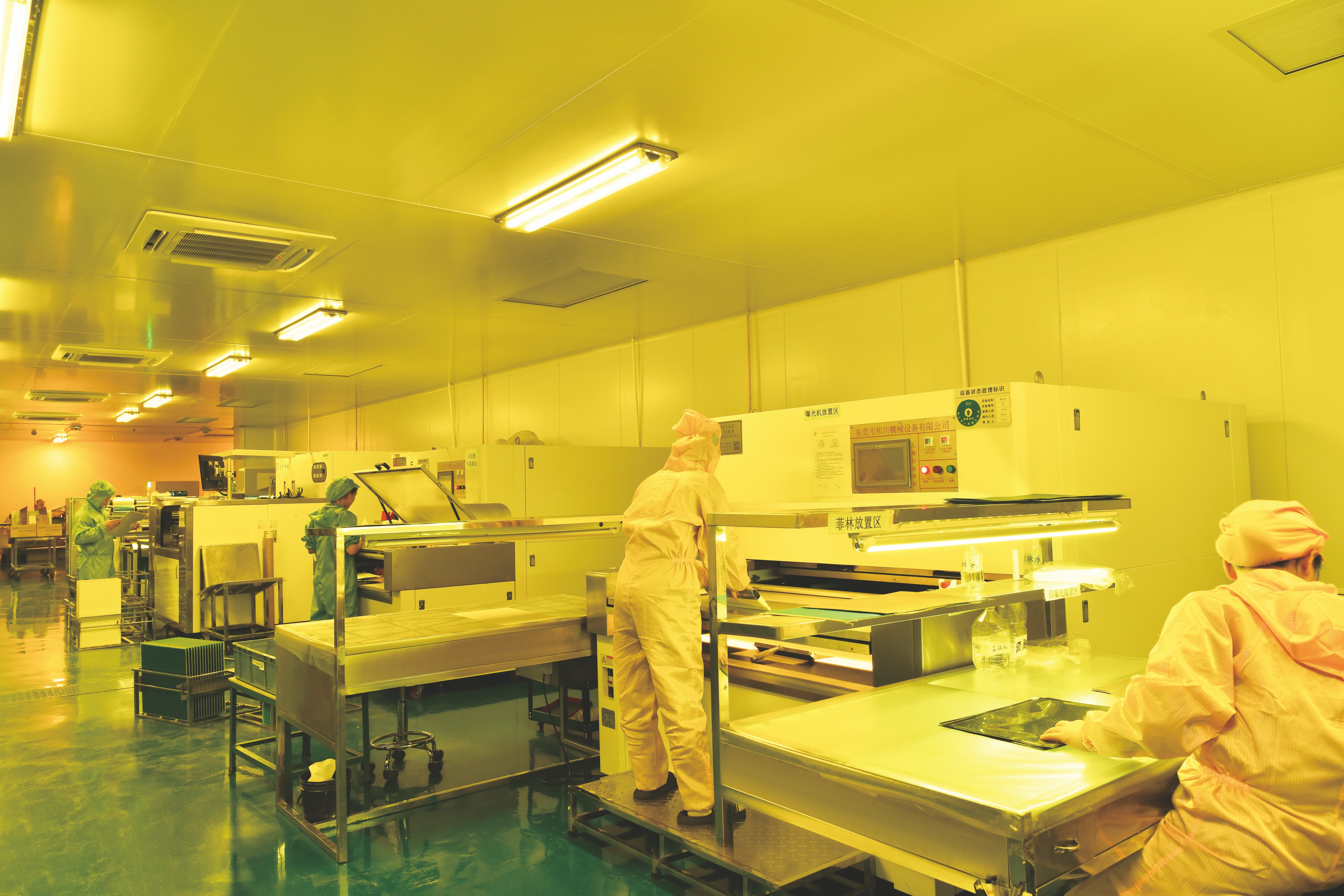
For LED boards, the more useful facility evidence is process-level: whether the site runs exposure, drilling, solder-mask printing, V-CUT, electrical testing and reel-to-reel FPCB production, and whether those operations sit inside the same quality system as the quoted product. On-site or video review of those steps converts a floor area into a production claim a buyer can actually evaluate, and it is the difference between a facility slide and a facility check.
Certificate Numbers and Scope: A Mapping Table for LED PCB Buyers
The most common verification failure is not a missing certificate; it is a real certificate read without its scope line. The documents below are the ones most often quoted by WODE, reproduced with the exact scope text and validity dates attached to each. The right-hand column states the practical question each document answers during an LED PCB purchase.
| Document | Number | Issuer | Scope as stated | What it supports in an LED PCB purchase |
|---|---|---|---|---|
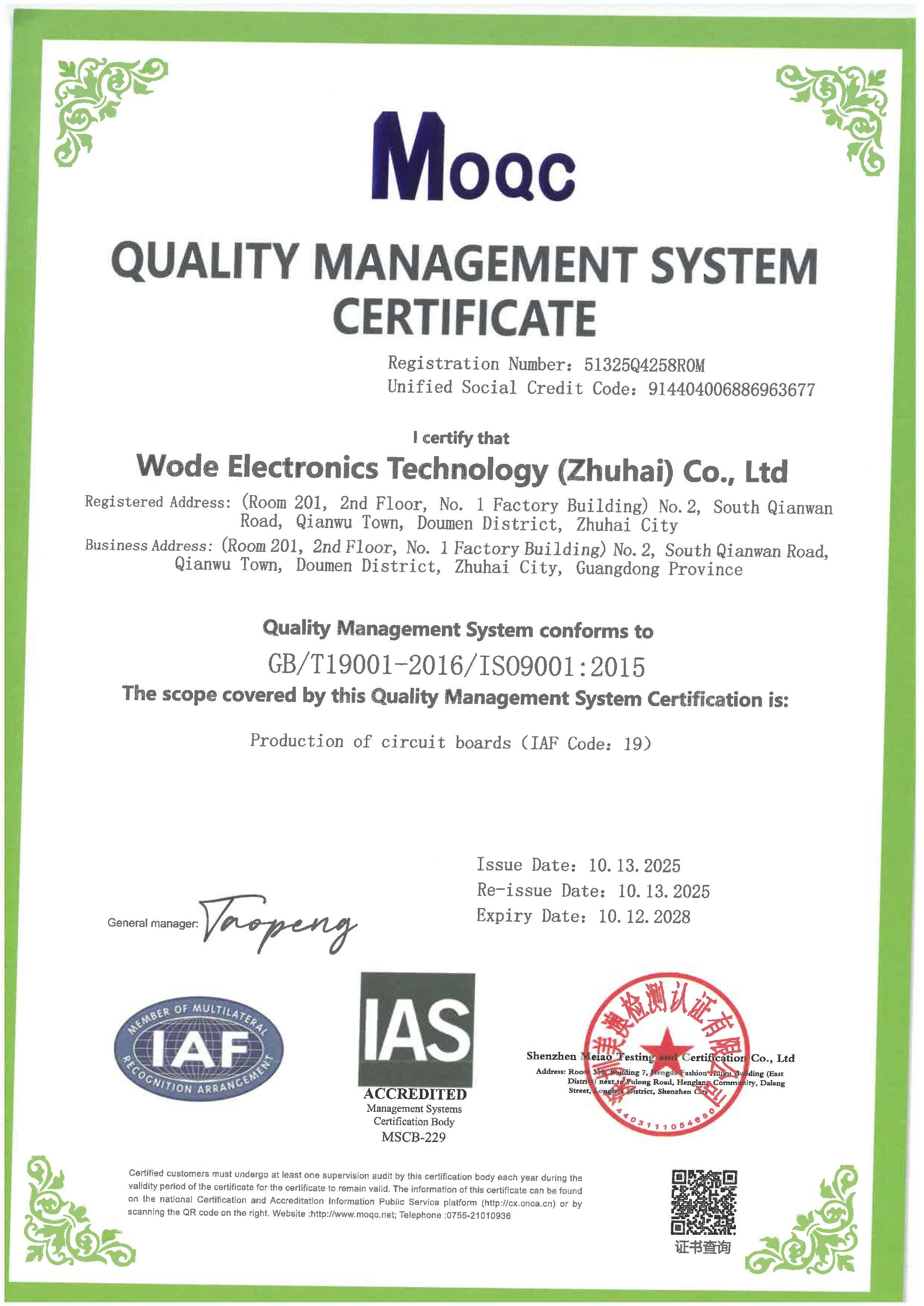
| ISO 9001:2015 | 51325Q4258ROM | Shenzhen Meiao Testing and Certification Co., Ltd | Production of circuit boards (IAF Code: 19); valid 2025-10-13 to 2028-10-12 | Confirms a certified quality management system for circuit-board production; it does not certify the thermal or electrical performance of a specific board |
| ISO 14001:2015 | 51325E2142ROM | Shenzhen Meiao Testing and Certification Co., Ltd | Environmental management activities related to the production of circuit boards (IAF Code: 19); valid 2025-10-13 to 2028-10-12 | Supports environmental sections of supplier questionnaires and customer audits |
| IATF 16949 | 0584371 | NQA Certification Limited | Human Resources, Purchasing, Strategic Planning for automotive printed circuit board manufacturing; support site Guangdong Kunxiang New Material Group Co., Ltd.; valid 2025-09-27 to 2028-09-26 | Relevant to automotive and motor-lighting programs; the scope wording is narrow and names a support site, so coverage should be confirmed against the ordered board |
| UL 796 | E323980 | UL Solution | Single-layer metal-base printed wiring board (WD-14, WD-15, WD-16, WD-17); single-layer rigid printed wiring board (RXD-11, WD-12, WD-13, RXD-10); issued 2022-01-01 | Covers single-layer metal-base and single-layer rigid boards; on its stated scope it does not list double-sided FR-4 |
| UL 796F | E498836 | UL Solution | Single-layer FMIC flexible printed circuit, model WD-F1, WD-F2 (ASP1); standard UL 796F and IPC-TM-650 2.6.27; issued 2022-01-01 | Covers a defined single-layer flexible circuit family used for LED strip and tube FPCs; the ordered part should be confirmed as falling within WD-F1/WD-F2 |
| CQC product certification | CQC22001367683 | China Quality Certification Centre | Printed circuit board on four substrate types (22F CEM1 5152, CEM-1, FR-4 GF211, FR-4 KB6160), thickness 0.2–3.2 mm, V-0 flammability; GB 4943.1-2022; valid 2026-01-13 to 2027-11-16 | Useful for CEM-1 and FR-4 boards inside the named substrates and thickness window; carries the earliest expiry date in the file |
| REACH SVHC test report | DGC251204025BD03 | NSTL | Double-sided aluminium-based board with HASL finish; EU REACH Regulation (EC) No 1907/2006 and ECHA SVHC candidate list; issued 2025-12-10 | A substance test report for one board construction, not a management-system certificate |
Reading the set rather than the list changes the questions a buyer asks. ISO 9001 answers whether a system exists. The UL recognitions answer which board constructions have been recognised. CQC answers which substrates and thicknesses were covered. The REACH report answers which substances were tested on which construction. None of them answers whether a board will survive a decade in an outdoor luminaire, and no supplier document can answer that without project-specific thermal and reliability data.
Two verification habits are worth building into the process. First, check the certificate on the issuer's own register rather than accepting a scanned image, because file numbers are searchable and scope revisions are published. Second, keep the certificate PDF alongside the quotation in the same procurement file, so that a later specification change triggers a scope re-check rather than a silent assumption.
Where the Scope Stops: Double-Sided FR-4, COB FPC and Roll-to-Roll
The most useful part of any certificate is where it ends, and this file has three boundaries that deserve explicit confirmation before an order is released.
Double-sided FR-4. The UL 796 recognition E323980 lists single-layer metal-base boards (WD-14 to WD-17) and single-layer rigid boards (RXD-11, WD-12, WD-13, RXD-10). Double-sided FR-4 sits outside that wording. That does not mean the construction is unrecognised — it means the single-layer file should not be presented, or accepted, as evidence for a double-sided order. The correct response is to request the separate recognition, test report or written declaration that covers the double-sided construction.
COB FPC and roll-to-roll FPCB. The UL 796F recognition E498836 covers a single-layer FMIC flexible circuit in models WD-F1 and WD-F2 (ASP1). COB FPCs, single-sided LED tube FPCs, single- or double-sided LED strip FPCs and infinity-length roll-to-roll FPCs all appear in the supplier's product range, but a buyer should confirm in writing which model designation each ordered construction falls under. Where a construction falls outside the listed models, the appropriate answer is a defined test programme, not a looser reading of the certificate.
Substrate and thickness limits. CQC22001367683 is tied to four named substrates and a 0.2–3.2 mm thickness range. A board built on a different laminate, or outside that window, is outside the scope as printed, even if the supplier can produce it.
A one-page board-to-certificate matrix — ordered part, construction, certificate number, scope reference, expiry date and document owner — is a reasonable deliverable to request at the evaluation stage. It is also the document that answers the question a year later, when the engineer who wrote the original RFQ has moved to another program.
How to read a scope line. Look for the product noun first (printed wiring board, flexible printed circuit, printed circuit board), then the construction qualifier (single-layer, metal-base, rigid, flexible), then any model or substrate list. If the ordered board fails any of those three elements, the certificate does not cover it, regardless of how prominently the logo appears on the supplier's homepage.
Matching Lighting Programs to the Evidence They Depend On
Different lighting programs stress different parts of the evidence file. The table below maps common fixtures to the board usually quoted and the document that carries the most weight in each case. It is a starting point for the RFQ, not a substitute for the buyer's own thermal and reliability validation.
| Lighting program | Board typically quoted | Evidence that carries the most weight |
|---|---|---|
| Street light, flood light, high bay | Single-layer metal-base MCPCB | UL 796 E323980 metal-base scope (WD-14 to WD-17), plus project thermal test data |
| Downlight, spotlight, panel light, bulb lamp | Single-sided CEM1, CEM3 or FR-4 | UL 796 single-layer rigid scope, plus the CQC substrate and thickness range |
| LED strip, tube and ultra-thin linear | Single-sided FPC | UL 796F E498836 (WD-F1/WD-F2), plus dimensional and bend requirements |
| COB arrays, roll-to-roll production | COB FPC, infinity-length FPCB | Written confirmation of model coverage, plus sample-based electrical and thermal validation |
| Automotive and motor lighting | FR-4 or CEM with thermal management | IATF 16949 0584371 and its stated scope, including the named support site |
| Grow light and high-load horticultural fixtures | High-power MCPCB | Measured thermal data and sample testing; certificates do not describe thermal performance |
Thermal conductivity is where the certificate file stops being useful and sample testing begins. Supplier product pages published for this topic quote dielectric ranges from roughly 1.0 to 8.0 W/m·K, and a secondary industry article cites 1–3 W/m·K for aluminium core material. These figures are not directly comparable across suppliers, because the dielectric definition, thickness and test method are frequently unstated; a buyer comparing a 2.0 W/m·K claim from one supplier against a 3.0 W/m·K claim from another is comparing labels rather than measurements. The practical request is narrower and more useful: dielectric material and thickness, copper weight, base thickness, the test method used, and measured thermal resistance for the actual stack-up proposed.
Durability evidence has the same shape. WODE describes one long-running German lighting OEM project in which its boards have covered 5,000 m² over five years, with stable operation cited in a harsh European climate. A single customer reference of this kind is useful context for a durability conversation, but it is a supplier-reported case rather than a controlled comparison, and it does not transfer to a different luminaire design without the buyer's own validation.
For indoor programs — downlights, wall lamps, panel lights — the evidence weight shifts toward substrate consistency and thickness control, because the CQC scope is tied to specific laminates and a 0.2–3.2 mm window. For outdoor programs, the metal-base UL scope and the thermal stack-up matter more, and the REACH test report becomes relevant when a double-sided aluminium construction is specified.
Purchasing Terms and Acceptance Criteria Worth Fixing Before Tooling
Terms are where evaluation becomes execution, and where ambiguity is most expensive. WODE's published purchasing information states a minimum order quantity that ranges from a few panels for sample orders to roughly 100 m² for mass orders, a lead time of 7–25 days depending on order quantity and design complexity, delivery arranged through the buyer's designated logistics method by sea, air or land, and acceptance carried out against mutually agreed technical specifications and inspection standards covering incoming, outgoing or third-party inspection. Payment terms are to be confirmed in the order or contract rather than published on the site.
Customisation options listed by the company include layer count, substrate, surface finish (ENIG, OSP, HASL, HASL-LF and others), impedance control, and routing, slotting and cutting. These are exactly the variables that move price and lead time, so they belong in the RFQ as explicit selections rather than as an assumed 'supplier standard'.
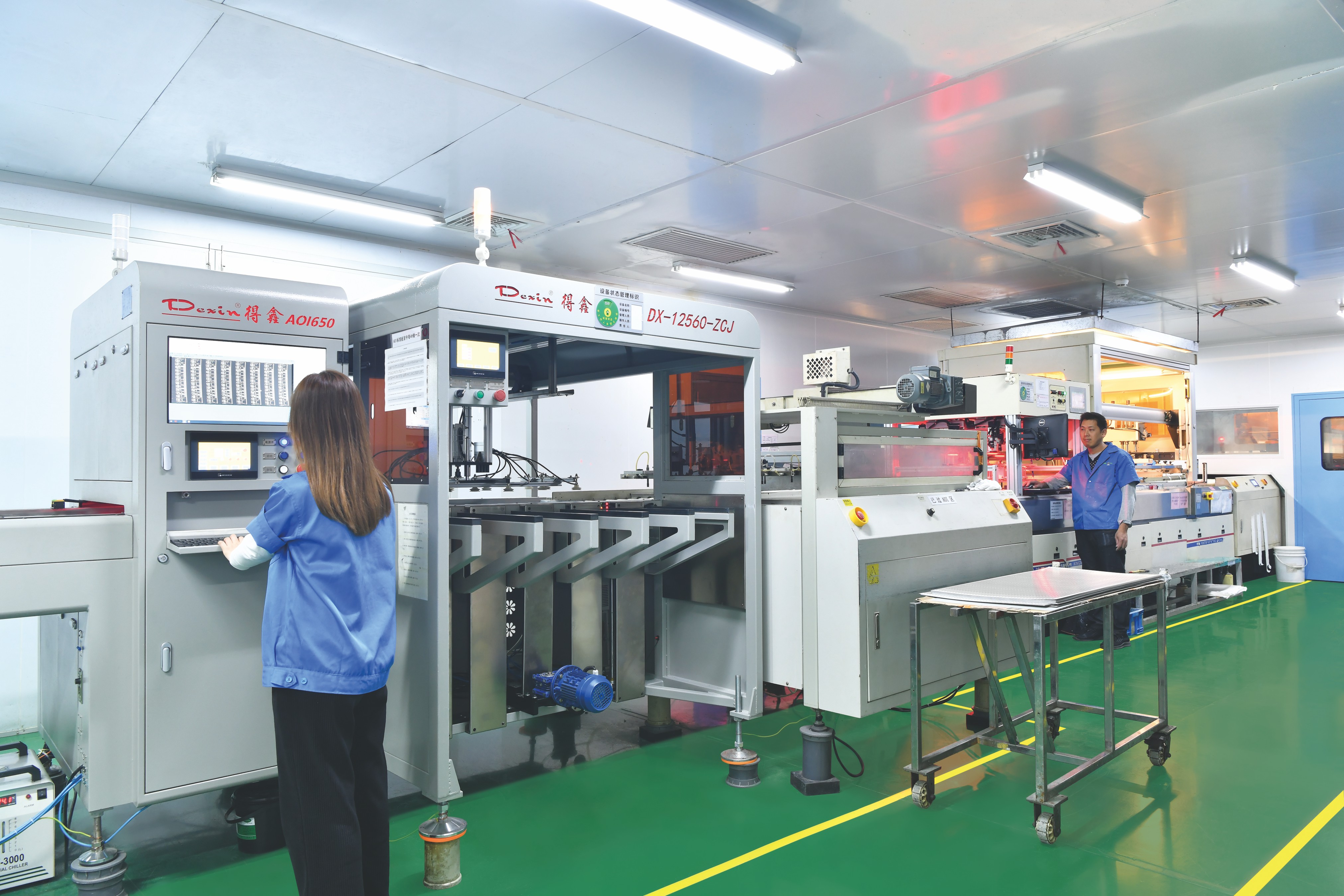
Quality control is described as a continuous-improvement system with incoming, process and final inspection plus electrical function testing. The company also notes that specific inspection equipment and criteria — AOI, X-ray and comparable tools — need to be provided separately. That is an honest limitation and should be treated as an action item: request the equipment list, the sampling plan, the defect classification scheme and the acceptance threshold that will apply to the order, and attach them to the contract.
After-sales support is described as technical support and a quality liaison, with warranty, returns and defect handling to be specified in the customer contract. Buyers should not rely on a general statement of support where a contractual defect procedure is what actually governs a claim six months into a production run.
A Six-Step Verification Sequence for Evaluation and Execution Stages
- Confirm the legal entity. Match the quotation, contract, certificate holder and payment beneficiary to one legal name and one address. Confirm that the listed address is a production site rather than a sales office.
- Fix the capacity question. Ask which workshop and line will run the order, what its current loading is, and what the 6,000,000 m² annual figure means for scheduling a repeat 100 m² order.
- Collect certificate numbers with scope text. Request the certificate PDFs rather than the logos, and read the scope line for the exact product description, model list and validity dates.
- Map every ordered construction to a certificate. Use a written matrix and escalate any construction that falls outside a listed scope, including double-sided FR-4 and unnamed flexible models.
- Validate by sample. Run the thermal, electrical and dimensional tests relevant to the luminaire, and record the stack-up actually tested against the stack-up ordered.
- Write the terms. MOQ, lead time, logistics method, inspection standard, acceptance criteria, payment and defect handling belong in the contract, not in an email thread.
Limits of Verification: What These Documents Do Not Establish
Verification reduces uncertainty; it does not remove it. A management-system certificate confirms that a quality system has been audited against a standard, not that a particular LED board will meet a particular thermal target. A UL recognition confirms that a construction has been evaluated to a safety standard, not that a finished luminaire complies with the market rules that apply where it will be sold. A REACH test report describes substances tested on one board construction at one point in time, not batch-to-batch consistency.
Two further limits are worth stating plainly. Capacity figures do not constitute a delivery commitment; a 6,000,000 m² annual output says nothing about where a 100 m² order sits in next month's schedule. And public certification information expires: CQC22001367683 runs to 2027-11-16, while the ISO and IATF certificates run to 2028, so a supplier file needs a review date as well as an approval date.
What proper verification does achieve is narrower and more durable. It converts a set of claims into a set of named documents with numbers, dates and scope statements that a different person can re-check next year without restarting the conversation — which is the point at which an LED PCB supplier becomes a qualified supplier rather than a preferred one.
FAQ
How does a lighting buyer confirm that a certificate covers the exact board being sourced?
Read the scope line and match three elements: the product noun (printed wiring board, flexible printed circuit or printed circuit board), the construction qualifier (single-layer, metal-base, rigid, flexible), and any model or substrate list. Then check the validity dates and the certificate holder's legal name. If any element fails, request the document that covers the ordered construction instead of accepting the nearest available certificate.
What do the 2003 establishment date and the 150,000 m² facility measure in practice?
They indicate scale and continuity: a supplier founded in 2003 with a 150,000 m² site, more than 500 employees and a reported 6,000,000 m² annual output has the resources to run multiple process lines and sustain quality systems over time. They do not describe the specific line, panel size, tolerance, yield or current loading that will apply to a given LED board order, which is why process-level evidence is requested alongside the facility figure.
Which WODE certificate applies to double-sided FR-4, COB FPC and roll-to-roll FPCB?
The UL 796 recognition E323980 lists single-layer metal-base and single-layer rigid boards, so double-sided FR-4 falls outside its stated scope. UL 796F recognition E498836 covers a single-layer FMIC flexible circuit in models WD-F1 and WD-F2 (ASP1), so COB FPCs and infinity-length roll-to-roll constructions should be confirmed in writing as falling within those models. Where a construction sits outside both scopes, the buyer should request the applicable document or a defined test programme.
What purchasing terms and acceptance criteria should be agreed before an LED PCB order?
Fix the minimum order quantity, the lead time basis, the logistics method and cost terms, the inspection standard (incoming, outgoing or third-party), the acceptance criteria and sampling plan, the payment method, and the defect handling procedure. WODE states an MOQ ranging from a few panels for samples to roughly 100 m² for mass orders and a lead time of 7–25 days depending on quantity and design complexity, with payment terms confirmed in the order or contract.
Does UL 796 or UL 796F recognition mean an LED luminaire is certified?
No. UL 796 and UL 796F are recognitions of printed wiring board and flexible circuit constructions against a board-level safety standard. They indicate that the recognised construction has been evaluated, and they support a luminaire certification process, but the finished fixture's compliance depends on the complete design, the driver, the enclosure and the market where it is sold. Board-level recognition and luminaire-level certification are separate steps.
WODE Circuit Technology (Zhuhai) Co., Ltd. publishes its product range, facility information and certificates through WODE Circuit Technology, and a downloadable company brochure covering its PCB and FPC lines is available here: WODE company brochure.
Есть вопросы или нужны дополнительные детали?
Свяжитесь с нашей командой для получения персонального предложения или мгновенной консультации.
Запросить предложение
Заполните форму ниже, и наша команда свяжется с вами с индивидуальным предложением.
Прямой чат WhatsApp
Предпочитаете общаться в реальном времени? Напишите нам в WhatsApp для мгновенной помощи и быстрых ответов.
- Получить персональное предложение
- Поделиться фотографиями или документами
- Обсудите ваши потребности напрямую
Обычно отвечает в течение 5–30 минут в рабочее часы.