
LED Strip FPC and Roll to Roll Infinity FPCB: Scenario Fit
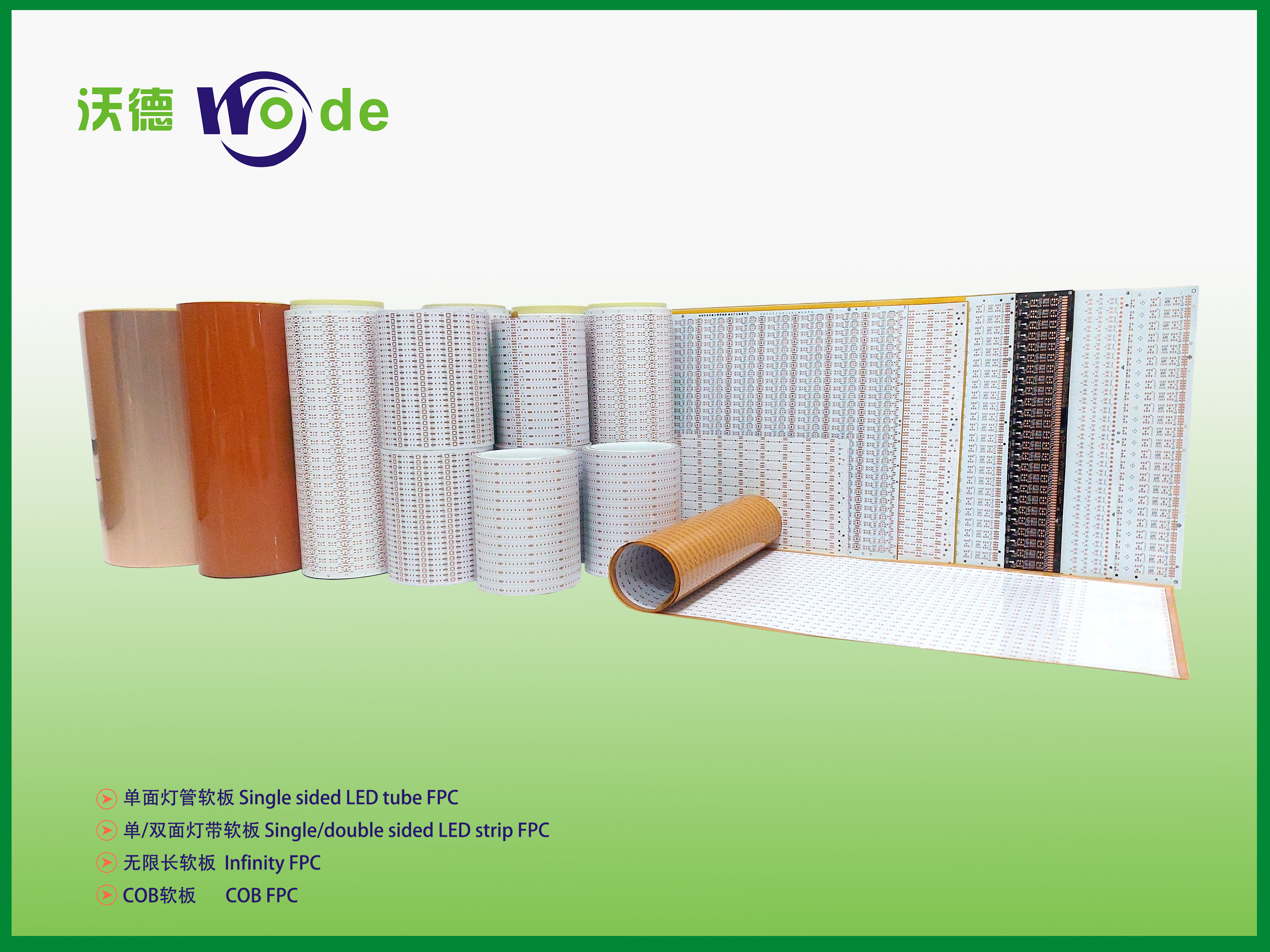
Flexible LED strip lighting is constrained less by the LEDs than by the circuit that carries them. This article examines how PI-based single/double sided LED strip FPC and Roll to Roll Infinity FPCB from WODE Circuit Technology (Zhuhai) Co., Ltd. map onto the material, thickness, panel-format and certification requirements of general, automotive, smart and specialty lighting projects — and where those flexible circuits reach their limits.
An Industry That Grew Around Flexible Light
Linear flexible lighting stopped being a decorative accessory some years ago. Strip-based light engines now sit inside cabinet and cove installations, retail shelving, architectural linear runs, industrial machinery enclosures, vehicle interiors and specialty equipment, and the format is being pulled along by the broader lighting market.
MarketsandMarkets valued the global LED lighting market at USD 78.4 billion in 2024 and projected a compound annual growth rate of 8.5% through 2029. Outdoor LED lighting specifically is projected by Future Market Insights to expand from USD 15.0 billion in 2025 to USD 28.0 billion by 2035. Underneath those fixtures sits the printed circuit board industry, valued by Global Market Insights at approximately USD 80.2 billion in 2025. Estimates for the same metric differ across research houses — Grand View Research places the 2025 PCB market at USD 82.7 billion — so the useful reading is a range rather than a single authoritative number.
The engineering consequence of that growth is straightforward. When a strip is specified, the conversation quickly moves past lumen output and colour temperature to three harder questions: how long can the circuit run without a joint, how thin can the assembled light engine be, and what compliance evidence exists for the substrate that carries the current. Those are printed-circuit questions, and they are the reason flexible circuits — not rigid boards — dominate strip lighting.
The Problem: Strip Lighting Is a Substrate Problem
Rigid single-sided laminates still have a place in linear lighting. WODE's single sided CEM1/CEM3/FR4 PCB line uses CEM-1, CEM-3, FR-4 or aluminium substrates with 0.5 oz to 3 oz copper, an overall thickness range of 0.6–2.0 mm, and a maximum length of 2000 mm. That last figure is the constraint. A rigid board ends at a fixed length, which means joints, connectors or splices in any long linear run, and each joint is a potential failure point, a shadow line and a cost item.
Flexible strip lighting pushes in the opposite direction: longer continuous runs, thinner profiles, tighter bend radii where the strip follows a curve, and — in smart and automotive variants — additional routing for control signals alongside the LED power rail. A rigid laminate cannot absorb that combination. A polyimide-based flexible circuit can, which is why the FPC layer has effectively become the specification battleground for strip products.
What WODE's LED Strip FPC and Roll to Roll Infinity FPCB Are
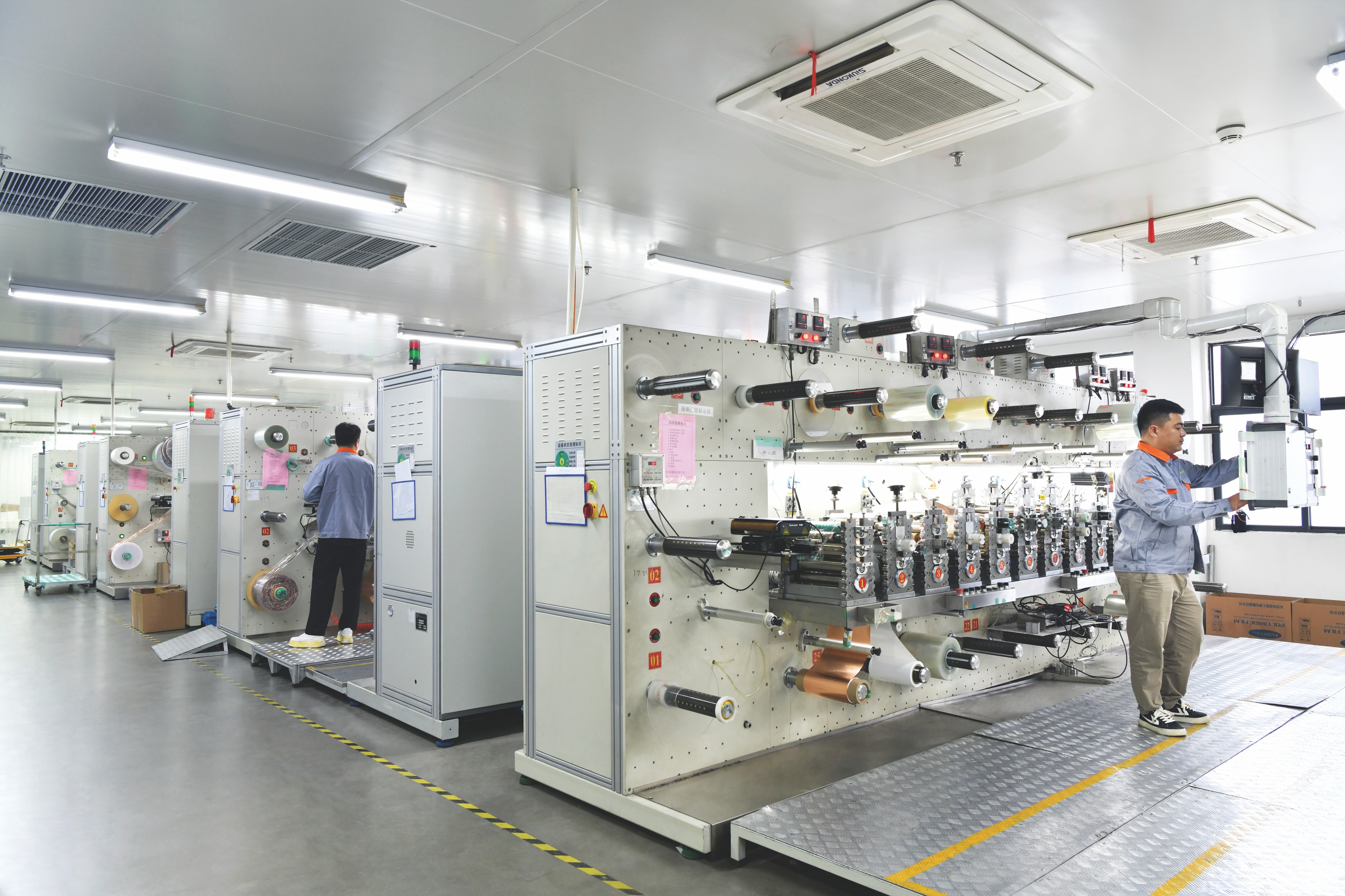
WODE Circuit Technology (Zhuhai) Co., Ltd. is a printed circuit board and flexible circuit manufacturer founded in 2003 and based in Zhuhai, China, operating a 150,000 m² facility with more than 500 employees and an annual output of 6,000,000 sqm. Its product line covers rigid MCPCB, FPCB, Infinity Length FPCB, FR-4/CEM1/CEM3 PCBs and copper-clad laminate, and PCB inks, with roughly 50% of output exported and main markets in Brazil, Turkey, India, Vietnam and Russia.
Two of its flexible products sit directly in the strip-lighting scenario. The first is the Single/double sided LED strip FPC, a polyimide (PI) circuit available in single or double sided construction. The second is the Roll to Roll Infinity FPCB, a single sided PI circuit produced through reel-to-reel processing — the same platform the company lists as Infinity Length FPCB and Reel to Reel unlimited FPC board in its product range.
For buyers evaluating scenario fit, the parameter set matters more than the product name, because these are the numbers that must survive thermal cycling, bending and certification review:
| Parameter | Single/double sided LED strip FPC | Roll to Roll Infinity FPCB |
|---|---|---|
| Substrate material | PI (polyimide) | PI (polyimide) |
| Layer configuration | Single sided or double sided | Single sided |
| Copper foil thickness | 1/1 oz or 1 oz | 1 oz |
| Overall thickness | 0.115 mm | 0.15 mm |
| Panel size | 366.00 mm × 250.00 mm (/1) up | 1000.00 mm × 124.00 mm (/13) up |
| Solder mask | White coverlay | White |
| Silkscreen colour | White | Black |
| Surface finish | OSP | OSP |
| UL listing cited | UL 796F (E498836) for the flexible PCB platform | UL 796F (E498836), North America |
Two adjacent products complete the picture for buyers whose strip project shares a platform with other formats: the COB FPC, which uses the same PI substrate, single/double sided construction, 1/1 oz or 1 oz copper and 0.115 mm overall thickness as the strip FPC, and the single sided LED tube FPC, a 0.5 oz, 0.08 mm PI circuit on a 1239.50 mm × 255.00 mm (/39) up panel.
Technical Explanation: Why These Numbers Matter in a Strip Stack
Polyimide is chosen as the substrate because it survives the flexing and heat exposure that a strip assembly experiences during lamination, reflow and end use. A 0.115 mm or 0.15 mm overall thickness is what allows an assembled strip to sit inside shallow extrusions and adhesive channels where a 0.6–2.0 mm rigid board simply will not fit.
Copper weight is the current-carrying decision. Strip lighting runs long distances with a constant-current LED driver, and voltage drop accumulates along the length of the trace. The 1/1 oz and 1 oz copper options on the LED strip FPC, and 1 oz on the Roll to Roll Infinity FPCB, define how much current a given trace width can carry before resistive losses become visible as colour shift or brightness falloff at the far end of a run. For high-current linear products, the double sided configuration is the lever: power and return paths can be separated across two layers rather than sharing one copper plane with the LED string, which reduces the effective resistance of the run and relieves routing congestion where sensors or control lines must also be carried.
The panel format is the production signal. The Roll to Roll Infinity FPCB is built on a 1000.00 mm × 124.00 mm panel laid out 13-up — a strip-oriented, high-panelisation format consistent with reel-to-reel processing, which is the operating model behind WODE's Reel to Reel FPCB production line. The LED strip FPC, by contrast, is built on a 366.00 mm × 250.00 mm (/1) up panel, a format suited to discrete flexible panels rather than continuous reel output. In practice a buyer choosing between them is choosing between continuous-feed assembly and panel-based assembly, not simply between two thicknesses.
Surface chemistry is the third variable. Both strip products specify OSP as the surface finish and a white solder mask — white coverlay on the strip FPC, white solder mask on the Roll to Roll Infinity FPCB. White soldermask and coverlay are common in strip construction because the surface sits inside the optical cavity of the fixture, and OSP is a lead-free, flat finish suited to fine-pitch LED placement where solderability must be consistent across a long panel.
Certification and Compliance: Reading the Listings Correctly
For a constraint-driven purchase — which is what strip lighting procurement usually is — certification is a gate, not a marketing line. The relevant WODE listings are specific and can be checked by number.
| Certification | Number | Issuing body | Scope and market |
|---|---|---|---|
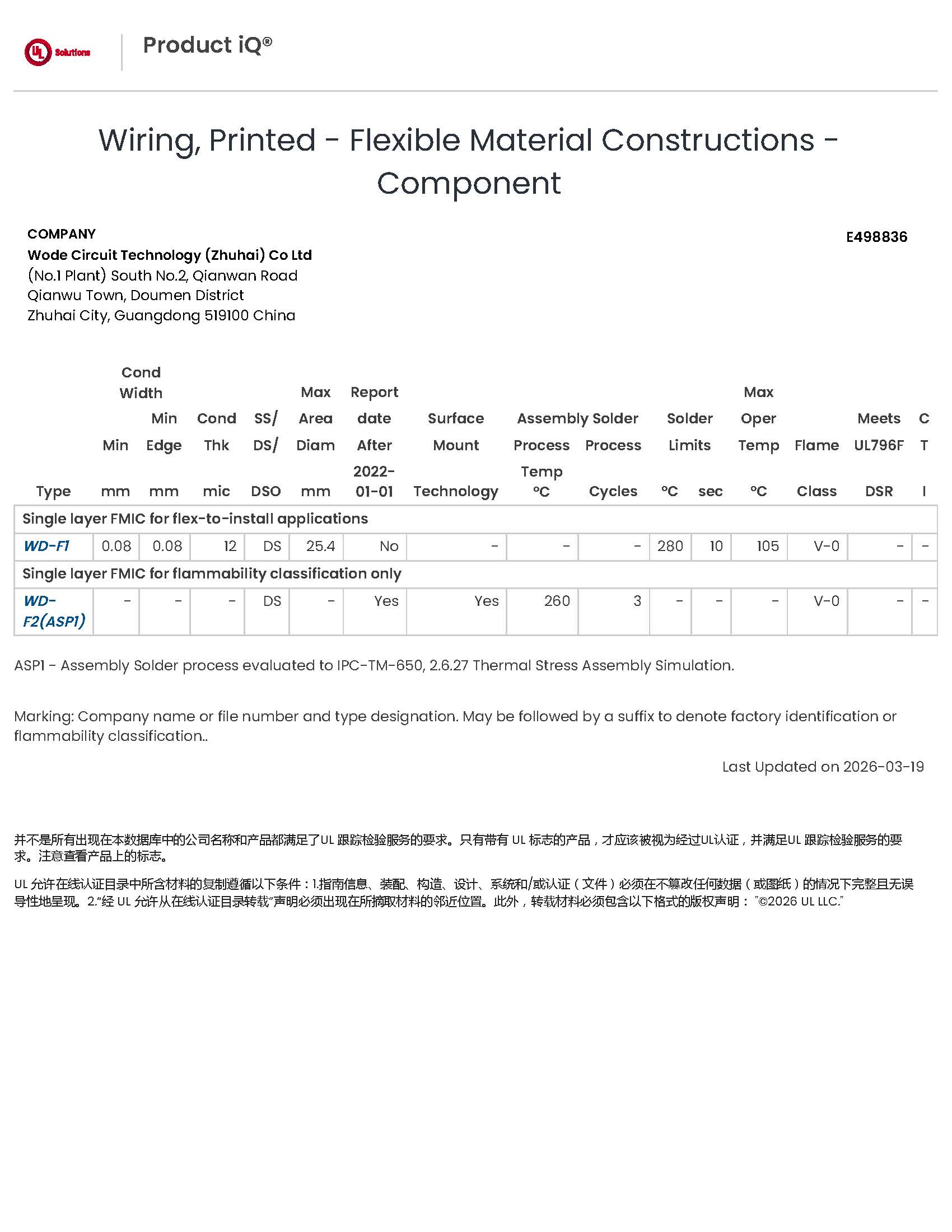
| UL 796F — Flexible PCB | E498836 | UL Solution | Single layer FMIC flexible printed circuit, models WD-F1, WD-F2 (ASP1); North America |
| UL 796 — Rigid PCB | E323980 | UL Solution | Single layer metal base and rigid printed wiring boards (WD-14 to WD-17, RXD-11, WD-12, WD-13, RXD-10); North America and recognized worldwide for rigid PCBs |
| IATF 16949 | 0584371 | NQA Certification Limited | Automotive printed circuit board manufacturing; global |
| CQC | CQC22001367683 | China Quality Certification Centre | GB 4943.1-2022; boards 0.2–3.2 mm, V-0 flammability; global |
| ISO 9001:2015 | 51325Q4258ROM | Shenzhen Meiao Testing and Certification Co., Ltd | Production of circuit boards (IAF Code 19); global |
| ISO 14001:2015 | 51325E2142ROM | Shenzhen Meiao Testing and Certification Co., Ltd | Environmental management for circuit board production; global |
| REACH / SVHC test report | DGC251204025BD03 | NSTL | EU REACH Regulation (EC) No 1907/2006, ECHA SVHC candidate list; double sided aluminium-based board; worldwide |
The flexible listing is the one that matters most for strip work. The Roll to Roll Infinity FPCB and the single sided LED tube FPC are covered by UL 796F certification number E498836, issued by UL Solution and applicable to the North America market, with the record citing UL 796F alongside IPC-TM-650 2.6.27 and an issue date of 1 January 2022.
Where These Circuits Fit: Scenario Mapping
Scenario fit is decided by the operating environment, and the lighting industry's four broad project categories place different demands on a flexible circuit.
General lighting
Bulb lamps, downlights, spotlights, panel lights, ceiling lights, tube lights and industrial high-bay lights represent the volume end of the market. The dominant working condition is indoor operation between 0°C and +40°C at 30% to 80% relative humidity with no special corrosion exposure, and duty cycles commonly run 8 to 16 hours per day. In this environment the flexible circuit's job is dimensional: fitting a long linear source into a shallow profile, and supporting dimming behaviour across a 0–100% range without mechanical joints. The single/double sided LED strip FPC's 0.115 mm thickness is the specification that makes ceiling and cove formats practical.
Outdoor lighting
Outdoor luminaires operate from –40°C to +50°C under high humidity, salt spray, UV radiation and wind-driven rain, typically through 10 to 14 hours of continuous night operation. Long continuous runs are common in façade and linear outdoor systems, which is where the Roll to Roll Infinity FPCB's continuous reel format and 1 oz copper become relevant — the higher copper weight limits voltage drop over distance, and reel-based output reduces the number of panels that must be joined.
Automotive lighting
Automotive lighting is the harshest electrical environment in the set: engine compartment conditions from –40°C to +125°C, vibration and shock, oil contamination and moisture condensation, driving headlamps, taillights, daytime running lights, ambient lighting and turn signals. WODE holds IATF 16949 certification (number 0584371, issued by NQA Certification Limited, applicable globally) covering automotive printed circuit board manufacturing, with the certificate's scope addressing human resources, purchasing and strategic planning and a named support site. Automotive procurement teams should still treat strip FPC selection as a project-level qualification exercise, with the certification as an entry condition rather than a substitute for application-specific validation.
Smart and specialty lighting
Smart lighting adds circuits the strip must carry in addition to the LED string: tunable white and colour control, sensor interfaces, and connected luminaire architectures including DALI-2 control. This is the clearest case for double sided construction, because control and power routing compete for the same copper layer in single sided designs. Specialty lighting — stage lights, grow lights, UV curing lamps, infrared illumination, surgical lights, explosion-proof lights and fishing attraction lights — sits outside the standard assumptions entirely and should be specified against the individual fixture's environmental and regulatory envelope.
Market Trends Shaping the Substrate Decision
Three trends are visible in published industry data and all three push in the same direction.
First, the lighting market continues to expand, but the growth is unevenly distributed. The global LED lighting market's projected 8.5% CAGR through 2029 is a blended figure, while outdoor LED lighting is forecast to nearly double between 2025 and 2035, from USD 15.0 billion to USD 28.0 billion. Outdoor and architectural linear applications are where long continuous strip formats carry the highest value.
Second, thermal architecture remains the dividing line between circuit technologies. Metal Core PCBs, particularly aluminium core, are the industry standard for high-power LED thermal management because of their heat dissipation efficiency. This is a trend that defines the boundary of flexible circuit application rather than competing with it: flexible circuits carry and interconnect, while the thermal path is engineered through metal-core boards, extrusions, heat sinks or board-level thermal structures.
Third, the supply base is concentrated and standard-driven. China accounted for 53.2% of global PCB production value as of 2024, and the top global PCB manufacturers include Zhen Ding Tech (ZDT), Unimicron, DSBJ, Nippon Mektron and TTM Technologies. At the same time, the compliance framework around LED products is becoming more explicit: LED modules are evaluated under IEC/EN 62031 and LED control gear falls under IEC/EN 61347-2-13, while IPC-6012 is the primary performance specification for rigid printed boards and is widely adopted for LED PCB quality classification. For flexible circuits, the equivalent anchor is UL 796F, which is why a listing number carries real procurement weight.
Comparison With Traditional Solutions — and Honest Limits
Strip lighting buyers typically weigh three substrate routes, and they are not interchangeable.
| Attribute | Single sided CEM1/CEM3/FR4 PCB | Single/double sided LED strip FPC | Roll to Roll Infinity FPCB |
|---|---|---|---|
| Substrate | CEM-1, CEM-3, FR-4 or aluminium | PI | PI |
| Layer | Single sided | Single or double sided | Single sided |
| Copper foil thickness | 0.5 oz, 0.75 oz, 1 oz, 2 oz, 3 oz and above | 1/1 oz or 1 oz | 1 oz |
| Overall thickness | 0.6–2.0 mm | 0.115 mm | 0.15 mm |
| Maximum length / panel | Maximum length 2000 mm | 366.00 mm × 250.00 mm (/1) up | 1000.00 mm × 124.00 mm (/13) up |
| Surface finish options | OSP, carbon film, HASL, lead-free HASL, nickel-plated gold, ENIG, Chem. Ag, ENEPIC | OSP | OSP |
| Typical fit | Rigid linear boards, high-copper heavy-current boards | Flexible panels, double sided routing for smart/power separation | Continuous reel-fed strip output |
The trade-offs that buyers should price into a decision are real and should be stated plainly.
Limitation one: an FPC is not a thermal substrate. A PI flexible circuit does not replace a metal-core thermal path. Where an application concentrates high-power LEDs in a small area, aluminium-core MCPCB remains the industry-standard solution, and the flexible circuit's role is to carry current and interconnect elements, not to spread heat. Projects that need both functions usually need both technologies in the same fixture, not one substituted for the other.
Limitation two: the continuous reel format is single sided and 1 oz. The Roll to Roll Infinity FPCB is specified as single sided with 1 oz copper foil and 0.15 mm overall thickness. Designs that require separated power and signal layers, higher copper weight, or the thinner 0.115 mm profile are better served by the single/double sided LED strip FPC. Choosing the continuous format for a routing problem it was not designed for is a common specification error.
Limitation three: certification scope does not transfer automatically. As noted above, the CQC certificate describes a 0.2–3.2 mm thickness range and the REACH report covers a double sided aluminium-based board. Neither describes a 0.115 mm PI strip circuit. A buyer who needs specific compliance evidence for a flexible strip part should request documentation matched to that part's construction.
Limitation four: reel-format material changes the downstream process. Flexible circuits supplied in continuous or high-panelisation formats assume that the customer's placement, reflow and cutting equipment can handle reel or panel input. Where downstream tooling is set up for discrete rigid panels, that change carries additional engineering and qualification effort that should be costed before selection, not after.
Future Outlook
The direction of strip lighting is toward longer continuous runs, thinner assemblies and more embedded control, and all three favour flexible circuits over rigid laminates. As the outdoor segment moves toward the USD 28.0 billion forecast for 2035, the share of linear fixtures specified with continuous flexible light engines is likely to grow with it, particularly in architectural, horticultural and industrial linear applications.
Two developments will shape supplier selection more than capacity will. The first is documentation depth: as LED modules and control gear are assessed against standards such as IEC/EN 62031 and IEC/EN 61347-2-13, and rigid boards against IPC-6012, the ability to produce scope-matched certification evidence per part number becomes a qualifying capability rather than a differentiator. The second is manufacturing format: reel-to-reel flexible circuit production — the platform behind WODE's Infinity Length FPCB and Reel to Reel unlimited FPC board lines — is what allows a supplier to serve long-run strip programmes without switching panel formats mid-project.
For a manufacturer operating a 150,000 m² facility with an annual output of 6,000,000 sqm and a customer base qualified by brands including Signify, Osram, Opple, NVC, Honeywell, Randon, Dixon, Ozdisan, IKIO and Motheson, the flexible strip segment is an extension of an existing rigid MCPCB and FR-4 business rather than a divergent one. That matters for buyers, because it means substrate, certification and capacity decisions can be consolidated with a single supplier across rigid and flexible lighting circuits.
Frequently Asked Questions
What does UL 796F certification actually cover for a flexible LED strip circuit?
UL 796F is the standard under which the Roll to Roll Infinity FPCB and the single sided LED tube FPC are certified, under certification number E498836 issued by UL Solution and applicable to the North America market. The certification record cites UL 796F together with IPC-TM-650 2.6.27 and states a scope of single layer FMIC flexible printed circuit for models WD-F1 and WD-F2 (ASP1), with an issue date of 1 January 2022. Because UL recognition is granted per construction and model rather than per product family, a buyer should confirm that the specific part number and build being purchased fall inside that listed scope.
Which specifications determine whether an LED strip FPC suits a project?
Six parameters carry most of the decision weight: substrate material, layer configuration, copper foil thickness, overall thickness, panel size and surface finish. On the single/double sided LED strip FPC these are PI substrate, single or double sided construction, 1/1 oz or 1 oz copper, 0.115 mm overall thickness, a 366.00 mm × 250.00 mm (/1) up panel, white coverlay solder mask, white silkscreen and OSP surface finish. On the Roll to Roll Infinity FPCB they are PI substrate, single sided construction, 1 oz copper, 0.15 mm overall thickness, a 1000.00 mm × 124.00 mm (/13) up panel, white solder mask, black silkscreen and OSP surface finish.
Should a strip lighting project use single sided or double sided FPC?
Single sided construction is adequate when the circuit carries only the LED string and current levels stay within the capacity of a single 1 oz copper layer. Double sided construction becomes the appropriate choice when power and return paths or control signals must be separated across two layers, which is typical in smart lighting products that combine an LED string with sensor interfaces or control electronics. Both configurations are available in the single/double sided LED strip FPC and the COB FPC, while the Roll to Roll Infinity FPCB and the single sided LED tube FPC are single sided formats.
What commercial terms apply to LED strip FPC orders?
WODE's stated capability terms for circuit board production are a monthly capacity of 600,000 sqm, a minimum order quantity of 100 sqm for mass orders, and a lead time of 7–25 days depending on order quantity and design complexity. Sample quantity is not limited according to the company's case documentation. Customisation options include layer count, substrate, surface finish such as ENIG, OSP, HASL or HASL-LF, impedance control, and routing, slotting or cutting. Quality control is structured around incoming, process and final inspection plus electrical function tests, with specific inspection equipment and criteria such as AOI and X-ray to be agreed for the project.
Can a PI flexible circuit replace a metal-core PCB for high-power LEDs?
No. Metal Core PCBs, particularly aluminium core, are the industry standard for high-power LED thermal management because of their heat dissipation efficiency, and a polyimide flexible circuit does not perform that function. The two are complementary: the flexible circuit carries current and interconnects components, while the thermal path is handled by a metal-core board, an extrusion, a heat sink or another engineered structure. In high-power designs both technologies are normally present in the same fixture rather than one substituted for the other.
Do these flexible circuits suit outdoor or automotive lighting projects?
The application environments are defined and demanding. Outdoor lighting operates from –40°C to +50°C under high humidity, salt spray, UV radiation and wind and rain erosion, typically through 10–14 hours of continuous nighttime operation. Automotive lighting operates in engine compartment conditions from –40°C to +125°C with vibration, shock, oil contamination and moisture condensation. WODE holds IATF 16949 certification, number 0584371 issued by NQA Certification Limited and applicable globally, covering automotive printed circuit board manufacturing. The UL 796F certification for the flexible products applies to the North America market. Both environments should be treated as project-level qualification exercises in which certification is an entry condition, not a substitute for application-specific validation.
For detailed product parameters, layer configurations and certification documentation, WODE's full product brochure is available here: WODE Circuit Technology product brochure.