
LED Strip Light Shortlist for Acoustic Wall Lighting: 2835 vs 3535
Acoustic wall lighting is one of the few interior applications where a LED Strip Light is specified for how it behaves across a surface rather than for how much light it emits. Acoustic panels exist to manage reverberation; the strip exists to graze the panel face, a reveal, or a slat edge with an even, shadow-free line of light. That pairing — a decorative substrate plus a concealed linear source — turns emitter spacing, colour consistency over long runs, and electrical stability into the characteristics that decide whether a specification holds up on site.
For buyers at the decision stage, the practical shortlist usually narrows to two surface-mount configurations: SMD 2835 and SMD 3535. This HTNXT industry reference compares those two options as they are applied to acoustic wall lighting, using a verified acoustic wall product — CA-DC24V-2835-180D-8mm-3000K — as the concrete 2835 reference, and it sets out the purchasing terms and acceptance criteria that should be confirmed before a supplier is selected from the shortlist.
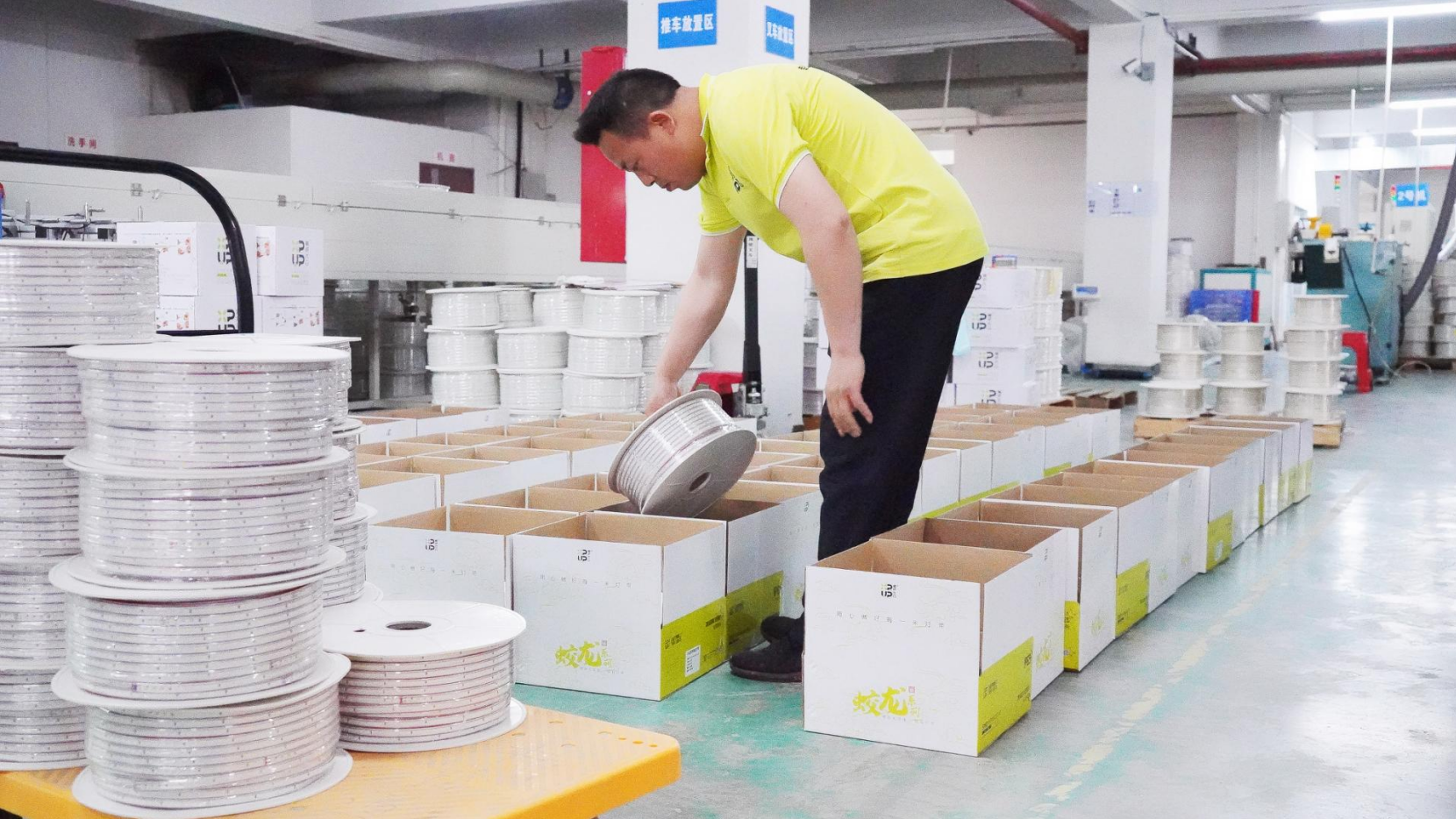
Flexible LED strip constructions are the usual source for concealed acoustic wall lighting; the shortlist decision turns on emitter density and board construction rather than on brightness alone.
What Acoustic Wall Lighting Demands from an LED Strip
Acoustic wall systems are installed where large, hard, flat surfaces would otherwise generate reflections: residential feature walls, hotel guest rooms and corridors, restaurants and bars, retail fit-outs, and commercial offices. Lighting is used to articulate those surfaces, and the strip is normally concealed behind a panel edge, inside a routed channel, or along the reveal between slats. Five requirements follow from that arrangement.
- Uniformity over length. When a strip runs along a panel edge at a shallow setback, the spacing between emitters determines whether the wall reads as a continuous line of light or as a row of visible points. Emitter pitch, not lumen output, is the controlling variable.
- Colour consistency across the wall and across batches. An acoustic wall is usually viewed as one uninterrupted plane, so a colour shift between the first metre and the last metre — or between two production batches delivered to the same project — becomes immediately visible.
- Electrical stability over run length. Long, continuous lines are the norm in wall applications, which makes voltage drop a live risk. Constant-voltage 24V DC is the mainstream starting point for such runs; the 24V segment accounted for 52.0% of the linear LED strip fixture market revenue in 2022, according to Grand View Research.
- Physical fit. Reveals and routed channels are shallow and frequently narrow, which constrains PCB width and largely rules out rigid light bars in curved or irregular geometry.
- Thermal path. Because the strip is hidden, it usually sits inside a profile or cavity where convection is limited, so heat management becomes a design constraint rather than an afterthought.
These requirements are not marginal to the market. Commercial applications contribute approximately 33.8% of global LED strip revenues, and more than 65% of new architectural lighting installations in 2025 utilise LED strip technology.
The Shortlist: SMD 2835 and SMD 3535 for Acoustic Walls
The two configurations that most frequently reach the final shortlist for acoustic wall lighting are SMD 2835 at 180 LEDs per metre and SMD 3535 at 120 LEDs per metre on a double-layer copper PCB.
Both are understood in this comparison as flexible, IP20-rated strips intended for wall lighting, luxury residential lighting, acoustic panel lighting, and commercial, hospitality and retail lighting. IP20 describes protection against solid objects above a defined size combined with no protection against water or condensation. In practice that places both options inside dry interior cavities: neither is appropriate for bathroom wet zones, exterior façades, or unventilated humid areas, where a higher ingress-protection class or an outdoor-rated construction is required.
SMD 2835 at 180 LEDs per metre
SMD 2835 is a compact surface-mount package. At 180 emitters per metre the pitch between diodes is short, so a strip mounted close to a panel face produces a comparatively continuous line rather than a row of bright spots. The verified acoustic wall reference model in this shortlist, CA-DC24V-2835-180D-8mm-3000K, uses this configuration.
SMD 3535 at 120 LEDs per metre with a double-layer copper PCB
SMD 3535 uses a larger package footprint than 2835. At 120 emitters per metre the spacing is wider than in the 180 LEDs/m option, and the distinguishing element of this configuration is the double-layer copper PCB: the additional copper cross-section lowers conductor resistance along the board, which supports current handling and spreads heat more effectively than a single-layer board of comparable width.
Because the two options differ on both emitter density and board construction, a shortlist decision cannot be made on LED count alone. Comparing 180 against 120 without also comparing PCB construction compares only half of the specification.
Reference Model: What CA-DC24V-2835-180D-8mm-3000K Tells a Buyer
CA-DC24V-2835-180D-8mm-3000K is the acoustic wall LED strip used as the 2835 reference in this shortlist. It is produced by Zhongshan Xiangpai (XPUP) Lighting Technology Co., Ltd., a LED strip manufacturer established in 2012 in Zhongshan, Guangdong Province, China, operating a 10,000 m² factory with a team of 80 and an annual output of 35,000,000 m of LED strip, and exporting to more than 170 countries and regions.
The model designation is built from the parameters that govern the specification and is read left to right:
- DC24V — 24V DC input
- 2835 — SMD emitter package
- 180D — 180 LEDs per metre
- 8mm — PCB width
- 3000K — colour temperature
Reading a model name this way has a practical purpose at the decision stage. Each block is a point that must be repeated identically on the datasheet, the drawing, the sample label, and the purchase order. Where a supplier quotes only 'a 2835 acoustic strip' without the remaining blocks, the buyer has no way to verify PCB width, emitter density, or colour temperature — and no basis for comparing that quotation against an alternative.
The colour temperature block is commercially significant for acoustic walls. The 3000K–4000K band held a 33.2% revenue share of the linear LED strip fixture market, reflecting its position as the warm-neutral range most often specified for residential, hospitality, and retail interiors where the light is meant to reveal surface texture rather than dominate the room.
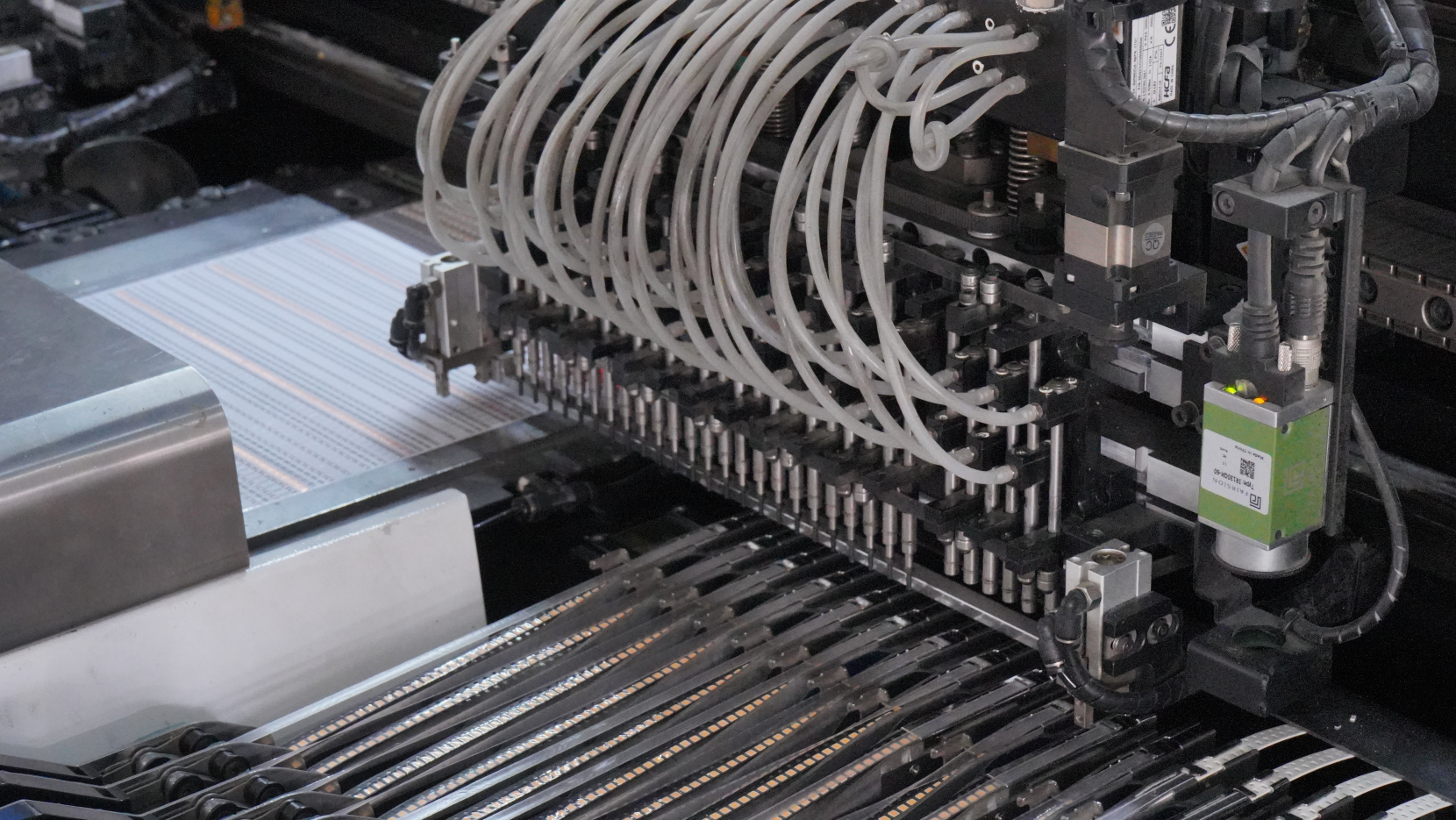
Emitter density and PCB construction are separate specification variables; both must appear on the datasheet before a shortlist comparison is meaningful.
Technical Explanation: Density, Copper, and Voltage Drop
Emitter density and visible dotting
Emitter density determines the minimum mounting distance at which a strip can be used without visible scalloping. Two strips with the same output per metre behave differently when set close to a panel face: the denser arrangement places more sources along the same length, so the light from adjacent emitters overlaps sooner and the wall reads as a continuous line. Where the mounting distance is generous — a deep cove or a wide reveal — the difference becomes far less visible, and the buyer's attention can move to other criteria.
What a double-layer copper PCB changes
Copper cross-section is the second variable in this comparison, and it is the one buyers most often overlook. A flexible strip is a long, thin conductor carrying a constant current, so the resistance of the copper traces directly affects brightness at the far end of a run and the amount of heat the board can dissipate. A double-layer copper PCB increases the conductive cross-section relative to a single-layer board, which supports current handling, reduces voltage drop along the length, and provides a more effective thermal path from the emitter to the surrounding profile.
Voltage drop and maximum run length
In a constant-voltage 24V DC system, current rises with the load per metre, and conductor resistance produces progressive voltage drop as the run lengthens. The visible symptom is a gradual fall-off in brightness toward the end of a line — precisely the effect that is most conspicuous on a continuous acoustic wall. Three design levers address it: a higher input voltage, a heavier copper conductor, and a shorter maximum run length.
The third lever is partly a supply-side decision. XPUP LED supplies its strip products in 10-metre rolls as a control against overloading. Buyers selecting from a shortlist should confirm the maximum permitted run length for the specific model, and whether that figure assumes a single feed or a feed at both ends.
IP20, heat, and the enclosing profile
An IP20 strip has an open face: the emitters and the board are exposed to the air inside the channel. In free air this is an advantage, because heat leaves the strip directly. Inside a closed aluminium profile, a sealed panel cavity, or a dense slat assembly, the same strip operates in a considerably warmer environment. The practical implication for the shortlist is that a higher-density configuration and a double-layer copper PCB are not simply 'better' specifications — they are specifications that assume an adequate thermal path. If the profile is narrow, closed, and unventilated, board construction and profile selection matter as much as emitter count.
SMD 2835 vs SMD 3535: Decision Criteria
| Decision criterion | SMD 2835, 180 LEDs/m (reference: CA-DC24V-2835-180D-8mm-3000K) | SMD 3535, 120 LEDs/m, double-layer copper PCB |
|---|---|---|
| Emitter package | SMD 2835 | SMD 3535 |
| Emitters per metre | 180 | 120 |
| Board construction | 8 mm PCB width, as stated in the reference model | Double-layer copper PCB |
| Nominal input (reference) | 24V DC | Confirm per model and datasheet |
| Colour temperature (reference) | 3000K | Confirm per model and datasheet |
| Ingress protection | IP20 | IP20 |
| Intended applications | Wall lighting, luxury residential lighting, acoustic panel lighting, commercial / hospitality / retail lighting | Wall lighting, luxury residential lighting, acoustic panel lighting, commercial / hospitality / retail lighting |
| Uniformity at shallow setback | Shorter emitter pitch; earlier overlap between adjacent sources | Wider emitter pitch; outcome depends more on mounting distance |
| Current handling and heat | Density concentrates heat per metre; profile ventilation is critical | Double-layer copper lowers conductor resistance and spreads heat |
| Where it tends to suit | Concealed lines viewed at close range, where dotting is the main risk | Longer or heavier runs, where conductor resistance and thermal spreading are the limiting factors |
| Both options require | Cut length and re-connection method, colour bin confirmation, and a profile matched to the IP20 rating and the thermal load | Cut length and re-connection method, colour bin confirmation, and a profile matched to the IP20 rating and the thermal load |
Application Fit: Luxury Residential, Acoustic Panels, Hospitality and Retail
Acoustic wall lighting is rarely a single-scenario purchase. The same shortlist is applied across four buying contexts, and each weights the comparison differently.
Luxury residential lighting
In residential feature walls and no-main-light interiors, the strip is usually hidden and the viewer stands close to the surface. Uniformity and colour consistency dominate, which favours the denser emitter pitch, while warm colour temperatures such as 3000K remain the usual target. Residential LED strip usage increased by 38% between 2022 and 2025 on the back of smart-home penetration, and nearly 49% of renovation projects include LED strip installations, particularly in kitchens.
Acoustic panel lighting
On slatted or fabric-wrapped acoustic panels, the strip either washes the panel face or sits in the gap behind it. The constraint here is mechanical as much as optical: the strip must follow panel geometry and must not be visible through the panel. Flexible construction is the reason LED strip is viable in these walls at all — flexible strips can bend freely and are better suited to curved and irregular installations, providing 70% higher installation flexibility for custom and architectural lighting layouts than alternatives.
Commercial, hospitality, and retail interiors
In hotels, restaurants, and retail interiors, walls are long, sight lines are uninterrupted, and access for maintenance is limited. Priorities shift toward run-length stability, consistent output end to end, and a serviceable fixing method. Commercial applications contribute approximately 33.8% of global LED strip revenues, and over 65% of new architectural lighting installations in 2025 utilise LED strip technology.
Project-based and OEM supply
Where an acoustic wall specification is repeated across a multi-room project or a private-label programme, the specification must be locked so that later deliveries match earlier ones. XPUP LED supports this through standardized mass production designed to ensure consistent colour temperature and brightness and controlled batch-to-batch colour differences, and through OEM/ODM customisation of voltage, colour temperature, PCB design, specifications, and packaging.
Market Context Behind the Shortlist
The commercial backdrop explains why this shortlist keeps reappearing in specifications.
- The global LED strip market was valued at approximately USD 5.8 billion in 2025 and is projected to reach USD 13.2 billion by 2034, growing at a CAGR of 9.6% (Dataintelo).
- Flexible LED strips represent the largest product type in the market, holding a 67.4% share as of 2025 (Dataintelo).
- High-density variants above 120 LEDs per metre account for nearly 19% of premium installations (Business Research Insights).
- The 24V segment accounted for 52.0% of linear LED strip fixture market revenue in 2022, and the 3000K–4000K band held a 33.2% revenue share (Grand View Research).
Two cautions belong with this data. Published estimates for the global LED strip market vary substantially between specialist strip reports and broader lighting-category reports, so the figures above should be read as directional rather than as a single reconciled number. Market share is also not specification guidance: a widely used configuration is not automatically the right one for a given cavity depth, run length, or colour requirement.
Compared with Rigid Bars and Neon — and Where the Comparison Stops
Compared with traditional rigid LED light bars, flexible LED strips have distinct advantages. They bend freely and suit curved and irregular installations, which provides 70% higher installation flexibility for custom and architectural lighting layouts. In many applications that flexibility reduces overall material and installation costs, and because the strips are easy to cut, install, and maintain, maintenance is simpler — particularly in customized layouts. Flexible LED strips also deliver higher energy efficiency while providing comparable lighting performance, and are suitable for residential ambient lighting, retail stores, commercial spaces, and architectural lighting.
Compared with traditional neon lighting, flexible LED strip lights again offer advantages in energy efficiency, environmental protection, and service life. Under typical applications, energy consumption can be reduced by up to 40% and service life extended up to three times longer, and lower maintenance requirements — supported by standardized replacement components — result in a lower total cost of ownership.
The limits matter as much as the advantages. IP20 flexible strip is not a wet-location product, so neither comparison transfers to exterior façades or high-humidity interiors without a change of product class. A flexible strip also needs a channel or a defined fixing method to hold it straight along a long wall; without one, the flexibility that makes the product suitable for curves becomes a source of visible waviness. And where a strip runs inside a closed profile, heat can become the limiting factor before light output does. Maximum run length, finally, is a real constraint rather than a formality — which is why XPUP LED supplies its strip products in 10-metre rolls to avoid overloading.
Purchasing Terms and Acceptance Criteria to Confirm Before Ordering
A shortlist is only useful if it can be converted into an order that arrives as specified. The following terms and acceptance checks should be confirmed in writing before a supplier is selected.
Specification lock
- The complete model reference — for example CA-DC24V-2835-180D-8mm-3000K — repeated identically on the quotation, datasheet, drawing, and sample label.
- PCB width confirmed against the actual profile or channel depth on site.
- Emitter density and board construction stated separately, so that a 180 LEDs/m single-layer option is not substituted for a 120 LEDs/m double-layer option, or the reverse.
- Colour temperature, colour bin, and batch-to-batch tolerance confirmed rather than assumed.
Compliance and market access
- Certification relevant to the destination market. XPUP LED products hold CE and RoHS certification and comply with EU market access requirements; EU energy-efficiency rules under the Ecodesign and Energy Labelling framework continue to drive LED adoption across the region.
- Standard mapping. In the United States, low-voltage LED strips operating at 12V or 24V are classified under UL 2108, and IEC 60598-2-20:2022 specifies safety requirements for lighting chains including LED strips. Required standards should be listed against the destination market before the order is placed.
Quality evidence
- Which inspections the supplier performs and at which stages. XPUP LED operates a full-process quality control system covering incoming material inspection, in-process inspection, aging tests, and final inspection, and products that fail quality standards are not allowed to proceed or be shipped. Buyers should request the corresponding records for the batch rather than a general statement of policy.
- Warranty terms. All XPUP LED product series are covered by a standard two-year warranty, with extended terms available for large-scale projects and ODM brand partnerships.
Delivery and project execution
- Delivery schedule and delay handling defined in the supply agreement, with proactive production updates and buffer capacity prepared according to project requirements.
- Installation documentation appropriate to the site team — multilingual installation documents, bilingual installation videos, and remote technical guidance.
- Engineering support for overseas commercial, architectural, and residential projects, including technical support and on-site assistance when required.
After-sales path
- Named after-sales contacts, defined procedures for quality issue handling and responsibility management, and the option of customized after-sales solutions based on project requirements.
A shortlist that does not settle these items in writing tends to reappear later as a dispute over substitution, colour shift, or end-of-run brightness.
Boundaries Buyers Should Respect
- IP20 is a dry-interior rating. Neither option in this shortlist belongs in wet, humid, or exterior locations without moving to a different ingress-protection class.
- High density is not automatically better. A 180 LEDs/m strip inside a narrow, closed profile transfers more heat into the assembly than a lower-density alternative, and the profile — not the strip — often determines the outcome.
- Emitter count does not describe board construction. Two 2835 strips at 180 LEDs/m can behave differently if their copper cross-sections differ.
- Run length is bounded. The 10-metre roll supply convention exists because overloading is a real failure mode; maximum run length must be confirmed per model and per feed arrangement.
- Market data is directional. Published market sizes for LED strips vary widely between sources and should not be used to justify a specification decision.
Future Outlook
Two structural trends are likely to shape this shortlist over the next several years. The first is the continued shift of architectural lighting toward concealed linear sources. Flexible LED strips already represent 67.4% of the LED strip market by product type, and the global LED strip market is projected to grow from approximately USD 5.8 billion in 2025 to USD 13.2 billion by 2034 at a 9.6% CAGR. Growth of that shape implies more acoustic and decorative wall specifications, not fewer.
The second is the standardisation of the electrical platform. Constant-voltage 24V is already the dominant choice for linear fixtures, and wired installations continue to hold the large majority of the smart lighting market — wired smart LED systems held 81.3% of the global smart lighting market share in 2024. For acoustic walls, that points toward a stable, well-understood 24V platform rather than toward rapid change in the underlying electrical architecture.
What is more likely to change is the specification discipline around it: clearer model nomenclature, more explicit PCB data in datasheets, and acceptance criteria that treat emitter density and board construction as separate variables. Buyers who already evaluate them separately will find the shortlist easier to manage than buyers who treat '2835' or '3535' as a complete answer.
FAQ
What is the difference between SMD 2835 and SMD 3535 for acoustic wall lighting?
The comparison turns on two variables, not one. The 2835 option carries 180 LEDs per metre, giving a short emitter pitch and a more continuous line when the strip is mounted close to a panel face. The 3535 option carries 120 LEDs per metre on a double-layer copper PCB, which lowers conductor resistance along the board and supports current handling and heat spreading. Both are IP20-rated flexible strips intended for wall lighting, luxury residential lighting, acoustic panel lighting, and commercial, hospitality and retail lighting.
Which configuration is better for acoustic panel lighting — 180 LEDs per metre or 120 LEDs per metre?
Neither is universally better. Emitter density decides how close the strip can sit to the panel face before individual diodes become visible, so the denser 180 LEDs/m arrangement has an advantage in shallow reveals. Board construction decides how the strip handles current and heat over distance, which is where the double-layer copper PCB of the 120 LEDs/m option matters. The deciding factors are mounting distance, run length, profile depth, and ventilation — not emitter count on its own.
Is an IP20 LED strip suitable for acoustic wall lighting in hospitality projects?
IP20 can be suitable where the strip sits inside a dry, enclosed interior cavity, which is the normal condition for concealed wall lighting in hotels, restaurants, and retail interiors. It is not suitable for wet zones, exterior façades, or unventilated humid areas, which require a higher ingress-protection class. Buyers should confirm the IP rating of the specific model against the actual installation location rather than against the project type.
How should buyers evaluate cost between a 2835 and a 3535 acoustic wall strip?
Cost comparison should follow the specification, not precede it. The two options differ in emitter count and board construction, so the relevant cost drivers are emitters per metre, PCB layer count and width, colour binning and consistency, warranty terms, and the volume and delivery conditions of the order. Flexible LED strips can reduce overall material and installation costs in many applications because they are easy to cut, install, and maintain in customized layouts, and against traditional neon lighting they offer a lower total cost of ownership through reduced maintenance and operating expenses. A unit price without the specification blocks attached is not comparable.
What should buyers confirm before ordering from an LED strip shortlist?
At minimum: the full model reference with every parameter block repeated on quotation, datasheet, drawing, and sample label; PCB width against the on-site profile; emitter density and board construction stated separately; colour temperature and batch tolerance; the certification and standard mapping required for the destination market; the supplier's inspection stages and batch records; warranty terms; delivery schedule and delay handling; installation documentation; and a named after-sales contact with a defined issue-handling procedure.
A downloadable specification and product reference covering the XPUP LED flexible strip range is available in the 2026 XPUP LED Strip Catalog.
Есть вопросы или нужны дополнительные детали?
Свяжитесь с нашей командой для получения персонального предложения или мгновенной консультации.
Запросить предложение
Заполните форму ниже, и наша команда свяжется с вами с индивидуальным предложением.
Прямой чат WhatsApp
Предпочитаете общаться в реальном времени? Напишите нам в WhatsApp для мгновенной помощи и быстрых ответов.
- Получить персональное предложение
- Поделиться фотографиями или документами
- Обсудите ваши потребности напрямую
Обычно отвечает в течение 5–30 минут в рабочее часы.