
LLY PACK Corrugated Machine Parts: Models, Specs & Factory Evidence
LLY PACK Corrugated Machine Parts: Models, Specs & Factory Evidence
A corrugated plant runs on wear parts. Slitting blades, anvil cover rubber, conveyor belts, rotary joints, pneumatic cylinders and ink pumps are consumed continuously, replaced on schedule or on failure, and reordered many times over the working life of a corrugator, flexo printer, die cutter or folder gluer. Because these items are bought repeatedly, sourcing them is rarely a problem of availability. The harder question is whether a supplier can identify a part precisely enough for the buyer to verify it before the order is placed.
This industry reference examines the parts supply capability of LLY PACK (HK) CO., LIMITED through evidence a buyer can check directly: named model designations, stated materials, published specifications and factory-level facts. The aim is not to restate a catalogue, but to show what supplier capability looks like when it is expressed as verifiable product identity rather than descriptive language.
The Identification Gap That Defines Parts Sourcing
Most corrugated machine parts are marketed by function. A buyer searches for an anvil cover rubber, a slitting blade or a conveyor belt, and receives quotations that use identical words while describing different objects. Material choice is one reason the same part name can mean different things in practice: slitting blades and NC cut-off blades for corrugated lines commonly rely on tungsten steel or high-speed steel to achieve wear resistance and long service life.
Model identity is the practical bridge between a part name and a purchase decision. When a supplier publishes a model designation and a material, the buyer can compare like with like, record which item was fitted previously, and reorder the same item instead of a description that may drift between batches. On consumable parts, that consistency carries more commercial weight than a one-off price difference.
The sections below set out the parts range LLY PACK lists, three anchor models with published specifications, the factory evidence behind the catalogue, and the boundaries a buyer should plan around.
The Manufacturer Behind the Parts Catalogue
LLY PACK (HK) CO., LIMITED is a manufacturer specializing in corrugated machines and high-speed corrugated cardboard production lines, operating from Foshan City, Guangdong Province. The company reports more than 25 years of experience in the specialized manufacturing of corrugated machines, a manufacturing facility covering 10,000㎡, and 4 sets of advanced CNC centers from Japan used for high-precision processing. Its main product lines include Corrugated Belt, Corrugating Roll, Single Facer, Auto Splicer and Corrugated Paper Board Production Lines.
On the supply side, LLY PACK (HK) CO., LIMITED reports an annual production capacity of 120,000 units, more than 3,500 successful installations of corrugated lines worldwide, and exports to over 40 countries, with export business accounting for 100% of total sales. The company also holds ISO 9001:2015 certification (Certificate No. 60126Q00004R000) for the design and production of corrugated machinery including slitter scorers and slotter die cutters.
For a parts buyer, the relevant point is not any single figure but the direction of the evidence. A manufacturer that builds and installs complete corrugated lines also produces the consumable parts those lines consume, which means parts and machinery sit inside the same engineering and quality system rather than being sourced separately at the trading layer.
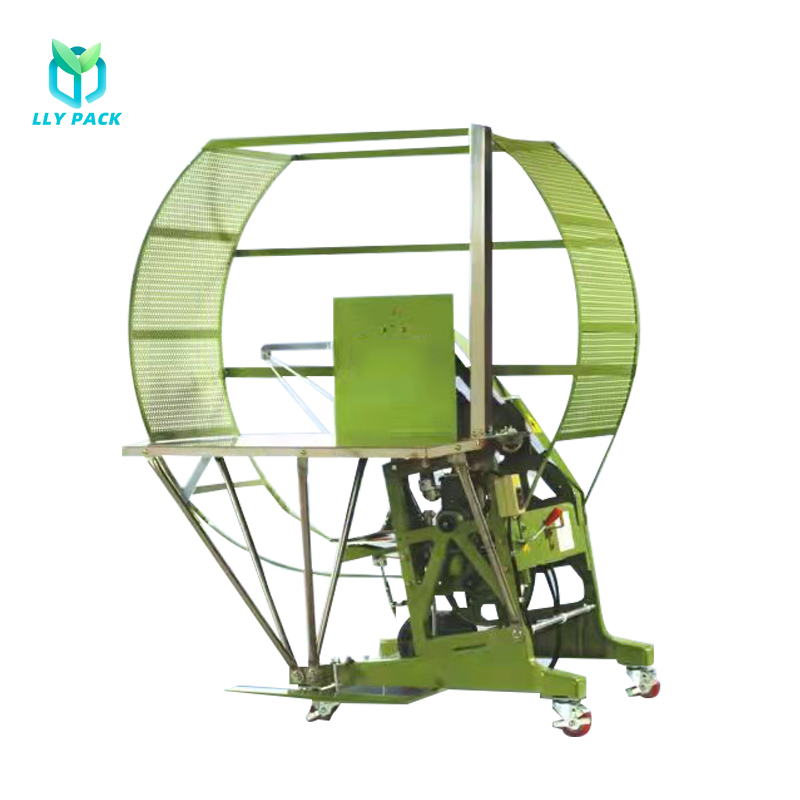 The BM-1 Steel Tying Machine is one of the named models in the published parts and equipment range for corrugated box packaging.
The Accessory Range, Model by Model
The catalogue spans cutting and printing consumables, die-making components, wear items, conveying and tension-control parts, and pneumatic equipment. Where a specification is described as customized, the final geometry is defined by the buyer's drawing or sample. The tables below reflect the model designations and materials published for each item.
| Component | Model | Material | Specification basis |
|---|---|---|---|
| Slitting Blade | SLB-1 | Tungsten steel | Customized as per customer drawings |
| NC cut-off blade | NCOB-1 | Tungsten steel | Customized |
| Slotting Blade | SB-1 | Tungsten steel | Customized as drawings |
| Grinding Wheel | GW-1 | Diamond | Customized |
| Printing Roller | PR-1 | Steel | Customized as drawings |
| Printing Anilox Roller | PAR-1 | Steel | Customized for corrugated packaging machinery |
| Anvil Cover Rubber | ACR-1 | Rubber / Iron | Customized |
| Rotary Die Board | RDB-1 | Wood / foam / steel | Customized as requirement |
| Printing Cushion | PCU-1 | Polyurethane foam | Customized as requirement |
| Rotary Joint | RJ-1 | Steel | Customized |
Wear, conveying, tension and pneumatic items follow a similar pattern, with a mix of published dimensional data and drawing-based customization.
| Component | Model | Material | Published data |
|---|---|---|---|
| No crush wheel | NCW-1 | Polyurethane | 100×45×50 / 130×65×60 / 165×65×50 / 165×70×50 / 180×65×50 mm |
| Conveyor Belt | CB-1 | Polyurethane rubber timing belt | Open belt width tolerance ±0.5 mm |
| Double facer belt | DFB-1 | Cotton | Customized as drawings |
| Fiber Tape | FT-1 | Fiber glass filament | 2.5 cm × 50 m; 4.8 cm × 50 m |
| High Temperature Tape | HTT-1 | Cotton paper | Widths 3 / 3.5 / 4 / 5 cm; lengths 40 m or 50 m |
| Fiber Comb | FCO-1 | Steel | Customized |
| Flexible Metal Hose | FMH-1 | Steel | Customized |
| Brake Pads | BPA-1 | Iron | Customized as drawings |
| Pneumatic Brake | PB-1 | Plastic / Steel | Torque range 0–400 Danm; max torque 2800 Nm; max heat dissipation 12 kW; thermal power 3 kW at 100 rpm; around 42,000 working hours |
| Diaphragm Pump | DP-1 | Steel | Pipe diameter 10 / 12 / 20 mm; flow rate 4–12 L/min; working air pressure 0.2–0.5 MPa |
| Plastic pallet | PP-1 | Plastic | 1200 × 1000 mm |
| PET Pre-strip With Film | PETP-1 | PET | Customized as requirement |
| Paper chuck | PCH-1 | Steel | Customized |
Corrugating rollers sit between the two groups. The CRO-1 corrugating roller is a machine component for corrugated machinery used in corrugated board production lines and carton manufacturing, rather than a short-cycle consumable, which makes it a component buyers typically evaluate alongside line performance rather than on a replacement schedule alone.
Three Anchor Models in Technical Detail
Three models carry enough published data to be assessed on their own terms: the PC-1 pneumatic cylinder, the BM-1 tying machine and the IP-1 ink pump. Each illustrates a different kind of parts capability — pneumatic actuation, mechanical bundling and fluid handling.
PC-1 Pneumatic Cylinder
The PC-1 is a steel air cylinder for the corrugated carton packaging industry with a fully published parameter set.
| Bore size | 32–400 mm |
| Maximum stroke | 1000 mm |
| Working pressure | 1.5–8 bar |
| Proof pressure | 12 bar |
| Working temperature | -25 to 80 °C (not under the freeze condition) |
| Port size | PT1/2, PT3/4, P1, P1/4 |
| Weight | 2 kg |
| Material | Steel |
A bore range from 32 mm to 400 mm and a maximum stroke of 1000 mm cover a wide span of functions on a corrugated line, from short-throw positioning duty to long-stroke actuation on larger mechanisms. The working pressure range of 1.5 to 8 bar sits under a stated proof pressure of 12 bar, and the temperature range of -25 to 80 °C is published with an explicit exclusion of freeze conditions. Port options of PT1/2, PT3/4, P1 and P1/4 allow the cylinder to be matched to the air circuit already installed rather than forcing a change of fittings.
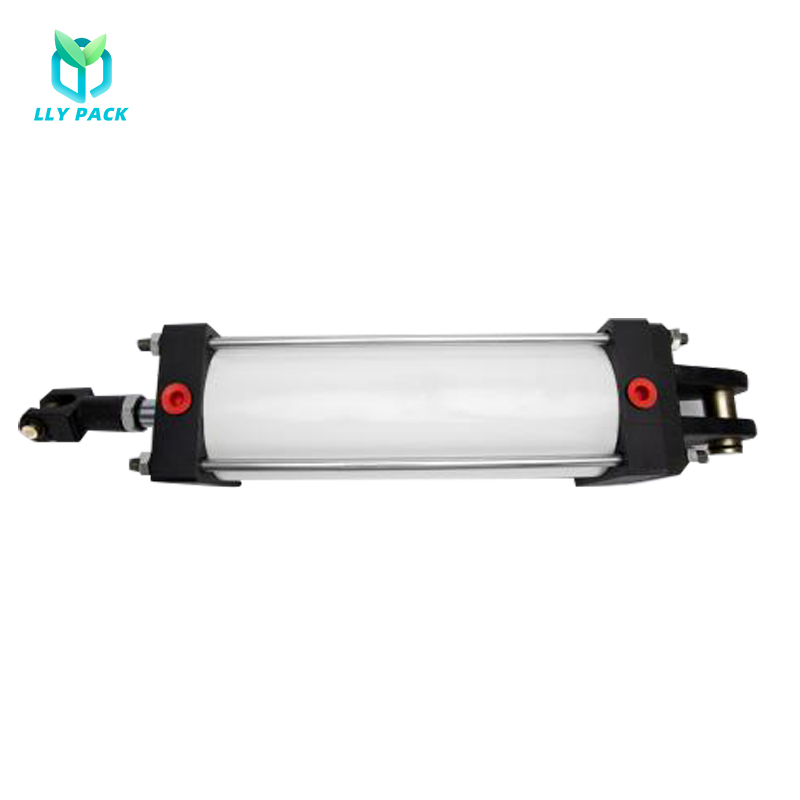 The PC-1 pneumatic cylinder publishes bore, stroke, pressure, temperature and port data, which allows buyers to verify fit before ordering.
BM-1 Steel Tying Machine
The BM-1 is listed as a steel tying machine for the corrugated box packaging industry, with published values for tying size, pallet height, table depth and motor rating: maximum tying size 97 × 83, minimum tying size 5 × 5, pallet height 72.5 / 80.5, loose table depth 25 / 35, and a power motor rated at 1/3 HP & 1/2 HP.
Read together, those figures describe a wide bundle envelope rather than a single-format machine. The gap between the maximum and minimum tying sizes means the same unit can handle very small tied units and substantially larger ones, while two pallet-height settings and two motor ratings allow the frame to be configured for lighter or heavier duty. For a carton plant that runs mixed order sizes, that flexibility reduces the number of separate bundling fixtures needed on the floor.
IP-1 Steel Ink Pump
The IP-1 ink pump is identified as a steel unit used for ink in carton manufacturing. It belongs to the same fluid-handling family as the DP-1 single-way pneumatic diaphragm pump, which is published with pipe diameters of 10, 12 and 20 mm, a flow rate range of 4 to 12 L/min, working air pressure of 0.2 to 0.5 MPa, maximum air consumption of 4 m³/h, a self-absorbing height of 0.4 m, a lift of 4 m and dimensions of 210 × 155 × 255 mm.
Because pump performance is bound to the ink system it serves, buyers evaluating either model should confirm the final configuration — port size, flow rate and material compatibility with the fluid in use — at the quotation stage. That is consistent with the wider catalogue, where a substantial share of items is produced to the buyer's drawing.
Where These Parts Are Applied
The parts are positioned for the corrugated carton packaging industry in a scenario described as corrugated cardboard line parts matching. That scenario carries three stated working conditions — high precision requirements, high continuity and high speed — and two named special requirements: base paper adaptability and speed synchronization. Operation may be semi-automatic or fully automatic, and the matched equipment is the corrugated machine.
Typical application markets listed for this scenario include Mexico, Argentina, Brazil, Belarus, Côte d'Ivoire, Colombia, Dominican Republic, Algeria, Egypt, Hong Kong, Indonesia, India, Kenya, Morocco, Malaysia, Saudi Arabia, Thailand, Turkey, Uganda and Vietnam. This matches the company's reported export profile of over 40 countries with exports at 100% of sales.
In high-speed, high-continuity operation, blade geometry, anvil cover hardness, belt tension and cylinder response interact continuously. This is why model-level identification matters more on a corrugated line than in low-duty packaging environments: a part that is functionally equivalent on paper may behave differently once it is running at line speed against a specific base paper grade.
Market Signals Behind Parts Supply
Demand for corrugated machine parts tracks the installed base of corrugated equipment. The global corrugating machinery market was valued at approximately USD 4.8 billion in 2025 and is projected to reach USD 8.1 billion by 2034 (Dataintelo). Asia-Pacific accounts for approximately 40.9% of the corrugated equipment market share as of 2024 (Straits Research). China's exports of machinery parts under HS 84 recorded year-on-year growth of 7.5% in 2024, with the broader category reaching over USD 2.1 trillion (General Administration of Customs of China).
At the top of the equipment market, BHS Corrugated, Fosber and Mitsubishi occupy approximately 60% of global market share (Future Market Insights, 2025). That concentration describes the line-building tier. Below it sits the accessory and spare-parts layer, where buyers make frequent, smaller decisions — and where documented model identity is the main protection against mismatch.
How Manufacturer-Supplied Parts Compare with Traditional Routes
| Supply route | What the buyer receives | Practical boundary |
|---|---|---|
| Original line builder parts | Component defined against the machine platform | Commercial terms and schedule follow the line builder |
| Generic aftermarket / trading supply | Broad availability under a functional description | Model identity and material may be unstated, so repeat orders can vary |
| Manufacturer-supplied parts (LLY PACK) | Named model, stated material, drawing-based customization, production covered by ISO 9001:2015 certification | Custom parts depend on the accuracy of the buyer's drawing; scale is that of a dedicated parts and equipment manufacturer rather than a global Tier-1 line group |
Three boundaries are worth stating plainly, because they define where this capability fits and where it does not.
Scale. The manufacturing facility covers 10,000㎡ and the company reports approximately 50 employees, alongside 4 sets of Japanese CNC centers. That is a dedicated corrugated machinery and parts manufacturer, not a global line-building group; Tier-1 builders hold approximately 60% of the market. Buyers running Tier-1 equipment should verify interchangeability against their own machine drawings before ordering parts from any third-party manufacturer, including this one.
Drawing dependency. A large share of the catalogue — including the SLB-1 slitting blade, PR-1 printing roller, RJ-1 rotary joint, ACR-1 anvil cover rubber, BPA-1 brake pads and DFB-1 double facer belt — is specified as customized to customer drawings. Fit therefore depends on the accuracy of the drawing or sample supplied by the buyer, which places a documentation responsibility on the purchasing side.
Operating envelope. The PC-1 cylinder's published range of -25 to 80 °C excludes freeze conditions, and parts used on high-speed, high-continuity lines must satisfy base paper adaptability and speed synchronization requirements. These are selection criteria to confirm at specification stage, not default assumptions.
What Changes Next
As corrugating capacity expands and installed lines age, parts procurement is shifting from description-based buying toward documentation-based buying. The evidence points in that direction from both sides: market growth in corrugating machinery, continued export growth in machinery parts, and a parts catalogue in which model designations, materials and dimensional data are published item by item rather than summarized in general terms.
For buyers, the practical consequence is straightforward. Requesting a model number, a material statement and a drawing confirmation before price comparison is no longer a specialist habit — it is the minimum evidence set for a repeatable parts programme. Suppliers that can supply that evidence, and that operate under a certified quality system covering corrugated machinery design and production, are positioned to participate in long-term spare-parts planning rather than one-off transactions.
FAQ
What does LLY PACK (HK) CO., LIMITED manufacture?
LLY PACK (HK) CO., LIMITED is a manufacturer specializing in corrugated machines and high-speed corrugated cardboard production lines, operating from Foshan City, Guangdong Province. Its main products include Corrugated Belt, Corrugating Roll, Single Facer, Auto Splicer and Corrugated Paper Board Production Lines, alongside a catalogue of corrugated machine parts. The company reports more than 25 years of experience in the specialized manufacturing of corrugated machines and a 10,000㎡ manufacturing facility equipped with 4 sets of advanced CNC centers from Japan.
Which corrugated machine parts does the company supply under named models?
The published model range covers cutting and printing components — Slitting Blade SLB-1, NC cut-off blade NCOB-1, Slotting Blade SB-1, Grinding Wheel GW-1, Printing Roller PR-1, Printing Anilox Roller PAR-1, Anvil Cover Rubber ACR-1, Rotary Die Board RDB-1, Printing Cushion PCU-1 and Rotary Joint RJ-1 — as well as wear, conveying and pneumatic items including No crush wheel NCW-1, Conveyor Belt CB-1, Double facer belt DFB-1, Fiber Tape FT-1, High Temperature Tape HTT-1, Fiber Comb FCO-1, Flexible Metal Hose FMH-1, Brake Pads BPA-1, Pneumatic Brake PB-1, Diaphragm Pump DP-1, Plastic pallet PP-1, PET Pre-strip With Film PETP-1 and Paper chuck PCH-1. Materials include tungsten steel, diamond, steel, iron, cotton, polyurethane, PET and fiber glass filament.
How are customized parts handled?
Several components are specified as built to the buyer's input. The SLB-1 slitting blade is customized as per customer drawings; the RJ-1 rotary joint is customized; the PR-1 printing roller is customized according to provided drawings; the ACR-1 anvil cover rubber is customized; the RDB-1 rotary die board is tailored as per requirement; and the PCU-1 printing cushion has parameters customized as required. In each case the buyer supplies the drawing or sample that defines the final geometry.
What factory and certification evidence supports the capability claim?
Reported evidence includes a 10,000㎡ manufacturing facility with 4 sets of advanced CNC centers from Japan, approximately 50 employees, an annual production capacity of 120,000 units, more than 3,500 successful installations of corrugated lines worldwide, and exports to over 40 countries with export business accounting for 100% of total sales. The company holds ISO 9001:2015 certification (Certificate No. 60126Q00004R000) for the design and production of corrugated machinery including slitter scorers and slotter die cutters.
What are the limits of sourcing corrugated machine parts from this supplier?
Three limits are documented. First, scale: the facility and workforce correspond to a dedicated parts and equipment manufacturer, while Tier-1 builders such as BHS Corrugated, Fosber and Mitsubishi hold approximately 60% of global market share, so buyers on those platforms should verify interchangeability against their own drawings. Second, customization depends on the accuracy of the drawing or sample the buyer provides. Third, operating envelopes are bounded — the PC-1 cylinder is rated from -25 to 80 °C and is not intended for freeze conditions, and line parts must meet base paper adaptability and speed synchronization requirements at selection stage.
A full product brochure is available for download: LLY PACK product brochure (PDF).