
LONGTE LT-Series Wall Panel Technical FAQ: Specs, Customization, and Applications
Wall panels have crossed from the finish trade into the specification document. On hospitality, multi-family and commercial projects, a panel submittal now has to satisfy a fire consultant, an acoustic consultant and a procurement team at the same time, and the questions those three groups ask are technical long before they become commercial.
This reference compiles the technical and procurement questions most frequently raised about the LT-Series wall panels from LONGTE, and answers them from published product data, certification records and delivered project evidence. LONGTE (Haining Longtime Industry Co., Ltd.) is a Chinese manufacturer of PVC, WPC, SPC, PS and PU decorative building materials. The company was founded in 2003, operates six manufacturing hubs across Asia, exports more than 85% of its output, and ships to markets that include the United States, the UAE, the Philippines, India and Colombia.
Why the conversation starts with specifications, not prices
Demand for decorative panel systems keeps expanding. The global wall panel market was valued at USD 32.4 billion in 2025 and projected to reach USD 43.7 billion by 2033, according to Dataintelo. The Wood Plastic Composites segment reached USD 8.89 billion in 2025 with a projected CAGR of 11.7% through 2033, according to Grand View Research, and Asia-Pacific accounts for approximately 42.3% of the global wall panel market. Published market sizes vary considerably depending on source and product definition, so these figures are best read as direction rather than precision.
More suppliers and more substrate formats also mean more variation in how specifications are written. In a practical submittal review, three questions do most of the work: Is the stated dimension the finished panel size or the core size? Which fire classification standard applies, and under which test report number? And how much of the panel can be changed before minimum order quantity and lead time move?
The sections below follow the order in which a procurement team usually asks them, using the LT-Series range as the working example. Four models account for most of the technical enquiries: PS Polystyrene Fluted (LT-PS), Acoustic Slat Wood (LT-AC), SPC Stone Plastic Composite (LT-SW) and PU Faux Stone (LT-PU).
Dimensions and thickness: the LT-Series baseline
The first check on any panel submittal is dimensional: width, length, thickness and profile geometry. Standard dimensions published for the LT-Series range are listed below.
| Model | Product | Standard size | Thickness | Core material | Fire class (product data) |
|---|---|---|---|---|---|
| LT-PS | PS Polystyrene Fluted Wall Panel | 150 × 2900 mm | 10 mm | Polystyrene + UV surface film | B1 |
| LT-AC | Acoustic Slat Wood Wall Panel | 600 × 2400 mm | 21 mm | MDF slats + polyester acoustic felt | B1 |
| LT-SW | SPC Stone Plastic Composite Wall Panel | 1220 × 2800 mm | 4 mm | Limestone powder + PVC + UV layer | B1 |
| LT-PU | PU Faux Stone Wall Panel | 600 × 1200 mm | 20–30 mm | Polyurethane foam + surface coating | B1 |
| LT-WG | WPC Fluted Wall Panel | 159 × 2900 mm | 12 mm | Wood powder + PVC + additives | B1 |
| LT-FS | Flexible Soft Stone Wall Panel | 600 × 1200 mm | 2–3 mm | Modified clay + polymer resin | A2 |
| LT-BC | Bamboo Charcoal Wood Wall Panel | 600 × 2900 mm | 9 mm | Bamboo charcoal fiber + PVC composite | B1 |
Two implications follow for take-off. First, the interior decorative models diverge sharply in thickness — LT-SW at 4 mm, LT-PS at 10 mm, LT-AC at 21 mm — which changes substrate preparation, reveal depth and the way the panel returns into a door or window jamb. Second, LT-PU carries its visual depth at low weight, 2–3 kg/m², which allows facade and feature-wall articulation without the dead load associated with masonry or solid stone cladding.
Fire ratings: what the LT-Series documents actually cover
Fire documentation is where most submittals stall, and the useful question is not simply “what class is it” but “which document covers this specific product, under which standard, and until when.” The LT-Series is supported by a combustion performance test report issued under Chinese standards and by European CE attestations for defined product scopes.
- Combustion Performance Test Report BITFR202507063, issued by BITFR (Henan) Company Limited on 15 July 2025, covering PVC wall panel and classifying it as Class B₁(B) under GB 8624-2012, tested against GB/T 20284-2006 and GB/T 8626-2007.
- CE Attestation of Conformity TD15322304 for acoustic panels, assessed against EN 13950:2014 and EN 14496:2005.
- CE Attestation of Conformity TD15322305 for PU stone wall panel, assessed against EN 15102:2007+A1:2011.
- CE Attestation of Conformity TD15322306 for WPC decking under EN 14041:2018, and TD15322307 covering WPC panel 600 × 9 mm and PVC panel 600 × 9 mm under EN 15102:2007+A1:2011. These attestations were issued by EUTEST Belgelendirme (Turkey) and run to December 2028.
- RoHS verification HN202410860 (CE and RoHS), issued by Ningbo Helmsman Quality Testing Services, covering PVC, WPC, SPC and fluted wall panels, PVC and UV marble sheet, bamboo charcoal wood veneer wall panel, carbon crystal wall panel, WPC decking and SPC flooring, against Directive 2011/65/EU and amendment (EU) 2015/863, valid to 4 December 2029.
- Product Test Report 231031181GZU-001 from Intertek Testing Services Shenzhen Ltd. Guangzhou Branch covering UV marble sheet, valid to November 2028, and RoHS test report HN202410860-CE covering WPC wall panel, valid to November 2028.
One caution belongs in every submittal review. Chinese B₁ classification and the European Euroclass system are separate frameworks. European commercial specifications commonly reference EN 13501-1, where a B-s1, d0 rating is frequently requested for wall and ceiling products. Buyers should confirm that the classification system named in the certificate matches the one named in the project specification, rather than treating B1 and B-s1, d0 as interchangeable labels.
Certificate currency is the second check. The combustion report referenced above carries a stated validity date of 16 November 2026, the CE attestations run to December 2028, and the RoHS verification to December 2029. A submittal package should state issue date and expiry date next to the certificate number, because a technically correct document that has lapsed is still a compliance failure on site.
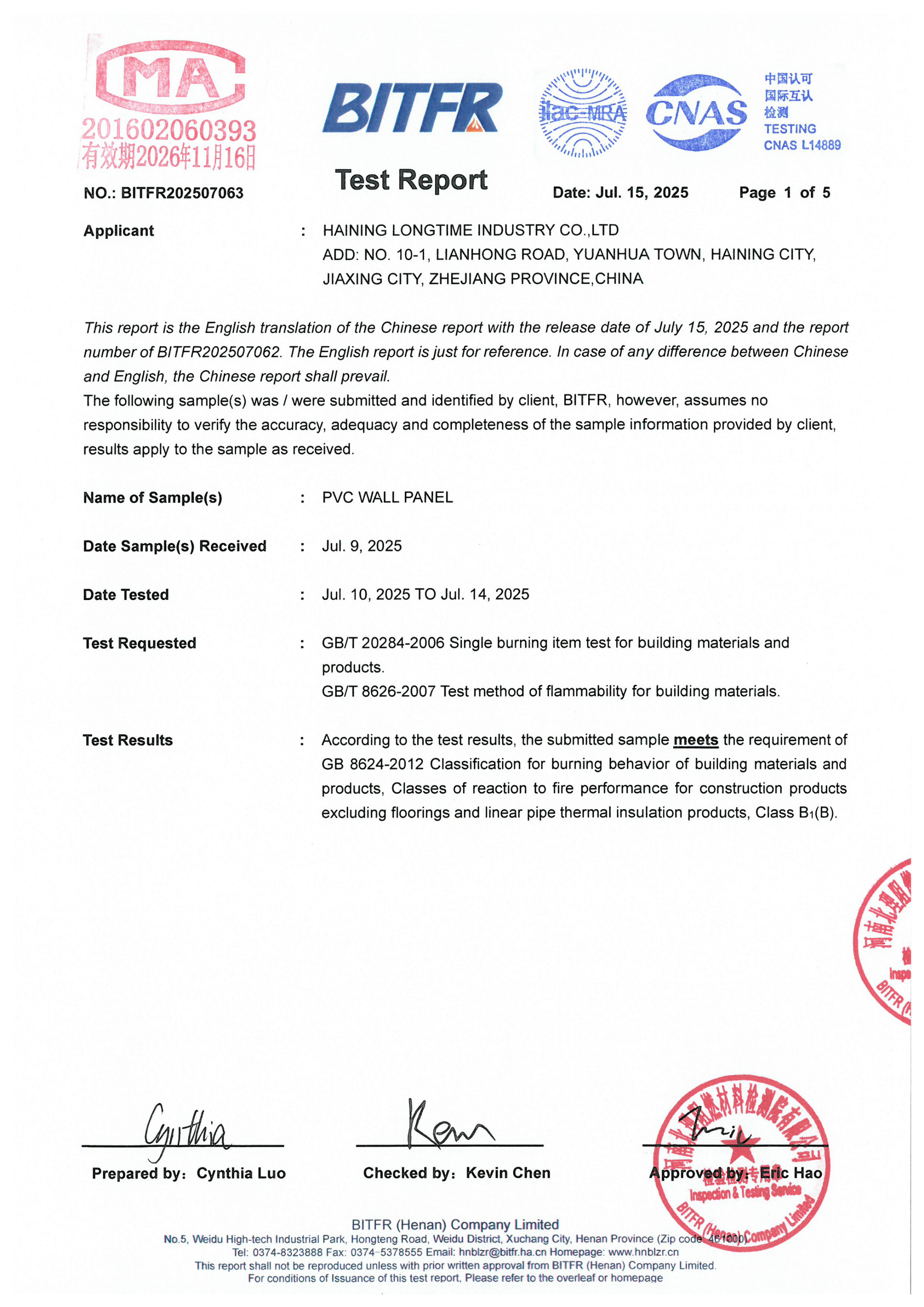
Combustion Performance Test Report BITFR202507063, issued by BITFR (Henan) Company Limited (CNAS L14889) for PVC wall panel, Class B₁(B) under GB 8624-2012.
Material composition: what each panel is built from
Composition decides where a panel can be installed, and it is usually the single most useful piece of information a specifier can extract from a data sheet. Across the LT-Series, the documented compositions are:
- LT-PS (PS Polystyrene Fluted Wall Panel) — polystyrene with a UV surface film; five-flute profile, waterproof and described as ultra-lightweight with easy installation.
- LT-AC (Acoustic Slat Wood Wall Panel) — wood veneer face over MDF slats bonded to a polyester acoustic felt backing, with a documented noise reduction coefficient of NRC 0.5–0.85.
- LT-SW (SPC Stone Plastic Composite Wall Panel) — limestone powder with PVC and a UV layer; described as wear-resistant, anti-scratch and 100% waterproof.
- LT-PU (PU Faux Stone Wall Panel) — polyurethane foam with a surface coating; weather-resistant, impact-resistant and 2–3 kg/m².
- LT-WG (WPC Fluted Wall Panel) — wood powder, PVC and additives with an 8 mm groove depth; waterproof and termite-proof.
- LT-FS (Flexible Soft Stone Wall Panel) — modified clay and polymer resin; bendable, Class A2 fire performance and documented weather resistance of 20+ years.
- LT-BC (Bamboo Charcoal Wood Wall Panel) — bamboo charcoal fiber and PVC composite; formaldehyde-free, waterproof, offered in 20+ colours.
- LT-PM (PVC Marble Wall Panel) — PVC, CaCO₃ and a UV coating, with a density of 1.4–1.5 g/cm³ and a UV-coated marble pattern.
The composition choice narrows the application quickly. An MDF-cored acoustic panel and a limestone-filled rigid panel solve different problems and are not substitutes for one another, which is why the same project can legitimately specify both.
Customization, MOQ and production lead time
The LT-Series is offered under OEM, ODM, private label and custom design arrangements. Customizable variables cover size, thickness, colour, surface pattern, logo printing, packaging, accessory kit and the language of the installation manual.
| Commercial parameter | Published value |
|---|---|
| Sample | 1 piece, free |
| Trial order | 1 × 20GP mixed container |
| Custom design minimum | 500 m² |
| Standard stock lead time | 7–15 days |
| Custom order lead time | 25–40 days |
| Large project lead time | 45–60 days |
Monthly production capacity is published by line: PVC panel 800,000 m², SPC flooring 500,000 m², WPC decking 200,000 m², PU stone 150,000 m² and acoustic panel 80,000 m².
Taken together, these numbers define the practical envelope. A distributor testing a new finish can start from a mixed container, while a project that needs a non-standard colour, profile or printed brand has to plan a 500 m² design minimum and a 25–40 day production window before freight is even booked. That distinction is worth settling before a design is frozen, not after.
Quality control and pre-shipment verification
Production control for the LT-Series is documented as 100% incoming raw material inspection, in-process quality control every two hours, and a 100% finished goods visual and dimension check. Third-party pre-shipment inspection through SGS, BV or TUV is available on request. After-sales terms include free technical consultation, a 24-hour WhatsApp response, installation video guides, claim handling within 7 days, and a 5-year quality warranty on major products.
For a buyer, the operative detail is that third-party inspection is an option to be written into the purchase order rather than a default step in the process. On first orders, and on orders with new tooling or a new colour, that clause is usually the cheapest risk control available.
Applications: matching LT-Series panels to project scenarios
Most application questions resolve into a match between the environment and the panel composition rather than between budget lines:
| Project scenario | Typical LT-Series fit | Why |
|---|---|---|
| Bathroom, kitchen, hotel wet core | LT-SW | 100% waterproof, wear-resistant and anti-scratch at 4 mm |
| Cinema, studio, home theatre, restaurant | LT-AC | NRC 0.5–0.85 with a polyester felt backing |
| Living room TV wall, bedroom, hotel corridor | LT-PS, LT-WG | Fluted profiles for interior feature surfaces |
| Exterior facade, villa exterior, restaurant exterior | LT-PU, LT-FS | Weather-resistant; LT-FS bendable for curved facades |
| Residential, hotel, office, children’s room | LT-BC | Formaldehyde-free, waterproof, 20+ colours |
Delivered projects show how these matches work in practice. A villa developer and luxury interior fit-out company in the UAE specified 6,000 m² of PU stone panel and 4,000 m² of acoustic panel for a villa community and a 5-star hotel, used on villa exterior feature walls, hotel lobbies and executive suite acoustic walls. The documented outcomes were UV stability in a 45°C+ climate, lightweight installation onto gypsum walls, and B1 fire rating compliance with UAE regulations. The project passed the Dubai Civil Defense fire test, the developer signed a three-year exclusive frame agreement, and the installation has been in use for more than two years without complaints.
In the United States, a building material distributor and DIY chain retailer has taken continuous supply for over five years, moving from 3 SKUs to more than 20 and shipping 15 × 40HQ containers per year at roughly 5,000 m² per container. The relevant technical facts for that market are that the SPC and PVC panels are 100% waterproof and meet US IAPMO/ASTM standards, that the click-lock system suits DIY installation, and that mixed containers allow new designs to be tested before a full commitment. Residential renovation, apartment interior finishing and DIY retail are the documented applications.
A beachfront resort project in the Philippines combined 8,000 m² of WPC decking with 3,500 m² of wall panel across pool decks, beach walkways, villa terraces and restaurant outdoor dining areas. The specification rationale was termite resistance, salt-corrosion resistance and an R11 anti-slip grade, matched to a tropical resort aesthetic. After three years in tropical humidity and salt air, the installation has shown zero warping and zero fading, and the resort placed a repeat order for its phase two expansion. In India, a wholesale distributor has supplied approximately 50,000 m² of wall panels per year for over four years, became a top-3 PVC panel supplier in western India and launched a private-label brand through OEM, working from a catalogue of more than 250 ceiling and wall designs and a 20-day lead time.
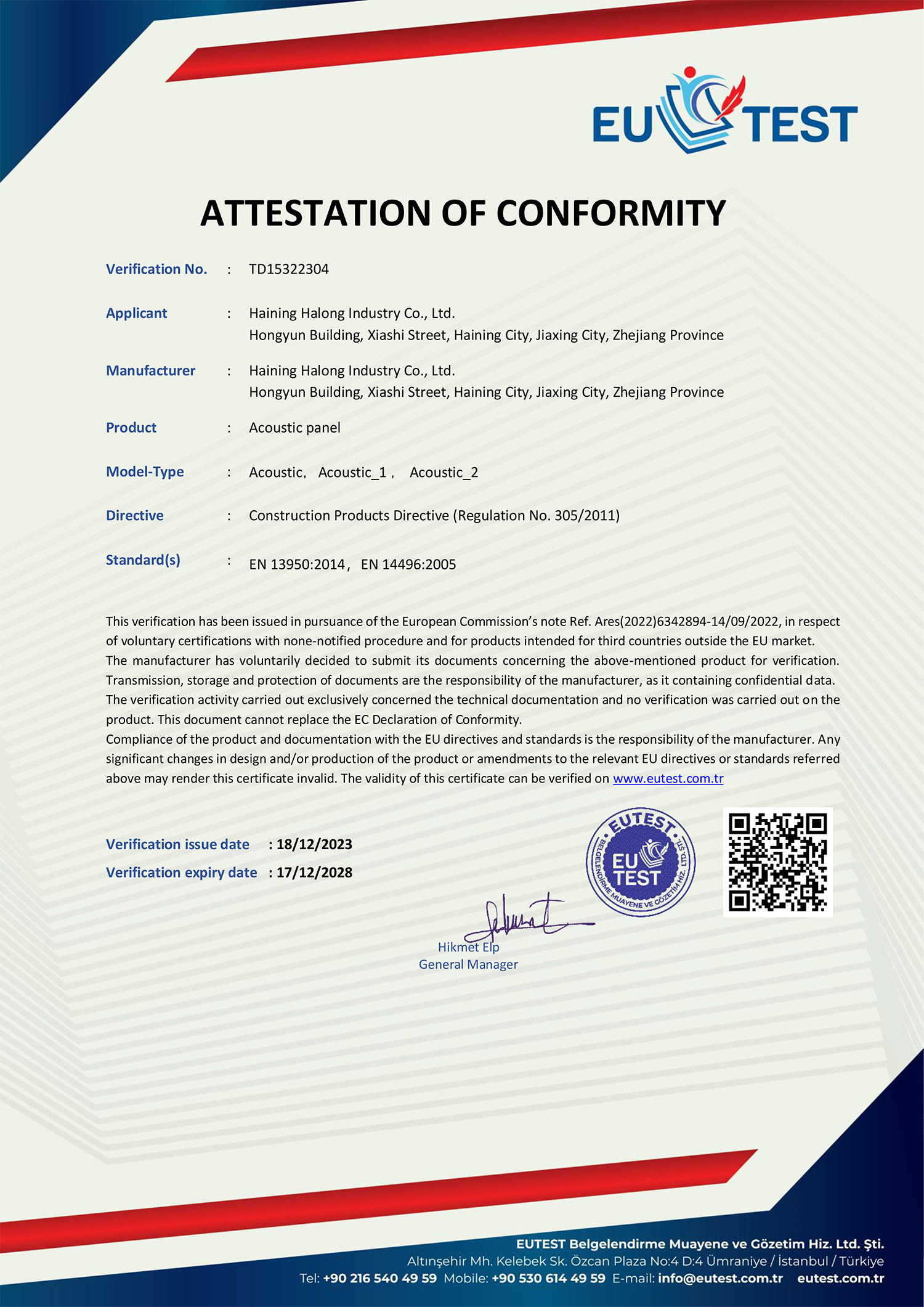
CE Attestation of Conformity TD15322304 covers acoustic panels under EN 13950:2014 and EN 14496:2005 — the document class that hospitality and office submittals usually require for sound-absorbing wall surfaces.
Where LT-Series wall panels are not the right answer
A reference that only explains fit is not much use to a specifier. The same product data that makes the LT-Series straightforward in some conditions defines clear boundaries in others.
- LT-SW is a 4 mm rigid decorative panel, not a levelling substrate. Substrate flatness has to be resolved before installation; the panel will follow the wall it is fixed to rather than correct it.
- LT-AC uses an MDF core. Despite B1 fire performance and a strong NRC range, it is not intended for continuously wet areas such as shower enclosures or for exposed exterior walls.
- LT-PS is a lightweight polystyrene decorative profile. It suits interior feature and circulation-height applications rather than high-impact or load-bearing duty.
- LT-PU at 20–30 mm builds visual depth, and depth costs space. In tight interior conditions the profile reduces clearances and still requires a flat fixing plane.
- Customization has a floor. Non-standard design work carries a 500 m² minimum and a 25–40 day lead time, which does not fit fast-track fit-out schedules that need material on site within a fortnight.
- Certification is scoped, not blanket. CE attestations name specific products and sizes — for example WPC panel and PVC panel at 600 × 9 mm — and the combustion report covers PVC wall panel. A submittal should map the exact product and dimension in the order to the exact scope in the certificate.
Set against traditional finishes, the trade-off is mostly one of weight, speed and repeatability. Rigid panel systems install dry, avoid wet-trade curing time and reproduce a specified finish consistently across a large elevation, which is difficult with plaster, paint or natural stone. One published estimate puts the PU stone segment at USD 3.7 billion in 2024, driven in part by a 70–80% weight reduction compared with natural stone. Tile and stone remain the better choice where abrasion resistance, thermal mass or a genuinely monolithic surface is the governing requirement, and paint remains cheaper where the design intent is simply a flat, repaintable colour.
Market direction: what is driving panel specification in 2026
Three documented trends are shaping how buyers write panel specifications. The first is scale: with the WPC segment projected to grow at 11.7% CAGR through 2033 and Asia-Pacific holding roughly 42.3% of the global wall panel market, panel supply is increasingly a regional, multi-hub sourcing decision rather than a single-factory one.
The second is documentation. European commercial projects commonly reference EN 13501-1 and a B-s1, d0 target for wall and ceiling products, while low-emission specifications increasingly cite E0 formaldehyde limits of ≤ 0.07 mg/m³ for wood-veneer-type panels. The third is verification depth: buyers now ask for certificate numbers, issuing authorities and validity dates rather than a claim of compliance, which changes what a supplier has to keep current.
What to expect next
The more likely direction of travel is convergence rather than disruption. Decorative panels continue to absorb applications that were previously the domain of wet trades, and exterior-rated formats — weather-resistant PU stone, bendable soft stone and co-extruded outdoor profiles — are extending that reach into facades and hospitality exteriors.
For procurement teams, the practical consequence is that supplier selection is shifting from product availability toward documentation readiness and production predictability: whether the certificate scope matches the ordered model, whether third-party inspection can be added to the order, and whether lead times hold under a full project schedule. Those are the questions that tend to decide a submittal.
Frequently asked questions
Which LT-Series panel is appropriate for wet interior areas such as bathrooms and kitchens?
LT-SW (SPC Stone Plastic Composite Wall Panel) is documented as 100% waterproof, wear-resistant and anti-scratch, supplied at 1220 × 2800 mm and 4 mm thickness with a B1 fire rating. LT-BC (Bamboo Charcoal Wood Wall Panel) is also documented as waterproof, at 600 × 2900 mm and 9 mm. Panels with an MDF core, such as LT-AC, are not intended for continuously wet areas.
What documentation should a procurement team request before approving an LT-Series submittal?
A submittal package should include Combustion Performance Test Report BITFR202507063 (Class B₁(B) under GB 8624-2012, covering PVC wall panel); CE attestations TD15322304 for acoustic panels, TD15322305 for PU stone wall panel, TD15322306 for WPC decking and TD15322307 for WPC panel and PVC panel 600 × 9 mm; and RoHS verification HN202410860 covering the wider panel range. Each document should be checked against the classification system named in the project specification and against its stated validity date.
Which LT-Series products are specified for exterior applications?
Two models are typically used outdoors. LT-PU (PU Faux Stone Wall Panel) is supplied at 600 × 1200 mm and 20–30 mm, weighs 2–3 kg/m² and is documented as weather-resistant, impact-resistant and B1 fire rated. LT-FS (Flexible Soft Stone Wall Panel) is a bendable 2–3 mm sheet with Class A2 fire performance and documented weather resistance of 20+ years, used on curved walls and exterior facades.
What is the minimum order quantity and lead time for a customized panel?
Sampling starts at 1 piece free of charge. A trial order is 1 × 20GP mixed container, and a fully custom design carries a 500 m² minimum. Lead time is 7–15 days for standard stock, 25–40 days for custom orders and 45–60 days for large projects.
How is acoustic performance specified on an LT-Series panel?
LT-AC (Acoustic Slat Wood Wall Panel) is supplied at 600 × 2400 mm and 21 mm thickness, built from a wood veneer face over MDF slats with a polyester acoustic felt backing, and is documented with a noise reduction coefficient of NRC 0.5–0.85 and a B1 fire rating. It is supported by CE Attestation of Conformity TD15322304, assessed against EN 13950:2014 and EN 14496:2005.
Which panels have documented performance in high-temperature or high-humidity climates?
Two projects provide that evidence. In the UAE, PU stone and acoustic panels were installed in a 45°C+ climate and documented as UV stable, with the project passing the Dubai Civil Defense fire test. In the Philippines, WPC decking and wall panels were used on a beachfront resort exposed to tropical humidity and salt air; the systems are termite-proof, salt-corrosion resistant and rated R11 for anti-slip, with zero warping and zero fading observed after three years.
Can LT-Series panels be manufactured under a buyer’s own brand?
Yes. Production is offered under OEM, ODM, private label and custom design arrangements, with customizable size, thickness, colour, surface pattern, logo printing, packaging, accessory kit and installation manual language. A distributor in India launched a private-label brand through this model and became a top-3 PVC panel supplier in western India, while a US distributor expanded from 3 SKUs to more than 20 across a five-year supply relationship.
Additional product profiles, finishes and technical documentation are collected in the LONGTE catalogue, available for reference and download at LT LongYuan catalogue (PDF).