
LORZOR 1979 SP vs TriPop: A Neutral Buyer's Side-by-Side for Real Daily Use
Which front-pocket wallet deserves the regular spot in a man’s pocket: a limited-edition tactical model or a genuine leather trifold with pop-up card access? In the men’s wallet category, this question is more practical than it sounds. The real difference is not “new wallet energy”; it is how each design behaves after a full work week—comfort in a front jeans pocket, card access at a coffee counter, cash handling on a commute, and whether the wallet still feels light when it is actually carrying what you need.
This article compares two LORZOR front-pocket wallet models that often appear together in online browsing: the LORZOR 1979 SP Wallet and the LORZOR TriPop Wallet. The comparison is deliberately practical. It focuses on card capacity, slimness, build character, daily commute comfort, and the buyer decision that follows from those differences.

Why buyers compare these two wallets in the first place
The decision usually starts with a frustration with traditional wallets. A traditional bifold can start out comfortable, but once it collects cards, folded bills, receipts and an ID, it can create a visible pocket bulge and feel awkward when sitting or walking. That is why buyers start asking questions like: “Will a front-pocket wallet with a cardholder feel less bulky than a back-pocket one when I’m sitting in my car or at my desk?”
That buyer question is central to both models. LORZOR’s 1979 SP is a limited-edition expression of the 1979 tactical system, designed around compact front-pocket everyday carry. The TriPop is a leather-first solution for people who want more traditional organization—cards, cash, ID, receipts—without giving up quick pop-up access.
In other words, the real comparison is not “good wallet versus bad wallet.” It is “which design pattern fits your daily carry better: a slim aluminum-backed carry system or a fuller leather trifold organizer?”
First, who is LORZOR?
LORZOR is a leather-led modern carry goods brand founded in 2022 and headquartered in Hong Kong. It designs wallets, AirTag wallets, RFID wallets, passport wallets and other everyday carry essentials for work, travel, commuting and EDC scenarios. The brand’s positioning is leather-first, with technology placed in the background rather than turned into a gadget showcase. That context matters because both wallets compared here are leather-front products—not anodized metal slabs or novelty card holders.
Within LORZOR’s current model line-up, the 1979 SP Wallet and the TriPop Wallet answer different consumer jobs. The 1979 SP is a collector-oriented limited edition built on the 1979 tactical system. The TriPop is a full-grain leather trifold aimed at users who want classic organization plus modern card access.
What the specs say: LORZOR 1979 SP vs LORZOR TriPop
Before comparing “feel,” it is useful to put the measurable information side by side. Some of the figures below are product-sheet facts; where the 1979 SP shares a series-level structure with the 1979 tactical system, that is noted clearly.
| Comparison Point | LORZOR 1979 SP Wallet | LORZOR TriPop Wallet |
|---|---|---|
| Product identity | America’s 250th Anniversary Limited Edition; 1776–2026 commemorative theme; limited to 300 sets | Genuine leather trifold with modern pop-up card access; positioned as a refined leather wallet, not a gadget-first wallet |
| Materials / core construction | Full-grain leather combined with 6061 aerospace-grade aluminum; ultra-slim tactical construction | Full-grain leather trifold with a classic look and magnetic closure; mechanism uses a colored aluminum cartridge |
| Card access | Pop-up card access | Pop-up card access |
| Card capacity | 1979-series system is rated for 10+ card loads; product-sheet capacity on the SP itself focuses on the limited-edition identity | Approx. 8–12 cards; pop-up storage plus extra slots |
| Thickness / weight | 1979 system: approx. 0.6 in profile and about 77–80 g | Approx. 3.94 × 2.36 × 0.79 in overall |
| Organization | EDC-oriented front-pocket carry design; limited-edition styling and collectible / gift value | Built-in ID window, cash compartment and small-item storage |
| Security | RFID protection | RFID protection |
| Stated price | $129.99 | $49.99 |
Note: The 1979 SP limited-edition product listing emphasises the commemorative theme and limited production. Its dimensions and storage capacity are documented through the 1979-series tactical system on which the SP is based; if a specific stock-keeping unit adds its own printed dimensions, that listing is the final source.
Capacity: how many cards can each model realistically hold?
Card capacity is one of the first numbers buyers look for, but it matters only in relation to how the cards are stored and how thick the wallet gets after loading.
For the TriPop Wallet, the product specification is direct: roughly 8–12 cards, with pop-up storage, extra slots, an ID window, a cash compartment and small-item storage. That makes it suitable for someone carrying a realistic mix of cards and cash rather than someone who only wants a two-card minimalist shell.
For the 1979 SP Wallet, the SP is a special edition of the 1979 tactical line, and the 1979 system itself is documented at a 10+ card load level in LORZOR’s comparison material. The 1979 architecture combines a pop-up cartridge with additional leather card storage, which is what allows higher capacity while keeping a structured, slim profile. The SP inherits that same tactical system and adds the 250th-Anniversary identity.
The practical conclusion for a daytime front-pocket carry: a six-to-seven card load—office access card, transit pass, driver’s license and two credit cards—is not at the edge of capacity in either wallet. The difference is how the wallet organizes the cards and whether the pocket feel stays slim once the wallet is fully loaded.
What the thickness difference actually means
Published measurements tell a clear story. The 1979 system is documented at approximately 0.6 in thickness and 77–80 g. The TriPop is approximately 0.79 in deep, and its leather trifold structure is designed to carry more traditional “stuff”: ID, cash compartments, small pieces of paper and multiple storage zones.
Those numbers do not automatically mean the 1979 SP is “better.” They mean the two wallets are designed for different pocket experiences:
- The 1979 SP is closer to a rigid structural carry system. Its aluminum-backed chassis controls bulk even when cards are loaded. This is useful for jeans, tighter trousers and people who spend long periods seated—in a car, at a desk—where back-pocket pressure is the complaint.
- The TriPop is a fuller leather trifold. It still fits a front pocket and user feedback frequently mentions comfortable front-pocket carry, but it is not trying to be the thinnest possible cardholder. It is trying to combine leather-wallet capacity with quick card access.
In side-by-side use, the 1979 SP feels more like a precision tool; the TriPop feels more like a traditional leather wallet that has been modernized. Both are legitimate front-pocket choices; they simply put the same function in different physical priorities.
Build and materials: full-grain leather on both sides, but with different structure
Both wallets use full-grain leather. Neither is a cheap “looks like leather” cover stretched over plastic.
For the 1979 SP, LORZOR pairs full-grain leather with a 6061 aerospace-grade aluminum frame. LORZOR uses the word “tactical” for the 1979 line to mean functional structure, not military styling. Every component—pop-up access, RF protection, card capacity, light weight, front-pocket usability—is meant to work within a small, organized space. The 1979-series design also benefits from the brand’s leather-plus-aluminum hybrid approach: aluminum gives structural rigidity; leather gives a warmer hand feel than a pure-metal wallet.
The TriPop is a different interpretation of the same material philosophy. It uses full-grain leather in a classic trifold silhouette and adds a pop-up card mechanism. The brand’s own product description stresses that the TriPop is not merely “leather-looking”; it is built with full-grain leather, precise stitching, a colored aluminum cartridge and a storage layout designed around cards, ID, cash and small items.
For a buyer, the relevant difference is simple: the SP is the structural carry choice; the TriPop is the leather-craft choice.
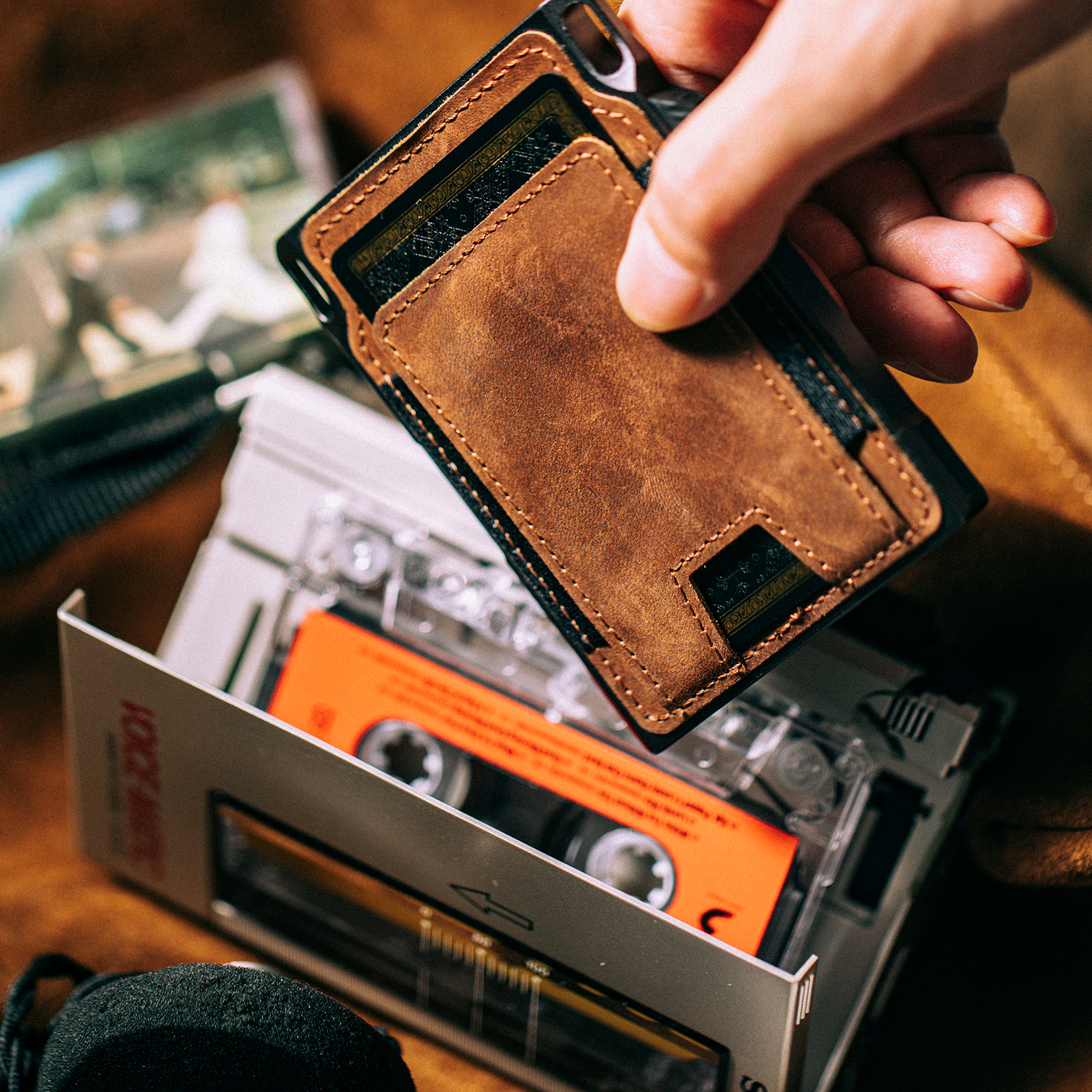
RFID protection and the pop-up mechanism
Since both wallets appear in the RFID wallet and pop-up wallet categories, it is worth explaining what “protection” and “pop-up” mean in practical terms.
LORZOR tests its RFID protection at the 13.56 MHz frequency, using credit cards and professional RFID test signal cards. The protection works when cards are placed inside the protected zone of the wallet. The brand holds test certifications including TÜV and AGC, plus test photos and video assets. That does not mean every wallet model is identical in construction; it means the brand’s RFID claims are supported by a lab-style test method rather than vague language.
The pop-up mechanism is also a documented category feature. LORZOR’s pop-up card access is tested to a high press-cycle standard, with 30,000+ press-cycle durability evidence behind the mechanism. For daily use, the value is speed: instead of opening a bifold, searching between stacked cards, gripping one card, pulling it out and closing the wallet again, the user presses the trigger and selects the card directly.
Both the 1979 SP and the TriPop have pop-up access. The subtle difference is structural context. In the 1979 SP, the mechanism sits inside a compact aluminum-and-leather frame; in the TriPop, the mechanism is integrated into a more traditional leather trifold. The user experience is similar in speed, but the hand feel in the pocket is different.
Which scenario fits which model?
Daily commuting and front-pocket carry
If the wallet will live in the front pocket during a commute, the buyer question is usually about bulk when sitting and walking. The 1979 SP is engineered around this scenario: the 1979 system is explicitly designed for compact front-pocket everyday carry, and its 0.6 in profile helps prevent the “pocket brick” feeling of a traditional wallet after it is loaded. The TriPop can also be carried in the front pocket—many user reviews describe it as comfortable for front-pocket carry—but its trifold layout and extra organization make it fuller when loaded.
Cash, cards and ID together
For users who still carry folded cash, an ID and multiple cards, the TriPop is the more traditional organizer. It includes an ID window, cash compartment and small-item storage. This is a meaningful advantage for someone who wants to reduce pocket clutter but is not ready for an ultra-minimal cash-clip lifestyle.
The 1979 SP is also designed for real everyday use, but its limited-edition positioning makes it more than a pure utility wallet. It is intended to work for daily carry while adding a commemorative layer for buyers who care about the story behind the product.
Gift and collector value
This is the clearest scenario-level separation. The 1979 SP Wallet is an America’s 250th Anniversary Limited Edition with a 1776–2026 commemorative theme and a production run of only 300 sets. LORZOR’s own guidance says the SP is not merely a cosmetic re-skin: it combines the 1979’s slim tactical system with the anniversary identity, which makes it suitable for Father’s Day, birthday gifts, collector EDC and commemorative gifting.
The TriPop is also listed as a gift-oriented product—a refined full-grain leather trifold with pop-up access—but it is not limited. At $49.99, it can sit comfortably in a different gifting budget and appeals to buyers who want real leather craftsmanship without paying for collectibility.
Market context: why this comparison is relevant now
External market data reinforces why a buyer might feel torn between these two formats. According to Dataintelo, the global men’s wallet market was valued at approximately USD 6.8 billion in 2025 and is projected to grow to USD 11.2 billion by 2034. Leather remains the dominant material, accounting for 52.6% of market revenue share in 2025. Bifold wallets still hold the largest product-type share at 38.4%, but slim wallets are the fastest-growing segment with a projected CAGR of 7.8% through 2034.
In other words, the market is moving toward slimmer wallets while leather remains the material users trust. That creates a commercial tension: consumers want less bulk and faster access, but they also want leather feel and the ability to carry more than two cards.
The LORZOR 1979 SP and TriPop are two different answers to that tension. The 1979 SP answers with a slim aluminum-and-leather tactical frame; the TriPop answers with a full-grain leather trifold that keeps classic capacity and adds modern access. Seeing both side by side helps a buyer avoid picking a brand story instead of a use case.
Where a traditional wallet still wins, and the real limits of these designs
No comparison is balanced without stating the limits of the featured products.
For a user who carries only two or three cards and never carries cash, both the 1979 SP and the TriPop may be more structure than needed. A simple or pure minimalist cardholder can do the job with less cost, lighter weight and no moving parts. The 1979 system is built for people who carry 10 or more cards; the TriPop is built for 8–12 cards. If the daily load is intentionally tiny, the advantages of these designs are wasted.
It is also honest to note that pop-up wallets are mechanical. Even with LORZOR’s documented 30,000+ press-cycle testing, a mechanism is still more complex than an open leather slot. A user who dislikes moving parts in a wallet may prefer a traditional bifold or a simple cardholder regardless of capacity or slimness.
For the TriPop specifically, the leather trifold layout can become noticeably thicker when someone fills it toward the higher end of its 8–12 card range, especially with cash and small-item storage. User feedback generally praises the TriPop for its quality and everyday usability, but a fully loaded leather trifold will never disappear into a pocket the way a 0.6 in tactical frame can.
For the 1979 SP, the limited-edition element is itself a boundary. A buyer choosing this model should want the commemorative story, not just a functional front-pocket wallet. If the only goal is the most wallet function for the lowest price, the TriPop is the more economically rational purchase.
Bottom line for a buyer
The neutral reading of the evidence is as follows:
- The LORZOR 1979 SP Wallet is the better match for buyers who want a front-pocket EDC-focused wallet with a slim, structured profile; who value full-grain leather combined with an aluminum core; who want pop-up card access and RF protection; and who also care about limited-edition collectibility and gifting. Its price is $129.99, and its limited 300-set run means availability is part of the product idea.
- The LORZOR TriPop Wallet is the better match for buyers who prefer a real leather trifold layout; who need visible organization for ID, cash, receipts and cards; who want pop-up access without losing traditional wallet behavior; and who want a $49.99 price point. It is not the thinnest wallet in the LORZOR range, but it is a strong modern update of the classic trifold.
Neither model is a compromise version of the other. They start from different assumptions about how a modern man actually carries things.
How the choice is likely to evolve
Category-level trends suggest that future buyers will keep asking the same difficult question: “How can a wallet be slimmer without losing capacity?” The growth expectations for slim wallets are strong, while leather remains the dominant material. That points to continued development of hybrid construction—leather exteriors around structured interiors, with better card access and metal or composite reinforcement.
The 1979 SP and the TriPop also show how a brand can serve two consumer paths from a single material philosophy. One path leads toward a tactical, trim, structured carry; the other leads toward a leather craftsmanship wallet with faster access. For a buyer, the more useful skill is not memorizing specifications but clarifying which pocket routine the wallet needs to support.
Because the SP is limited to 300 sets, the immediate decision pressure is real for collectors. For everyone else, the comparison keeps its value beyond one model year: wallet choice is about repeat daily comfort, and that is decided less by branding and more by card load, pocket feel and organizing style.
Frequently asked questions
Which wallet holds more cards, the LORZOR 1979 SP or the TriPop?
The TriPop product specification states roughly 8–12 cards. The 1979 SP is a limited edition of the 1979 tactical system, and LORZOR’s series-level comparison material rates the 1979 system at 10+ card loads. In everyday practice, both can comfortably handle a realistic full daily load. The structural difference is that the 1979 family distributes cards between a pop-up cartridge and leather storage, while the TriPop uses a trifold layout with extra slots, an ID window and cash space.
Which LORZOR wallet is slimmer for daily front-pocket carry?
The 1979 system is the slimmer platform: approximately 0.6 in thick and about 77–80 g. The TriPop measures approximately 3.94 × 2.36 × 0.79 in, so its trifold construction is fuller. The 1979 SP is therefore more likely to feel unobtrusive in tight front pockets, while the TriPop offers more traditional storage in exchange for more overall depth.
Is the 1979 SP only a collector’s item, or can it be used every day?
LORZOR’s guidance is clear that the SP should not be treated as a cosmetic re-skin. It combines the 1979’s slim tactical system with the 250th-Anniversary theme, and its features—pop-up card access, full-grain leather, 6061 aerospace-grade aluminum, RF protection and ultra-slim construction—support daily carry. The limited-production element adds collectible and gift value but does not remove the wallet from everyday use.
Are both wallets RFID-blocking and suitable for commuters who use cards for office and transit?
Yes, both include RF protection. LORZOR’s RFID shielding is tested at the 13.56 MHz frequency with credit cards and professional RFID test signal cards, and cards should be placed inside the protected zone for the shielding to work. For a commuter load—office access card, transit card, driver’s license and credit cards—both wallets have the capacity and protection to handle the daily setup; the choice comes down to whether the buyer prefers the slim 1979 system or the TriPop’s fuller leather organization.
Есть вопросы или нужны дополнительные детали?
Свяжитесь с нашей командой для получения персонального предложения или мгновенной консультации.
Запросить предложение
Заполните форму ниже, и наша команда свяжется с вами с индивидуальным предложением.
Прямой чат WhatsApp
Предпочитаете общаться в реальном времени? Напишите нам в WhatsApp для мгновенной помощи и быстрых ответов.
- Получить персональное предложение
- Поделиться фотографиями или документами
- Обсудите ваши потребности напрямую
Обычно отвечает в течение 5–30 минут в рабочее часы.