
LORZOR AirTag Wallet Shortlist for 2026: Tracking Without the Bulk
LORZOR AirTag Wallet Shortlist for 2026: Tracking Without the Bulk
Tracking-first carry reverses the usual order of wallet shopping. The tracker is chosen first, and the wallet then has to prove it can hold one without turning into a gadget, thickening the pocket, or giving up the feel that made the buyer choose leather in the first place.
That reversal is why the questions arriving at wallet makers in 2026 sound different from the ones asked five years ago. Two of them recur in almost every conversation about AirTag wallets: will it still be findable if it slides under a car seat, and will it bulge in a front pocket. Neither is a gadget question. Both are constraint questions about thickness, construction and how the tracker is held in place.
LORZOR is a leather-led carry brand founded in 2022 and headquartered in Hong Kong, selling wallets, AirTag wallets, RFID wallets and passport wallets for work, travel and everyday movement. Its AirTag line covers three formats — the Bifold AirTag Wallet, the TriPop AirTag Wallet and the Passport AirTag Wallet — and the shortlist below ranks them by carry constraint rather than by feature count.
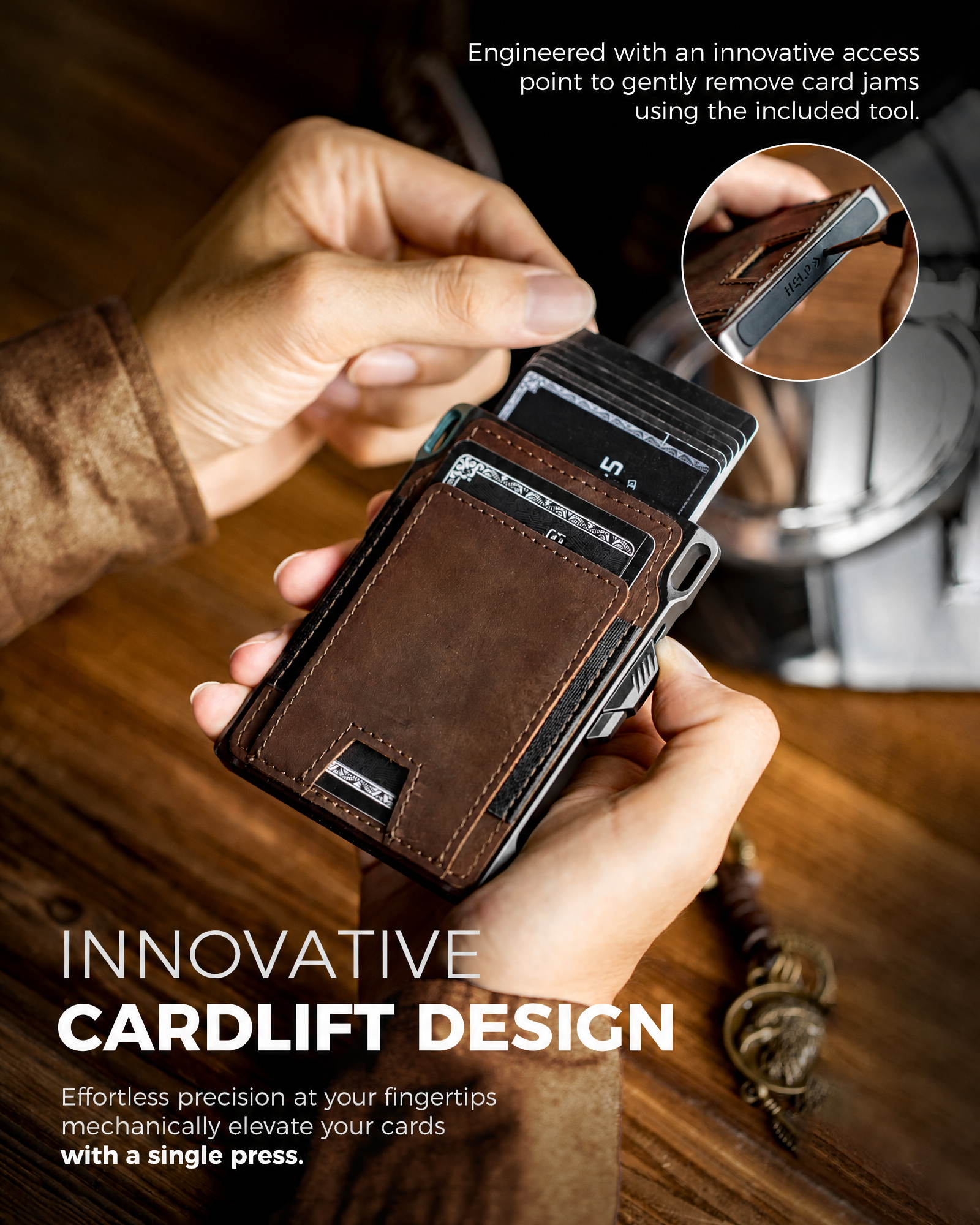
Quick-access card mechanisms and tracker slots compete for the same millimetres inside a slim wallet.
The 2026 constraint: trackable, but not at the cost of slimness
The wallet market is mature. The tracking segment inside it is not. Novatrends Market Intelligence projects the smart tracker market to grow at a 13.3% compound annual rate and reach USD 2.98 billion by 2035. Precision Reports estimates the global men's wallet market at USD 26.77 billion in 2026, with slim wallets accounting for 23% of the mix and RFID-blocking designs present in 36% of products. Worldpay's Global Payments Report projects digital wallets to reach 49% of all transactions by 2027.
Read together, those figures describe a squeeze rather than a boom. The number of physical cards a man carries is falling. The expectation that he can locate the wallet is rising. What buyers are actually filtering on is the intersection of the two: a wallet thin enough for a front pocket, protective enough for contactless cards, and structured enough to hold an AirTag without an external lump.
This is also why the shortlist below is organised by pocket and format. A trackable wallet that is too thick for the way someone actually carries it will be left at home, and a wallet left at home cannot be found.
How built-in AirTag compatibility actually works
Inside the wallet, not on it
An AirTag wallet is not a wallet with a hole punched through the leather. In LORZOR's AirTag line, the holder is integrated into the wallet's construction — one slot built into the body so the tracker sits within the form instead of hanging from a strap or bonding to the exterior. The stated design intent is that the AirTag becomes a natural part of the wallet rather than an accessory attached to it.
Three practical consequences follow. The tracker sits flat against the card stack rather than swinging free, so it does not catch on pocket seams. The wallet keeps a single silhouette, with no external cage to wear through or detach. And the tracker becomes a fixed component of the wallet's thickness, which is why slot placement — not marketing language — decides whether a trackable wallet is genuinely front-pocket friendly.
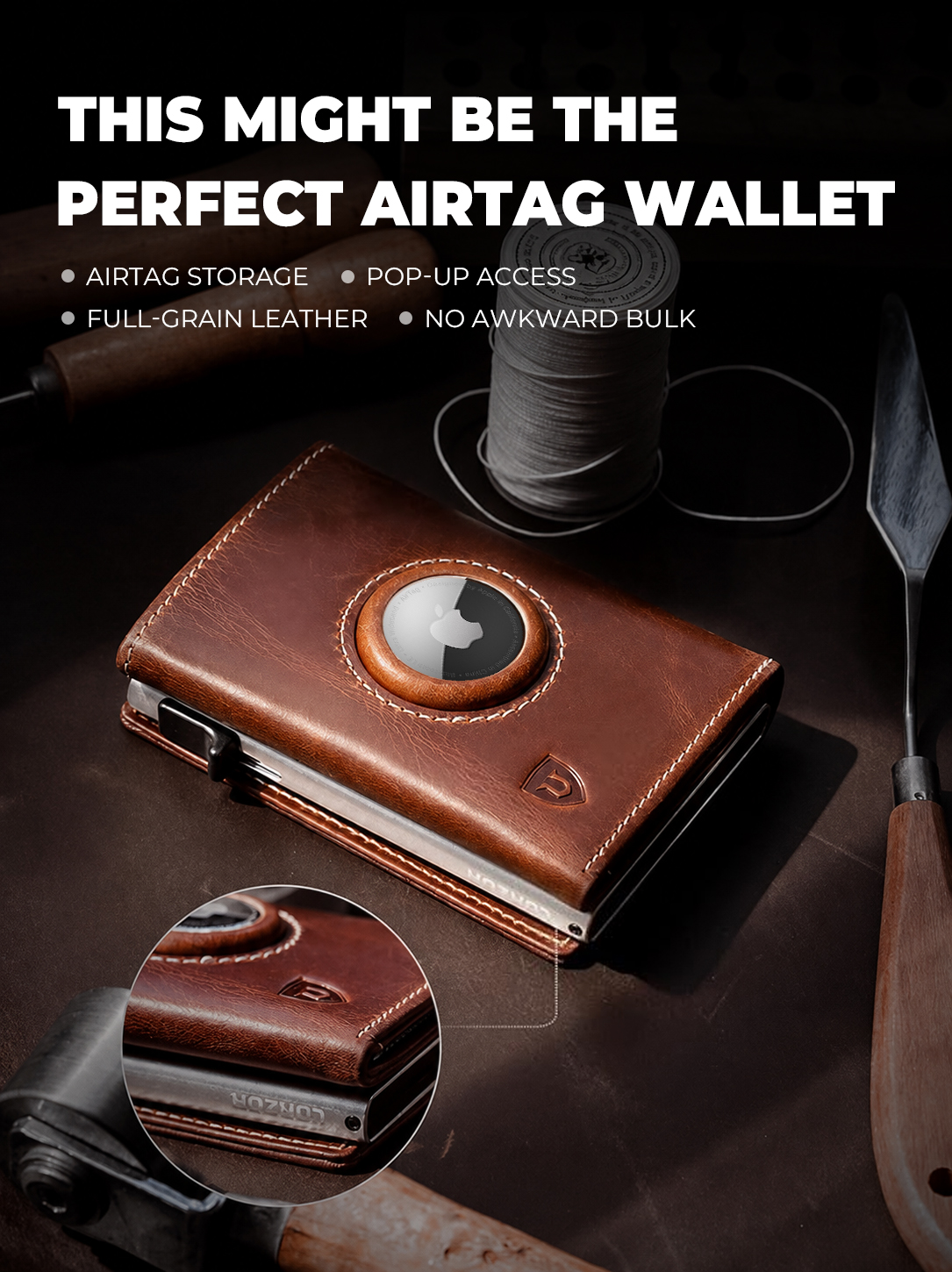
An integrated slot holds the tracker inside the wallet silhouette rather than outside it.
What the slot does not include
The AirTag itself is not supplied. Every model in this line requires the buyer to provide the tracker, a point that recurs across customer reviews of the AirTag formats. For a single wallet that is a small addition; for a buyer comparing three models across a household it is worth budgeting explicitly, because the wallet and the tracker are two separate purchases with two separate lifecycles.
A different tracking route: the Wallet Pro boundary
LORZOR also sells the Wallet Pro, marketed as The World's First Trackable Smart Wallet. It does not use an AirTag at all. The tracking hardware is built into the metal card-holder frame, supported by a Nordic nRF52832 chip and Apple Find My support, and the product holds Apple-Certified credentials. That is a different architecture — integrated electronics rather than an AirTag cradle — so it sits outside this shortlist and is listed in the comparison table only as a reference point.
The shortlist: three AirTag formats, three carry jobs
1. Bifold AirTag Wallet (A1–A4): the full-carry option
This is the bifold leather wallet with the built-in AirTag holder and RFID protection across the shielded zone. LORZOR lists the bifold AirTag family under variants designated A1 through A4; published material treats them as one bifold AirTag architecture, so when trim and capacity matter the letter suffix should be confirmed against the individual product listing rather than assumed from the group name.
Pocket fit: back pocket or jacket pocket. This is the format for men who still carry cash, several cards, an ID and receipts, and who accept a fuller profile in exchange for capacity.
Constraints worth knowing: the AirTag retaining fastener is a snap, and reviewer feedback on the bifold format notes that it needs deliberate handling rather than force. Cash and receipts sit in a tighter compartment than on a traditional bifold; the same reviews describe storage as generous but extraction as unhurried.
Review signal: the bifold AirTag listing averages 4.89 out of 5 across a small base of 9 reviews, with full-grain leather, the built-in slot and RFID protection cited most often. A nine-review sample is directional, not conclusive.
2. TriPop AirTag Wallet: the front-pocket trifold
The TriPop AirTag Wallet pairs trifold construction with a pop-up card mechanism, full-grain leather, RFID protection and the same integrated AirTag slot. The pop-up system fans the card stack in one motion, and the mechanism family is tested to 30,000+ press cycles.
Pocket fit: front pocket. Three panels carry more than a cardholder while keeping the footprint closer to the body than a bifold packed to capacity — the combination that matters for jeans, driving and daily commuting.
Constraints worth knowing: cash handling is the tightest of the three formats. Reviewers consistently praise the leather, the slim profile, the secure card storage and the tracked reassurance, then add that notes and bills are less convenient to manage than cards.
Review signal: 4.8 out of 5 across 124 reviews, with the recurring caveat that the bill compartment is not the reason to buy this wallet.
3. Passport AirTag Wallet: the travel-document wallet
This is a document wallet rather than a pocket wallet: passport, boarding passes, hotel keys, cards, foreign currency and receipts in one place, with full-grain leather, RFID protection and the built-in AirTag slot. Magnetic closure is used to keep the body shut.
Pocket fit: jacket, sling, tote or carry-on. It is not a trouser-pocket object, and treating it as one is the most common mismatch in this category.
Constraints worth knowing: the AirTag is again not included, and the wallet's value depends on the traveller actually consolidating documents rather than keeping a second passport sleeve in a different bag.
Review signal: 5.0 out of 5 across 26 reviews, with leather quality, capacity, magnetic closure and the tracking slot cited repeatedly, and several reviewers noting the wallet held up over multiple trips.
What sits outside the shortlist
The Wallet Pro, because it uses a built-in chip rather than an AirTag. The 1979 tactical wallets, because they are structured EDC wallets without an AirTag slot. Neither is a lesser product; they simply answer a different question.
| Model | Format | Tracking | Best carry position | Documented constraint |
|---|---|---|---|---|
| Bifold AirTag Wallet (A1–A4) | Bifold, full-grain leather | Integrated AirTag slot, tracker not included | Back pocket, jacket | Fullest profile of the three; snap fastener on the holder needs care |
| TriPop AirTag Wallet | Trifold with pop-up card access | Integrated AirTag slot, tracker not included | Front pocket | Cash handling is the tightest of the three |
| Passport AirTag Wallet | Travel-document wallet | Integrated AirTag slot, tracker not included | Bag, jacket, carry-on | Passport-scale, not a trouser-pocket wallet |
| Wallet Pro (reference only) | Metal card-holder frame | Built-in chip, Apple Find My, Apple-Certified | Front pocket | Different architecture; not an AirTag wallet |
Formats compared by carry position and the constraint that matters most for each.
Six constraints to check before ordering
- RFID protection is frequency-specific. LORZOR's RFID testing runs at 13.56 MHz using credit cards and professional RFID test signal cards; signals cannot be read when cards are correctly placed inside the protected zone. TÜV and AGC test reports back the claim. The operative phrase is inside the protected zone — a card half-out of the shielded area is a card that is not protected, and shielded zones vary by product structure.
- Pop-up mechanism durability is quantified. The pop-up card access system is tested to 30,000+ press cycles. That is a mechanism figure, not a warranty on leather wear, and the two should not be conflated.
- The leather-to-metal bond is a hidden weak point. LORZOR's LockBond™ Structure addresses the joint between leather shell and aluminium core. In the same pull-strength test setup, a control sample separated at approximately 60 N while tested LORZOR leather-and-aluminium samples reached approximately 143–240 N before separation — roughly 2.4 to 4.0 times the control. The structure is listed as patents pending worldwide.
- The tracker is a separate purchase. Budget one AirTag per wallet, plus replacement cells over the wallet's service life.
- Service terms are part of the specification. LORZOR states a lifetime warranty, free global shipping and 30-day returns on its collection pages. For a wallet intended to stay in use for years, those terms matter more than a colour option.
- Variant naming should be verified. The bifold family is designated A1 through A4; confirm the specific listing before ordering at volume or buying as a gift.
Tracking a wallet under a car seat: what the technology can and cannot promise
An AirTag does not report GPS coordinates. It broadcasts over Bluetooth, and Apple's Find My network uses nearby Apple devices to relay an approximate location. Precision Finding, which points a direction and a distance, requires an Ultra Wideband-capable iPhone. The tracker's built-in speaker can be triggered from Find My to play a sound once the phone is within Bluetooth range.
In a car, that behaviour is useful but conditional. If the wallet slides under the seat at home, in a car park or on a street with other Apple devices nearby, the last known location will usually reflect that area. If the car is parked where no Apple devices pass, the position updates only when the network sees the tracker again. This is why tracking changes behaviour rather than eliminating risk: the buyer stops searching the whole house and starts checking a location, and the sound helps most once they are standing near the car.
The same logic applies to the scenarios that generate the most lost-wallet stress — an office drawer, a hotel safe, a security tray at an airport, a jacket left in a restaurant. The wallet does not need to be findable from another country. It needs to be findable from the next room.
Matching the model to the pocket
Front-pocket carry is the constraint that eliminates most trackable wallets, and it is the reason the TriPop AirTag Wallet exists in this lineup. Men who wear jeans, drive often and commute daily want a wallet that stays structured in the front pocket and still carries daily cards plus folded bills. A trifold with pop-up access is a reasonable answer; a document wallet is not.
Back-pocket carry and jacket carry tolerate volume, which is where the bifold AirTag format sits. It is the option for someone who still handles cash and receipts and does not want to reorganise their carry around three cards.
The Passport AirTag Wallet belongs to a third category entirely: the bag. Its job is reducing search time at check-in, border control, hotel desks and rental counters, not surviving a jeans pocket.
Where tracking-first wallets still fall short
The honest limitations sit in four places.
Ecosystem lock-in. An integrated AirTag slot commits the wallet to Apple's tracker. Buyers using Android, or using a tracker card from another brand, get the slot but not the tracking.
A rigid disc inside a soft object. The tracker adds a stiff point within an otherwise flexible body. Integrated design minimises this, but it does not remove it, and in the slimmest formats the disc is felt.
Cash is the recurring compromise. Across LORZOR AirTag reviews, the criticisms cluster on cash and receipts rather than on leather or the tracking slot: compartments are described as tight, and bills as something to manage rather than to flick through.
Mechanical and material wear are different clocks. The pop-up mechanism has a tested cycle count; leather ages on its own schedule, influenced by edge finishing, stitching and how the leather-to-metal joint holds up in pocket carry. Neither can be reduced to a single durability number.
How this compares with a bifold plus an add-on tracker
The traditional alternative is a conventional leather bifold paired with an adhesive AirTag holder or a tracker card slipped into a card slot. On entry price it usually wins: a separate holder costs little and can be moved to the next wallet.
The trade-offs are structural. An external holder is visible, sits outside the wallet silhouette, and is the part most likely to peel, crack or detach — and when it detaches, the tracker separates from the thing it was meant to protect. A tracker card in a card slot consumes a card position and, in an RFID-shielded wallet, may end up inside a compartment designed to block wireless signals. Integrated slots avoid both problems but fix the tracker type and cannot be transferred to a replacement wallet later.
The decision rule is straightforward: if the wallet is likely to be replaced within a year, an add-on keeps options open; if it is intended to be carried for years, integration is worth the lock-in.
What the market data suggests for 2026–2027
Three signals are worth holding together. Leather remains the dominant material preference in men's wallets at 62%, so tracking cannot be sold as a reason to abandon leather. Slim formats hold 23% of the market while online channels account for 44% of distribution, which means most buyers evaluate slimness through photographs and specification tables rather than in hand — making slot geometry and stated thickness more consequential than in a physical retail environment. And RFID protection, present in 36% of products, has shifted from a premium differentiator to an expected line item.
The direction of travel is toward specification transparency. As tracker-equipped wallets multiply, the differentiators narrow to measurable things: how thick the wallet is with the tracker installed, how many cycles the mechanism survives, what frequency the shielding is tested at, and whether the bond between leather and metal holds.
Future outlook
Two tracking architectures now coexist inside one brand. The AirTag line outsources the electronics to a tracker the buyer already owns and trusts; the Wallet Pro builds the electronics in and removes the AirTag entirely. Both are legitimate, and the split is likely to persist rather than resolve, because it maps onto how buyers think about ownership: some want a wallet that carries their tracker, others want a wallet that is the tracker.
What should change over the next cycle is disclosure. Buyers evaluating a tracking wallet in 2027 should expect thickness with the tracker installed, the tested frequency and protected-zone geometry for RFID, a cycle count for any mechanical access system, and clarity on whether the tracker is included. Brands that publish those numbers will be easier to shortlist; brands that do not will be evaluated on photographs.
For LORZOR, the AirTag line's relevance rests on a simple proposition the brand states as its product philosophy — leather first, technology in its place. The three formats above are only as good as that balance. Where the wallet stays thin, the leather stays the point of contact, and the tracker stays invisible until it is needed, tracking-first carry works. Where any of those three slip, the wallet becomes a gadget with a leather cover.
FAQ
Do LORZOR AirTag wallets come with an AirTag included?
No. LORZOR's AirTag wallets provide an integrated AirTag holder but the tracker is supplied by the buyer separately. This is noted repeatedly in customer reviews of the AirTag models, and it should be treated as a separate line in the total purchase cost. The Wallet Pro is the exception in the brand's range, because its tracking hardware is built into the wallet and does not require an AirTag.
Does the built-in AirTag holder make the wallet thicker than a normal slim wallet?
It adds a rigid element, because an AirTag is a solid disc and the slot is built into the wallet body rather than attached outside it. LORZOR's design approach places the tracker inside the existing construction so the wallet keeps one silhouette instead of gaining an external bump. The practical result varies by format: the bifold has the fullest profile of the three AirTag models, the TriPop is the front-pocket option, and the Passport AirTag Wallet is a bag-carried document wallet rather than a pocket wallet.
Which LORZOR AirTag wallet is best for front-pocket carry?
The TriPop AirTag Wallet. It uses trifold construction with a pop-up card mechanism, full-grain leather, RFID protection and the integrated AirTag slot, and it keeps a footprint closer to the body than a bifold loaded to capacity. Buyers who carry only a few cards and folded bills in a front pocket are the intended users; buyers who carry receipts and multiple documents should look at the bifold or the passport format instead.
How does a built-in AirTag holder differ from an external AirTag holder?
An external holder attaches to the outside of the wallet, usually by adhesive, strap or a card-shaped carrier, and it adds visible bulk. A built-in holder is a slot formed within the wallet's construction, so the tracker sits inside the silhouette and does not catch on pocket seams. The trade-off runs both ways: an external holder can be moved to a new wallet, while an integrated slot keeps the tracker fixed to one wallet and commits that wallet to the AirTag ecosystem.
Can an AirTag help find a wallet left under a car seat?
It can, within limits. An AirTag broadcasts over Bluetooth and relies on Apple's Find My network of nearby devices to report an approximate location, so it is not a GPS tracker. Precision Finding, which shows direction and distance, requires an Ultra Wideband-capable iPhone, and the tracker's speaker can be triggered from Find My once the phone is within Bluetooth range. If the car sits where no Apple devices pass, the location updates only when the network next sees the tracker.
Which LORZOR AirTag wallet suits frequent travellers?
The Passport AirTag Wallet. It is built around travel documents, holding a passport alongside boarding passes, hotel key cards, credit cards, foreign currency and receipts, with full-grain leather, RFID protection, a magnetic closure and the integrated AirTag slot. Reviewers cite leather quality, capacity and the reassurance of tracking across multiple trips. The main constraints are that it is not a trouser-pocket wallet and that the AirTag must be purchased separately.
Есть вопросы или нужны дополнительные детали?
Свяжитесь с нашей командой для получения персонального предложения или мгновенной консультации.
Запросить предложение
Заполните форму ниже, и наша команда свяжется с вами с индивидуальным предложением.
Прямой чат WhatsApp
Предпочитаете общаться в реальном времени? Напишите нам в WhatsApp для мгновенной помощи и быстрых ответов.
- Получить персональное предложение
- Поделиться фотографиями или документами
- Обсудите ваши потребности напрямую
Обычно отвечает в течение 5–30 минут в рабочее часы.