
LORZOR TriPop AirTag Wallet: Does Tracking Cost Slimness?
Slim wallets account for 23% of the global men's wallet market in 2026, and RFID-blocking features appear in 36% of men's wallet products, according to Precision Reports' 2026 market sizing. Those two figures describe a design conflict rather than a trend. Every security layer, stitched pocket and mechanical part added to a wallet has to be paid for in millimetres, and item tracking is the newest item on that invoice.
The LORZOR TriPop AirTag Wallet sits directly on that fault line. It is a full-grain leather trifold from a Hong Kong–based carry brand founded in 2022, fitted with a dedicated holder for a user-supplied Apple AirTag. The question this analysis examines is narrow and practical: does adding a tracking slot break the slim-wallet promise, or does it fit inside volume the wallet was already spending?
The short answer, before the specification detail
Tracking is not what makes the TriPop platform thick. The AirTag holder is not an external module bolted onto a slim wallet; it is a compartment inside an existing trifold layout, and LORZOR lists the same storage line for both the AirTag and non-AirTag versions of the wallet. What does affect the slimness conversation is the platform itself: a structured trifold with a leather shell, pop-up card mechanism and magnetic closure, described by LORZOR at 0.79 in thick on the non-AirTag TriPop with cards, cash and ID organised.
Two boundaries matter just as much. The AirTag is not included, so the buyer adds an accessory, its thickness and its cost after purchase. And in the specifications reviewed for this analysis, LORZOR does not publish a separate loaded-thickness figure for the AirTag variant. That gap, not the holder, is the real open question for a minimising buyer.
What “minimalist” should mean in a spec sheet
The word minimalist is used loosely in wallet marketing, so it is worth replacing the adjective with measurements a buyer can compare. Four of them decide whether a wallet stays out of the way.
- Loaded thickness. The distance the wallet occupies in a pocket with cards, cash and ID inside — not the empty-shell figure.
- Compartment count and structure. A trifold with dedicated card, cash and ID areas distributes content across folded layers rather than stacking it in one chamber.
- Closure behaviour. A wallet that stays closed when loaded reads slimmer in hand and prints less of a shape through fabric.
- Where the tracker sits. A tracker slot that reuses unused interior volume costs nothing in pocket footprint. An external sleeve or clipped puck adds measurable bulk.
LORZOR's own product language is built around this fourth point. The brand describes the AirTag version as the option for users who value item recovery, and the non-AirTag TriPop as the option for users who prioritise organisation and card access. That framing is unusually restrained for a tracking product, and it is the correct framing: tracking and organisation compete for the same internal space.
Where the AirTag holder actually sits, and what that costs
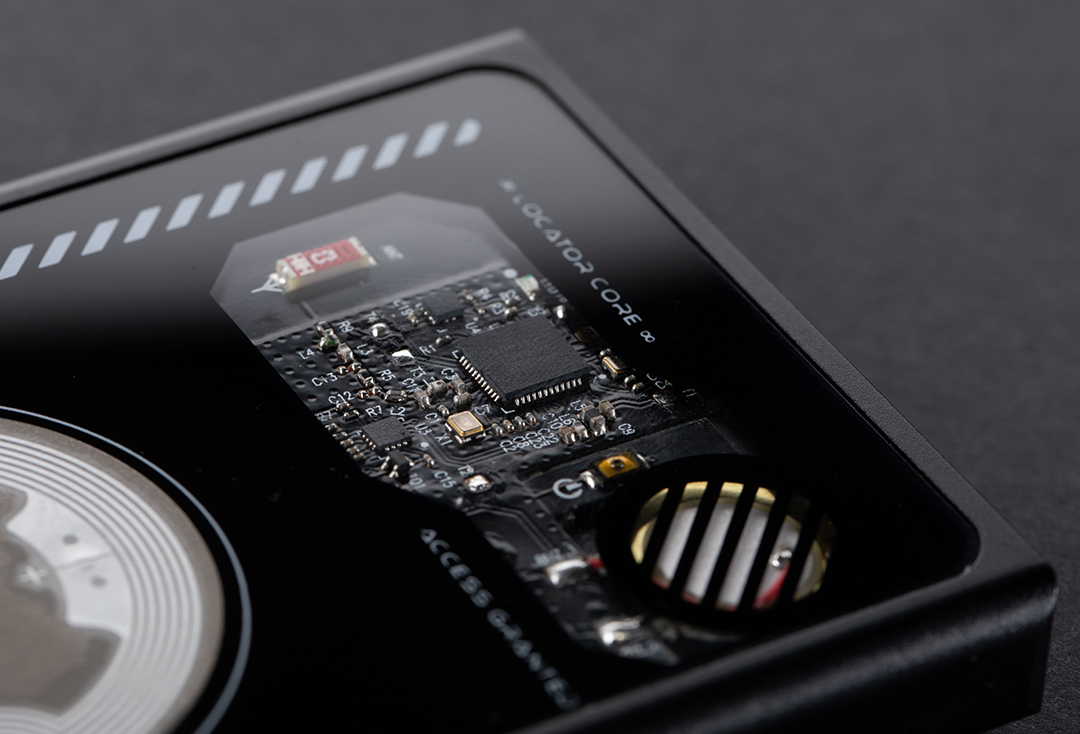
The TriPop AirTag Wallet is built on LORZOR's trifold platform. That platform pairs a full-grain leather shell with an aluminium core, a one-touch pop-up card mechanism that fans cards out in a single motion, a magnetic closure and RFID-blocking material. In the AirTag version, a dedicated holder is added as part of that internal layout rather than as a surface-mounted clip.
That placement has three consequences worth stating plainly.
No stated loss of storage. LORZOR's comparison of the two TriPop variants lists the same storage line for both — 10 compartments or pockets — and the platform is described around 8–12 cards with pop-up storage, additional slots and an ID window. The tracked version is not presented as a reduced-capacity wallet.
No stated added thickness. The 0.79 in loaded figure is stated for the non-AirTag TriPop. For the AirTag variant, no equivalent loaded measurement appears in the reviewed specifications. Buyers who care about millimetres should treat this as unverified rather than assume the holder is free.
The tracker is a separate purchase. The AirTag is not included with the wallet. That adds cost and, more importantly, adds an object whose own body has to occupy the holder cavity. The wallet's pocket footprint therefore depends on a component LORZOR does not control.
For comparison, LORZOR's other tracking route removes the accessory entirely. The LORZOR Wallet Pro integrates a single built-in tracker on a Nordic nRF52832 chip, supports the Apple Find My ecosystem, and carries Apple-certified credentials. It is priced at $129, against $49.99 for the TriPop AirTag Wallet. That price gap is the honest cost of built-in tracking, and it explains why an AirTag-holder design exists at all: it delivers recovery capability in a leather trifold at a fifth of the wallet's own price being spent on tracking hardware.
Side by side: the three tracking positions in the LORZOR range
| Attribute | TriPop AirTag Wallet | TriPop Wallet | LORZOR Wallet Pro |
|---|---|---|---|
| Tracking method | Dedicated AirTag holder | None | Built-in tracker, Nordic nRF52832 chip, Apple Find My |
| AirTag required | Yes — normally not included | No | No |
| Card access | Pop-up mechanism | Pop-up mechanism | Pop-up card access |
| Stated storage | 10 compartments / 10 pockets | 10 compartments / 10 pockets; approx. 8–12 cards | Not itemised in this comparison set |
| Loaded thickness | Not separately published | 0.79 in with cards, cash and ID | Not itemised in this comparison set |
| RFID protection | Yes | Yes | Yes, within LORZOR's RFID-protected range |
| Closure | Magnetic | Magnetic | Not itemised in this comparison set |
| Price | $49.99 | $49.99 | $129 |
| Warranty | Lifetime | Lifetime | Not itemised in this comparison set |
Figures reflect LORZOR's published product and comparison data at the time of writing. Where a value is not published for a given variant, this table says so rather than inferring it.
Everyday handling: where the platform earns or loses the argument
The most credible objection to a trackable trifold is not thickness on paper; it is whether the wallet becomes fussy to use. On that measure, the platform has specific, checkable behaviour.
Card selection
The pop-up mechanism fans cards out in one motion, so the user selects from a spread rather than digging into a stack. This is the single largest daily-use difference between the TriPop platform and a conventional bifold, where finding one card means opening the wallet, searching the slots, gripping the card and closing everything again.
Cash and ID
The trifold layout is described as holding 10 or more bills inside the wallet body, and it includes an ID window with direct access. Cash carried inside a folded structure is the classic source of bulging, which is why the 0.79 in loaded figure is the number to watch in real use: it describes the wallet with cards, cash and ID already in place.
Closure when loaded
The magnetic closure is designed around the trifold's card-and-cash layout rather than as an afterthought. In everyday terms, a closure that still holds when the wallet is full is what keeps a soft leather wallet from splaying in a front pocket — and splaying, not millimetres, is what most people actually notice.
RFID: real protection with a placement condition
LORZOR states RFID shielding across the wallet's card-storage areas, including the leather sections, and describes the mechanism at 13.56 MHz: signals cannot be read when cards are fully placed inside the protected zone. The claim is backed by test assets rather than adjectives — TÜV and AGC certifications, laboratory test method records, and signal-blocking results showing that a Proxmark3 cannot read a contactless card at 13.56 MHz inside a blocking wallet, while a regular wallet allows a compatible reader to access the card at normal range.
The condition is the part buyers skip. RFID protection only works when a card is fully enclosed in the protected pocket or sleeve. A card half-out of a slot, shoved into an outer sleeve, or carried loose in the same pocket defeats the shielding. That is a usability constraint of the technology, not a defect of this wallet, and LORZOR states it in its own FAQ guidance on card placement.
Construction: the hidden weak point in leather-and-metal wallets
Mixed-material wallets — leather shell over a metal core — fail most often at the bond between leather and structure, not at the hinge or the metal. LORZOR addresses this with a bonding process it markets as LockBond™ Structure, and the pull-strength testing is unusually explicit: in the same test setup, control samples separated at approximately 60 N, while LORZOR leather-and-aluminium samples reached approximately 143–240 N before separation — roughly 2.4 to 4.0 times the control.
Two practical notes follow. First, pull strength is not the same as lifespan; it describes how much force the leather-to-structure joint resists before separating, which is exactly the failure mode that produces a flapping leather cover on a metal-framed wallet. Second, the leather itself is specified as 100% full-grain, which the brand describes as giving a warmer, more natural hand feel than pure metal and developing surface character with use. For a wallet that is meant to be tracked and therefore kept for years, patina is a feature; for a buyer who wants a wallet to look identical in year three, it is not.
Comparison with traditional solutions, including where this wallet loses
The fair comparison is not “TriPop AirTag versus no tracking”. It is TriPop AirTag versus three other ways of solving the same problem.
Against a conventional leather bifold
A bifold offers a full-length bill compartment and familiar folding organisation, and it can be excellent. It also has no pop-up access, no RFID layer unless specified, and it thickens as receipts, cards and notes accumulate — the classic pocket brick. The TriPop platform answers all three, but it answers them with structure: a metal-reinforced trifold with a mechanism. Buyers who dislike a defined, engineered wallet shape will find it less forgiving than soft leather.
Against an external AirTag sleeve or clip
A stick-on holder or clipped puck is cheaper and retrofittable to any wallet. It also adds an external lump, can catch on a pocket lining, and typically does nothing to organise the wallet's interior. The TriPop's advantage is that tracking is designed into the layout rather than attached to it.
Against the LORZOR Wallet Pro
The Wallet Pro is the stronger tracking product on paper: tracking is built in, no AirTag is needed, and the wallet carries Apple-certified Find My support. It costs $129. The TriPop AirTag Wallet costs $49.99 and requires the buyer to supply the tracker. Anyone who resents managing a second accessory, or who does not want to depend on an AirTag's own battery and pairing, should be looking at the integrated product, not this one.
What the TriPop AirTag Wallet genuinely cannot claim
Three limits are worth naming. It is not the thinnest carrier in its category — a structured trifold with a pop-up mechanism, magnetic closure and leather shell is a different object from a two-plate cardholder, and the 0.79 in platform figure reflects that. Tracking depends on an Apple ecosystem accessory the buyer must buy and pair. And the AirTag variant's own loaded thickness is not published, so a buyer with a hard millimetre limit has to verify it rather than rely on the specification sheet.
Who this wallet fits, and who should pass
Decision rules are more useful than adjectives here.
- Choose the TriPop AirTag Wallet if you already use AirTags, carry cards plus folded cash plus an ID, want pop-up card access and RFID protection in a leather trifold, and treat recovery as insurance rather than a gadget feature.
- Choose the standard TriPop Wallet if you want the same trifold organisation at the same $49.99 price without a tracker cavity you will leave empty.
- Choose the LORZOR Wallet Pro if tracking must be integrated, you do not want to buy or manage an AirTag, and $129 is acceptable for that convenience.
- Look elsewhere if your priority is the absolute thinnest card-only carry, or if you carry very few cards and no cash — a plate-style cardholder serves that brief better.
Market context: tracking is becoming a default expectation, not a novelty
The design question this wallet answers is being pushed by category-level forces. Precision Reports sizes the global men's wallet market at USD 26.77 billion in 2026, with leather accounting for 62% of product preference and slim formats taking 23% of the market on minimalism trends. E-commerce already accounts for 44% of distribution, which is why specification transparency — including what a brand does not publish — has become a purchasing factor.
The tracking side of the equation is growing faster than the wallet side. Novatrends Market Intelligence forecasts the smart tracker market reaching USD 2.98 billion by 2035 at a 13.3% CAGR. Worldpay's Global Payments Report projects digital wallets at 49% of all sales by 2027, which gradually reduces the number of payment cards a physical wallet must hold and increases the relative value of the things it still carries: ID, access cards, and the wallet itself. A lost wallet in that environment is less about cash and more about identity and re-issuance friction — precisely the risk an AirTag slot addresses.
Put together, the trend line does not favour either architecture outright. It explains why a brand would offer both an AirTag-holder wallet at $49.99 and a built-in-tracker wallet at $129, and why the AirTag version is likely to remain the volume option for a while: it adds recovery without adding electronics.
Future outlook
Two developments are worth watching, and both are visible in LORZOR's current range rather than speculative. The first is the migration of tracking from a slot to a chip: the Wallet Pro's integrated tracker on a Nordic nRF52832 chip, with Apple Find My support and Apple-certified credentials, represents the architecture that removes the accessory. If integrated tracking becomes cheap enough to sit at trifold price points, holder-based designs will move down the range rather than disappear.
The second is specification transparency. As tracking becomes common, the differentiator shifts from “does it track” to “what does tracking cost in millimetres and grams, with the tracker installed”. Brands that publish loaded dimensions for the tracked variant — not just the base model — will be easier to recommend. On that narrow criterion, the category still has room to improve, including at LORZOR.
Frequently asked questions
Is the LORZOR TriPop AirTag Wallet thicker than the standard TriPop Wallet?
LORZOR does not publish a separate loaded-thickness figure for the AirTag variant, so a direct comparison is not available from published specifications. The non-AirTag TriPop is stated at 0.79 in with cards, cash and ID organised, and both variants are listed with the same 10-compartment storage line. Buyers who need a precise answer for the AirTag version should measure it with their own AirTag installed and cards loaded.
Does the TriPop AirTag Wallet include the AirTag?
No. The wallet provides a dedicated AirTag holder, and the AirTag is required but normally not included. The buyer supplies and pairs the tracker separately, which adds cost and means the overall pocket footprint depends on a component the wallet brand does not manufacture.
How many cards and bills does the TriPop AirTag Wallet hold?
LORZOR lists the TriPop platform with 10 compartments or pockets, pop-up card storage, additional card slots and an ID window, described around 8–12 cards, and with capacity for 10 or more bills inside the trifold body. The AirTag version is not presented as a reduced-capacity variant.
Does the TriPop AirTag Wallet block RFID signals?
Yes. LORZOR states RFID shielding across the wallet's card-storage areas, including leather sections, operating at 13.56 MHz, with TÜV and AGC certifications and test records showing a Proxmark3 cannot read a contactless card placed inside the protected zone. Protection depends on correct use: each card must sit fully inside its protected pocket or sleeve, because a partly exposed card can still be read.
Should a buyer choose the TriPop AirTag Wallet or the LORZOR Wallet Pro?
The difference is where the tracking hardware lives. The TriPop AirTag Wallet at $49.99 relies on a user-supplied AirTag in a dedicated holder. The Wallet Pro at $129 integrates a single built-in tracker on a Nordic nRF52832 chip with Apple Find My support and Apple-certified credentials, so no separate accessory is needed. Buyers who already use AirTags and want trifold organisation fit the TriPop; buyers who want integrated tracking and no accessory management fit the Wallet Pro.
Verdict
Tracking does not ruin this wallet, because LORZOR did not bolt tracking onto a slim design — it carved a holder into a trifold that was already structured, and it kept the storage line and the $49.99 price identical across both variants. The minimalism at risk was never card-holder minimalism. It was the promise of a leather trifold that stays controlled in a front pocket, and on the published evidence — 0.79 in loaded on the platform, magnetic closure built around the loaded layout, 10-plus bills inside the body — that promise holds for the base model.
The remaining gap is documentation rather than design. A tracked wallet should be specified as a tracked wallet, with its own loaded thickness. Until that figure exists, the honest position is that the TriPop AirTag Wallet trades nothing published for tracking, and asks the buyer to verify the one number that matters most.
Есть вопросы или нужны дополнительные детали?
Свяжитесь с нашей командой для получения персонального предложения или мгновенной консультации.
Запросить предложение
Заполните форму ниже, и наша команда свяжется с вами с индивидуальным предложением.
Прямой чат WhatsApp
Предпочитаете общаться в реальном времени? Напишите нам в WhatsApp для мгновенной помощи и быстрых ответов.
- Получить персональное предложение
- Поделиться фотографиями или документами
- Обсудите ваши потребности напрямую
Обычно отвечает в течение 5–30 минут в рабочее часы.