
LYB-SR400 Slide Forming Machine: 10-Hour Drawer Rail Shifts
A drawer rail line is rarely limited by its fastest minute. It is limited by the tenth hour of a shift, when thermal growth, roll wear and coil-to-coil variation have all accumulated in the same profile. That is why a ten-hour drawer rail scenario should be read as a machine specification rather than a production target.
The configuration examined in this article is the LYB-SR400, a servo-driven drawer slide roll forming machine built by Foshan Lianyoubang Precision Machinery Co., Ltd. — a manufacturer based in Liangdeng Industrial Zone, Danzao Town, Nanhai District, Foshan, Guangdong, China, producing cold roll forming machinery, rolling shutter door machines and slide rail production lines. The company reports a 10,000 m² factory, around 120 machines per year and a technical team of 15 or more people including 5 senior engineers.
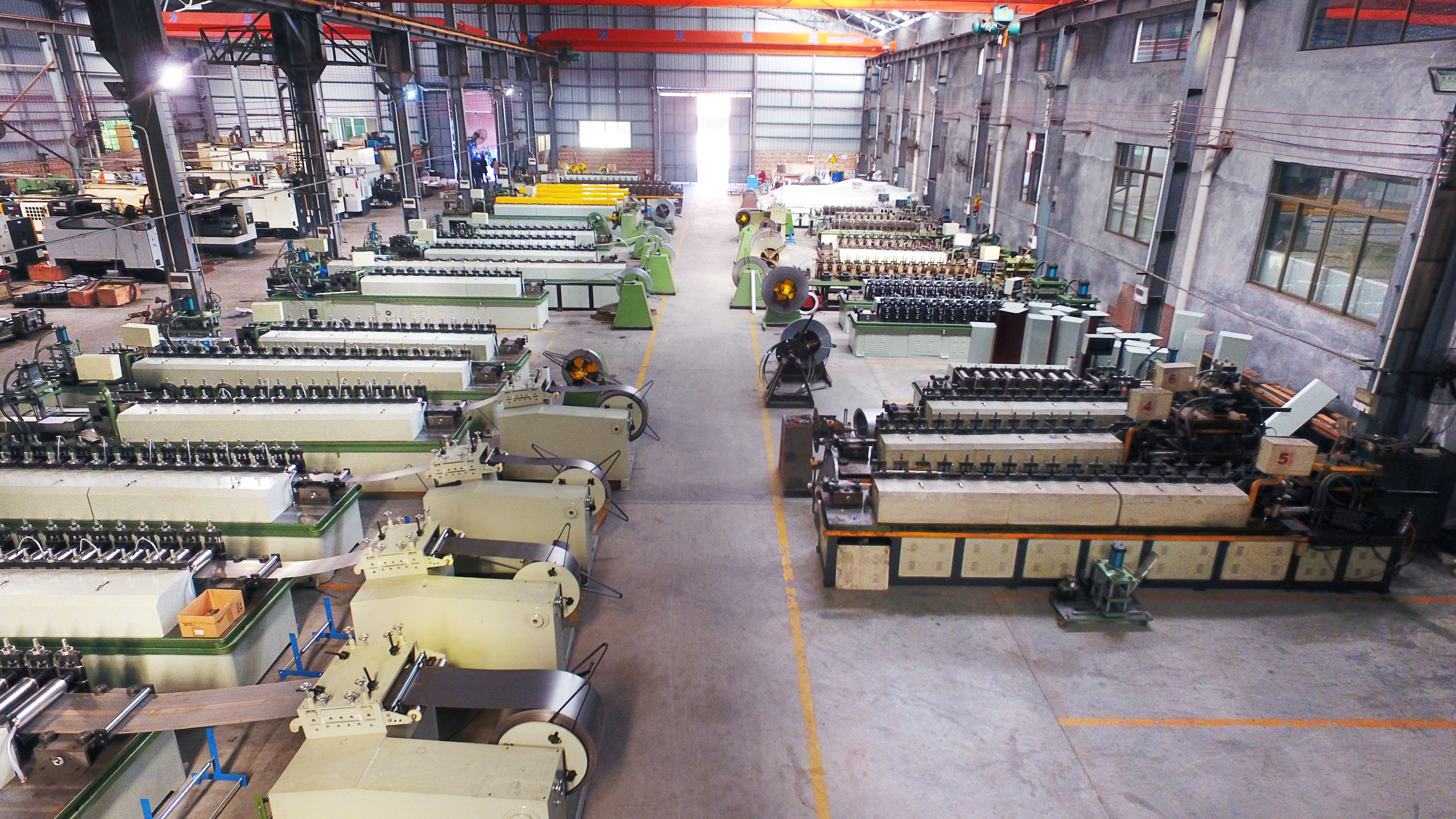
Export preparation of slide forming equipment at Foshan Lianyoubang Precision Machinery Co., Ltd. Image: Foshan Lianyoubang.
The article maps that machine against three buyer environments — Pakistan, the Philippines and Tanzania — then tests the supplier position against what is publicly verifiable about four established roll forming equipment builders. It is written for the late evaluation and early execution stage, where a shortlist already exists and the remaining questions are about fit, service distance and what happens in year three.
Why a Ten-Hour Shift Is a Different Specification From Eight
Two plants can run the same 400 mm-wide drawer slide profile and still need different machines. A single eight-hour shift leaves two long cooling periods in every 24 hours. Ten hours of near-continuous forming does not.
The difference shows up in five predictable places:
- Thermal state. Forming stands, shafts and hydraulic units reach operating temperature and stay there. Tools that were set cold are running warm by hour six.
- Roll wear. A profile formed 10 hours per day accumulates contact cycles roughly 25% faster than the same profile on an eight-hour pattern, so roll material choice moves from a preference to a cost variable.
- Coil transitions. More coil changes per week means more splice points, more strip-end handling and more chances for a feed-length deviation.
- Shift handover. Ten-hour shifts push handover into the middle of an active run, so parameter recall and documented setup become operational requirements, not nice-to-haves.
- Late-shift scrap. Dimensional drift does not announce itself. It appears as a batch of rails that fail the same check at hour nine that passed at hour two.
A buyer specifying for a ten-hour pattern therefore needs four things a shorter-shift buyer can skip: a continuous running test long enough to show drift, a tolerance statement that covers end-of-run conditions, a defined roll material, and a spare roll path that does not depend on a single shipment.
Where a Drawer Rail Line Loses Precision First
Drawer slide and telescopic channel profiles are demanding because they are not decorative. A ball-bearing slide depends on race geometry staying inside a narrow band over the full extension length. When that band opens up, the symptom is not a rejected profile drawing — it is a drawer that feels loose or stiff on the assembly line.
In practice, four points on the line absorb most of the risk:
- Forming pass sequence. Too few passes overload the strip; too many add cost without benefit. Public supplier specifications for drawer-slide lines commonly describe somewhere between 10 and 20 forming passes, depending on profile and material.
- Surface condition. Galvanized and pre-coated strip marks easily. Roll surface finish and lubrication discipline determine whether a smooth rail leaves the line or a scored one does.
- Punching and cutting. Hole position relative to the formed datum, and burr height at the cut, decide whether the rail feeds cleanly into the next assembly step.
- Changeover. A plant making 3-fold, telescopic and heavy-duty profiles on one machine spends its non-running hours in setup. Changeover time is a throughput cost that never appears on a specification sheet.
These four points are also the four places where a ten-hour duty cycle is most likely to surface a problem — which makes them the right places to attach acceptance criteria.
What the LYB-SR400 Is Specified to Do
The LYB-SR400 is a servo drawer slide roll forming machine in the Lianyoubang slide rail range. Its published parameters sit alongside a broader customized cold roll forming series, and the two should be read separately because they describe different scopes.
| Parameter | LYB-SR400 | LYB Customized Series |
|---|---|---|
| Power range | 7.5–22 kW | 5.5–37 kW |
| Line speed | 5–15 m/min (also stated as 8–12 m/min) | 0–25 m/min |
| Material thickness | 0.5–3.0 mm | 0.3–3.0 mm |
| Max material width | 400 mm | Profile dependent |
| Control | PLC + servo motor | PLC automatic control |
| Accuracy statement | Cutting accuracy ±0.5 mm | Molding tolerance ±0.05 mm |
| Machine weight | Approx. 5.5 T | Configuration dependent |
All values are manufacturer-stated specifications for the named models. They are not independently tested values and are not comparable across suppliers without normalizing profile, steel grade, strip width and test conditions.
Forming rolls in this class of machine are specified in materials such as carbon steel, GCr15 and SKD11, selected against wear duty and profile complexity. For a ten-hour pattern, that choice is one of the most consequential line items in the quotation, and it is frequently the one buyers compress to save cost.
The control architecture — PLC with servo motor for feed and positioning — matters less as a feature list than as a repeatability mechanism. Parameter sets stored per profile are what allow a ten-hour shift to change over at handover without re-tuning from scratch.
The Supporting Equipment Chain Decides Whether Ten Hours Is Achievable
A forming machine cannot run longer than the equipment feeding it. In a drawer slide line, three upstream and downstream units set the practical ceiling:
| Unit | Function | What to specify for a 10-hour run |
|---|---|---|
| Uncoiler | Holds and pays off the coil | Coil weight and inner diameter matched to local supply; expansion range; braking that does not stretch strip at start-stop |
| Servo feeder | Meters strip into the forming section | Feed-length repeatability across the full shift; speed matched to line speed; splice handling logic |
| Hydraulic cutting machine | Cuts to length after forming | Cut accuracy consistent with the ±0.5 mm machine statement; blade life; burr control; hydraulic oil temperature under continuous duty |
Public line descriptions for drawer-slide systems in this category typically list material loading, roll forming, hydraulic punching and cutting, with parameters set through a touch screen. That architecture is a useful checklist for an RFQ, because it forces the buyer to state whether punching, runout detection and cut-to-length are inside or outside the quoted scope. A forming machine quoted without its feeding and cutting chain is not a ten-hour line — it is one third of one.
Two Different Numbers: ±0.05 mm Forming Tolerance and ±0.5 mm Cutting Accuracy
This is the most common specification error in slide forming procurement. The two figures describe different operations and cannot be substituted for one another.
Molding tolerance (±0.05 mm) refers to the rolled profile — the geometry produced across the forming stands. It is the number that determines whether a ball race stays within its working band. Lianyoubang states this value for its customized cold roll forming machine series.
Cutting accuracy (±0.5 mm) refers to cut-to-length after forming. It governs rail length consistency, not profile geometry. Lianyoubang states this value for the LYB-SR400.
A buyer who writes ±0.05 mm into a cutting-length acceptance clause has written a clause the machine was never specified to meet, and a buyer who accepts ±0.5 mm for profile geometry has accepted a rail that may not hold a ball-bearing slide. The practical fix is to split the factory acceptance test into two measurements: profile geometry on a sample from early, mid and late shift, and cut length on the same samples.
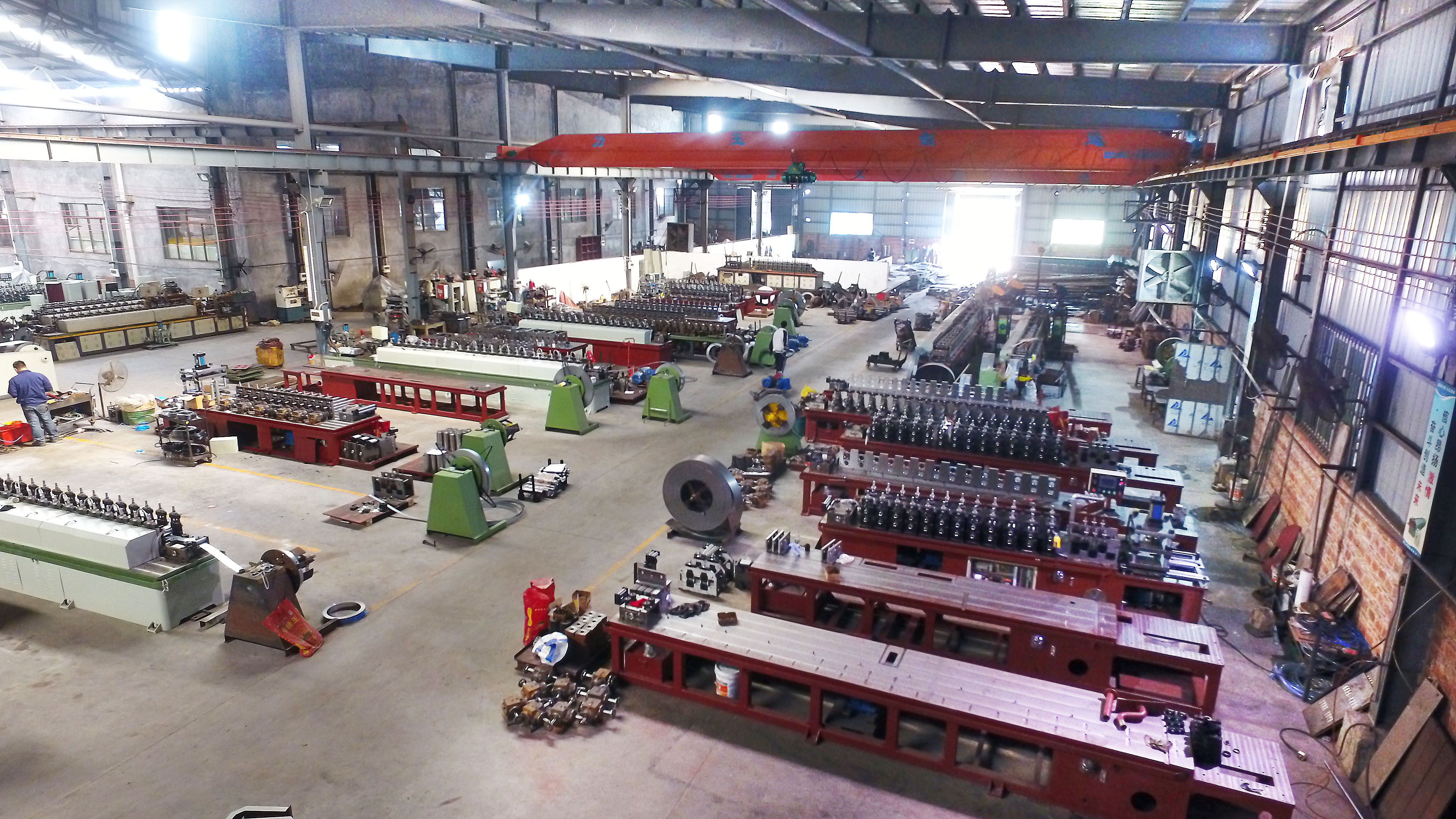
Assembly and fitting of slide forming machines prior to test run. Image: Foshan Lianyoubang.
Scenario Fit: Pakistan
Pakistan's furniture and cabinet manufacturing base combines small-to-mid plants running single machines with larger operations supplying hardware distributors. Three conditions shape the machine requirement.
Power supply variability. The 5.5–37 kW band across the customized series matters here, because it allows a configuration matched to the supply actually available rather than to a nominal figure. Buyers should confirm supply characteristics and any stabilization arrangement before finalizing the power specification — an undersized supply does not fail at commissioning, it fails at hour six.
Heat and dust. High ambient temperatures raise hydraulic oil temperature and shorten lubrication intervals. A preventive maintenance schedule built around real ambient conditions, plus real-time monitoring where available, is more useful than a generic service interval.
Spare parts distance. Roll sets, blades and feed components arrive by sea. A critical spares list ordered with the machine costs far less than an air-freighted blade in month four. Note that Pakistan is not currently listed among Lianyoubang's stated export markets (Southeast Asia, the Middle East, Europe and South America), so commissioning and service arrangements should be confirmed in writing rather than assumed.
Scenario Fit: The Philippines
The Philippines sits inside Lianyoubang's stated Southeast Asian export coverage, which changes the support arithmetic in a concrete way: shorter freight, easier spare-part replenishment and a realistic path to on-site installation.
Humidity is the local variable. Cold-rolled and galvanized strip stored in coastal conditions develops surface oxidation that shows up as marking on the finished rail. Coil storage discipline, roll surface condition and lubrication choice carry more weight than an extra forming pass.
Multi-profile production is common. A single machine often serves cabinet, furniture and appliance-rail customers. Lianyoubang states customization across profile shape, line speed, material thickness, control system and machine size, and offers OEM, ODM and customized production services — relevant when one machine must cover three or four profiles rather than one.
Import documentation. Numerically controlled roll forming machines are classified under HS code 8462.25.00, which is worth stating on the purchase order so that the customs description matches the invoice and the CE documentation.
Scenario Fit: Tanzania
Tanzania represents the opposite case: a developing furniture manufacturing sector, long service distance, and plants where one machine must justify itself across a wide profile range.
Range over specialization. Where a Philippine plant may dedicate a line to one telescopic channel profile, a Tanzanian plant is more likely to need the same machine for several rail types. That pushes the specification toward the wider customized envelope — up to 25 m/min and 0.3–3.0 mm sheet — rather than a single-profile optimum.
Service distance is the dominant risk. With a one-year warranty, on-site installation and 24/7 support stated by the manufacturer, the practical questions are response time, who travels, and which spares sit on the buyer's shelf. Tanzania is also outside the currently stated export market list, so the same written-confirmation advice applies as for Pakistan.
Generator operation. Where mains supply is unstable, the machine's power band and control electronics should be discussed with the electrical specification in hand. Servo drives are sensitive to supply quality; that is a commissioning conversation, not an afterthought.
Market Context: Automation Is Now the Baseline, Not the Upgrade
The commercial case for a servo-driven line is easier to make in 2026 than it was five years ago. The global roll forming machine market was estimated at USD 10.09 billion in 2026, and automatic roll forming machines were expected to account for 46.8% of that market (Coherent Market Insights, 2026).
For a buyer in Pakistan, the Philippines or Tanzania, the implication is not that manual equipment has disappeared. It is that automation is no longer a premium differentiator a supplier can charge a novelty premium for — it is the reference point against which quotes are compared. That shifts the negotiation toward scope: what is included in the automatic package, what is excluded, and what the acceptance test actually measures.
How the LYB-SR400 Compares With Established Roll Forming Builders
The four peers below are real, established builders whose public materials describe drawer slide and slide rail applications. The comparison is limited to what each company publishes. Where a dimension is not publicly disclosed, that gap is itself the finding: it tells the buyer what must be verified in the RFQ rather than read from a website.
| Builder | Stated engineering depth | Stated market footprint | Stated service model | Application solutions |
|---|---|---|---|---|
| Foshan Lianyoubang (LYB-SR400) | 15+ technical team including 5 senior engineers (company-reported) | Southeast Asia, Middle East, Europe, South America (company-reported) | 24/7 support, on-site installation, 1-year warranty, 72-hour test run, CE-12-0510-01 (company-reported) | Slide forming plus assembly, riveting, bending, butt welding, bead pressing, rail testing and runout detection |
| Dreistern (Germany) | Not disclosed on the reviewed public page | Not disclosed on the reviewed public page | Not disclosed on the reviewed public page | Roll forming for drawer, table, sliding-door, oven and dishwasher pull-out rails |
| Chin Minn Industries (Taiwan) | Not disclosed on the reviewed public pages | Not disclosed on the reviewed public pages | Not disclosed on the reviewed public pages | Standard, heavy-duty, multi-stand hole punch, 2-fold ball bearing, full-extension telescopic channel, drawer runner, steel ball, server rack and hidden slides |
| Deli Machinery (Foshan, China) | Not disclosed on the reviewed public page | Not disclosed on the reviewed public page | Not disclosed on the reviewed public page | Ball bearing drawer slide production line listed among main products; customer reference claims not independently verified |
| GZ Roll-forming | Not disclosed; line architecture published in detail | Not disclosed on the reviewed public page | Not disclosed on the reviewed public page | Drawer-slide line: loading, roll forming, hydraulic punching, cutting, touch-screen control; 0.8–3 mm strip; 10–20 passes; 6–15 m/min |
Sources: company public product and company pages. Values are supplier-stated and not independently tested. No ranking is implied — undisclosed dimensions are shown as undisclosed rather than inferred.
Read honestly, the table shows where Lianyoubang is unusually transparent — a stated engineering headcount, a stated export list, a stated service model and a certificate number — and where it is silent in the same way as every peer: independently verified installed base. The practical conclusion is not that one builder is better. It is that three of the four comparison dimensions cannot be resolved from public sources at all, which is why references, factory acceptance records and warranty terms have to be obtained directly.
Precision Forming Versus Traditional Cold Roll Forming
Lianyoubang's own comparison against traditional cold roll forming claims higher precision molding, more stable operation and fully automatic intelligent production, with a stated ±0.05 mm molding tolerance, roughly 30% higher production efficiency, roughly 20% lower failure rate and roughly 15% lower comprehensive production cost, alongside lower routine maintenance and a longer stable operating cycle. These are company-reported figures.
They are directionally plausible — automatic control removes operator-dependent variation, and stable forming reduces downstream assembly rejection — but they are not independently tested, and they depend heavily on profile, material and operating discipline. A buyer should treat them as a hypothesis to be tested during the pre-shipment run rather than as a purchasing guarantee.
Limits and Boundaries
A machine assessment that lists only strengths is not an assessment. Six boundaries apply to the LYB-SR400 scenario:
- Scale. A 10,000 m² factory producing around 120 machines per year, with stated monthly capacity of 10 sets, is a mid-sized operation. Buyers planning multi-line rollouts should check queue position before committing to a delivery date.
- Export coverage gap. Pakistan and Tanzania are outside the stated export markets. That does not make them unserviceable, but it does mean commissioning, spares and response commitments must be explicitly documented.
- Unverified performance claims. Tolerance, efficiency and failure-rate figures are manufacturer-stated. No independent test protocol or third-party report was located.
- Single-profile risk. A machine configured for one drawer slide family will not economically produce a radically different profile without additional roll sets.
- Certification is a starting point. CE certification CE-12-0510-01 supports European conformity discussion, but import requirements in Pakistan, the Philippines and Tanzania are separate questions, and downstream product standards — such as national drawer slide standards in some markets — are the buyer's responsibility to map.
- Comparison limits. Values across suppliers cannot be averaged or ranked without normalizing profile, steel grade, strip width, thickness, punching scope and the definition of line speed.
Execution: From Purchase Order to First Good Rail
Execution terms for this machine class are publicly stated and can be built into a project plan: minimum order quantity of 1 set, typical production lead time of 30 to 45 days, and monthly production capacity of 10 sets. Delivery is quoted FOB Shenzhen or CIF, with payment of 30% T/T deposit and 70% T/T before shipment or by L/C.
Acceptance is structured around a pre-shipment test run, with third-party inspection available on request. The manufacturer states a 100% pre-delivery test run, a 72-hour test run for the LYB-SR400, on-site installation, a one-year warranty and 24/7 support — the four commitments that matter most when the buyer is 6,000 km from Foshan.
A realistic ten-hour readiness plan sequences these in order: profile and material sign-off, power and utility confirmation, coil supply verification, factory acceptance test, spares order, shipment, installation, and a supervised ramp from single shift to ten hours over several weeks rather than on day one.
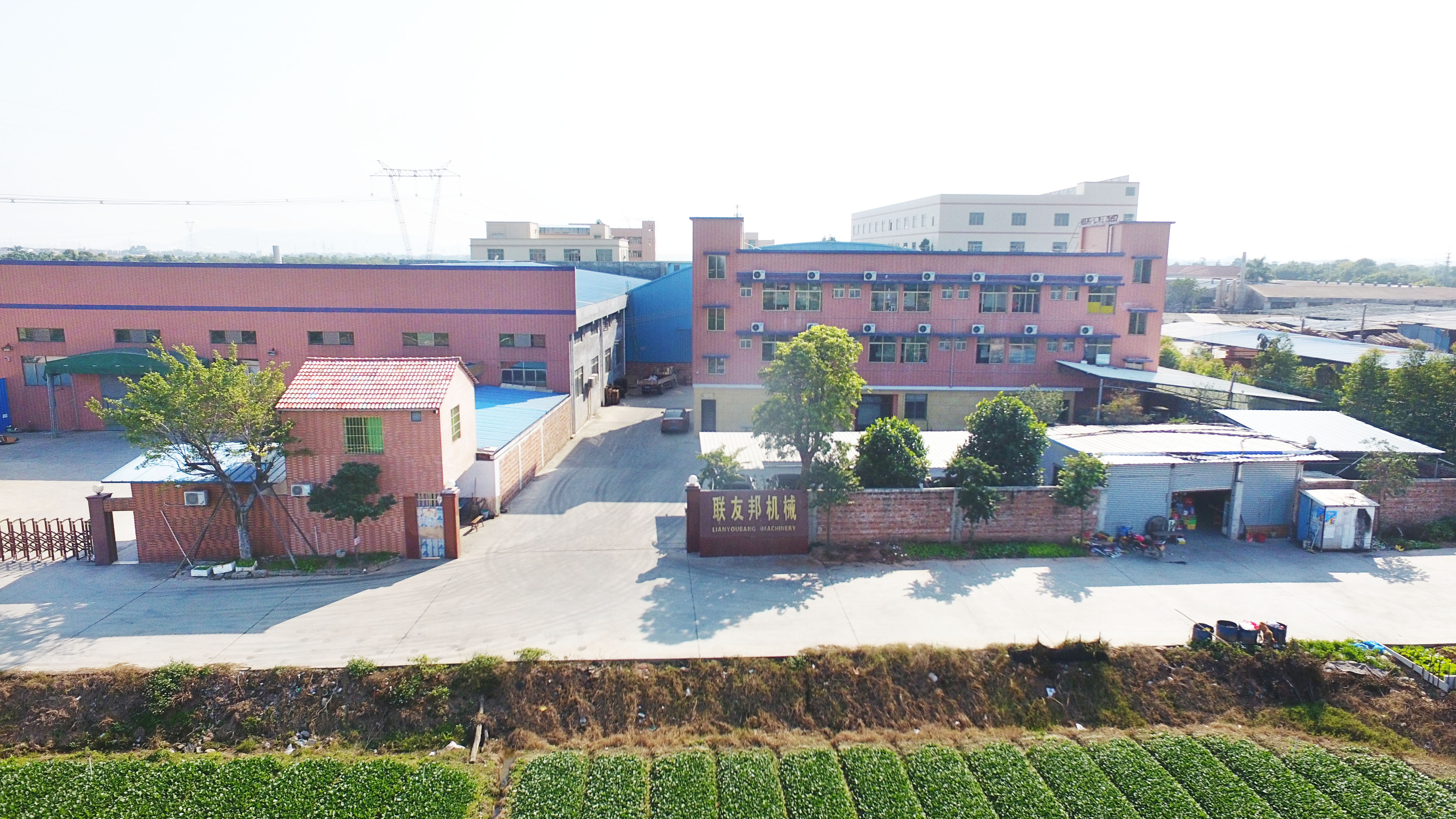
Foshan Lianyoubang Precision Machinery Co., Ltd., Liangdeng Industrial Zone, Danzao Town, Nanhai District, Foshan. Image: Foshan Lianyoubang.
What Long-Term Support Actually Requires
Long-term supplier value in slide forming is not measured at delivery. It is measured in year two, when the first roll set needs replacement, and in year four, when a new profile is added.
Four provisions carry most of that weight: a documented spare-parts list with part numbers and lead times; a roll-set replacement path that includes regrinding policy; operator training that covers parameter recall and changeover rather than only start-up; and a named service contact with a stated response window.
Portfolio breadth helps here. Lianyoubang states a slide machinery range that extends beyond forming to automatic and semi-automatic assembly machines, riveting machines, bending machines, butt-welding machines, bead-pressing machines, rail testing machines, assembly lines and runout detectors. For a buyer planning to add assembly capacity later, sourcing forming and downstream equipment from the same builder reduces interface risk — though it also concentrates supplier dependency, which is a trade-off worth naming rather than ignoring.
Future Outlook
Three directions appear likely to shape drawer rail equipment decisions through the rest of the decade. First, automatic and servo-controlled machines continue to take share, consistent with the 46.8% automatic segment figure for 2026, which gradually turns manual equipment into a niche rather than a budget alternative. Second, downstream product standards in importing markets will keep pushing requirements upstream into machine acceptance criteria. Third, service distance will matter more than catalogue specifications as buyers in Africa and South Asia add capacity, because a ten-hour line that stops for a week costs more than the difference between two quotations.
For the LYB-SR400 specifically, the near-term question is not capability but evidence: whether documented factory acceptance records, reference installations and normalized test data become available to support the stated specifications. That is the gap that separates a discoverable supplier from a procurement-ready one.
FAQ
What does a ten-hour shift change in a slide forming machine specification?
It changes the evidence you require rather than the machine category. A ten-hour pattern accumulates thermal growth, roll wear and coil transitions faster, so the specification should include a continuous running test long enough to show drift, a tolerance statement that applies at the end of a run, a defined roll material (carbon steel, GCr15 or SKD11), and a spare roll path that does not depend on a single shipment.
How is the ±0.05 mm molding tolerance different from the ±0.5 mm cutting accuracy?
The ±0.05 mm figure refers to rolled profile geometry and is stated by Lianyoubang for its customized cold roll forming machine series. The ±0.5 mm figure refers to cut-to-length accuracy and is stated for the LYB-SR400. They measure different operations, so acceptance tests should measure profile geometry and cut length separately on samples taken at the start, middle and end of a shift.
What supporting equipment has to be quoted alongside the forming machine?
At minimum an uncoiler to pay off the coil, a servo feeder to meter strip accurately into the forming section, and a hydraulic cutting machine to cut to length. Each has its own acceptance criteria: coil weight and expansion range, feed-length repeatability across a full shift, and burr and blade life at the cut. A forming machine quoted without these units is not a complete production line.
What are the order, lead time and payment terms?
The minimum order quantity is 1 set, typical production lead time is 30 to 45 days, and monthly production capacity is 10 sets. Delivery is FOB Shenzhen or CIF, with 30% T/T deposit and 70% T/T before shipment, or payment by L/C. Acceptance is based on a pre-shipment test run, with third-party inspection available.
If we operate in Pakistan or Tanzania, what must be confirmed before ordering?
Both markets sit outside Lianyoubang's stated export footprint of Southeast Asia, the Middle East, Europe and South America. Buyers should therefore confirm in writing who performs on-site installation, what the 24/7 support response window is across time zones, which spare parts are held locally versus shipped, and how the one-year warranty is administered — rather than assuming a service network exists.
Which compliance documents should accompany the machine?
The machine is stated to carry CE certification CE-12-0510-01, and numerically controlled roll forming machines are classified under HS code 8462.25.00 for customs purposes. Certificate number, customs description and invoice description should match. Separate national import requirements and any downstream drawer slide product standards in the destination market remain the buyer's responsibility to verify.
Reference
The full machine specification and product range are documented in the manufacturer brochure: Foshan Lianyoubang Precision Machinery — Product Brochure (PDF).
Manufacturer data referenced in this article is company-reported and was not independently verified. Market share and market size figures are attributed to Coherent Market Insights (2026).
Есть вопросы или нужны дополнительные детали?
Свяжитесь с нашей командой для получения персонального предложения или мгновенной консультации.
Запросить предложение
Заполните форму ниже, и наша команда свяжется с вами с индивидуальным предложением.
Прямой чат WhatsApp
Предпочитаете общаться в реальном времени? Напишите нам в WhatsApp для мгновенной помощи и быстрых ответов.
- Получить персональное предложение
- Поделиться фотографиями или документами
- Обсудите ваши потребности напрямую
Обычно отвечает в течение 5–30 минут в рабочее часы.