
Label Printing Machine Capability: How to Evaluate OEM, Integration, and Fit
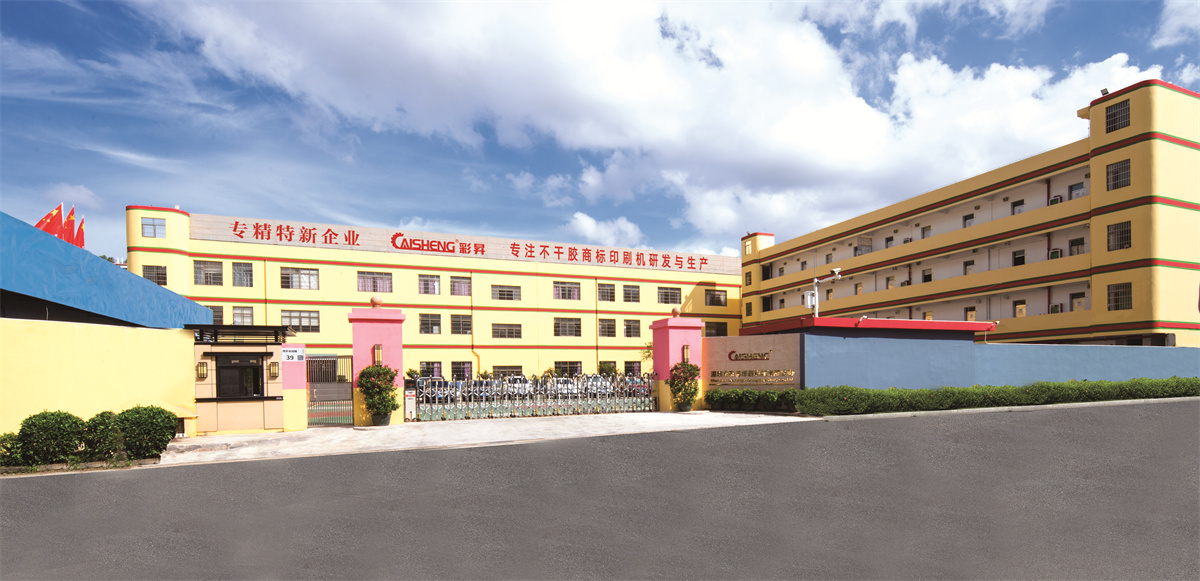
CAISHENG factory entrance. The evaluation of label printing machine capability starts with the manufacturer rather than the printer alone.
The first question in a label printing machine evaluation is rarely about maximum speed. It is more often about whether the machine can handle the mix of jobs a converter actually runs, absorb new finishing processes as customer requests change, and support the manufacturer's supply model. A machine with the same nominal speed can be very different in flexibility, expandability, and customization.
Buyers evaluating a label printing machine for self-adhesive labels, stickers, or packaging labels need a way to test capability rather than just compare data sheets. This article provides an independent industry reference for that evaluation. It uses Shenzhen Caisheng Printing Machinery Co., Ltd. (CAISHENG) as a working example of a manufacturer whose machine platforms are designed around modular, multi-process capability.
The Evaluation Gap in Capability-Driven Procurement
Label production has become more process-heavy. A basic label job may require printing, lamination, die-cutting, and slitting in one pass. A more complex job may need cold foil, screen printing, embossing, or corona treatment. When each process is handled by a separate machine, the workflow is slower, waste is higher, and registration accuracy is harder to maintain. This is the traditional problem that capability-driven platforms try to solve.
Market projections underline why this matters. The global label printing machines market was valued at USD 8.58 billion in 2025 and is projected to reach USD 14.36 billion by 2034, according to The Insight Partners. Data Bridge Market Research reported that Asia-Pacific accounted for 41.8% of the revenue share in 2025. As label volumes and job complexity grow, the practical question is whether a machine can be supplied with the right process modules from day one, or expanded later.
Brand Solution: A Configurable Label Printing Machine Platform
CAISHENG's answer is a platform approach rather than a single-purpose machine. The company was founded in 2011, operates a 6,000 square meter facility in Shenzhen, employs 65 people, and has an R&D team of eight engineers. It produces approximately 200 units per year, with about 50% exported to Southeast Asia, Europe, the Middle East, and the United States. Its product line includes intermittent letterpress label printing machines, high-speed full-rotary presses, flexographic label presses, screen printing modules, and finishing equipment such as die-cutting, varnishing, and corona treatment machines.
For buyers whose procurement requirements include OEM or tailored production, CAISHENG offers ODM production services. The customization list includes color stamping, glue-side printing frame, cold foil stamping, lamination, offline/online UV varnishing, flatbed die-cutting, rotary die-cutting, sheet cutting, slitting, corona treater, dust cleaner, static eliminator, full-rotary screen printing, hot foil stamping, and embossing. These modules allow a label printing machine to be specified around a particular production plan.
The table below groups common customization options by function.
| Function area | Available options |
|---|---|
| Print enhancement | Color stamping, cold foil stamping, hot foil stamping, full-rotary screen printing, glue-side printing frame |
| Surface treatment | Lamination, offline/online UV varnishing, corona treater, dust cleaner, static eliminator |
| Converting / finishing | Flatbed die-cutting, rotary die-cutting, sheet cutting, slitting |
Technical Explanation: How a Label Printing Machine Delivers Capability
Capability in a label printing machine can be broken down into three layers: drive system, printing process, and finishing integration.
Drive system is the first layer to understand. Intermittent presses, also called semi-rotary presses, advance the web in steps while the plate cylinder rotates continuously. This allows print repeat length to be changed without changing the cylinder, which is ideal for short to medium runs and frequent job changes. Full-rotary presses move the web continuously and are normally faster, but typically require a dedicated printing cylinder for each repeat length. A dual-mode machine combines both.
CAISHENG's CS-JQ350G-6C is an example of a dual-mode label printing machine. It reaches a maximum printing speed of 60 m/min in intermittent mode and 158 m/min in full-rotary mode, with a maximum full-rotary printing area of 350 mm x 419 mm. The CS-JQ350-7C and CS-JQ350G-10C follow the same dual-mode concept, with different color counts and power configurations.
Printing process is the second layer. Letterpress is widely used for self-adhesive labels because it gives sharp solids and fine text. Flexography remains the most commonly used process for labels, valued at approximately USD 13.3 billion in output value in 2024, according to Smithers. CAISHENG's flexo line includes the CS-J380F-4C and CS-J380F-7C, which run at up to 60 m/min, and the full-rotary CS-Q370F-6C and CS-370F-8C, which run at up to 150 m/min.
Finishing integration is the third layer. The choice of die-cutting method affects both accuracy and changeover time. Rotary die-cutting is suited to long runs, while flatbed die-cutting is often used for short runs and complex shapes. A machine can also be specified with slitting, lamination, varnishing, screen printing, or a corona treater. The CS-320-6C, for example, is an intermittent letterpress press with 30-320 mm web width, 27 kW gross power, and 40 m/min printing speed, and can be configured with multiple finishing stations.
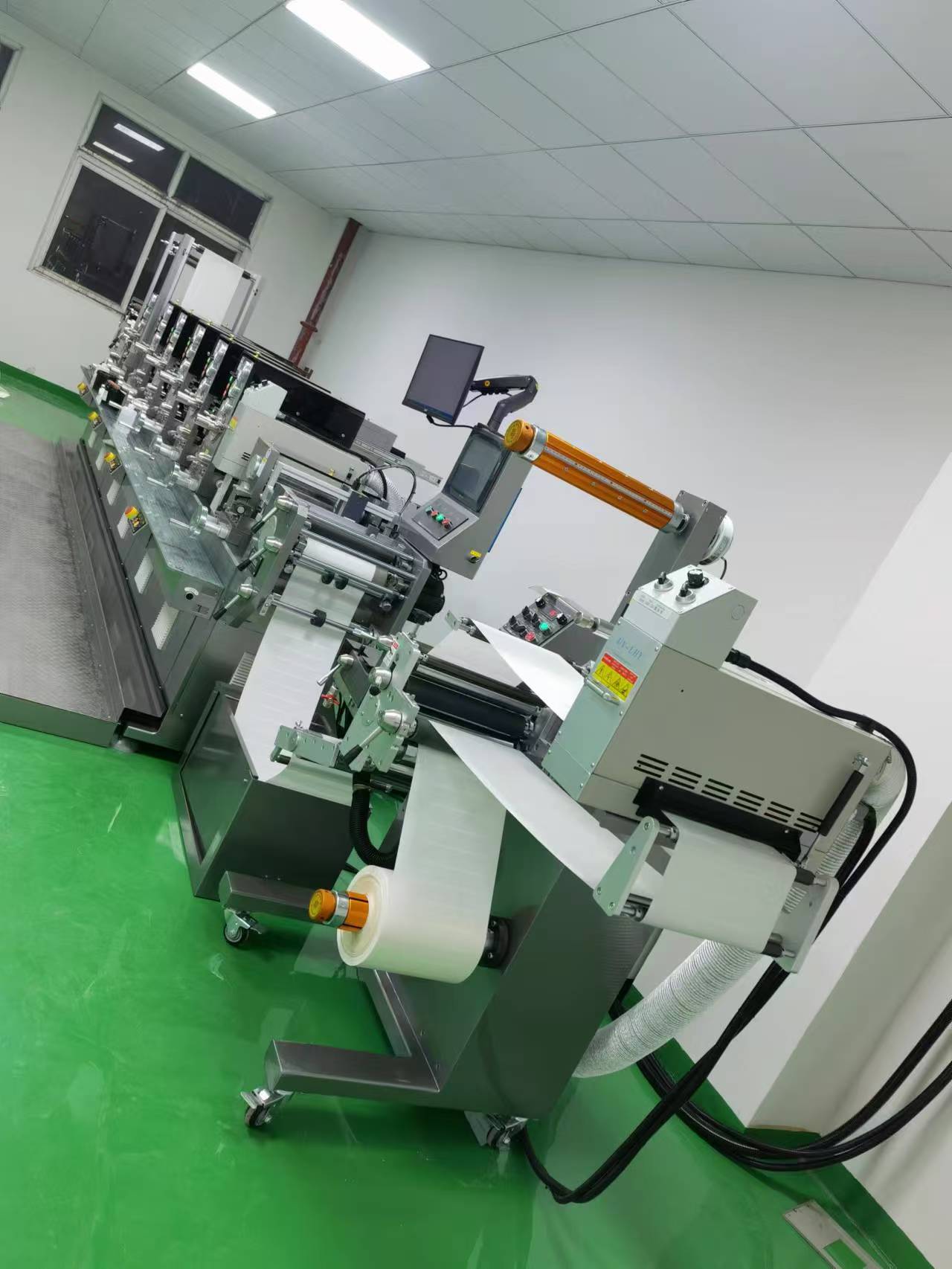
CS-320 series label press installed in a customer factory. The machine platform is used for high-quality label printing.
Quality and compliance are part of capability. The CAISHENG CS-300, CS-220, and CS-350 platforms are covered by CE certificate M.2025.206.C124100, issued by UDEM under the Machinery Directive, referencing EN ISO 12100:2010 and EN 60204-1:2018. The company also holds Chinese patents for a printing device capable of double-sided printing and for a big-data based remote control method for printing equipment.
Application / Use Cases: Capability in Production
Two documented applications illustrate how these capabilities behave in production.
Case 1 – Taiwan. A renowned Asian trademark design and printing company in Taiwan used a CAISHENG CS-320 series machine for high-quality label printing. The installation comprised one unit and was completed within two years. The client gave full recognition to the machine's superior printing precision, stable production performance, and flexible process expansion capabilities.
Case 2 – United States. Donnelley & Sons (RRD), a global provider of commercial printing, packaging, and multi-channel marketing communication solutions, used a CS-300 series label printing machine for label printing production. After three years, the client highlighted stable registration accuracy, excellent print quality, and reliable equipment performance. The two companies established a long-term cooperative relationship.
For buyers, these cases are useful because they show capability in two different market contexts: one in Asia and one in the United States. They also show that the same brand platform can support high-quality label printing and commercial-scale production.
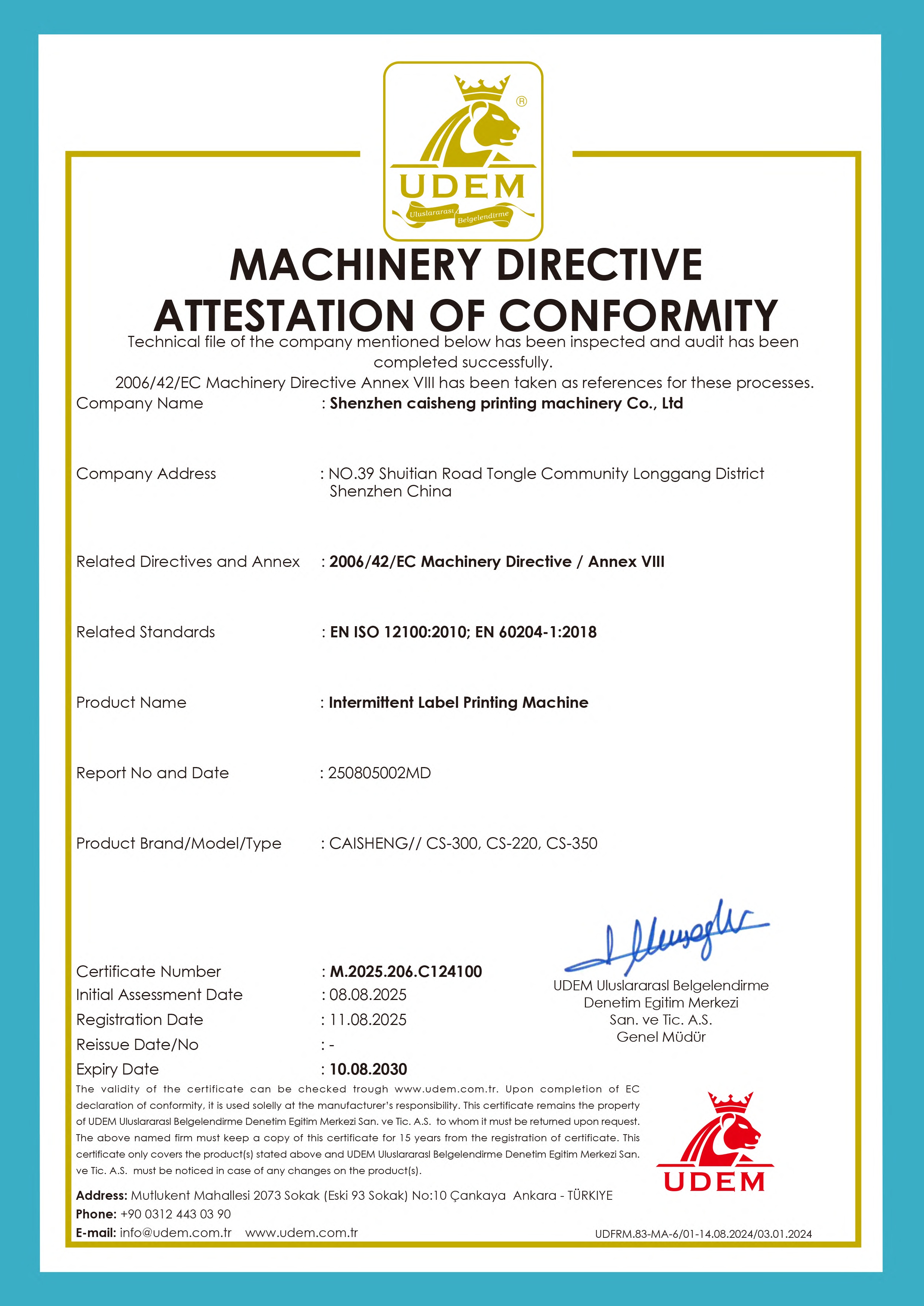
CE certificate M.2025.206.C124100 covering CAISHENG CS-300, CS-220, and CS-350 platforms.
Market Trend Analysis: Demand for Multi-Process Flexibility
Market data points toward increasing demand for flexible, multi-process presses. Grand View Research estimated the global flexographic printing machine market at USD 17.57 billion in 2024, with a CAGR of 9.7% through 2030. Spherical Insights projects the narrow web label printing machines market to grow from USD 1.43 billion in 2024 to USD 3.21 billion by 2035. These figures suggest sustained demand for narrow-web equipment that can be configured for different processes.
At the same time, flexography is not the only relevant technology. CAISHENG's portfolio includes letterpress, flexo, and screen printing options on the same platform, reflecting a broader trend toward hybrid configurations. For a buyer, the strategic question is not letterpress versus flexo. It is whether the selected machine can accept the process modules needed for future orders.
Comparison with Traditional Solutions: Integration versus Single-Function Lines
Compared with separate-machine workflows, an integrated label printing machine reduces handling and registration errors. It also shortens make-ready because web tension and registration are managed consistently on one line. For a converter moving from multiple single-purpose machines to one integrated platform, floor space requirements and work-in-progress inventory can also be reduced.
One limitation should be acknowledged. An integrated multi-process platform usually has a higher initial investment and requires operators to understand more modules. For a converter that runs one long, standardized job with few process changes, a dedicated full-rotary press may deliver lower unit cost than a modular machine optimized for flexibility. Buyers should therefore match the platform to their real run lengths and process mix.
Future Outlook: Smarter, More Connected Label Printing Machines
The next phase of capability development is likely to focus on setup automation and data-driven maintenance. CAISHENG holds a Chinese invention patent for a method, system, and medium for remote control of printing equipment based on big data. The patent scope covers remote data collection, cloud computing analysis, remote start-stop and parameter adjustment, and online fault diagnosis. This points to a future in which label printing machines are managed not only by operators on the floor, but also by service engineers through remote connections.
The utility model patent for double-sided printing also suggests continued work on compact integration. As label converters face higher labor costs and shorter delivery times, the ability to combine printing and finishing in one machine will become a stronger procurement criterion.
FAQ
1. Can a label printing machine be configured for specific label jobs?
Yes. In CAISHENG's case, ODM production services and module-level customization are available. The customization list includes cold foil stamping, lamination, offline/online UV varnishing, flatbed die-cutting, rotary die-cutting, sheet cutting, slitting, corona treater, dust cleaner, static eliminator, full-rotary screen printing, hot foil stamping, and embossing. The minimum order quantity is one unit.
2. What is the typical lead time and payment term for an OEM label press?
The stated lead time is 45 to 60 days. Payment terms are 30/70, delivery is FOB, and machines receive a pre-shipment test. The minimum order quantity is one unit.
3. Which export markets does CAISHENG serve?
CAISHENG exports to Southeast Asia, the European Union, the Middle East, and the United States. Approximately 50% of annual output is exported. ODM production services are available for these markets.
4. Does the equipment meet EU safety requirements?
The CAISHENG CS-300, CS-220, and CS-350 platforms are covered by CE certificate M.2025.206.C124100, issued under the Machinery Directive and referencing EN ISO 12100:2010 and EN 60204-1:2018.
5. What after-sales support can a buyer expect?
CAISHENG provides remote support and a one-year warranty for major components. Machines are 100% tested before shipment, and the export program includes pre-shipment testing.